Saved Bookmarks
This section includes 7 InterviewSolutions, each offering curated multiple-choice questions to sharpen your Current Affairs knowledge and support exam preparation. Choose a topic below to get started.
| 1. |
An organic compound (A) of molecular formula C_7H_8on reaction with hot alkaline KMnO_4gives (B) of formula C_7H_6O_2which gives brisk effervescence with NaHCO_3solution. (B) on reaction with sodium hydroxide gives (C ) of formula C_7H_5O_2NaCompound (C )on treatment with sodalime gives (D) the simplest aromatic hydrocarbon. |
Answer» SOLUTION : (i) From the molecular formula (A) is identified as Toluene. Toluene on treatment with hot alkaline `KMnO_4`, oxidation take place and the PRODUCT (B) formed is Benzoic acid. 
|
|
| 2. |
An organic compound (A) of molecular formula C_7H_6O_2reacts with PCI_5to give (B) of formula C_7H_5OCl. (B) on treatment with ammonia gives (C ) of formula C_7H_7NO(C ) on treatment with phosphorous pentoxide gives (D) of formulaC_7H_5N. Identify A,B,C,D and explain the reactions involved. |
Answer» SOLUTION :
|
|
| 3. |
An organic compound (A) of molecular formula C_7H_6Oreacts with acedaldehyde in the presence of sodium ethoxide gives (B) of formula C_9H_8Oan unsaturated aldehyde. Compound (A) reacts with acetic anhydride in the presence of sodium acetate gives (C) and (D) of formula C_9H_8O_2 & C_2H_4O_2 respectively. Identify A,B,C,D and explain the reaction involved. |
|
Answer» Solution : (i) From the molecular formula (A) is identified as BENZALDEHYDE `C_6H_5CHO` .Benzaldehyde reacts with acetaldehyde to give cinnamaldehyde as B in Claisen condensation reaction. `underset("benzaldehyde (A)")(C_6H_5CHO) + underset("acetaldehyde")(CH_3CHO) underset(DELTA H^(+) )overset(C_2H_5ONa)(to) underset("cinnmaldehyde (B)")(C_6H_5CH = CH - CHO + H_2O)` (ii) Benzaldehyde reacts with acetic ANHYDRIDE (perkin.s reaction) to give cinnamic acid (C ) as product ` C_6H_5 + CH_3CO - O-COCH_3 overset(CH_3COONa)(to) underset("cinnamic acid (C )")(C_6H_5CH = CH - COOH) + underset("acetic acid (D)")(CH_3COOH)` |
|
| 4. |
An organic compound (A) of molecular formula C_(7)H_(6)O is not reduced by Fehling's solution but will undergo Cannizzaro reaction. Compound (A) reacts with aniline to give compound (B). Compound (A) also reacts with Cl_(2) in the presence of catalyst to give compound (C). Identify (A), (B) and (C) and explain the reactions. |
|
Answer» SOLUTION :(i) Compound A is identified as BENZALDEHYDE `C_(6)H_(5)CHO` from its molecular FORMULA. `C_(6)H_(5)CHO` undergoes Cannizzaro REACTION and it does not reduce Fehling's solution. `C_(6)H_(5)CHO+C_(6)H_(5)CHOoverset(NaOH)toC_(6)H_(5)CH_(2)OH+C_(6)H_(5)COONa` (ii) Benzaldehyde reacts with aniline to form shiff's base `C_(6)H_(5)CH=NC_(6)H_(5)` and it is (B). `C_(6)H_(5)-overset(H)overset(|)(C)=O+underset("Aniline")(C_(6)H_(5)NH_(2))tounderset("Schiff's base(B)")(C_(6)H_(5)CH=NC_(6)H_(5))+H_(2)O` (iii) Benzaldehyde reacts with chlorine in the presence of catalyst to give m-chlorobenzaldehyde and it is (C). 
|
|
| 5. |
An organic compound (A) of molecular formula C_(7)H_(6)O is called as oil of bitter almonds. (A) on oxidation gives (B) of molecular formula C_(7)H_(6)O_(2) which gives brisk effervescence with aqueous alcoholic KCN, compound ( C) is formed. Identify A, B and C and write the equations. |
|
Answer» Solution :(i) From the molecular formula, (A) is identified as benzaldehyde and it is called as oil of BITTER almonds. (ii) Benzaldehyde is oxidised to benzoic acid by alkaline permanganate which gives brisk effervescence with `NaHCO_(3)`. `underset((A))(C_(6)H_(5)CHO)overset((O))tounderset((B))(C_(6)H_(5))-COOH` (iii) When benzaldehyde is refluxed with AQUEOUS alcoholic KCN, BENZOIN ( C) is formed. `underset((A))(C_(6)H_(5)CH=O+H-overset(O)overset(||)(C)-C_(6)H_(5))underset(KCN)overset("alc")tounderset((C))(C_(6)H_(5)-underset(OH)underset(|)(CH)-overset(O)overset(||)(C)-C_(6)H_(5))` 
|
|
| 6. |
An organic compound (A) of molecular formula C_7H_6Ogives brisk effervescence with Na_2CO_3 . Sodium salt of (A) on treatment with sodalime gives (B) a simplest aromatic hydrocarbon. (B) on reaction with acetylchloride in the presence of anhydrous AlCl_3gives (C) of formula C_8H_8O . (C ) on treatment with conc. nitric acid and conc. sulphuric acid gives (D) of formula C_8H_7NO_3 . Identify A,B,C,D,E and explain the reactions involved. |
|
Answer» Solution : (i) (A) gives brisk effervescence with `Na_2CO_3` solution and it MUST be a carboxylic acid. (A) (i) (A) gives brisk effervescence with `Na_2CO_3`solutionand it must be a carboxylic acid. (A) is `C_6H_5COOH`benzoic acid. (ii) Sodium salt of benzoic acid on reaction with SODALIME (decarboxylation) produces benzene as (B) 
|
|
| 7. |
An organic compound (A) of molecular formula C_(6)H_(7)N on reaction with sodium nitrite and hydrochloric acid at 0^(@)C gives (B) or formula C_(6)H_(5)N_(2)Cl (B) on treatment with cuprous cyanide give (C) of formula C_(7)H_(5)N. (C)on reaction with sodium and ethanol gives (D) of formula C_(7)H_(9)N. (D) on reaction with nitrous acid gives (E) of molecular formula C_(7)H_(8)O. Identify A,B,C,D and E and explain the reactions involved. |
|
Answer» Solution :(i) (A) is identified as Ailine from the molecular formula. (ii) Aniline on REACTION with sodium nitrite and hydrochloric acid at `0^(@)C` DIAZOTISATION take PLACE and the product (B) formed is benzene diazonium chloride. 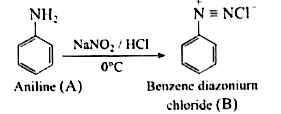 (iii) Benzene diazonium chloride on treatment with CuCN produces (C) as cyano benzene. 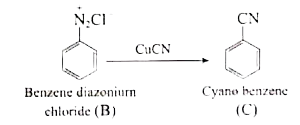 (iv) Cyano benzene on reaction with Na and `C_(2)H_(5)OH` undergoes reduction reaction to give (D) as benzylamine. 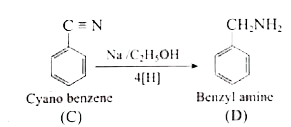 (v) BEnzylamine on treatment with nitrous acid gives benzyl alcohol as (E). 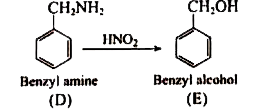
|
|
| 8. |
An organic compound A of molecular formula C_(6)H_(6)O gives violet colouration with neutral FeCl_(3). Compound A on treatment with metallic Na gives compound B. Compound B on treatment with CO_(2) at 400 K under pressure gives C. This product on acidification gives compound D (C_(7)H_(6)O_(3)) which is used in medicine. Identify A,B, C and D and explain the reaction. |
|
Answer» Solution :(i) Compound A is phenol `(C_(6)H_(5)OH)` Phenols on reaction with metallic Na gives compound (B) i.e., Sodium Phenoxide. `3C_(6)H_(5)OH + 2Na to 2C_(6)H_(5) O"Na" + H_(2)` (II) (B) is heated with `CO_(2)` at 400 K under pressure, to give (C ). This is decomposed by dil. HCl, and (D) is formed. 
|
|
| 9. |
An organic compound (A) of molecular formula C_6H_6Ogives white precipitate with bromine water. (A) on reaction with NaOH gives (B). (B) reacts with methyl iodide in presence of dry ether gives (C) of molecular formula C_7H_8O which will not liberate H2 gas with metallic Na. (C) on reaction with acetyl chloride gives (D) and (E) of formula which are position isomers. Identify A, B, C, D & E and explain the reaction. |
|
Answer» Solution :(i) An organic compound gives WHITE precipitate with bromine water MEANS it must be a PHENOL. From the molecular formula it is identified as `C_6H_5OH`. (ii) Phenol on reaction with NaOH gives (B) as sodium phenox `C_6H_5ONa`. 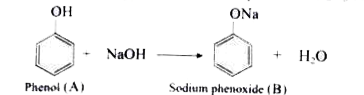 (i) Sodium phenoxide on reaction with methyl iodide in the pressure of dry ether undergo Williamsons synthesis and gives Anisole as (C). 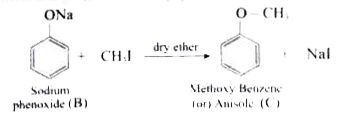 (iv) Anisole on reaction with acetyl CHLORIDE undergoes Friedel Craft.s ACETYLATION and vicid o-methoxy acetophenone and p-methoxy acetophenone as (D) and (E). 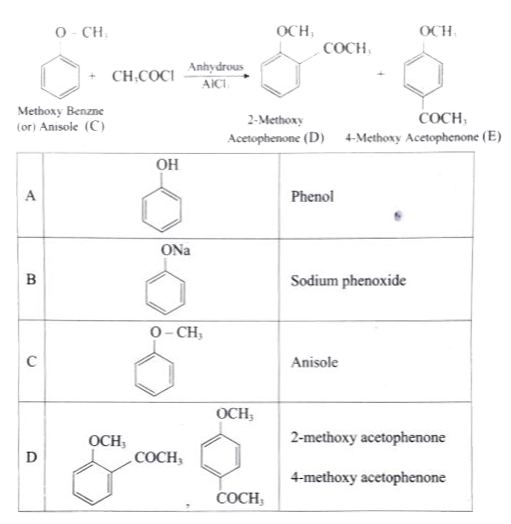
|
|
| 10. |
An organic compound (A) of molecular formula C_6H_6reacts with propylene in the presence of H_3PO_4 at 532 K gives (B) formula C_9H_12. (B) on air oxidation gives C_9H_12O_2as (C ).(C ) on acidification with H_2SO_4 gives (D) of formula C_6H_6O and (E) of formula C_3H_6O. Identify A,B,C,D and E and explain the reaction. |
|
Answer» SOLUTION :(i) (A) is identified as benzene from the molecular formula. (i) Benzene reacts with propylene in the presence of `H_3PO_4`gives cumene as (B). 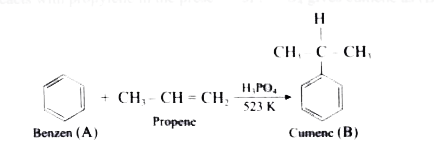 (iii) Cumene on AIR OXIDATION produces cumene hydroperoxide as (C). 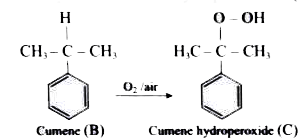 (iv) Cumene hydroperoxide on treatment with `H_2SO_4` yiclds phenol as (D) and acetone as (E). 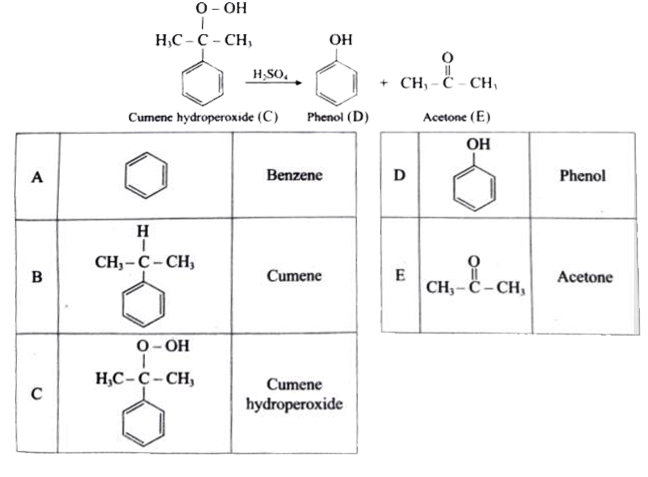
|
|
| 11. |
An organic compound (A) of molecular formula C_(6)H_(6)O gives voilet colorwith neutral FeCl_(3) (A) gives maximum of two isomers (B) and(C ) when an alkaline solution of (A) is refluxed with C Cl_(4), (A) also reacts with C_(6)H_(5)N_(2)Cl to give the compound (D) which is red orange dye. Identify (A), (B), ( C) and (D). Explain the suitable chemical reactions. |
|
Answer» Solution :(i) COMPOUND A GIVING VIOLET COLOUR with neutral ferric chloride is phenol. `(C_(6)H_(5)OH)`. (ii) (B) and ( C) isomers are formed when alkaline solution of (A) is treated with `C Cl_(4)`.  (III) (A) when treated with `C_(6)H_(5)N_(2)Cl`, forms a red orange dye (D).  (iii) 
|
|
| 12. |
An organic compound (A) of molecular formula C_6H_5Cl on reaction with aqueous NaOH gives (B) of formula C_6H_6O. (B) on reaction with NaOH gives (C) of formula C_6H_5ONa. (C) on treatment with C0, followed by acid hydrolysis yield (D) of formula C_7H_6O_3 an aromatic hydroxy acid. Identify A, B, C, D and explain the reactions involved. s |
|
Answer» Solution :(i) (A) is identified from the formula as `C_6H_5Cl`. Chloro benzene. (i) Chloro benzene on TREATMENT with aqueous NAOH yeilds `C_6H_5OH`- phenol as (B). (in) Phenol on reaction with NaOH produces sodium phenoxide, `C_6H_5ONa`as (C ). (iv) Sodium phenoxide on reaction with `CO_2`, FOLLOWED acid HYDROLYSIS, Kolbe.s reaction takesplace to give Salicylic acid as (D). 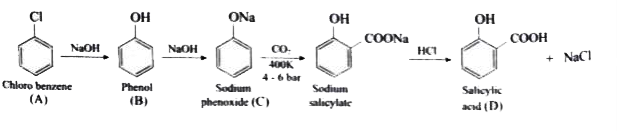 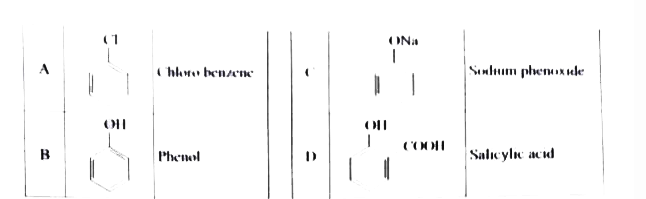
|
|
| 13. |
An organic compound (A) of molecular formula C_6H_5Cl on boiling with hot water gives (B) of molecular formula C_6H_6O.(B) on reaction with Zinc dust gives (C) a simplest aromatic hydrocarbon. (C) on reaction with methyl chloride in the presence of anhydrous AlCl_2 gives (D) of molecular formula C_7H_8. ldentify A, B, C, D and explain the reaction. |
|
Answer» Solution :(i) A) is identified from the FORMULA as Benzene diazonium chloride `-C_6H_5N_2Cl` (ii) Benzene diazonium chloride when boiled with HOT water produces phenol as (B). `underset("Chloride(A)")underset("Benzene diazonium")(C_6H_5N_2Cl) + HOH overset(Delta)to underset("Phenol(B)")(C_6H_5OH) + N_2uarr + HCl` (ii) Phenol on reaction with Zinc dust gives Benzene as (C) which is simplest aromatic hydrocarbon. 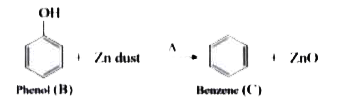 (iv) Benzene on treatment with (C) methyl chloride in the presence of anhydrous `AlCl_3`,Friedel Crafts reaction take PLACE and the PRODUCT formed is Toluene as (D). 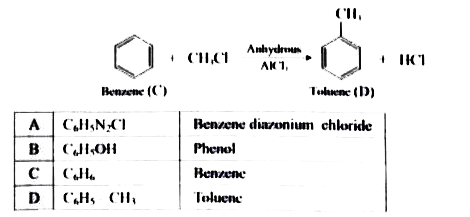
|
|
| 14. |
An organic compound (A) of molecular formula C_5H_8 when treated with sodium in liquid ammonia followed by reaction with n-propyl bromide yields (B), C_8H_14. (A) gives a ketone ©, C_5H_10O when treated with dilute H_2SO_4 and HgSO_4. (B) on oxidation with alkaline KMnO_4 gives two isomeric acids (D) and (E) C_4H_8O_2. Give structures of compound (A) to (E) with proper reasoning. |
|
Answer» Solution :(i) (A) reacts with SODIUM in liquid ammonia and thus it is TERMINAL ALKYNE i.e. `C_3H_7C-=C-H` `C_3H_7C-=CHoverset(Na)rarrC_3H_7C-Naoverset(CH_3=CH_2-CH_2-Br)rarrC_3H_7C-=C-underset((B))(CH_2)-CH_2-CH_2-CH_3` (iii) `C_3H_7C-=CHoverset(HgSO_4)underset(H_2SO_4)rarrC_3H_7CO-CH_3` (iv) `C_3H_7C-=C-CH_2-CH_2-CH_3overset([O])underset(KMnO_4)rarrCH_3-CH_2underset((D))-CH_2-COOH+underset((E))(C_3H_7COOH)` SINCE (D) and (E) are isomers, thus the STRUCTURE of (E) is 
|
|
| 15. |
An organic compound (A) of molecular formula C_6 H_6reacts with Br_2in the presence of FeCl_3gives (B) of formula C_6 H_5Br . B on treatment with mg in the presence of dry ether gives ( C) compound ( C) on treatment with dry ice followed by hydrolysis gives a compound (D) of molecular formula C_7H_6O_2Identify A,B,C,D and explain the reactions involved. |
Answer» SOLUTION :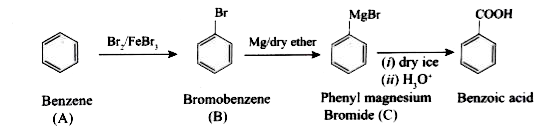
|
|
| 16. |
An organic compound (A) of molecular formula C_6 H_6 Ogives violet colour with neutral FeCl_3. (A) on reaction with zinc dust gives (B) of formula C_6 H_6(B) on treatment with acetyl chloride in the presence of anhydrous AICI_3gives (C) of formula C_8H_8O . (C) on Clemmenson reduction gives (D) of formula C_8H_10 O. Identify A,B,C,D and explain the reaction involved. |
Answer» SOLUTION :
|
|
| 17. |
An organic compound (A) of molecular formula C_(4)H_(9)Cl on treatment with alcoholic KOH solution gives 3 isomeric alkenes. The stble alkene among the three (B), was treated with aqueous Br_(2) solution which resulted in (C). (C) on treatment with NaOH liberated a gas with the formation of (D). (D) on treatment with CH_(3)MgCl followed by hydrolysis gives (E). (E) on treatment with H^(+)//HB r gave (F) and (F) on treatment with alcoholic solution of NaOH gave (G). if (G) can't show geometrical isomerism identify the structures of (A) to (G). |
Answer» SOLUTION :
|
|
| 18. |
An organic compound (A) of molecular formula C_4H_8is symmetric alkene. (A) on ozonolysis gives 2 moles (B) of molecular formula C_2H_4O . (B) on reaction with ammonia gives (C) of molecular formula C_2H_5N |
Answer» SOLUTION :(i) (A) is a SYMMETRIC alkene. From the MOLECULAR FORMULA, it is identified as But - 2 - ene (ii) But - 2 -ene on OZONOLYSIS gives 2 moles of acetaldehyde as product (B) 
|
|
| 19. |
An organic compound (A) of molecular formula C_(3)H_(8)O_(2) is obtained as by-product in the manufacture of soap. Compound (A) on heating with P_(2)O_(5) gives an unsaturated compound (B) of molecular formula C_(3)H_(4)O. Compound (A) with well cooled mixture of Conc. H_(2)SO_(4) and fuming HNO_(3) form compound ( C) which is an explosive. Identify A, B and C and explain the reaction. |
|
Answer» Solution :(i) Compound (A) with MOLECULAR formula `C_(3)H_(8)O_(3)` is GLYCEROL. (ii) Glycerol on heating with `P_(2)O_(5)` gives an unsaturated compound (B). `underset((A))underset(CH_(2)OH)underset(|)overset(CH_(2)OH)overset(|)(CHOH) overset(P_(2)O_(7))underset(DELTA) to underset("unstable")underset(CHOH)underset(||)overset(CH_(2))overset(||)C to underset((B))underset(CHO) underset(|)overset(CH_(2))overset(||)CH` (iii) Glycerol with cooled mixture of conc. `H_(2)SO_(4)` and fuming `HNO_(3)` form compound (C). `underset((A))underset(CH_(2)OH)underset(|)overset(CH_(2)OH)overset(|)(CHOH) + 3HNO_(3) overset("conc" H_(2)SO_(4)) to underset((C))underset(CH_(2)ONO_(2))underset(|)overset(CH_(2)ONO_(2))overset(|)(CHONO_(2)) + 3H_(2)O` 
|
|
| 20. |
An organic compound (A) of molecular formula C_3H_8Ogives blue colour in Victor Meyer's test. (A) on reaction with Cu at 573 K gives (B) which further reacts with Methyl magnesium bromide followed by acid hydrolysis yields (C) of molecular formula C_4H_10O. (C) on reaction with Cu at 573 K gives (D) of formula C_4H_8. Identify A, B, C, D and explain the reactions involved. |
|
Answer» Solution :(i) An organic compound gives blue colour in Victor Meyer.s TEST means it must be a secondary alcohol. From the formula, it is identified as `CH_3-underset(OH)underset(|)(CH)-CH_3` propan - 2- OL (A). (ii) Propan-2-ol on reaction with Cu at 573 K gives Propanone as (B). `underset("Propan-2-ol(A)") (CH_3 - underset(OH)underset(|)(CH)-CH_3)overset(Cu//573K)toundeset("Propanone(B)")(CH_3-underset(O)underset(||)C-CH_3) + H_2uarr` (iii) Propanone on treatment with `CH_3MgBr` followed by acid hydrolysis will yield Tertiary butyl alcohol `(CH_3)_3-OH` as (C ). `CH_3-underset(O)underset(|)C-CH_3 + CH_3MgBr to CH_3-underset(CH_3)underset(|)overset(CH_3)overset(|)C-OMgBr underset(H^(+))overset(H_2O)to underset("Tertiary butyl alcohol(C)")(CH_3-underset(OH)underset(|)overset(CH_3)overset(|)C-CH_3) + Mg(OH)Br` (IV) Tertiary butyl alcohol on reaction with copper at 573 K undergoes dehydration reaction to produce Isobutylene as (D). `CH_3-underset(CH_3)underset(|)overset(CH_3)overset(|)C-OH overset(Cu//573 K)to underset("Isobutylene(D)")(CH_3-overset(CH_3)overset(|)C=CH_2) +H_2O` 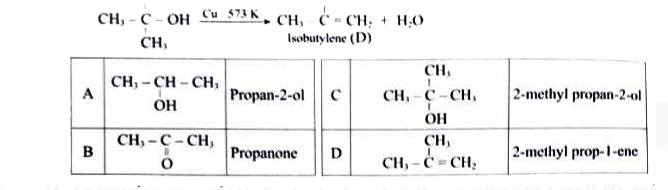
|
|
| 21. |
An organic compound (A) of molecular formula C_4H_10O gives no colouration in Victor Meyer's test. (A) on reaction with P//I_2 gives (B) of formula C_4H_9I. (B) on treatment with nitrous acid gives (C ) of formula C_3H_9NO_2. (C ) does not react with KOH. Identify A, B, C and explain. |
Answer» Solution :`C_4H_10O` gives no COLOURATION in VICTOR Meyer.s test MEANS it MUST be tertiary alcohol. So (A) is tertiary butyl alcohol. The REACTIONS involved are, 
|
|
| 22. |
An organic compound (A) of molecular formula C_3H_8O on reaction P//I_2 gives C_3H_7I as (B). (B) on reaction with AgNO_2 produces (C) with formula C_3H_7NO_2. (C) on reaction with nitrous acid gives (D) of molecular formulaC_3H_6N_2O_3. (D) on reaction with KOH produces blue colour. Identify A, B. C, D and explain the reaction. |
Answer» Solution :From the final COLOUR blue, this REACTION are CONSIDERED as reactions of secondary alcohol in VICTOR Meyer.s test. (A) is identified as `CH_3-underset(OH)underset(|)(CH)-CH_3` 2- PROPANOL. 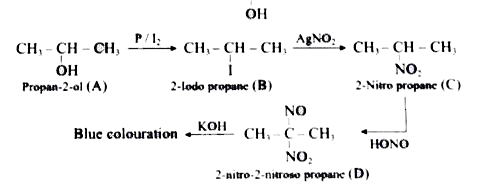
|
|
| 23. |
An organic compound (A) of molecular formula C_(3)H_(8)O gives turbidity within 5-10 min on reaction with anhydrous ZnCl_(2)//HCl. Compound (A) on treatment with sodium hypochlorite gives a carbonyl compound (B) with on further chlorination gives compound (C) of molecular formula C_(3)H_(3)OCl_(3). Identify (A),( B) and (C). Explain the reaction. |
|
Answer» Solution :(i) (A) that gives turbidity WITHIN 5-10 min on reaction with anhydrous `ZnCl_(2)//HCL` means it must be secondary alcohol. `CH_(3)-underset(OH)underset(|)(CH)-CH_(3) overset("anhydrous ZnCl_(2)//HCl) to CH_(3)-underset(Cl) underset(|)(CH-CH_(3)) + HCl` (ii) Iso PROPYL alcohol on treatment with SODIUM hypochlorite, undergoes oxidation to give acetone compound (B). `underset(A)underset(OH)underset(|)(CH)-CH_(3) overset((O)) to underset(B)underset(O)underset(||)C-CH_(3)` (iii) Acetone on treatment with chlorine gives trichloro acetone and it is (C). `underset(B)underset((O))underset(||)C-CH_(3) + 3Cl_(2) to underset((C))underset(O)underset(||)C-CH_(3) + 3HCl` 
|
|
| 24. |
An organic compound A of molecular formula C_(3)H_(6)O answer iodoform test. Another organic compound B of molecular formula C_(7)H_(6)O is known as oil of bitter almonds. A reacts with B to form an unsaturated compound C of molecular formula C_(10)H_(10)O. Compound B reacts with malonic acid in the presence of pyridine to form an unsaturated acid D of molecular formula C_(9)H_(8)O_(2). Identify A, B, C and D. Explain the reactions. |
|
Answer» Solution :(i) Organic Compound (A) is Acetone. Acetone (A) on iodoform test. `underset((A))(CH_(3)COCH_(3))underset(NaOH)overset(I_(2))tounderset("Iodoform")(CHI_(3))+CH_(3)COONa` (ii) Compound (B) is Benzaldehyde. It is CALLED OIL of bitter ALMONDS. (iii) Acetone (A) reacts with (B) Benzaldehyde to from Benzal acetone (C). This reaction is KNOWN Claisen Schmidt reaction. `underset((B))(C_(6)H_(5)CHO)+CH_(3)COCH_(3)overset(NaOH)tounderset((C))(C_(6)H_(5)CH=CHCOCH_(3))` (iv) Benzaldehyde reacts with malonic acid in the presence of pyridine gives compound (D) Cinnamic acid `underset((B))(C_(6)H_(5)CHO)+underset("Malonic acid")(H_(2)C(COOH)_(2))toC_(6)H_(5)CH=C(COOH)_(2)tounderset((D))(C_(6)H_(5)CH=CHCOOH)` This reaction is called Knoevenagal reaction. 
|
|
| 25. |
An organic compound (A) of molecular formula C_3H_6Oreduces Tollen's reagent on reaction with methyl magnesium bromide followed by acid hydrolysis gives (B) of formula C_4H_10 O(B) gives blue colour in victor meyer test. (B) on reaction with Cu at 573 K gives (C) of formula C_4H_8O(C) on reaction with hydrazine and sodium ethoxide gives (D) of 'molecular formula C_4H_10. Identify A,B,C,D and explain the reactions involved. |
|
Answer» Solution :(i) An ORGANIC compound (A) reduces Tollen.s reagent it must be an aldehyde. From the formula, it is identified as `CH_2 - CH_2 - CHO` propanal. (ii) Propanal on reaction with methyl magnesium bromide followed by acid hydrolysis gives (B) as BUTAN - 2 - ol. It must be a SECONDARY alcohol and gives blue colour with victor meyer.s test. 
|
|
| 26. |
An organic compound A of molecular formula C_(3)H_(6)O on reduction with LiAlH_(4) gives B. Compound B gives blue colourin Victor Meyer's test and also forms a chloride C with SOCl_(2). The chloride on treatment with alcoholic KOH gives D. Identify A,B,C and D and explain the reactions. |
|
Answer» Solution :(i) Compound (A) is carbonyl compound, it is acetone. (ii) (A) on REDUCTION with`LiAlH_(4)` gives B it gives blue color in Victor Meyer's test. `underset(A)underset(O)underset(||)C-CH_(3) overset(LiAlH_(4))underset([H]) to underset(B)underset(OH)underset(|)(CH_(3)-CH-CH_(2))` (III) (B) REACTS with `SOCl_(2)` to give C. (iii) B reacts with `SOCl_(2)` to give( C). `underset((B))underset(OH)underset(|)(CH_(3)-CH-CH_(2)) overset(SOCl_(2)) to underset(( C))underset(Cl)underset(|)(CH_(3)-CH-CH_(3)) + SO_(2) darr + HCl` (iv) ( C) on treatment with alcoholic KOH, FORMS ( D) by elimination reaction. `underset((C))underset(Cl)underset(|)(CH_(3)-CH-CH_(3)) overset("alc KOH") to underset((D))(CH_(3)CH=CH_(2)+HCl` 
|
|
| 27. |
An organic compound (A) of molecular formula C_3H_6 on reaction with Conc. H_2SO_4 and H_2O gives C_3H_8O as (B) as a Markownikoff's produet. (B) on oxidation with Cu at 573 K gives (C) of formula C_3H_6O. (C )on reaction with CH_3MgBr followed by acid hydrolysis yields (D) as C_4H_10O which will not give any colour in Victor Meyer's test. Identify A, B, C, D and explain the reactions involved. |
|
Answer» Solution :(i) An organic compound (A) is identified from the molecular formula as `CH_3-CH=CH_2` propene. (ii) Propene on hydrolysis in ACID medium, Markownikoff.s rule is followed and the product formed is `CH_3-underset(OH)underset(|)CH-CH_3`Propan-2-ol as (B). `underset("Prop-1-ene(A)")(CH_3-CH = CH_2 + H_2O) overset(CONC. H_2SO_4)to underset("Propan-2-ol(B)")(CH_3-underset(OH)underset(|)CH-CH_3)` (iii) Propan-2-ol on reaction with Cu at 573 K undergoes dehydrogenation reaction to produce Propanone as (C). `CH_3-underset(OH)underset(|)(CH)-CH_3 underset(573K)overset(Cu)to underset("Propanone(C)")(CH_3-underset(O)underset(||)C-CH_3) + H_2uarr` (iv) Propanone on reaction with `CH_3MgBr` followed by acid hydrolysis GIVES tertiary BUTYL ALCOHOL (D). It will not give any colouration in Victor Meyer.s test. 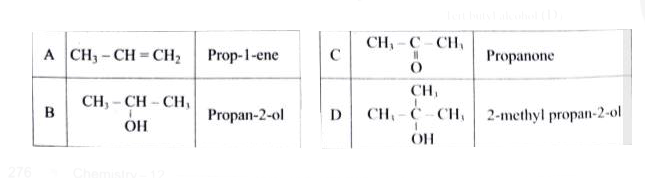
|
|
| 28. |
An organic compound (A) of molecular formula C_3H_6on hydration in the presence of H_2SO_4gives (B) C_3H_2Owhich gives blue colour in victor meyer's test. (B) on treatment with cu at 573 K gives C_3H_6Oa compound (C) on self condensation in the presence of magnesium amalgam and water gives (D) of formula C_6H_14O_2 . Identify A,B,C,D and explain the reaction involved. |
Answer» SOLUTION :
|
|
| 29. |
An organic compound (A) of molecular formula C_2H_6Oreacts with metallic Na and liberates H_2 gas. (A) on mild oxidation with Cu at 573 K gives (B) of molecular formula C_2H_4O. (B) on reaction with methyl magnesium bromide followed by acid hydrolysis gives (C) of molecular formula C_3H_8O,(C) gives Blue colour in Victor Meyer's test. (C) on mild oxidation with Cu at 573 K gives (D) of formula C_3H_6O. Identify A, B, C, D and explain the reactions. |
|
Answer» Solution :(i) An organic compound (A) REACTS with Na metal and liberates `H_2` gas means it must be ALCOHOL. From the molecular formula it is identified as Ethanol `(CH_3-CH_2OH)`. (II) Ethanol on oxidation with Cu at 573 K undergoes catalytic dehydrogenation and produes Acetaldehyde as product (B). `underset("Ethanol(A)")(CH_3-CH_2OH) overset(Cu // 573K)to underset("ETHANAL(B)")(CH_3CHO) + H_2uarr` (iii) Acetaldehyde on reaction with `CH_3MgBr` followed by hydrolysis will give Isopropyl alcohol as (C ).  (iv) Propan-2-ol is secondary alcohol and so it gives blue colour in Victor Meyer.s test. (C) on reaction with Cu at 573 K will give Propanone as (D). `underset("Propan-2-ol")(CH_3 - underset(OH)underset(|)(CH)-CH_3)overset(Cu//573K)tounderset("Propanone(D)")(CH_3-underset(O)underset(||)C-CH_3) + H_2uarr` 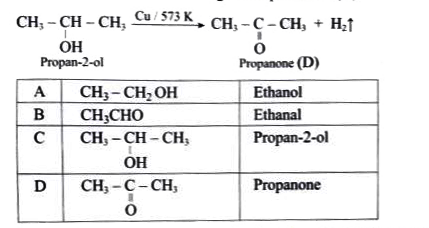
|
|
| 30. |
An organic compound (A) of molecular formula C_2H_6O reacts P//I_2 gives (B) which on further reaction with silver nitrite gives (C) of formula C_2H_5NO_2. (C) on treatment with nitrous acid yield (D) of formula C_2H_4N_2O_3. (D) on reaction with KOH give red color product (E). Identify A, B, C, D and E. |
Answer» SOLUTION :From the final PRODUCT (E) RED colour product, it is identified these reactions are the reactions of primary alcohols in Victor Meyer.s test. 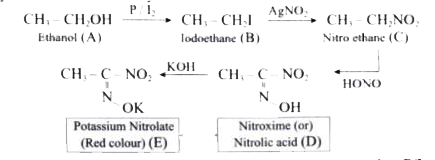
|
|
| 31. |
An organic compound (A) of molecular formula C_2H_6O on reaction with conc. H_2SO_4 at 443 K gives an unsaturated hydrocarbon (B). (B) on reaction with Baeyer's reagent produces (C) of molecular formula C_2H_6O_2. (C )on reaction with anhydrous ZnCl_2 produces (D) of molecular formula C_2H_4O. (D) reduces Tollen's reagent. Identify A,B, C and D, and explain the reactions involved. |
|
Answer» SOLUTION :(i) An organic COMPOUND (A) reacts with Conc. `H_2SO_4` at 443 K produces ethane by intermolecular dehydration. So, (A) is ethanol - `CH_3 CH_2OH`. `underset("Ethanol(A)")(CH_3-CH_2OH)underset(443K)OVERSET(conc.H_2SO_4)tounderset("Ethene"(B))(CH_2=CH_2) + H_2O` Ethene on reaction with Baeyer.s reagent (cold, dilute alkaline `KMnO_4`) produces ethylene glycol as product (C). `CH_2 =CH_2 underset("alkaline"KMnO_4)overset("cold,dilute")tounderset("ETHYLEN glycol(C)"){:(CH_2OH),(|),(CH_2OH):}` (iii) Ethylene glycol on reaction with anhydrous ZnCl, dehydration and tautomerisation take place to give aetaldehyde as product (D). `underset(""CH_2OH)overset(""CH_2OH)(|)underset(-H_2O)overset("anhydrous"ZnCl_3)to[underset(CH-OH)overset(CH_2)(||)]overset("Tautomerisation")tounderset("Acetaldehyde(D)")(CH_3-CHO)` 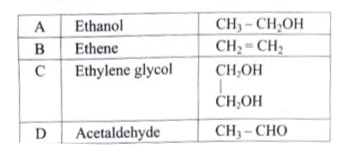
|
|
| 32. |
An organic compound (A) of molecular formula C_2H_6Oon reaction with acidified K_2Cr_2O_7gives (B) of molecular formula C_2H_4Owhich on further oxidation gives (C) of molecular formula C_2H_4O. Compound (C) reacts with (A) in the presence of conc. H_2SO_4gives (D) of molecular formula C_4H_8O_2 .Identify A,B,C,D and explain the reaction involved. |
|
Answer» Solution :(i) An organic compound (A) of molecular formula `C_2H_6O`is identified as ethanol. (ii) Ethanol on OXIDATION with acidified` K_2Cr_2O_7`gives first acetaldehyde as (B) which on further oxidation gives acetic acid as (C) `UNDERSET("ethanol (A)")(CH_3CH_2OH underset(H_2SO_4)overset(K_2Cr_2O_7)(to) underset("acetaldehyde (B) ")(CH_3 - CHO) overset((O))(to) underset("acetic acid (C )")(CH_3COOH)` (III) Ethanol reacts with acetic acid in the presence of conc. `H_2SO_4` , esterification take PLACE to give ethyl acetate as product (D) `CH_3-CH_2OH + CH_3COOH overset(conc.H_2SO_4)(to) underset("ethyl ecetate (D)")(CH_3COOC_2H_5 + H_2O)` |
|
| 33. |
An organic compound (A) of molecular formula C_2H_6O liberates H_2 gas with metallic sodium and gives (B). (B) on reactionwith methyl bromide promide produces (C ) of molecular formula C_3H_8O. (C ) on reaction with excess HI produces (D) and (E ). Identify A,B,C,D and E and explain the reactions involved.s |
|
Answer» SOLUTION :(i) An ORGANIC compound (A) reacts with Na metal and liberates `H_2` gas means it must be an alcohol. From the molecular formula it is identified as ethanol `-CH_3-CH_2OH` (A). (II) Ethanol on reaction with Na metal to produce sodium ethoxide as (B) with liberation of `H_2` gas. `2CH_3 - CH_2OH + 2Na to underset("Sodium ethoxide(B)")(2CH_3 - CH_2ONa) + H_2uarr` (iii) Sodium ethoxide on reaction methyl bromide undergo Williamson.s synthesis to produce methoxy ethane as (C). `CH_3 - CH_2ONa + CH_3Ioverset("Ether")to underset("Methoxy ethane(C )")(CH_3 - CH_2 - O - CH_3) + NAI` (iv) Methoxy ethane on reaction with excess HI will give Ethyl iodide and Methyl iodide as (D) and (E). `CH_3 - CH_2 - O - CH_3 + 2HI to underset("Ethyl iodide(D)")(CH_3-CH_2I) + underset("Methyl iodide(E)")(CH_3I) + H_2O` 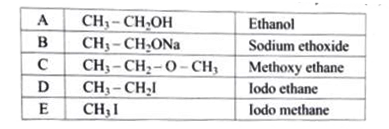
|
|
| 34. |
An organic compound A of molecular formula C_2H_5ON treated with bromine and KOH gives B of molecular formula CH_5N. Identify A and B. Write the equation involved. |
|
Answer» Solution :ORGANIC COMPOUND A is ACETAMIDE `CH_3COH_2` Organic compound B is METHYL AMINE `CH_3NH_2` `{:(CH_3CONH_2+4KOH+Br_2 to CH_2NH_2+2KBr+2H_2O+K_2CO_3),("(A)(B) "):}`. |
|
| 35. |
An organic compound (A) of molecular formula C_2H_4O_2 reacts with PCI_5 to give (B) of formula C_2H_3OCI . (B) on treatment with ammonia gives (C) of formula C_2H_5NO . (C) on reaction with Br_2 and KOH gives CH_5 Nas (D). Identify A,B,C,D and explain the reactions involved. |
|
Answer» SOLUTION :(i) The ORGANIC compound (A) is identified as `CH_3 COOH ` (ACETIC acid). (ii) Acetic acid reacts with `PCl_5`to form acetyl CHLORIDE as (B) `HC_3COOH + PCl_5 to underset("acetyl chloride (B)")(CH_3COCl ) + POCl_3 + HCl` (iii) Acetyl chloride on reaction with ammonia gives acetamide as (C) `CH_3COCl + NH_3 to underset("acetamide (C )")(CH_3CONH_2) + HCl` (iv)Acetamide on treatment with `Br_2` and KOH gives methylamine as (D) `CH_3CONH_2 + Br_2 + 4KOH overset(Delta)(to) underset("methyl amine (D) ")(CH_3NH_2) + K_2CO_3 + 2KBr + H_2O` |
|
| 36. |
An organic compound (A) of molecular formula C_2H_5NOon treatment with LiAIH_4gives (B) of formula C_2H_7N . (A) on treatment with Br_2and excess of caustic alkali gives (C) of formula CH_5N . (A) on treatment with phosphorous pentoxide gives (D) of molecular formula C_2 H_3 NIdentify A,B,C,D and explain the reactions involved. |
|
Answer» Solution :(i) The ORGANIC COMPOUND (A) is identified as `CH_3CONH_2`acetamide. (ii) Acetamide on treatment with `LiAlH_4`gives ethylamine as product (B) `underset("acetamine (A)")(CH_3- undersetoverset(||)(O)(C ) -NH_2 + 4[H]) overset(LiAIH_4)(to) underset("ethylamine (B) ")(CH_3-CH_2-NH_3+H_2O)` (iii) Acetamide on reaction with `Br_2` and caustic alkali gives METHYL AMINE as (C ) `CH_3- undersetoverset(||)(O)(C ) -NH_2 + B_2 + 4KOHtounderset("methyl amine (C )")(CH_3NH_2) + K_2CO_3 + KBr + 2H_2O` (iv) Acetamide on treatment with `P_2O_5` gives Aceto nitrile (or) methyl cyanide as (D) `CH_3 - undersetoverset(||)(O)(C )-NH_2 underset(Delta)overset(P_2O_5)(to) underset("methyl cyanide(D )")(CH_3-C-= N + H_2O)` |
|
| 37. |
An organic compound (A) of molecular formula C_2H_4O_2gives brisk effervescence with sodium carbonate. (A) on reaction with thiony chloride gives (B) of formula C_2H_3OCl . (B) on reaction with Pd//BaSO_4gives (C) of molecular formula C_2H_4Othat reduces Tollen's reagent to silver mirror. (C) on reaction with dilute NaOH gives (D) of molecular formula C_4H_8O_2. . Identify A,B,C,D and explain the reactions involved. |
|
Answer» Solution : (i) (A) gives brisk effervescence with `Na_2CO_3`means it must be a carboxylic ACID. So (A) must be `CH_3COOH` Acetic acid. (ii) Acetic acid reacts with thionyl chloride to give acetyl chloride `CH_3COCl` as (B) . ` underset("acetic acid (A) ")(CH_3COOH) + SOCl_2 to underset("acetyl chloride (B)")(CH_3COCl) + SO_2 uarr + HCl` (III) Acetyl chloride reacts with `Pd//BaSO_4` , it undergoes Rosenmund.s reduction to give acetaldehyde as (C) `CH_3COCl underset([H])overset(Pd//BaSO_4)(to) underset("acetaldehyde (C )")(CH_3CHO) + HCl` (iv) When acetaldehyde is warmed with dilute NaOH, it undergoes aldol condensation to `CH_3 - oversetunderset(|)(H)( C) = O + H - CH_2 CHO overset(dil.NaOH)(to) underset("acetaldolor 3 - hydroxy butanal")(CH_3- undersetoverset(|)(OH)(C ) H - CH_2CHO)` |
|
| 38. |
An organic compound (A) of molecular formula C_2H_4O_2gives brisk effervescence with Na_2CO_3 . Acetyl chloride reacts with sodium acetate to give C_4H_6O_3as (B). (B) on reaction with PCl_5gives (C) of formula C_2H_2OCI . (C) on reaction with ammonia gives (D) of molecular formula C_2HNO . Identify A,B,C,D and explain the reactions involved. |
|
Answer» Solution : (i) Compound (A) gives BRISK effervescence with `Na_2CO_3`and so it MUST be a carboxylic acid. `CH_3COOH`(acetic acid) is compound A. (II) Acetyl chloride on heating with SODIUM acetate to give acetic ANHYDRIDE as (B) 
|
|
| 39. |
An organic compound (A) of molecular formula C_2H_4Oreduces tollen's reagent to silver mirror. (A) on treatment with C_2H_5MgBrfollowed by acid hydrolysis gives (B) of formula C_4H_10 O .(B) on reaction with Cu at 573 K gives (C) of formula C_4H_8Owhich does not reduce tollen's reagent but answers iodoform test. Identify A,B,C,D and explain the reaction involved. |
Answer» SOLUTION :
|
|
| 40. |
An organic compound (A) of molecular formula C_(2)H_(4) reacts with alkaline potassium permanganate and gives compound (B) of molecular formula C_(2)H_(6)O_(2). Compound (B) when heated with anhydrous zinc chloride forms ( C) of molecular formula C_(2)H_(4)O. Identify A, B and C and explain the reactions. |
|
Answer» SOLUTION :(i) An organic compound with molecular FORMULA `C_(2)H_(4)` is ethylene. Ethylene reacts with potassium permanganate to give compound B (ethylene glycol). `UNDERSET((A))(CH_(2)=CH_(2) + H_(2)O + (O) overset("alk" KMnO_(4)) to underset((B)) overset(CH_(2)-OH)underset(CH_(2)-OH)| .` (ii) Ethylene glycol when heated with anhydrous `ZnCl_(2)` forms compound C. `underset(CH_(2)-OH)overset(CH_(2)OH)|overset(ZnCl_(2))underset(-H_(2)O)to CH_(3)CHO` 
|
|
| 41. |
An organic compound (A) of molecular formula C_2H_3OCI on reaction with pd and BaSO_4gives (B) of formula C_2H_4O . (B) on reaction with LiAIH_4gives (C) of formula C_2H_6O . (B) on reaction with I_2and NaOH gives (D) of formula CH_2ONa and iodoform. Identify A,B,C,D and explain the reactions involved. |
|
Answer» Solution :(i) From the molecular formula (A) is identified as `CH_3COCI`(Acetyl chloride) (ii) Acetyl chloride on treatment with PD and `BaSO_4`gives ACETALDEHYDE `CH_3 CHO`as (B) `underset("acetyl chloride (A)")(CH_3COCl) underset(2[H])overset(Pd//BaSO_4)(to) underset("acetaldehyde (B)")(CH_3CHO) + HCl` (iii) Acetaldehyde on reaction with `LiAlH_4`gives ethyl ALCOHOL as (C) `CH_3CHO underset([H])overset(LiAlH_4)(to) underset("ethyl alcohol (C )")(CH_3 - CH_2 OH)` (IV) Acetaldehyde when treated with `I_2` and NaOH gives sodium formate (D) and iodoform `CHI_3` as products. `CH_3CHO underset(NaOH)overset(3I_2)(to) underset("iodoform")(CHI_3) + underset("sodium formate (D)")` |
|
| 42. |
An organic compound (A) of molecular formula C_2H_3non acid hydrolysis gives (B) of molecular formula C_2H_4O_2calcium salt of (B) gives (C ) of molecular formulaC_3H_6O Compound (C ) on reduction of hydrazine and sodium ethoxide gives (D) of molecular formula C_3H_8 .Identify A,B,C,D and explain the reaction involved. |
Answer» SOLUTION :
|
|
| 43. |
An organic compound (A) of molecular formula C_2H_3NO on reaction with P_2O_5, gives C_2H_3N (B). (B) on hydrolysis gives (C) of formula C_2H_4O_2(C) on reaction with LiAIH_4gives (D) formula C_2H_6OIdentify A,B,C,D and explain the reactions involved. |
|
Answer» SOLUTION :(i) (A) is identified as `CH_3CONH_2`acetamide. (ii) Acetamide on reaction with `P_2O_5`gives methyl CYANIDE as (B) `UNDERSET("acetamide (A) ")(CH_3CONH_2) underset(Delta)OVERSET(P_2O_5)(to) underset("methyl cyanide (B)")(CH_3CN) + H_2O` (iii) Methyl cyanide on acid hydrolysis gives ACETIC acid `CH_3COOH`as( C) `CH_3CN + 2H_2O overset(H^(+))(to) underset("acetic acid (C )")(CH_3COOH) + NH_3` (iv) Acetic acid on reaction with `LiAlH_4`gives ethanol as (D) `underset("acetic acid (C ) ")(CH_3-undersetoverset(||)(O)(C ) -OH) underset(4[H])overset(LiAlH_4)(to) underset("ethanol (D)")(CH_3 - CH_2OH) + H_2O` |
|
| 44. |
An organic compound (A) molecular formula CH_(2)O reacts with CH_(3)MgI to give compound (B). Compound (B) liberates Hydrogen with metallic sodium. Compound (B) in the presence of Conc. H_(2)SO_(4) at 410 K on dehydration to give compound (C ) molecular formula C_(4)H_(10)O. Identify (A), (B) and (C ). Explain the above reactions. |
|
Answer» Solution :(i) An ORGANIC compound (A) with molecular formula `CH_(2)O` is formaldehyde (HCHO). `HCHO + CH_(3)MgI overset(H-OH) to CH_(3)CH_(2)OH ` +  (III) ETHANOL on dehydration with conc. `H_(2)SO_(4)`at 410 K gives compound C. `2C_(2)H_(5)OH overset(410 K) underset(H_(2)SO_(4)) to C_(2)H_(5)-O-C_(2)H_(5)` 
|
|
| 45. |
An organic compound A (molecular formula C_(8)H_(16)O_(2)) was hydrolysed with dilute sulphuric acid to give a carboxylic acid (B) and an alcohol (C). Oxidation of (C) with chromic acid produced (B). (C) on dehydration gives but-2-ene as the major product. write equation for the reactions involved. |
|
Answer» Solution :(i) Since the ORGANIC compound (S) with M.F. `C_(8)H_(16)O_(2)` upon hydrolysis with dil. `H_(2)SO_($)` gives carboxylic acid (B) and the alcohol (C), therefore, (A) must be an ester. Further, since oxidation of (C) with chromic acid produces the acid (B), therefore, both the carboxylic acid (B) and the alcohol (C) must contains the same number of carbon atoms. (ii) Since ester (A) contains eight carbon atoms, therefore, both the carboxylic acid (B) and the alcohol (C) must contain four carbon atoms each. (iii) Since the alcohol (C) on dehydration gives but-1-ene, therefore, (C) must be a straight chain alcohol, i.e., butna-1-ol. (IV) if (C) is butan-1-ol, then the acid (B) which it gives on oxidation must be butanoic acid and the ester (A) must be butyl butanoate. (v) The relevant equation for the all the reactions involved may be EXPLAINED as follows: `underset("Butyl butanoate (A) "(M.F.=C_(8)H_(16)O_(2)))(CH_(3)CH_(2)CH_(2)-overset(O)overset(||)(C)-OCH_(2)CH_(2)CH_(2)CH_(3) underset("Hydrolysis")overset("Dil. "H_(2)SO_(4))to underset("Butanoic acid (B)")(CH_(3)CH_(2)CH_(2)-overset(O)overset(||)(C)-OH)+underset("Butan-1-ol (C)")(CH_(3)CH_(2)CH_(2)CH_(2)OH)` `underset("Butanoic acid (B)")(CH_(3)CH_(2)CH_(2)-overset(O)overset(||)(C)-OH) underset("Oxidation")overset(CrO_(3)//H_(2)SO_(4))larr underset("Butan-1-ol (C)")(CH_(3)CH_(2)CH_(2)CH_(2)OH) underset((-H_(2)O)) overset('Dehydration")tounderset("But-2-ene")(CH_(3)CH=CHCH_(3))`. |
|
| 46. |
An organic compound (A) (molecular formula C_(8)H_(16)O_(2)) was hydrolysed with dilute sulphuric acid to give a carboxylic acid (B) and an alcohol (C ). Oxidation of (C ) with chromic acid produced (B). (C ) on dehydration gives but - 1 - ene. Write equations for the reactions involved. |
|
Answer» Solution :(i) The organic COMPOUND (A) with molecular formula `C_(8)H_(16)O_(2)` UPON hydrolysis with dil. `H_(2)SO_(4)` gives carboxylic acid (B) and the alcohol (C ), therefore, (A) must be an ESTER. Further, oxidation of (C ) with chromic acid produces the acid (B), therefore, both the carboxylic acid (B) and the alcohol (C ) must CONTAIN the same number of carbon atoms. (ii) Since ester (A) contains eight carbon atoms, therefore, the carboxylic acid (B) and the alcohol (C )must contain four carbon atoms each. (iii) Since the alcohol (C ) on dehydration gives but -1- ene, (C ) must be a straight chain alcohol, i.e., butan -1- ol. (iv) If (C ) is butan -1- ol, then the acid (B) which it gives on oxidation must be butanoic acid and the ester (A) must be butyl butanoate. (v) The reaction can now be explained as follows : `underset(("Molecular formula "=C_(8)H_(16)O_(2)))underset("butylbutanoate (A)")(CH_(3)CH_(2)CH_(2)-overset(O)overset(||)C-OCH_(2)CH_(2)CH_(2)CH_(3))overset("Dil. "H_(2)SO_(4))underset("Hydrolysis")rarrunderset("Butanoic acid (B)")(CH_(3)CH_(2)CH_(2)-overset(O)overset(||)C-OH)+underset("Butan-1-ol (C)")(CH_(3)CH_(2)CH_(2)CH_(2)OH)` `underset("Butanoic acid (B)")(CH_(3)CH_(2)CH_(2)-overset(O)overset(||)C-OH)overset(CrO_(3)//CH_(3)COOH)underset("Oxidation")larrunderset("Butan -1- ol (C)")(CH_(3)CH_(2)CH_(2)OH) overset("Dehydration")underset((-H_(2)O))rarr underset("But -1- ene")(CH_(3)CH_(2)CH=CH_(2))` |
|
| 47. |
An organic compound A (Molecular formula C_(6)H_(12)O_(4))does not change the colour of acidic dichromate solution. Compound A on treatment with H_(2)SO_(4) produces alkene, which on oxiative ozonolysis gives a molecule (C_(6)H_(10)O_(3)) which gives positive iodoform test. Find the structure of 'A'. |
|
Answer»
|
|
| 48. |
An organic compound (A) (molecular formula, C_(4)H_(8)O_(2)) was hydrolysed with dilute H_(2)SO_(4) to give a carboxylic acid (B) nd an alcohol (C). Oxidation of (C) with chromic acid produced (B). Write possible structures of (A), (B) and (C) and give their IUPAC names. write chemical equations involved in the process. |
|
Answer» SOLUTION :(i) `underset("ETHYL acetate ")(A(C_(4)H_(8)O_(2)))(CH_(3)COOC_(2)H_(5))+H_(2)O overset(Dil.H_(2)SO_(4))to underset("Acetic ACID (B)")(CH_(3)COOH)+ underset("Ethyl alcohol (C)")(CH_(3)CH_(2)OH)` (ii) `underset("Ethyl alcohol (C)")(CH_(3)CH_(2)OH) underset(("Oxidation"))overset(CrO_(3)//H_(2)SO_(4))to underset("Acetic acid (B)")(CH_(3)COOH` |
|
| 49. |
An organic compound (A) (molecular formula C_8 H_16O_2)was hydrolysed with dilute sulphuric acid to give a carboxylic acid (B) and an alcohol (C). Oxidation of (C) with chromic acid produced (B). (C) on dehydration gives but -1-ene. Write equations for the reactions involved. |
Answer» Solution :The relevant EQUATIONS for all the REACTIONS involved MAY be explained as FOLLOWS: 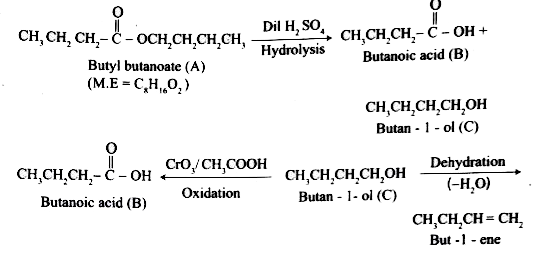
|
|
| 50. |
An organic compound (A) molecular formula C_3H_6Ois resistant to oxidation but form a compound (B) (C_3H_8O)on reduction (B) reacts with HBr to form a bromide ( C) which on treatment with alcoholic KOH forms an alkene (D) (C_3H_6) . Deduce the structures of A,B,C and D. |
Answer» SOLUTION :
|
|