Saved Bookmarks
This section includes 7 InterviewSolutions, each offering curated multiple-choice questions to sharpen your Current Affairs knowledge and support exam preparation. Choose a topic below to get started.
| 1. |
An organic compound A (molecular formula C_(3)H_(6)O) is resistant is oxidation but forms a compound B (C_(3)H_(8)O) on reduction. B. reacts with HBr to form a bromide C which o treatment with alcoholic KOH forms an alkene D (C_(3)H_(6)). Deduce the structures of A,B,C and D. |
|
Answer» SOLUTION :STRUCTURES of A,B, C and D are deduced in the following manner: `CH_(3)-UNDERSET(A)underset("Acetone")underset(O)underset(||)(C)-CH_(3)underset("Reduction")overset(LiAlH_(4))(to)CH_(3)-underset(B)underset("Propane-2-ol")underset(OH)underset(|)(CH)-CH_(3)` `CH_(3)-underset(A)underset("Propan"-2-ol)underset(OH)underset(|)(CH)-CH_(3)+HBR to CH_(3)-underset(C)underset(2-"Bromopropane")underset(Br)underset(|)(CH)-CH_(3)` `CH_(3)-underset(C)underset(2-"Bromopropane")underset(Br)underset(|)(CH)-CH_(3)+KOH(alc)toCH_(3)-underset(D)underset("Propene")(CH)=CH_(2)+KBr+H_(2)O` |
|
| 2. |
An organic compound (A) (mol. Wt. =74) contained C(48.65%), H(8.11%) and O(43.24%). (A) on treatment with bromine, gave (B) containing 52.3% of Br, while on treatment with phosphorus and bromine, gave (C ) containing 74.1% of bromine. Both (B) and (C ), on boiling with water, gave the same product (D). (A), on distillation with soda lime, gave ethane. Assign structural formulae to (A), (B), (C ) and (D) |
|
Answer» Solution :For the compound (A) Moles of `C:H:O= (48.65)/(12): (8.11)/(1): (43.24)/(16)` `=4.054: 8.11: 2.70` `=1.5: 3: 1` `=3: 6: 2` `therefore` empirical formula of (A) is `C_(3)H_(6)O_(2)` (74) As the mol. Wt. = emp. Formula wt, `therefore` molecular formula of (A) is `C_(3)H_(6)O_(2)` As (A), on DISTILLATION with soda LIME gave `C_(2)H_(6)`, (A) must be `CH_(3).CH_(2).COOH` (propioic acid) Now  For (B): Br% `=(80)/(153) XX 100 ~~52.3%` For (C ): `Br%= (160)/(216)xx 100~~74.1%` As the Br% in (B) and (C ) are same as given (B) is `CH_(3).CHBr.COOH` and (C ) is `CH_(3).CHB.CO.Br` Now since both (B) and (C ) will give the same PRODUCT `CH_(3).CH(OH).COOH` (`alpha`-hydroxy propionic acid), (D) must be `CH_(3).CH(OH).COOH` |
|
| 3. |
An organic compound (A) (MG C_(4)H_(10)O) upon dehydrogenation gives a compound (B) which forms phenyl hydrazone. With phenylhydrazine and both the compounds (A) and (B) respond to iodoform test. Hence the compound (A) is: |
|
Answer»
|
|
| 4. |
An organic compound (A) (MFC_(4)H_(10)O) upon dehydrogenation gives a compound (B) which forms phenyl hydrazone with phenythydrazine and both the compound (A) and (B) respond to iodoform test. Hence, the compound (A) is |
|
Answer»

|
|
| 5. |
An organic compound 'A' is a sodium salt of phenolic acid with molecular formula C_(7)H_(5)O_(3)Na. 'A' on hearting with soda lime gives compound 'B' of molecular formula C_(6)H_(6)O. 'B' gives violet colour with neutral ferric chloride. 'B' on treatment with C_(6)H_(5)COCl in the presence of NaOH gives an ester 'C'. Identify 'A', 'B' and 'C'. Explain the reactions. |
|
Answer» Solution :(i) The organic compound (A) which is sodium salt of PHENOLIC acid is sodium salicylate. (II) (A) on heating with soda lime gives Compound (B) phenol gives violet colouration with neutral ferrichloride.  (iii) Phenol on TREATMENT with `C_(6)H_(5)COCl` in the presence of NaOH gives on ESTER C. `C_(6)H_(5)OH + C_(6)H_(5)COCl overset(NaOH) to C_(6)H_(5)OCO C_(6)H_(5) + HCl` 
|
|
| 6. |
An organic compound (A) having molecular weight, 58, contained 62.06% of C and 10.35% of H and rest, oxygen (A),on reduction gave (B) which gave iodoform test.(B), on dehydration, gave an unsaturated hydrocarbon (C ) having molecular weight 42. Find (A), (B) and (C) |
| Answer» SOLUTION :`(CH_(3).CO.CH_(3), CH_(3)CH(OH)CH_(3), CH_(3).CH= CH_(2))` | |
| 7. |
An organic compound (A) is a calcium salt of acetic acid. (A) on dry distillation gives (B) of formula C_3H_6O . (B) on reaction with LiAIH_4gives ( C) of formula C_3H_8O(C ) on heating with conc. H_2SO_4gives (D) of molecular formula C_3H_6 . Identify A,B,C,D and explain the reaction involved. |
Answer» SOLUTION :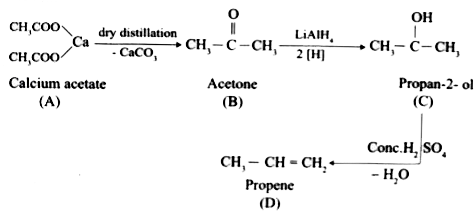
|
|
| 8. |
An organic compound 'A' having molecular formula C_(5)H_(10)O gives negative Tollens' test forms n-pentane on Clemmensen reduction but doesn't give iodoform test. Identify 'A' and give all the reactions involved. |
|
Answer» Solution :The COMPOUND A is `underset("Pentan-3-one")(CH_(3)CH_(2)COCH_(2)CH_(3))` Tollen.s test is not given by ketones. Iodoform test is given by methyl ketones, SINCE this is not a methyl ketone, iodoform test is not given by pentan-3-one Clemmensen REDUCTION reaction. `underset("n-Pentane")(CH_(3)CH_(2)COCH_(2)CH_(3)underset(HCl)overset(Zn-Hg)(to)CH_(3)CH_(2)CH_(2)CH_(2)CH_(3))` |
|
| 9. |
An organic compound 'A' having molecular formula C_(4)H_(10)O does not react with sodium metal. On hydrolysis with dilute H_(2)SO_(4) It gives only one organic compound 'B' . The compound B on heating with red phosphours and iodine gives compound 'C'. The compound C can also beobtained from compound 'A' on heating with excess HI. Identify the compounds A, B and C. |
|
Answer» SOLUTION :(1) The organic COMPOUND'A' with molecular formula `C_(4)H_(10)O` maybe an alcohol or ether. (2) Since 'A' does not react with sodium (Na), It is not react with sodium (Na), it is not an alcohol . Hence 'A' may be an ether. (3) Sincean ether 'A' on hydrolysiswith dilute `H_(2)SO_(4)` givesonly one compound 'B', the compound 'A" must be a symmetrical (simple) ether. Hence compound 'A' may be, `C_(2)H_(5) - O - C_(2)H_(5)`. `underset((A))underset("diethyl ether")(C_(2)H_(5)-O-C_(2)H_(5))+H_(2)Ooverset("dil." H_(2)SO_(4))underset("HEAT, pressure")rarrunderset((B))underset("ethyl alcohol")(2C_(2)H_(5)-OH)` (4) `underset((B))underset("ethyl alcohol")(3C_(2)H_(5)-OH+PI_(3))overset("red" P + I_(3))underset(Delta)rarrunderset((C))underset("ethyl iodide")(3C_(2)H_(5)-I)+underset("phosphorus acid")(H_(3)PO_(3))` 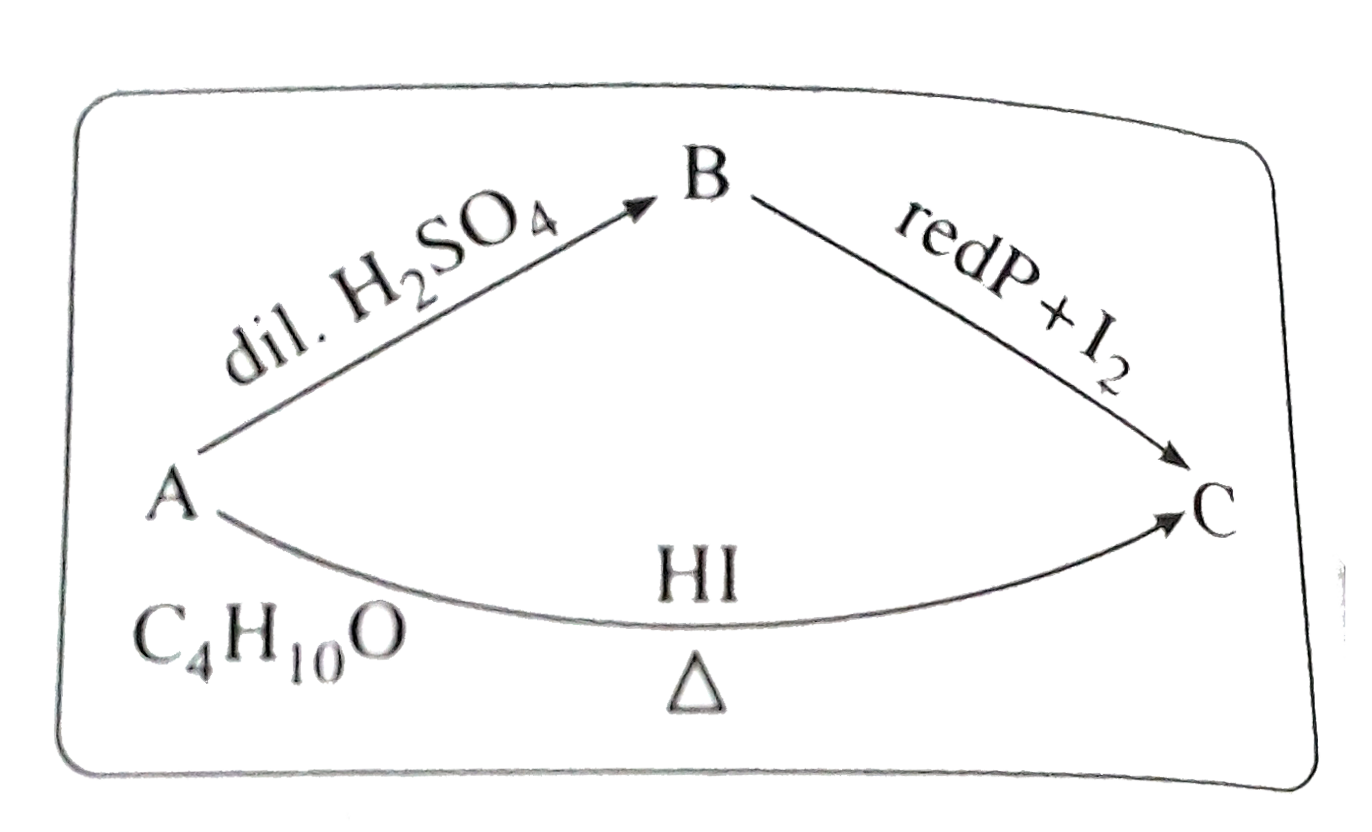
|
|
| 10. |
An organic compound 'A' having molecular formula C_(2)H_(7)N on treatment with HNO_(2) gives an oily yellow substance. Identify (A) |
Answer» 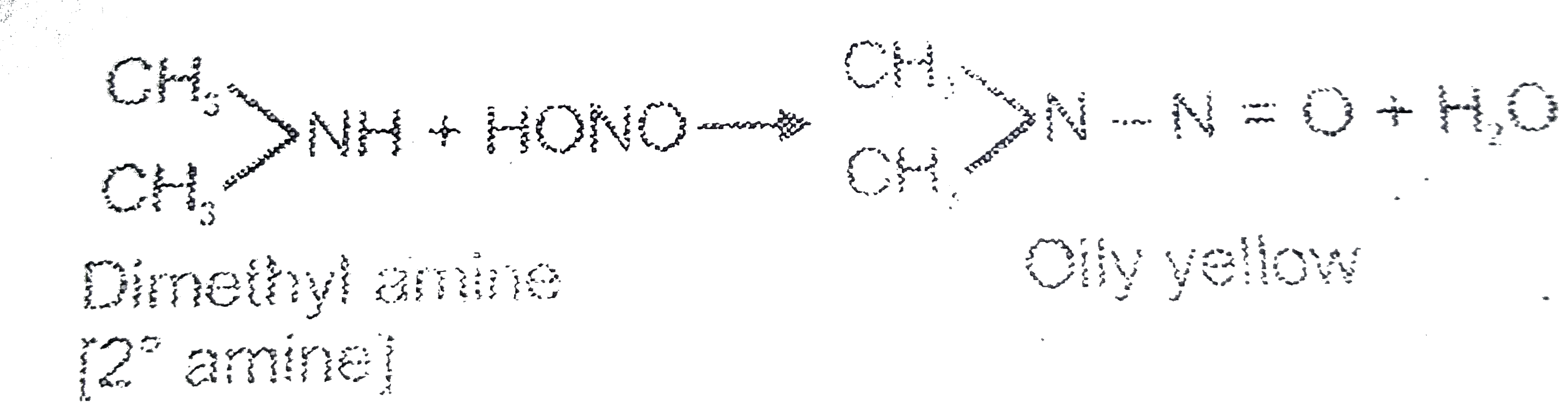
|
|
| 11. |
An organic compound A having molecular formula C_(3)H_(5)N on hydrolysis gave another compound B. The compund B on treatment with HNO_(2) gave ethyl alcolol. B on warming with CHCl_(3) and alcoholic caustic potash gave an offensive smelling substance C. Identify A, B and C. |
|
Answer» Solution :`UNDERSET(A)(C_(2)H_(5)N-=C)+2H_(2)Ooverset(H^(+))(to) underset(B)(C_(2)H_(5)NH_(2))overset(HNO_(2))(to)C_(2)H_(5)OH+N_(2)+H_(2)O` `underset(B)(CH_(3)CH_(2)CNH_(2))+CHCl_(3)+3KOHtounderset(C)(CH_(3)CH_(2)N-=C+3KCl+3H_(2)O` |
|
| 12. |
An organic compound 'A' having molecular formula C_(2)H_(6)O evolves hydrogen gas on treatment with sodium metal and on treatment with red phosphorous and iodine gives compound 'B'. The compound 'B' on treatment with alcoholic KCN and on subsequent reduction gives compound 'C'. Write the balanced chemical equations for all the reactions involved and identify the compounds 'A', 'B' and 'C'. |
|
Answer» Solution :`A=C_(2)H_(5)OH"ETHANOL"` `B=C_(2)H_(5)I"ethyl iodide"` `C=C_(2)H_(5)CH_(2)NH_(2)" n-propyl amine"` `underset(A)(2C_(2)H_(5)OH+Na) to underset("Sodium ethoxide")(2C_(2)H_(5)ONa+H_(2))` `3C_(2)H_(5)OH+PI_(3) underset("in situ")OVERSET(2P+3I_(2))to underset(B)underset("Ethyl iodide")(3C_(2)H_(5)I+H_(3)PO_(3))` `underset(B)(C_(2)H_(5)I+KCN) underset(Delta)overset("alcohol")to underset("Ethyl NITRITE")(C_(2)H_(5)CN+4(H)) overset(Na//C_(2)H_(5)OH)to underset((C))underset("n-Propyl amine")(C_(2)H_(5)CH_(2)NH_(2))` |
|
| 13. |
An organic compound 'A' having molecular formula C_(2)H_(6)O evolves hydrogen gas on treatment with sodium metaland on treatment with red phosphorous and iodine gives compound 'B'. The compound 'B' on treatment with alcoholic KCN and on subsequentreduction gives compound 'C'. The compound 'C' on treatment with nitrousacid evolves nitrogen gas. Write the balanced chemical equationsfor all the reactions involved and identify the compounds 'A', 'B' and 'C'. |
Answer» Solution :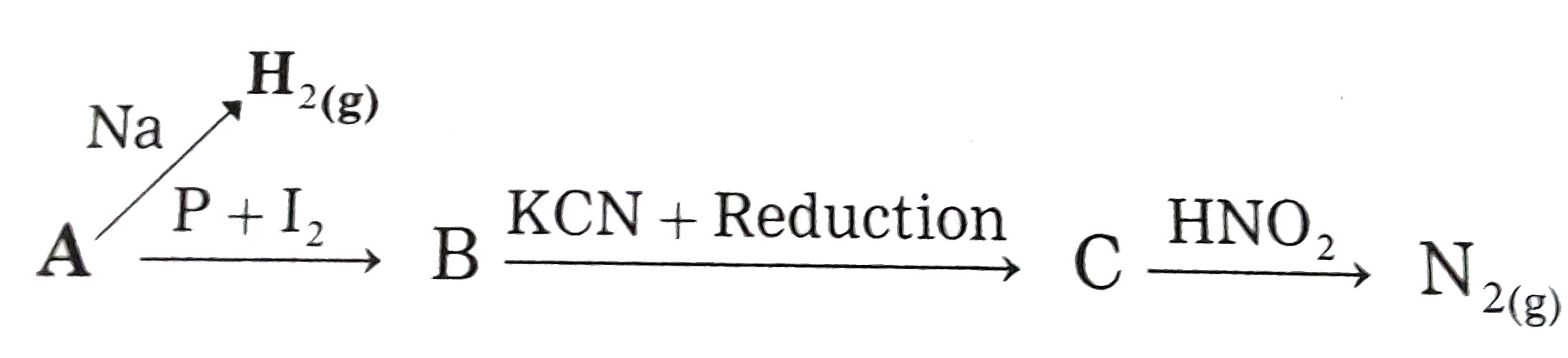 (1) `underset((A))(2C_(2)H_(5)OH)+Na rarr underset("SODIUM ethoxide")(2C_(2)H_(5)ONa + H_(2))` `underset((A))(3C_(2)H_(5)OH + PI_(3)) overset(2P + 3I_(2))underset("in situ")rarrunderset((B))underset("ethyl iodide")(3C_(2)H_(5)I + H_(3)PO_(3))` (3) `underset((B))(C_(2)H_(5)I + KCN overset("alcohol")underset(Delta_(-KI))rarrunderset("ethyl nitrite")(C_(2)H_(5)CN) +4(H) overset("Na"/C_(2)H_(5)OH)rarrunderset((C))underset("n-propyl amine")(C_(2)H_(5)CH_(2)NH_(2))` (4) `underset("n-propyl amine")(C_(2)H_(5)CH_(2)NH_(2)) +HNO_(2) rarr underset("propan-1-ol")(C_(2)H_(5)CH_(2)OH) + N_(2) darr + H_(2)O` `A = C_(2)H_(5)OH` ethanol `B = C_(2)H_(5)I` ethyl iodide. `C = C_(2)H_(5)CH_(2)NH_(2)` n-propyl amine Compound `C_(2)H_(6)O = C_(2)H_(5)OH` |
|
| 14. |
An organic compound A having molecular formula C_(2)H_(3)N on reduction gave a compound B. Upon treatment with HONO, B gave ethyl alcohol and on warming with CHCI_(3) and alcoholic KOH, it gave offensive smell. The compound A is: |
|
Answer» Acetamide |
|
| 15. |
An orgnic compound (A) on reduction gave a compound (B). Upon treatment with HNO_(2) ,(B) gave ethyl alcohol and on warming with CHCI_(3), and alcoholic KOH, (b) gave offensive smell. The compound (A) is: |
| Answer» Answer :B | |
| 16. |
An organic compound A having molecular formula C_2H_7N on treatment with HNO_2 gave the oily yellow substance. Identify A. |
| Answer» SOLUTION :`UNDERSET("N-Methylmethanamine")(CH_3 - OVERSET(CH_3) overset(|) (NH))` | |
| 17. |
Anorganiccompound AhavingmolecularformulaC_(2) H_(3) Non reductiongave acompound B. Upontreatmentwith HONO, B gaveethylalcoholand on warmingwithCHCI_(3) andalcoholicKOH , it gaveoffensivesmell. The compoundA is |
|
Answer» acetamide Theaminemust be `C_(2) H_(5) NH_(2)` Hence`C_(2) H_(3) N ` is`CH_(3)CN`(methyl cyanide ) |
|
| 18. |
An organic compound (A) havig molecular formula, C_(2)H_(4)O reduces tollens' reagent. Two moles of (A) react with Al(OC_(2)H_(5))_(3) to yield C_(4)H_(8)O_(2)(B) which reacts with NH_(3) to give C_(2)H_(6)O(C) and C_(2)H_(5)NO(D). Identify A,B,C and D. |
|
Answer» Solution :(i) Since compound (A) with M.F. `C_(2)H_(4)O` reduces tollens' reagent, it must be an ALDEHYDE, i.e., acetaldehyde `(CH_(3)CHO)`. `underset("Acetaldehyde")(CH_(3)CHO) +underset("Tollens' reagent")(2[Ag(NH_(3))_(2)]^(+))+3OH^(-)to CH_(3)COO^(-)+2Ag darr+4NH_(3)+2H_(2)O` (ii) In presence of `Al(OC_(2)H_(5))_(3)`, aldehydes undergo Tischenko reaction to give esters. thus, when two moles of acetaldehyde `(CH_(3)CHO)` react in presence of `Al(OC_(2)H_(5))_(3)`, ethyl acetate (B) with M.F. `C_(4)H_(8)O_(2)` is PRODUCED. `underset("Acetaldehyde (A) (two moles)")(CH_(3)CHO+OHC CH_(3)) underset(("Tischenko reaction"))OVERSET(Al(OC_(2)H_(5))_(3))to underset("Ethyl acetate (B) "M.F.C_(4)H_(8)O_(2))(CH_(3)COOCH_(2)CH_(3))` (ii) The structure of ethyl acetate (B) is confirmed by the observation that on treatment with `NH_(3)`, it gives one molecule of an alcohol, i.e., ethyl alcohol, `CH_(3)CH_(2)OH(C)` and one molecule of an amide, i.e., acetamide, `CH_(3)CONH_(2)(D)` `underset("Ethyl acetate (B)")(CH_(3)COOCH_(2)CH_(3))overset(NH_(3))to underset("Ethyl alcohol (C) "M.F.C_(2)H_(6)O)(CH_(3)CH_(2)OH)(CH_(3)CONH_(2))`. |
|
| 19. |
An organic compound (A) having moleclar formula C_(2)H_(6)O on oxidation with Na_(2)Cr_(2)O_(7)//H_(2)SO_(4) produces a compound (B) which reduces Tollens' reagent. Both (A) and (B) produce a yellow soli on treatment with I_(2)//OH^(-). Identify (A) and (B). |
|
Answer» Solution :(i) Since an organic compound (A) with M.F. `C_(2)H_(6)O` on oxidation with `Na_(2)Cr_(2)O_(7)//H_(2)SO_(4)` gives compound (B) which reduces Tollens' reagent, therefore (A) must be ETHANOL and (B) must be ETHANAL (B). `underset("Ethanol (A) "M.F.C_(2)H_(6)O)(CH_(3)CH_(2)OH) underset(("Oxidation"))overset(Na_(2)Cr_(2)O_(7)//H_(2)SO_(4))to underset("Ethanal (B)")(CH_(3)CHO)` (ii) Since ethanol (A), `CH_(3)CH_(2)OH` contains the grouping `CH_(3)CHOH-` and ethanal (B), `CH_(3)CHO` contain the grouping `CH_(3)CO-`, herefore, both these on TREATMENT with `I_(2)//OH^(-)` undergo iodoform REACTION to give yellow solid of iodoform. `underset("Ethanol (A)")(CH_(3)CH_(2)OH)` or `underset("Ethanal (B)")(CH_(3)CHO) underset(("Iodoform reaction"))overset(I_(2)//OH^(-))to underset("Iodoform (Yellow solid)")(CHI_(3))`. |
|
| 20. |
An organic compound A has the molecular formula C_(5)H_(10)O. It does not reduce Fehling's solution but forms a bisulphite compound. It also positive iodoform test. What are possible structuresof A? Explain your reasoning which helped to arrive at the structures. |
|
Answer» Solution :Strucutre of A is ARRIVED at as under: It does not reduce Fehling.s solution but forms bisulphite compound, therefore, it is a kentone. It GIVES POSITIVE iodoformtest, therefore, it is METHYL ketone. The possible structures are as follows `CH_(3)-overset(O)overset(||)(C)-CH_(2)-CH_(2)-CH_(3)` and `CH_(3)-overset(O)overset(||)(C)-underset(CH_(3))underset(|)(CH)-CH_(3)` |
|
| 21. |
An organic compound (A) has molecular formula (C_(5)H_(10)O). It does not reduce Tollen's reagent but forms an orange precipitate with 2, 4-DNP reagent. It forms a carboxylic acid (B) with molecular formula (C_(3)H_(6)O_(2)) when treated with alkaline KMnO_(4), yellow precipitate on treatment with NaOH and I_(2) under vigorous conditions. On oxidation it gives ethanoic acid and propanoic acid. Sodium slat of (B) gave a hydrocarbon (C ) in Kolbe's ElectrolyticReduction. Identify (A), (B) and (C ) and write the reactions involved. |
Answer» Solution :The COMPOUND (A) is `CH_(3)CH_(2)COCH_(2)CH_(3)`. The reactions are EXPLAINED as under:  `underset((A))(CH_(3)CH_(2)COCH_(2)CH_(3)) overset([O])to underset("Propanoic acid")(CH_(3)CH_(2)COOH)+underset("ETHANOIC acid")(CH_(3)COOH)` `underset("Sodium propionate")(CH_(3)CH_(2)COONa) underset("Electrolytic reduction")overset("Kolbe.s")to underset((C ))underset("n-Butane")(CH_(3)CH_(2)CH_(2)CH_(3))` Thus A, B, C are `A=CH_(3)CH_(2)COCH_(2)CH_(3)""B=CH_(3)CH_(2)COOH""C=CH_(3)CH_(2)CH_(2)CH_(3)` |
|
| 22. |
An organic compound (A) has a characteristic odour. On treatment with NaOH, it forms compounds (B) and (C). Compound (B) has molecular formula C_7H_(8)Owhich on oxidation gives back (A). The compound (C) is a sodium salt of an acid. When (C) is treated with soda-lime, it yields an aromatic compound (D). Deduce the structures of (A), (B), (C) and (D). Write the sequence of reactions involved. |
|
Answer» Solution : (A), (B), (C) and (D) have the following structures : `underset((A))underset("Benzaldehyde Characteristic odour")(C_(6)H_(5)CHO) overset("Cannizzaro.s reaction")underset(NAOH) to underset((B))to underset((B)"Benzyl alcohol")(C_(6)H_(5)CH_(2)OH) + underset((C)"Sod BENZOATE")(C_(6)H_(5)COONa)` `underset((B))(C_(6)H_(5)CH_(2)OH) overset([O])underset(-H_(2)O)to underset((A))(C_(6)H_(5)CHO)` `underset((C)"Sod. benzoate")(C_(6)H_(5)COONa) overset("Soda-lime")to underset((D)"Benzene")(C_(6)H_(6))` |
|
| 23. |
An organic compound (A) has a characteristic colour, on treatment with NaOH, it forms compound (B)and (C ). Compound (B) has molecular formula C_(7)H_(8)O which on oxidation gives back (A). The compound (C ) is sodium salt of an acid. When (C ) is treated with sodalime, it yields on aromatic compound (D). Deduce the structures of (A), (B), (C ) and (D). Write the sequence of reactionsinvolved. |
|
Answer» |
|
| 24. |
An organic compound (A) has 76.6% C and 6.38% H. its vapour density is 47. it gives characteristic colour with FeCl_(3) solution. (A) when treated with CO_(2) and NaOH at 140^(@) C under pressure gives (B) which on being acidified gives (C). (C) reacts with acetyl chloride to give (D) which is a well known pain killer. identify (A), (B), (C), (D) and explain the reactions involved. |
|
Answer» Solution :`{:("Atomic weight",,"Atomic ratio"),(C=76.6,=76.6//12,=6.38~~6),(H=6.38,=6.38//1,=6.38~~6):}` `O=100-(76.6+6.38)=17.02//16=1.06~~1` Emperical formula `=C_(6)H_(6)O` Emperical formula weight=94 Molecular weight=`V.d.xx2=47xx2=94` So, molecular formula=`C_(6)H_(6)O` Since (A) gives characteristic COLOUR with AQUEOUS `FeCl_(3)`. So it must be a phenolic compound and the formula of (A) may be 
|
|
| 25. |
An organic compound (A) has 76.6% C, 6.38% H. Its vapour density is 47. It gives characteristic colours with FeCl_(3) solution. (A) when treated with CO_(2) and NaOH at 120^(@)C under pressure gives (B) which on acidification gives (C). (C) reacts with acetyl chloride to give (D) which is a well known pain killer. Identify (A), (B), (C) and (D) and also explain the reactions. |
|
Answer» Solution :The simplest ratio between the atoms may be calculated as : `C=76.6=76.6/12=6.38/1.06=6, H=6.38=6.38/1=6.38/1.06=6` `O=17.02=17.02/16=1.06/1.06=1""["Pencentage of "O=100-(76.6+6.38)=17.02]` Empirical formula `=C_(6)H_(6)O` Empirical formula MASS `=6xx12+6xx1+16=94` Molecular mass `=2 xx"Vapour density"=2xx47=94` (GIVEN) `n=("Molecular mass")/("Empirical formula mass")=94/94=1` Molecular formula `=("Empirical formula")xxn=94xx1=94` Since (A) give characteristic COLOUR with aqueous `FeCl_(3)`, it must be a phenol of (A) is 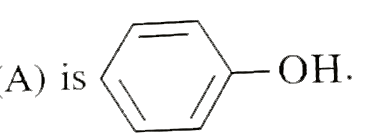 The chemical reactions involved may be listed as follows : 
|
|
| 26. |
An organic compound (A) gives positive Liebermann's nitroso reaction and on treatment with CHCl_(2)//KOH followed by hydrolysis gives (B) and (C). Compound (B) gives pink colour with Schiff's reagent but not (C) which is steam volatile. (C) on treatment with LiAlH_(4) gives (D) (C_(7)H_(5)O_(2)) which on oxidation gives E. 'E' reacts with acetic anhydride and gives compound F. calculate molecular weight of 'F'. |
|
Answer» |
|
| 27. |
An organic compound A forms B with Na metal. A also forms C with PCl_(5) B and C from diethyl ether. Identify the compounds A, B and C |
|
Answer» `C_(2) H_(5) OH, C_(2) H_(5) Cl, C_(2) H_(5) ONA ` |
|
| 28. |
An organic compound (A) contains C=32%, H=6.66% and N=18.67%. On reduction, it gives a primary amine (B) which gives ethyl alcohol with nitrous acid. (B) gives an offensive odour on warming with CHCl_(3) and KOH and gives compound (C ) which on reduction forms ethyl methyl amine. Assign the structures of (A), (B) and (C ) |
| Answer» Solution :`[((A) C_(2)H_(5)NO_(2)),((B) C_(2)H_(5)NH_(2)),((C )C_(2)H_(5)NC)]` | |
| 29. |
An organic compound (A) contains C and H only (C=90%). (A) produces another compound (B) on treatment with HBr. (B) contains 79.2% of Br. If the molecular weight of (A) is 40, find the formulae of (A) and (B). (Br= 80) |
|
Answer» Solution :MOLES of `C= (90)/(12)= 7.5` Moles of `H= (10)/(1)=10` `therefore` moles of `C:H= 7.5: 10` =`3:4` `therefore` empirical formula is `C_(3)H_(4)` As molecular weight is 40, the molecular formula, will be the same as the empirical formula i.e., (A) is `CH_(3)- C -= CH or, CH_(2)=C= CH_(2)` SINCE with HBr, (A) will produce `CH_(3)-C(Br_(2))- CH_(3)` in which Br % `=(160)/(202)XX 100=79.2%` Which is the same as the GIVEN value, (B) will be `CH_(3)-C(Br_(2))-CH_(3)` |
|
| 30. |
An organic compound (A) contains 69.42% C, 5.78% H and 11.57% N. Its vapour density is 60.5. It evolves ammonia when boiled with caustic potash. On heating with P_(2)O_(5), it gives a compound (B) containing 81.55%C, 4.85% H and 13.59% N. On reduction with Na and alcohol, (B) forms a base which reacts with HNO_(3) giving off nitrogen and yielding and alcohol (C ). The alcohol can be oxidised to benzoic acid. Assign structural formulae to (A) , (B) and (C ) |
|
Answer» Solution :For compound (A): Moles of `C: H: N: O= (69.42)/(12): (5.78)/(1): (11.57)/(14): (13.23)/(16)` `=5.66: 5.78: 0.82: 0.82` `=7:7:1:1` Empirical FORMULA of (A) is `C_(7)H_(7)NO` (121) `therefore` molecular formula of (A) is also `C_(7)H_(7)NO` `(("mol.wt"=2 xxV.D),(=2 xx 60.5= 121))` For compound (B): Moles of `C:H: N= (81.55)/(12): (4.85)/(1): (13.59)/(14)` `=6.8 : 4.85: 0.97` `=7:5:1` `therefore` empirical formula of (B) is `C_(7)H_(5)N` Molecular formula of (B) will also be `C_(7)H_(5)N` as it is derived from `C_(7)H_(7)NO` (A) by dehydration with `P_(2)O_(5)` As (A) evolves ammonia when BOILED with caustic potash, it must be an amide `(C_(6)H_(5).CO.NH_(2))`. Thus, (B) and 9C ) can also be named from the given REACTION sequence, `underset(underset("Benzamide")((A)))(C_(6)H_(5)CONH_(2)) underset(-H_(2)O)overset(P_(2)O_(5))rarr underset((B))(C_(6)H_(5)CN) underset(Na//alc)overset("Red")rarr underset(darrHNO_(2))(C_(6)H_(5)CH_(2)NH_(2)) underset("Benzoic acid")(C_(6)H_(5)COOH) overset((O))larr underset((C ))(C_(6)H_(5)CH_(2)OH) + H_(2)O + N_(2)` The structure may be represented as 
|
|
| 31. |
An organic compound (A) contains 40% carbon 6.7% hydrogen and rest, oxygen. Its vapour density is 15. On reacting with a concentrated solution of KOH, it gives two compounds, (B) and (C ). When (B) is oxidised, the original compound (A) is obtained. When (C ) is treated with concentrated HCl, it gives a compound (D) which reduces Fehling's solution as well as ammoniacal AgNO_(3) solution and also gives effervescence with NaHCO_(3) solution. Write the structures of (A), (B), (C ) and (D) |
|
Answer» Solution :Moles of `C: H: O` in `(A)= (40)/(12): (6.7)/(1): (53.3)/(16)` `=3.33: 6.7: 3.33` `=1: 2: 1` Empirical formula of (A) is `CH_(2)O` (30) As molecular WEIGHT of (A) is also equal to 30 (i.e., `2 xx VD`), molecular formula of (A) is `CH_(2)O`. Now from the FOLLOWING reaction sequence `{:((A),overset(KOH)rarr,(B),+,(C )),((CH_(2)O),,darr(O),,darrHCl),(,,(A),,(D)),(,,(CH_(2)O),,"reduces Fehling.s solution and AMM"),(,,,,AgNO_(3) "and gives effervescence with"NaHCO_(3)):}` It is clear that, (A) is HCHO (B) is `CH_(3)OH` ( C) is HCOOK and (D) is HCOOH |
|
| 32. |
An organic compound, (A) containing C, H, N and O, on analysis gives 49.32% carbon, 9.59% hydrogen and 19.18% nitrogen. (A) on boiling with NaOH gives off NH_(3) and a salt which on acidification gives a monobasic nitrogen -free acid (B). The silver salt of (B) contains 59.67% silver. Deduce the structures of (A) and (B) |
| Answer» Solution :(A) `C_(2)H_(5)CONH_(2)` (B) `C_(2)H_(5)COOH` | |
| 33. |
An organic compound A containing C, H and O has a pleasant odour with boiling point of 78^(@)C On boiling A with concentrated H_(2)SO_(4), a colourless gas is produced which decolourises bromine water and alkaline KMnO_(4). The organic liquid A is |
|
Answer» `C_(2)H_(5)CI` (i) Ethyl alcohol is a colourless liquid with a CHARACTERISTIC PLEASANT smell, having boiling point `78.1^(@)C` (ii) `C_(2)H_(2)OHoverset(concH_(2)SO_(4))tounderset("which decolourises Br, water and alkaline (KMnO_(4))")underset(darr)(CH_(2)=CH_(2))` |
|
| 34. |
An organic liquid A containing C,H and O has a pleasant odour with a boiling point of 78^(@)C. On boiling. A with conc. H_(2)SO_(4) a colourless gas is produced which decolourises bromine water and alkaline KMnO_(4). One mole of this gas also takes one mole of H_(2). The organic liquid A is |
|
Answer» `C_(2)H_(5)CL` |
|
| 35. |
An organic compound A containing C, H and O has a pleasant odour. On boiling A with Conc.H_2SO_4 a colourless gas is produced whichdecolourises brominewater and alkaline KMnO_4. The organic liquid A is …………………….. . |
|
Answer» `C_2H_5COOCH_3` |
|
| 36. |
An organic compound A containing C = 70% and H =11.6% gave the following results : (P) 0.384 gm of the compound A displaced 100 ml of air at 1 atm and 273 K. (Q) On treatment with PCl_(3)A gave another compound, which contained 33.97%(34%)chlorine. An ismor of A and B which gives two organic product with PCl_(5) is : |
|
Answer»
|
|
| 37. |
An organic compound A containing C = 70% and H =11.6% gave the following results : (P) 0.384 gm of the compound A displaced 100 ml of air at 1 atm and 273 K. (Q) On treatment with PCl_(3)A gave another compound, which contained 33.97%(34%)chlorine. An ismor of it B gave compound C containing 50.35% chlorine with PCl_(5).C gives back B with aq. KOH correct structure of B is: |
|
Answer» pent-4-en-1-ol |
|
| 38. |
An organic compound A containing C = 70% and H =11.6% gave the following results : (P) 0.384 gm of the compound A displaced 100 ml of air at 1 atm and 273 K. (Q) On treatment with PCl_(3)A gave another compound, which contained 33.97%(34%)chlorine. IUPAC anme of the compound A is : |
|
Answer» pentanal `{:("Element",%,"At.Wt.","Ralative ratio","Simple ratio"),(C,70,12,5.83,5.06(5)),(H,11.6,1,11.6,10.086(10)),(O,18.4,16,1.15,1(0)):}` So, ORGANIC compound`(C_(5)H_(10)O)_(x)` MOLECULAR waight`=(WRT)/(PxxV)=(0.384xx0.0821xx273)/(1xx(100)/(1000))` `""=86` `""86xx = 86` `rArr""`x = 1 So, compounA is `C_(5)H_(10)O`. If compound A is alodohol. `C_(5)H_(10)Ooverset(PCl_(5))rarrC_(5)H_(9)Cl` `(12xx5+9+35.5=104.5)""(%Cl=(35.5)/(104.5)=33.97)` |
|
| 39. |
An organic compound (A) (C_(9)H_(12)) gave (B) (C_(8) H_(6)O_(4)) on oxidation by alkaline KMnO_(4) (B) on heatingdoes not from anhydride. Also , (B)reacts withBr_(2) in the presenceof ironto give only onemonobromo-derivative (C)(C_(8)H_(5) BrO_(4)). WHat are (A), (B), and (D) ? |
Answer» SOLUTION :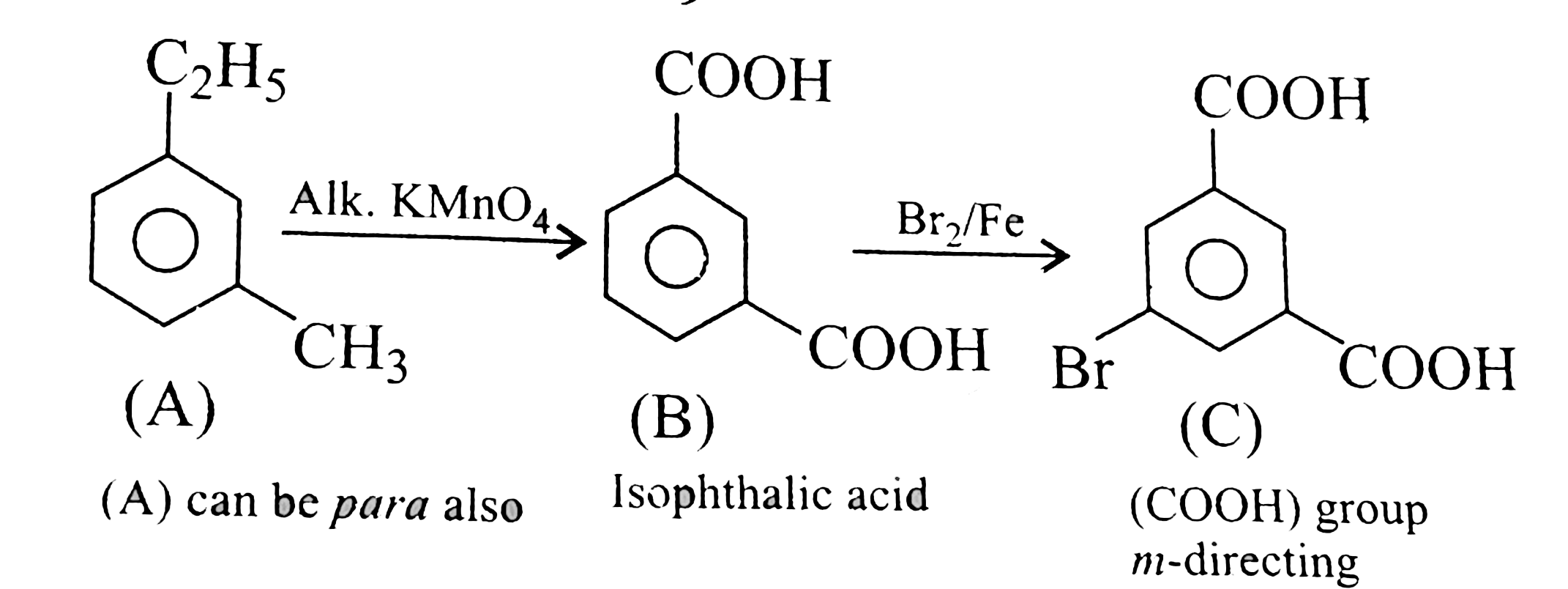
|
|
| 40. |
An organic compound A (C_(9)H_(10)O) does not evolve any gas on reatement with Na-metal but on hydrolysis with dil. H_(2)SO_(4) gives B(C_(9)H_(12)O_(2)) which on further treatement with alkaline solution of iodine gives an yellow precipitate. Also A on treatment with excess of conc. HBr gives C(C_(9(H_(11)OBr) as the major product. C on furthertreatment with C_(2)H_(5)ONa//C_(2)H_(5)OH followed by acidification of product gives D (an isomer of A). D on ozonolysis followed by work-up with dimethyl sulphide gives ortho hydroxyl benzaldehyde as one of the product. Answer the following three questions based on the above information. The statement that is true regarding A to D is |
|
Answer» it oxygen of A is labelled by `.^(18)O,D` will retain `.^(18)O` |
|
| 41. |
An organic compound A (C_(9)H_(10)O) does not evolve any gas on reatement with Na-metal but on hydrolysis with dil. H_(2)SO_(4) gives B(C_(9)H_(12)O_(2)) which on further treatement with alkaline solution of iodine gives an yellow precipitate. Also A on treatment with excess of conc. HBr gives C(C_(9(H_(11)OBr) as the major product. C on furthertreatment with C_(2)H_(5)ONa//C_(2)H_(5)OH followed by acidification of product gives D (an isomer of A). D on ozonolysis followed by work-up with dimethyl sulphide gives ortho hydroxyl benzaldehyde as one of the product. Answer the following three questions based on the above information. Which of the following statement regarding B is correct? |
|
Answer» B is an optically INACTIVE substance |
|
| 42. |
An organic compound A (C_(9)H_(10)O) does not evolve any gas on reatement with Na-metal but on hydrolysis with dil. H_(2)SO_(4) gives B(C_(9)H_(12)O_(2)) which on further treatement with alkaline solution of iodine gives an yellow precipitate. Also A on treatment with excess of conc. HBr gives C(C_(9(H_(11)OBr) as the major product. C on furthertreatment with C_(2)H_(5)ONa//C_(2)H_(5)OH followed by acidification of product gives D (an isomer of A). D on ozonolysis followed by work-up with dimethyl sulphide gives ortho hydroxyl benzaldehyde as one of the product. Answer the following three questions based on the above information. The most likely structure of starting compound A is |
|
Answer»
|
|
| 43. |
An organic compound (A) C_(8)H_(4)O_(3) in dry benzene in the presence of anhydrous AlCl_(3) gives compound (B), the compound (B) on treatment with PCl_(5) followed by reaction with H_(2)//Pd("BaSO"_(4)) gives compound ( C ) which on reaction with hdyrazine gives a cyclized compound (D)C_(14)H_(10)N_(2). Identify (A), (B), ( C ), and (D). Explain the formation of (D) from ( C ). |
Answer» SOLUTION :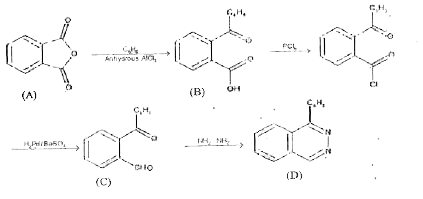
|
|
| 44. |
An organic compound (A), C_(8)H_(4) O_(3) in dry benzene in the preseneof anhydorusAlCl_(3) givescompound(B). Compound (B) on treatmentwith PCl_(5) followedby reaction with H_(2)//Pd (BaSO_(4)) gives compound (C)which on reaction with hydrazine gives a cyclised compound (D),(C_(14) H_(10) N_(2)) Idenyify (A),(B),(C) and (D). Explain the formation of (D) from(C). |
Answer» Solution :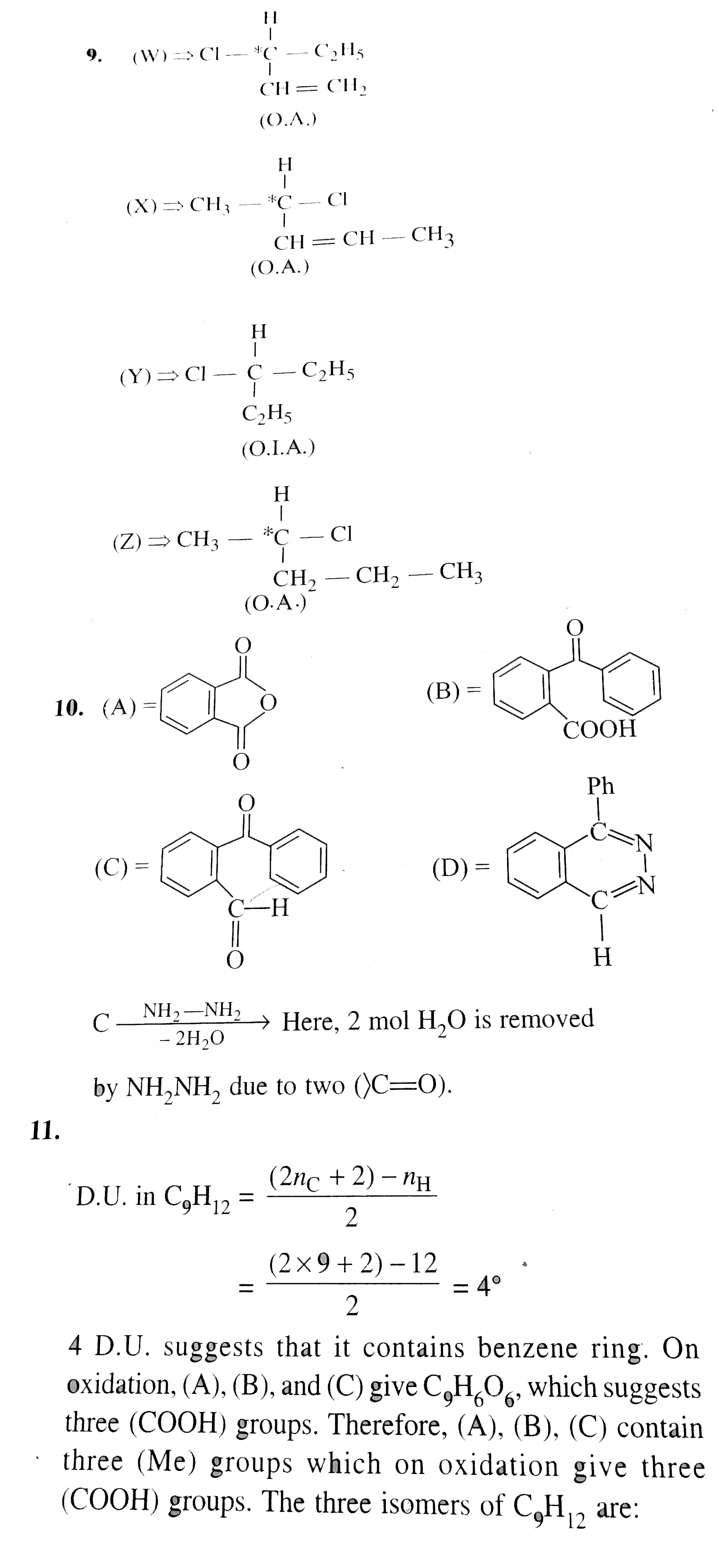 `C underset(-2H_(2)O)OVERSET(NH_(2)-NH_(2))(rarr)` Here, `2 MOL H_(2)O` is removed by `NH_(2)NH_(2)` due to two `(gtgt C = 0)` |
|
| 45. |
An organic compound (A) , C_(8)H_(10)O. The compound (B) upon treatment of alkaline solution of iodine gives a yellow precipitate. The filtrate. The filtrate on acidification gives a while solid ("C") , C_(7)H_(6)O_(2). Give structures of A, B, C and explain the reactions involved. |
|
Answer» Solution :`underset((A))(C_(8)H_(9)Br) overset(aq.KOH)tounderset((B))(C_(8)H_(10)underset(I_(2))overset(NaOH)tounderset("Yellow PPT")(CHI_(3))darr` Since (A) is HYDROLYSED , Br is not ATTACHED to ring i.e., it is attached to the side chain. (A) could be : 
|
|
| 46. |
An organic compound (A) C_(7)H_(8)O is insoluble in aqueous NaHCO_(3), but soluble in NaOH. (A) on treatment with bromine water rapidly forms compound (B), C_(7)H_(5)Obr_(3). The compound (A) is .... |
|
Answer»
|
|
| 47. |
An organic compound (A) C_(7)H_(8), on oxidation at 773K in the presence of V_(2)O_(5) gives compound (B) of molecular formula C_(7)H_(6)O. (B) reduces Tollen's reagent. (B) on heating with sodium acetate in the presence of acetic anhydride gives (C_(9)H_(8)O_(2)). Identify A, B and C. Write the reactions. |
|
Answer» SOLUTION :(i) An organic compound (A) `C_(7)H_(8)`, on oxidation at 773 K in the presence of `V_(2)O_(5)` gives compound (B) of molecular formula `C_(7)H_(6)O`. (ii) (B) reduces Tollen's reagent. (B) on heating with sodium acetate in the presence of acetic ANHYDRIDE gives `(C_(9)H_(8)O_(2))`(C). `underset((A))(C_(6)H_(5)-CH_(3))underset(V_(2)O_(5)//773K)OVERSET((O))toC_(6)H_(5)-CHO+H_(2)O` `underset((B))(C_(6)H_(5)-CHO)+CH_(3)-CO-O-CO-CH_(3)overset(CH_(3)COONa)tounderset((C))(C_(6)H_(5)-CH=CH-COOH)` 
|
|
| 48. |
An organic compound A (C_(7)H_(6)O) reduces Tollen's reagent. On treating with an alkali compound A forms B and C. B on treating with sodalime forms benzene and C (C_(7)H_(8)O) is an antiseptic. Identify compounds A, B and C. Explain the reactions. |
|
Answer» Solution :(i) From the molecular formula compound (A) is identified as Benzaldehyde `C_(6)H_(5)CHO` and it reduces Tollen's reagent. `underset("Tollen's reagent SILVER mirror")(C_(6)H_(5)CHO+Ag_(2)Oto2Ag+C_(6)H_(5)COOH)` (ii) Benzaldehyde on treatment with alkali undergoes Cannizzaro reaction to give benzoic ACID (B) and benzyl alcohol (C). `underset((A))(C_(6)H_(5)CHO+C_(6)H_(5)CHO)overset(NaOH)tounderset((B))(C_(6)H_(5)COOH)+underset((C))(C_(6)H_(5)CH_(2)OH)` (iii) Benzoic acid on treatment with SODALIME gives benzene. `underset((B))(C_(6)H_(5)COOH)underset(CaO)overset(NaOH)tounderset("Benzene")(C_(6)H_(6))+CO_(2)` (iv) Benzyl alcohol acts as an antiseptic. 
|
|
| 49. |
An organic compound (A) C_(7)H_(6)O reduces Tollen's reagent. Compound (A) reacts with acetic anhydride in the presence of anhydrous sodium acetate and gives an unsaturated acid (B). Compound (A) reacts with acetone in the presence of alkali and gives (C). What are (A), (B) and (C)? Explain the reactions. |
|
Answer» Solution :(i) An organic compound (A) is identified as `C_(6)H_(5)CHO` benzaldehyde. Benzaldehyde REDUCES Tollen's reagent and also undergoes Cannizaro reaction. `underset((A))(C_(6)H_(5)CHO)+Ag_(2)Oto2Ag+underset((B))(C_(6)H_(5)COOH)` (ii) Benzaldehyde REACTS with ACETIC anhydride in the presence of sodium acetate gives cinnamic acid and it is (B) an unsaturated acid. `underset((A))(C_(6)H_(5)CHO)+(CH_(3)CO)_(2)Ooverset(CH_(3)COONa)tounderset((B))(C_(6)H_(5)CH)=CHCOOH+CH_(3)COOH` (iii) Compound A reacts with acetone to form compound (C) benzal acetone. `underset((A))(C_(6)H_(5)CHO)+CH_(3)COCH_(3)overset(NAOH)tounderset((C))(C_(6)H_(5)CH=CH-COCH_(3))` 
|
|
| 50. |
An organic compound (A) C_(6)H_(6)O gives violet colour with neutral FeCl_(3) solution. With NH_(3) in the presence of anhydrous ZnCl_(3) (A) gives (B) (C_(6)H_(7)N). (A) with dimethyl sulphate gives ( C) (C_(7)H_(8)O). What are (A), (B) and (C )? Explain the reactions. |
|
Answer» Solution :(i) An organic compound (A) `C_(6)H_(6)O` gives violet colour with netural `FeCl_(3)` solution. (ii) With `NH_(3)` in the presence of anhydrous `ZnCl_(2)` (A) gives (B) `(C_(6)H_(7)N)`. `C_(6)H_(5)OH + NH_(3) overset(ZnCl_(2)//473 K) to C_(6)H_(5)NH_(2) + H_(2)O` (iii) (A) with DIMETHYL sulphate gives (C ) `(C_(7)H_(8)O)`. `C_(6)H_(5)OH + underset("dimethyl sulphate")(CH_(3))_(2)SO_(4) overset(NAOH) to C_(6)H_(5)OH + underset("Methyl hydrogen sulphate")(CH_(3)OSO_(2)OH)` 
|
|