

Saved Bookmarks
| 1. |
An organic compound (A) has 76.6% C, 6.38% H. Its vapour density is 47. It gives characteristic colours with FeCl_(3) solution. (A) when treated with CO_(2) and NaOH at 120^(@)C under pressure gives (B) which on acidification gives (C). (C) reacts with acetyl chloride to give (D) which is a well known pain killer. Identify (A), (B), (C) and (D) and also explain the reactions. |
|
Answer» Solution :The simplest ratio between the atoms may be calculated as : `C=76.6=76.6/12=6.38/1.06=6, H=6.38=6.38/1=6.38/1.06=6` `O=17.02=17.02/16=1.06/1.06=1""["Pencentage of "O=100-(76.6+6.38)=17.02]` Empirical formula `=C_(6)H_(6)O` Empirical formula MASS `=6xx12+6xx1+16=94` Molecular mass `=2 xx"Vapour density"=2xx47=94` (GIVEN) `n=("Molecular mass")/("Empirical formula mass")=94/94=1` Molecular formula `=("Empirical formula")xxn=94xx1=94` Since (A) give characteristic COLOUR with aqueous `FeCl_(3)`, it must be a phenol of (A) is 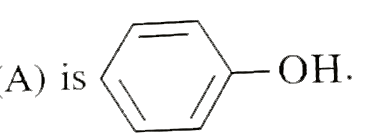 The chemical reactions involved may be listed as follows : 
|
|