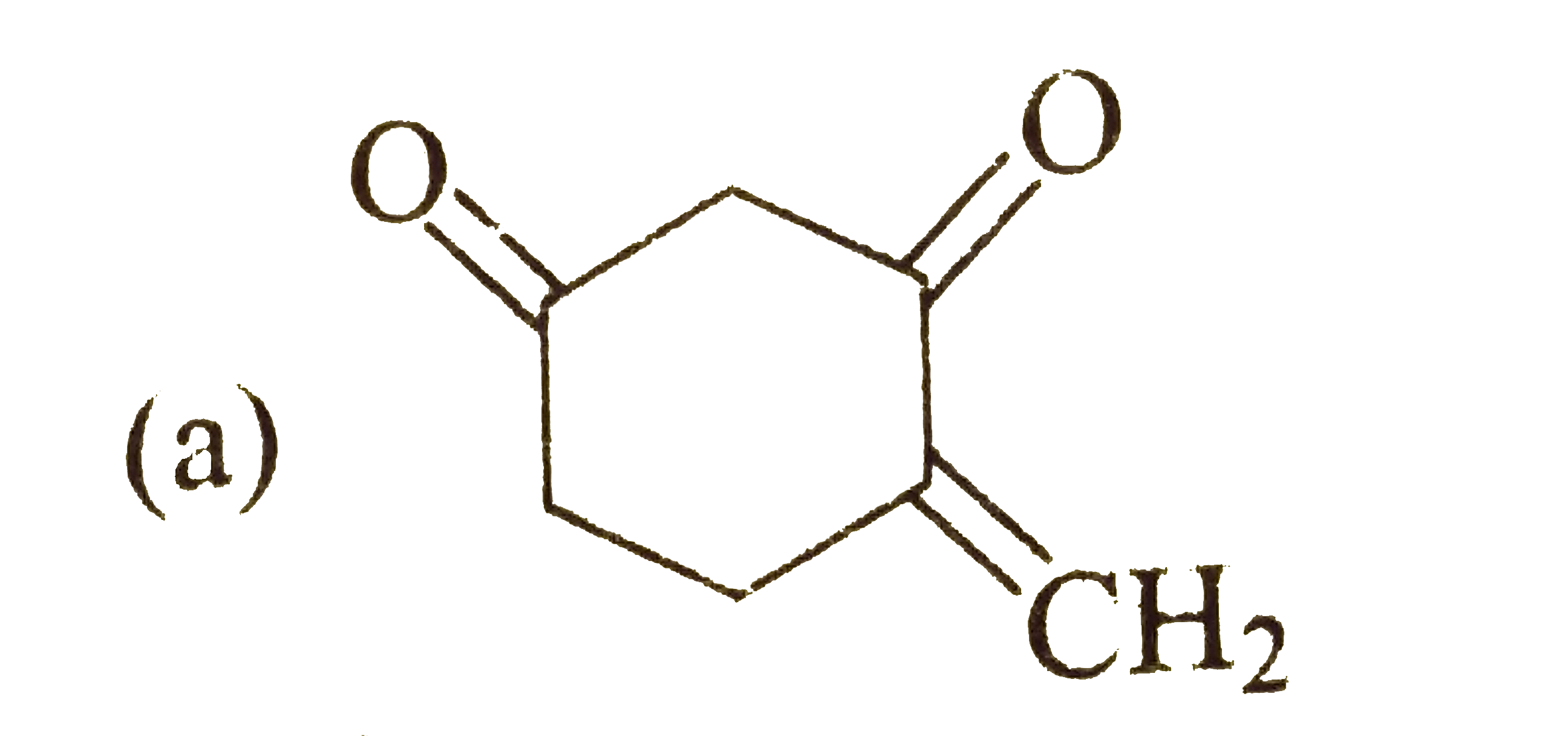
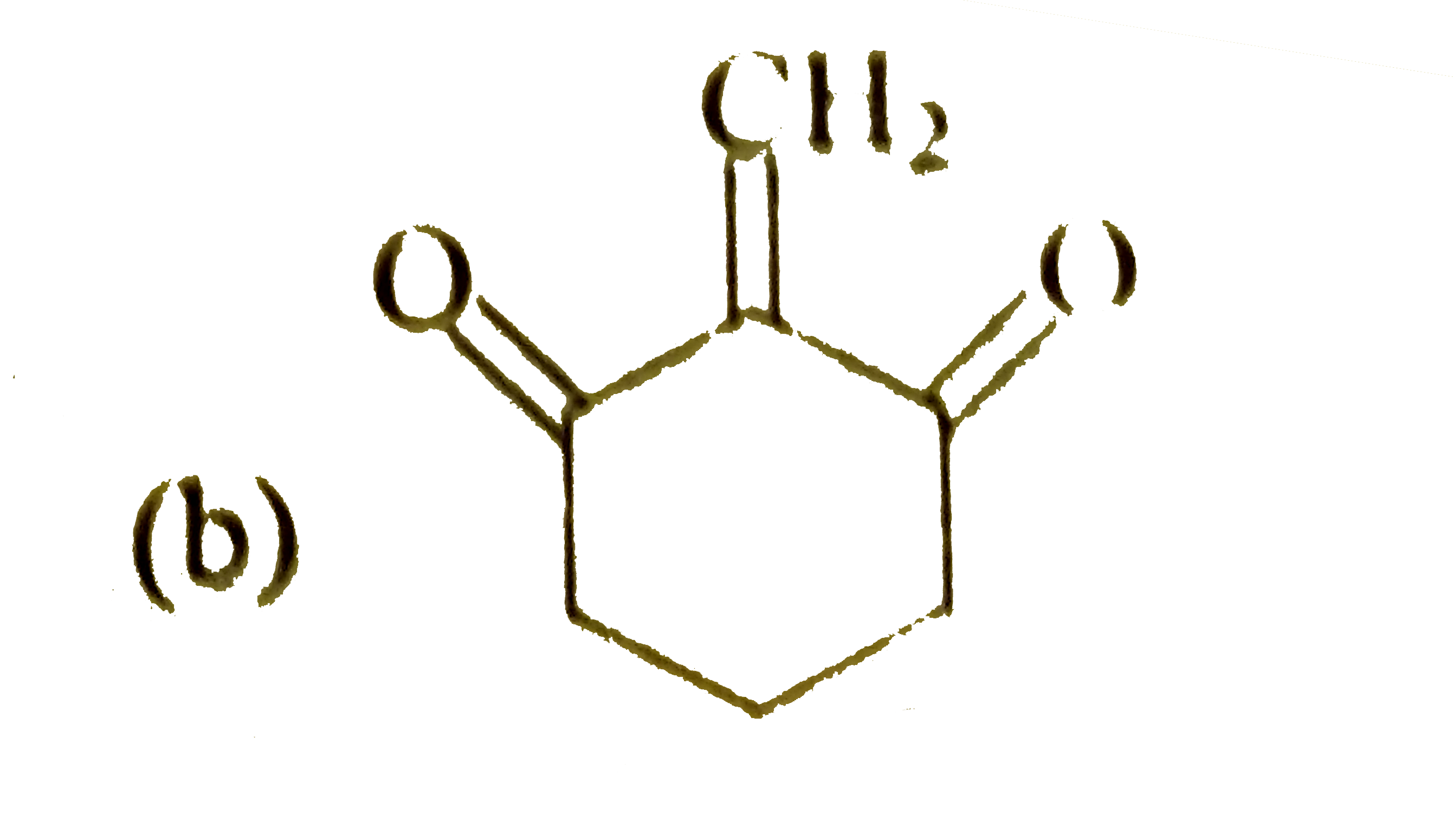
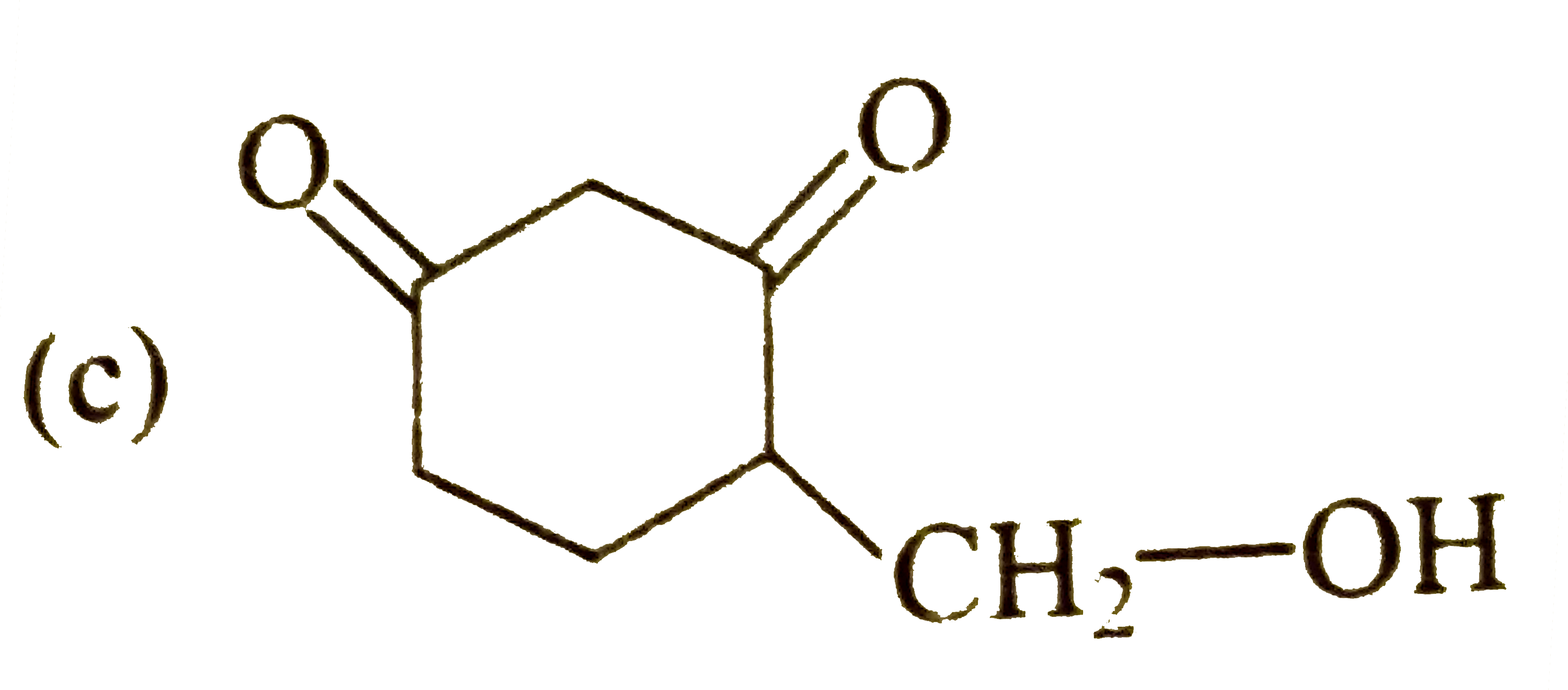
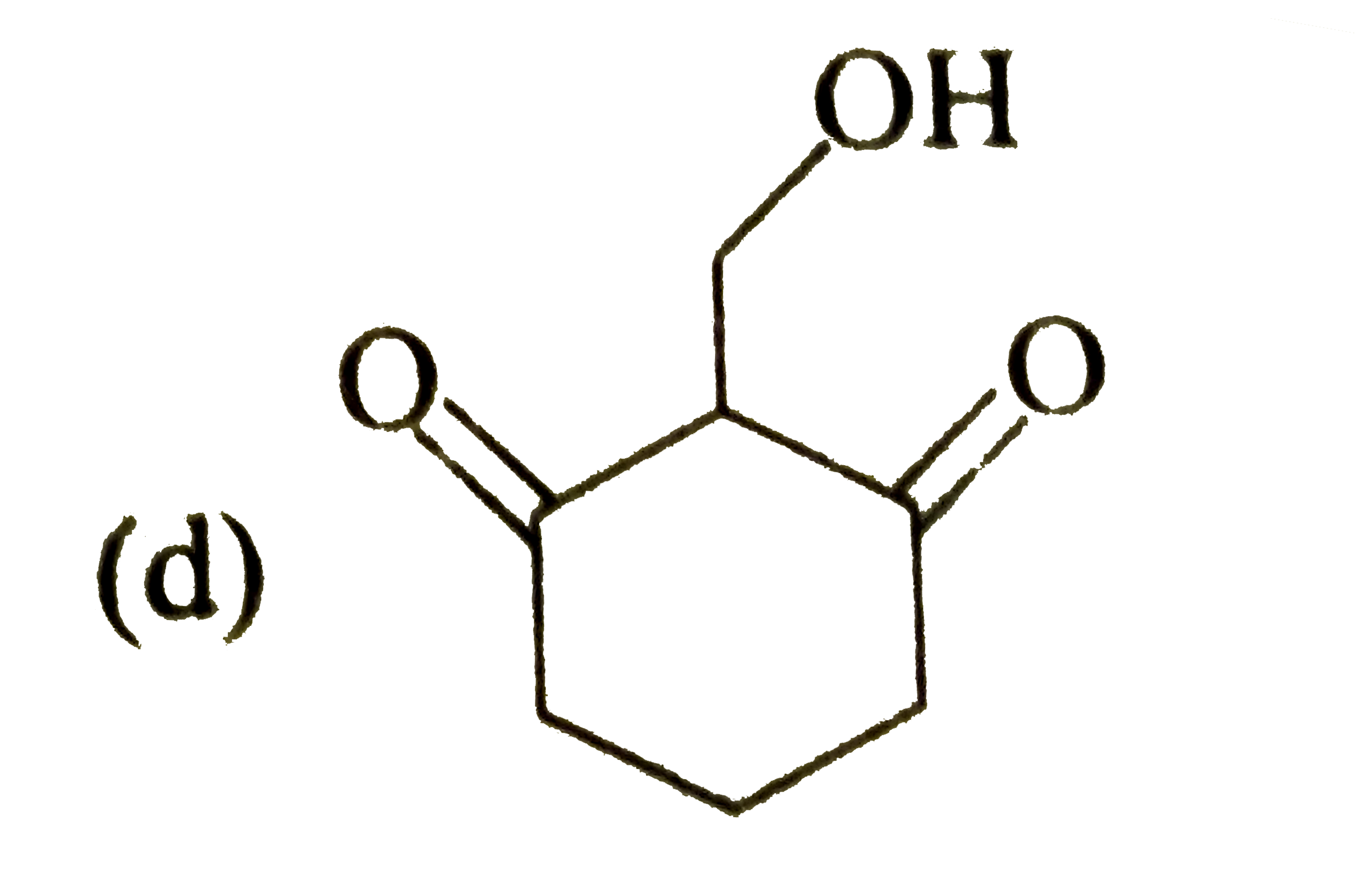
Saved Bookmarks
This section includes 7 InterviewSolutions, each offering curated multiple-choice questions to sharpen your Current Affairs knowledge and support exam preparation. Choose a topic below to get started.
| 1. |
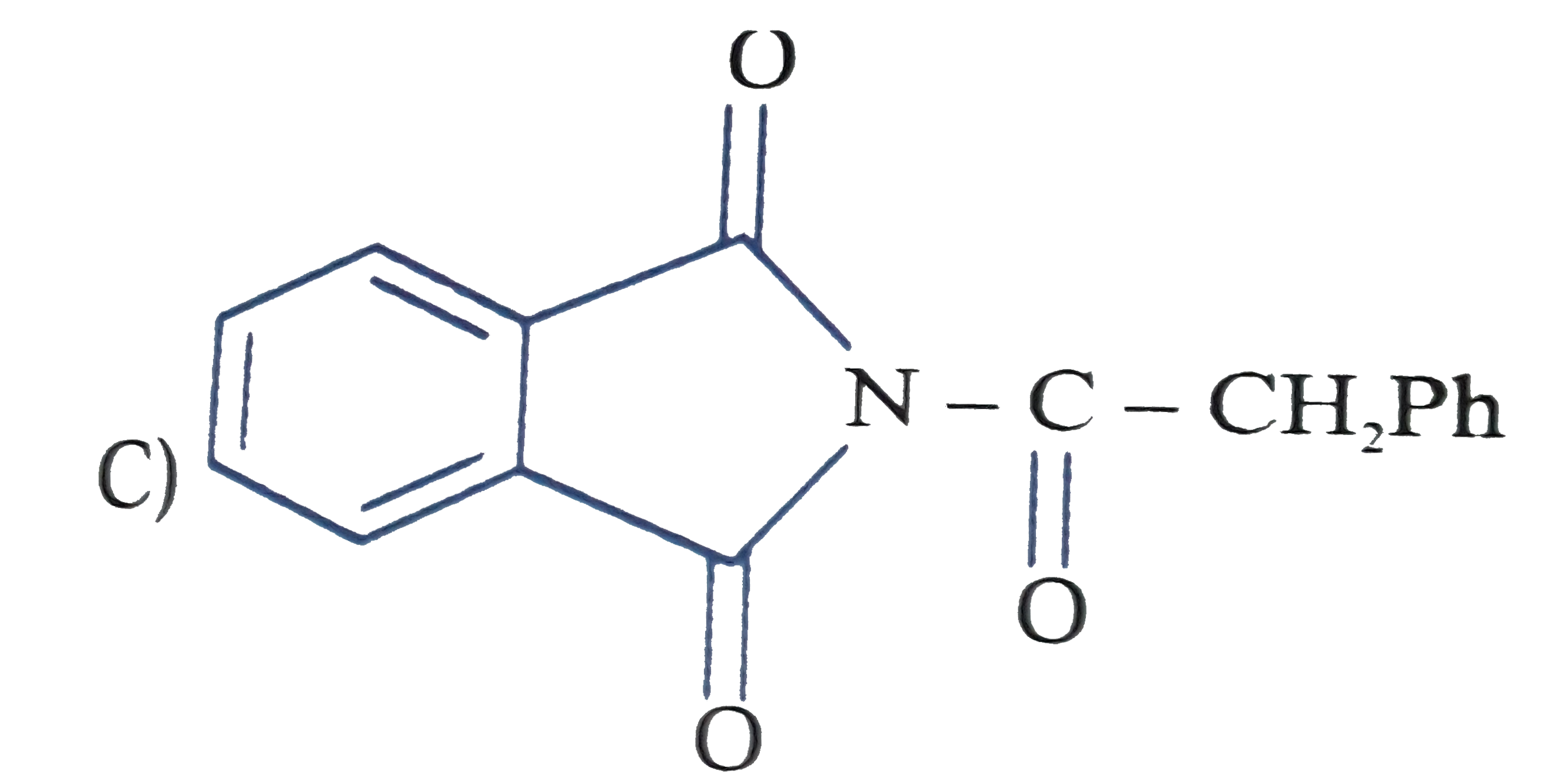
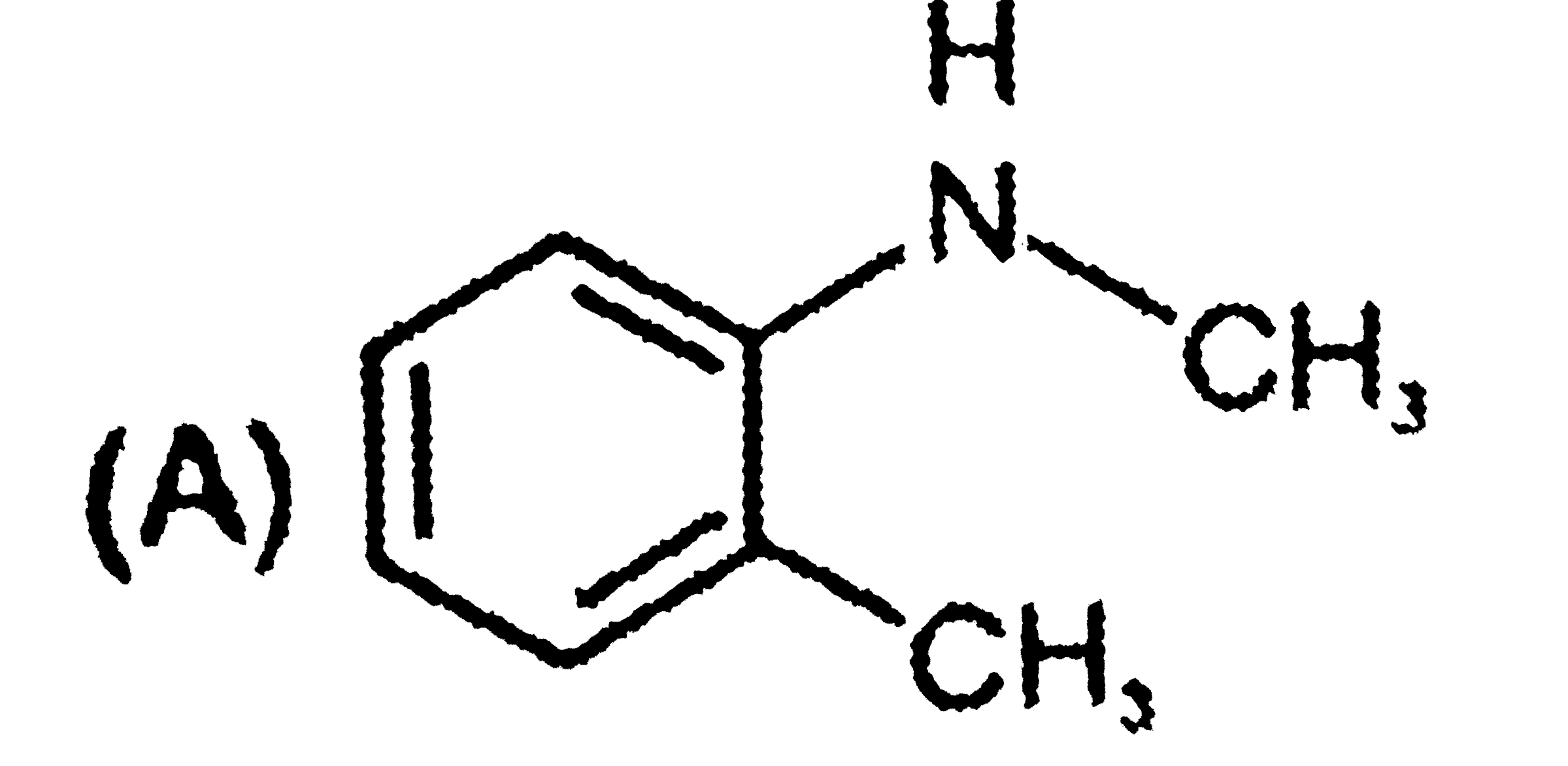
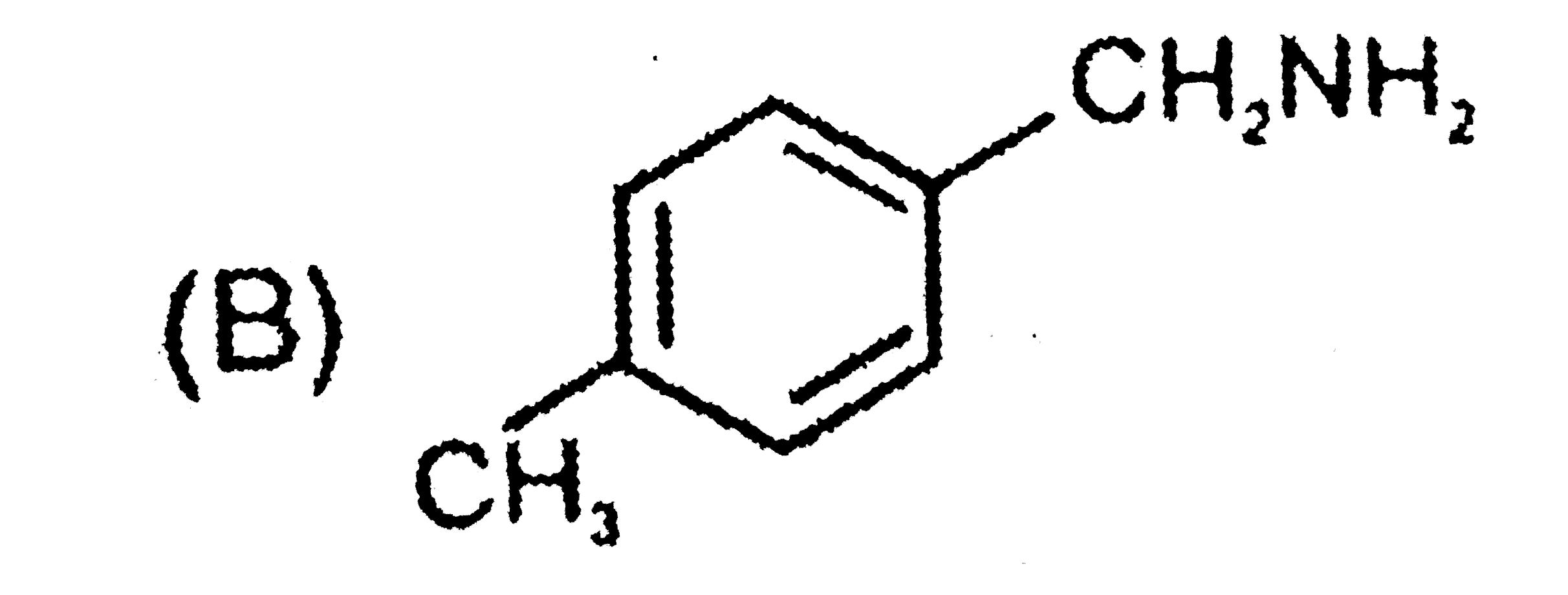
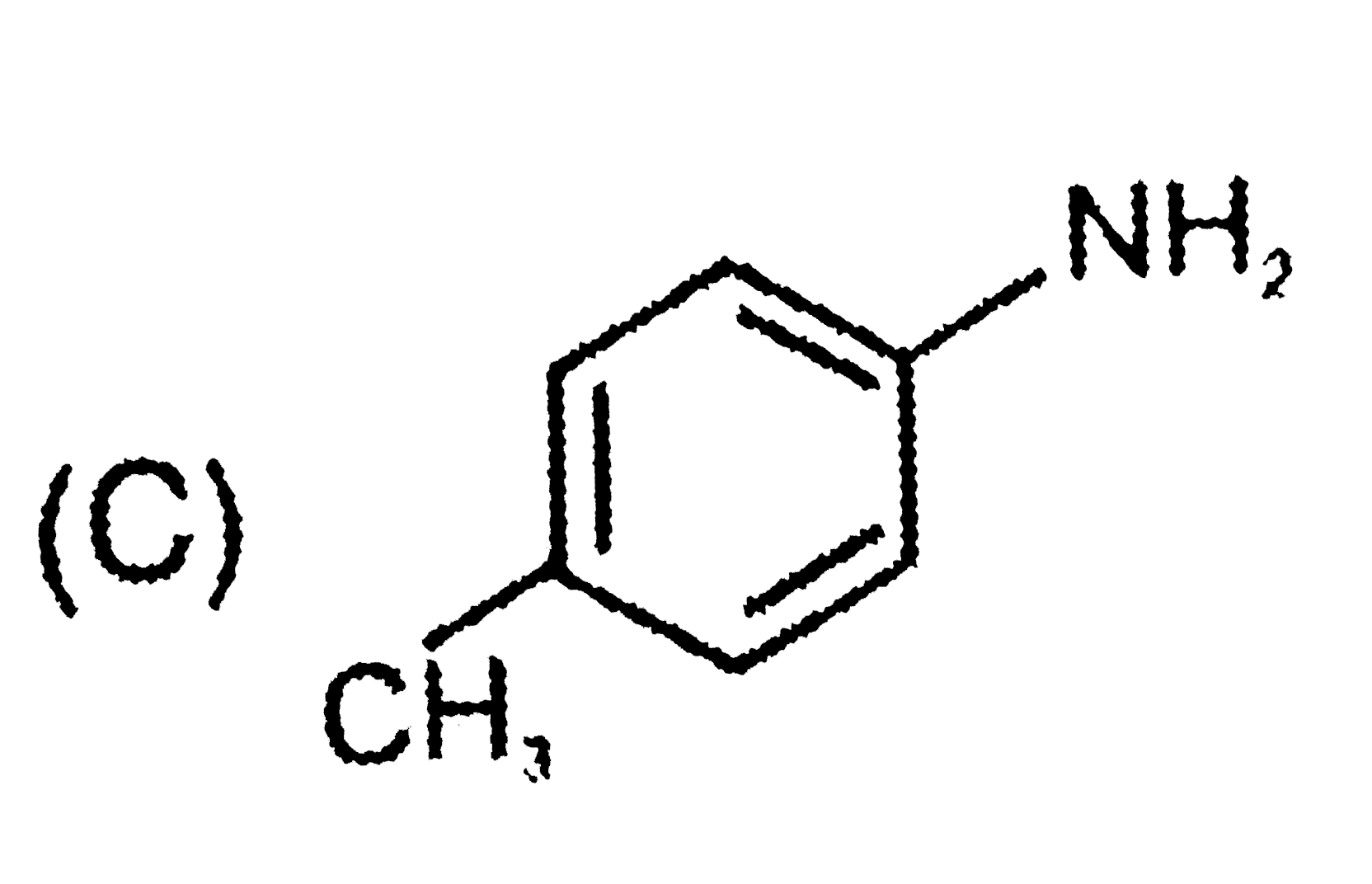
An organic compound (A) C_(6)H_(12)O_(3) on treatment with concentrated H_(2)SO_(4) gives CO, H_(2)O and (B). Compound (B) can be prepared by passing vapours of 1-pentanol Over heated copper at 570 K. Compound (A) on heating gives (C), C_(12)H_(20)O_(4). Give the structures of (A) to ( C) with proper reasoning. |
|
Answer» Solution :Compound (B) MUST be pentanol because 1t is PREPARED by passmg vapours of 1-pentanol over HEATED copper `underset("Pentan -1-ol ")(CH_(3)(CH_(2))_(3)CH_(2)OH)underset(570 K)overset(Cu)tounderset("Pentanal")(CH_(3)(CH_(2))_(3)-CHO+H_(2)O)` Compound (A) gives `CO_(2)` and `H_(2)O` on treatment with conc. `H_(2)SO_(4)`. Thus, compound (A) must be`alpha` -hydroxy acid 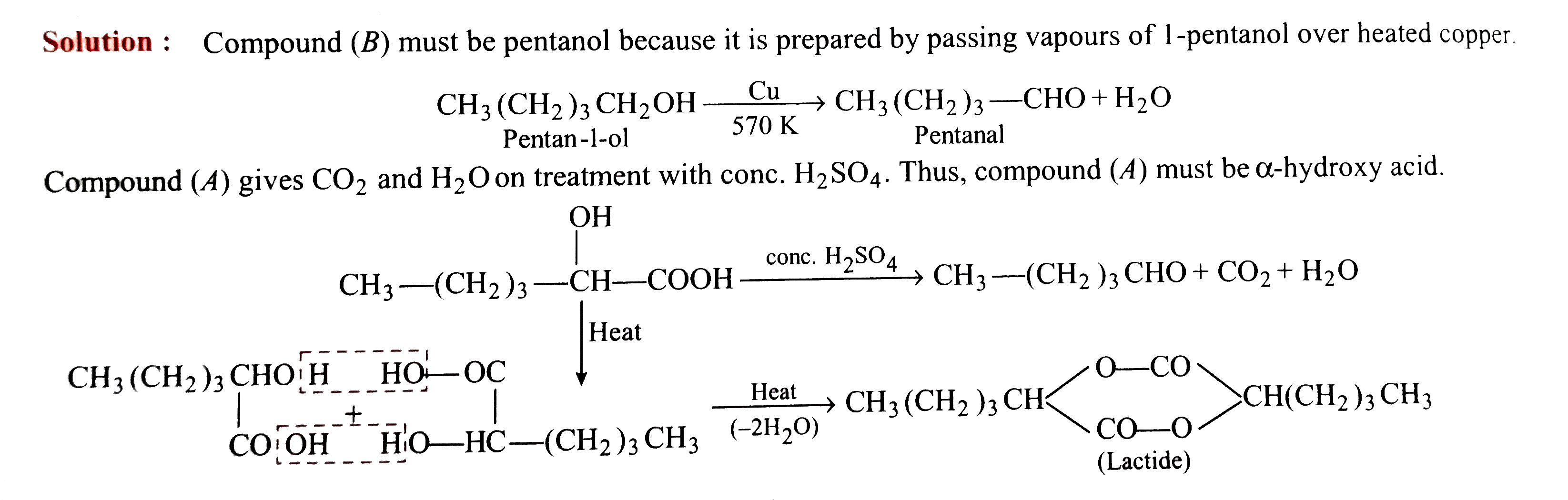
|
|
| 2. |
An organic compound (A) (C_(6)H_(6)O) gives maximum of two isomers (B) and ( C), When an alkaline solution of (A) is refluxed with chloroform. (B) on oxidation gives acid (D). The acid (D) is also obtained by treating. Sodium salt of (A) with CO_(2) under pressure followed by hydrolysis, Identify the compounds (A), (B), (C) and (D) and explains with proper chemical reactions. |
Answer» SOLUTION :(i) When ALKALINE solution of (A) is refluxed with chloroform, isomers (B) and (C ) are obtained.  (ii) (B) on OXIDATION GIVES ACID (D).  (iii) The acid (D) is also obtained by treating, sodium salt of (A) witih `CO_(2)` under pressure followed by hydrolysis. 
|
|
| 3. |
An organic compound A (C_(6)H_(12)O) neither decolourise bromine water nor changes the colour of acidic dichromate solution. A on heating with H_(2)SO_(4) produces an alkene which on oxidative ozonolysis gives B (C_(6)H_(10)O_(3)), which gives a yellow precipitate with NaOH//l_(2). The most probable structure of A is |
|
Answer»
|
|
| 4. |
An organic compound (A) C_(5)H_(7)OC l reacts rapidly with ethanol to give (B) C_(7)H_(12)O_(2). (A) also reacts with water to produce acid which reacs with Br_(2) to give C_(5)H_(8)Br_(2)O_(2). 'B' on boiling with aqueous H_(2)SO_(4) formed an acid (C). when (C) is oxidized with KMnO_(4) to an acid (D) C_(4)H_(6)O_(3) and CO_(2) gas are produced. on mild heating, 'D' gives E. E cannot reduce Tollen's reagent. calculate the molecular weight of E. |
|
Answer» |
|
| 5. |
An organic compound (A) C_(5)H_(10)O_(2) reacts with Br_(2) in presence of phosphorus to give (B). Compound (B) contains an asymmetric carbon atom and yields (C) on dehydrobromination compound (C) does not show geometrical isomerism and on decarboxylation gives an alkene (D) which on ozonolysis gives E and F. Compound (E) gives positive Schiff test but (F) does not. |
|
Answer»
|
|
| 6. |
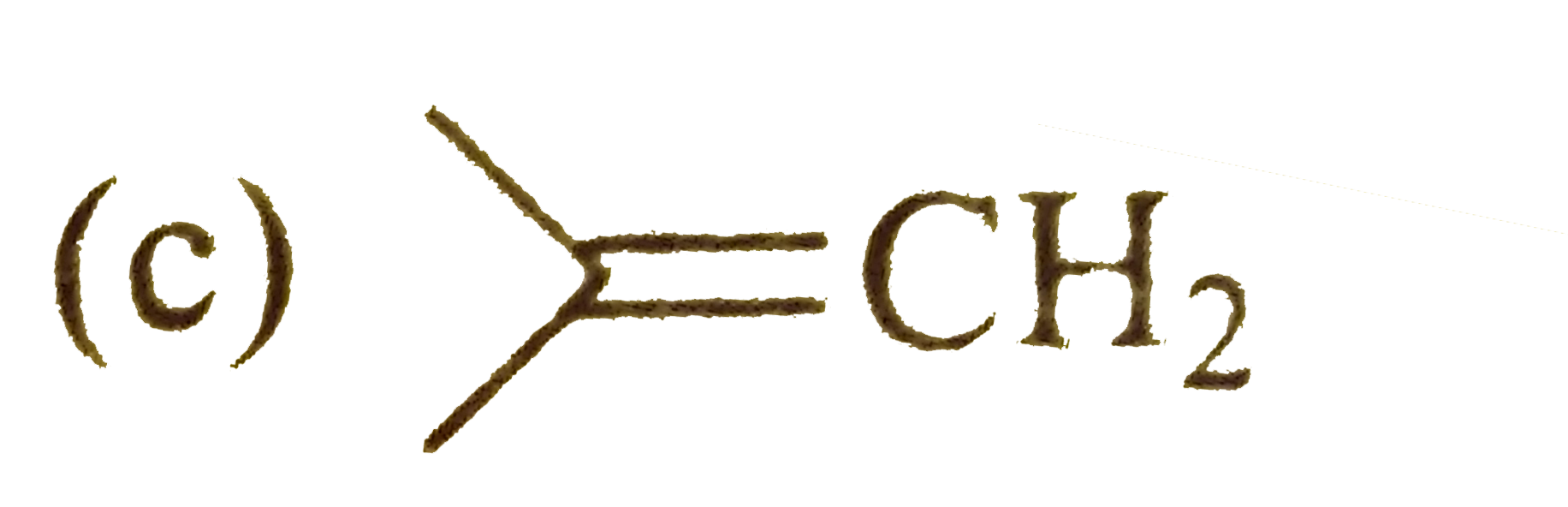
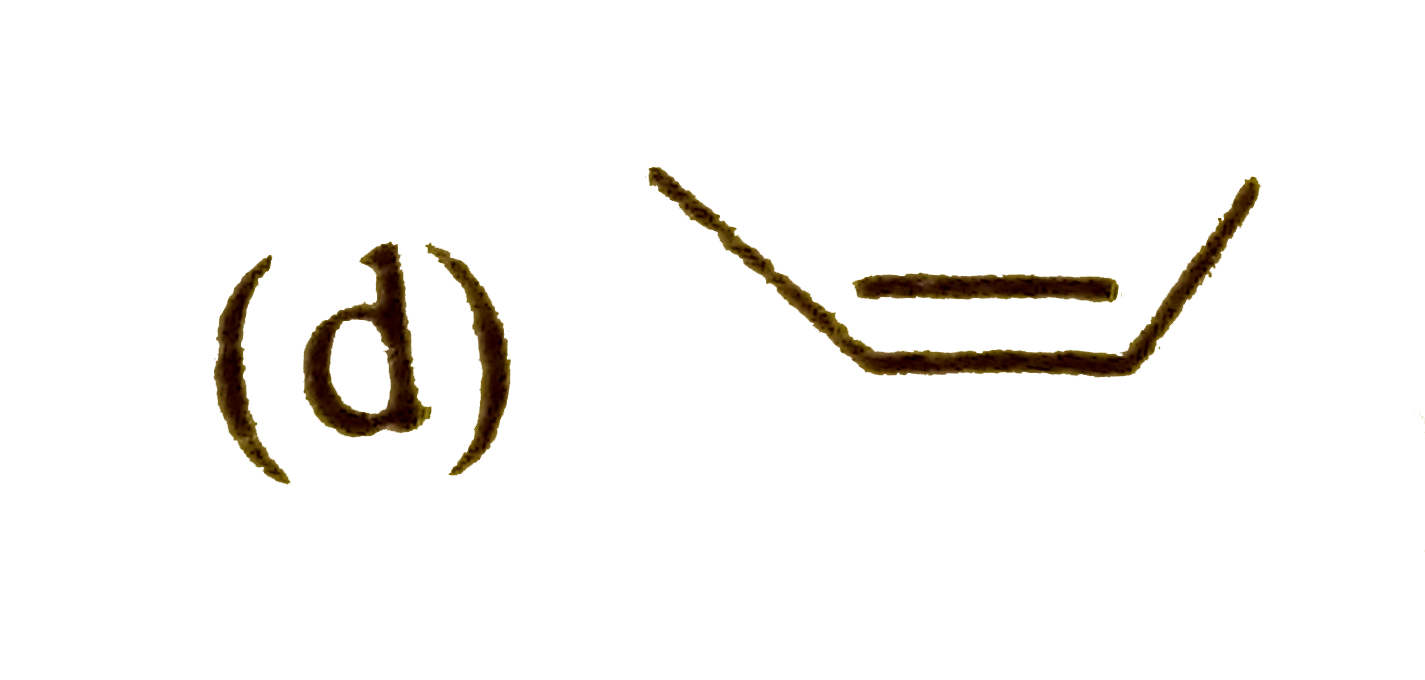
An organic compound (A) C_(5)H_(10)O_(2) reacts with Br_(2) in presence of phosphorus to give (B). Compound (B) contains an asymmetric carbon atom and yields (C) on dehydrobromination compound (C) does not show geometrical isomerism and on decarboxylation gives an alkene (D) which on ozonolysis gives E and F. Compound (E) gives positive Schiff test but (F) does not. Find out structure of D : |
|
Answer»
|
|
| 7. |
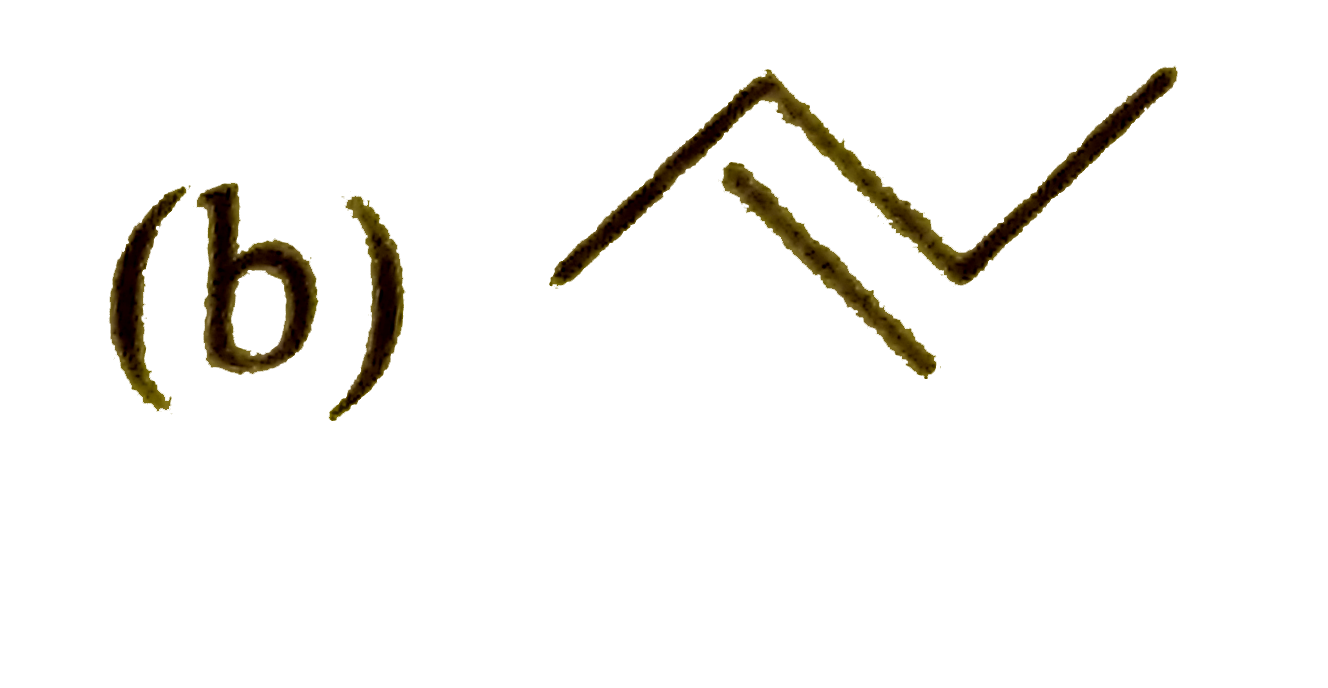
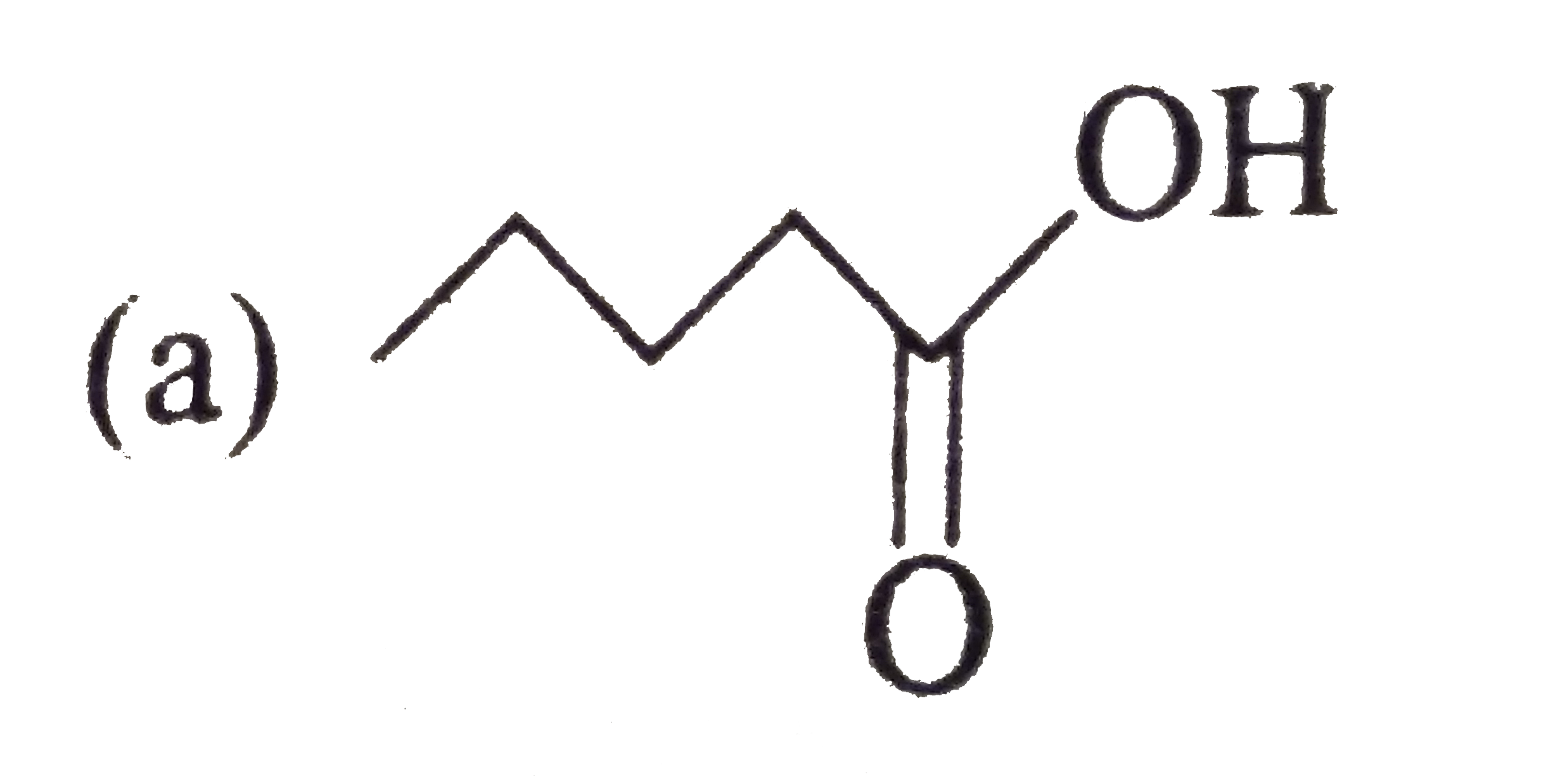
An organic compound (A) C_(5)H_(10)O_(2) reacts with Br_(2) in presence of phosphorus to give (B). Compound (B) contains an asymmetric carbon atom and yields (C) on dehydrobromination compound (C) does not show geometrical isomerism and on decarboxylation gives an alkene (D) which on ozonolysis gives E and F. Compound (E) gives positive Schiff test but (F) does not. Identify correct structure of A: |
|
Answer»
|
|
| 8. |
An organic compound A (C_(4)H_(9)Cl) on reactionwith Na/diethyl ether givesahydrocarbonwhich on monochlorination gives onlyonechloro derivative, then A is |
|
Answer» tert-butyl chloride 
|
|
| 9. |
An organic compound (A) , C_(4)H_(8)Cl_(2) on hydrolysis forms another compound (B) , C_(4)H_(8)O. If the compound (B) responds positively to iodo form test , then identify (A) and (B). |
|
Answer» Solution :`UNDERSET(C_(4)H_(8)Cl_(2))(A) overset(KOH(aq))to underset(C_(4)H_(8)O)(B)underset(I_(2))overset(NAOH)toCHI_(3)` `rArr`(B) is a methyl ketone since it RESPONDS positively to iodoform TEST. Hence (B) is `CH_(3)-overset(O)overset(||)C-CH_(2)CH_(3)` Clearly (A) will be `CH_(3)-underset(Cl)underset(|)overset(Cl)overset(|)C-CH_(2)-CH_(3)` |
|
| 10. |
An organic compound (A) , C_(4)H_(8)Cl_(2) on hydrolysis forms another compound (B) , C_(4)H_(8)O. If (B) does not responds to iodo form test , then identify possible structures of (A) and (B). |
|
Answer» Solution :If (B) does not GIVE iodoform TEST , it can be an aldehyde. Hence (B) may be : `CH_(3)CH_(2)CH_(2)CHO "or" CH_(3)UNDERSET(CH_(3))underset(|)CH-CHO` Accordingly (A) will be : `CH_(3)CH_(2)CH_(2)underset(Cl)underset(|)CH-Cl underset(KOH)overset(aq.)toCH_(3)CH_(2)CH_(2)CHO` or `(CH_(3))_(2)CH-underset(Cl)underset(|)CH-Cl underset(KOH)overset(aq.)to(CH_(3))_(2)CH- CHO` |
|
| 11. |
An organic compound (A) , C_(4)H_(8)Cl_(2) on hydrolysis forms another compound (B) , C_(4)H_(8)O. If all possible structures of (B) visualised above in (a) and (b) are treated with Zn - Hg/HCl , what are the products ? |
|
Answer» SOLUTION :The possible STRUCTURE of B and their reduction products with Zn - Hg/HCL (Clemmenson's reduction) are: `CH_(3)-overset(O)overset(||)C-CH_(2)CH_(3)underset(HCl)overset(Zn - Hg)to CH_(3)CH_(2)CH_(2)CH_(3)` `CH_(3)CH_(2)CH_(2)CHO underset(HCl)overset(Zn - Hg)to CH_(3)CH_(2)CH_(2)CH_(3)` `CH_(3)-underset(CH_(3))underset(|)CH- CHO underset(HCl)overset(Zn - Hg)to CH_(3)-underset(CH_(3))underset(|)CH-CH_(3)` |
|
| 12. |
An Organic compound (A) C_(4)H_(7)Cl_(3) yields (B) with KOH(aq.) (B) on treating with NH_(3) gives (C) which on heating gives (D). On heating (D) with P_(2)O_(5), 2-methyl propane nitrile is formed. What are (A), (B), (C) and (D)? |
| Answer» SOLUTION :(A) `(CH_(3))_(2)CH"CC"l_(3)`, (B) `(CH_(3))_(2)CHCOOH`, (C) `(CH_(3))_(2)CHCOONH_(4)`, (D) `(CH_(3))_(2) CHCONH_(2)` | |
| 13. |
An organic compound A ,C_(4)H_(4)O_(3) in dry benzene in the presence of anhydrous AlCl_3 gives compound B. the compound B on treatment with PCl_(5), followed by reaction with H_(2)//Pd(BaSO_(4)) gives compound C, which one reaction with hydrazine gives a cyclised compound D (C_(10)H_(10)N_(2)) . identifyA,B,C and D. Explain the formation of D from c. |
Answer» 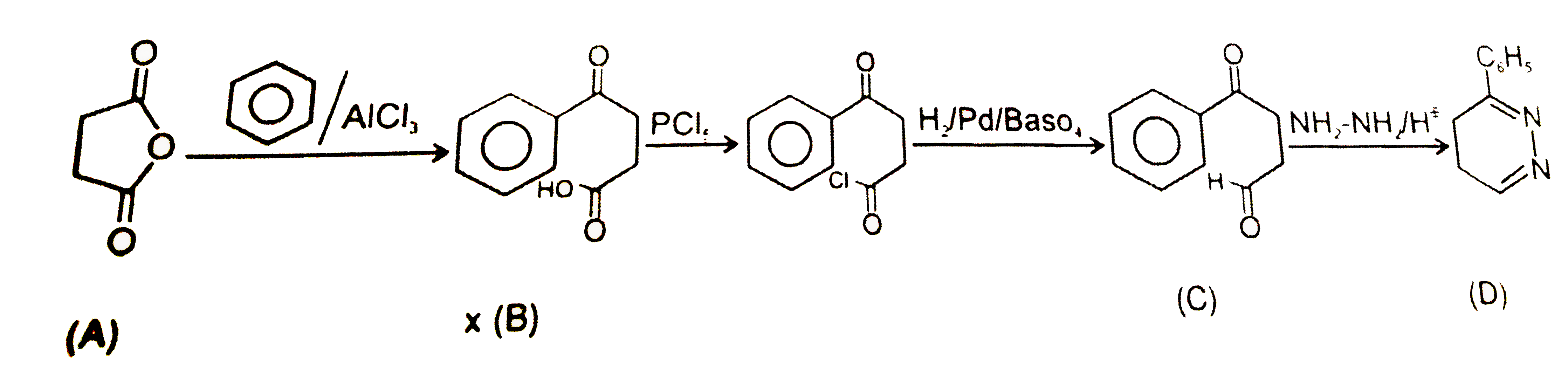
|
|
| 14. |
An organic compound (A) C_(3)H_(8)O answers Lucas test within 5-10 minutes andon oxidation forms B (C_(3)H_(6)O). This on further oxidation forms C(C_(2)H_(4)O_(2)) which gives effevescence with Na_(2)CO_(3) also undergoes iodoform reaction. Identify A, B, and C. Explain the conversion of A to B and C. |
|
Answer» Solution :(i) Isopropyl ALCOHOL (A). (ii) (B) on oxidation GIVES (B). `underset((A))underset(OH)underset(|)(CH_(3)-CH-CH_(2)) overset(O) to underset((B))underset(O)underset(||)C-CH_(3)` (B) on further oxidation gives (C ) whichgives brisk efferescence with `Na_(2)CO_(3)`. `CH_(3)-underset(B)underset(O)underset(||)C-CH_(3) + I_(2) + KOH to CHI_(3) + CH_(3)COOH` 
|
|
| 15. |
An organic compound (A) C_(3)H_(8)O answers Lucas test within 5-10 min and on oxidation forms (B) C_(3)H_(6)O. (B) on further oxidation forms ( C) C_(2)H_(4)O_(2) which gives effervescence with NaHCO_(3) (B) also undergoes iodoform reactions. Identify A, B and C. Explain the reactions involved. |
|
Answer» Solution :(i) Compound (A) `C_(3)H_(8)O)` ANSWERS Lucas test within 5-10 MIN is at `2^(@)`- alcohol. `UNDERSET((A))(CH_(3)-overset(CH_(3))overset(|)(CH)-OH` - Isopropyl alcohol (ii) Compound (A) on oxidation gives (B) `C_(3)H_(6)O`. `CH_(3)-underset(H)underset(|)overset(CH_(3))overset(|)C-underset(H)underset(|)O + (O) overset(-H_(2)O) to CH_(3) -underset(B)overset(CH_(3))overset(|)C-O` (iii) Compound (B) on further oxidation gives ( C) `C_(2)H_(4)O_(2)`. `H_(3)C -overset(CH_(3))overset(|)C=O overset((O)) to underset((C)) (CH_(3)COOH)` (iv) Compound (B) undergoes iodoform reactions. `CH_(3)-overset(CH_(3))overset(|)(CH) -OH overset(I_(2)//KOH) to CH_(3)COCH_(3) overset(I_(2)) to CI_(3)COCH_(3) overset(KOH) to CHI_(3) + CH_(3)COOK` 
|
|
| 16. |
An organic compound 'A' (C_3H_6O) is resistant to oxidation but forms compound 'B' (C_3H_8O) on reduction. 'B' reacts with HBr to form the compound 'C' .'C' with Mg forms Grignard's reagent 'D' which reacts with 'A' to form a product which on hydrolysis gives 'E'. Identify 'A' to 'E'. |
Answer» SOLUTION :A' MUST be KETONE. 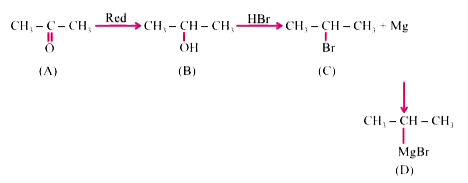 . .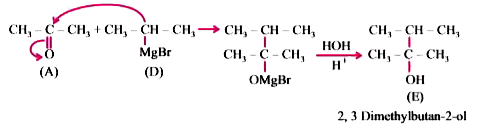 . .
|
|
| 17. |
An organic compound A (C_(2)H_(6)O) reacts with sodium to form a compound B with the evolution of H_(2) and gives a yellow compound C on reacting with iodine and NaOH. When heated with conc. H_(2)SO_(4) at 413 K, it gives a compound D (C_(4)H_(10)O) which on reaction wiht conc. HI at 373 K gives compound E. The compound D is also obtained when B is heated with E. Idntify the compounds A,B,C,D and E write the equations for the reaction involved. |
|
Answer» Solution :(i) The COMPOUND A is an alcohol `(CH_(3)CH_(2)OH)` as it reacts with NA to evolve hydrogen and forms compound B, `(CH_(3)CH_(2)ON a)` . It also reacts with `I_(2)` and NaOH to from `C(CHI_(3))` which is yellow. `CH_(3)underset([B])(CH_(2))ONaoverset(Na)underset(-1//2H_(2))larrCH_(3)underset([B])(CH_(2))OHoverset(I_(2)//NaOH)rarrunderset([C])(CHI_(3))` (ii) Upon heating A with concentrated `H_(2)SO_(4)` at 413 K , diethyl ether [D] is formed which reacts WIHT HI to from E `(C_(2)H_(5)I)` `2CH_(3)underset([A])(CH_(2))OHoverset("Conc".H_(2)SO_(4)//413 K)rarrCH_(3)CH_(2)-underset([D])(O)-CH_(2)CH_(3)overset(2HI)rarr2CH_(3)underset([E])(CH_(2)I)` (iii) According to the data, `C_(2)H_(5)ONa` [B] reacts with `CH_(3)CH_(2)I`[E] to from `CH_(3)CH_(2)OCH_(2)CH_(3)[D]` `CH_(3)CH_(2)underset([B])(O)Na+ICH_(2)underset([E])(CH_(2))CH_(3)rarrCH_(3)CH_(2)underset([D])(-)O-CH_(2)CH_(3)` |
|
| 18. |
An organic compound A (C_3H_6O) is resistant to oxidation but forms a compound B (C_3H_8O) on reduction. B reacts with HBr to form a bromide C which on treatment with alcoholic KOH forms an alkene D (C_3H_6). Deduce the structures of A to D by giving chemical reactions. |
Answer» SOLUTION :)
|
|
| 19. |
An organic compound A (C_(2)H_(6)O) liberates hydrogen with sodium metal. A when heated with alumina at 620 K gives an alkene. B which when passed through Bayer's reagent gives C(C_(2)H_(6)O_(2)). C reacts with PI_(3) and gives back B. Identify A,B and C. Write the reactions. |
|
Answer» Solution :(i) An organic compound `A (C_(2)H_(6)O))` liberates hydrogen with sodium metal. `underset(A)(2C_(2)H_(5)OH) + 2Na to 2C_(2)H_(5)O"Na" + H_(2)` (ii) A when heated with alumina at 620 K gives an ALKENE B which when passed through Bayer's reagent gives `C(C_(2)H_(6)O_(2))`. `underset(A)(C_(2)H_(5)OH) overset(Al_(2)O_(3))underset(620 K) to underset((B))(CH_(2)=CH_(2))` `CH_(2)=CH_(2) + H_(2)O + (O) overset("Cold DILL alkaline" KMnO_(4))underset("Baeyer's Reagent") to underset((C))underset(CH_(2)OH)underset(|)overset(CH_(2)OH)` (iii) (C) reacts with `PI_(3)` and gives back B. Identify A, B and C. Write the REACTIONS. `underset(CH_(2)OH)overset(CH_(2)OH)|overset(PI_(2))to underset(CH_(2)I)overset(CH_(2)I)| overset(-I_(2))to underset(CH_(2))overset(CH_(2))(||)` 
|
|
| 20. |
An organic compound (A) C_(2)H_(6)O react with sodium metal to form compound (B) with evolution of H_(2) gas give yellow compound (C) with alkaline iodine. When (A) is heated with conc. H_(2) SO_(4) at 413K gives a compound (D) C_(4) H_(10) O. Which treatment with conc. HI at 373 K gives (E). The compound ( D) also obtained when (B) is heated with (E). Identify compound(E). |
|
Answer» `CH_(3)CH_(2)OH` |
|
| 21. |
An organic compound (A), C_(2)H_(5)NO_(2) gives on reduction another compound (B) C_(2)H_(7)N. The reaction of nitrous acid on (B) evolves nitrogen and gives another compound (C) C_(2)H_(6)O. The compound (C) on oxidation gives acetic acid. The compounds A, B, C are |
|
Answer» NITROETHANE, ETHYLAMINE, ETHYL alcohol |
|
| 22. |
An organic compound (A) C_(2)H_(6)O liberates hydrogen on treatment with metallic sodium. (A) on mid oxidation gives (B) C_(2)H_(4)O which answers iodoform test. (B) treated with conc. H_(2)SO_(4) undergoes polymerisation to give (C ), a cyclic compound. Identify (A), (B) and(C) and explain the reactions. |
|
Answer» Solution :(i) `2CH_(2)H_(5)OH + 2Na to 2C_(2)H_(5)Ona + H_(2) darr` (ii) ETHYL alcohol on MILD oxidation gives acetaldehyde (B) it answers iodoform TEST. `CH_(3)-underset(A)(CH_(2)OH) overset("Mild"(O)) to underset((B))(CH_(3)CHO + H_(2)O)` `underset(B)(CH_(3)-CHO + 3I_(2)) + NaOH overset(B)underset("Iodoform") to CHI_(3) + HCOONa + 3HI` (iii) Acetaldehyde when treated with Conc. `H_(2)SO_(4)` undergoes polymerisation and the product obtained is paraldehyde (C). `underset((B)) (3CH_(3)CHO overset("conc"H_(2)SO_(4)) to` 
|
|
| 23. |
An organic compound A (C_(2)H_(3)N) on reduction with SnCl_(2)//HCl gives B (C_(2)H_(4)O) which reduces Tollen's reagent. Compound B on reduction with N_(2)H_(4)//C_(2)H_(5)ONa gives C (C_(2)H_(6)). Identify the compound A, B and C. Explain the reactions involved. |
Answer» SOLUTION :(i) An organic compound A `(C_(2)H_(3)N)` on reduction with `SnCl_(2)//HCl` gives B `(C_(2)H_(4)O)` which reduces Tollen's reagent.  (ii) Compound B on reduction with `N_(2)H_(4)//C_(2)H_(5)ONa` gives C `(C_(2)H_(6))`. 
|
|
| 24. |
An organic compound A (C_2H_3N) is used as a solvent of choice for many organic reactions because it is not reactive in mild acidic and basic conditions. Compound A on treatment with Ni//H_2 forms B. When B is treated with nitrous acid at 273K, ethanol is obtained. When B is warmed with chloroform and NaOH, a foul smelling compound C is formed. Identify A to C along with their structures and given reactions. |
Answer» SOLUTION :
|
|
| 25. |
An organic compound 'A' (C_(16)H_(13)O_(2)N) is insoluble in dil cold aqueous alkali but on warming gives a clear solution. ‘A’ when treated with dil H_(2)SO_(4) gives B(C_(16)H_(15)O_(2)N) which when boiled with conc. HCl under reflux and cooled, a solid compound C(C_(8)H_(6)O_(4)) is crystallized out. The mother liquor when separated and concentrated gives D(C_(8)H_(12)NCl). Compound ‘D' can be |
|
Answer» `Ph(CH_(2))_(2)NH_(3)^(+)CL^(-)`  
|
|
| 26. |
An organic compound 'A' (C_(16)H_(13)O_(2)N) is insoluble in dil cold aqueous alkali but on warming gives a clear solution. ‘A’ when treated with dil H_(2)SO_(4) gives B(C_(16)H_(15)O_(2)N) which when boiled with conc. HCl under reflux and cooled, a solid compound C(C_(8)H_(6)O_(4)) is crystallized out. The mother liquor when separated and concentrated gives D(C_(8)H_(12)NCl). B overset("Soda lime")underset(Delta)to 'M' product (M) is |
|
Answer»
 
|
|
| 27. |
An organic compound 'A' (C_(16)H_(13)O_(2)N) is insoluble in dil cold aqueous alkali but on warming gives a clear solution. ‘A’ when treated with dil H_(2)SO_(4) gives B(C_(16)H_(15)O_(2)N) which when boiled with conc. HCl under reflux and cooled, a solid compound C(C_(8)H_(6)O_(4)) is crystallized out. The mother liquor when separated and concentrated gives D(C_(8)H_(12)NCl). Structure of compound ‘A’ can be |
|
Answer»
 
|
|
| 28. |
An organic compound 'A' (C_(16) H_(13) O_2 N) is insoluble in dil cold aqueous alkali but on warming gives a clear solution. 'A' when treated with dil H_2 SO_4 gives B(C_(16) H_(15) O_2 N) which when boiled with conc. HCl under reflux and cooled, a solid compound C(C_8 H_6 O_4) is crystallized out. The mother liquor when separated and concentrated gives D(C_8 H_(12) NCl) Compound 'D' can be |
|
Answer» `PH(CH_(2))_(2)NH_(3)^(+)CL^(-)` |
|
| 29. |
An organic compound 'A' (C_(16) H_(13) O_2 N) is insoluble in dil cold aqueous alkali but on warming gives a clear solution. 'A' when treated with dil H_2 SO_4 gives B(C_(16) H_(15) O_2 N) which when boiled with conc. HCl under reflux and cooled, a solid compound C(C_8 H_6 O_4) is crystallized out. The mother liquor when separated and concentrated gives D(C_8 H_(12) NCl) B overset("Soda Lime") underset(Delta) to 'M', product (M) is |
|
Answer»
|
|
| 30. |
An organic compound 'A' (C_(16) H_(13) O_2 N) is insoluble in dil cold aqueous alkali but on warming gives a clear solution. 'A' when treated with dil H_2 SO_4 gives B(C_(16) H_(15) O_2 N) which when boiled with conc. HCl under reflux and cooled, a solid compound C(C_8 H_6 O_4) is crystallized out. The mother liquor when separated and concentrated gives D(C_8 H_(12) NCl) Structure of compound 'A' can be |
|
Answer»
|
|
| 31. |
An organic compound A (C_(12)H_(20)) decolarizes bromine water, and on reductive ozonolysis produces two molecules of B (C_(6)H_(10)O). Compound B on aldol condensation followed by dehydration of product gives C (C_(12)H_(18)O), which on reduction with N_(2)H_(4)//OH_(2) regenerates A. COmpound B on reduction with Zn(Hg)HCl produces D (C_(6)H_(12)), which on monochlorination gives E (C_(6)H_(11)Cl) as the sole product. |
|
Answer»
|
|
| 32. |
An organic compound A (C_(12)H_(20)) decolarizes bromine water, and on reductive ozonolysis produces two molecules of B (C_(6)H_(10)O). Compound B on aldol condensation followed by dehydration of product gives C (C_(12)H_(18)O), which on reduction with N_(2)H_(4)//OH_(2) regenerates A. COmpound B on reduction with Zn(Hg)HCl produces D (C_(6)H_(12)), which on monochlorination gives E (C_(6)H_(11)Cl) as the sole product. Structure of compound is |
|
Answer»
|
|
| 33. |
An organic compound 'A' burns with a sooty flame . It is negative towards Tollen's reagent test and positive for Borsche's reagent test . The compound 'A' is |
|
Answer» Benzaldehyde Negative test toward's Tollen's reagent indicates absence of aldehydes . Positive test for Borsche's reagent test indicates KETONES (possibility of aldehydes being nullified) . So 'A' is an aromatic ketone . |
|
| 34. |
An organic compound 'A' burns with a sooty flame. It is negative towards Tollen's reagent test and positive for Borsche's reagent test. The compound 'A' is |
|
Answer» Benzaldehyde |
|
| 35. |
An organic compound .^(1)CH_(3)-^(2)CH_(3)-^(3)CH_(3)-^(4)CH_(2)-^(5)CH_(2)-^(6)CH_(2)-^(7)CH_(3) To make it chiral compound the attack should be on which carbon atom |
|
Answer» 1 |
|
| 36. |
An organic compoud (A), C_8H_6, on treatment with dilute sulphuric acid containing mercuric sulphate gives a compound (B), which can also be obtained from a reaction of benzene with an acid chloride in the presence of anhydrous aluminium chloride. The compound (B) on reaction with NH_2-NH_2/base, gives (C). |
Answer» SOLUTION :(a) MOLECULAR FORMULA SUGGESTS that (A) is  
|
|
| 37. |
An organic comound weighing 0.15g on Carius estimation gave 0.12g ofAgBr . The percentage of Br in the compound will be close to (At. Mass Ag=108, Br=80) |
|
Answer» `46%` |
|
| 38. |
An organic base (X) reacts with nitrous acid at 0^(@)C to give a clear solution. Heating the solution with KCN and cuprous cyanide followed by continued heating with conc. HCl gives a crystalline solid. Heating this solid with alkaline potassium permanganate gives a compound which dehydrates on heating to a crystalline solid. "X" is : |
|
Answer»
|
|
| 39. |
An organic base X has K_(b) valusequalto 1xx10^(-9) . In what amounts should 0.01 M HCl and 0.01M solutionof X beprepare1 Lof a buffer solution havingpH = 7.0 ? |
|
Answer» Solution :`X + H_(2) O hArr XH^(+) + OH^(-)` `K_(B)=([XH][OH^(-)])/([X]) = 1XX10^(-8)` `pOH = pK_(b) + log ([XH^(+)])/([X])` ` rArr 7 = - log (10^(-8)) + log. ([XH^(+)])/([X])` ` rArr 7 = 8 + log. ([XH^(+)])/([X])` `log.([XH^(-)])/([X]) = -1 ` ` :.([XH^(+)])/ ([X])= 10^(-1)= 0.1 ` |
|
| 40. |
An organic base is tartraacidic. If from every 10 gm of the choloroplatinate salt of the base 3.9 gm of residue of platinum is obtained then what will be the molucular mass of the base [Pt=195] |
|
Answer» 180 `10/M XX 4=1xx3.9/195` M=40 x 50 =2000 M= 40 x 50 =2000 2B+4x 410 =2000 B=180 |
|
| 41. |
An organic aromatic compound 'A' with the molecular formula C_(6)H_(7)N is sparingly soluble in water. 'A' on treatment with dil. HCl gives a water soluble compound 'B'. 'A' also reacts with chloroform in presence of alcoholic KOH to form an obnoxious smelling compound 'C'. 'A' reacts with benzene sulphonyl chloride to form an alkali soluble compound 'D'. 'A' reacts with NaNO_(2) and HCl to form a compound 'E' which on reaction with phenol forms an orange red dye 'F'. Elucidate the structures of the organic compounds from 'A' to 'F' |
Answer» SOLUTION :The STRUCTURES of COMPOUNDS A to F are GIVEN below : 
|
|
| 42. |
An organic aromatic compound (X) containing 52.2% of C, 3.7% of H and 44.1% of chlorine on oxidation with alkaline KMnO_(4) gave a monobasic acid (Y), the sodiumsalt of which on distillation with soda lime gave benzene. What is the structural formula of (X) and (Y) ? |
| Answer» SOLUTION :`(C_(6)H_(5)CH.Cl_(2), C_(6)H_(5)COOH)` | |
| 43. |
An organic amino compound reacts with aqueous nitrous acid at low temperature to produce an oily nitrosoamine. The compound is |
|
Answer» `CH_3NH_2` |
|
| 44. |
An organic acid without a carboxylic acid group is |
|
Answer» PICRIC ACID 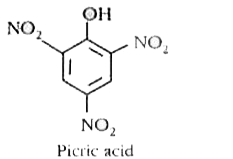 Picric acid has no -COOH GROUP. |
|
| 45. |
An organic acid when heated strongly with P_2O_5, gave rise to a colourless gas which burns with a pale blue flame. The acid is : |
|
Answer» ACETIC ACID |
|
| 46. |
An organic acid was converted into its calcium salt and it was dry distilled . The product formed is formaldehyde. The organic acid is : |
| Answer» Answer :B | |
| 47. |
An organic acid (A) reacts with concentrated oxide (C) and a diatomic oxide (D). When D reacts with chlorine gas a poisonous gas (E) is evolve. This gas with ammonia gives an organic compound (F). Which of the following are true. |
|
Answer» The compound A = `H_(2)C_(2)O_(4)` |
|
| 48. |
An organic acid 'A' (C_(5)H_(10)O_(2))reacts with Br_(2) in presence of phosphorus to produce a resolvable compound, which on dehydrobromination gives an unsaturated acid. The unsaturated acid does not show geometrical isomerism and decarboxylation gives alkene. Alkene on ozonolysis ongives two compounds, one gives positive Schiff's test while the other does not. The organic compound A is : |
|
Answer» `CH_(3)CH_(2)CH_(2)CH_(2)COOH` |
|
| 49. |
An organic acid (A), C_(5)H_(10)O_(2)reacts with Br_(2) in the presence of phosphorusto give (B). Compound (B) contains an asymmetric carbon atom and yields (C ) on dehydrbomination. Compound (C ) does not show geometric isomerism and on decarboxylation gives on alkene (D) which on ozonolysis gives (E) and (F). Compound (E) gives a positive Schiff's test but (F) does not. Give the structures of (A) to (F) with reasons. |
Answer» SOLUTION :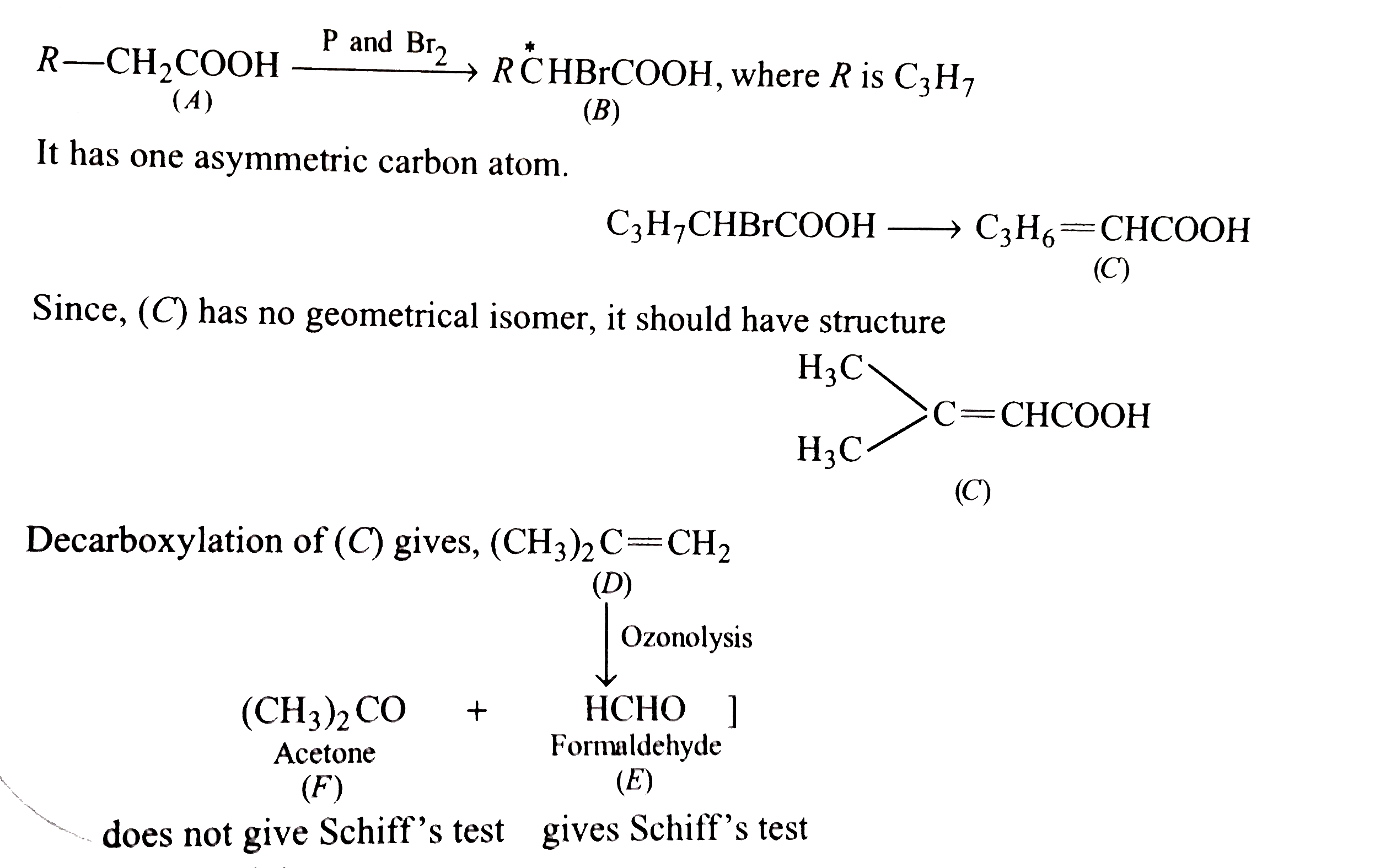
|
|
| 50. |
An organic acid (A), C_(5)H_(10)O_(2) reacts with Br_(2) in the presence of phosphorous to give (B). Compound (B) contains an asymmetric carbon atom and yield (C) on dehydrabromination. Compound (C) does not show geometric isomerism and on decarboxylation give an alkene (D) which on ozonolysis gives (E) and (F), compound (E) gives a positive schiff's test but (F) does not. Give structures of (A) to (F) with reasons. |
|
Answer» |
|