

Saved Bookmarks
| 1. |
An organic compound 'A' having molecular formula C_(4)H_(10)O does not react with sodium metal. On hydrolysis with dilute H_(2)SO_(4) It gives only one organic compound 'B' . The compound B on heating with red phosphours and iodine gives compound 'C'. The compound C can also beobtained from compound 'A' on heating with excess HI. Identify the compounds A, B and C. |
|
Answer» SOLUTION :(1) The organic COMPOUND'A' with molecular formula `C_(4)H_(10)O` maybe an alcohol or ether. (2) Since 'A' does not react with sodium (Na), It is not react with sodium (Na), it is not an alcohol . Hence 'A' may be an ether. (3) Sincean ether 'A' on hydrolysiswith dilute `H_(2)SO_(4)` givesonly one compound 'B', the compound 'A" must be a symmetrical (simple) ether. Hence compound 'A' may be, `C_(2)H_(5) - O - C_(2)H_(5)`. `underset((A))underset("diethyl ether")(C_(2)H_(5)-O-C_(2)H_(5))+H_(2)Ooverset("dil." H_(2)SO_(4))underset("HEAT, pressure")rarrunderset((B))underset("ethyl alcohol")(2C_(2)H_(5)-OH)` (4) `underset((B))underset("ethyl alcohol")(3C_(2)H_(5)-OH+PI_(3))overset("red" P + I_(3))underset(Delta)rarrunderset((C))underset("ethyl iodide")(3C_(2)H_(5)-I)+underset("phosphorus acid")(H_(3)PO_(3))` 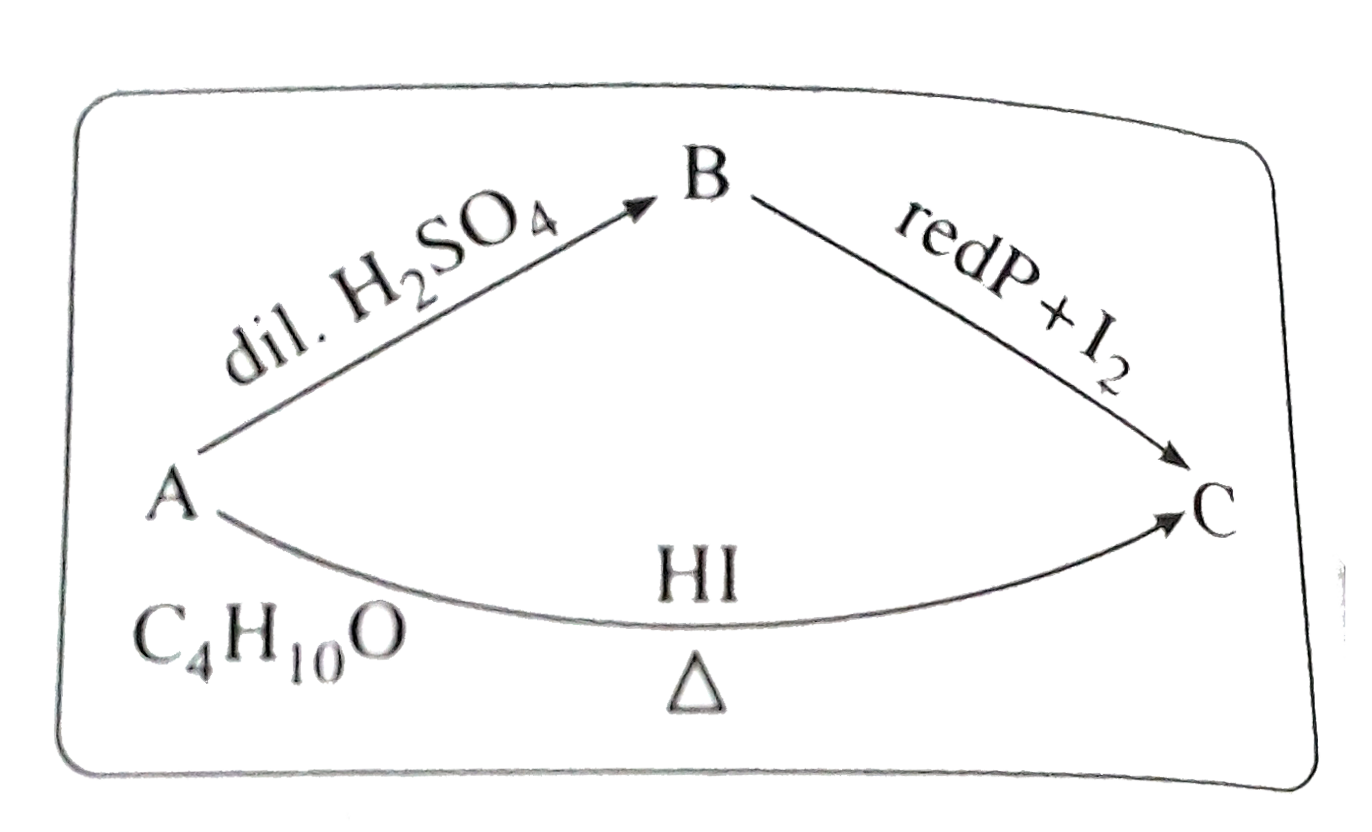
|
|