

Saved Bookmarks
This section includes 7 InterviewSolutions, each offering curated multiple-choice questions to sharpen your Current Affairs knowledge and support exam preparation. Choose a topic below to get started.
| 1. |
Calculate the vapour pressure of a 0.1 M urea solution at 298 K. The vapour pressure of pure water at 298 K is 20 mm hg. Assume density of solution tobe 1g mL^(-1) |
|
Answer» `"Mass of 1000 mL urea solution"=Vxxd=(1000mL)XX(1g mL^(-1))=1000 g` `"Mass of 0.1 mole of urea"=(0.1 mol)xx(60 g mol^(-1))=6G` `"Mass of water"(n_(A))=((994g))/((18 g mol^(-1)))=55.22 mol` `"Mole fraction os water"(x_(A)) =((55.22 mol))/((55.22 mol+0.1 mol))=0.998` `Vapour pressure of solution (P)=P_(A)^(@)X_(A)=(200mm)xx(0.998)-199.6 mm Hg`. |
|
| 2. |
Calculate the vapour pressure at 295 K of a 0.1 M solution of urea. The density of the solution may be taken as 1g//cm^(3). The vapour pressure of pure wa ter at 295 K is 20 mm. |
|
Answer» |
|
| 3. |
Calculate the van't Hoff factor of CdSO_(4) (molecular mass 208.4) if the dissolution of 5.21 g of CdSO_(4) in half litre water gives a depression in freezing point of 0.168^(@)C (K_(f) of water is "1.86 K kg mol"^(-1)) |
|
Answer» `DeltaT_(f)"(calculated)"=K_(f)xxm=1.86xx0.05=0.093` `DeltaT_(f)"(OBSERVED)"=0.168^(@)C""therefore""i=(0.168)/(0.093)=1.806""("orapply "DeltaT_(f)=eK_(f)m)` |
|
| 4. |
Calculate the Van't Hoff factor (i) for the following if: i.100% ionization or association takes place b.50% ionization or association takes place a.S ,b.Se , c.Te , d.P e.As , f.Sb , g.B , h.AlCl_(3) i. Hg_(2)Cl_(2) , j.HgCl_(2) , k.Be_(2)C , l.Al_(4)C_(3) m.CaC_(2) , n. Mg_(2)C_(3) |
|
Answer» Solution :i. `(a,b,c)` `S`,`Se`,and `Te` exist as `S_(8)`,`Se_(8)` and `Te_(8)` molecules. So association TAKES place. `8S hArr S_(8) hArr Se_(8), 8Te hArr Te_(8)` `i=1/8` `(d,e,f)` `P`,`As`and `Sb` exist as `P_(4)`,`As_(4)` and `Sb_(4)` molecules, so association takes place. `4P hArr P_(4), 4As hArr As_(4), 4Sb hArr Sb_(4)` `i=1/4` g. `B` exists as `B_(12)` molecule (icosahendron structure, 12 corners, and 20 faces), association takes place. `12 B hArr B_(12)` `i=1/12` h. `AlCl_(3)` exists as dimer in non-polar solvent, so association takes place. `2AlCl_(3) hArr Al_(2)Cl_(6)` `i=1/2` i. `Hg_(2)Cl_(2)` (calomel) ionizes to give `Hg_(2)^(2+)` (mercurous ion)and `2Cl^(ө)`(So, i=3)`Hg_(2)Cl_(2) hArr Hg_(2)^(+) + 2Cl^(ɵ)` (So, i = 3) J. `HgCl_(2)` (corrosive sublimate)is a covalent compound and does not ionize. (So i=1). `HgCl_(2)` is POISONOUS and antidote is white of an egg. (k,l) `Be_(2)C` and `Al_(4)C_(3)` in `H_(2)O` gives `CH_(4)` gas, so it contains `C^(4-)` methinide ion. `Be_(2) C + 4H_(2) O hArr 2Be (OH)_(2) + CH_(4)` `Al_(4)C_(3) + 12 H_(2)O hArr 4Al (OH)_(3) + CH_(4)` Hence, `Be_(2)C` and `Al_(4)C_(3)` ionizes in solution as follows: `Br_(2)ChArr 2Be^(2+) + C^(4-) (i = 3)` `Al_(4)C_(3) hArr 4Al^(3+) + 3 C^(4-) (i = 7)` m.`CaC_(2)` given `(CH -= CH)` gas with `H_(2)O`. So it contains `(C^(ɵ) -= -= C^(ɵ) "or" C_(2)^(2-) "ion")` `CaC_(2) + 2 H_(2) O hArr Ca(OH)_(2) + CH -= CH` So `CaC_(2)` ionizes in solution as follows : n. `Mg_(2)C_(3)` gives `(CH_(3) - C -= -= CH)` gas with `H_(2)O` so, it contains `CH_(3) C -= -= C^(ɵ) "or" C_(3)^(4-) "ions")` `Mg_(2)C_(3) + 4H_(2) O hArr 2Mg(OH)_(2) + CH_(3) - C -= -= CH` `Mg_(2) C_(3)` ionizes in solution as follows : `Mg_(2) C hArr 2Mg^(2+) + C_(3)^(4-) (i = 3)` II.(a,b,c) 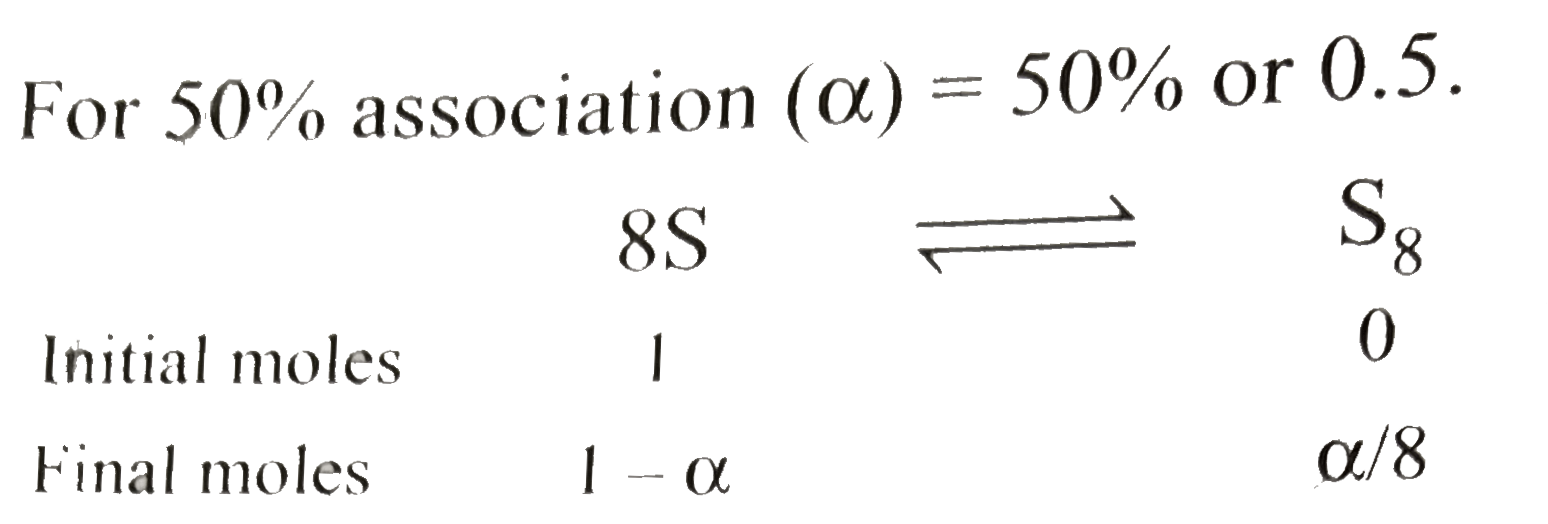 Total moles at equilibrium = `1-alpha+(alpha/8)` `i="Total moles"/"Initial moles"` `=(1-alpha+(alpha/8))/1` `=(8-8alpha+alpha)/8` `=(8-7alpha)/(8) =(8-7xx0.5)/8 =4.5/8 = 0.5625` Alternate method `i=("Number of ions" xx alpha)+(1-alpha)` =`(1/8xx0.5)+(1-0.5)=0.5/8+0.5` `:.i=4.5/8=(0.5625)` (d,e,f) 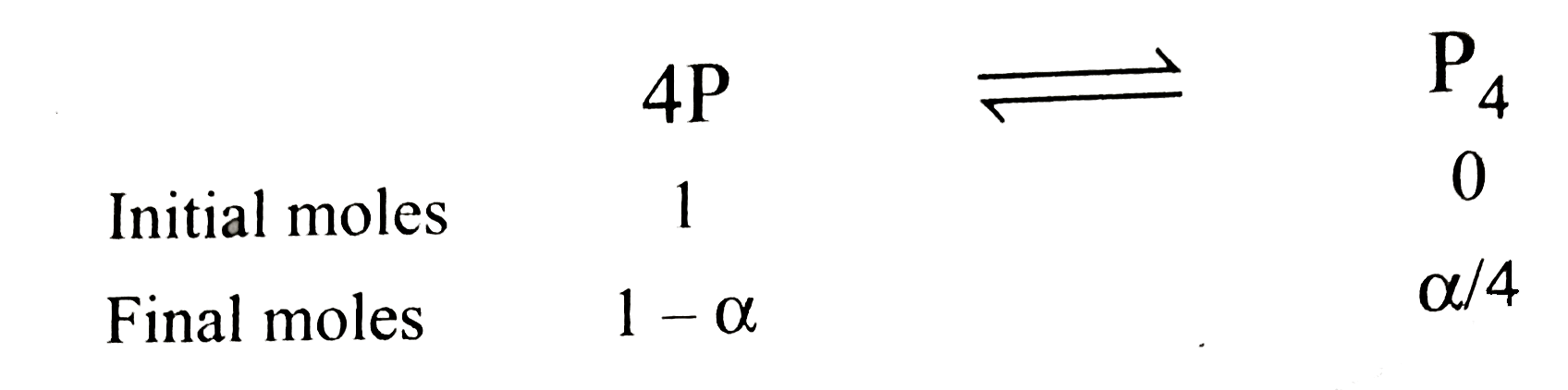 `i=(1-alpha+alpha/4)/1` `=(4-4alpha+alpha/4)` ` =(4-3alpha)/4 = (4-3xx0.5)/4 =2.5/4 =0.625` Alternate method `i=("Number of ions" xx alpha)+(1-alpha)` `=(1/4xx0.5)+(1-0.5)` `=0.5/4+0.5=2.5/4=0.625` g. 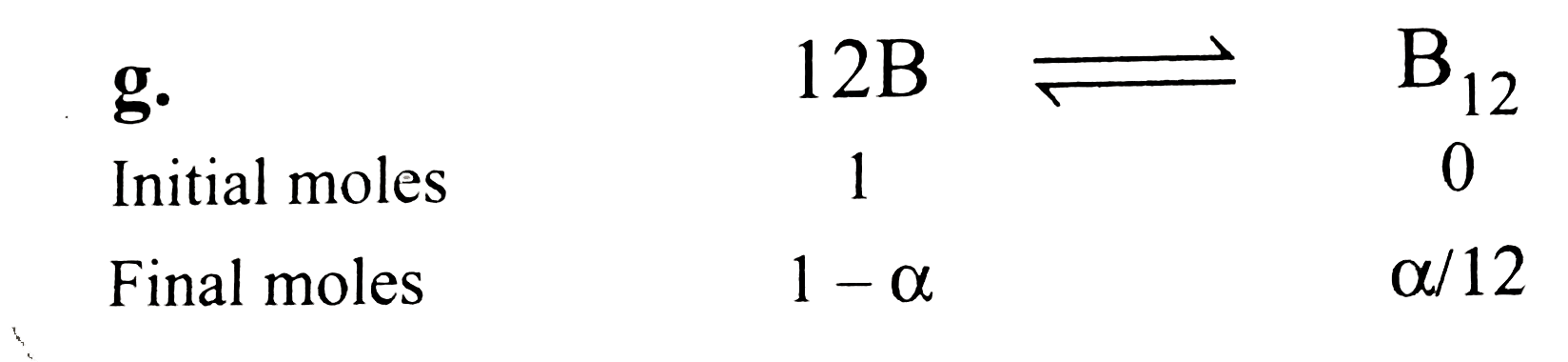 ` i=(1-alpha+alpha/12)/1` `=(12-12alpha+alpha/12)` ` =(12-11alpha)/12 = (12-11xx0.5)/12 =6.5/12 =0.54` Alternate method `i=("Number of ions" xx alpha)+(1-alpha)` `=(1/12xx0.5)+(1-0.5)` `=0.5/12+0.5=6.5/12=0.54` h. 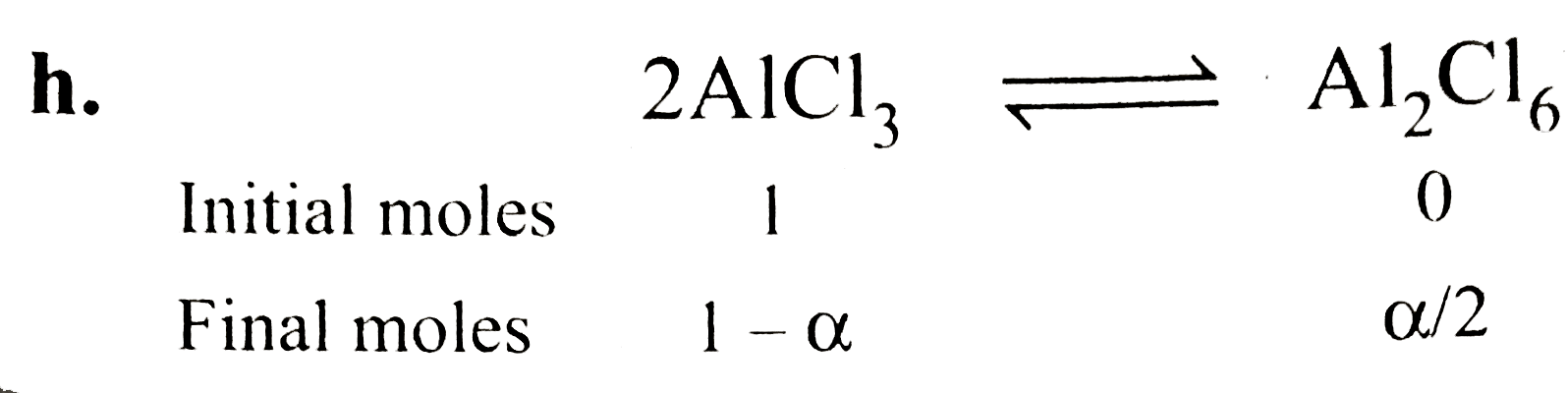 ` i=(1-alpha+alpha/2)/1` `=(1-2/alpha+alpha/1)` ` =(12-11/alpha)/12 = (12-11xx0.5)/2 =1.5/2 =0.75` Alternate method `i=("Number of ions" xx alpha)+(1-alpha)` `=(1/2xx0.5)+(1-0.5)` `=0.5/2+0.5=1.5/2=0.75`  ` i=(1-alpha+alpha+2alpha)/1` `=(1-2alpha=1+2xx0.5=2` Alternate method `i=("Number of ions" xx alpha)+(1-alpha)` `=(3xx0.5)+(1-0.5)` `=1.5+0.5=2` j. Since i=1, it does not ionize. k.  ` i=(1-alpha+alpha+2alpha)/1` `=(1-2alpha=1+2xx0.5=2` Alternate method `i=("Number of ions" xx alpha)+(1-alpha)` `=(3xx0.5)+(1-0.5)` `=1.5+0.5=2` j. Since i=1, it does not ionize. l. 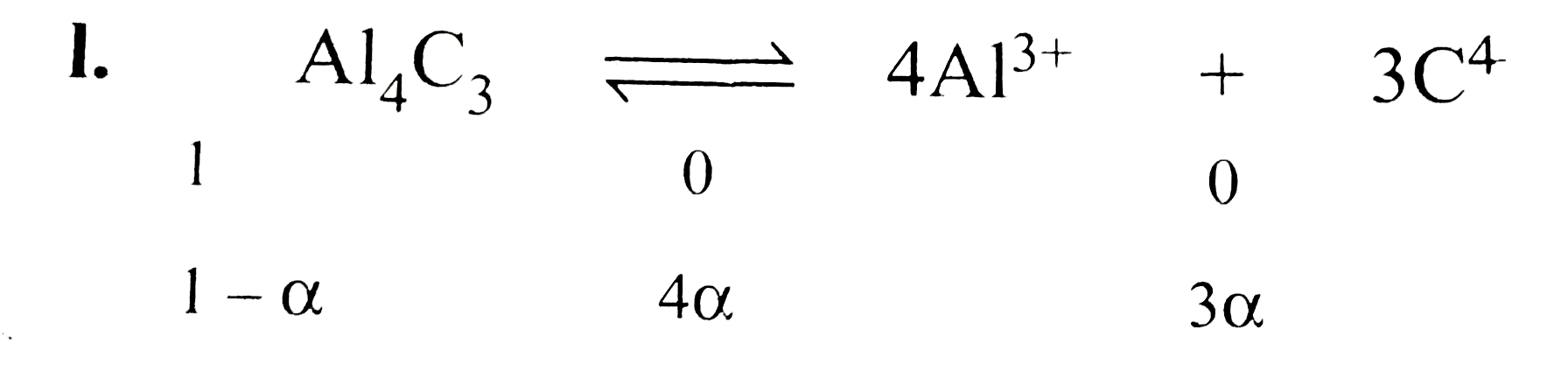 ` i=(1-alpha+4alpha+3alpha)/1` `=(1-6alpha=1+6xx0.5=4` Alternate method `i=("Number of ions" xx alpha)+(1-alpha)` `=(7xx0.5)+(1-0.5)` `=3.5+0.5=4` m.  ` i=(1-alpha+alpha+alpha)/1` `=(1+alpha=1+0.5=1.5` Alternate method `i=("Number of ions" xx alpha)+(1-alpha)` `=(2xx0.5)+(1-0.5)` `=1.0+0.5=1.5` n. 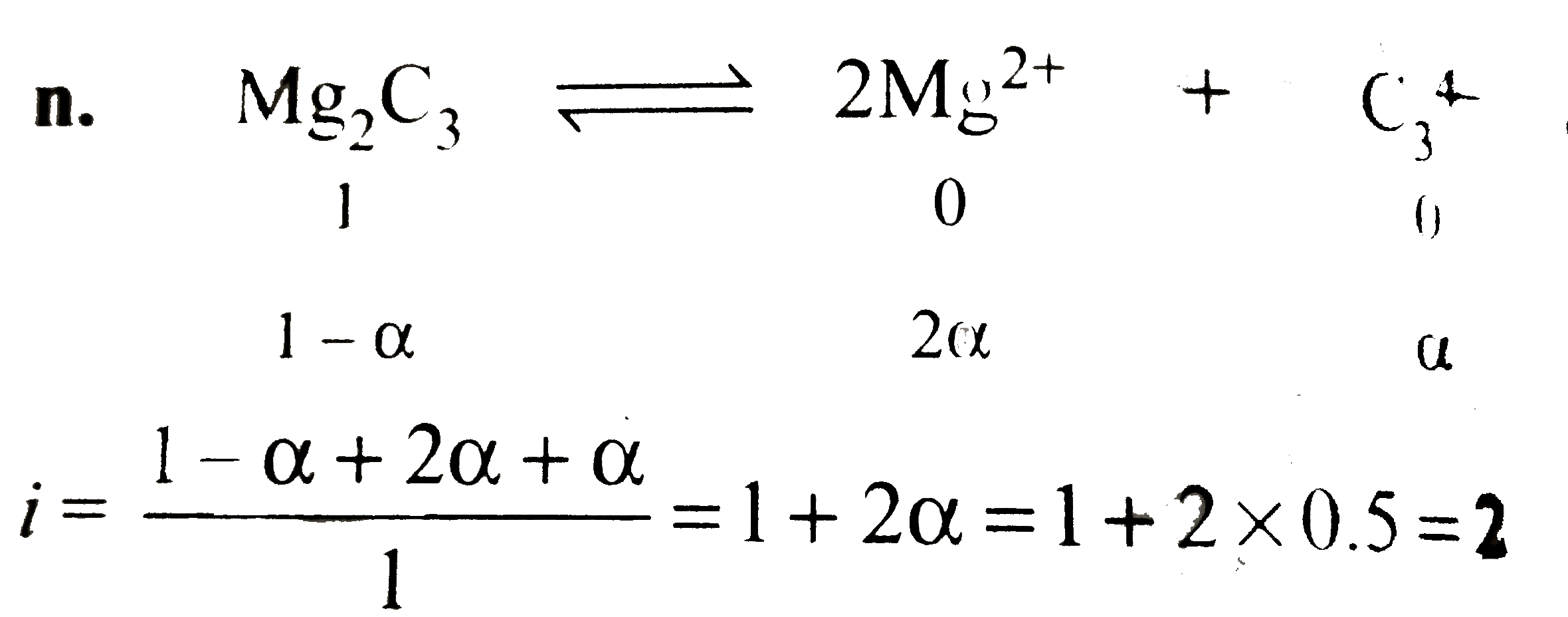 ` i=(1-alpha+2alpha+alpha)/1` `=(1+2alpha=1+2xx0.5=2`) Alternate method `i=("Number of ions" xx alpha)+(1-alpha)` `=(3xx0.5)+(1-0.5)` `=1.5+0.5=2` |
|
| 5. |
Calculate the value of " x+y-z" here x,y and z are total number of non-bonded electron pair (s),pie (pi) bond(s) and sigma (sigma) bonds in hydrogen phosphite ion respectively. |
Answer» 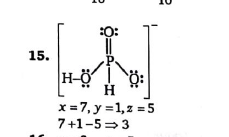
|
|
| 6. |
Calculate the valueX-Y for XeOF_(4). (X= Number of sigma bond pair and Y= Number of Ione pair on central atom). |
|
Answer» so, X-Y=5-1=4 |
|
| 7. |
Calculate the value of log K_pfor the reaction: N_2(g) + 3H_2(g)iff 2NH_3(g) at 25^@C.The standard enthalpy of formation of NH_3(g)is -46 kJ and standard entropies of N_2, H_2 and NH_3gases are 191, 130, 192 JK^(-1) "mol"^(-1) respectively. |
|
Answer» Solution :Apply `Delta G^@ = Delta H^@ - T Delta S^@` and `Delta G^@ =- 2.303 RT LOG K_p` 5.845 |
|
| 8. |
Calculate the value of Avogadro numberfrom the internuclear distanceof adjacent ions in NaCl, 0.282 nm and the densityof solid NaCl is 2.17xx10^(3)kg//m^(3) . A unit cell contains 4 NaCl formulaunits. |
|
Answer» Solution :To calculate the Avogadro constant, that is, NUMBER of NaCl formula UNITS per mole, let us take 1 mole of NaCl. Volume of 1 mole of NaCl `=("mass of 1 mole")/("density")` `=(58.5 xx 10^(-3))/(2.17 xx 10^(3)) = 2.7 xx 10^(-5) m^(3)` Volume of 1 unit cell `=a^(3) = (0.564 xx 10^(-9))^(3) = 1.79 xx 10^(-28) m^(3)` `therefore` number of unit cell per mole `=(2.7 xx 10^(-9))/(1.79 xx 10^(-28)) = 1.51 xx 10^(23)` Since 1 unit cell of NaCl has 4 NaCl formula units, Avogadro constant (formula units per mole) `=4 xx (1.51 xx 10^(23))` `=6.04 xx 10^(23)` |
|
| 9. |
Calculate the value of log K_(3) when log values of K_(2),K_(1),K_(4) and K_(4) respectively are 2.0, 3.20, 4.0 and 11.9 ? |
|
Answer» Solution :`beta=K_(1)K_(2)K_(3)K_(4)` LONG `beta=log(K_(1)K_(2)K_(3)K_(4))` `logbeta=logK_(1)+logK_(2)+logK_(3)+logK_(4)` `logK_(3)=11.9-(3.20+2.0+4.0)` `logK_(3)=2.7` |
|
| 10. |
Calculate the value of E.A.N of metal cation in [Cu(NH_(3))_(4)]SO_(4) complex |
|
Answer» |
|
| 11. |
Calculate the value of Bohr magneton. For a hydrogen like atom with a 3d electron, what is the value of the orbital angular momentum in terms of h? (e=1.6 xx 10^(-19)c, h= 6.626 xx 10^(-34)J.s and m_(e)= 9.109 xx 10^(-31)kg) |
|
Answer» Solution :We have, `mu_(B) (BM)= (EH)/(4pi m)` `= ((1.6 xx 10^(-19)) (6.626 xx 10^(-34)))/(4 xx 3.14 xx 9.109 xx 10^(-31))` `=9.266 xx 10^(-24)JT^(-1)` Further, we have `L= sqrt(l(l+1)) (h)/(2pi) = sqrt(l(l+1))ħ` For a 3d electron, l=2 `L= sqrt(2 (2+1))ħ= sqrt6ħ` |
|
| 12. |
Calculate the value of Avogadro number (N_(0)) from following data : (i) "Density of" NaCl = 2.165 gm cm^(-3) (ii) Distance between Na^(+) & Cl^(-) in NaCl = 281 pm. |
|
Answer» Solution :`rho = 2.165 g//cc` `a = 281 XX 2 "pm"= 526 "pm"` `= 5.62 xx 10^(-8)` cm Z= 4(FCC) `N_(0)= ?` M = 23 + 35.5 = 58.5 a.m.u. `rho = (Z xx M)/(N_(0)a^(3))` `N_(0)=(Z xx M)/(rho.a^(3))` `= (4 xx 58.5)/(2.165 xx ( 5.62 xx 10^(-8))^(3))` `= (4 xx 58.5 xx 10^(24))/(2.165 xx ( 5.62)^(3))` `N_(0) =6.02 xx 10 ^(23)` |
|
| 13. |
Calculate the useful work of the reaction Ag(s)+1//2Cl_2(g)to AgCl(s) Given E_(C l^(-)//C l^(-))^(@)=+1.36 V, E_(Ag|AgCl|Cl^(-))^(@)=0.22 V If P_(Cl_(2))=1 atm and T=298 K |
|
Answer» 110 kJ/mol `(2)1//2Cl_2+e to Cl^(-) " " E^@=1.36 V` we GET `Ag(s) + 1//2 Cl_2(g) to AgCl(s) " " E_("cell")^@=0.14 V` `therefore DeltaG=-nEF^@=-(1)(96500)(1.14)=-110` kJ/mol |
|
| 14. |
Calculate the U_("rms")" of "O_(2) if its density at 1 atm pressure and 0^(@)C is 1.4290 g " litre "^(-1) |
|
Answer» Solution :`U_("RMS") =sqrt((3P)/(d))` In M.K.S : P=1 atm `=101.325 xx10^(3) PA,` `d=1.4290" g/litre "=(1.4290xx10^(-3))/(10^(-3))kg//m^(3)=1.4290kg//m^(3)` `therefore U_("rms") =sqrt((3xx101.325xx10^(3))/(1.4290))=461.21 m//sec` |
|
| 15. |
Calculate the uncertainty in velocity (Delta v)of a cricket ball (mass = 0.15 kg) if the uncertainty position (Delta x) is of the order of 1 Å (i.e. 10^(-10) m) . |
| Answer» Solution :`3.5 XX 10^(-24) m SEC^(-1)` | |
| 16. |
Calculate the uncertainty in the velocity of a wagon of mass 3000kg whose position is known to an accuracy of± 10 pm (Planck’s constant = 6.626 xx 10^(−34) Kg m^2 s^(-1) . |
|
Answer» Solution :Here we are given `m = 3000 kg ` ` DELTA x = ` 10PM ` = 10 XX 10^(-12) m = 10^(-11) m` ` THEREFORE ` By uncertainly principle ` Delta v = (h)/(4pi xx m xx Delta x)` ` = (6.626 xx 10^(-34))/(4 xx 22/7 xx 3000 xx 10^(-11))` ` = 1.76 xx 10^(-27) ms^(-1)` |
|
| 17. |
Calculate the uncertainty in the position of an electron if the uncertainty in its velocity is 5.7 xx 10^5 m//sec (h = 6.626 xx 10^(-34) kg m^2 s^(-1) , mass ofthe electron = 9.1 xx 10^(−31) kg ). |
|
Answer» Solution :Here we are given `Delta v = 5.7 xx 10^5 ms^(-1)` `m = 9.1 xx 10^(-31) kg ` `H = 6.626 xx 10^(-34) kg m^2 s^(-1)` SUBSTITUTING these values in the equation for uncertainty principle `Delta x xx (m xx Delta v) = (h)/(4PI)` we have`Delta x = (h)/(4pi xx m xx Delta v)` ` = (6.626 xx 10^(-34))/(4 xx 22/7 xx 9.1 xx 10^(-31) xx 5.7 xx 10^5)` ` =1.0 xx 10^(-10) m` Uncertainly in position `= pm 10^(-10) m` |
|
| 19. |
Calculate the total pressure at 400^@C that must be applied to a mixture of three parts of hydrogen and one part of nitrogen to give a mixture containing 10 % ammonia at equilibrium . Given N_2(g) +3H_2(g) hArr 2NH_3(g) , K_p =1.60 xx 10^(-4) "bar"^(-2) at 400^@C. |
|
Answer» |
|
| 20. |
Calculate the total number of open chain isomeric compounds of molecular formula C_(4)H_(10) which can show geometrical isomerism. |
|
Answer» |
|
| 21. |
Calculate the total number of p-orbitals electrons present in Cu(29) atoms. [Divide answer by 2] |
| Answer» Solution :`1s^(2)2S^(2)2P^(6)3S^(2)3p^(6)4S^(1)3d^(10)` | |
| 22. |
The total number possible isomers for the complex compound [Cu^(II)(NH_(3))_(4) [Pt^(II)CI_(4)] are |
|
Answer» 3 |
|
| 23. |
Calculate the total number of electrons present in 1.4 g nitrogen gas. |
|
Answer» `=3.01xx10^(22)xx14" electrons"=4.214xx10^(23)" electrons (as 1 MOLECULE of " N_(2) " contains 14 electrons)"` |
|
| 24. |
Calculate the total number of coulombs carried by Cl^-ions weighing 20.1 g. |
| Answer» SOLUTION :`5.46 XX 10^4 C` | |
| 25. |
Calculate the total number of alpha and betaparticles emitted in the nuclear reaction,""_92^238U to ""_82^214Pb |
| Answer» SOLUTION :`8:6 ALPHA + 2 BETA` | |
| 26. |
Calculate the time to deposit 1.27 g of copper at cathode when a current of 2 A was passed through the solution of CuSO_(4).[Molar mass of Cu = 63.5 g mol^(-1), 1 F = 96500 C mol^(-1)] |
|
Answer» Solution :`Cu^(2+) | 2E^(-) to Cu(s)` No. of COULOMBS required to deposit 63.5 g Cu `=2 xx 96500` No. of coulombs required to deposit 1.27 g Cu `=(2 xx 96500)/(63.5) xx 1.27` `=(2 xx 96500 xx 1.27)/(63.5)xx 1.27` `(2 xx 96500 xx 1.27)/(63.5) = 2` amperes `xx` TIME in seconds or Time (in seconds) `=(2 xx 96500 xx 1.27)/(63.5 xx 2) = 1930` seconds. |
|
| 27. |
Calculate the tmperature at which a solution containing 54 g glucose (C_(6)H_(12)O_(6)) in 80 g of water will freeze (K_(f)for water=1.86 Kmol^(-1)kg). |
|
Answer» `"No. of MOLES of glucose"(n_(B))=W_(B)/M_(B)=((54G))/((180"g mol"^(-1)))=0.3mol` `"Molarity of glucose solution (m)"=n_(B)/w_(B)=(0.3mol)/(0.25kg)=1.2" mol kg"^(-1).` `DeltaT_(f)=K_(f)xxm=(1.86" K kg mol"^(-1))=2.23 K`. `"Freezing point of solution"=(273.0-2.23)K=270.77 K` |
|
| 28. |
Calculate the temperature values at which the molecules of the first two members of the homologous series, C_(n) H_(2n+2) will have the same rms speed as CO_(2) gas at 770 K .The normal b.p. of n - butaneis 273 K. Assuming idealgas behaviour of n-butane upto this temperature , calculate the mean velocity and the most probable velocity of its molecules at this temperature. |
|
Answer» |
|
| 29. |
Calculate the temperature at which the root-mean-square speed of SO_(2) molecules is the same as that of oxygen at 27^(@)C. |
|
Answer» Solution :We have, `C = SQRT((3RT_(SO_(2)))/(M_(SO_(2)))) = sqrt((3RT_(O_(2)))/(M_(O_(2))))` or `sqrt((3RT_(SO_(2)))/(64)) = sqrt((3R.300)/(32))` `T_(SO_(2)) = 600 K`. |
|
| 30. |
Calculate the temperature at which DeltaG=-5.2kJmol^(-1)DeltaH=145.6kJmol^(-1)andDeltaS=216JK^(-1)mol^(-1) for a chemical reaction - |
|
Answer» `698^(@)C` |
|
| 31. |
Calculate the temperature at which a solution containing 54 g of glucose (C_(6)H_(12)O_(6)) in 250 g of water will freeze (K_(f) for water = "1.86 K mol"^(-1)"kg"). |
| Answer» SOLUTION :`-2.23^(@)C` | |
| 32. |
Calculate the surface area of a catalyst that adsorbs 10^3 cm^3 of N_2 (reduced to STP) per gram in order to form the monolayer. The effective area occupied by N_2 molecule on the surface is 1.62 xx 10^5 cm^2 |
|
Answer» `2520 x 10^5 cm^2` `22400 to 6 xx10^(23)` molecules , `10^3 to ?` `(6 xx 10^(26))/(22400) "then" (6 xx 10^(26))/(22400) xx 1.62 xx 10^(-15) ` area occupied `= 435 xx 10^(15) a^2` |
|
| 33. |
Calculate the strength of H-bond between F^(-)(g) and CH_(3)COOH (g) from the given data. {:(DeltaH_("solution")[KF. CH_(3)COOH(s)]" in glacial acetic acid",=,-3" kJ/mole"),(DeltaH_("solution") [KF(s)]" in glacial acetic acid",=,+35" kJ/mole"),("Lattice Enthalpy KF(s)",=,+797" kJ/mole"),("Lattice enthalpy of " KF. CH_(3)COOH(s),=,+734" kJ/mole"),(DeltaH_("vaporization") [CH_(3)COOH (l)],=,+21" kJ/mole"):} |
Answer» SOLUTION : `-3=+734+E_(H)-797+35-21` `E_(H)=-3-734-35+797+21=+46" kJ/mole"` |
|
| 34. |
Calculate the strengthof 20 V of H_(2)O_(2) in terms of percentage |
|
Answer» SOLUTION :Strength in percentage is grams per 100 ML so from part (ii) of the solution , Strength in percentageof 20 V of `H_(2)O_(2)= 6.086 % ( g // 100 mL)` |
|
| 35. |
Calculate the strengthof 20 V of H_(2)O_(2) in terms ofmolarityand |
|
Answer» SOLUTION :Molarity = `("normality")/("factor RELATING mol.wt and eq.wt ") ""….(EQN . 6I)` ` = (3.58)/2 = 1.79 ` M |
|
| 36. |
Calculate the strengthof 20 V of H_(2)O_(2) in terms of (i) normality |
|
Answer» Solution :The strength of `H_(2)O_(2)`as . 20 V. means 1 volume of `H_(2)O_(2)` decomposition gives 20 volumes of oxygen at NTP or 1 LITRE of `H_(2)O_(2)` gives 20 litresof oxygen at NTP . (i) `2H_(2)O_(2) to 2H_(2)O + O_(2)` `1 lit "" 20 " lit at NTP "` . ` 1 lit"" 20/(5.6) eq . ""...(Eqn.4ii)` `{:(( :. " 1 mole oxygen (32 g) occupies a vol. of 22 . li at NTP"),( :. " 1 eq of oxygen(8 g) shall occupy "(22.4)/4" lit . at NtP = 5.6 lit")):}` `:. `equivalent in 1 lit . of `H_(2)O_(2)`= eq . of oxygen produced ` 20/(5.6) = 3.58` ` :. ` equivalent per litre REPRESENTS normality ` :. ` normality of 20 V `H_(2)O_(2) = 3.58 N ` |
|
| 37. |
Calculate the strengthof 20 V of H_(2)O_(2) in terms ofgramsper litre |
|
Answer» SOLUTION :From the abovereaction , eq. WT . Of `H_(2)O_(2) = (" mol.et")/2 = 34/2 = 17 ` ` :. ` STRENGTH of 20 V `H_(2)O_(2)` = normality `xx ` eq.wt ` = 3.58 xx17` ` = 60.86 ` g/lit |
|
| 38. |
Calculate the strength in g/L of 3 N HCl and N/2 H_(2)SO_(4) solutions . |
| Answer» SOLUTION :`(109.5,24.5)` | |
| 39. |
Calculate the strength in g//L of 10 volume solution of hydrogen peroxide at 273 K and 1 bar pressure. [Report your answer divided by 10] |
|
Answer» `2H_(2)O_(2)(l)rarrO_(2)(g)+H_(2)O(l)` `2xx34g""22.7" at STP"` 68g On the BASIS of above equation 22.7 L of `O_(2)` is produced from 68 g `H_(2)O_(2)` at STP and 10 L of `O_(2)` at STP is produced from `(69xx10)/(22.7)g=29.9g~~30gH_(2)O_(2)`. Therefore, strength of `H_(2)O_(2)` in 10 volume `H_(2)O_(2)` solution `= 30 g/L = 3% H_(2)O_(2)` solution |
|
| 40. |
Calculate the standarde free energy change in kJ for the reaction: Cu^(+) + I^(-) to "Cul" Given: "Cul" + e to Cu + I^(-), E^(@) = -0.17 V Cu^(+) + e to Cu, E^(@) = 0.53 V |
|
Answer» `-67.55` |
|
| 41. |
Calculate the standard reduction potential of the following half cell S^(2-)|CuS|Cu Given: K_(sp)(CuS)=10^(-35)andE_(Cu^(2+)//Cu)^(@)=0.34V |
|
Answer» Solution :A cell can be assumed as follows: Anode: `Cu(s)toCu^(2+)+2e^(-),E^(@)=E_(1)` Cathode: `underline(CuS+2e^(-)toCu(s)+S^(2-),E^(@)=E_(2))` NET reaction: `CuStoCu^(2+)+S^(2-)` Applying Nernst equation to each of the above TWO electrode reaction `E_(1)=E_(Cu^(2+)//Cu)^(@)+(0.0591)/(2)LOG[Cu^(2+)]` `E_(2)=E_(S^(-)//CuS//Cu)^(@)-(0.0591)/(2)log[S^(2-)]` `E_(cell)=E_(2)-E_(1)` Wehn the cell reaction is in equilibrium, `E_(cell)=0` `thereforeE_(2)=E_(2)` i.e., `E_(S^(2-)//CuS//Cu)^(@)-(0.0591)/(2)log[S^(2-)]=E_(Cu^(2+)//Cu)^(@)+(0.0591)/(2)log[Cu^(2+)]` or `E_(S^(2-)//CuS//Cu)^(@)=E_(Cu^(2+)//Cu)^(@)+(0.0591)/(2)log[Cu^(2+)][S^(2-)]` `=E_(Cu^(2+)//Cu)^(@)+0.02955logK_(SP)(CuS)` `=0.34+0.02955log10^(-35)` `=0.34+0.02955(-35)=-0.694V` |
|
| 42. |
Calculate the standard reduction potential of Ag^(+)|Ag electrode when the cellpotential for the cell , Cu (s) |Cu^(2+) (1 M) || Ag^(+) (1 M) Ag is 0.46 V . Given that Cu^(2+) |Cu = 0.34 V |
|
Answer» `0.46 = E_(Ag^(+) |Ag)^(Theta) = -0.34` `THEREFORE E_((Ag^(+)|Ag))^(Theta) = 0.80 V` |
|
| 43. |
Calculate the standard potential for the reaction, Hg_(2)Cl_(2)+Cl_(2) rarr 2Hg^(2+)+4Cl^(-) Given : {:(Hg_(2)Cl_(2)+2e^(-) rarr 2Hg+2Cl^(-),,E^(@)=0.270" volt"),(Hg_(2)^(2+) rarr 2Hg^(2+)+2e^(-),,E^(@)=-0.92" volt"),(2Hg rarr Hg_(2)^(2+)+2e^(-),,E^(@)=-0.79"volt"),(Cl_(2)+2e^(-) rarr 2Cl^(-),,E^(@)=1.36" volt"):} |
|
Answer» `Hg_(2)Cl_(2) rarr 2Hg^(2+) +2Cl^(-) +2e^(-)` ELECTRODE. It comes to -1.44 VOLT. This electrode is now coupled with `Cl_(2)+2e^(-) rarr 2Cl^(-)` electrode. |
|
| 44. |
Calculatethe standard N- Hbondenthalpy from thefollowingdata :N_(2(g)) +2H_(2(g)) to 2NH_(3(g)) Delta H^(@) = - 83 kJ Delta H^(@)(N= N)= 946 kJ mol^(-1) , Delta H^(@)(H-H)436 kJ mol^(-1) |
| Answer» Solution :`DELTA H_(N- H)^(@)= 389kJ mol^(-1)` | |
| 45. |
Calculate the standard reduction potential for the reaction H_2O+ e to 1/2 H_2+OH^- using the Nernst equation and the fact that the standard reduction potential for the reaction H^+ + e to 1/2 H_2 is by definition equal to 0.00V at 25^@C |
|
Answer» Solution :Given that `H_2O + e to 1/2 H_2 +OH^- , E^@=xV` (say) `THEREFORE` for the reaction, `H_2Oto H^+ +OH^- , E^@=xV` The Nernst EQUATION is `E_(cell)=E^@- 0.0591/1 LOG[H^+][OH^-]` At EQUILIBRIUM `E_(cell)=0 and [H^+][OH^-]=K_w=1 times 10^-14` `therefore 0=x-0.0591/1 log 10^-14` or `x=-0.8274 V` |
|
| 46. |
Calculate the standard Gibbs energy change for the redox reaction of Daniell cell. |
|
Answer» Solution :CELL reaction in daniell cell is `ZN + Cu^(2+) (aq) to Zn^(2+) (aq) + Cu` The standard ELECTRODE potential , `E_("cell")^(@)` is 1.1 V. The standard free energy CHANGE, `Delta G^(@) = -nFE_("cell")^(@) = -2 xx 1.1 xx 96500 = -21.3 kJ MOL^(-1)` |
|
| 47. |
Calculate the standard heat of formation of carbon disulphide (l), given that the standard heat of combustion of carbon (s), sulphur (s) and carbon disulphide (l) are -393.3, -293.72and -1108.76 kJ mol^(-1) respectively |
|
Answer» `-128.02 KJ MOL^(-1)` `C+O_(2)rarrCO_(2)DeltaH=-393.3 kJ "....(i)"` `S+O_(2)rarrSO_(2)DeltaH=-293.72 kJ "....(II)"` `CS_(2)+3O_(2)rarrCO_(2)+2SO_(2) DeltaH=-1108.76 kJ"....(iii)"` eq.(ii) `xx2+` eq. (i) - eq. (iii) - and find required RESULT. |
|
| 48. |
Calculate the standard Gibbs energy change for the redox reaction of Daniel cell . |
|
Answer» Solution :Cell reaction in Daniel cell is `Zn+Cu^(2+) AQ) RARR Zn^(2+) (aq) +Cu` The standard electrode potential, `E_("cell")^(@)`is 1.1 V. The standard FREE energy change, `DeltaG^(@)= -nFE_("cell")^(@)` ` = - 2xx1.1xx96500=-21.3 "kJ MOL"^(-1)`. |
|
| 49. |
The standard entropy change Delta S_r^@ for CH_(4(g)) + 2O_(2(g)) to CO_(2(g)) + 2H_2O_((l)) is -242.98 JK^(-1) at 25^@C.Calculate the standard reaction enthalpy for the above reaction if standard Gibbs energy of formation of CH_(4(g)), CO_(2(g)) and H_2O_((l)) are-50.72, -394.36 and - 237.13 kJ mol^(-1)respectively. |
| Answer» SOLUTION :` –1010.02 KJ "MOLE"^(-1)` | |
| 50. |
Calculate the standard free energy change of the reaction : 4NH_(3(g)) + 5O_2 to 4NO_((g)) + 6H_2O_((l))and predict on the feasibility of the reaction. Standard free energies of formation of NH_(3(g)),NO_((g)) and H_2O_((l)) are 16.65, 86.61, –237.20 kJ. "mole"^(-1)respectively. |
| Answer» SOLUTION :` –1010.02 KJ "MOLE"^(-1)` | |