

Saved Bookmarks
This section includes 7 InterviewSolutions, each offering curated multiple-choice questions to sharpen your Current Affairs knowledge and support exam preparation. Choose a topic below to get started.
| 1. |
Calculate the weight of water in grams per litre of air at 20^(@)C and 45% relative humidity. Vapour pressure of water at 20^(@)C is 17.5 mmHg. |
|
Answer» Solution :We have that, % relative humidity `= ("partial pressure of " H_(2)O "in air")/("vapour pressure of " H_(2)O " at the same temp.") XX 100` `therefore p_(H_(2)O) = (45 xx 17.5)/(100) = 7.9 m m= 0.0104` atm. Thus for 1 litre of air, MOLE of `H_(2)O` can be calculated as, `n = (pV)/(RT) = (0.0104 xx 1)/(0.0821 xx 293) = 4.3 xx 10^(-4)` mole. `therefore` WT. of `H_(2)O = 4.3 xx 10^(-4) xx 18 = 7.74 xx 10^(-3)` g/L of air. |
|
| 2. |
Calculate the weight of NaOH in grams in Example 2 . |
|
Answer» SOLUTION :Weight in G = EQUIVALENTS `xx` eq.wt `=0.1 xx 40 = 4 ` g |
|
| 3. |
Calculate the weight of MnO_(2) required to react with HCl having specific gravity 1.2gm//ml. 4% by mas necked to produce 1.8L of Cl_(2) at STP by reaction. |
|
Answer» `100gm` SOL CONTAINS `4gm HCl` `100/1.2 ML` sol contains `4 GM HCl` `nCl_(2)=1.8/22.4=0.0805` `W_(MnO_(2))=0.0805xx87=8gm` |
|
| 4. |
Calculate the weight of line (CaO) thatcan be prepared by heating 200 kgof limestone(CaCO_(3))whichis 95% pure. |
|
Answer» Solution :`CaCO_(3) to CaO + CO_(2)` Actual amount of `CaCO_(3) = (95)/( 100) xx 200000 g = 190000 g` Since CA atomsare CONSERVED, applying POAC for Ca atoms,MOLES of Ca in `CaCO_(3)` = MOLESOF Ca in CaO `1 xx ` moles of `CaCO_(3) = 1 xx `moles of CaO `(190000)/( 100) = (wt. of CaO)/( 56)""`(Rule 1, Chapter 1) Wt. of CaO = 106400 g = 106.4 kg |
|
| 5. |
Calculate the weight of carbon which is burnt with excess of oxygen to form 22.4 L of CO_2 at NTP |
|
Answer» 4 g |
|
| 6. |
Calculate the weight of ""^(14)C (t_((1)/(2)) =5720yr) atoms which will give 3.70 xx 10^(7) disintegrations per second (dps) |
|
Answer» |
|
| 7. |
Calculate the wavelength, wave number and frequency of photon which has energy equal to 3 eV. |
| Answer» SOLUTION :`lambda=4.13xx10^(-5)CM, barupsilon=2.42xx10^(4)cm^(-1)` | |
| 8. |
Calculate the wave length of an electron moving with a velocity of 2.05xx10^(7)ms^(-1). |
| Answer» SOLUTION :`0.077Å` | |
| 9. |
Calculate the wavelength of a particle of mass m = 6.62 xx 10^(-27) kg moving with kinetic energy 7.425 xx 10^(-13) J (h = 6.626 xx 10^(-34) kg m^2 sec^(-1)) . |
| Answer» SOLUTION :`6.657 XX 10^(-15) m` | |
| 10. |
Calculate the wavelength of 1000 kg rocket moving with a velocity of 300 km per hour. |
| Answer» SOLUTION :`7.92 XX 10^(-39) m` | |
| 11. |
Calculate the wavelength in nanometer associated with a proton moving at 1.0xx10^(3)ms^(-1), (mass of proton = 1.67xx10^(-27)kgandh=6.63xx10^(-34)Js) |
|
Answer» 0.032 nm |
|
| 12. |
Calculate the wavelength in angstrom of the photon that is emitted when an electron in Bohr orbit n=2 returns to the orbit n=1 in the hydrogen atom. The ionisation potential of the ground state of hydrogen atom is 2.17 xx10^(-11) erg per atom. |
|
Answer» Solution :SINCE the hydrogen atom has only one orbit containing only one ELECTRON, the ionisation potential of the ground state of the hydrogen atom is the energy of the electron of the first orbit, i.e, `E_(1)= -2.17 xx 10^(-11)` erg Thus, `E_(2)= (E )/(n^(2))` `= -(2.17 xx 10^(-11))/(2^(2))` `therefore` energy of the radiation EMITTED, `DeltaE= E_(2)- E_(1)` `= - (2.17 xx 10^(-11))/(2^(2)) -(-2.17 xx 10^(-11))` `=1.627 xx 10^(-11)` erg We know `DeltaE= hv= (hc)/(LAMDA)` Thus `(hc)/(lamda)= 1.627 xx 10^(-11)` `lamda= (6.62 xx 10^(-27) xx 3 xx 10^(10))/(1.627 xx 10^(-11)) = 1.22 xx 10^(-5)cm` `=1220 Å (1 Å= 10^(-8)cm)` |
|
| 13. |
Calculate the wavelength associated with a proton moving at 1.0xx10^(3)m//s. (Mass of proton =1.67xx10^(-27)kg and h=6.63xx10^(-34) Js) |
|
Answer» 0.032 nm, `=3.9xx10^(-10)m` |
|
| 14. |
Calculate the wavelength associated with an electron (mass 9.1 xx 10^(-31) kg) moving with a velocity of 10^3m sec^(-1) (h=6.626 xx 10^(-34) kg m^2 sec^(-1)) . |
|
Answer» Solution :Here we are given `m = 9.1 XX 10^(-31) KG ` ` V= 10^3m sec^(-1)` `H = 6.626 xx 10^(-34) kg m^2 sec^(-1)` `LAMDA =(h)/(mv) = (6.626 xx 10^(-34))/((9.1 xx 10^(-31) ) xx 10^3)` `= 7.25 xx 10^(-7) m ` |
|
| 15. |
Calculate the wave number for the longest wavelength transition in the Balmer series of atomic hydrogen emission spectrum. |
| Answer» SOLUTION :`1.523xx10^(6)m^(-1)` | |
| 16. |
Calculate the wave number and frequency of radiation having wavelength 5800+E65Å |
| Answer» SOLUTION :172400 `CM^(-1), 5.172 XX 10^(14)` cycles `s^(-1)` | |
| 17. |
Calculate the wave length of atomic electron revolving in the third shell of hydrogen atom. |
| Answer» SOLUTION :`10^(-9)m` | |
| 18. |
Calculate the volume of water to be added to 400 ml of seminormal HCl solution to make it decinormal |
|
Answer» 1000 ml |
|
| 19. |
Calculate the volume of STP occupied by (i) 14 g of nitrogen, (ii) 1.5 moles of carbon dioxide and (iii) 10^(21) molecules of oxygen. |
|
Answer» SOLUTION :(i) Molecular mass of nitrogen = 28 U 1 mole of nitrogen = 28 g = 22.4 L at STP, i.e., 28 g of nitrogen occupy 22.4 L at STP `therefore" 14 g of nitrogen will occupy"=(22.4)/(28)xx14=11.2"L at STP"` (ii) 1 mole of carbon dioxide have volume = 22.4 L at STP `therefore "1.5 MOLES of carbon dioxide will occupy volume"=(22.4)/(1)xx1.5L=33.6"L at STP"` (iii) 1 mole of `O_(2)` molecules = `6.022xx10^(23)" molecules"=22.4" L at STP"` i.e., `6.022xx10^(23)` molecules of oxygen will occupy 22.4 L at STP `10^(21)` molecules of oxygen will occupy `=(22.4)/(6.022xx10^(23))xx10^(21)"L at STP"` `=3.72xx10^(-2)"L at STP"=3.72xx10^(-2)xx10^(3)"mL at STP"=37.2"mL at STP"` |
|
| 20. |
Calculate the volume of SO_(2) at STP obtained by bruning 500 g of S containing 4% sand by weight. |
|
Answer» |
|
| 21. |
Calculate the volume of oxygen at NTP will react with 1.0 g of calcium |
|
Answer» |
|
| 22. |
What is the volume of oxygen at N.T.P. needed to cause complete combustion of 100 ml of acetylene and also calculate the volume of carbon dioxide. |
|
Answer» |
|
| 23. |
Calculate the volume of hydrogen liberated at STP when 500 cm^(3) of sulphuric acid reacts with excess of zinc. (H = 1, O = 16, S = 32) |
|
Answer» Solution :The chemical equation representing the reaction is : `Zn+underset(98.0g)(H_(2)SO_(4))rarrZnSO_(4)+underset(22400cm^(3)"at STP")(H_(2))` STEP 1. To calculate the AMOUNT of `H_(2)SO_(4)` in `500 cm^(3)` of 0.5 N `H_(2)SO_(4)` solution. Strength/litre of `H_(2)SO_(4)"solution" = "Normality"xx"Eq. mass"=0.5xx49=24.5"g/litre"` Now, `1000 cm^(3)` of the acid solution contain 24.5 g of pure `H_(2)SO_(4)` `therefore 500cm^(3)" of the acid solution will contain pure "H_(2)SO_(4)=24.5xx(500)/(1000)=12.25g` Step 2. to calculate the volume of `H_(2)` liberated at STP `" 98 g of "H_(2)SO_(4)" react to liberate "22400cm^(3)" of "H_(2)" at STP"` `therefore"12.25 g of "H_(2)SO_(4)" would liberate H"_(2)" at STP"=(22400)/(98)xx12.25cm^(3)=2800cm^(3)` Thus, the volume of HYDROGEN liberated at STP = `2800cm^(3)` |
|
| 24. |
Calculate the volume of hydrogen evolved at 400K and 700 mm pressure by treating 5.6g of super heated iron with sufficient steam. |
|
Answer» |
|
| 25. |
Calculate the volume of hydrogen at NTP produced, when 6 gm of magnesium is dissolved in excess of dilute sulphuric acid. |
|
Answer» |
|
| 26. |
Calculate the volume of hydrogen at NTP obtained by passing a current of 0.4 ampere through acidified water for 30 minutes |
|
Answer» A) 0.836 litre |
|
| 27. |
Calculate the volume of hydrogen at NTP obtained by passing a current of 0.4 ampere through acidified water for 30 minute: |
|
Answer» `0.0836` LITRE |
|
| 28. |
Calculate the volume of CO_2 at NTP produced. By complete combustion of 3 g of carbon. |
|
Answer» |
|
| 29. |
Calculate the volume of air required for the complete combustion of 20L of CH_(4) at STP:- |
|
Answer» 100L 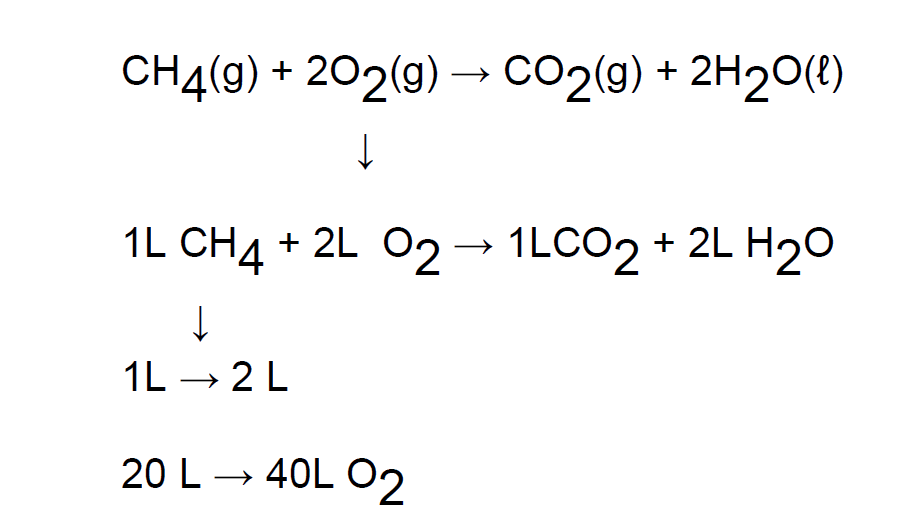 As we KNOW, VOLUME of AIR=5` xx`volume of `O_(2)` `=5xx40` =200L of air. |
|
| 30. |
Calculate the volume of air containing 21% oxygen by volume at STP required to convert 294cm^(3) of sulphur dioxide to sulphur trioxide under the same conditions. |
|
Answer» <P> `therefore""H_(2)" PRODUCED at STP from 0.15 g AL"=(3xx22400)/(54)xx0.15" mL = 186.7 mL"` `underset("(STP conditions)")((P_(1)V_(1))/(T_(1)))=underset("(Required conditions)")((P_(2)V_(2))/(T_(2)))` `"i.e.,"(1atmxx186.7mL)/(273K)=(0.987atm xxV_(2))/(293K)"(1 bar = 0.987 atm)"` `"or"V_(2)=203.0mL` |
|
| 31. |
Calculate the volume of air at N.T.P. containing 20% of oxygen by volume is required for complete burning of 100 g of sulphur containing 6% incombustible matter. |
|
Answer» |
|
| 32. |
Calculate the volume of 80%H_(2)SO_(4) (density = 1.80 g/cc) required to prepare on litre of 20% H_(2)SO_(4) (density = 1.25 g/cc). |
|
Answer» `"Molarity of 20% "H_(2)SO_(4)=(20//98)/(100//1.25)xx1000=2.55M` `underset((80%H_(2)SO_(4)))(M_(1)V_(1))=underset((20% H_(2)SO_(4)))(M_(2)V_(2))` `i.e.""14.69 xxV_(1)=2.55 xx1000"or"V_(1)=173.6cm^(3)`. |
|
| 33. |
Calculate the volume of 80% (by mass) of H_(2)SO_(4) (density=1.8 g/mL) reqiored tp [reare 1 litre of 0.2 M H_(2)SO_(4). |
|
Answer» `"Molarity of acid (M)"=0.2 M=0.2"mol L"^(-1), "Volume os solution"=1 L` Molar mass of acid = 98 g `mol^(-1)` `"Molarity"=("Mass/Molar mass")/("Volume of solution in LITRES")` `(0.2" mol L"^(-1))=W/((98" g mol"^(-1))xx(1L))` `1=(0.2" mol L"^(-1))xx(98" g mol"^(-1))(1L)=19.6 g`. step II. Calculation of volume os 80% `H_(2)SO_(2)` `"Volume of pure"H_(2)SO_(4)=("Mass")/("density")=((19.6g))/((1.8" g mol"^(-1)))=10.89 mL` `"Volume of 80% "H_(2)SO_(4)=(10.89mL)xx100/80=13.61 mL` |
|
| 34. |
Calculate the volume of 75% of H2SO4 by weight (d = 1.8 gm/ml) required to prepare 1 L of 0.2 M solution. |
| Answer» SOLUTION :DUE to FORMATION of AZEOTROPE at (95.4%). | |
| 35. |
Calculate the volume of 80% (by mass) of H_2SO_4 (density = 1.80 g/mL] required to prepare 1 litre of 0.2 molar H_2SO_4 [Relative atomic masses : H = 1, O = 16, S = 32] |
|
Answer» Solution :Applying the following relation and SUBSTITUTING the values, we get Molarity =`("PERCENTAGE by MASS x10 x d")/("molar mass") = (80 xx 10 xx 1.8)/(98) = 1440/98 = 14.69 "MOL" L^(-1)` Using molarity equation `M_1 V_1 = M_2V_2` `14.69 xx V_1= 0.2 xx 1000 mL` ` V_1 = (200)/(14.69) = 13.69 mL` Thus volume of `H_2SO_4` required = 13.6 mL |
|
| 36. |
Calculate the volume of 75% of H_(2) SO_(4) by weight (d = 1.8 gm/ml) required to prepare 1 L of 0.2 M solution. |
|
Answer» SOLUTION :`M_(1) = ("Mass %" xx d xx 10)/(98)` `M_(1) V_(1) = M_(2) V_(2) = 14.5` ml |
|
| 37. |
Calculate the volume of 1.00 mol L^(-1) aqueous sodium hydroxide solution that is neutralized by 200 mL of 2.00 mol L^(-1) aqueous hydrochloric acid and mass of sodium chloride produced. |
|
Answer» `""NaOH+HClrarrNaCl+H_(2)O` `"200 mL of 2.0 M HCl "=(2.0)/(1000)xx200=0.4 mol` `"1 mol of HCl PRODUCES NACL = 1 mol"` `therefore" 0.4 mol of HCl will PRODUCE NaCl = 0.4 mol "=0.4xx58.5g=23.4g.` |
|
| 38. |
Calculate the volume occupied by 5 g of acetylene gas at at 50^(@)C and 740 mm pressure. |
|
Answer» |
|
| 39. |
Calculate the volume occupied by 1.25g methane (mol.wt. 16) at 18^@ C and 746 mm pressure (use general gas equation). |
|
Answer» |
|
| 40. |
Calculate the volume occupied by 10^(22) molecules of a gas at 300 K and 760 mm pressure. |
|
Answer» `(P_(1)V_(1))/(T_(1))=(P_(2)V_(2))/(T_(2))=(760xxV_(1))/(300)=(760xx372.1)/(273)"or"V_(1)=408.9cm^(3)` |
|
| 41. |
Calculate the volume occupied by 1 mole of He, H and O atoms at NTP. |
| Answer» Solution :As He is MONOATOMIC, 1 MOLE of it will OCCUPY 22.4 LITRES atNTP. | |
| 42. |
Calculate the volume occupied at 270^(@)C and 2 atm pressure of the gas evolved by 2 mL of solid CO_(2). Given density ofsolid CO_(2) is 1.53 g mL^(-1) |
|
Answer» <P> Solution :Given, P(723/760) atm, w=3.2 G,T=273+450=723 K, V=(780/1000) litre `because PV =(w)/(m) RT` `therefore m=(WRT)/(PV)` `=(3.2xx0.0821xx760xx1000xx723)/(723xx780)=256` `because 32 g" S has N atom of S"` `therefore 256 g` S has (256/32) N atoms of S=8 N atoms of S=8 N atoms of S `therefore` molecular formula of `S=S_(8)` |
|
| 44. |
Calculate the voltage,E, of the cell Ag(s)|AgIO_3(s)|Ag^+(x M),HIO_3(0.300M)||Zn^(2+) (0.175M)|Zn(s) if K_(sp)=3.02xx10^(-8) for AgIO_3(s) and K_(a)=0.162 for HIO_3 |
|
Answer» |
|
| 45. |
Calculate the viscosity of molecular oxygen in Pa s at 273 K and 1 bar. Given that molecular diameter = 0.36 xx 10^(-9) m, k = 1.38 xx 10^(-23) JK^(-1) and Av. const. = 6.022 xx 10^(23) |
|
Answer» Solution :Mass of one `O_(2)` MOLECULE, `m = (32 xx 10^(-3))/(6.022 xx 10^(23))` `= 5.314 xx 10^(-26) KG`. We have, `eta = (5)/(16 SIGMA^(2))((m k T)/(pi))^(1//2)` `= (5)/(16 xx (0.36 xx 10^(-9))^(2))((5.314 xx 10^(-26) xx 1.38 xx 10^(-23) xx 273)/(22//7))^(1//2)` `= 1.926 xx 10^(-5)` Pa s. |
|
| 46. |
Calculate the velocity of electrons in the first Bohr orbit of hydrogen atom. r = a_0 = 0.53 xx 10^(-10) m . |
| Answer» SOLUTION :`2.18 XX 10^6 m//s` | |
| 47. |
Calculate the velocity of an electron revolving in the second orbit of a hydrogen atom from the given data |
|
Answer» SOLUTION :`v_(1)= 2.19 XX 10^(8) cm//s` We have, `v_(N)= (v_(1))/(n)` `therefore v_(2)= (2.19 xx 10^(8))/(2)` `=1.09 xx 10^(8) cm//s` |
|
| 48. |
Calculate the velocities of the electron in the first and the tenth orbits of the hydrogen atom |
| Answer» SOLUTION :`v_(1)=21.9 XX 10^(7)cm//s` | |
| 49. |
Calculate the vapour pressure of solution having 3.42g cane sugar in 180 g water at 40^(@)C and 100^(@)C . Given that boiling point of water is 100^(@)C and heat of vaporization is of 0.2 molal cane solution at 40^(@)C. |
|
Answer» Solution :At `100^(@)C` , vapour pressure of PURE water `(P^(@))=760 mm` `(P^(@)-P_(s))/(P_(s))=(w_(1)xxm_(2))/(m_(1)xxw_(2))` `(760-P_(2))/(P_(s))=(3.42xx18)/(342xx180)` `:.P_(s)=759. 2mm` `"LOG" (P_(2))/(P_(T))=(DeltaH_(v))/(2.303R)=[(T_(2)-T_(1))/(T_(1)T_(2))]` `P_(2)=760 mm, T_(2)= 373K_(F) T_(t)= 313 K` `Delta=10"Kcal mol"^(-1)`. `"log"(760)/(P_(1))=(10)/(2.303xx2xx10^(-3))[(373-313)/(373xx313)]` `:.P_(1)=58.2 mm` At `40^(@)C,(P^(@)-P_(s))/(P_(s))=(w_(1)xxm_(2))/(m_(2)xxw_(2))` For `0.2` molal solution `P_(H_(2)O)^(0)=58.2 mm` of Hg at `40^(@)C` `=(58.2-P_(s))/(P_(s))=(0.2xx18)/(1000)` `:.P_(s)=57.99 mm` `:.DeltaO=P^(@)-P_(S)=58.20-57.99` `n=0.21 mm` |
|
| 50. |
Calculate the vapour pressure of solution having 3.42 g of cane-sugar in 180 g water at 40^(circ)C and 100^(circ)C. Given that boiling point of water is 100^(circ)C and heat of vaporisation is 10 kcal mol^(-1) in the given temperature range. Also calculate the lowering in vapour pressure of 0.2 molal cane-sugar at 40^(circ)C. |
|
Answer» |
|