

Saved Bookmarks
This section includes 7 InterviewSolutions, each offering curated multiple-choice questions to sharpen your Current Affairs knowledge and support exam preparation. Choose a topic below to get started.
| 1. |
Calculate the standard free energy change for the reaction , 2 Ag + 2 H^(+) to H_(2) + 2 Ag^(+) , E^(@) for Ag^(+) + e^(-) to Ag is 0.80 V |
|
Answer» `+ 154.4` KJ `DELTA G^(@) = -n F E_(cell)^(@)` = `-2 xx 96500 xx (-0.80) J = 154.4 kJ` . |
|
| 2. |
Calculate the standard free energy change for a reaction at 273K, if the equilibrium constant of the reaction at 273K is 20 |
|
Answer» Solution :`G^@=-2.303 RT LOG K` `G^@=-2.303 times 8.314 times 273 times log 20` `G^@=-6800.54 J` |
|
| 3. |
Calculate the standard free energy change (Delta^@) of the following reaction and say whether it is feasible at 373 K or not 1/2H_(2(g)) + 1/2I_(2(g)) to HI_((g)) , DeltaH_r^@is + 25.95 kJ "mole"^(-1). Standard entropies of HI_((g)).H_(2(g)) and I_(2(g)) are 206.3, 130.6 and 116.7 JK^(-1) "mole"^(-1). |
| Answer» SOLUTION :SPONTANEOUS | |
| 4. |
Calculate the standard enthalpy or comustion of CH_(3)COOH_((l)) from the following data: Delta_(f)H^(@)(CO_(2))=-39383 KJ "mol"^(-1) Delta_(f)H^(@)(H_2O)=-285*8 KJ "mol"^(-1) Delta_(f)H^(@) (CH_(3)COOH)=-483*KJ"mol"^(-1) |
|
Answer» SOLUTION :`CH_(3)COOH+2O_(2) to 2CO_(2)+2H_(2)O Delta H_(2)= ?` `2(Delta H_(f)CO_(2))+2(Delta _(f)H_(2)O)-Delta _(f)HCH_(3)COOH=Delta H_(E)` `=2xx393.KJ//"MOL"+2xx-285*8 KJ//"mol"-(-483*2KJ//"mol")` `=-786*6-577*6+48*3` `=-875*0 kJ//"mol"` |
|
| 5. |
Calculate the standard enthalpy change (in kJ "mol"^(-1)) for the reaction H_(2)(g)+O_(2)(g)toH_(2)O_(2)(g), given that bond enthalpy of H-H, O=O,O-H and O-O (in kJ "mol"^(-1)) are respectively 438, 498, 464 and 138. |
| Answer» ANSWER :B | |
| 6. |
Calculate the standard emf, standard free energy charge and equilibrium constant of a cell in which the following reaction takes place at 25^@C 1/2Cu (s)+1/2 Cl_2(g)=1/2Cu^(2+)+Cl^- E_(Cl_2,Cl^-)^@=+1.36 volt, E_(Cu^(2+),Cu)^@=+0.34 volt(1.02 volt -98.43 kJ, 2 times 10^17) |
| Answer» SOLUTION :( `1.02` VOLT, `-98.43 KJ, 2 TIMES 10^17)` | |
| 7. |
Calculate the standard e.m.f. of the reaction Fe^(3+)+3e^(-)rarrFe_((s)). Given the e.m.f. values of Fe^(3+)+e rarr Fe^(2+) and Fe^(2+)+2e rarr Fe_((s))" as "+0.771 V and =0.44V " respectively." |
|
Answer» Solution :Let `E_(1)=0.771V" for "Fe^(3+)+e rarr Fe^(2+)` `E_(2)=0.44V" for "Fe^(2+)+2e rarr Fe_((s))` then `E_(1)+E_(2)=0.331V` and this e.m.f. CORRESPONDS to `Fe^(3+)+3E rarr Fe_((s)).` |
|
| 8. |
Calculate the standard emf of the cell, provided the standard reduction potentials of cathode and anode are -0.763 V and 0.80 V. |
| Answer» Answer :A | |
| 9. |
Calculate the standard EMF of a cell which invovles the following cell reaction Zn+2Ag^(+)toZn^(2+)+2Ag Given that E_(Zn,Zn^(2+))^(@)=0.76 "volt" and E_(Ag,Ag^(+))^(@)=0.080 volt. |
|
Answer» Solution :The cell reaction may be split into two HALF reactioin as: `ZntoZn^(2+)+2e^(-)`(oxidation half reaction) `2Ag^(+)+2e^(-)to2Ag`(Reduction half reaction) Here, we are given STANDARD oxidation potentials as `E_(Zn,Zn^(2+))^(@)=0.76` VOLT and `E_(Ag,Ag^(+))^(@)=0.80` volt We need oxidation potential of zinc electrode but reduction potential of SILVER electrode. Reduction potential of Ag electrode=-Oxidation potentil of Ag electrode =-(-0.80 volt)=+0.80 volt Std. EMF of the cell=Std. oxid. potential of zinc electrode+Std. redn. potential of Ag electrode =+0.76+0.80 volt=1.56 VOLTS. |
|
| 10. |
Calculate the standard emf of the cell : Cd|Cd^(2+)|Cu^(2+)|Cu and determine the cell reaction. The standard reduction potential of Cu^(2+)|Cu and Cd^(2+)|Cd^2|Cd are 0.34 V and -0.40 volts respectively. Predict the feasibility of the cell reaction. |
|
Answer» Solution :Cell reactions: `{:("Oxidation at ANODE":, Cd(s) to Cd^(2+)(aq) + Cu(s)` `E_("cell")^(@) = (E_("ox")^(@)) + (E_("RED")^(@)) = 0.4 + 0.34 = 0.74 V` emf is +ve , so `DeltaG` is (-)ve, the reaction is feasible. |
|
| 11. |
Calculate the standard emf of the cell: Cdabs(Cd^(2+))abs(Cu^(2+))Cu and determine the cell reaction. The standard reduction potentials of Cu^(2+)|Cu " and " Cd^(2+)|Cdu are 0.34V and -0.40 volts respectively. Predict the feasibility of the cell reaction. |
|
Answer» Solution :CELL REACTIONS: Oxidation at anode : `Cd_((s)) rarr CD^(2+)""_((aq))+2e^(-)` `""(E_("ox")^(@))_(Cd|Cd^(2+))=0.4V` Reduction at CATHODE: `Cu^(2+)""_((aq))+2e^(-) rarr Cu_((s))` `""(E_("red")^(@))_(Cu^(2+)|Cu)=0.34V` `E_("Cell")^(@)=(E_("ox")^(@))+(E_("red")^(@))_("cathode")` `""=0.4+0.34` `""=0.74V`. emf is +ve, so `DELTAG` is (-)ve, the reaction is feasible. |
|
| 12. |
Calculate the standard emf of the cell having the standard free energy change of the cell reaction is -64.84 kJ for 2 electrons transfer. |
| Answer» SOLUTION :`E^(@)=0.336` | |
| 13. |
Calculate the standard EMF of a cell involving cell reaction. Zn+2Ag^(+) to Zn^(++)+2Ag Given E_(Zn//Zn)^(@)=0.76V, E_(Ag//Ag^(++))^(@)=-0.80V |
|
Answer» SOLUTION :The cell can be REPRESENTED as `ZN|Zn^(2+)||AG^(+)|Ag` `E_("cell")^(@)=underset((SRP))(E_(Ag)^(@))- underset((SRP))(E_(Zn)^(@))` `=0.80-(-0.76)` `=1.56V`. |
|
| 14. |
Calculate the standard electrode potential of the Ni^(2+)//Ni electrode if the cell potential of the cell Ni|Ni^(2+)(0.01M)||Cu^(2+)(0.1M)|Cu is 0.59 V. Given E_(Cu^(2+)//Cu)^(@)=+0.34V. |
|
Answer» |
|
| 15. |
Calculate the standard cell potentials of galvanic cells in which the following reaction take place: (i) 2Cr_((S))+3Cd_((aq))^(2+) to 2Cr_((aq))^(3+)+3Cd (ii) Fe_((aq))^(2+)+Ag_((aq))^(+) to Fe_((aq))^(3+)+Ag_((S)) Calculate the Delta_(r)G^(@) and equilibrium constant of the reactions. |
Answer» Solution : Cell representation : `Cr_((S))|Cr_((aq))^(3+)||Cd_((aq))^(2+)|Cd_((S))` (i) So oxidation half reaction : `Cr_((S)) to Cr_((aq))^(3+)+3e^(-)` So, this half cell is on left side of galvanic cell. `E_(L)^(Theta)=E_(Cr^(3+)|Cr)^(Theta)=-0.74V` * REDUCTION half reaction : `Cd^(2+)+2E^(-) to Cd_((S))` In this, reduction is occurred so this half-cell is present on the right side of the galvanic cell. `E_(R)^(Theta)=E_(Cd^(2+)|Cd)^(Theta)=-0.40V` * So The standard potential, `Delta_(cell)^(Theta)=(E_(R)^(Theta)-E_(L)^(Theta))` `=[-0.40-(-0.74)]V` `=[-0.40+0.74]V` `=0.34V` * Calculation of Gibbs free energy: Where, `Delta_(r)G^(Theta)=`Cell of Gibbs free energy, n=6 mole F=96500 Coulomb `"mole"^(-1)`,`E_(cell)^(Theta)=0.34V` `Delta_(r)G^(Theta)=-nFE_(cell)^(Theta)` `Delta_(r)G^(Theta)=-(6mol)xx(96500" C "MOL^(-1))xx(0.34V)` `=-196860CV` `=-196860J` `=-196.860kJ` * Calculation for equilibrium constant K : `Delta_(r)G^(Theta)=-2.303RT" log "k` `therefore log " "k=(-196860)/(2.303xx8.314xx298)=34.5014` `therefore k="Antilog "34.5014=3.174xx10^(34)` (ii) Calculation for cell potential of : `Fe_((aq))^(2+)+Ag_((aq))^(+) to Fe_((aq))^(3+)+Ag_((S))`  Cell representation : `Fe_((aq))^(2+)|Fe_((aq))^(3+)||Ag_((aq))^(+)|Ag_((S))` * So oxidation half reaction : `Fe_((aq))^(2+) to Fe_((aq))^(3+)+e^(-)` `E_(L)^(Theta)=E_(Fe^(3+)|Fe^(2+))^(Theta)=0.77V` * Reduction half reaction: `Ag_((aq))^(+)+e^(-) to Ag_((S))` In this, reduction is occurred so this half-cell is present on the right side of the galvanic cell. `E_(R)^(Theta)=E_(Ag^(+)|Ag)^(Theta)=0.80V` So the standard potential, `DeltaE_(cell)^(Theta)=(E_(R)^(Theta)-E_(L)^(Theta))` `=0.80-0.77V` `=0.03V` * Calculation of Gibbs free energy : Where, `Delta_(r)G^(Theta)=`Cell of Gibbs free energy, n=1 mole `F=96500` Coulomb `"mole"^(-1)`, `E_(cell)^(Theta)=Delta_(r)E_(cell)^(Theta)=0.03V` `Delta_(r)G^(Theta)=-nFE_(cell)^(Theta)` `therefore Delta_(r)G^(Theta)=-(1mol)xx(96500" C "mol^(-1))xx(0.03V)` `=-2895CV` `=-2895J` `=-2.895kJ` * Calculation for equilibrium constant K : `Delta_(r)G^(Theta)=-2.303RT " log "k ` `therefore -2895J=-(2.303)xx(8.314J)xx(298k)log" "k_(C)` `therefore log" "k_(C)=(-2895)/(2.303xx8.314xx298)=0.5074` `therefore k_(C)="Antilog "0.5074=3.216~~3.22` |
|
| 16. |
Calculate the standard cell potentials of galvanic cells in which the following reactions take place: (i) 2Cr(s)+3Cd^(2+)(aq)to2Cr^(3+)(aq)+3Cd(s) (ii) Fe^(2+)(aq)+Ag^(2+)(aq)toFe^(3+)(aq)+Ag(s) Given E_(Cr^(3+),Cr)^(@)=-0.74V,E_(Cd^(2+),Cd)^(@)=-0.40V,E_(Ag^(+),Ag)^(@)=0.80V,E_(Fe^(3+),Fe^(2+))^(@)=0.77V Also calculate Delta_(r)G^(@) and equilibrium constant of the reaction. |
|
Answer» Solution :(i) `E_(cell)^(@)=E_(cathode)^(@)-E_(ANODE)^(@)=-0.40V-(-0.74V)=+0.34V` `Delta_(r)G^(@)=-nFE_(cell)^(@)=-6molxx96500" C "mol^(-1)xx0.34V` `=-196860" CV "mol^(-1)=-196860J" "mol^(-1)=-196.86" kJ "mol^(-1)` `-Delta_(r)G^(@)=2.303" RT "logK` `196860=2.303xx8.314xx298logK` or `logK=34.5014` K=Antilog 34.5014=3.192`xx10^(34)` (II) `E_(cell)^(@)=+0.80V-0.77V=+0.03V` `Delta_(r)G^(@)=-nFE_(cell)^(@)=-(1mol)xx(96500" C "mol^(-1))xx(0.03V)` `=-2895" CV "mol^(-1)=-2895" J "mol^(-1)` ltBrgt `=-2.895" kJ "mol^(-1)` `Delta_(r)G^(@)=-2.303" RT "logK` `-2895=-2.303xx8.314xx298xxlogK` or LOG K`=0.5974` or K=Antilog (0.5974)=3.22. |
|
| 17. |
Calculate the standard electrode potential of Cu^(+)//Cu half cell. Given that the standard reduction potentials of Cu^(2+)//Cu and Cu^(2+)//Cu^(+) are 0.337V and 0.153V respectively. |
|
Answer» Solution :Given: (i) `Cu^(2+)+2e^(-)toCu,E^(@)=0.337V,""DeltaG_(1)^(@)=-2xxFxx0.337J` (ii) `Cu^(2+)+e^(-)toCu^(2+),E^(@)=0.153V,""DeltaG_(2)^(@)=-1xxFxx0.153J` Aim: `Cu^(+)+e^(-)toCu,DeltaG_(3)^(@)=?` (i)-(ii) gives the REQUIRED RESULT, i.e., `DeltaG_(3)^(@)=DeltaG_(1)^(@)-Delta_(2)^(@)=[-674-(0.153)]F=-0.521F` `therefore-nFE_(Cu^(+)//Cu)^(@)=-0.521F` or `E_(Cu^(+)//Cu)^(@)=0.521V(becausen=1)`. |
|
| 18. |
Calculate the standard cell potential of the galvanic cell in which the following reaction takes place: 2Cr(s)+3Cd^(2+)(aq)to2Cr^(3+)(aq)+3Cd(s) Also calcuate the triangle_(r)G^(ɵ) value of the reaction (given E_(cr^(3+)//Cr)^(ɵ)=-0.74V,E_(Cd^(3+)//Cd)^(ɵ)=-0.40V and F=96500Cmol^(-1) |
|
Answer» Solution :`E_("cell")=E_("cathode")^(@)-E_("anode")^(@)` `=-.40-(-0.74)=0.34V` `DeltaG^(@)=-nFE_("cell")^(@)=-6xx96500xx0.34=-196860` `=-"196868 J mol"^(-1)=-"196.86 kJ/mol"` `-DeltaG^(@)=2.303" RT log K"_(c)` `196860=2.303xx8.314xx"298 log K"_(c)` `"ORLOG K"_(c)=34.5014` `K_(c)="antilog 34.5014"=3.192xx10^(34)` |
|
| 19. |
Calculate the standard cell potential ofgalvanic cell in which the following reactions take place :(Given E_(OP)^0 Cr,Cd,Fe^(2+),Ag are 0.74,0.40V, -0.77 and -0.80V respectively) Fe_((aq))^(2+)+Ag_((aq))^+ to Fe_((aq))^(3+)+Ag_((s)) |
|
Answer» Solution :`E_("CELL")^0=E_(OP_(Fe^(2+)//Fe^(3+))^0+E_(RP_(Ag^+//Ag))^0` `[Fe^(2+)toFe^(3+)+E^-,Ag^+ +e toAg]` `=-0.77+0.80=0.03V` Also `-/_\_rG^0=nE^0F=1xx0.03xx96500` or `/_\_rG^0=-2895J` Also `-/_\_rG^0=2.303RT LOG K` 2895=`2.303xx8.314xx298 log K` K=3.22 |
|
| 20. |
Calculate the standard cell potential of the galvanic cell in which the following reaction takes place : 2Cr(s) + 3Cd^(2+) (aq) to 2Cr^(3+) (aq) + 3Cd (s) Also calculate the Delta_(r)G^(@) value of the reaction. [Given: E_(Cr^(3+)//Cr)^(@) = -0.74 V: E_(Cd^(2+)//Cd)^(@) = -0.40 V and F = 96500 C mol^(-1)] |
|
Answer» Solution : The electrode REACTIONS may be represented as under : `2Cr (s) to 2Cr^(3+)(aq) + 6e^(-)` `3Cd^(2+)(aq) + 6e^(-) to 3Cd(s)` Thus, n =6 Standard cell potential may be OBTAINED as under : `E_("cell")^(@) = E_(Cd^(2+)//Cd)^(@) -E_(Cr^(3+)//Cr)^(@) =-0.40 V -(-0.74 V)` or `E_("cell")^(@) =0.34 V` To calculate `Delta_(r)G^(@)` , applying the following RELATION and substituting the VALUES, we get: `Delta_(r)G^(@) =-nE^(@) F = -6 xx 0.34 V xx 96500 C` or `Delta_(r)G^(@) = -196.86 KJ mol^(-1)` |
|
| 21. |
Calculate the standard cell potentials of galvanic cell in which the following reactions take place: (i) 2Cr (s) + 3Cd^(2+) (aq) to2Cr^(3+) (aq) + 3Cd (ii) Fe^(2+)(aq) + Ag^(+)(aq) to Fe^(3+)(aq) +Ag (s) Given: E_(Cr^(3+),Cr) = -0.74 V, E_(Cd^(2+),Cd)^(@) = -0.04 V, E_(Ag^(+),Ag) = 0.80 V, E_(Fe^(3+),Fe^(2+))^(@) = 0.77 V. Calculate the Delta_(r)G^(@) and equilibrium constant of the reactions. |
|
Answer» Solution :USING the following relations and substituting the values, we get (i) `E_(cell)^(@) = E_("cathode")^(@) -E_("ANODE")^(@) = -0.40 V -(-0.74 V) = +0.34` V `Delta_(R)G^(@) =-nFe_("cell")^(@) =-6 mol xx 96500 C mol^(-1) = -196.86 kJ mol^(-1)` `=-19600 C V mol^(-1) = -19860 J mol^(-1) = -196.86 kJ mol^(-1)` `-Delta_(r)G^(@) =2.303 RT log K` or 196860 = `2.303 xx 8.314 xx 298 log K` or log K = 34.5014 (ii) `E_("cell")^(@) = +0.80 V - 0.77 v = 0.03 V` `Delta_(r)G^(@) =-nFE_("cell")^(@) =-(1 mol ) xx (96500C mol^(-1)) xx (0.03 V)` `K = "Antilog" (0.5074) = 3.22` |
|
| 22. |
Calculate the standard cell potential (in V) of the cell in which following reaction takes place:Fe ^(2 +)( aq )+A g^ +( aq )toFe ^(3 +)( aq )+Ag (s )GiventhatE _(Ag ^ +// Ag ) ^0 =x V ,E _( Fe^(2+) // Fe ) ^0 =yV , E _(Fe^(3+)//F e )^0 =z V |
|
Answer» X-Z |
|
| 23. |
Calculate the stability constant of the complex [Zn(NH_(3))_(4)]^(2+) formed in the reaction Zn^(2+)+4NH_(4)hArr[Zn(NH_(3))_(4)]^(2+). Given that E_(Zn^(2+)//Zn)^(@)=-0.76V and E_((Zn(NH_(3))_(4)]^(2+))^(@)//Zn,4NH_(3))^(@)=-1.03V |
|
Answer» Solution :We are given `ZN^(2+)(aq)+2e^(-)hArrZn(s)""E^(@)=-0.76V` `[Zn(NH_(3))_(4)]^(2+)+2e^(-)hArrZn(s)+4NH_(3),E^(@)=-1.03V` To GET the OVERAL reaction, we should write `Zn^(2+)(aq)+2e^(-)hArrZn(s),""E^(@)=-0.76V` `Zn(s)+4NH_(3)hArr[Zn(NH_(3))_(4)]^(2+)+2e^(-),""E^(@)=1.03V` Adding, we get `E_(CELL)^(@)=1.03-0.76=0.27V` `E_(cell)^(@)=(0.0591)/(n)logK` or `logKk=(0.27xx2)/(0.0591)=9.1371` or `K="Antilog "9.1371=1.371xx10^(9).` |
|
| 24. |
Calculate the spin only magnetic moment of Ti^(3+)in C.G.S unit |
|
Answer» Solution :Electronic configuration of `Ti^(3+)` ION is `[Ar] 4s^(0) 3D^(1)` Number of unpaired electrons in `Ti^(3+)` ion `= (n) = 1` Therefore, spin only magnetic moment, `mu_(s)=sqrt(n(n+2))BM=sqrt(1(1+2))=1.732 BM` `1.732BM=1.732xx9.273xx10^(-21)erg=1.6xx10^(-20) "erg/gauss"` |
|
| 25. |
Calculate the 'spin only' magnetic moment of M_((aq))^(2+)ion (Z=27) |
|
Answer» SOLUTION :Electronic configuration of M atom with `Z = 27 ` is `[Ar] 3D^(7) 4s^(2)` `:. `Electronic configuration of `M^(2+)` will be `[Ar] 3d^(7)` , i.e.,  Thus, it has three UNPAIREDELECTRONS. `:. `Spin only magnetic moment `( mu) = sqrt(n( n+2))` B.M.`= sqrt(3(3+2)) = sqrt(15)` B.M.`= 3.87 `B.M. |
|
| 26. |
Calculate the 'spin only' magnetic moment of M_((aq)^(2+) ion (Z=27) |
|
Answer» SOLUTION :The ELECTRONIC configuration of `M_((aq))^(2+)` is `d^(7)`. Hence there are 3 UNPAIRED ELECTRONS. `:. mu sqrt(n(n+2)) = sqrt(3(3+2)) = sqrt15` =3.87 BM |
|
| 27. |
Calculate the 'spin-only' magnetic moment of M^(2+)(aq) ion (Z = 27). |
|
Answer» Solution :ELECTRONIC configuration of M with Z = 27 is `[Ar]3D^(7)4s^(2)`. Thus, Electronic configuration of `M^(2+)` will be `[Ar]3d^(7)`. This can be represented as 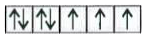 Thus, it has three unpaired electrons. `:.` Spin-only magnetic MOMENT `(mu)=SQRT(n(n+2))BM=sqrt(3(3+2))=sqrt(15)BM=3.87" BM"` |
|
| 28. |
Calculate the ‘spin only’ magnetic moment ofM^(2+) (aq) ion (Atomic number Z of M= 27) |
Answer» Solution :ELECTRONIC configuration of `M=[Ar]3d^7 4s^2` Outer electronic configuration of `M^(2+)=3d^7` i.e. `THEREFORE` Number of unpaired electrons =3 `therefore` Spin only mangnetic MOMENT `sqrt(n(n+2))=sqrt(3(3+3))=sqrt(15)=3.87` BM 
|
|
| 29. |
Calculate the spin only magnetic moment of Hg^(2+)[Co(SCN)_(4)]^(2-). |
| Answer» SOLUTION :`SQRT(15)BM` | |
| 30. |
Calculate the spin only magnetic moment of Fe^(2+) |
| Answer» SOLUTION :`mu=SQRT(N(n+2))=sqrt(4(4+2))=sqrt(24)=4.9BM` | |
| 31. |
Calculate the spin - only magnetic moment of Fe [Atomic number of iron = 26]. |
Answer» Solution :`Fe=1s^(2)2s^(2)3s^(2)3P^(6)4s^(2)3D^(6)`  `(i)mu=SQRT(N(n+2))` `=sqrt(4(4+2)=4.89B.M` |
|
| 32. |
Calculate the specific resistance of a 0.02 N solution of an electrolyte having equivalent conductance 103 ohm^(-1)cm^(2) (g eq.)^(-1). |
|
Answer» `Delta_(E)=103" ohm"^(-1)cm^(2)(G eq)^(-1),C=0.02" N"` `:."" k=(103" ohm"^(-1)cm^(2) cm^(-1)("g eq")^(-1)xx0.02("g eq"))/((1000" cm"^(3)))=2.06xx10^(-3)" ohm^(-1)cm^(=-1)` Specific RESISTANCE `(rho)=(1)/(k)=(1)/(2.06xx10^(-3) ohm^(-1) cm^(-1))=485.4" ohm " cm`. |
|
| 33. |
Calculate the specific activity of a radioactive substance ._(98)^(250) Cf if its half life is 6.93 min . Express your answer in terms of10^(16) dps. ("Use" : N_(A) = 6xx10^(23)) |
|
Answer» |
|
| 34. |
Calculate the solubility product of the reactionFe(OH)_3 = Fe^(3+)+ 3OH^(-)Given that Fe(OH)_3(s)+ 3e = Fe(s) + 3OH^(-) , E^@ =-0.77VFe^(3+) + 3e = Fe(s) E^@ = -0.036V |
| Answer» SOLUTION :`8.699 XX 10^(-38)` | |
| 35. |
Calculate the solubility product of AgCl from the two half reactions and standardelectrode potentials at 25^@CAg^(+) + e to Ag(s)E^@ = 0.799VAgCl + e to Ag(s) + Cl^(-) E^@ = 0.222V |
|
Answer» SOLUTION :`AGCL to Ag^(+) Cl^(-) , E^@ = 0.222-0.799` ` E^@ = 0.0591 LOG [Ag^+] Cl^-] = 0.0591 log K_(sp)` `1.66 XX 10^(-10)` |
|
| 36. |
Calculate the solubility product ofAg_(2)CrO_(4) at 298k, if the EMF of the concentration cell, Ag, Ag^(+)("solid" Ag_(2)CrO_(4))"//"Ag^(+)(0.1M), Ag is 0.164 V. |
|
Answer» Solution :`E_("cell")=0.164=0.059 LOG [Ag^(+)]_("cath")//[Ag^(+)]_("ANOD")` `log. ([Ag^(+)]_("cathode"))/([Ag^(+)]_("anode"))=(0.164)/(0.059)=2.78 = log. (0.1)/([Ag^(+)]_("anode"))` `[Ag^(+)]_("anod")=[Ag^(+)]` from saturated `Ag_(2)CrO_(4) =1.66xx10^(-4)M`. Solubility PRODUCT of `Ag_(2)CrO_(4)` is given as, `[Ag^(+)]^(2)[CrO_(4)^(2-)]`. Solubility product of `Ag_(2)CrO_(4)` `=(1.66xx10^(-4))^(2)(1.66xx10^(-4)//2)` `=2.28xx10^(-12)"mol"^(3)"lit"^(-3)` |
|
| 37. |
Calculate the solubility product of Ag_(2)CrO_(4) at 298K, if the EMF of the concentration cell, Ag, Ag^(+)(Solide Ag_(2)CrO_4)"//"Ag^(+)(0.1M), Ag is 0.164 V. |
|
Answer» Solution :`E_("cell") = 0.164 = 0.059 "log" [Ag^+]_("cath")//[Ag^+]_("ANOD")` `"log" ([Ag^+]_("cath"))/([Ag^+]_("anod")) = (0.164)/(0.059) = 2.78 = "log"(0.1)/([Ag^+]_("anod"))` `[Ag^+]_("anod") = [Ag^+]` from saturated solution of `Ag_(2)CrO_(4) = (1.66 xx 10^(-4))^(2) (1.66 xx 10^(-4)//2) = 2.28 xx 10^(-12) mol^(3) "LIT"^(-3)`. |
|
| 38. |
Calculate the solubility product of Ag_2 CrO_4 at 25^@Cif the concentration of Ag^+ions is 1.5 xx 10^(-4)mole/litre in a saturated solution of Ag_2CrO_4 at 25^@C |
| Answer» SOLUTION :`1.69 XX 10^(-12)` | |
| 39. |
Calculate the solubility of H_(2) in water at 25^(@)C if its partial pressure above the solution is 1 bar. Given that Henry's constant for H_(2) in water at 25^(@)C is 71.18 kbar. |
| Answer» SOLUTION :`7..79xx10^(-4)"MOL L"^(-1)` | |
| 40. |
Calculate the solubility in water in term of mole fraction in partial pressure of CO_(2) is 2xx10^(-3) bar at 298 K temperature, the K_(a) value for CO_(2) is 6.02xx10^(-4) bar. |
|
Answer» `3.322xx10^(-3)` `X_(CO_(3))=(P_(CO_(3)))/(KH)=(2XX10^(-8)"bar")/(6.02xx10^(-4)"bar")` `= 3.332xx10^(-4)`. |
|
| 41. |
Calculate the rms speed of ozone kept in a closed vessel at 20^(@)C and 82 cmHg pressure. |
|
Answer» SOLUTION :Volume occupied by 1 mole of `O_(3)` at `20^(@)` and 82 cm pressure `= 22400 xx (293)/(273) xx (76)/(82) = 22282` CC `p = 82 xx 13.6 xx 981 "dynes/cm"^(2)`. Now we have, `C = sqrt((3pV)/(M))` `= sqrt((3 xx 82 xx 13.6 xx 981 xx 22282)/(48))` |
|
| 42. |
Calculate the rms speed of ozone kept in a closed vessel at 20^(@)C and 82 cm Hg pressure. |
| Answer» SOLUTION :`3.9xx10^(4)" CM SEC"^(-1)` | |
| 43. |
Calculate the rms speed in cm/s at 25^(@)C at a free electron and of a molecule of UF_(6). (H = 1 , U = 238, F = 19) |
|
Answer» Solution :Mass of electron on atomic wt. scale is 1/1837 amu `THEREFORE` mass of 1 mole of electron `= (1)/(1837)g`. `R = 8.314 xx 10^(7)` ergs/k/mole `T = 273 + 25 = 298 K`. We have, `C = sqrt((3RT)/(M)) = sqrt((3 xx 8.314 xx 10^(7) xx 298)/(1//1837))` `therefore` rms speed of an electrons `1.16 xx 10^(7)` cm/s. To calculate rms spd. of `UF_(6)`, put `M = (238 + 6 xx 19)` |
|
| 44. |
Calculate the resulting molarity of the solution that is obtained by adding 5 g of NaOH to 250 ml of (M)/(4)NaOH solutoin (density =1.05 g//cm^(3)). The density of the resulting solutoin is 1.08 g//cm^(3). |
|
Answer» Solution :`"250 ml of "(M)/(4)" NaOH CONTAINS "=(40)/(4)xx(250)/(1000)g="2.5 g NaOH"` `"250 ml of NaOH sol "=250xx1.05g=262.5g` After ADDING 5g NaOH, now solute = 7.5 g and solution = 267.5 g VOLUME of NEW solution `=(267.5)/(1.08)=247.7ml=0.2477L` Molarity `=(7.5)/(40)molxx(1)/(0.2477L)=0.76M.` |
|
| 45. |
Calculate the result of 15. - 0.072 to proper number of significant figures: |
|
Answer» 15  SINCE 15 has no DIGIT after decimal , the answer should be ROUNDED off upto decimal point as 15. |
|
| 46. |
Calculate the resonance energy of N_(2)O from the following data : DeltaH_(f)^(0) "of" N_(2)O=82 kJ "mole"^(-1) Bond energies of N-=N, N=N,O=O and N=O bonds are 946, 418, 498 and 607 kJ "mole"^(-1) respectively. |
|
Answer» |
|
| 47. |
Calculate the resonance energy of isoprene (C_(5)H_(8)) from the data given. The standard heat of sublimation of graphite is 718 K kJ"mole"^(-1) and heat of formation C_(5)H_(8)(g) is 79 kJ mole. (Give your answer in kcal "mole"^(-1) , approximate integer.) |
|
Answer» |
|
| 48. |
Calculate the resonance energy of 1,3-butadiene from the following data- CH_3CH_2CH=CH_2+H_2overset(Pt)toCH_3CH_2CH_3 DeltaH=-30 kcal.mol^(-1) CH_2=CH-CH=CH_2+2H_2overset(Pt)toCH_3CH_2CH_2CH_3 DeltaH=-57kcal.mol^(-1) |
|
Answer» SOLUTION :Heat liberated due to HYDROGENATION of one DOUBLE bond = 30 kcal `mol^(-1)`. `:.` Heat liberated due to hydrogenation of TWO double bonds `= 30 xx 2 = 60 kcal mol^(-1)`. Heat liberated due to hydrogenation of 1, 3-butadiene `(CH_(2)=CH - CH = CH_(2)) = 57 kcal mol^(-1)` Therefore, resonance energy of 1,3-butadiene `60 -57 = 3 kcal. mol^(-1)` |
|
| 49. |
Calculate the relative rates of diffusion of 235 UF_(6) and 238 U F_(6) in the gaseous form. |
|
Answer» |
|
| 50. |
Calculate the resonance energy in CH_(3)COOH from the following data if the observed heat of formation of CH_(3)COOH is -439.7 kJ. {:("Bond energy (kJ)",,"Heat of atomisation (kJ)"),(C-H=413,,C=716.7),(C-C=348,,H=218.0),(C=O=732,,O=249.1),(C-O=351,,),(O-H=463,,):} |
|
Answer» Solution :Calculation of `DeltaH_(f)(CH_(3)COOH)`: `2C(s)+2H_(2)(g)+O_(2)(g) to CH_(3)COOH[H-underset(H)underset(|)overset(H)overset(|)(C)-overset(O)overset(||)(C)-O-H]` For reactants : Heat of atomisation of 2 moles of `C=2xx716.7=1433.4 KJ` Heat of atomisation of 4 moles of `H=4xx218.0=872.0 kJ` Heat of atomisation of 2 moles of `O=2xx249.1=498.2 kJ` For products : Heat of FORMATION of 3 moles of`C-H=-(3xx413)=-1239 kJ` Heat of formation of 1 moles of `C-C=-(1xx348)=-348 kJ` Heat of formation of 1 moles of `C-O=-(1xx732)=-732 kJ` Heat of formation of 1 moles of `C-O=-(1xx351)=-351 kJ` Heat of formation of 1 mole of `O-H=-(1xx463)=-463 kJ` Resonance energy in `CH_(3)COOH=xkJ ("say")` Adding algebraically, we get `DeltaH_(f)` of `CH_(3)COOH` `-329.4+x=-439.7 ("given")` `:. x=-110.3 "kJ mole"^(-1)`. |
|