

Saved Bookmarks
| 1. |
Calculate the Van't Hoff factor (i) for the following if: i.100% ionization or association takes place b.50% ionization or association takes place a.S ,b.Se , c.Te , d.P e.As , f.Sb , g.B , h.AlCl_(3) i. Hg_(2)Cl_(2) , j.HgCl_(2) , k.Be_(2)C , l.Al_(4)C_(3) m.CaC_(2) , n. Mg_(2)C_(3) |
|
Answer» Solution :i. `(a,b,c)` `S`,`Se`,and `Te` exist as `S_(8)`,`Se_(8)` and `Te_(8)` molecules. So association TAKES place. `8S hArr S_(8) hArr Se_(8), 8Te hArr Te_(8)` `i=1/8` `(d,e,f)` `P`,`As`and `Sb` exist as `P_(4)`,`As_(4)` and `Sb_(4)` molecules, so association takes place. `4P hArr P_(4), 4As hArr As_(4), 4Sb hArr Sb_(4)` `i=1/4` g. `B` exists as `B_(12)` molecule (icosahendron structure, 12 corners, and 20 faces), association takes place. `12 B hArr B_(12)` `i=1/12` h. `AlCl_(3)` exists as dimer in non-polar solvent, so association takes place. `2AlCl_(3) hArr Al_(2)Cl_(6)` `i=1/2` i. `Hg_(2)Cl_(2)` (calomel) ionizes to give `Hg_(2)^(2+)` (mercurous ion)and `2Cl^(ө)`(So, i=3)`Hg_(2)Cl_(2) hArr Hg_(2)^(+) + 2Cl^(ɵ)` (So, i = 3) J. `HgCl_(2)` (corrosive sublimate)is a covalent compound and does not ionize. (So i=1). `HgCl_(2)` is POISONOUS and antidote is white of an egg. (k,l) `Be_(2)C` and `Al_(4)C_(3)` in `H_(2)O` gives `CH_(4)` gas, so it contains `C^(4-)` methinide ion. `Be_(2) C + 4H_(2) O hArr 2Be (OH)_(2) + CH_(4)` `Al_(4)C_(3) + 12 H_(2)O hArr 4Al (OH)_(3) + CH_(4)` Hence, `Be_(2)C` and `Al_(4)C_(3)` ionizes in solution as follows: `Br_(2)ChArr 2Be^(2+) + C^(4-) (i = 3)` `Al_(4)C_(3) hArr 4Al^(3+) + 3 C^(4-) (i = 7)` m.`CaC_(2)` given `(CH -= CH)` gas with `H_(2)O`. So it contains `(C^(ɵ) -= -= C^(ɵ) "or" C_(2)^(2-) "ion")` `CaC_(2) + 2 H_(2) O hArr Ca(OH)_(2) + CH -= CH` So `CaC_(2)` ionizes in solution as follows : n. `Mg_(2)C_(3)` gives `(CH_(3) - C -= -= CH)` gas with `H_(2)O` so, it contains `CH_(3) C -= -= C^(ɵ) "or" C_(3)^(4-) "ions")` `Mg_(2)C_(3) + 4H_(2) O hArr 2Mg(OH)_(2) + CH_(3) - C -= -= CH` `Mg_(2) C_(3)` ionizes in solution as follows : `Mg_(2) C hArr 2Mg^(2+) + C_(3)^(4-) (i = 3)` II.(a,b,c) 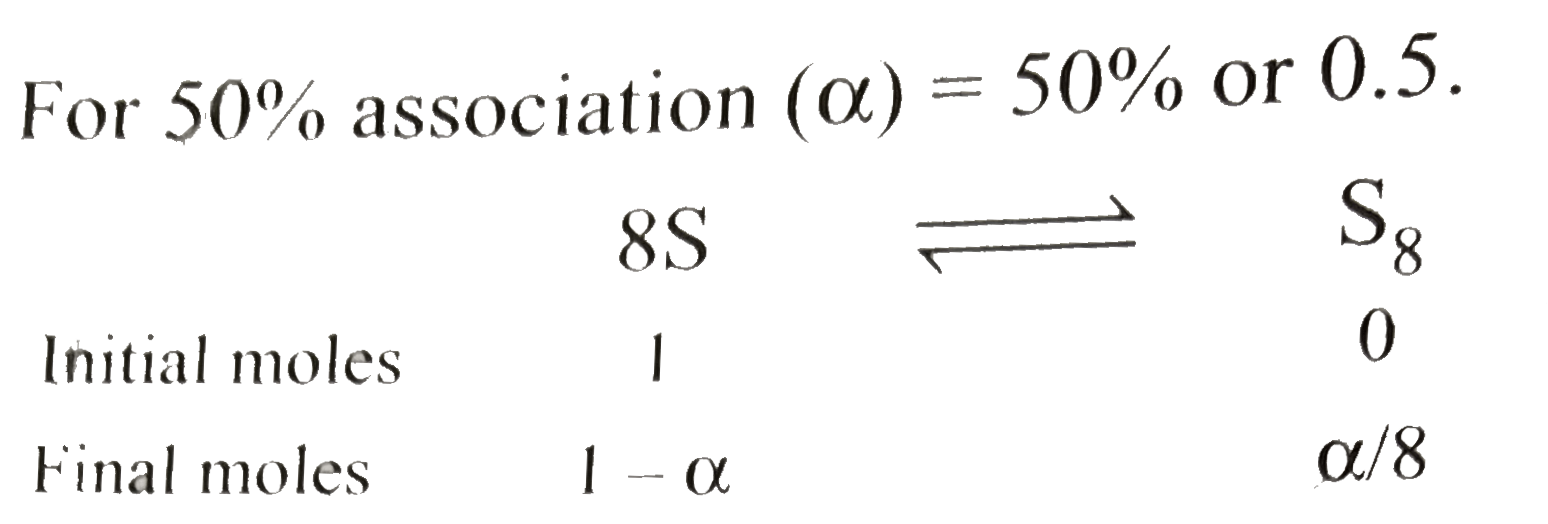 Total moles at equilibrium = `1-alpha+(alpha/8)` `i="Total moles"/"Initial moles"` `=(1-alpha+(alpha/8))/1` `=(8-8alpha+alpha)/8` `=(8-7alpha)/(8) =(8-7xx0.5)/8 =4.5/8 = 0.5625` Alternate method `i=("Number of ions" xx alpha)+(1-alpha)` =`(1/8xx0.5)+(1-0.5)=0.5/8+0.5` `:.i=4.5/8=(0.5625)` (d,e,f) 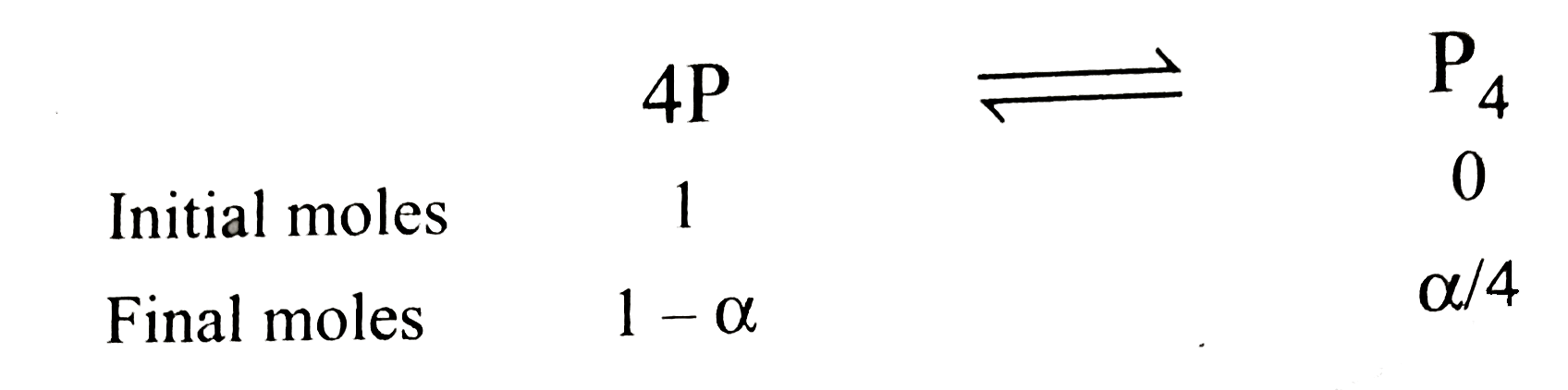 `i=(1-alpha+alpha/4)/1` `=(4-4alpha+alpha/4)` ` =(4-3alpha)/4 = (4-3xx0.5)/4 =2.5/4 =0.625` Alternate method `i=("Number of ions" xx alpha)+(1-alpha)` `=(1/4xx0.5)+(1-0.5)` `=0.5/4+0.5=2.5/4=0.625` g. 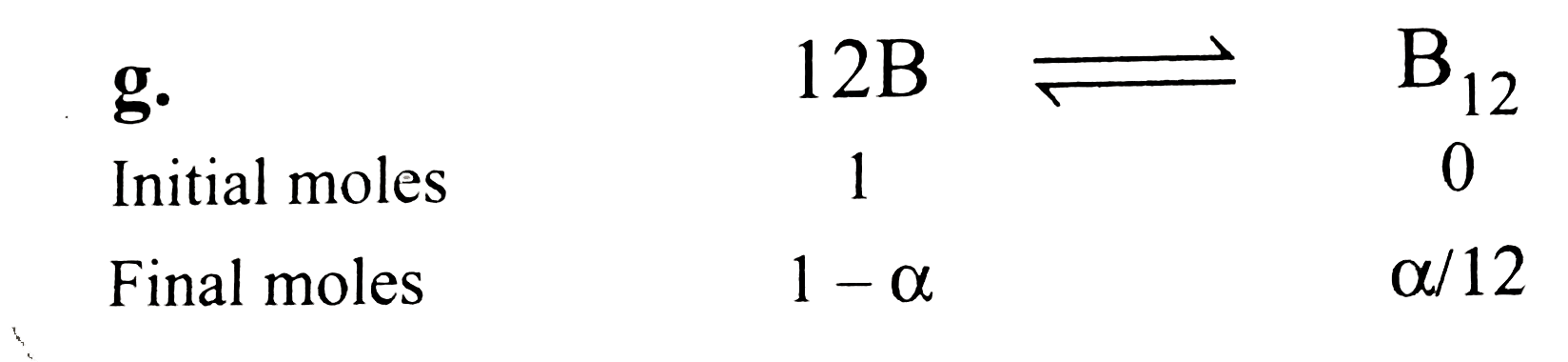 ` i=(1-alpha+alpha/12)/1` `=(12-12alpha+alpha/12)` ` =(12-11alpha)/12 = (12-11xx0.5)/12 =6.5/12 =0.54` Alternate method `i=("Number of ions" xx alpha)+(1-alpha)` `=(1/12xx0.5)+(1-0.5)` `=0.5/12+0.5=6.5/12=0.54` h. 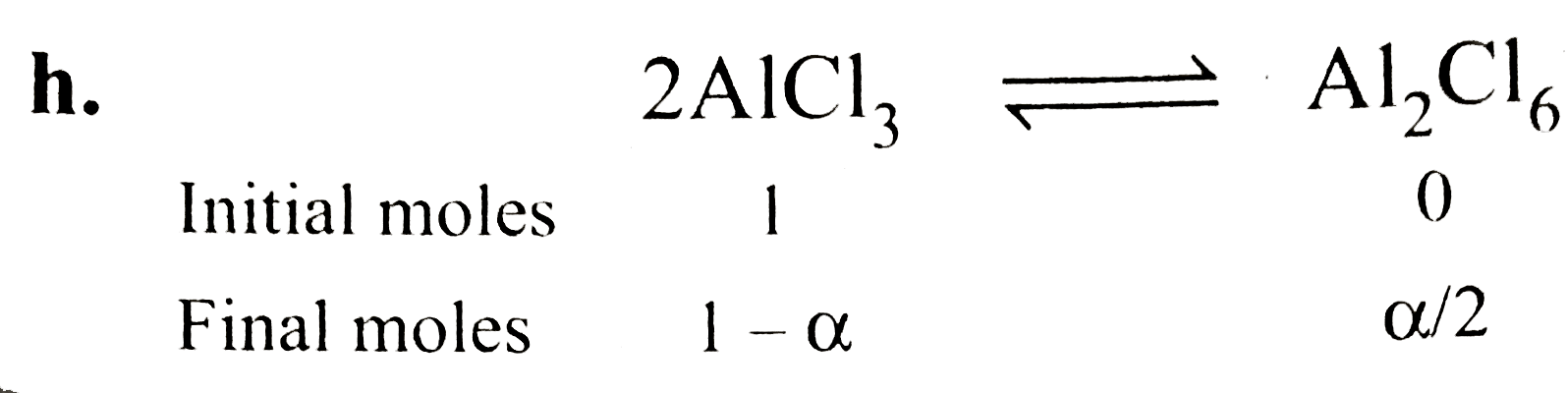 ` i=(1-alpha+alpha/2)/1` `=(1-2/alpha+alpha/1)` ` =(12-11/alpha)/12 = (12-11xx0.5)/2 =1.5/2 =0.75` Alternate method `i=("Number of ions" xx alpha)+(1-alpha)` `=(1/2xx0.5)+(1-0.5)` `=0.5/2+0.5=1.5/2=0.75`  ` i=(1-alpha+alpha+2alpha)/1` `=(1-2alpha=1+2xx0.5=2` Alternate method `i=("Number of ions" xx alpha)+(1-alpha)` `=(3xx0.5)+(1-0.5)` `=1.5+0.5=2` j. Since i=1, it does not ionize. k.  ` i=(1-alpha+alpha+2alpha)/1` `=(1-2alpha=1+2xx0.5=2` Alternate method `i=("Number of ions" xx alpha)+(1-alpha)` `=(3xx0.5)+(1-0.5)` `=1.5+0.5=2` j. Since i=1, it does not ionize. l. 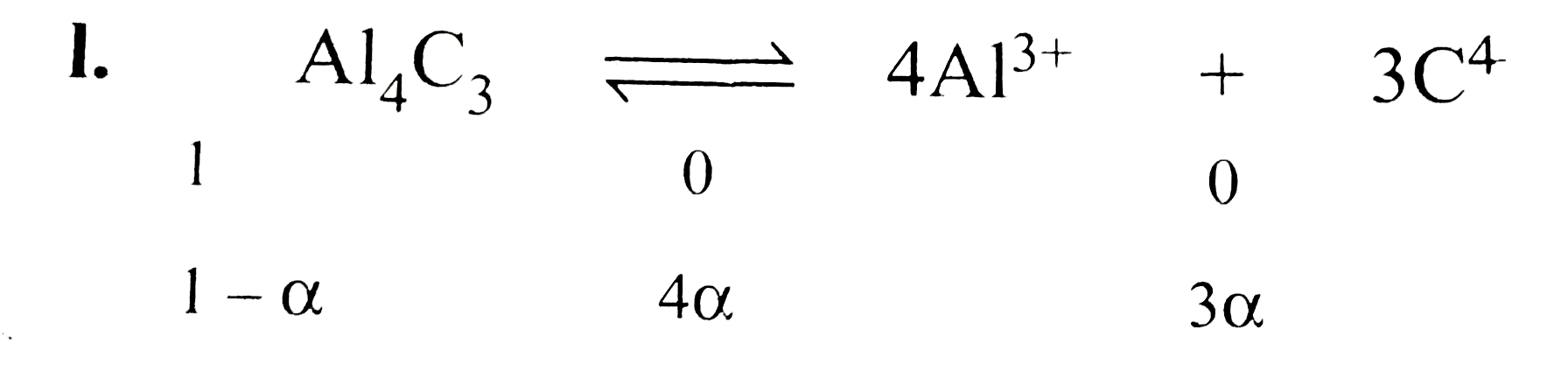 ` i=(1-alpha+4alpha+3alpha)/1` `=(1-6alpha=1+6xx0.5=4` Alternate method `i=("Number of ions" xx alpha)+(1-alpha)` `=(7xx0.5)+(1-0.5)` `=3.5+0.5=4` m.  ` i=(1-alpha+alpha+alpha)/1` `=(1+alpha=1+0.5=1.5` Alternate method `i=("Number of ions" xx alpha)+(1-alpha)` `=(2xx0.5)+(1-0.5)` `=1.0+0.5=1.5` n. 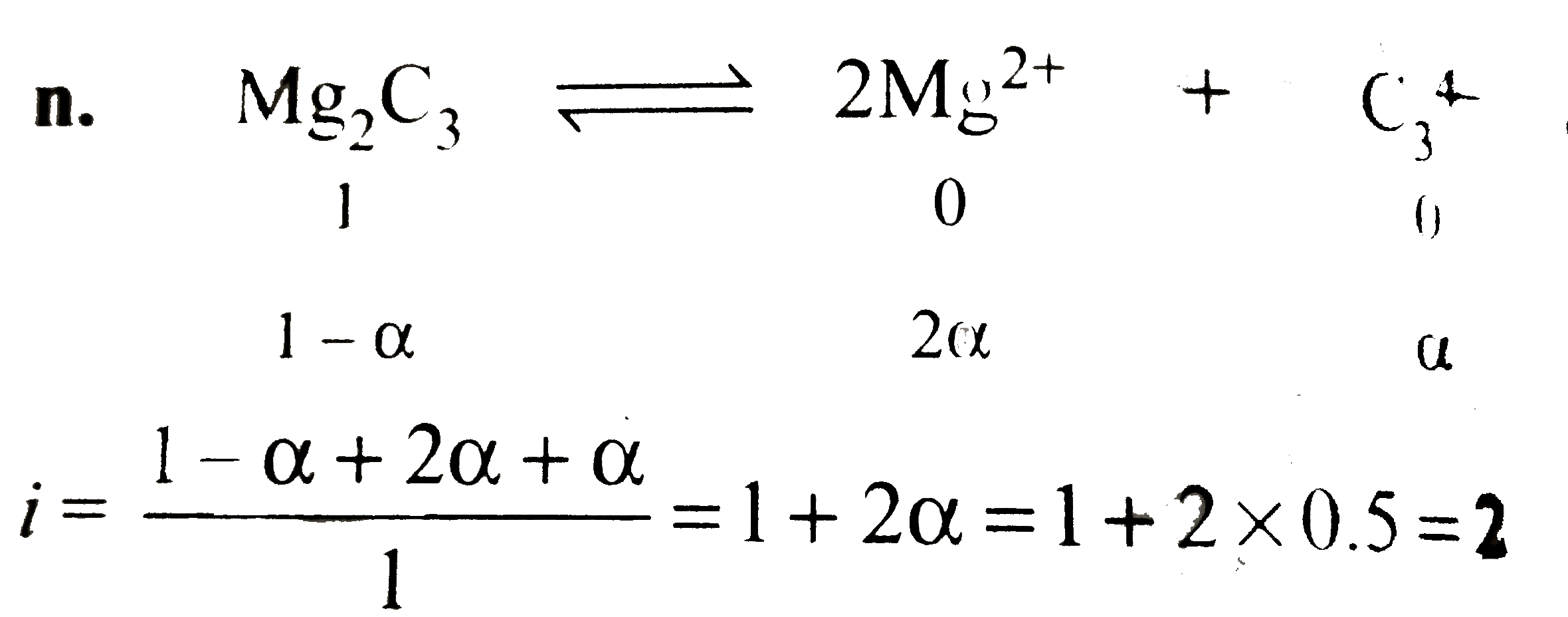 ` i=(1-alpha+2alpha+alpha)/1` `=(1+2alpha=1+2xx0.5=2`) Alternate method `i=("Number of ions" xx alpha)+(1-alpha)` `=(3xx0.5)+(1-0.5)` `=1.5+0.5=2` |
|