

Saved Bookmarks
This section includes 7 InterviewSolutions, each offering curated multiple-choice questions to sharpen your Current Affairs knowledge and support exam preparation. Choose a topic below to get started.
| 1. |
Calculate the packing fraction for the Ca unit cell, given that Ca crystallizes in a face-centered cubic unit cell. |
|
Answer» Solution :One-eighth of each CORNER ATOM and one-half of each face-centred atom are CONTAINED within the unit cell of Ca GIVING `Z=8 (1/8) + 6(1/2) = 4` Further, atomic RADIUS, `r=(sqrt(2)a)/4`…………….. (eqn 4) Volume of 4 atoms `4 xx 4/3 pi r^(3) = 4 xx 4/3 xx pi ((sqrt(2)a)/4)^(2) = (sqrt(2)pia^(3))/6` Packing fraction `=(sqrt(2)pia^(3))/6// a^(3) = (sqrt(2)pi)/6 = 0.74` |
|
| 2. |
Calculate the packing fraction for the K unit cell. K crystallizes in a body-centred cubic unit cell. |
|
Answer» |
|
| 3. |
Calculate the packing fraction of simple cubic arrangement. |
|
Answer» Solution :In a SIMPLE cubic arrangement `"PACKING fraction (or) efficiency"=("Total volume occupied by spheres in unit cell")/("volume of the unit cell")xx100` Consider the CUBE with an EDGE length .a. Volume of the cube with edge length a as `=axxaxxa=a^(3)"....(1)"` Let .r. is the radius of the sphere `"From the figure a"=2r rArr r=(a)/(2)` `therefore"volume of the sphere with radius r"=(4)/(3)pir^(3)` `=(4)/(3)pi((a)/(2))^(3)` `=(4)/(3)pi((a^(3))/(8))` `=(pia^(3))/(6)"...(2)"` In a simple cubic arrangement, numer of spheres belongs to a unit cell equal to one. `therefore` Total volume occupied by the spheres in sc unit cell `=1xx((pia^(3))/(6))"...(3)"` Dividing 3 by 1 `"Packing fraction "=((pia^(3))/(6))/(a^(3))xx100=(100pi)/(6)=52.31%` Only `52.31%` of the available volume is occupied by the spheres in simple cubic packing, making in efficient use of available space and hence minimizing the ATTRACTIVE forces. 
|
|
| 4. |
Calculate the packing efficiency of a metal crystal for a simple cubic lattice. |
Answer» Solution :Let the side of the cube be a and the radius of each particle be r. 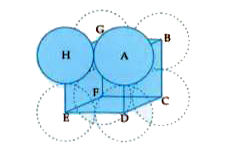 Then`""a=2r` Volume of the unit cell `=(2r)^(3)=8r^(3)` Simple CUBIC unit cell contains only 1 atom Volume of the occupied space `=(4)/(3)pir^(3)` Volume of the occupied space `=(4)/(3)pir^(3)` `THEREFORE"Packing efficiency "=("Volume of one atom")/("Volume of cubic unit cell")XX100` `=((4)/(3)pir^(3))/(8r^(3))xx100=(PI)/(6)xx100=52.4%` |
|
| 5. |
Calculate the packing efficiency in simple cubic unit cell. |
|
Answer» SOLUTION :In a simple cubic UNIT cell, two spheres at the corners of the cube touch each other. Let edge length of cube = a. Let radius of SPHERE = R The radius of sphere and edge length of cube is related as: a = 2r The volume of cubic unit cell `= a^3 = (2r)^3 = 8r^3` Since the simple cubic unit cell contains only 1 atom, the volume of the occupied space is= `4/3 pi r^3` % Packing efficiency =`("Volume occupied by four spheres in unit cell" xx 100)/("Volume of the unit cell")` ` = 4/3 pi r^3_(8 r^3) xx 100 = pi/6 xx 100` `52.4%`. |
|
| 6. |
Calculate the packing efficiency in fcc unit cell ? |
|
Answer» SOLUTION :Total number of spheres BELONGS to a single fcc unit cell is 4. `"VOLUME of the sphere with radius r is "=(4)/(3)pi((sqrt2a)/(4))^(3)` `=(sqrt2pia^(3))/(24)` `therefore"Volume of all spheres in fcc unit cell"=4XX((sqrt2pia^(3))/(24))` `=(sqrt2pia^(3))/(6)` `"Packing efficiency "=(((sqrt2pia^(3))/(6)))/(a^(3))xx100` `=(sqrt2pi)/(6)xx100` `=(1.414xx3.14xx100)/(6)=74%` |
|
| 7. |
Calculate the packing efficiency in Face Centred Cubic (FCC) structure. |
Answer» Solution : The edge length `=.a.` Radius of sphere = r Face diagonal AC = b = 4r In `DeltaABC , AC^(2) = b^(2) =AB^(2) + BC^(2)` `=a^(2)+ a^(2) = 2a^(2)` `:. b=SQRT(2)a " But " b = 4r = sqrt(2) a ` ` a= (4r)/(sqrt(2)) = 2 sqrt(2) r ` VOLUME of sphere `= ((4)/(3))pir^(3)` Volume of cube `=a^(3) = (2sqrt(2)r)^(3)` Number of particle per unit CELL in FCC = Z = 4 spheres . Packing efficiency `=("Volume OCCUPIED by four spheres in the unit cell " xx 100)/("Total volume of the unit cell ") or ` Packing efficiency `=(ZV_("sphere") xx 100)/(a^(3))` `=(4 xx (4)/(3) pir^(3) xx 100)/((2sqrt(2)r)^(3))=(16 pi r^(3)xx 100)/( 48 sqrt(2) r^(3))` ` (pi xx 100)/(3 sqrt(2)) = 74%` |
|
| 8. |
Calculate packing efficiency in BCC lattice. |
|
Answer» Solution :Diagram Relationship between .a. and .r. `a = 4/SQRT3 r` OR `r = (sqrt3a)/4` Packing efficiency formula Substitution and answer Detailed Answer: In `DeltaABC`, `b^2 = a^2 + a^2 :.b^2 = 2a^2`, In, `Delta ABC`  `C^2 = a^2 + b^2= a^2 + 2a^2 :. C = sqrt 3a` Radius of the atom `=r`. Length of the body diagonal ` C =4r` `sqrt 3a = 4r` `a = ( 4r)/(sqrt3)` EDGE length of the CUBE`= a = (4r)/sqrt(3)` Volume of the cubic unit cell `= a^3 = ((4r)/sqrt(3))^3` Volume of one particle (sphere) `= 4/3 pi r^3` The number of particles PER unit cell of a bcc = 2 Total volume occupied by two spheres `= 2 xx 4/3 pi r^3` Packing efficiency `= ("Total volume occupied by the two spheres")/("VOlume of a cubic unit cell") xx 100` `(4/3pir^3xx2)/((4/sqrt3r)^3) xx100 =(8/3pir^3)/(64/(3sqrt3)r^3)xx100 =68%` (1) A face CENTRED cube contains 8 lattice points at the eight corners and 6 lattice points at the centres of six faces. (2) A particle present at the corner shares `1/8` of that particle to each unit cell. (3) A particle present at the centre of a face provdes a share of `1/2` of that particle to each unit cell. |
|
| 9. |
Calculate the number of particles in Body Centered Cubic (BCC) lattice. |
|
Answer» SOLUTION :In `/_\ABG` `b^2=a^2+a^2" ":.b^2=2a^2` In `/_\AGD` `C^2=a^2+b^2=a^2+2a^2"":.C=sqrt(3a)` Radius of the atom=r Length of the body diagonal C=4r `sqrt3a=4r,a=(4r)/(sqrt3)` Edge length of the cube`=a=(4r)/(sqrt3)` Volume of the cubic unit cell`=a^3=((4r)/(sqrt3))^3` Volume of one particle (sphere)`=4/3pir^3` The number of PARTICLES per unit cell of a BCC=2 Total volume occupied by two spheres`=2xx4/3pir^3` Packing efficiency`=("Total volume occupied by the two spheres")/("Volume of a cubic unit cell")xx100` `(4/3pir^3xx2)/((4/(sqrt3)r)^3)xx100=(8/3pir^3)/((64)/(3sqrt3)r^3)xx100=68%` |
|
| 10. |
Calculate the oxidation number of the central metal atoms or ions : (any 4): (4) [CoCl_(2)(en)_(2)]^(+) |
|
Answer» SOLUTION :ASSUME, the oxidation NUMBER of the central metal ATOM or ion = x. `x-1xx2+0xx2=+1, or, x=+3` |
|
| 11. |
Calculate the oxidation number of sulphur in H_(2)SO_(3) and in H_(2)S_(2)O_(8) |
|
Answer» SOLUTION :`H_(2)SO_(5)` has one peroxy bond. Two oxygen ATOMS have -1 OXIDATION state. Oxidation number of .S. in `H_(2)SO_(5)` is +6. `H_(2)S_(2)O_(8)` has one peroxy bond. Two oxygen atoms have -1 oxidation state. Oxidation number of each .S. in `H_(2)S_(2)O_(8)` in +6. |
|
| 12. |
Calculate the oxidation number of Mn in the product of alkaline oxidative fusion of MnO_2 |
|
Answer» SOLUTION :`4KOH + 2MnO_2 + O_2 to 2K_2MnO_4 + 2H_2O` 9 |
|
| 13. |
Calculate the oxidation number of iron in (a) pentacarbonyl and (b) potassium ferrocyanide. |
|
Answer» |
|
| 14. |
Calculate the oxidation number of iron in (a) FeO, (b) Fe_(2)O_(3) and (c) Fe_(3)O_(4). |
|
Answer» |
|
| 15. |
Calculate the oxidation number of Co ln [Co(NH_(3))_(5)Cl]^(2+) . |
|
Answer» SOLUTION :`LN[Co(NH_(3))_(5)Cl]^(2+)` let the oxidation number of cobalt is `x`. The net change `=+2=x+5(0)+1(-1)` `x-1=+2` `:.x=+3` |
|
| 16. |
Calculate the oxidation number of chromium in K_2Cr_2O_7. |
|
Answer» SOLUTION :2(+1) + 2`cdot`X + 7(-2) = 0 2x-12=0 x=6 |
|
| 17. |
Oxidation number of chromium in K_2Cr_2O_7 is: |
|
Answer» SOLUTION :`2(+1) + 2X + 7(-2) = 0` `IMPLIES 2x - 12 = 0` `implies x=6` |
|
| 18. |
Calculate the overall order of a reaction which has the rate expression. (a) Rate= k[A]^(1//2) [B]^(3//2) (b) Rate= k[A]^(2//2) [B]^(-1) (c ) Rate= k[A]^(1//2) [B]^(-1) Rate= [A]^(X)[B]^(Y) = Order= x + y |
|
Answer» Solution :(a) Rate ` = k[A]^(1//2)[B]^(3//2)` ORDER ` = (1)/(2) + (3)/(2) = 2` (b) Rate` = k[A]^(3//2)[B]^(-1)`Order ` = (3)/(2) - 1 = (1)/(2)` (c ) Rate ` = k[A]^(1//2)[B]^(2) = 2.5` |
|
| 19. |
Calculate the overset(@)Lambda_(m) for MgCl_(2). The limiting molar conductivities of Mg^(2+)and Cl^(-1)ions are 106.0 S cm^(2)" mol"^(-1)and 76.3 S cm^(2)"mol"^(-1)respectively. |
|
Answer» SOLUTION :`overset(@)Lambda_(m)(MgCl_(2))=LAMBDA^(@)mg2+2lambda^(@)Cl^(-)` `=(106.0S CM^(2)+2xx76.3S cm^(2))` `overset(@)Lambda_(m)(MgCl_(2))=258.6 S cm^(2)` |
|
| 20. |
Calculate the overall order of a reaction which has the rate expression. |
|
Answer» SOLUTION :(a)Rate =`K[A]^((1)/(2)) [B]^((3)/(2))` (b)`k[A]^((3)/(2)) [B]^(-1)` (a)Rate=`k[A]^(x) [B]^(y)` ORDER =x+y So, order =`(1)/(2)+(3)/(2)`= 2 i.e SECOND order . (b)Rate =`k[A]^((3)/(2)) [B]^(-1)` Order =x+y `=(3)/(2)-1=(1)/(2)` i.e hald order . |
|
| 21. |
Calculate the overall complex dissociation equillibrium constant for the [Cu(NH_3)_4]^(+2) ion,given that (beta_4) for this complex is 2.1xx10^13. |
| Answer» SOLUTION :THEREFOR OVERALL DISSOCIATION CONSTANT=`1//beta_4=1//2.1xx10_3`=`4.7xx10^-14` | |
| 22. |
Calculate the overall complex dissociation equilibrium constant for the Cu(NH_(3))_(4)^(2+) ion, given that beta_(4) for this complex is 2.1 xx 10^(13). |
|
Answer» Solution :Overall STABILITY constant `(beta_(4))=2.1xx10^(3)` Overall DISSOCIATION constant is the RECIPROCAL of the overall stability constant. Hence, overall dissociation constant= `1/(beta_(4))=1/(2.1xx10^(13))=4.7xx10^(-14)` |
|
| 23. |
Calculate the osmotic pressure os potassium ferrocyanide solution whose 0.1M aqueous solution dissociates to 45% at 298 K. |
|
Answer» `K_(4)[FE(CN)_(6)]to 4K^(+)+[Fe(CN)_(6)]^(4-)` `alpha=(i-1)/(n-1)=,0.45=(i-1)/(5-1)=(i-1)/4or i=0.45xx4+1=2.8` Step II. `"Calculation of osmotic pressure "(PI)` `pi=I CRt` `pi=(2.8)xx(0.1" MOL L"^(-1))xx(0.0821" L atm K"^(-1)mol^(-1))xx(298 K)=6.85 "atm".` |
|
| 24. |
Calculate the overall complex dissociation equilibrium constant for the Cu(NH_(3))_(4)^(2+) ion, given that beta_(4) for this complex is 2.1xx10^(13) |
|
Answer» Solution :Overall stability constant `(beta_(4))=2.1xx10^(13)` Overall DISSOCIATION constant is the RECIPROCAL of the overall stability constant. HENCE,overall dissociation constant `=(1)/(beta_(4))=(1)/(2.1xx10^(13))=4.7xx10^(-14)`. |
|
| 25. |
Calculate the osmotic pressure of the solution prepared in the above question T = 300 K , (R = 0.08 L atm mol^(-1) K^(-1)) |
|
Answer» `10.8` ATM |
|
| 26. |
Calculate the osmotic pressure of a soution obtained by mixing 100cm^(3) of 0.25 M solution of urea and 100cm^(3)of 0.1 M solution of cane sugar at 298 K |
|
Answer» `"No. of moes of cane sugar"=(0.1"mol")xx((100cm^(3)))/((1000cm^(3)))=0.01 mol` `"TOTAL no. of moles of solutes"=(0.025+0.01)=0.035 mol` `"Total volume of the solution"=200/1000=0.2 L` `"Osmotic pressure "(pi)=(n_(B)RT)/V=((0.035mol)xx(0.0821"L atm K"^(-1)mol^(-1))xx(298K))/((0.2L))=4.28 atm.` |
|
| 27. |
Calculate the osmotic pressure of a solution containing 17.1 g of cane - sugar (molecular mass 342) in 500 g of water at 300 K (R = 0.082 lit. atm deg^(-1)mol^(-1)). Density of the solution of urea. Find the molecular weight of urea. |
|
Answer» `"VOLUME of the solution = Mass/Density"=517.1//1.034cm^(3)=500cm^(3)=0.5L` `pi=(wRT)/(M_(2)V)=(17.1gxx0.082"L atm K"^(-1)"MOL"^(-1)xx300K)/("342 G mol"^(-1)xx0.5L)="2.46 atm."` |
|
| 28. |
Calculate the osmotic pressure of a 0.1 M monobasic and if its pH is 2.0 at 25^(@)C. |
|
Answer» <P> Solution :`{:(,HA,hArr,H^(+),+,A^(-)),("INITIAL","C mol L"^(-1),,,,),("At. eqm.",""C-Calpha,,""Calpha,,"Calpha):}``""(alpha = " degree of dissociation")` `"i.e."[H^(+)]=C alpha. " But "[H^(+)] = 10^(-2)M` `therefore""Calpha =10^(-2) or alpha =(10^(-2))/(C)=(10^(-2))/(0.1)=0.1` Total number of particles after dissociation `=C-C alpha + C alpha+ C alpha=C(1+alpha)` `therefore"van't Hoff factor (i)"=(C(1+alpha))/(C)=1+alpha=1+0.1=1.1` `therefore"Osmotic PRESSURE (P) = i CRT = "1.1xx0.1xx0.0821 xx 298 atm = 2.69 atm.` |
|
| 29. |
Calculate the osmotic pressure of a decinormal solution of cane sugar at 0^(@)C. |
|
Answer» <P> Solution :`(N)/(V)=` molar concentration `=0.1M``R=0.082`lit. atm /K/mole, `T=273K` We have, `p=(n)/(V)RT`……..(Eqn. 6) `:.p=0.1xx0.082xx273` `=2.24atm` |
|
| 30. |
Calculatethe osmoticpressureof 6%sucrose(C_(12) H_(22)O_(11))solutionat 300 K (R 8. 314 J mol^(-1) K^(-1)) |
|
Answer» M= Molecularweightof sucrose`=(C_(12) H_(22) O_(11))` `=(12 xx 12 + 22 xx 1+ 11 xx 16)` `=342 "mol"^(-1)` `= 342 xx 10^(-3) kg "mol"^(-1)` n= Number of themoles ofsucrose `= (W)/(M)= (6.0 xx 10^(-3))/(352 xx 10^(-3))` `=0.01754 "mol"` V= Volumeof the solution=100ml = 0.1 `dm^(3)` `=0.1 xx 10^(-3)m^(3)` T=Temperatureof thesolution=300 K `R= 8.314 J "mol"^(-1) K^(-1)` 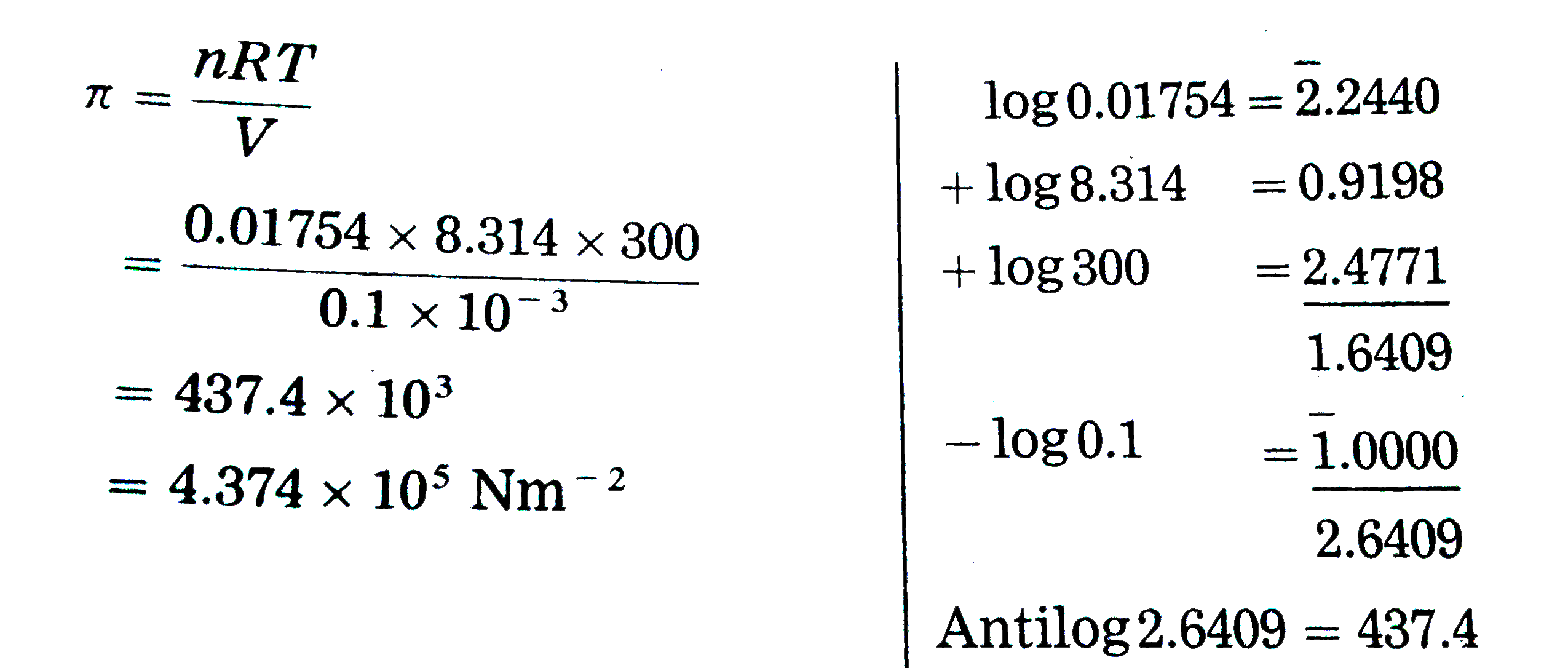
|
|
| 31. |
Calculate the osmotic pressure of 5% solution urea at 273 K. |
|
Answer» `W_(B)=5g, R=0.0821" L atm K"^(-1)mol^(-1), T=273 K` `M_(B)=60" g mol"^(-1), V=100 m L=0.1 L` `M_(B)=((5g)xx(0.0821"L atm K"^(-1)mol^(-1))xx(273 K))/((60" g mol"^(-1))xx(0.1L))=18.6 atm.` |
|
| 32. |
The osmotic pressure of 5% solution of urea at 273 K is |
|
Answer» = 18.68 atm. |
|
| 33. |
Calculatethe osmoticpressureof 5%glucose (C_(6) H_(12) O_(6)) solutionat 300 k. (R= 8.314 J mol^(-1)K^(-1) , " Atomic weights " C = 12 , H =1 , O=16) |
| Answer» SOLUTION :692 .8 KPA | |
| 34. |
Calculate the osmotic pressure of 0.25 M urea solution at 27^(@)C temp. (R=0.082 lit.at./mole K, R = 1.987 K cal.) |
|
Answer» 0.0615 atmosphere `= (W)/(MV)XX RT` `= C xx RT` `= 0.25xx0.082xx300` = 6.15 atmosphere |
|
| 35. |
Calculate the osmotic pressure of 0.01 M solution of cane-sugar at 300 K (R = 0.0821 litre atm/degree/mole). |
|
Answer» Solution :(a) Here, we are given that `"C = 0.01 M= 0.01 mole/LITRE, R = 0.0821 litre atm/degree/mole, T = 300 K"` Using the reation `pi=CRT,` we GET `pi=("0.01 MOL L"^(-1))XX("0.0821 L at K"^(-1)"mol"^(-1))("300 K")="0.2463 atm."` |
|
| 36. |
Calculate the osmotic pressure of 0.05% urea solution in water at 20^(@)C. Given R = 0.0821 atm mol^(-1)K^(-1) . Molar mass of urea = 60 g mol^(-1) . |
|
Answer» Solution :`pi ` = CRT = `("no. of moles")/("volume") xx R xx T` `= (W_(B))/(M_(B)) xx (RT)/(V)` = `(0.05)/(60) xx (0.0821 xx 293)/(100)` `pi` 0.0002 ATM. |
|
| 37. |
Calculate the osmotic pressure in pascals exerted by a solution prepared by dissolving 1.0 g of polymer of molar mass 185,000 in 450 mL of water at 37^(@)C. |
|
Answer» Solution :It is given that : Volume of water, `V = 450 ML = 0.45 L` , Temperature, `T=(37+273)K = 310 K` NUMBER of the polymer, `n = (1)/(185000)` We know that, OSMOTIC PRESSURE, `X = (n)/(V)RT` `= (1)/(185000)mol xx (1)/(0.45 L)xx 8.314xx10^(3)` Pa. L. `K^(-1)mol^(-1)xx310 K` = 30.96 Pa (approximately) |
|
| 38. |
Calculatethe osmoticpressureof 0.2 Mglucosesolution at 300K. (R=8.314 J mol^(-1)K^(-1)) |
|
Answer» `=0.2 "mol" dm^(-2)` `=0.2 xx 10^(3) "mol" m^(-3)` Temperature `= T= 300 K` `R= 8.314 J mol^(-1) K^(-1)` Theosmoticpressure`PI` is givenby `pi` = CRT `=0.2xx 10^(3)xx 8.314 xx 300` `=4.988 xx 10^(5)Nm^(-2)`(or pa)` |
|
| 39. |
Calculate the osmotic pressure in pascals exerted by a solution prepared by dissolving 1.0 g of polymer of molar mass 185,000 in 450 mL of water at 37^@C |
|
Answer» SOLUTION :Applying the relation `pi = CRT = n/V RT` Number of moles of solute dissolved`(n) = (10g)/(185,000 g "mol"^(-1))= (1)/(185,000)` `V = 450 ML = 0.450 L, T = 37^@C = 37 + 273 = 310 K` The osmotic pressure is to be GIVEN in pascals. ` R = 8.314 kPa LK^(-1) "mol"^(-1) = 8.314 xx 10^3 Pa LK^(-1) "mol"^(-1)` SUBSTITUTING the values, we get `pi = (1)/(185000) "mol" xx (1)/(0.45 L) xx 8.314 xx 10^3 Pa LK^(-1) "mol"^(-1) xx 310 K = 30.96 Pa ` |
|
| 40. |
Calculate the osmotic pressure in Pascals exerted by a solution prepared by dissolving 1.0 g of polymer of molar mass 1,85,000 in 450 mL of water at 37^(@)C. Use the formula for osmotic pressure (pi)="CRT and C"=(n)/(V)" and n"=(W_(B))/(M_(B)) |
|
Answer» SOLUTION :Mass of polymer `(W_(B))=1.0" g"` Molar mass of polymer `(M_(B))=185000" g mol"^(-1)` Volume of solution (V) `=450" mL"=0.450" L"` Temperature (T) = `37+273=310" K"` Solution constant ( R ) `=8.314xx10^(3)" Pa L K"^(-1)" mol"^(-1)` Osmotic pressure `(pi)=CRT` `=(W_(B)xxRxxT)/(M_(B)xxV)` `pi=((1.0" g")XX(8.314xx10^(3)" Pa L K"^(-1)" mol"^(-1))xx(310" K"))/((185000" g mol"^(-1))xx(0.450" L"))` `=30.96" Pa"` |
|
| 41. |
Calculate the osmotic pressure in pascals exerted by a solution prepared by dissolving 1.0 g of polymers of molar mass 185,000 in 450 mL of water at 37^(@)C. |
|
Answer» Solution :`pi=CRT=(n)/(V)"RT"` Here, NUMBER of MOLES of solute dissolved `(n)=(1.0g)/("185,000 g mol"^(-1))=(1)/("185,000 g mol")` `"V = 450 mL = 0.450 L,T = "37^(@)C= 37+273=310K` `R = "8.314 KPA L K"^(-1)"mol"^(-1)=8.314xx1^(3)" pA L K"^(-1)"mol"^(-1)` Substituting these values, we get `pi=(1)/(185,000)"mol"xx(1)/(0.45 L)xx8.314xx10^(3)" Pa L K"^(-1)"mol"^(-1)xx310 K=30.96 Pa.` |
|
| 42. |
Calculate the osmotic pressure exerted by a solution prepared by dissolving 1.5g of a polymer of molar mass 185000in 500mL of water at 37^@C (R = 0.0821 L atm K^(-1) mol^(-1) |
| Answer» SOLUTION :`PI = (WRT)/(MV)=(1.5xx0.0821xx310)/(185000xx500/1000) = 0.00041` ATM. | |
| 43. |
Calculate the osmotic pressure at 273 K of a 5% solution of urea (Mol. Mass = 60). (R = 0.0821 litre atm/degree/mole). |
|
Answer» Solution :`5%` solution of urea means that it contains 5 g of urea per `100cm^(3)` of the solution, i.e., `w_(2)=5g, V=100 cm^(3)=(1)/(10)" litre = 0.1 litre."` `M_(2)-"60 g MOL"^(-1), R="0.0821 L atm K"^(-1)"mol"^(-1), T= 273 K` `therefore""pi=(n)/(V)RT=(w_(2))/(M_(2))xx(1)/(V)RT=(w_(2)RT)/(M_(2)V)=((5g)("0.08211 L atm K"^(-1)"mol"^(-1))(273 K))/(("60 g mol"^(-1))("0.1 L"))="18.68 atm."` |
|
| 44. |
Calculate the osmosis pressure of a solution obtained by mixing 100cm^(3)of 1.5% solution of urea (mol. Mass = 60) and 100cm^(3) of 3.42% solution of cane-sugar (mol. Mass = 342) at 20^(@)C (R = 0.082 litre atm/degree/mole) |
|
Answer» Solution :After mixing, total VOLUME of the solution `=100+100=200cm^(3)` Osmotic pressure DUE to the urea in the solution : 1.5 g urea which was present originally in `100 cm^(3)` is now present in `200cm^(3)`, i.e., in the final solution Concentration of urea, `C = 1.5g//200cm^(3)=1.5xx"5 g/litre = 7.5 g/litre "=(7.5)/(60)"moles/litre"` `""(because" Molar MASS of urea = 60 g mol"^(-1))` `T = 20+273=293K, R = "0.082 litre atm/degree/mole"` `therefore""pi=CRT=((7.5)/(60)" mol L"^(-1))=(0.082" L atm K"^(-1)"mol"^(-1))XX(293 K)=3.00 atm.` Osmotic pressure due to cane-sugar in the solution : In the final solution. Concentration of cane sugar, `C=3.42g//200cm^(3)=3.42xx"5 g/litre = 17.10 g/litre"=(17.10)/(342)" moles/litre"` `""(because"Molar mass of sugar = 342 g mol"^(-1))` `therefore""pi=CRT=((17.10)/(342)" mol L"^(-1))xx("0.082 L atm K"^(-1)"mol"^(-1))(293 K)="1.20 atm"` As the TWO solutes behave independent of each other in the solution, Total Osmotic pressure = Osmotic pressure of urea `+` Osmotic pressure of sugar `=3.00 +1.20=4.20` atm. Alternatively, as colligative properties depend only on the number of moles of the solute and do not depend upon the nature of the solute, problem can be solved by finding the total number of the moles of the solute as follow : No. of moles of urea present `=(1.5)/(60)=0.025" ,No. of moles of cane sugar present"=(3.42)/(342)=0.01` Total no. of moles of the solute `=0.025+0.01=0.035` Total volume of the solution `=100+100cm^(3)=200cm^(3)=0.2L` Applying the relation, `pi=(n)/(V)RT,` we have `pi=("0.035 mol"xx"0.0821 L atm K"^(-1)"mol"^(-1)xx293K)/(0.2L)="4.20 atm."` |
|
| 45. |
Calculate the order of the reaction whose rate law expression was predicted as : "Rate = "k[NO]^((3)/(2))[O_(2)]^((1)/(2)) |
| Answer» SOLUTION :ORDER of the REACTION `=3/2+1/2=2` | |
| 46. |
Calculate the order of reaction for the reaction 2NH_(3)(g) to N_(2)(g) + 3H_(2)(g) Given that half life period (t_(1//2)) under a pressure of 50mm Hg is 3.52 and under a pressure of 100 mm Hg is 1.82 |
|
Answer» <P> `n=1+(LOG(t_(1//2))1-log(t_(1//2))2)/(log p_(2)-log p_(1))` `1+ (log 3.52 - log 1.82)/(log 100 - log 50)` `1+(0.5465 - 0.2600)/(2-1.6989)` `1+ (0.2865)/(0.3011) = 1+0.9515=2` |
|
| 47. |
Calculatethe [OH^(-)]of a solution after100 mLof 0.1M MgCl_(2)is addedto 100 mL0.2M NaOH K_(sp)of Mg(OH)_(2) is 1.2 xx10^(-11) . |
|
Answer» Solution :` {:(,MgCl_(2),+,2NaOH,to,"Mg"(OH)_(2),+,2NaCl),(" mm before REACTION",10,,20,,0,,0),(,0,,0,,10,,20):}` Thus , 10 m moleof `Mg(OH)_(2)`are formes . The productof `[Mg^(2+)][OH^(-)]^(-2)` is therefore`[(100)/(200)]XX [(20)/(200)]^(2) = 5 xx10^(-4)`whichis more than`K_(SP)`of `Mg(OH)_(2)`, Now SOLUBILITY (S) of`Mg(OH)_(2)`can bederived by ` K_(sp) = 4S^(3)` ` :. S = root3(K_(sp)) = root3(1.2 xx 10^(-11)) = 2.29 xx10^(-4)` ` :. [OH^(-)] = 2S = 2xx 2.29 xx10^(-4) = 4.58 xx10^(-4)`. |
|
| 48. |
Calculate the OH– concentration and the H_3PO_4 concentration of a solution prepared by dissolving 0.1 mol of Na_3PO_4 in sufficient water to make 1 l of solution K_(1)=7.1 xx 10^(-3), K_(2)=6.3 xx 10^(-8), K_(3)=4.5 xx 10^(-13))? |
|
Answer» `[OH^(-)] 3.73 xx 10^(-18) M, [H_(3)PO_(4)]=6 xx 10^(-3)M` |
|
| 49. |
Calculate the number of unpaired electrons in Ti^(3+), Mn^(2+) and calculate the spin only magnetic moment. |
|
Answer» Solution :`Ti^(3+)` Ti (Z = 22). Electronic CONFIGURATION [Ar] `3D^(2)4s^(2)` `Ti^(3+)` - Electronic configuration `[Ar]3d^(1)` So, the number of UNPAIRED electrons in `Ti^(3+)` is equal to 1. Spin only magnetic moment of `Ti^(3+) = SQRT(1(1+2)) = sqrt(3) = 1.73 mu_(B)` `Mn^(2+)` Mn (Z = 25). Electronic configuration `[Ar] 3d^(5) 4s^(2)` `Mn^(2+)` - Electronic configuration `[Ar]3d^(5)` `Mn^(2+)` has 5 unpaired electrons. Spin only magnetic moment of `Mn^(2+) = sqrt(5(5+2)) = sqrt(35) = 5.91 mu_(B)` |
|
| 50. |
Calculate the number of unpaired electrons in the following gasesous ions: Mn^(3+), Cr^(3+), V^(3+) and Ti^(3+). Which one of these is the most stable in aqueous solution? |
|
Answer» Solution :`Mn^(3+): 3d^(4) 4s^(0) rArr 4` unpaired electrons `Vr^(3+) : 3d^(3) 4s^(0) rArr 3` unpaired electrons `V^(3+) : 3d^(2) 4s^(0) rArr 2` unpaired electrons `Ti^(3+): 3d^(1) 4s^(0) rArr 1` unpaired electrons `CR^(3+)` is most stable as it has half filled `t_(2g)` ORBITALS. |
|