

Saved Bookmarks
This section includes 7 InterviewSolutions, each offering curated multiple-choice questions to sharpen your Current Affairs knowledge and support exam preparation. Choose a topic below to get started.
| 1. |
Calculate the pH of solution with H_3O^+ concentration in mol dm^(-3). (i) 10^(-4) |
|
Answer» SOLUTION :`pH=-log[H_3O^+]` (i) `pH=-log[10^4]` `pH=log1-log10^4` `pH=4` |
|
| 2. |
Calculate the pH of solution with H_3O^+ concentration in mol dm^(-3). (ii) 10^(-7) |
|
Answer» SOLUTION :`pH=-log[H_3O^+]` (II) `pH=-log[10^(-7)]` `pH=log1-log10^(-7)` `pH=7` |
|
| 3. |
Calculate the pH of solution obtained by mixing 10mL of 0.1M HCl and 40mL of 0.2M H_(2)SO_(4) take log3.4=0.53 |
|
Answer» Solution :Given is the CASE of a mixture of `2` strong acids. MILL moles of `H^(+)` form `HCl =10xx0.1=1` MILLI moles of `H^(+)` form `H_(2)SO_(4)=40xx0.2xx2=16` ,.TOTAL millimoles of `H^(+)` in solution =`1+16=17` `:.[H^(+)]=(17)/(50)=3.4xx10^(-1)( :.[H^(+)]_(f)=(("Millmoles"_("Total"))/(V))` `:.pH=-log[H^(+)]=-log0.34` `pH=0.47` |
|
| 4. |
Calculate the ph of solution obtained by mixing 100 ml of 0.1 M HCl and 9.9 ml of 1.0m H_2SO_4. |
|
Answer» 3.0409 |
|
| 5. |
Calculate the pH of an aqueous solution of 1.0 M ammonium formate assumingcomplete dissociation. pK_aof formic acid = 3.8 and pK_bof ammonia = 4.8. |
|
Answer» |
|
| 6. |
Calculate the pH of a solution obtained by mixing equal volume of 0.02MHOCl &0.2MCH_(3)COOH solutions Given that K_(a)(HOCl)=2xx10^(-4),K_(a)(CH_(3)COOH)=2xx10^(-5) Also calculate [OH^(-)],[OCl^(-)],[CH_(3)COOH] at equilibrium .Take log2=0.3 |
|
Answer» Solution :Volume of final solutions BECOMES double . So , concentrated becomes half so after mixing: `C_(1)=0.01M,C_(2)=0.1M` `[H^(+)]=sqrt(C_(1)K_(a_(1))+C_(2)K_(a_(2)))=sqrt(2xx10^(-4)xx0.01+2xx10^(-5)xx0.1)=sqrt(2xx10^(-6)+2xx10^(-6))=2xx10^(-3)M` `:.pH=3-log2=2.7` `[OCl^(-)]=(0.01xx2xx10^(-4))/(2xx10^(-3))=1xx10^(-3)M,[CH_(3)COO^(-)]=(0.1xx2xx10^(-4))/(2xx10^(-3))=1xx10^(-3)M`, `[OH^(-)]=(K_(w))/([H^(+)]=(10^(-14))/(2xx10^(-3))=5xx10^(-12)M` |
|
| 7. |
Calculate the pH of a buffermixture which contains 7.5gms if acetic acid and 10.25 gms of sodium acetate in 1 litre of the solution. K_a for acetic acid is 1.8xx10^(-5). |
|
Answer» Solution :`pH=pK_a+log.(["salt"])/(["acid"])` The CONCENTRATION of the salt and the acid should be in MOLES/lit. Number of moles of acetic acid `("weight of acetic acid")/("molecular weight of acetic acid")=(7.5)/(60)` Number of moles of sodium acetate `=("weight of sodium acetate")/("molecular weight of sodium acetate")=(10.25)/(82)` `pK_a=-log K_a` `=-log 1.8xx10^(-5)` `=log .(1)/(1.8xx10^(-5))` `=log 1-log 1.8-log 10^(-5)` `=5-0.2553=4.7447` `therefore pH=4.7447+log.(0.125)/(0.125)` `pH=4.7447.` |
|
| 8. |
Calculate the pH of a buffer containing 0.08 mole of acetic acid and 0.12 mole of sodium acetate per dm_2 of the solution. The ionisation constant of acetic acid is 1.8xx10^-5. |
|
Answer» SOLUTION :The pH of a buffer solution is GIVEN by the Henderson's equation . `pH=pK_a+log.(["SALT"])/(["ACID"])` `pK_a=-logK_a=-log[1.8xx10^(-5)]` `=log.(1)/(1.8xx10^(-5))` `=log 1-log1.8-log 10^(-5)` `=5-0.2553` `=4.7447` `pH=4.7447+log.(0.12)/(0.08)` `4.7447+log1.5` `=4.7447 +0.1761` `pH=.921.` |
|
| 9. |
Calculate the pH of a 0.15 M aqueous solutions of AlCl_(3) Given :[Al(H_(2)O)_(6)]^(3+)(aq)+H_(2)O(l)hArr[(AlH_(2)O)_(5)OH]^(2+)(aq),K_(a)=1.5xx10^(-5) |
|
Answer» `2.82` |
|
| 10. |
Calculate the pH of a 0.10 N solution of H_2CO_3 |
|
Answer» 3.68 |
|
| 11. |
Calculate the pH of a 0.005 M Na_2 S solution. K_1 and K_2 for H_2S are 1xx10^(-7) and 1xx 10^(-14)respectively. |
|
Answer» Solution : The first STEP of HYDROLYSIS, i.e., `S^(2-) + H_2O IFF HS + OH^-`is predominant and hence `K_2`value is used in the calculations. 11.70 |
|
| 12. |
Calculate the pH of 1.5xx10^(-3) M solution of Ba(OH)_2. |
|
Answer» Solution :`{:(Ba(OH)_(2)" "RARR" "Ba^(2+)+2OH^(-)),(1.5xx10^(-3)M""2xx1.5xx10^(-3)M):}` `[OH^(-)]=3xx10^(-3)M` `[because pH+pOH=14]` `pH=14-pOH` `pH=14-(-LOG[OH^(-)])` `=14+log[OH^(-)]` `=14+log(3xx10^(-3))` `=14+log3+log10^(-3)` `=14+0.4771-3` `=11+0.4771` `pH=11.48` |
|
| 13. |
Calculate the pH of 1.5 times 10^-3 M solution of Ba(OH)_2. |
|
Answer» SOLUTION :`Ba(OH)_2toBa^(2+)+2OH^(-)` `1.5 times10^-3M 2 times1.5 times10^-5M` `[OH^-]=3 times10^-3M` `[becausepH+pOH=14]` `pH=14-pOH` `pH=14-(-LOG[OH^-])` `=14+log[OH^-]` `=14+log(3 times10^-3)` `=14+log3+log10^-3` `=14+0.4771-3` `=11+0.4771` pH=11.48 |
|
| 14. |
Calculate the pH of 0.5 M aqueous solution of NaCN, the pK_(b) " of " CN^(-) is 4.70 |
|
Answer» `4.70` `pK_(a) "for " HCN=14-4.70=9.30` `therefore pH=7+(1)/(2)xx9.30+(1)/(2) log 0.5, pH=11.5` |
|
| 15. |
Calculate the pH of 0.1M CH_3COOH solutoion. Dissociation constant of acetic acid is 1.8 times 10^-5. |
|
Answer» Solution :`pH=-log[H^+]` For weak ACIDS, `[H^+]=sqrt(K_s times C)` `=sqrt(1.8 times 10^-5 times 0.1)` `=1.34 times 10^-3 M pH=-log(1.34 times 10^-3)` `=3- log1.34` `=3-0.1271` `=2.8729 APPROX 2.87` |
|
| 16. |
Calculate the pH of 0.1 M solution of (i) NaHCO_(3) , (ii) Na_(2)HPO_(4) and (ii) NaH_(2)PO_(4). Given that : CO_(2)+H_(20O Leftrightarrow H^(+) + HCO_(3)^(-) K_(1)=4.2 xx 10^(-7) M HCO_(3)^(-) Leftrightarrow H^(+)+CO_(3)^(2-), K_(2)=4.8 xx 10^(-11)M H_(3)PO_(4) Leftrightarrow H^(+) +H_(2)PO_(4)^(-), K_(1)=7.5 xx 10^(-3)M H_(2)PO_(4)^(-) Leftrightarrow H^(+)+HPO_(4)^(2-), K_(2)=6.2 xx 10^(-8)M HPO_(4)^(2-) Leftrightarrow H^(+)+PO_(4)^(3-), K_(3)=1.0 xx 10^(-12)M |
|
Answer» |
|
| 17. |
Calculate the pH of 0.1 M solution of H_2NCH_2 CH_2NH_2 , ethylenediamine (en). Determine the en H_2^(2+). concentration in the solution. K_(b_(1)) and K_(b_(2)) values of ethylenediamine are 8.5 xx 10^(-5) and 7.1 xx 10^(-8) respectively. |
|
Answer» |
|
| 18. |
Calculate the pH of 0.1 M CH_3 COOH solution.Dissociation constant of acetic acid is 1.8xx10^(-5) M. |
|
Answer» Solution :For WEAK ACIDS, `[H^+]=sqrt(K_axxC)` `=sqrt(1.8xx10^(-5)xx0.1)=sqrt(1.8xx10^(-6))` `=1.34xx10^(-3)M` `therefore pH=-LOG[H^+]=log(1.34xx10^(-3))` `therefore pH=2.87`. |
|
| 19. |
Calculate the pH of 0.1 M acetic acid if its ionisation constant K_a=1.8xx10^(-5). |
|
Answer» Solution :Degree if dissociation `alpha=SQRT((K_a)(C )), C alpha = sqrt(K_a . C)` `THEREFORE pH=log.(1)/(sqrt(K_a. C))=log.(1)/(sqrt(1.8xx10^(-5)xx.1))` `1=log.(1)/(sqrt(1.8xx10^(-3)))=log.(10^3)/(sqrt(1.8))` `=3-(1)/(2)log1.8` `=3-(1)/(2)xx0.2553=3-0.1276=2.8724` Alternation, `[H^+]=sqrt(K_a xx C)` `=sqrt(1.8xx10^(-5)xx0.1)=sqrt(1.8xx10^(-6))` `=1.341xx10^(-3)` `therefore pH=-log[H^+]=-log(1.341xx10^(-3))` `=3-0.1277=2.8723`. |
|
| 20. |
Calculate the pH of 0.04 M HNO_3 Solution. |
|
Answer» SOLUTION :CONCENTRATION of `HNO_3=0.04M` `[H_3O^+]=0.04` MOL dm `pH=-log[H^3 O^+]` `=-log(4xx10^(-2))` =2-log4` `=2-0.6021` `=1.3979` `=1.40` |
|
| 21. |
Calculate the pH of 0.02 MHCI. |
|
Answer» Solution :( HCI strong ACID FULLY ionised) `pH=log.(1)/(H^+)=log.(1)/(01)` `=log. (100)/(2) = 1.6990` |
|
| 22. |
Calculate the pH of 0.02 m Ba(OH)_2 aqueous solution assuming Ba(OH)_2 as a strong electrolyte. |
|
Answer» SOLUTION :`BA(OH_2) to Ba^(2+)+2OH^-` `THEREFORE [OH^-]=2[Ba(OH)^2]` `=2xx0.02 =0.04 M` `therefore pOH=-log [OH^-]` `=1.398 - 1.40` `therefore pH=14-1.4=12.6` |
|
| 23. |
Calculate the pH of 0.01 M NaOH. |
|
Answer» Solution :(NaOH strong BASE fully ionised) `pOH=LOG.(1)/(OH^-)=log. (1)/(.01)` `=log.(100)/(1)=2.0` `pOH=14-pOH=14-2=12`. |
|
| 24. |
Calculate the pH of 0.001M HCl solution HCl_(0.001M) leftrightarrow^(H_2O)H_3O_(0.001M)^(+)+Cl_(0.001M)^(-) |
|
Answer» Solution :`H_3O^+` from the auto ionisation of `H_2O(10^-7M)` is negligible when compared from `10^-3 M HCL` HENCE `[H_3O^+]=0.001 MOL dm^-3` `pH=-log_10[H_3O^+]` `=-log_(10)(0.001)` `=-log_10(10^-3)=3` |
|
| 25. |
Calculate the pH at which the following conversion (reaction) will be at equilibrium in basic medium ? I_2(s)hArr I^(-)(aq)+IO_(3)^(-)(aq) When the equilibrium concentrations at 300 K are [I^(-)] =0.10 M and [IO_3^(-)]=0.10 M {Given that DeltaG_f^@(I^(-)aq)=-50 kJ/mole , DeltaG_f^(@)(IO_3^(-),aq)=-123.5 kJ/mole , DeltaG_f^(@)(H_2O,l)=-233 kJ/mole , DeltaG_f^(@)(OH^(-),aq)=-150 kJ/mole , Ideal gas constant =R=25/3 J "mole"^(-1)K^(-1),log e =2.3 , deltaG_f^@(element, standard state )=0, DeltaG_r^@(reaction)=sumv_pDeltaG_f^@(products)-sumv_rDeltaG_f^@(reactants), where v_p and v_r are the stochiometric coefficients in the balanced chemiclal equation. } |
|
Answer» `3I_2(s)+6OH^(-)hArr5I^(-)(AQ)+IO_(3)^(-)(aq)+3H_2O(l)` `DeltaG^(@)=-172.5 "kJmole"^(-1)=-25/3xx300xx2.3xx10^(-3)`log k log k=30 `10^(30)=(10xx^(-5)xx10^(-1))/([OH^(-)]^(6))` so `[OH^-]=10^(-6)` and therefore `[H^+]=10^(-8)` so, pH=8 |
|
| 26. |
Calculatethe pH at whichan acidindicator with K_(a)= 1xx 10^(5) changescolourwhenindicator concentrationis 1 xx 10^(-3)M . Alsorport the pH at whichcoloured ionsare 80 %present. |
|
Answer» SOLUTION :Forindicatordissociation equilibrium `HlnhArr H^(+)+In^(-)` ColourAColour B ` K_(In) = ([H^(+)][In^(-)])/([HLN]) ` `rArr1 xx 10^(-5) = ([H^(+)]xx 80//100)/(20//100)` ` :.[ H^(+)] = 0.25 xx 10^(-5)` `:. PH = 5.6020` |
|
| 27. |
Calculate the pH at the equivalence point when a solution of 0.01 M CH_(3)COOHis titrated with a solution of 0.01 M NaOH.pKa of CH_(3)COOH is 4.74 |
|
Answer» VmL of 0.01 M `CH_(3)COOH` will require V ml of 0.01 mL NaOH. But `CH_(3)COONa` formed will make solution alkaline due to hydrolysis `CH_(3)COONa = 0.01/2 = 0.005` M USING EQUATION for PH of salt of weak acid and strong base. `pH = 7 + (pK_(a))/2 + (log C)/2 = 7 + (4.74)/2 + (log 0.005)/2` = 8.22 |
|
| 28. |
Calculate the percentage of water of crystallisation in the sample of washing soda, Na_(2)CO_(3).10H_(2)O. |
| Answer» SOLUTION :`62.94%` | |
| 29. |
Calculate the percentage of water of crystallisation in the sample of blue vitriol (CuSO_(4).5H_(2)O). |
|
Answer» Solution :`"MOL. MASS of "CuSO_(4).5H_(2)O=63.5+32+4xx16+5xx18=249.5` `"No. of PARTS by mass of "H_(2)O=5xx18=90""therefore""%" of "H_(2)O=(90)/(249.5)xx100=36.07%.` |
|
| 30. |
Calculate the percentage of water of crystalline in Blue vitrial CuSO_4.5H_2O (Atomic masses aregiven as Cu = 63.5, S = 32, O = 16, H = 1 |
|
Answer» 0.072 |
|
| 31. |
Calculate the percentage of vacant space in a Si unit cubic cell. The unit-cell content for Si is 8 and r=(sqrt(3)a)/8. |
|
Answer» |
|
| 32. |
Calculate the percentage of the naturally occurring isotopes .^(35)Cl and .^(37)Cl that accounts for the atomic mass of chlorine taken as 35.45. |
|
Answer» Solution :Suppose `.^(35)Cl` present `=x%`. Then `.^(37)Cl` present `=(100-x)%` `therefore"AVERAGE atomic MASS"=(x xx35+(100-x)xx(37)/(100))=35.45"(Given)"` `"or"35x+3700-37x=3545 or 2x=155 or x=77.5%` Thus, `.^(35)Cl=77.5% and .^(37)Cl=100-77.5=22.5%.` |
|
| 33. |
Calculate the percentage of (i) SO_(4)^(2-) (ii) H_(2)O in pure crystals of Molar salt, viz., FeSO_(4).(NH_(4))_(2)SO_(4).6H_(2)O. |
|
Answer» `%" of "H_(2)O=(108)/(392)xx100=27.55%,%" of "SO_(4)^(2-)=(2(32+64))/(392)xx100=48.98%` |
|
| 34. |
Calculate the percentage of free volume available in 1 mole gaseous water at 1 atm pressure and 373 K. |
|
Answer» |
|
| 35. |
Calculate the percentage of hydrolysis in 0.003 M aqueous solution of NaOCN. K_a for HOCN = 3.33 xx 10^(-4) M . |
|
Answer» SOLUTION :`OCN^(-) + H_2O IFF HOCN + HO^(-)` 0.01% |
|
| 36. |
Calculate the percentage of free volume available in 1 mol of gaseous water at 1.0 atm and 100^(@)C. Density of liquid H_(2)O at 100^(@) is 0.958 g//mL |
|
Answer» |
|
| 37. |
Calculate the percentage of free SO_(3)in an oleum ( considered as a solution of SO_(3)in H_(2)SO_(4)) thatis labelled109 %H_(2)SO_(4) . |
|
Answer» SOLUTION :109 % `H_(2)SO_(4)` refersto the total massof pure `H_(2)SO_(4)`i.e ., 109 G that will be formed when 100 g ofoleum is dilutedby 9g of `H_(2)O ` which`(H_(2)O)` COMBINES with all the free `SO_(3)` present in OLEUM to form `H_(2)SO_(4)` `H_(2)O+SO_(3) to H_(2)SO_(4)` 1 mole of `H_(2)O` combines with 1 moleof `SO_(3)` or 18 g of `H_(2)O ` combines with 80 g of `SO_(3)` or 9 gof `H_(2)O `combines with 40 g of `SO_(3)` Thus , 100 g of oleum contains 40 gof `SO_(3)`or oleum 40 % of free `SO_(3)` |
|
| 38. |
Calculate the percentage of carbon, hydrogen and oxygen in ethanol (C_(2)H_(5)OH). |
| Answer» SOLUTION :`C=52.17%,H=13.04%,O=34,78%` | |
| 39. |
Calculatethe percentageefficiencyof packing in case of bodycenteredcubiccrystal. |
|
Answer» SOLUTION :Packingefficiency: inbodycenteredcubicarrangementthe spheresare touchingalongtheleadingdiagonalof the cubeas shownin the FIGURE. `AC^(2) - AB^(2) + BC^(2)` `AC = sqrt(a^(2) +a^(2)) = sqrt(2a^(2))= sqrt(2a)` In `Delta ACG` `AG^(2) = AC^(2) +CG^(2)` `AG = sqrt((2a)^(2) +a^(2))` i.e., `sqrt(3) a= 4r` Volumeof THESPHERE withradiusr Numberof spherebelongto aunitcell inbccarrangement is equalto twoandbencethe totalvolumeof allspheres 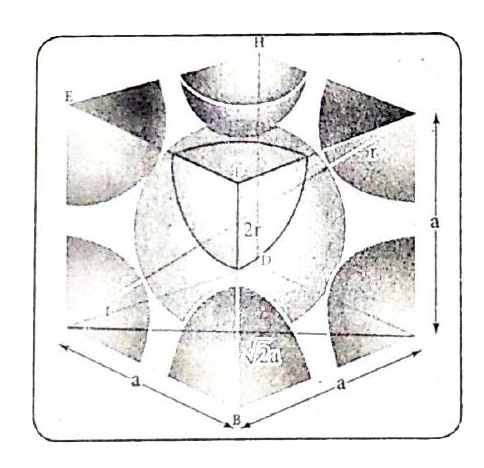 Packin fraction= `("Totalvolumeoccupiedbyspheresin a unitcell ") /("Volumeof theunitcell") xx 100` Packingfraction`=((sqrt(3) pi a^(3))/( 8))/((a^(3))) xx 100` `=1.732 xx 3.14xx 12.5=68%` |
|
| 40. |
Calculate the percentage efficiency of packing in case of body centered cubic crystal. |
|
Answer» Solution :Packing efficiency `:` Here, the spheres are touching along the leading DIAGONAL of the cube as shown in the figure. In `Delta ABC` `AC^(2) = AB^(2) + BC^(2)` `AC = sqrt( AB^(2) + BC^(2))` `AC = sqrt(a^(2) +a^(2)) = sqrt(2a^(2)) = sqrt(2) a` In `Delta ACG` `AG^(2) = AC^(2) + CG^(2)` `AG= =sqrt( AC^(2) +CG^(2))` `= AG = sqrt((sqrt(2a))^(2) + a^(2))` `AG = sqrt( 2a^(2) + a^(2)) = sqrt( 3a^(2))` `AG =sqrt(3) a` i.e., `sqrt(3) a = 4r` ` r(sqrt(3) )/( 4) a` `:.` Volume of the sphere with radius 'r' `= ( 4)/( 3) pir^(3)` `= ( 4)/( 3) pi ((sqrt(3))/( 4) a)^(3)` `= ( sqrt(3))/(16) pi a^(3)`....(1) Number of spheres belong to a unit cell in bcc arrangement is EQUAL to TWO and hence the total volume of all spheres. `=2 XX ((sqrt(3) pia^(3))/(16))= (sqrt(3) pia^(3))/( 8)` Dividing (2) by (3) Packing fraction `= ((sqrt(3) pi a^(3)))/((a^(3))) xx 100` `= ( sqrt(3)pi)/( 8) xx100` `= sqrt(3) pi xx 12.5 ` `= 1.732 xx 3.14 xx 12.5` `= 68%` i.e., 68% of the available volume is occupied. The available space is used more efficiently than in simple cubic packing. |
|
| 41. |
Calculate the percentage composition of calcium nitrate. |
|
Answer» SOLUTION :The FORMULA of calcium nitrate is `Ca(NO_(3))_(2)`. Thus, the formula mass or molecular mass =At. Mass of Ca+2 X at. Mass of N+6X at. Mass of oxygen. `=40+2xx14+6xx16=164` % of `Ca=(40)/(164)xx100=24` % of `N=(28)/(164)xx100=17` % of `O=100-(24+17)=59` |
|
| 42. |
Calculate the percentage amount of oxalate in a given sample of oxalatesaltwhen 0.3 g of salt was dissolved in 100 mL and 10 mLof which required 8 mLof N/20 KMnO_(4)solution. |
|
Answer» SOLUTION :Let the AMOUNT of oxalate in the sample be x g . Now , m.e of `KMnO_(4) = 1/20 xx 8 = 0.4 "" ` …(Eqn.1) ` :. ` m.e of 10 mL of oxalate salt solution = 0.4..(Eqn.2) ` :. ` m.eof 100 mL of oxalatesolution = 4.0 but m.e of oxalate = m.e of oxalate salt = 4 ...(Eqn . 7) ` :. ` equivalent of oxalate = `4/1000= (0.04) ` ....(Eqn.3) Wt . of oxalate ` = (0.004 xx 44 ) g ` ` = 0.176 g` ` {" eq. wt of " C_(2)O_(4)^(2-)= 88/2 = 44}` Percentage amount of oxalate = `(0.176 )/(0.3) xx 100 = 58.67 ` % |
|
| 43. |
Calculate the percent loss in weight after complete decomposition of a pure sample of potassium chlorateKClO_(3)(s) to KCl + O_(2)(g) |
|
Answer» |
|
| 44. |
Calculate the per cent dissociation of H_2S(g) if 0.1 mole of H_2Sis kept in a 0.4-litrevessel at 1000 K.For the reaction2H_2S (g) iff 2H_2(g) + S_2(g)the value of K_c is 1.0 xx 10^(-6) |
|
Answer» |
|
| 45. |
Calculate the per cent error in hydronium ion concentration made by neglecting the ionisation of water in 1.0 xx 10^(-6) M NaOH |
|
Answer» Which is very SMALL and so NEGLIGIBLE if ionisation of `H_(2)O` is not neglected, then `{:(H_(2)O,hArr,H^(+)+,H^(-)),(,,a,(10^(-6)+a)):}` `:. a xx (10^(-6) + a) = 10^(-14) "" a = 9.9 xx 10^(-9)` `:.` % error `= (10 xx 10^(-9) - 9.9 xx 10^(-9))/(9.9 xx 10^(-9)) xx 100 = 1%` |
|
| 46. |
Calculate the per cent concentration of a 9.28N NaOH solution of density 1.31g//mL. |
|
Answer» |
|
| 47. |
Calculate the partial vapour pressure of C_(2)H_(4)Br_(2) at 85^(@)C for an ideal solution with mole fraction of 0.25. Vapour presure of pure C_(2)H_(4)Br_(2) at 85^(@)C is 170 mm Hg. |
|
Answer» <P> |
|
| 48. |
Calculate the partial pressure of carbon monoxide from the following data’s CaCO_(3)(s) overset(Delta)to CaO(s) + CO_(2)(g), K_(p) = 8 xx 10^(-2)CO_(2)(g) + C(s) rarr 2CO(g), K_(p) = 2 |
|
Answer» <P>0.2 `CO_(2)(g) + C(s) rarr 2CO(g)` `K_(p) = p^(2)_(CO)/p_(CO_(2)) = (2X)^(2)/0.08` |
|
| 49. |
Calculate the partial pressur of carbon monoxide from the following CaCO_(3(s))overset(Delta)toCaO_((s))+CO_(2)uarr,K_(p)=8xx10^(-2) CO_(2(g))+C_((s))to 2CO_((g)),K_(p)=2 |
|
Answer» `0.2` `C_((s))+CO_(2(g))hArr2CO_((g)), K_(p1)=pCO_(2)` `K_(p2)=([pCO]^(2))/([pCO_(2)]),pCO=sqrt([Kp_(1)xxKp_(2)])` `pCO=sqrt([8XX10^(-2)xx2])=sqrt(16xx10^(-2))=4xx10^(-1)=0.4` |
|