Saved Bookmarks
This section includes 7 InterviewSolutions, each offering curated multiple-choice questions to sharpen your Current Affairs knowledge and support exam preparation. Choose a topic below to get started.
| 1. |
At 10^@C, the osmotic pressure of urea solution was formed to be 500 mm. The solution is diluted 'x' times and the temperature raised to 25^@C when the osmotic prssure was noticed to be 105.3mm, then 'x' is |
|
Answer» 3 |
|
| 2. |
At 10^@C, the osmotic pressure of 1% (w/v) solution of 'X' is 7.87 xx 10^(4) Nm^(-2). What is the molecular weight of solute X ? |
|
Answer» SOLUTION :Osmotic pressure of the given solution = `pi` `=7.87xx10^4 N m^(-2)` Volume of the solution = V= 100 ML = `10^(-4) m^3` Solution constant =S=8.314 J `K^(-1) "mol"^(-1)` Temperature =2.73+10 = 283 K , weight of solute =w= 1g Molecular weight of solute = `(wST)/(PIV)` `=(1xx8.314xx283)/(7.87xx10^4xx10^(-4))=299 "g mol"^(-1)` |
|
| 3. |
At 1090K, K_(p) for the reaction CO_(2)(g) +C(s) rarr 2CO(g) is 10 atm, At the constant temperature ,Equilibrium position will shift, when pressure change occurs. In the above Equilibrium reaction, partial pressure of CO_(2) of equilibrium : |
|
Answer» 10 atm 102Initial moles 1-x02xmoles at EQUILIBRIUM `k_(p) = ((p_(CO))^(2))/( P_(CO_(2)))= (((2x)/( 1+x).P)^(2))/((1-x)/(1+x).P) = 10 rarr x = 0.62 ` Moles of `CO_(2) = 1-x = 1 - 0.62 = 0.38` `P_(CO_(2)) = ( 1-x)/( 1+x ) . P = ( 1- 0.62 )/( 1+ 0.62) ( 4) = 0.928` atm |
|
| 4. |
At 1090K, K_(p) for the reaction CO_(2)(g) +C(s) rarr 2CO(g) is 10 atm, At the constant temperature ,Equilibrium position will shift, when pressure change occurs. In the above reaction, if we use catalyst. Equilibrium constant value : |
|
Answer» increases |
|
| 5. |
At 1090K, K_(p) for the reaction CO_(2)(g) +C(s) rarr 2CO(g) is 10 atm, At the constant temperature ,Equilibrium position will shift, when pressure change occurs. In the above reaction, at what total pressure will the gaes analyse 8% CO_(2) by volume ? |
|
Answer» <P>10 ATM `k_(p) = ((P_(CO))^(2))/((P_(CO_(2)))) = ( ( 0.92P)^(2))/( 0.08) = ( ( 0.92 )^(2) P )/(0.08) = 10` `P = ( 10 xx 10.08)/( ( 0.92)^(2)) = 0.95 ` atm |
|
| 6. |
At 100^(@)C the K_(w) of water is 55 times its value at 25^(@)C. What will be the pH of neutral solution (log 55 = 1.74) |
|
Answer» `7.00` `K_(w) = 55 xx 10^(-14)` `H^(+) = SQRT(55 xx 10^(-14))` `= 7.41 xx 10^(-7)` `pH = -log [H^(+)]` `= -log[7.41 xx 10^(-7)]` `= -[log 7.41 + log 10^(-7)]` `= -[0.86 - 7] = -[-6.13] = 6.13` |
|
| 7. |
At 100^(@)C the vapour pressure of a solution of 6.5 gm of a solute in 100 g water is 732 mm. If K_(b)=0.52, the boiling point of this solution will be : |
|
Answer» `100^(@)C` `(760-732)/(760)=(6.5xx18)/(M_(2)xx100) "" therefore M_(2)=31.6` `Delta T_(b)=(0.52xx6.5xx1000)/(31.6xx100)=1.07` `therefore` Vapour PRESSURE `= 100+1.07` `= 101.07^(@)C` `~~101^(@)C` |
|
| 8. |
At 100^(@)C the vapour pressure of a solution of 6.5 g of a solute in 100 g water is 732 mm. If K_(b)=0.52, the boiling point of this solution will be |
|
Answer» <P>`102^(@)C` `or n_(2)=(28)/(760)xx(100)/(18)="0.2046 mole"` `"Molality of the solution"=("0.2046 mole")/("100/1000 kg")` `="2.046 mole kg"^(-1)` `DeltaT_(B)=K_(b)xx"molality"=0.52xx2.-46=1.06^(@)` i.e., `T_(b)-T_(b)^(@)=1.06^(@)` `or T_(b)=T_(b)^(@)+1.06=100+1.06^(@)C=101.06^(@)C` |
|
| 9. |
At 100^(@)C the vapour pressure of a solution of 6.5 g of a solute in 100 g water is 732 mm. If Kb = 0.52, the boiling point of this soltuion will be |
|
Answer» `101^(@)C` at `100^(@)C, P^(@)=760 MM` `(760-732)/(760)=(6.5xx18)/(M_("solute")xx100)` `M_("solute")=31.75 g mol^(-1)` `Delta T_(B)=m xx K_(b)=(w_("solute")xx1000)/(M_("solute")xxw_("solvent"))xx K_(b)` `Delta T_(b)=(0.52xx6.5xx1000)/(31.75xx100)=1.06^(@)C` `therefore` boiling point of solution `= 100^(@)C+1.06^(@)C ~= 101^(@)C` |
|
| 10. |
At 100^@C, the gaseous reaction A to 2B + Cis observed to be of Ist order. Starting with pure A, it is found that at the end of 10 minutes the total pressure is 176 mm and after a long time 270 mm. Find (a) the initial pressure of A, (b) the partial pressure of ‘A’ at the end of 10 minutes, (c) the rate constant of the reaction, (d) the half-life period of the reaction. |
| Answer» Solution : (a) 90 mm, (b) 47 mm, (C ) `1.08166 xx 10^(-3) SEC^(-1)`,(d) 10.67 minutes. | |
| 11. |
At 100^(@)C, K_(w)=10^(-12), pH of pure water at 100^(@)C will be |
|
Answer» `6.0` |
|
| 12. |
At 100^@C, copper (Cu) has FCC unit cell structure with cell edge length of x Å. What is the approximate density of Cu (in g cm^(-3))at this temperature ? [Atomic Mass of Cu = 63.55 u] |
|
Answer» `105/(x^3)` `d=(4xx63.55)/(6.023xx10^(23xx x^(3)xx(10^(-8))^(3))` `d=(422)/(x^(3))"gcm"^(-3)` |
|
| 13. |
At 100^(@)C and 1 atm pressure the density of water vapour is 0.0005970 g/cc. (a) What is the molar volume and how does this compare with ideal gas value ? (b) What is the compressibility factor 'Z' ? |
| Answer» Solution :V (obs.) = 30.18 LIT, and V (IDEAL) = 30.621 LITRES, Z = 0.986 | |
| 14. |
At 100^@C and 1 atm, if the density of liquid water is 1.0 g cm^(-3), and that of water vapour is 0.0006 g cm^(-3) , then the volume occupied by water molecules in one litre of stream at that temperature is : |
|
Answer» 6 `cm^3` |
|
| 15. |
At 100^(@)C and 1 atm, if the density of liquid water is 1.0 g/cc and that of water vapour is 0.0006 g/cc, then the volume occupied by water molecule in one litre of steam at that temperature is |
|
Answer» 6 cc `THEREFORE` Volume of liquid water `=(0.6)/(1) =0.6 cc` HENCE, (C ) is the CORRECT ANSWER. |
|
| 16. |
At 1000^(@)C, Zn_((s)) +(1)/(2)O_(2(g)) to ZnO_((s)), DeltaG^(@)=-360 KJ "mol"^(-1) C_((s)) + (1)/(2)O_(2(g)) to CO_((g)),DeltaG^(@) =-460 KJ "mol"^(-1) The correct statement is |
|
Answer» ZINC can be oxidised by carbon monoxide |
|
| 17. |
At 1000 K water vapour at 1 atm, has been found to be dissociated into H_2 and O_2 to the extent of 3xx10^(-5)%. Calculate the free energy decrease of the system, assuming ideal behaviour. |
|
Answer» `-DELTAG=90,060` CAL `K_P=alpha/(1-alpha)((alpha/2P)/(1+alpha/2))^(1//2)=11.62xx10^(-)11("atm")^(1//2)IMPLIES DeltaG^(@)= -RT "In" K_P`= -45.76 kcal |
|
| 18. |
At 1000 k , the pressure of iodine gasis found to be 0.112 atm due to partial dissociation of I_2 (g) into I. Had there been no dissociation , the pressure would have been 0.074 atm. Calculate the value of K_p for the reaction, I_2 (g) hArr 2I(g) |
| Answer» SOLUTION :`K_p =0.16 ATM` | |
| 19. |
At 100^@ C the vapour pressure of a solution of 6.5 gm of a solute in 100 gm of water is 732 mm. If K_b = 0.52, the boiling point of this solution will be |
|
Answer» `102^@C` |
|
| 20. |
At 10^(@) C, the average osmotic pressure of blood is 8.8 atm. Find the concentration of the various constituents in the blood. Assuming that the concentration is the same as the molarity. Find the freezing point of the solution (K_(f) " for water " = 1.86 K" kg mol"^(-1)) |
|
Answer» Solution :Step - I : Calrulation for concencertration of the solution. According to Van.t Hoff equation `pi = "CRT" or C = (pi)/(RT)` `pi = 8.8 "atm" , T = 40^(@) C = 313 K ` R = 0.0821 L atm `K^(-1) MOL^(-1)` C = `(8.8)/(0.0821 xx 313) = 0.34 "molL"^(-1) `(M) Step -II : Calculation of freezing point of the solution Depression in free.zing point of solution `Delta T_(f) = K_(f) xx m` m = 0.34 mol `Kg^(-1) ` (same as MOLARITY as GIVEN) `K_(f) = 1.86 K" kg mol"^(-1)` `Delta T_(f) = 1.86 xx 0.34(because Delta T_(f) = K_(f) m) ` = 0.63 K = `0.63^(@)` C Freezing point of the solution = 0`0.63^(@) ` C = - `0.63^(@)` C |
|
| 21. |
At 0^(@)C and 1 atm pressure, the relative amounts of water and ice remain unchanged with time in the equilibrium water |
| Answer» | |
| 22. |
At 0^(@)C and 1 at pressure, why is the equilibrium established between water and ice regarded as dynamic in nature? |
| Answer» SOLUTION :At `0^(@)C` and under 1 ATM pressure, 'water`hArr`ice' equilibrium is said to be DYNAMIC since at equilibrium the RATE of melting of ice is equal to the rate fo FREEZING of water. | |
| 23. |
Asymmetric carbon atom. |
| Answer» Solution :A CARBON which is ATTACHED to FOUR different atoms or groups is CALLED asymmetric carbon atom. | |
| 24. |
Asthma patients used a mixture of…….. For respiration: |
|
Answer» `O_2` and He |
|
| 25. |
Asthma patient use a mixture of.......fo respiration |
|
Answer» `O_(2)` and `N_(2)O` |
|
| 26. |
Astatine is the element below iodine in the group 17 of the periodic table. Which of the following statements (s) is ( are ) true for astatine ? |
|
Answer» It is LESS electronegative than iodine (ii) Inter molecular forcesbetween astatine MOLECULE will be larger than between iodine molecule (iii) It is compassed to di atomic molecules `(I_(2))` |
|
| 27. |
Astatine is a |
|
Answer» Halogen <BR>Rare EARTH element |
|
| 28. |
Astatine is the element below iodine in the group 17 of the periodic table. Which of the following statement is not true for Astatine? |
|
Answer» It is LESS electronegative than iodine |
|
| 29. |
Assuming the velocity be same, which sub-atomic particle possesses smallest de Broglie wavelength: |
|
Answer» An electron |
|
| 30. |
Assuming the formation of an ideal solution, determine the boiling point of a mixture containing 1560 g benzene (molar mass = 78) and 1125 g chlorobenzene (molar mass = 112.5) using the following against an external pressure of 1000 torr. |
|
Answer» `90^(@)C` |
|
| 31. |
Assuming the degree of ionization to be equal, the ratio of osmatic pressures of equimolar solution of A1_(2)(SO_(4))_(3),Na_(3)PO_(4) and K_(4)[Fe(CN)_(6)]is |
|
Answer» `5:04:05` `Na_(3) PO_(4) hArr 3 Na^(+) + PO_(4)^(3-),n=4` `K_(4)[FE(CN)_(6)] hArr 4K^(+)+[Fe(CN)_(6)]^(4-),n=5`:. Ratio is 5:4:5 i.e. 1:0.8:1 |
|
| 32. |
Assuming the compounds to be completely dissociated in aqueous solution, identify the pair of the solutions that can be expected to is isotonic at the same temperature. |
|
Answer» 0.01 M Urea and 0.01 M NaCl As the given solutions are at same TEMPERATURE thus, `i_(1)C_(1)RT = i_(2)C_(2)RT` (a) For urea , `i_1 =1,C_1 = 0.01 M` For `NaCl , i_(2) , C_(2) =0.01 M` `1 xx 0.01 xx RT ne 2 xx 0.01 xx RT` (not isotonic) (b) For `NaCl : i_(1) = 2, C_1 =0.02 M` for `Na_(2)SO_(4) , i_(2) =3, C_(2) =0.01 M ` `2 xx 0.02 xx RT ne 3 xx 0.01 xx RT` (not isotonic) (c) For NaCl ,`i_(1) =2 , C_(1) = 0.03 M ` For Mg`Cl_(2): i_(2) = 3 ,C_(2) = 0.02 M` `2 xx 0.03 xx RT = 3 xx 0.02 xx RT` 0.06 RT = 0.06 RT Thus , these solutions are isotonic. |
|
| 33. |
Assuming the compounds to be completely dissociated in aqueous solution, identify the pair of the soltions which can be expected to be isotonic at the same temperature ? |
|
Answer» `0.01 M " urea and " 0.01 M NaCI` For isotionic solution, `pi_(1)=pi_(2)` Sincethe two sloutions are at the same temperature, `i_(1)C_(1)RT=i_(2)C_(2)RT` (a) For urea, `i_(1)=1, C_(1)=0.01M` `"For" NaCI, i_(2)=2, C_(2)=0.01M` `1xx0.01xxRT ne2xx0.01xxRT ("Not isotonic") ` (b)`" For" Naci, i_(1)=2,C_(1)-0.02M` For `Na_(2)SO_(4), i_(2)=3, C_(2)=0.01 M` `2xx0.02xxRTnr3xx0.01xxRT` ("Not isotonic")` (c) For NaCI, `i_(1)=2, C_(1)=0.03 M` For `MgCI_(2), i_(2)=3,C_(2)=0.02 M` `2xx0.03 xxRT=3xx002xxRT` (d) For SUCROSE, `i_(1)=1, C_(1)=0.01M` For glucose, `i_(2)=1,C_(2)=0.02M` `1xx0.01xxRT =2xx0.02xxRT` (Not isotonic) is the correct answer. |
|
| 34. |
Assuming the bond direction to the z-axis, which of the overlapping of atomic orbitals of two atom (A) and (B) will result in bonding ? (I) s-orbital of A and p_(x) orbital of B(II) s-orbital of A and p_(z) orbital of B (III) p_(y)-orbital of A and p_(z) orbital of B (IV) s-orbital of both (A) and (B) |
| Answer» Answer :D | |
| 35. |
Assuming the age of the earth to be 10^(th) years , if the percentage of original amount of U^(238) still in existance on earth is x% (nearly) (t_(1//2) of U^(238) is 4.5 xx 10^(9) years) . Then 'x/10' is ____ |
|
Answer» `(10)/(15)= log ((N_0)/(N_t)) , log ((N_0)/(N_t)) = (2)/(3) , log ((N_0)/(N_t)) = 0.667, ((N_(0))/(N_(t))) `= anti log `(0.667) , ((N_0)/(N_t)) = (4.65)/(1)` `((N_t)/(N_0)) = (1)/(4.65%) , % ((N_t)/(N_(0))) = (1)/(4.65) xx 100 = 21.5%` , Here `((X)/(10)) = (21.5%)/(10) = 2.15 -=2` |
|
| 36. |
Assuming that water vapour is an ideal gas, the internal energy (DeltaU) when 1 mol of water is vapourised at 1 bar pressure and 100^(@)C, (Given : Molar enthalpy of vapourization of water at 1 bar and 373 K = 41 kJ mol^(-1) and R = 8.3 J mol^(-1)K^(-1)) will be |
|
Answer» `4.100 KJ mol^(-1)` `Deltan_(g)=1-0=1` `DeltaH=DeltaH+Deltan_(g)RT` `=41-8.3xx10^(-3)xx373=37.9 kJ mol^(-1)` |
|
| 37. |
Assuming that water vapour is an ideal gas, the internal energy change (DeltaU) when 1 mol of water is vapourised at 1 bar pressure and 100^(@)C, (Given : Molar enthalpy of vapourisation of water at 1 bar and 373K=41kJmol^(-1)andR=8.3Jmol^(-1)K^(-1)) will be - |
|
Answer» `4.100kJmol^(-1)` |
|
| 38. |
Assuming that van't Hoff type equation can be used to determine the temperature dependence of the amount of the gas adsorbed on the surface of a solid, calculate the enethalpy of adsorption, DeltaH_(ads) for N_(2) at 1 atm. Given that 155 cm^(3) of the gas measured at STP is adsorbed by 1 g of charcoal at 88 K and 15 cm^(3) at 273 K. |
|
Answer» Solution :van't Hoff type equation for adsorption of a gas at two different temperatures can be written as `ln""(v_(2))/(v_(1))=-(DeltaH_(ads))/(R)((1)/(T_(2))-(1)/(T_(1)))or log ""(v_(2))/(v_(1))=-(DeltaH_(ads))/(2.303R)((1)/(T_(2))-(1)/(T_(1)))` `log ""(155)/(15)=-(DeltaH_(ads))/(2.303xx8.314)((1)/(88)-(1)/(273))` `(2.1903-1.1761)=-(DeltaH_(ads))/(2.303xx8.314)XX(185)/(88xx273)` `DeltaH_(ads)=-2521.7J mol^(-1)=-2.52kJ mol^(-1)` |
|
| 39. |
Assuming that sea water is and aqueous solution of NaCI, its density is 1.025 g/mL at 20^(@)C and NaCI concerntration is 3.5% (by mass). The normality of sea water is : |
|
Answer» 0.65 N Mass of solution= 100 g `"Volume of solution"="Mass"/"DENSITY" ` `=((100G))/((1.025g m L^(-1)))=97.56 m` `"Equivalent mass of NaCI"=58.5 g equiv^(-1)` `"Normality of solution (N)"=("No. of g equiv"^(-1)solute)/("Volumeof solution in litres")` `((3.5g)//(58.5 "g equiv"^(-1)))/(97.56//1000L)` ` =0.61 "equiv L"^(-1)=0.61 N` |
|
| 40. |
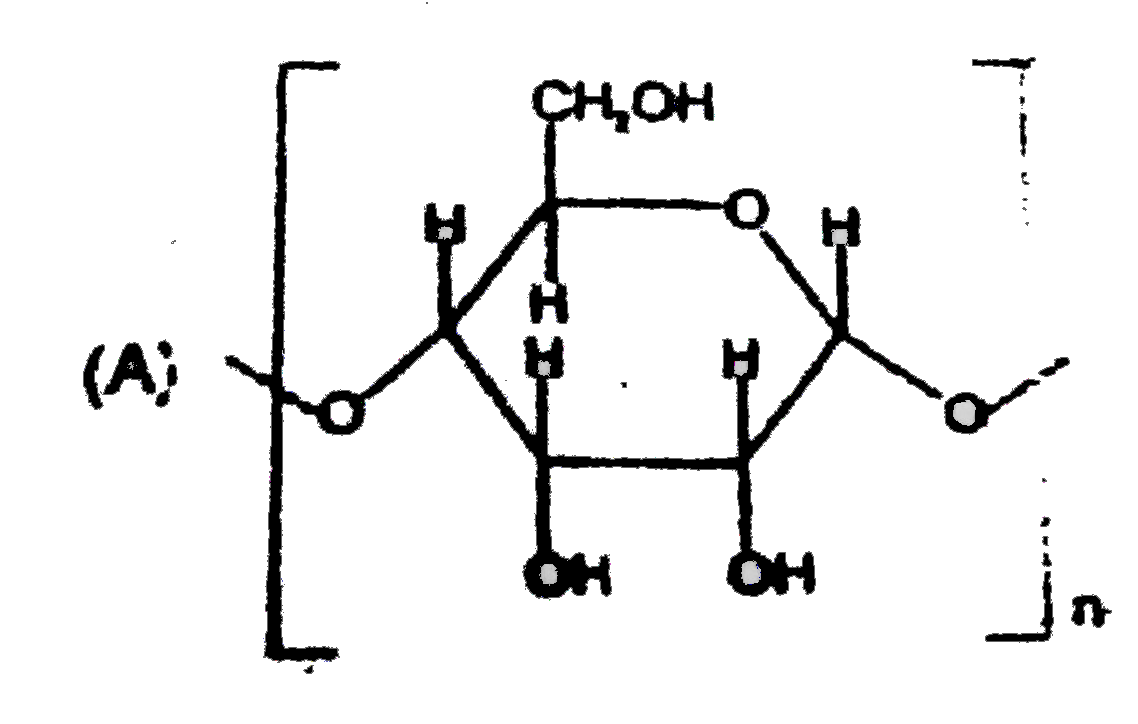
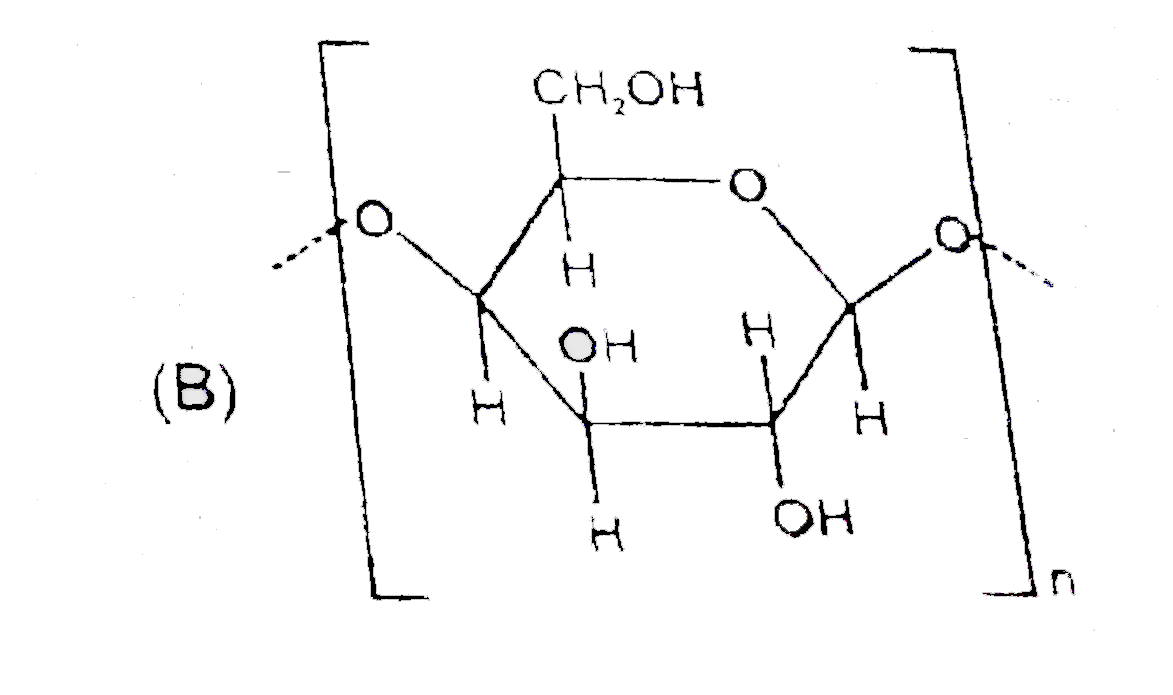
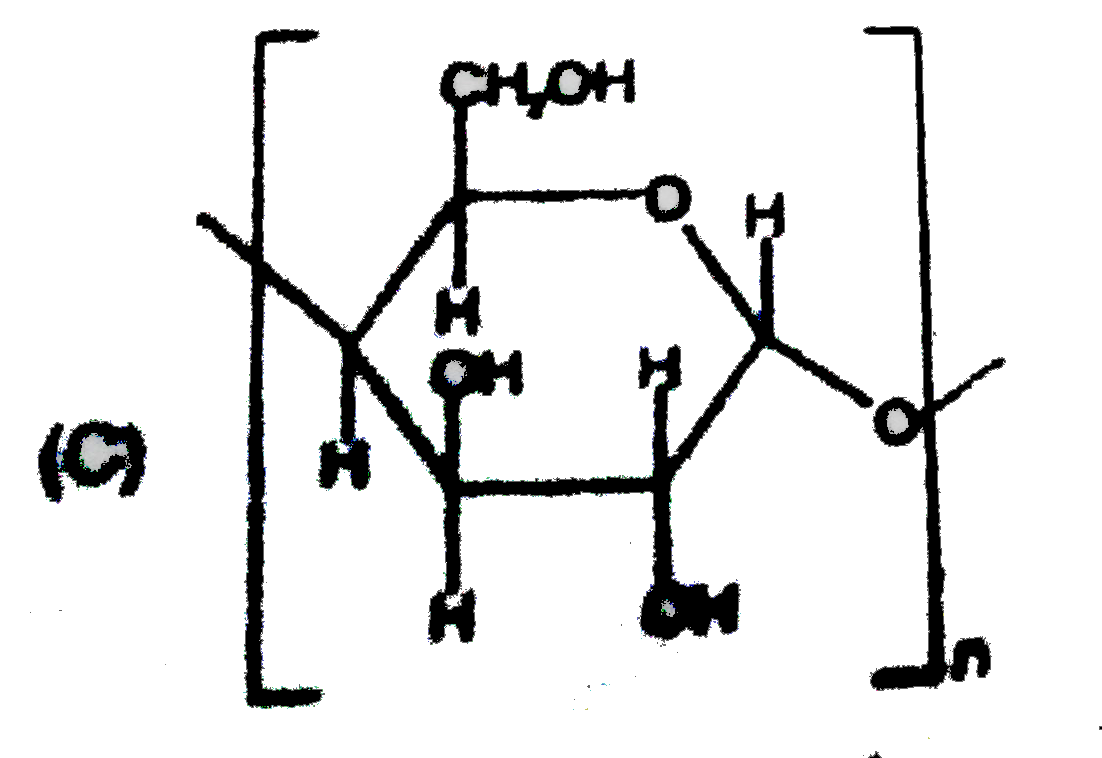
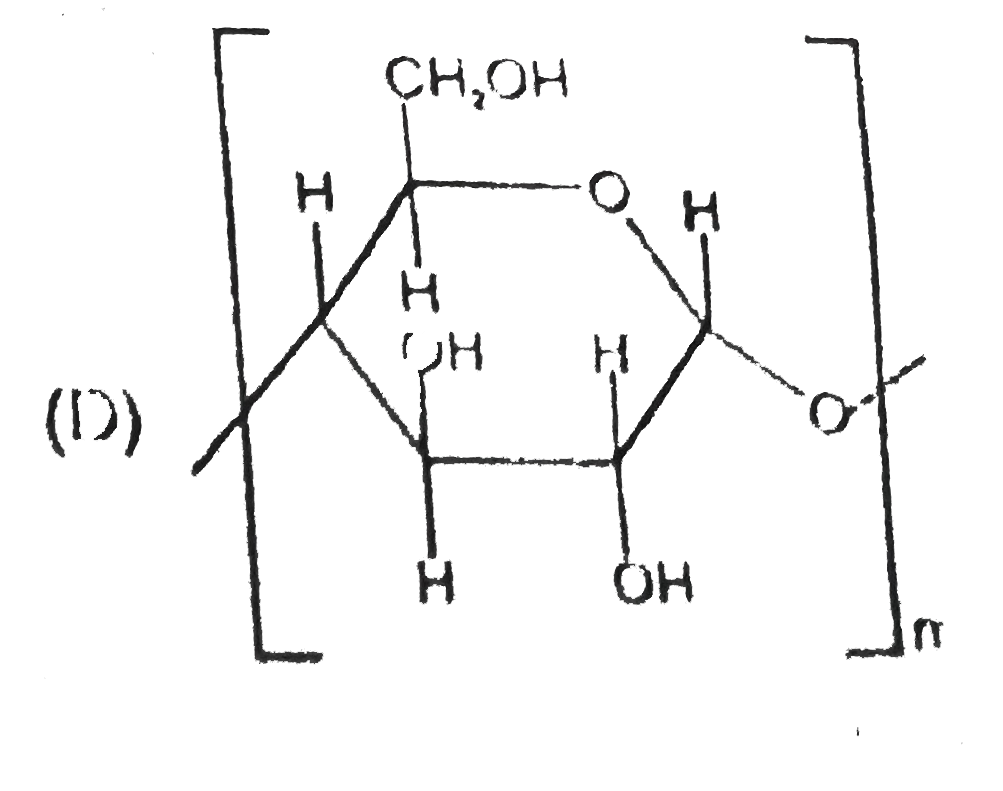
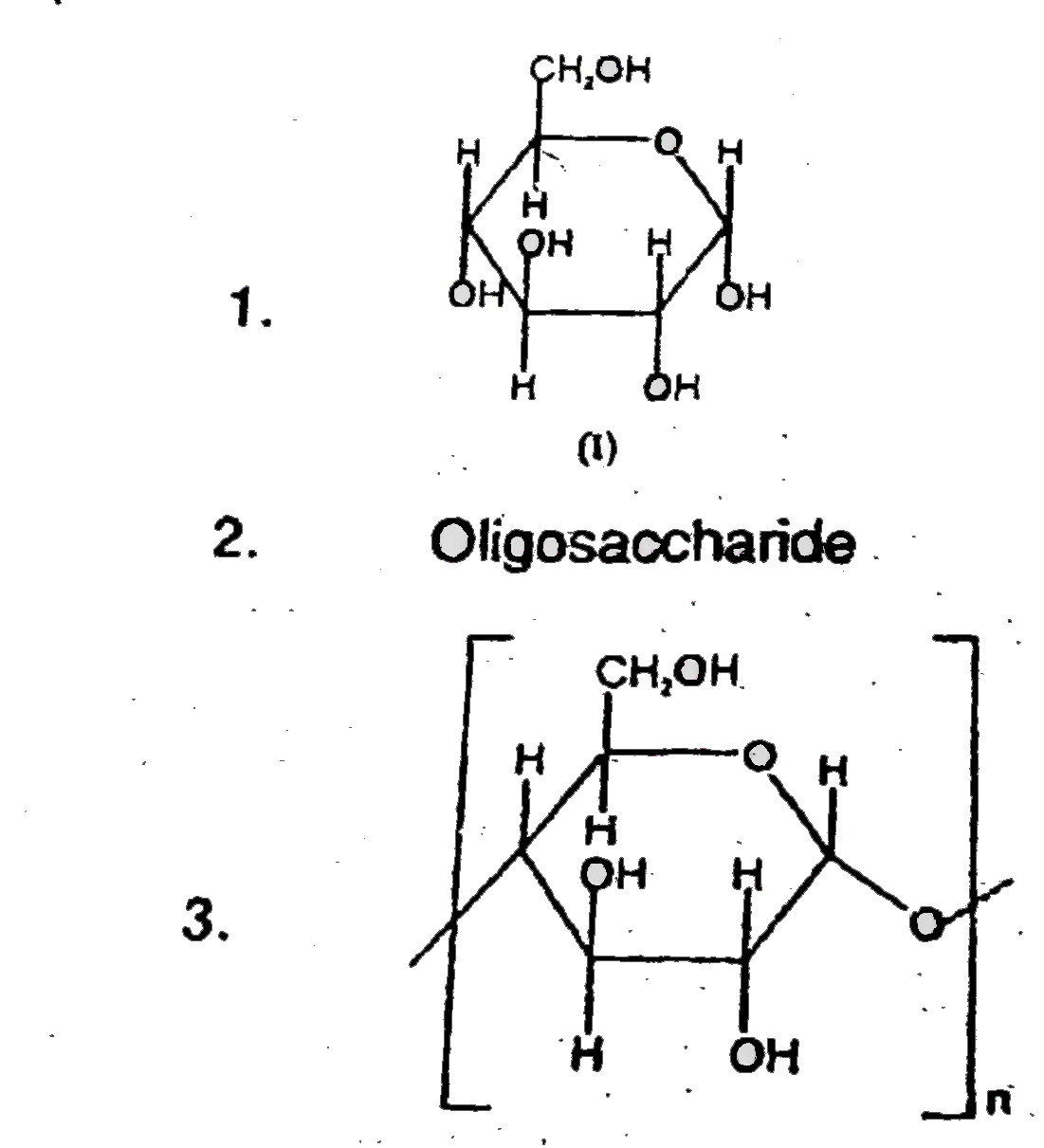
Assuming that polymerisation of (I) takes place in the manner similar to its dimerisation, then the structure of polymer (III) can be correctly represented as |
|
Answer»
|
|
| 41. |
Assuming that petrol is octane (C_(8)H_(18)) and has a density of 0.8g Ml^(-1), 1,425 litre of petrol on combustion will consume: |
|
Answer» 100 MOLE of PHOSPHINE |
|
| 42. |
Assuming that Raoult's Law is followed, what wolud be the vapour pressue of a solution formed when 40 g of sugar density is 1g/mL. |
|
Answer» `"Moles of WATER",n_(A)=("Mass of water")/("Gram molar mass")=((360G))/((18g//mol))=20 mol` `"Mole fraction of water"(X_(A))=n_(A)/(n_(A)+n_(B))=((20 mol))/((20 mol)+(0.117 mol))=0.9942` `"Vopour pressure of solution"(P_(A))=P_(A)^(@)x_(A)=20mmxx0.9942=19.884 mm.` |
|
| 43. |
Assumingthatpetrol is octane (C_(8)H_(16)) and has density 0.8 g/ml., 1.425 liters of petrol on completecombustion will consume |
|
Answer» 50 moles of `O_(2)` |
|
| 44. |
Assuming that elements are formed to complete the seventh period, what would be the atomic number of the alkaline earth metal of the eighth period? |
|
Answer» 113 |
|
| 45. |
Assuming that energy of activation for most of the reactions is 52 kJ, what conclusion you draw about the effect of temperature on the rate of a reaction ? (Based on Arrhenius equation) |
| Answer» Solution :Substituting `T_(1)=300" K", T_(2)=310" K",E_(a)=52000" J mol"^(1)` in the Arrhenius equation, viz., `log""(k_(2))/(k_(1))=(E_(a))/(2.303R)((1)/(T_(1))-(1)/(T_(2)))`, we get `k_(2)~~2k_(1)`. This SHOWS that for `10^(@)` rise of TEMPERATURE, the rate of REACTION is nearly doubled. | |
| 46. |
Assuming that a constant current is delivered, how many kW-h of electricity can be produced by the reacation of 1.0 mole Zn with Cu^(2+) ion in a Daniel cell in which all the concentration remains 1.00 M ? (E_(Zn//Zn^(2+))^(@) = 0.76 V , E_(Cu//Cu^(2+))^(@) = -0.34 V) |
|
Answer» |
|
| 47. |
Assuming that 50% of the heat is useful, how many kg of water at 15^@Ccan be heated to 95^@Cby burning 200 litres of methane at NTP? DeltaH_("combustion") (CH_4) = 211 kcal/mole, sp. heat of water = 1 kcal/kg K. |
| Answer» SOLUTION :11.8 KG | |
| 48. |
Assuming same expression og colligative property to be aplicable for solid in solid solution, calculate what will be the melting point of an alloy of lead and tin if 12 g of tin is present for every 100 g of lead. The molal depression constant of lead is 8.5 K-kg "mole"^(-1). [Given : Atomic mass Sn=120, Pb=208, Melting point of Pb=327^(@) C] [Express your answer in Kelvin] |
|
Answer» |
|
| 49. |
Assuming Rydberg constant (R_(H)) to be 109670 cm^(- 1), the longest wavelength line in the Lyman series of the hydrogen spectrum is |
|
Answer» `1215.8Å` i.e., `barv=109670(1/(1^(2))-1/(2^(2)))=109670xx3/4=82252.5cm^(-1)` `lamda=1/v=1/(82252.5cm^(-1))` `=1215.8xx10^(8)cm=1215.8 Å` |
|
| 50. |
Assuming petrol is isooctane (C_8 H_18) and has a density of 0.8 g mL^(-1) 1.425 litres of petrol on complete combustion will consume |
|
Answer» 100 moles of `O_2` Now , the combustion equation is , `underset(114 g) (C_(8) H_(18)) + underset(25//2 "moles") (25//2 O_(2)) to 8 CO_(2) + 9 H_2 O` 114 g of petrol requires `O_2 = 25//2` moles `therefore` 1140 g of petrol will require `O_2 = (25)/(2) xx (1140)/(114) = 125` moles |
|