

Saved Bookmarks
This section includes 7 InterviewSolutions, each offering curated multiple-choice questions to sharpen your Current Affairs knowledge and support exam preparation. Choose a topic below to get started.
| 1. |
Assuming molecular orbital diagrams similar to that of O_(2) , use MO theory to predict the proper ordering of bond energies of the following pairs. |
|
Answer» `UNDERSET("GREATER")(N_2),N_(2)^(+) and O_(2), underset("greater")(O_(2)^(+))` `N_(2)^(+)` bond order = 2.5 `O_(2)` bond order = 2 `O_(2)^(+)` bond order = 2.5 Bond order `PROP` Bond ENERGY. |
|
| 2. |
Assuming ideal gas behaviour, how many atoms of Ar are contained In a typical hunin breath of 0.5L at 1.0 bar and 27^(@)C? Air consists of 1% Ar atoms. Assuming that the argon atoms from last breath ot Plato have been distributed randomly throughout the atmosphere ( 5xx 10^(18)m^(3)). How long would it take to breadth one of the atoms? A typical adult breath rate is 10" min"^(-1). |
| Answer» SOLUTION :`O_(2)=68.2%` | |
| 3. |
Assuming ideal gas behaviour, how many atoms of Ar are contained in a typical human breath of 0.5 litre at 1.0 bar and 37^@C ? Air consists of 1% Ar atoms. Assuming that the argon atoms from the last breath of Plato have been distributed randomly throughout the atmosphere (5 xx 10^18 m^3) , how long would it take to breathe one of these atoms? A typical adult breath rate is 10 "min"^(-1) |
| Answer» SOLUTION :` 1 XX 10^20 " BREADTH"^(-1)`, 10 min | |
| 4. |
Assuming fully decomposed, the volume of CO_2released at N.T.P. on heating 9.85 g of BaCO_3(atomic mass of Ba = 137) will be |
|
Answer» 0.84 L Mol. Mass of `BaCO_3 = 137+ 12 +3XX 16 = 197` 197 g of `BaCO_3` on heating GIVES `CO_2 = 22.4L` 9.85 g of `BaCO_3` on heating GIVE `CO_2 = (22.4 xx 9.85)/(197) = 1.12 L` |
|
| 5. |
Assuming each salt to be 90% dissociated which of the following will have highest osmotic pressure: |
|
Answer» Decinormal `Al_2(SO_4)_3` |
|
| 6. |
Assuming enthalpy of combustion of hydrogen at 273 K is -286kJ and enthalpy of fusion of ice at the same temperature to be +6.0kJ, calculate enthalpy change during formation of 100 g of ice. |
|
Answer» `+1622`KJ |
|
| 7. |
Assuming Delta_(r )H^(Θ) and Delta_(r ) S^(Θ) to be independent of temperature, at what temperature will the reaction given below becomes spontaneous ?{:(,N_(2)(g),+,O_(2)(g),rarr,2NO(g),,,Delta_(r )H^(Θ)=180.9 kJ mol^(-1)),(S^(Θ)//JK^(-1)mol^(-1),191.4,,204.9,,210.5,,):} |
|
Answer» Solution :First calculate `Delta_(r )S^(Θ)` for the GIVEN reaction as follows : `Delta_(r )S^(Θ)=sum S_(P)^(Θ)-sum S_(R )^(Θ)=2S_("NO")^(Θ)-S_(N_(2))^(Θ)-S_(O_(2))^(Θ)=2xx210.5-191.4 = 24.7 JK^(-1)MOL^(-1)` Using : `Delta_(r )G^(Θ)=Delta_(r )H^(Θ)-T Delta_(r )S^(Θ)=180.8298xx24.7xx10^(-3)=173.4 kJ mol^(-1)` Clearly, he given endothermic reaction is NON - spontaneous at room temperature. So, we need to increase the temperature to make the reaction spontaneous. `rArr Delta_(r )G^(Θ)=180.8 -(Txx24.7xx10^(-3))kJ mol^(-1)` For SPONTANEITY, put `Delta_(r )G^(Θ)=0` to get : `T_("Switch")=(Delta_(r )H_("system")^(Θ))/(Delta_(r )S_("System")^(Θ))` `rArr T_("switch")=(180.8xx10^(3))/(24.7)~~ 7320 K` The reaction becomes spontaneous above a temperature of 7320 K. |
|
| 8. |
which of the following will have highest osmotic pressure: |
|
Answer» 0.001M`Al_2(SO_4)_3` |
|
| 9. |
Assuming degree of ionization to be unity in each case, which of the following equimolal solutions would freeze at the lowest temperature? |
|
Answer» `[Pt(NH_(3))_(6)]Cl_(4)` |
|
| 10. |
Assuming complete ionization, which one of the following aqueous solutions will have maxmum boiling point ? |
|
Answer» `0.2 m NaCI` `(a) 0.2 xx 2 xx 1 = 0.4(b) 0.2 xx 3 xx 1 = 0.6` `(c) 0.1 xx 3 xx 1 = 0.3(d) 0.1 xx 4 xx 1 = 0.4` Higher the no. of particles, more is the BOILING point. |
|
| 11. |
Assuming complete ionization same moles of which of the following compounds will require the least amount of acidified KMnO_(4) for complete oxidation? |
|
Answer» `FeC_(2)O_(4)` `{:(2,Fe^(2+) rarr Fe^(3+)),(,C_(2)O_(4)^(2-) rarr 2CO_(2)):} {:(1),(2):}}rArr 3` `{:(3,Fe^(2+) rarr Fe^(3+)),(,2NO_(3)^(-) rarr 2NO_(3)^(-)):} {:(1),(4):}}rArr 5` 4. `Fe^(2+) rarr Fe^(3+) 1` Least NUMBER of ELECTRONS are involved in `FeSO_(4)` |
|
| 12. |
Assuming complete ionisation, the pH of 1.0 M HCl is 1. The molarity of H_(2)SO_(4) with the same pH is |
|
Answer» 0.2 Hence `[H_(2)SO_(4)] = (10^(-1))/(2) = (1)/(20) =0.05 M`. |
|
| 13. |
Assuming complete ionisation, same moles of which of the following compounds will require the least amount of acidified KMnO_4 for complete oxidation ? |
|
Answer» `FeSO_3` |
|
| 14. |
Assuming complete dissociation, which of the following aqueous solutions will have the same pH value |
|
Answer» 100 ML of 0.01 M HCl M. eq. of 0.02 M `H_(2)SO_(4) = (0.04 xx 50)/(1000) = 2 xx 10^(-3)` M. eq. of 0.02 M NaOH `= (0.02 xx 50)/(1000) = 1 xx 10^(-3)` Left `[H^(+)] = 2 xx 10^(-3) - 1 xx 10^(-3) = 1 xx 10^(-3)` pH = 3 |
|
| 15. |
Assuming complete dissociation of the salts , calculatethe molatity of sodium chloridesolution whose elevation in boilingpoint is numerically equal to the depression in frezing point of0.02 m aluminium sulphatesolutionin water (K_(b) and k_(f) for water are 0.52and 1.86 K kg " mol"^(-1)respectively ). |
|
Answer» Solution :I for NACL = 2,in for`Al_(2) (SO_(4))_(3) = 5` ` Delta T_(B)` [ NaCl sol.] = `Delta T_(f) [ Al_(2) (SO_(4))_(3) " sol ." ]` (GIVEN ) ` :. i xx K_(b) xx m (NaCl) = i xx K_(f) xx m [ Al_(2) (SO_(4))_(3)] . i.e ., 2 xx 0.52 xx m = 5 xx1.86 xx 0.2 or m = 1.788` |
|
| 16. |
What is the pH of 0.01 M NaOH assuming complete ionisation ? |
|
Answer» 2 |
|
| 17. |
Assuming complete dissociation , calculate the pH of the following solution: 0.003 M HCl (ii) 0.005 M NaOH (iii) 0.002 M HBr (iv) 0.002M KOH |
|
Answer» SOLUTION :(i) `HCl+aqtoH^(+)+Cl^(-) THEREFORE[H^+]=[HCl]=3 times10^-3M,pH=-log(3times10^-3)=2.52` <BR> (ii) `NaOH+aq to Na^(+)+OH^(-)` `therefore [OH^+]=5 times 10^-3 M [H^+]=10^-14//(5 times 10^-3)=2 times 10^-12 M` `pH=-log(2 times 10^-12)=11.70` (iii) `HBr+aqtoH^(+)+Br, therefore[H^+]=2 times10^-3 M,pH=-log(2 times10^-3)=2.70` (iv) `KOH+aq to K^(+) +OH^(-)` `therefore [OH^+]=2 times 10^-3 M, [H^+]=10^-14//(2 times 10^-3)=5 times 10^-12` `pH=-log(5 times 10^-12)=11.30` |
|
| 18. |
Assuming all the solutes are non volatile and all solutions are ideal. |
|
Answer» `{:(Column-I,Column-II),(10ml 0.1M NaOH" aqueous solution is",(p)"Osmotic pressure of solution INCREASES"):}` Conc. `darr RARR C.P darr rArr pi darr rArr (DeltaP)/(P^(@)) darr rArr ps uarr DeltaT_(b) darr` `rArr T_(b)'darr rArr DeltaT_(f)darr rArr DeltaT_(f)uarr` `a rArr (q,s)` |
|
| 19. |
Assuming all the solutes are non volatile, all solutions are ideal and neglect any hydrolysis of cation and anion. |
|
Answer» |
|
| 20. |
Assuming 100% polymerization of an organic compound in is aqueous solution, te number of moles of orgaic compound undergoing polymerization containing 9.4g of organic compound per 100g of the solvent is ……….Freezing point depression is 0.93K, K_(f) of water is 1.86K kg"mol"^(-1) and molecular weight of organic compound is 94u |
|
Answer» `DeltaT_(f)=iK_(f)m` `i=(DeltaT_(f))/(K_(f)m)=(0.93xx94xx100)/(1.86xx9.4xx1000)` `i=1/n=0.5` `n=2` |
|
| 21. |
Assuming 2s - 2p mixing is NOT operative , the paramagnetic among the following is |
|
Answer» `Be_2` |
|
| 22. |
Assuming 2s-2p mixing is NOT operative, the paramagnetic species among the following is |
|
Answer» `Be_(2)` |
|
| 23. |
Assuming 100 % ionisation which of the following will have highest vapour pressure |
|
Answer» `0.1 M Na_(2)SO_(4)` 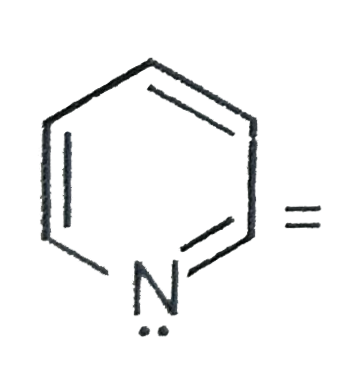 = Most BASIC nitrogen because its lone pair is not in RESONANCE & availablemore for donation = Most BASIC nitrogen because its lone pair is not in RESONANCE & availablemore for donation
|
|
| 24. |
Assume that the reaction considered here is homogeneous gaseous reaction A(g) rarr B(g) {:(,"Column-I(containing order of the reaction)",,"Column-II(containing properties of the reaction)"),("(a)","Order less than 1",,"(p)Reaction will not undergo 100% completion in finite time interval"),("(b)","Order equal to zero",,(q)underset("uniform as long as reactant is remaining")"Rate of reaction will remain"),("(c)","Order greater than or equal to 1",,"(r)Rate of reaction may increase as the reaction proceeds"),(,,,"(s)Reaction can never be elementary"):} |
|
Answer» |
|
| 25. |
Assume that the centre of the sun consists of gases whose average molecular weight is 2. The density and pressure of the gases are 1.3 g/mL and 1.12 xx 10^9 atm respectively. Find the temperature. |
| Answer» SOLUTION :`2.1 XX 10^7 K` | |
| 26. |
Assume that the only change in volume is due to the production of hydrogen and calculate the work done in joules when 2.0 moles of Zn dissolve in hydrochloric acid, giving H_(2) at 35^(@)C and 1 atm. Zn(s)+2HCl(aq) to ZnCl_(2)(aq)+H_(2)(g) |
|
Answer» |
|
| 27. |
Assume that impure copper contains only iron, silver, and gold as impurities. After passage of 140 A, for 482.5 s, the mass of the anode decreased by 22.260 g and the cathode increased in mass by 22.011 g. Estimate the % iron and % copper originally present. |
|
Answer» Solution :The increase in mass of the cathode is solely due to copper. Hence, there is 22.011 g of copper (equivalance to 0.3464 mol) and therefore a total of 0.249 g of iron, gold and silver. Only the iron and copper are OXIDIZED. The gold silver fall to the bottom in the anode mud. SINCE each of the active metals REQUIRES 2 mol electrons pre mol metal, there MUST be (482.5s) `(140 C)/s(1"mol E")/(96500 C)(1 mol M^(2+))/(2 mol) = 0.3500` moles of `M^(2+)` The no. of moles of iron is therefore 0.0036, and the mass of iron is 0.20 g. The metal ios 98.88% copper and 0.90% iron. |
|
| 28. |
Assume that impure copper contains only Fe, Au and Ag as impurities. After passage of 140 ampere for482.5 sec, the mass of anode decreased by 22.260g and the cathode increased in mass by 22.011g. Calculate the percentage of iron and percentage of copper originally present. |
|
Answer» |
|
| 29. |
Assume that each of the following mixtures was added to a flask or a separatory funnel that contained diethyl ether (as an organic solvent) and mixed well. In which layer (diethyl ether or water) would the organic compound predominate in each case, and in what form would it exist (in its neutral form or as its conjugate base)? |
|
Answer»
|
|
| 30. |
Assume that during electrolysis of AgNO_(3) only H_(2)O is electrolyesd and O_(2) is formed at the anode as : 2H_(2)Orarr 4H^(+)+O_(2)+4e^(-) O_(2) formed at NTP due to passage of 2 amperes of current for 965 sec is : |
|
Answer» `0.112L` |
|
| 31. |
Assume that air is 21% oxygen and 79% nitrogen by volume if the barometric pressure is 740 mm the partial pressure of oxygen is closets to which one of the following |
|
Answer» 740 mm |
|
| 32. |
Assume liquefied petroleum gas (LPG) is a 50-50 (by mole) mixture of n-pentane and n-butnane.Calculate the calorific value (in KJ//"mol") of gas available form a newly filled cylinder. Give your answer divide by 100. {:(,n-"butane",C_4H_10n-"pentane" C_6H_12),("Vapour pressure",1800 "Torr",600 "Toor"),("Calorific value ",2800 kJ//"mol",3600 kJ//"mol"):} |
|
Answer» First of all we find mole fractions in LIQUID mixture, let mixture is 100 mole So moles of PENTANE=50 moles of Butane=50 So,`X_("pentane")=0.5 " " X_("Butane")=0.5` `P_T=600xx0.5+1800xx0.5=1200` `Y_("pentane")=300/1200=1/4 " " Y_("Butane")=900/1200=3/4` Calorific VALUE `=3600xx1/4+2800xx3/4`=3000 kJ/mol During use `Y_("pentane") " " "calorific value" uarr` |
|
| 33. |
Assume liquefied petroleum gas (LPG) is a 50-50 (by mole) mixtures of n-pentene and n-butane. Calculate the calorific value (in kJ//mol) of gas available from a newly purchased cylinder. Will the calorific value increase, decrease or remain the same during use? {:(,"n-butane,"C_(4)H_(10),"n-pentane,"C_(5)H_(12)),("vapour pressure",1800 " torr"," 600 torr"),("calorific value"," 2800 kJ"//mol,"3600 kJ"//mol):} |
|
Answer» |
|
| 34. |
Assume ideal gas behaviour for all the gases considered and neglect vibrational degrees of freedom. Separate equimolar samples of Ne, O_(2), CO_(2) and SO_(2) were subjected to a two process as mentioned. Initially all are at same state of temperature and pressure Step I rarr All undergo reversible adiabatic expansion to attain same final volume, which is double the original volume thereby causing the decreases in their temperature Step II rarr After step I all are given appropriate amount of heat isochorically to restore the original temperature Mark the correct option(s) |
|
Answer» Due to step I only, the decrease in temperature will be maximum for Ne SECOND step is isochoric (w=0) 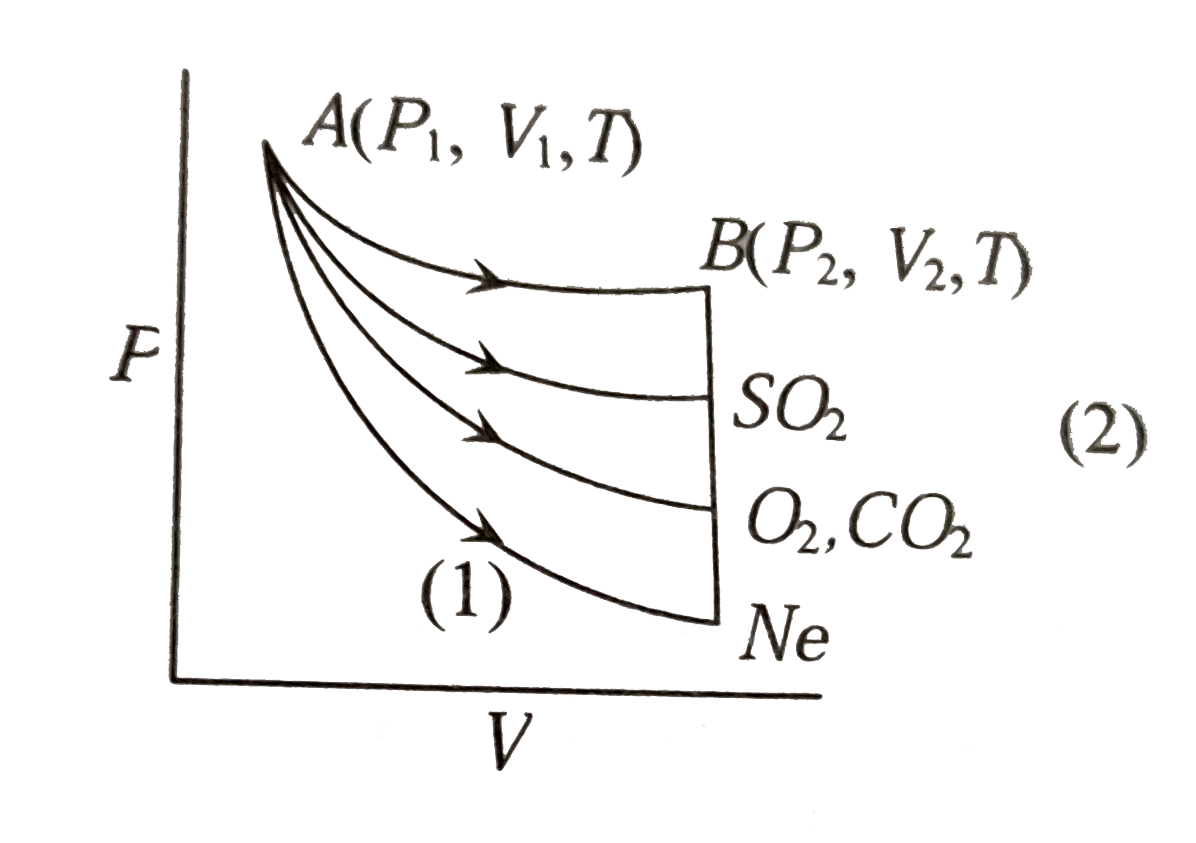 So, `DeltaU_(2)=q_(2)` `because` initial and FINAL temp. are same `therefore DeltaU_("TOTAL")=DeltaU_(1)+DeltaU_(2)=0 or w_(1)+q_(2)=0` Max, work done by the gas, `SO_(2)` is (area) under the curve so, `SO_(2)` absorbed `because gamma_(SO_(2))ltgamma_(CO_(2))=gamma_(O_(2))ltgamma_(Ne)` so, max. decrease in temp. of Ne due to step 1. |
|
| 35. |
Assume each reaction is carried out in an open container. For which reaction will be Delta H = Delta U ? |
|
Answer» `C(s) + 2H_(2)O(g) rarr 2H_(2)(g) + CO_(2)(g)` For the reaction `H_(2)(g) + Br_(2)(g) rarr 2HBr(g)` `Delta n_(g) = 2 - (1 + 1) = 0` :. `Delta H = Delta U` |
|
| 36. |
Assumeideal gas behaviour for all the gasconsidered &vibrationaldegreesof freedomto be active. Separatedequimolar sampleof He, H_(2), SO_(2) & CH_(4) weresubjectedto atwo stepprocess as mentioned. Initially all areat samestate of tempreature&prssure.Step-ItoAll undergo reversible adiabaticexpansion to attainsamefinal volume, which is doublethe original volume thereby causingthe decreases in their temperature .Step -II toAfterstep I allare given appropriate amount of heatisochoricallyto restore the Mark the correct option(s). |
|
Answer» Due to step -I only, thedecrease in thetempreaturewill be maximumfor `CH_(4)` `because DelatE= 0 ` for all `because` (C) is correct Also`because|W|` ismaximum for `CH_(4)` is stepI & OVERALL `DeltaE =0 because |q|` for `CH_(4)` will be maximum `because` option(B) is correct Sinceafterstep I, all havesame volume , same MOLES &PRESSURE of `CH_(4)`is highest `because`Temperatureof `CH_(4)`will be highest& sinceinitialit issame `because` decrease in temperaturewill beleast `because` option (A) is incorrect `because gamma ` for the `SO_(2)`& `CH_(4)`is different (due tovibrational degree of freedom ) `because` graphis different `because` option (D) is incorrect `because` option (B), (C) 
|
|
| 37. |
Assume a metal is in contact with its salt solution and the salt solution pressure (P_(S)) is greater than the osmotic pressure (P_(O)) . Which of the following statement is TRUE ? |
|
Answer» electronation TAKE place |
|
| 38. |
Assume 96500 C as one unit of electricity. If cost of electricity of producing x gm Al is Rs x, what is the cost of electricity of producing x gm Mg |
| Answer» | |
| 39. |
Asssertion : Azeotropic mixtures are formed only by non-ideal solutions and they may have boiling points either greater than both the components or less than both the compounds. Reason : The composition of the vapour phase is same as that of the liquid phase of an azeotropic mixture. |
|
Answer» If both assertion and REASON are true and the reason is the correct explanation of the assertion |
|
| 40. |
Association of alcohol molecules takes place because of : |
|
Answer» ELECTROVALENT bond |
|
| 41. |
Associated colloids are also known as micelles. How are they formed? |
|
Answer» |
|
| 42. |
Associated colloids |
|
Answer» Behave as electrolytes at low concentration |
|
| 43. |
Assign the priority order number to the following atoms or groups: (a) -OH,-CH_(2)OH, -CHO,-H (b) -CHO,-CH_(2)OH,-CH_(3),-OH (c ) C_(6)H_(6)-,-CH(CH_(3))_(2),-H,-NH_(2) (d) -CH(CH_(3))_(2),-CH=CH_(2),-C-=CH,C_(6)H_(5)- (e) -CH_(3),-CH_(2)Br,-CH_(2)OH,-CH_(2)Cl (f) -OCH_(3),-N(CH_(3))_(2),-CH_(3),-H (g) -CH=CH_(2),-CH_(3),C_(6)H_(5)-,-CH_(2)CH_(3) (h) (CH_(3))_(2)CH-,-Cl,-CH_(2)CH_(2)CH_(2)Br-CH_(2)CH_(2)Br (i) -Cl,-Br,-I,-NH_(2) |
|
Answer» Solution :(a) 1,3,2,4 (b) 2,3,4,1 (c ) 2,3,4,1 (D) 4,3,2,1 (e) 4,1,3,2 (F) 1,2,3,4 (g) 2,4,1,3 (H) 2,1,4,3 (i) 3,2,1,4 |
|
| 44. |
Assign the structure of (B), the principal organic product of the following reaction: |
Answer» Solution :It is an INTRAMOLECULAR `SN^(2)`- TYPE REACTION that PROCEEDS proceeds through an intermediate epoxide. 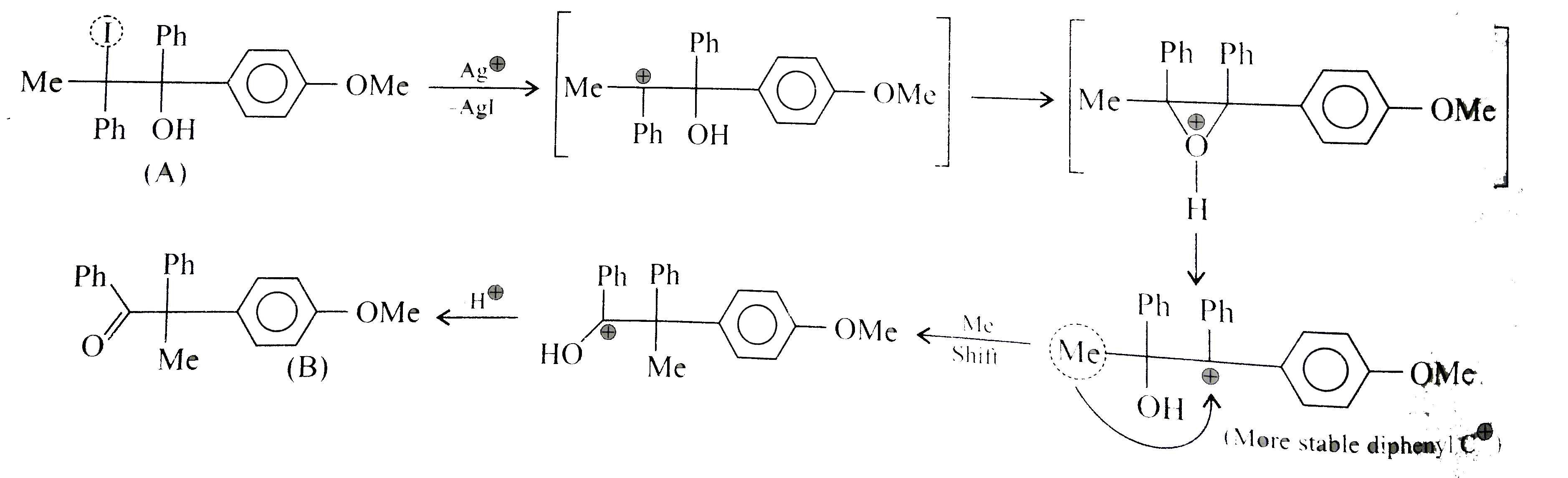
|
|
| 45. |
Assign the position of the element in periodic table having outer electronic configuration (i) (n-1) d ^(2) ns^(2)for n =4 (ii) (n-2) f^(7) (n-1)d^(1) ns^(2) for n =6 Find the group no. |
|
Answer» |
|
| 46. |
Assign the position of the element having outer electronic configuration, (A) ns^(2)np^(2)(n=6) (B) (n-1)d^(2)ns^(2)""(n=4) (C) (n-2)f^(7)(n-1)d^(-1)ns^(2)(n=6) Which of the following statement(s) is/are correct? |
|
Answer» The element 'A' belong to 3RD period and 16th GROUP. |
|
| 47. |
Assign the number 1,2,3,4 for the formation of products A,B,C,D in appropriate box as per the given instruction . If aliphatic nucleophilic substitution reaction then assign = 3 If aromatic nucleophilic substitution reaction then assign =4 If esterification reaction then assign = 1 if dehydration reaction then assign=2 |
Answer» SOLUTION :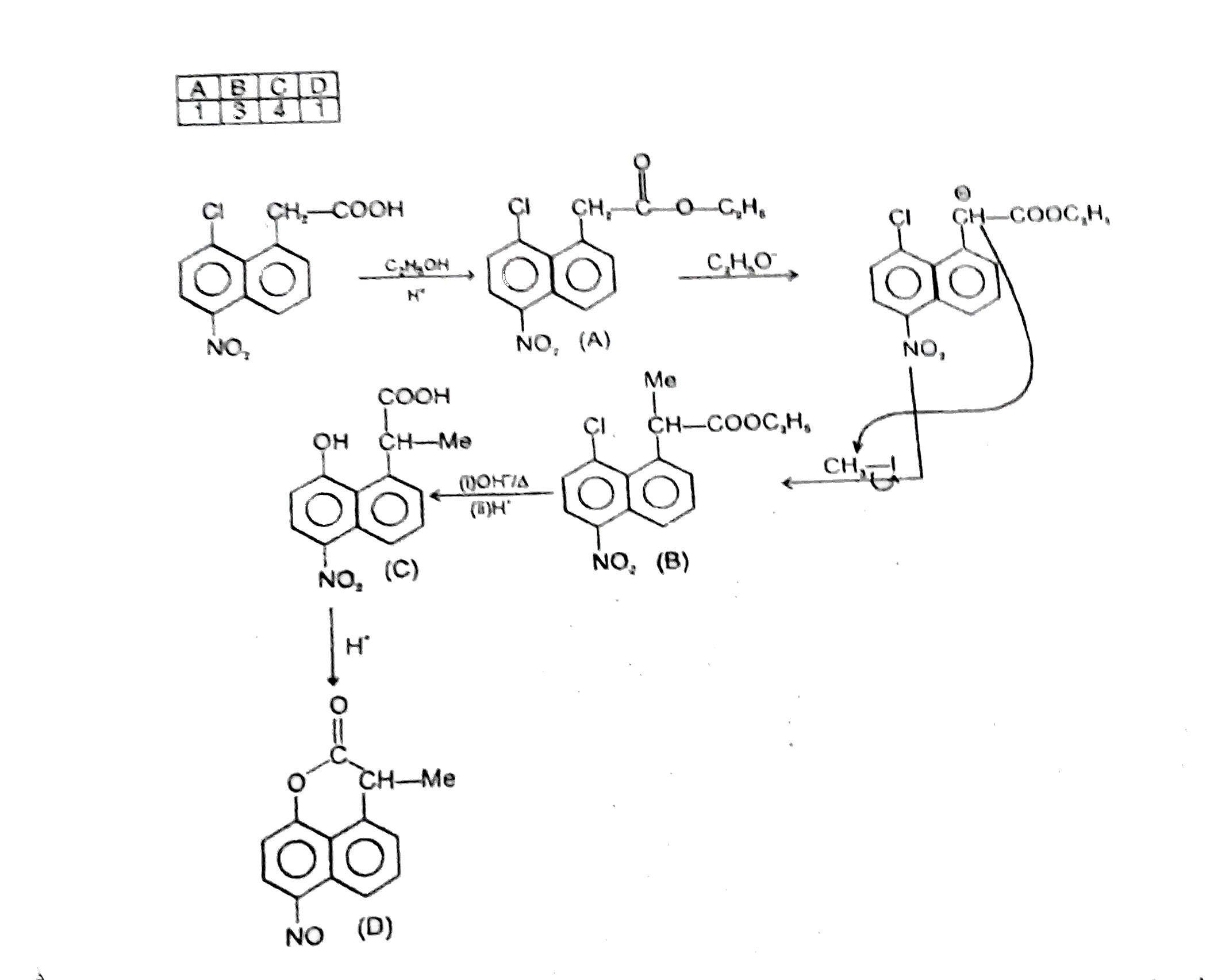
|
|
| 48. |
Assign the configuration E/Z to the following compounds. |
|
Answer» |
|
| 49. |
Assign suitable terms to the following : (i) Materials which can withstand very high temperatures without melting and softening. (ii) Sulphide ores are generally heated in a stream of air. (iii) The substances used for the removal of gangue in the ores in the form of slags. (iv) Two metals which are manufactured by the electrolysis of their fused salts. (v) Two metals used for reduction in metallurgical processes. |
|
Answer» SOLUTION :(i) Refractory MATERIALS (II) Roasting (III) FLUXES (iv) Sodium, aluminium (v) Aluminium, magnesium, iron or sodium. |
|
| 50. |
Assign reasons for the following : (i) When a moist blue litmus paper is dipped in a solution of hypochlorous acid, it first turns red and then latter gets decolourised. Explain. (ii) Iodine is liberated when KI is added to a solution of Cu^(2+) ions but Cl_(2) is not liberated when KCI is added to a solution of Cu^(2+) ions. Why ? (iii) Na_(2)S_(2)O_(3) reacts with Cl_(2) and I_(2) to give different oxidation products. Write the equations of the reactions involved and give a plausible explanation of their contrasting behaviour. (iv) Name a compound of fluorine which shows +1 oxidation state. How is this compound prepared ? Is this a disproportionation reaction ? |
|
Answer» Solution :(i) HOCl acts as an acid and hence turns blue litmus red. `HOCl rarr H^(+) OCl^(-)` It also works ASA bleaching AGENT, and thus decolourises red litmus by nascent oxygen. `HOCl rarr HCl + [O]` (ii) The `I^(-)` ion being a strong reduucing agent reduces `Cu^(2+)` to `Cu^(+)` and itself gets oxidised to `I_(2)` `2 Cu^(2+) + 4 KI rarr Cu_(2)I_(2) + I_(2) + 4 K^(+)` Since `Cl^(-)` ion does not act as a reducing agent, therefore, `Cl_(2)` is not liberated when KCl is added to a solution of `Cu^(2+)` ions. (iii) `Cl_(2)` is a stronger oxidising agent than `I_(2)` and hence oxidises `Na_(2)S_(2)O_(3)` to `NaHSO_(4)` in which the oxidation state of S increase from +2 to +6 while with `I_(2)` only sodium tetrathionate is obtained in which the oxidation state of S increases from + 2 to + 2.5 only. `{:(Na_(2)overset(+2)(S_(2))O_(3)+4Cl_(2) + 5H_(2)O rarr 2 Na overset(+6)(HSO_(4))+8HCl),(""Na_(2)overset(+2)(S_(2))O_(3)+I_(2)rarr 2 NaI + underset("Sod. tetrathionate")(Na_(2)overset(+2.5)(S_(4))O_(6))):}` (iv) The compound of F which SHOWS an oxidation state of +1 is HOF. It is prepared by passing `F_(2)` over ice at 233 K. `overset(0)(F_(2))+H_(2)O(ice) overset(23 K)hArr overset(+1)(HOF)+overset(-1)(HF)` This is a disproportionation reaction since the oxidation state of F decreases from zero in `F_(2)` to -1 in HF and increases to +1 in HOF. |
|


