Saved Bookmarks
This section includes 7 InterviewSolutions, each offering curated multiple-choice questions to sharpen your Current Affairs knowledge and support exam preparation. Choose a topic below to get started.
| 1. |
Calculate the cell potential for Ag_((S))|Ag^(+)(0.01M)||Ag^(+)(0.1M)|Ag_((S)) at 298K. |
|
Answer» |
|
| 2. |
Calculate the cell e.m.f. at 25^(@)C for the cell: Mg(s)|Mg^(2+)(0.01M)||Sn^(2+)(0.1M)|Sn(s) Given E_(Mg^(2+)//Mg)^(@)=-2.34V,E_(Sn^(2+)//Sn)^(@)=-0.136V,1F=96,500" C "mol^(-1) Calculate the maximum work that can be accomplished by the operation of this cell. |
|
Answer» `E_(cell)=E_(cell)^(@)-(0.0591)/(2)"log"([Mg^(2+)])/([Sn^(2+_)]), thereforeE_(cell)=2.204-(0.0591)/(2)"log"(0.01)/(0.1)=2.500V` `w_(max)=-DeltaG^(@)=nFE_(cell)^(@)=2xx96500xx2.204=425372J` (Note that `w_(max)` is RELATED to `E_(cell)^(@)` and not `E_(cell)`). |
|
| 3. |
Calculate the capillary depression of Hg in a tube of diameter 1.0 mm. Assume that the contact angle is zero. The density of Hg is 13.6 xx 10^3 kg m^(-3) and the surface tension of Hg is 0.460 Nm^(-1). |
|
Answer» |
|
| 4. |
Calculate the buffer capacity of 1L solution of : (i)0.1MCH_(3)COOH and 0.1MCH_(3)COONa (ii) 0.2MCH_(3)COOH and 0.2MCH_(3)COONa Given:pK_(a)(CH_(3)COOH)=4.74 Which will be a better buffer? |
|
Answer» SOLUTION :Buffer capcaity =`(2.303(a+x)(b-x))/(a+b)~~(2.303ab)/(a+b)xltlta,b` Buffer capacity =`(0.1xx0.1xx2.303)/(0.1+0.1)=0.11515` Buffer capacity `=(0.2xx0.2xx2.303)/(0.2+0.2)=0.2303` Second buffer solution (having GREATER buffer CAPCITY )can be called BUTTER buffer. |
|
| 5. |
Calculate the bond enthalpy of Xe-F bond as given in the equation, XeF_(4)(g)toXe^(+)(g)+F^(-)(g)+F_(2)(g)+F_(g),Delta_(r)H=292" kcal "mol^(-1) Ionisation energy of Xe=279 kcal/mol bond energy (F-F)=38 kcal/mol Electron affinity of F=85 kcal/mol |
|
Answer» 8.5 kcal/MOL `292=(4x+279)-(38+85)impliesx=34` kcal `mol^(-1)` |
|
| 6. |
Calculate the bond energy of C-H bond from the following data : (a) C (s) + 2 H_(2) (g) to CH_(4) (g) , Delta H = -74.8 KJ (b) H_(2) (g) to 2 H (g) , Delta H = 435.4 KJ (c) C(s) to C(g) , Delta H = 718.4 KJ |
|
Answer» 316.0 KJ/mol |
|
| 7. |
Calculate the bond energy of C-=C in C_(2)H_(2) from the following data : (i)C_(2)H_(2)(g)+2(1)/(2)O_(2)(g) to 2CO_(2)(g)+H_(2)O,DeltaH=-310"kcal" (ii)C(s)+O_(2)(g) to CO_(2)(g),DeltaH=-94"kcal" (iii) H_(2)(g)+(1)/(2)O_(2)(g) to H_(2)O(g),DeltaH=-68 "kcal" Bond energy of C-H bonds =99 kcal Heat of atomisation of C=171 kcal Heat of atomisation of H=52 kcal |
|
Answer» SOLUTION :Let us first calculate heat of formation of `C_(2)H_(6)` from which we can calculate bond energy of `C-=C` bond. `2C(s)+H_(2) to C_(2)H_(2)(g)` , `DeltaH=?` Applying the inspection method , i.e., `[2xx` Eqn. (ii) `+` Eqn. (iii) - Eqn. (i)] we get `2C(s)+2O_(2)(g)+H_(2)(g)+(1)/(2)O_(2)(g)-C_(2)H_(2)(g)-2(1)/(2)O_(2) to 2CO_(2)(g)+H_(2)O(g)-2CO_(2)(g)-H_(2)O(g), DeltaH=2xx(-94)+(-68)-(-310)kcal` or `2C(s)+H_(2)(g) to `C_(2)H_(2)(g) `, `DeltaH=54` kcal Now heat CHANGES for reactants Heat of atomisation of 2 moles of `C=2xx171` kcal Heat of atomisation of 2 moles of `H=2xx52` kcal And heat change for the product `(H-C-=C-H)` Heat of formation of 2 moles of C-H bonds `=-2xx99` kcal Heat of formation of 1 MOLE of `C-=C` bonds `=x` (say) Summing up, we get heat of formation of `C_(2)H_(2)`, `2xx171+2xx52-2xx99+x=54` `x=-194` kcal Hence bond energy of `C-=C` bond in `C_(2)H_(2)` is `+194` kcal |
|
| 8. |
Calculate the bolling point of one mole aqueous solution (density 1.06 g cm^(-3)) of KBr. (Given : K_(b), for H_(2)O =0.52K kg mol^(-1), Atomic mass : K =39 , Br = 80 ] |
|
Answer» Solution :One molar aqueous solution BOILING POINT = 7 d = 1.06 g/ml assuming VOLUME 1 L of KBr. Weight of KBr = 1.06 g `DeltaK_(b)=0.52` K kg /mol . `DeltaT_(b)=iK_(b)` m weight of solvent 1 kg `DeltaT_(b) = T_(2)-T_(1)` where `T_(1)= 373 K` `DeltaT_(b) = iK_(b) xx(W_(B)xx1000)/(M_(B)W_(A))` `DeltaT_(b)=2xx0.52 xx(1.06xx1000)/(119xx1)` `DeltaT_(b)=(1.1024xx1000)/(119)` =9.26 `T_(2)-373=9.26` `=382.26 K` . |
|
| 9. |
Calculate the boiling point sollution when 2 g of Na_(2)SO_(4) (M=142 g mol^(-1)) was dissoved in 50 g of water assuming that NaSO_(4) undergoes complete ionization (K_(b) for water = 0.52 K kg mol^(-1)) |
|
Answer» `Na_(2)SO_(4)" DISSOCIATES in aqueous solution as ":` `Na_(2)SO_(4)(s)overset(("aq"))to2Na^(+)("aq")+SO_(4)^(2-)("aq")` `i=3, W_(B)==2g, M_(B)=142"g MOL"^(-1), W_(A)=50g=0.050 kg` `K_(b)=0.52" K kg mol"^(-1)` `DeltaT_(b)=ixxK_(b)xxm=(xx(0.52" K kg mol"^(-1))xx(2g))/((142" g mol"^(-1))xx(0.050" kg "))=0.44 K` Step II. `"Calculation of boilling point of solution" (T_(b))` `T_(b)=T_(b)^(@)+DeltaT_(b)=373 K+0.44 K=373.44 K` |
|
| 10. |
Calculate the boiling point of solution when 4 g of MgSO_4 (M = 120 g "mol"^(-1))was dissolved in 100 g of water, assuming MgSO_4undergoes complete ionisation. |
|
Answer» SOLUTION :Apply the relation ` Delta T_b = i xx K_b xx m` For `MgSO_4 , i = 2` Molarity of solution = ` (4//120)/(100) xx 1000 = 4/120 xx 10 = 1/3` Substituting the values in EQUATION (i), we have ` Delta T_b = 2 xx 0.52 xx 1/3 = 0.347` Boiling point of the solution = `100 + 0.347 = 100.347^@C = 373.347 K ` |
|
| 11. |
Calculate the boiling point of bromine from the following data : DeltaH^(0) and DeltaS^(0) values of Br_(2)(l) to Br_(2)(g) are 30.91 kJ/"mole" and 93.2 J/"mol". K respectively. Assume that DeltaH and DeltaS do not vary with temperature. |
|
Answer» Solution :Consider the process : `Br_(2)(L) to Br_(2)(G)` The b.p. of a LIQUID is the temperature at which the liquid and the pure gas coexist at equilibrium at 1 atm `:. DeltaG=0` As it is given that `DELTAH` and `DeltaS` do not change with temperture `DeltaH=DeltaH^(@)=30.91kJ` `DeltaS=DeltaS^(@)=93.2J//K=0.0932kJ//K` We have, `DeltaG=DeltaH-TDeltaS=0` `:.T=(DeltaH)/(DeltaS)=(30.91)/(0.0932)=331.6K` This is the temperature at which the SYSTEM is in equilibrium that is the b.p. of bromine. |
|
| 12. |
Calculate the boiling point of a solution prepared by adding 15.00 g of NaCl to 250.0 g of water. (K_(b), for water 0.512 K. kg mol^(-1), molar mus of NaCl = 58.44g) |
|
Answer» SOLUTION :`DeltaT_(B)=K_(b)xxm` `DeltaT_(b)=K_(b)XX(W_(B))/(M_(B))xx(1000)/(W_(A)" in g")` `T_(b)-T_(b)^(0)= (0.512xx15xx1000)/(58.44) ` = 0.5256 K `T_(b) = T_(b)^(0)+DeltaT_(B) = 0.53K` `T_(b)= 373 +0.5256= 373.53K` |
|
| 13. |
Calculate the boiling point of a solution prepared by adding 15.00 g of NaCl to 250.0 g of water (K_(b) for water = "0.512 K kg mol"^(-1) , Molar mass of NaCl = 58.44 g) |
|
Answer» |
|
| 14. |
Calculate the boiling point of a solution prepared by adding 15.0 g of NaCl of 250.0 g of water (K_(b) for water ="0.512 K kg mol"^(-1), Molar mass of NaCl = 58.44 g) |
| Answer» SOLUTION :(B) `101.05^(@)C(i=2)` | |
| 15. |
Calculate the boiling point of a solution containing 25 g urea (NH_(2)CONH_(2)) and 25 g thiourea (NH_(2)CSNH_(2)) in 500 g chloroform, CHCl_(3). The boiling point of pure chloroform is 61.2^(@)C and K_(b)=3.63 K m^(-1). |
|
Answer» SOLUTION :25 G urea `=(25)/(60)` mole = 0.417 mole, 25 g THIOUREA `= (25)/(76)` mole = 0.329 mole TOTAL moles `= 0.417+0.329=0.746` Mass of solvent `= 500 g = 0.500 kgtherefore "Molality"=(0.746 MOL)/(0.500 kg)=1.492 m`, `Delta T_(b)=K_(b)xx m=3.63xx1.492 = 5.416^(@)` Boiling point of solution `= 61.2+5.416^(@)C=66.616^(@)C`. |
|
| 16. |
Calculate the boiling point of a solution containing 0.61 g of benzoic acid in 50 g of carbon disulphide assuming 84% dimerisation of the acid. The boiling point and K_(b) of CS_(2) are 46.2^(@)C and "2.3 K kg mol"^(-1) respectively. |
|
Answer» `DeltaT_(b)=iK_(b)m=0.58xx2.3xx(0.61)/(122)xx(1000)/(50)=0.1334^(@)."HENCE "T_(b)=46..2+0.133=46.333^(@)C`. |
|
| 17. |
Calculate the boiling point of a solution containing 0.456 g of camphor (mol. Mass = 152) dissolved in 31.4 g of acetone (b.p. = 56.30^(@)C), if the molecular elevation constant per 100 g of acetone is 17.2^(@)C. |
|
Answer» SOLUTION :Here, we have `w_(2)=0.456 g, M_(2)=152, w_(1)=31.4 g, T_(0)=56.30^(@)C, K_(b)=17.2^(@)C//100 g` `Delta T_(b)=(100 K_(b).w_(2))/(w_(1)M_(2))=(100xx17.2xx0.456)/(31.4xx152)=0.16^(@)C` `therefore` BOILING point of solution `(T_(b))=T_(b)^(@)+Delta T_(b)=56.30+0.16 = 56.46^(@)C` |
|
| 18. |
Calculate the boiling point of a solution containing 1.8 g of a non-volatile solute dissolved in 90 g of benzene. The boiling point of pure benzene is 353.23 K, (K_(b)=2.53 K kg mol^(-1) , density of water= 1 g mol^(-1)). |
|
Answer» `K_(b)=2.053" K kg mol"^(-1), M_(B)=58"g mol"^(-1),T_(b)=?` `DeltaT_(b)=(K_(b)xxW_(B))/(DeltaT_(b)xxW_(A))=((2.53" K kg mol"^(-1))XX(1.8g))/((58" g mol"^(-1))xx(0.09 kg))=0.872 K` `T_(b)=T_(b)^(@)+DeltaT_(b)=353.23+0.872=354.102 K.` |
|
| 19. |
Calculatethe boiling point of a one molaraqueous solution (density 1.04g"mL "^(1))ofpotassium chlorideK_(b)for water = 0.52K "mol "^(-1). Atomicmasses : K = 39, Cl = 35.5 ) |
|
Answer» Solution :Concentrationof solution = 1M ,Density of solution = 1.04 g `" mL"^(-1)` LET us FIRST calculate the motality of the solution. mount of solute (KCI) = 1mol = 74.5 g , Volumeof solution= 1:L = 1000 mL Mass of the solution ` = 1000 xx 1.04 g = 1040 g` `:. ` Mass of solvent=` 1040 - 74.5` g = 965 . 5 g = 0.9655 kg `"Molality of the solution"= ("No. of moles of the solute ")/("Mass of the solvent in kg")= ("1mol")/(0.9655 "kg") = 1.0357 "molkg"^(-1) = 1.0357 m` KCl DISSOCIATES as : ` KCl to K^(+)Cl^(-)` ` :. ` Numberof particles after dissociation=2`:. `van't Hoff factor , i = 2 Now` Delta T _(b) = i xx K_(b) xx m = 2 xx 0.52 xx 1.0357 = 1.078^(@) C` `:. ` BOILING point of the solution = ` 100 + 1.078 = 101.078 ^(@)C` |
|
| 20. |
Calculate the boiling point elevation for a solution prepared by adding 10 g of CaCI_(2) to 200 g of water. (K_(b) for water = 0.512 K kg mol, Molar mass of CaCI_(2) = 100 g mol^(-1)). |
|
Answer» `CaCI_(2)(s)OVERSET(("aq"))toCa^(2+)("aq")+2CI^(-)("aq")` `i=3, W_(B)=10 g, W_(A)=200 g= 0.2, K_(b)=0.512" K KG mol"^(-1)` `M_(B)=110" g mol"^(-1)` `DeltaT_(b)=ixxK_(b)m=(ixxK_(b)xxW_(B))/(M_(B)xxW_(A))` `DeltaT_(b)=((3)xx(0.512" K kg mol"^(-1))xx(10g))/((110" g mol"^(-1))xx(0.2 kg ))=0.69 K` |
|
| 21. |
Calculate the Avogadro constant from the following data: Density of solid NaCl = 2.165 g/cc. Distance between centres of adjacent Na^(+)and Cl^(-) = 0.2819 nm. Also, calculate the edge length of a cube containing 1 mole of NaCl and the number of ions (Na^+ Cl^(-)) along one edge of the cube. |
|
Answer» |
|
| 22. |
Calculate the binding energy for ._(1)H^(2) atom. The mass of ._(1)H^(2) atom is 2.014102 amu where 1n and 1p have their weights 2.016490 amu. Neglect mass of electron. |
|
Answer» |
|
| 23. |
Calculate the average volume available to a molecule in a sample of nitrogen gas at STP. What is the average distance between neighbouring molecules if nitrogen molecules are spherical in nature ? |
|
Answer» SOLUTION :`6.023 xx10^(23)` molecules of `N_(2)` occupy `22400 cm^(3)` `THEREFORE` one molecules of `N_(2)` occupies `=(22400)/(6.023xx10^(23))cm^(3)` or volume of one molecule of `N_(2)=3.72xx10^(-20) cm^(3)` Also, the average distance between TWO molecules =2r and `(4)/(3) pi r^(3)=3.72xx10^(-20)` `therefore r^(3) =(3.72xx10^(-20)xx3xx7)/(4xx22)` `therefore r=20.7xx10^(-8) cm` Thus, average distance `=2xx20.7xx10^(-8)` `=41.4xx10^(-8) cm` |
|
| 24. |
Calculate the average atomic mass of hydrogen using the following data : {:("Isotops",%"Natural abundance","Molar mass"),(.^(1)H,"99.985","1"),(.^(2)H,"0.015","2"):} |
|
Answer» <P> Solution :`"Average atomic mass "= (Sigmap_(i)A_(i))/(100)""(p_(i)="PERCENT abundance, "A_(i)="atomic mass of ISOTOPE ")``=(99.985xx1+0.015xx2)/(100)=(99.985+0.030)/(100)=(100.015)/(100)=1.00015u.` |
|
| 25. |
Calculate the atomicity of mercury molecules from the following data : (a) 10.0 g of mercury combine with 0.8 g of oxygen to form an oxide. (b) 500 mL of mercury vapour at S.T.P. weigh = 4.465g (c) Specific heat of mercury is 0.033. |
|
Answer» Solution :Calculation of equivalent mass `"0.89 g of oxygen combine with Hg = 10.0 g"` `therefore"8 g of oxygen will combine with Hg "=(10)/(0.8)xx8=100g` `therefore"Equivalent mass of mercury"=100` Calculation of molar mass `"500 ML of mercury VAPOUR at S.T.P. weigh = 4.465 g"` `therefore"22400 mL of mercury vapour at S.T.P. will weigh"=(4.465)/(500)xx22400g=200g` `therefore"Molar mass ofmercury = 200 g mol"^(-1)` Calculation of valency. By Dulong and Petit's law. `"Approx. atomic mass of mercury "=(6.4)/("Sp. Heat")=(6.4)/(0.033)=193.9` `therefore"Valency of mercury"=("Approx. atomic mass")/("Valency")=(193.9)/(100)~~2"(as valency is a whole no.)"` `therefore"Actual atomic mass "="Eq. mass"XX"Valency"=100xx2=200` `"Calculation of atomicity.Atomicity"=("Mol. mass")/("At. mass")=(200)/(200)=1` Thus, mercury molecules are monoatomic. |
|
| 26. |
Calculate the atomic mass (average) of chlorine using the following data : {:(,""%"Natural Adundance","Molar mass"),(.^(35)Cl,"75.77","34.9689"),(.^(37)Cl,"24.23","36.9659"):} |
|
Answer» SOLUTION :`"FRACTIONAL abundance of ".^(35)Cl=0.7577," Molar MASS "=34.9689` `"Fractional abundance of ".^(37)Cl=" 0.2423. Molar mass "=36.9659` `therefore"Average atomic mass "=(0.7577)+(34.9689 AMU)+(0.2423)(36.9659amu)` `=26.4959+8.9568= 34.4527` |
|
| 27. |
Calculate the angle at which (a) first order reflection and (b) second order reflection will occur in an X-ray spectrometer when X-ray of wavelength 1.54A^@ are diffracted by the atoms of a crystal, given that the interplanar distance is 4.04A^@. |
| Answer» SOLUTION :`10^@59. , 22^@24` | |
| 28. |
Calculate the amount of (NH_(4))SO_(4) in grams which must be added to 500 ml of 0.200 M NH_(3) to yield a solution with pH = 9.35 (K_(b) for NH_(3) = 1.78 xx 10^(-5)) |
|
Answer» 10.56 gm |
|
| 29. |
Calculate the amount of limen, Ca(OH)_(2), required to remove hardness of 50,000 litres of well water which has been found to contain 1.62 g of calcium bicarbonate per 10 litre. |
|
Answer» Solution :(i) Calculation of total `Ca(HCO_(3))_(2)` present 10 L of water contains `Ca(HCO_(3))_(2)=1.62 G` `therefore 50, 000 L` of water will contain `Ca(HCO_(3))_(2)=(1.62)/(10)xx50000 g=8100 g` (ii) Calculation of lime REQUIRED. The BALANCED EQUATION for the reaction involved is : `{:(""Ca(HCO_(3))_(2),+,""Ca(OH)_(2),rarr,2CaCO_(3)+2H_(2)O),("1 mole",,"1 mole",,),(40+(1+12+48)xx2=162 g,,40+(16+1)xx2=74 g,,):}` `162 g Ca(HCO_(3))_(2)` required lime = 74 g `therefore 8100g Ca(HCO_(3))_(2)` will required lime `=(74)/(162)xx8100 g=3700 g = 3.7 kg` |
|
| 30. |
Calculate the amount of NaCl which must be added to 100 g of water so that the freezing point is depressed by 2 K. For water, K_(f)=1.86K//m. |
|
Answer» `therefore"AMOUNT of NaCl to bedissolved in 100 G"=(0.538xx100)/(1000)xx58.5g=3.147g.` |
|
| 31. |
Calculate the amount of KCl which must be added to 1 kg of water so that the freezing point is depressed by 2 K. (K_(f) " for water = " 1.86 " K kg "mol^(-1)) |
|
Answer» Solution :SINCE one mole of KCI gives 2 mole PARTICLES, the value of I = 2 `DELTA T_(f) = 2 K ` `K_(f) = 1.86 " kg mol"^(-1)` Applying equation, `T_(f) = iK_(f) `m `m = (Delta T_(f))/(iK_(f)) = (2)/(2 xx 1.86)` Therefore, 0.54 mole of KCI should be added to one kg of water. MOLAR mass of KCI = 39 + 35.5 = 74.5 g AMOUNT of KCl = 0.54 `xx 74.5 `g = 40.23 g |
|
| 32. |
Calculate the amount of KCl which must be added to 1 kg of water so that the freezing point is depressed by 3 K. (K for water = 1.86 K "mol"^(-1)). |
|
Answer» Solution :KCI is a strong ELECTROLYTE and is completely DISSOCIATED in water as : `KCIto K^+ +Cl^-` Now, 1 mole of KCI will give 2 mole IONS. THEREFORE, the value of Van.t Hoff factor (i) will be equal to 2. `Deltat=i k_f m ` `K_f =1.86 (K kg "mol"^(-1))` `DeltaT = 3 K,i=2` `m= (Delta T )/(i K _f ) = ( 3 )/( 2 xx 1.86 ) = 0.81` mole Thus, 0.81 mole or `0.81 xx74.5 g = 60-34 g` must be added to 1 kg of water. |
|
| 33. |
Calculate the amount of ice that will separated out when a solution containing 50 g of ethylene glycol in 200 g of water is colled to -9.3^(@)C.""(K_(f)" for "H_(2)O="1.86 K kg mol"^(-1)) |
|
Answer» Solution :`DeltaT_(f)=(1000K_(f)w_(2))/(w_(1)M_(2))` LET us calculate the amount of WATER `(w_(1))`present when `DeltaT_(f)=9.3^(@)` `9.3=(1000xx1.86xx50)/(w_(1)xx62)""("MOL. mass of "(CH_(2)OH)_(2)=62)` `"or"w_(1)=161.29 g` `therefore"Water frozen to ice "=200-161.29=38.71g` |
|
| 34. |
Calculate the amount of heat that must be supplied to raise the temperature of 2 kg of water from 25^(@)C to its boiling point at one atmospheric pressure. The average specific heat of water in the range 25 - 100^(@)C is 4.184 JK^(-1) g^(-1). |
|
Answer» 628 KJ `m = 2000g, Delta T = 100 - 25 = 75^(@)`, `C_(s) = 4.184 JK^(-1) g^(-1)` Heat required = `2000 x 4.184 xx 75` `= 6.28 xx 10^(5) J` or= 628 kJ |
|
| 35. |
Calculate the amount of heat evolved during the complete combustion of 100 ml of liquid benzene from the following data. Predict your answer as (Delta H)/(100) ( in KJ/mol). (i) 18 gm of graphite on complete combustion evolve 585 KJ heat (ii) 15540 KJ heat is required to dissociate all the molecules of 1 litre water into H_(2) and O_(2). (iii) The heat of formation of liquid benzene is 48 kJ/mol (iv) Density of C_(6)H_(6)(l)=0.87 gm//ml |
|
Answer» `(ii) "" H_(2)(g)+(1)/(2)O_(2)(g) rarr H_(2)(l) , DeltaH_(f)^(0) =-280 KJ//mol ,"" Delta H_(f)^(0) = (15540)/(55.5)` `(III)"" C_(6)H_(6)(l) + (15)/(2)O_(2)(g) rarr 6CO_(2)(g) + 3H_(2)O(l) ,"" DeltaH_(f)^(0) = -48` `THEREFORE""DeltaH^(0) = [6(-390) + 3(-280)] - 48 = -3228 KJ//mol` `""` Mass of benzene is `= 0.87 xx 100 = 87g` `therefore""` Heat evolved from `87` gm benzene `=3600KJ` `""` Hence , `(DeltaH)/(100)=36KJ.` |
|
| 36. |
Calculate the amount of energy released in ergs, calories and in joules when 0.001 kg of mass disappears. [Given, Velocity of light =3xx10^(8)m s^(-1)] |
|
Answer» SOLUTION :According to Einstein equation , `E=mc^(2)` `m=0.001kg=1XX10^(-3)kg, c=3XX10^(8)ms^(-1)` `E=(1xx10^(-3))(3xx10^(8))^(2)=9xx10^(13)J` 1J`=10^(7)"erg"=0.24` cal `9xx10^(13)J=9xx10^(13)xx10^(7)"erg"=9xx10^(13)xx0.24` cal `=9xx10^(20)` erg `=2.16xx10^(13)` cal. |
|
| 37. |
Calculate the amount of chlorine required to completely react with 4.56 g of hydrogen (h_2) to yield hydrochloric acid (HCl) ? Also calculate the amount of HCl formed. |
|
Answer» |
|
| 38. |
Calculate the amount of CaCl_2[molar mass = 111 g "mol"^(-1) ] which must be added to 500 g of water to lower the freezing point by 2 K, assuming CaCl_2is completely dissociated. |
|
Answer» Solution :APPLY the relation (without taking dissociation into CONSIDERATION) ` Delta T_f = (K_f xx 1000 xx w_2)/(M_2 xx w_1)` `2K = (1.86 K KG "MOL"^(-1) xx 1000 g kg^(-1) xx w_2)/(111 g "mol"^(-1) xx 500 g) ` ` w_2 = (2 xx 111 xx 500)/(1.86 xx 1000) = 59.68 g` One molecule of `CaCl_2` dissociates into one `Ca^(2+)` ion and two `Cl^-` ions. `CaCl_2 to Ca^(2+) + 2Cl^(-)` PARTICLE dissociates into three particles. Therefore, the amount of `CaCl_2`needed = `(59.68)/(3) = 19.89 g` |
|
| 39. |
Calculate the amount of carbon dioxide that could be produced when (i) 1 mole of carbon is burnt in air. (ii) 1 mole of carbon is burnt in 16 g of dioxygen. (iii) 2 moles of carbon are burnt in 16 g of dioxygen. |
|
Answer» Solution :The balanced equation for the combustion of carbon in dioxygen/air is `underset("1 mole")(C(s))""+""underset("(32 g)")underset("1 mole")(O_(2)(g))""rarr""underset("(44 g)")underset("1 mole")(CO_(2)(g))` (i) In air, combustion is complete. THEREFORE, `CO_(2)` produced from the combustion of 1 mole of carbon = 44 g. (II) As only 16 g of dioxygen is available, it can combine only with 0.5 mole of carbon, i.e., dioxygen is the limiting REACTANT. Hence, `CO_(2)` produced = 22 g. (III) Here again, dioxygen is the limiting reactant. 16 g of dioxygen can combine only with 0.5 mole of carbon. `CO_(2)` produced again is equal to 22 g. |
|
| 40. |
Calculate the amount of calcium oxide required when it reacts with 852 g ofP_4O_10 |
|
Answer» <P> Solution :`CaO + P_4O_10 to Ca_3 (PO_4)_2`APPLY POAC for CA and P atoms 1008 G |
|
| 41. |
Calculate the amount of CaCl_(2) (van't Hoff factor I =2*47) dissolved in 2*5 L solution so that its osmotic pressure at 300 K is 0*75 atmosphere. Given : Molar mass of CaCl_(2) is 111 g."mol"^(-1), R=0*082L." atm "K^(-1)"mol^(-1). |
|
Answer» Solution :The osmostic pressue (calculated), `pi=(n)/(v)RT` . . .(i) where, V=volume `=2*5L,` T=Temperature = 300 K, n= dissolving moles of `CaCl_(2)` `=("Wt. of solute(g)")/("Molecular mass of solute (M)")` Thus equation (i) becomes `pi_("Cal")=(g)/(MV)RT` `:,""pi_("Cal")=(g)/(111"g mol"^(-1)xx2*5l)xx0*082l" atm"` `K^(-1)"mol"^(-1)xx300K` `=(24*6)/(277*5)atm=08=886xxg" atm. gm"` Van's HOFF factor (i) `=("observed osmotic pressure "(pi_(ob)))/("calculated osmotic pressure"(pi_(Cal)))` `:.""2*47=(0*75" atm")/("calculated osmotic pressure")` `:.""2*47=(0*75" atm")/(pi_"Cal")or,pi_("Cal")=0*3036` atm Thus, `0*3036=0*0886xx"g gm or",g=3*4271" gm"` Hence, the amount of `CaCl_(2)` dissolve in `2*5" l"` solution is `3*4271` gm. |
|
| 42. |
Calculate the amount of benzoic acid (C_6H_3COOH)required for preparing 250 mL of 0.15 M solution in methanol |
|
Answer» SOLUTION :0.15 M solution MEANS that 0.15 mole of benzoic acid is present in 1 L, i.e., 1000 mL of thesolution. Molar mass of benzoic acid `(C_6H_5COOH) = 72 + 5 + 12 + 32 + 1 = 122 g "mol"^(-1)` ` THEREFORE `0.15 mole of benzoic acid contains = 0.15 x 122 g = 18.3 g of benzoic acid Thus, 1000 mL of the solution contain = 18.3 g benzoic acid ` therefore `250 mL of the solution will contain =` (18.3)/(1000) XX 250 = 4.575 g `benzoic acid |
|
| 43. |
Calculate the amount of benzoic acid (C_(6)H_(5)COOH) required for preparing 250 mL of 0.15 M solution in methanol. |
|
Answer» Solution :0.15 M solution MEANS that 0.15 mole of benzoic acid is PRESENT in 1 L, i.e., 1000 ML of the solution. Molar MASS of benzoic acid `(C_(6)H_(5)COOH)=72+5+12+32+1="122 g MOL"^(-1)` `therefore"0.15 mole of benzoic acid "=0.15xx122 g=18.3g` `therefore"250 mL of the solution will contain benzoic acid "=(18.3)/(1000)xx250="4.575 g."` |
|
| 44. |
Calculate the amount of AgNO_3 which should be added to 60 ml of solution to perpare a concentration of 0.03 g ml^(-1) |
|
Answer» 1.8 g |
|
| 45. |
Calculate the actual mass of one molecule of carbon dioxide (CO_(2)) |
|
Answer» SOLUTION :Molecular mass of `CO_(2)=44` amu 1 amu=`1.66xx10^(-24)G` So, the actual mass of `CO_(2)=44xx1.66xx10^(-24)` `=7.304xx10^(-23)g` |
|
| 46. |
Calculate the Activation Energy (E_(a)) of a reaction that follows the equation ,k=(4.5xx10^(11)s^(-1)) e. |
| Answer» SOLUTION :`(E_(a))/(R)=28000 therefore E_(a)=232.79"kJ.mol"^(-1)` | |
| 47. |
Calculate the accelerating potential that must be imparted to a proton beam to give it an effective wavelength of 0.005nm. |
|
Answer» Solution :Atomic weight of hydrogen is 1.008 amu. `therefore` weight of 1 MOLE of PROTON = 1.008g `therefore` weight of 1 proton `= (1.008)/(6.022 xx 10^(23))=0.167 xx 10^(-23)g` `=0.167 xx 10^(-26)kg` We have, `v= (h)/(m lamda)= ((6.63 xx 10^(-34)J.s))/((0.167 xx 10^(-26)kg) (0.005 xx 10^(-9) m))= 7.94 xx 10^(4) m//s` Kinetic energy `=(1)/(2) mv^(2) = (1)/(2) (0.167 xx 10^(-26)) (7.94 xx 10^(4))^(2)` `=5.26 xx 10^(-18)J` `=(5.26 xx 10^(-18))/(1.602 xx 10^(-19))eV` = 32.8eV As the magnitude of charge of a proton is the same as that of an electron, the potential required is equal in magnitude to the number of eV, i.e., 32.8 volts. |
|
| 48. |
Calculate the accelerating potential that must be imparted to a photon to give it an effective wavelength of 0.005 nm (mass of proton =1.67xx10^(-27)kg) |
|
Answer» |
|
| 49. |
Calculate sum of number of products formed in the reaction a,b and c . |
Answer» 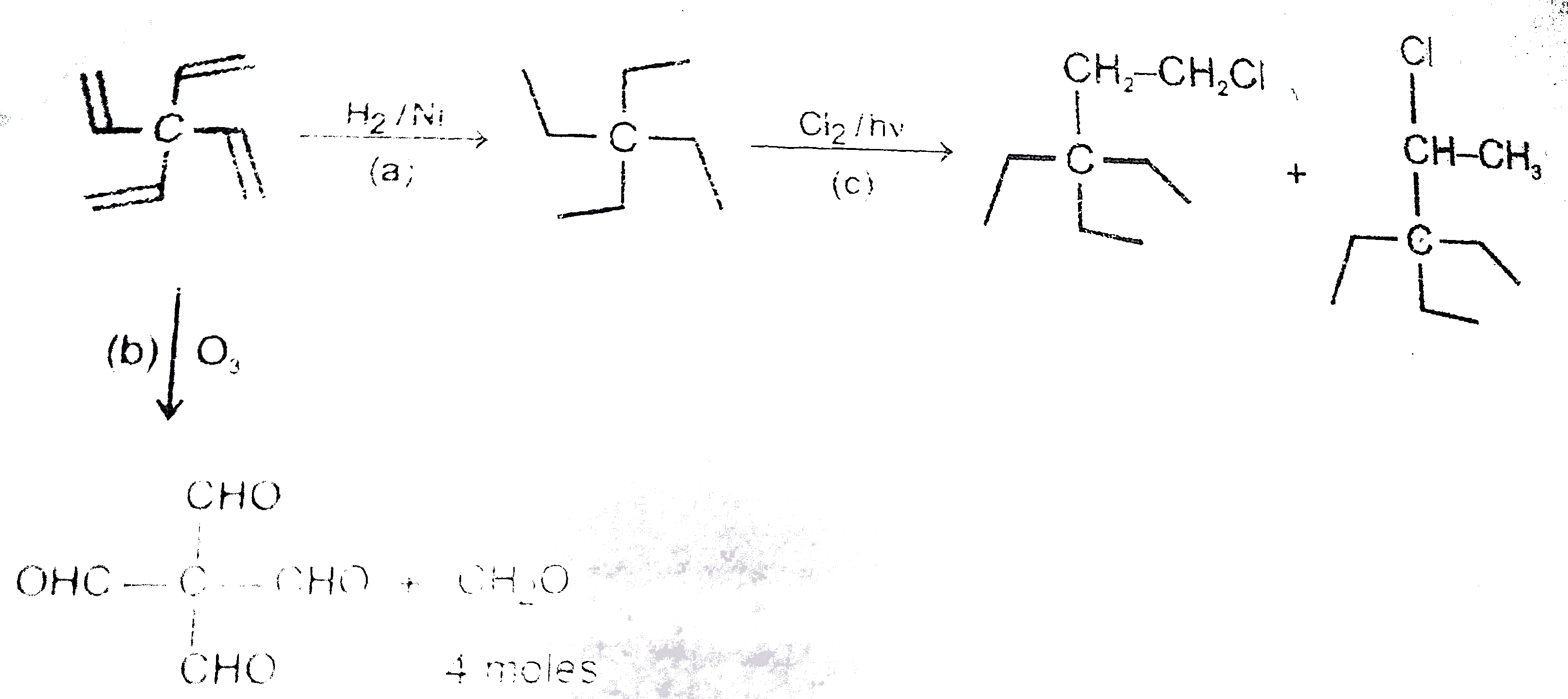
|
|