

Saved Bookmarks
This section includes 7 InterviewSolutions, each offering curated multiple-choice questions to sharpen your Current Affairs knowledge and support exam preparation. Choose a topic below to get started.
| 1. |
Calculate the distance between (111) planes in a crystal of Ca. Repeat the calculation for the (2 2 2) planes. Which planes are closer? |
|
Answer» Solution :We have, `d =a/sqrt(h^(2) + K^(2) + l^(2))` `d_(111) = 0.556/sqrt(1^(2) + 1^(2) + 1^(2)) = 0.321 nm` and `d_(222) = 0.556/sqrt(2^(2) + 2^(2) + 2^(2)) = 0.161 nm` The separation of the (1 1 1) planes is TWICE as great as that of the (2 2 2) planes. |
|
| 2. |
Calculate the dissociation constant of water at 25^(@)C from the following data : Specific conductance of H_(2)O = 5.8 xx 10^(-8) "mho cm"^(-1) lambda_(H^(+))^(@) = 350.0 and lambda_(OH^(-))^(@) = 198.0 "mho cm"^(2) |
|
Answer» Solution :SUPPOSE WATER contains X moles per litre (or X eq./L) of `H^(+)` IONS (or `OH^(-)` ions). `because` X equivalents of `H^(+)` ions are produced from X eq. of water `therefore` volume (cc) containing 1 eq. of water which dissociated into its ions `= (100)/(X)`. `therefore` eq. conductance of water = sp. cond. `xx` V `= 5.8 xx 10^(-8) xx (1000)/(X)` Since water dissociated feebly, i.e, water may be considered to be a diliute solution of `H^(+)` and `OH^(-)` ions. `Lambda_(H_(2)O) = Lambda_(H_(2)O)^(@) = lambda_(H)^(@) + lambda_(OH^(-))^(@)` `therefore 5.8 xx 10^(-8) xx (1000)/(X) = 350 + 198 = 548`. `therefore X = 1.0 xx 10^(-7)` `therefore [H^(+)] = [OH^(-)] = 1 xx 10^(-7)` For the equilibrium, `H_(2)O = H^(+) + OH^(-)` Equilibrium constant (K) `= ([H^(+)][OH^(-)])/([H_(2)O])` `K_(w) = K xx [H_(2)O] = [H^(+)][OH^(-)]` `= 1.0 xx 10^(-7) xx 1.0 xx 10^(-7) = 1 xx 10^(-14)` `therefore K = (K_(w))/([H_(2)O]) = (1xx 10^(-14))/(55.5) = 1.8 xx 10^(-16)` mole/litre. `([H_(2)O] = (1000)/(18) = 55.5 " mole/litre")` |
|
| 3. |
Calculate the dissociation constant of water at 25^(@)C from the following data. Specific conductance of H_(2)O = 5.8 xx 10^(-8) mho cm^(-1), lambda_(H^(+))^(oo) = 350.0 and lambda_(OH^(-))^(oo) = 198.0 mho cm^(2) |
|
Answer» `because X` equivalents of `H^(+)` ions are produces form X eq. of water `:.` volume (cc) containin 1 eq. of water which DISSOCIATED into its ions `= (1000)/(X)` `:.` eq. conductance of water = sp. cond . XV `= 5.8 xx 10^(-8) xx (1000)/(X)` Since water dissociates feebly, i.e., water may be considered to be a dilute solution of `H^(+)` and `OH^(-)` ions. `Lamda_(H_(2)O)=Lamda_(H_(2)O)^(@) =lamda_(H)^(@) +lamda_(OH^(-))^(@)` `:. 5.8 xx 10^(-8) xx (1000)/(X)=350 +198 =548` `:. X = 1.9 xx 10^(-7)` `:. [H^(+)]=[OH]=1 xx 10^(-7)`ltbtgt For the EQUILIBRIUM, `H_(2)O = H^(+) + OH^(-)` Equilibrium constant `(K)=([H^(+)][OH^(-)])/([H_(2)O])` `K_(w)=K xx [H_(2)O]=[H^(+)O]==[H^(+)][OH]` `=1.0 xx 10^(-7) xx 1.0 xx 10^(-7) = 1 xx 10^(-14)` `:. K=(K_(w))/([H_(2)O]) =(1 xx 10^(-14))/(55.5) =1.8 xx 10^(-16) "mole/L"` `([H_(2)O]=(1000)/(18) =55.5 "mole/L")`. |
|
| 4. |
Calculate the dipole moment of HBr molecule if the bond length is 1.2476 |
|
Answer» Solution :`mu=q.r=(1.6023xx10^(-19)C)(1.2476xx10^(10)m)` `=1.99xx10^(-23)CM` `=(1.99xx10^(-29))/(3.336xx10^(-30))=5.99D` |
|
| 5. |
Calculate the depression in the freezing point of water when 10 g of CH_(3)CH_(2)CHClCOOH is added to 250 g of water. K_(a)=1.5xx10^(-3),K_(f)=1.86" K kg mol"^(-1) |
|
Answer» Solution :`"MOLAR MASS of "CH_(3)CH_(2)CHClCOOH=15+14+13+35.5+45="122.5 g mol"^(-1)` `"10 g of "CH_(3)CH_(2)CHClCOOH=(10)/(122.5)" mole"=8.16xx10^(-2)" mole"` `therefore"Molality of the solution (m)"=(8.16xx10^(-2)" mole")/("250 g")xx"1000 g kg"^(-1)=0.3264` If `alpha` is the degree of dissociation of `CH_(3)CH_(2)CHClCOOH`, then `{:(,CH_(3)CH_(2)CHClCOOH,hArr,CH_(3)CH_(2)CHClCOO^(-),+,H^(+)),("Initial CONC.","C mol L"^(-1),,"0",,"0"),("At eqm.",""C(1-alpha),,""Calpha,,Calpha):}``therefore""K_(a)=(Calpha.Calpha)/(C(1-alpha))~=Calpha^(2)or alpha=SQRT((K_(a))/(C))=sqrt((1.4xx10^(-3))/(0.3624))=0.065` The CALCULATE van't Hoff factor : `{:(,CH_(3)CH_(2)CHClCOOH,hArr,CH_(3)CH_(2)CHClCOO^(-),+,H^(+)),("Initial moles","1",,,,),("Moles at eqm.",""1-alpha,,""alpha,,alpha):}` `i=(1+alpha)/(1)=1+alpha=1+0.065=1.065=1.065" ,"DeltaT_(f)=iK_(f)m=(1.065)(1.86)(0.3264)=0.65^(@)`. |
|
| 6. |
Calculate the depression in the freezing point of water when 10 g of CH_(3)CH_(2)CHCl COOH is added to 250 g of water. K_(a)=1.4xx10^(-3), K_(f)=1.86" K kg mol"^(-1). |
|
Answer» Solution :Molar mass of `CH_(3)CH_(2)CHClCOOH` `=15+14+13+35.5+12+16+16+1` `= 122.5 g mol^(-1)` Therefore, No. of moles present in 10 g `CH_(3)CH_(2)CHClCOOH` `=(10 g)/(122.5 g mol^(-1))` = 0.0816 mol It is given that 10 g of `CH_(3)CH_(2)CHClCOOH` is added to 250 g of water. Therefore, Molality of the solution, `=(0.0186)/(250)xx1000` `=32.64 " mol kg"^(-1)` Let a be the degree of dissociation of `CH_(3)CH_(2)CHClCOOH`. `CH_(3)CH_(2)CHClCOOH` UNDERGOES dissociation according to the following EQUATION : `{:("Initial",CH_(3)CH_(2)CHClCOOH,hArr,CH_(3)CHClCOO^(-),+,H^(+)),("conc. At",C,,O,,O),("equilibrium",C(1-alpha),,C alpha,,C alpha):}` `K_(a)=(C^(2)x^(2))/(C(1-x))` Since x is very small with respect to 1 so x can be ignored, `1-alpha =1` Now, `K_(a)=(cx^(2))/(1)` `x=((K_(4))/(C ))^(0.5)` `= sqrt((1.4xx10^(-3))/(0.3264)) (because K_(a)=1.4xx10^(_3))` = 0.0655 Again, `{:("Again,",CH_(3)CH_(2)CHClCOOH,hArr,CH_(3)CHClCOO^(-),+,H^(+)),("initial","1 mol",,0,,0),("equilibrium",1-x,,x,,x):}` i(Vant Hoff factor) `= 1-x+x+x=1+x` `= 1+0.0655` = 1.0655 Hence, the depression in the freezing point of water is given as : `Delta T_(f)=i.K_(f).m` `=1.0655xx1.86" K kg mol"^(-1)xx0.3264 " mol kg"^(-1)` = 0.65 K |
|
| 7. |
Calculate the density of unit cell of sodium, if the edge length of cubic structure is 4.24 angstroms. |
|
Answer» Solution :`n=` Number of atoms PER unit cell= 2 (SINCE Na CRYSTALLISE in bee lattice) `M=` Gram atomic mass of sodium `= 23 g mol^(-1)` `N_(0) =` Avogadro number `=6.023 xx 10^(23) ` `a=` Edge length `=4.24` angstroms `=4.24 xx 10^(-10)m` Density, `d= (n xx M)/( a^(3) N_(0) ) = ( 2 (23 xx 10^(-3)) )/( 6.023 xx 10^(23) xx (4.24 xx 10^(-10) )^(3) ) = 1.002 xx 10^(3) kgm^(-3)` |
|
| 8. |
Calculate the depression in the freezing point of water when 10 g of CH_3 CH_2 CHCICOOHis added to 250 g of water. K_a = 1.4 xx 10^(-3) ,K_f = 1.86 K kg "mol"^(-1) |
|
Answer» Solution : Molar mass of `CH_3 CH_2 CHCICOOH = 15 + 14 + 13 + 35.5 + 45 = 122.5 g "mol"^(-1)` Number of MOLES in 10 g of `CH_3CH_2CHCICOOH = (10)/(122.5) `MOLE ` = 8.16 XX 10^(-2)` mole MOLALITY of the solution `(m) = (8.16 xx 10^(-2))/(250) xx 1000 = 0.3264` 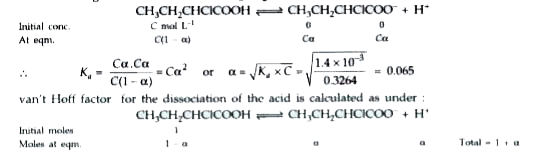 `i=(1 + alpha)/(1) = 1 + alpha = 1+ 0.065 = 1.065` ` Delta T_f = iK_f m =(1.065)(1.86)(0.3264) = 0.65^@` |
|
| 9. |
Calculate the density of unit cell of sodium, if the edge length of cubic structure is 4.24 A^(@). |
|
Answer» Solution :DENSITY `d=(ZxxM)/(a^(3)N_(0))` Z = Number of atoms per unit cell = 2 (since Na crystallise in BCC lattice) M = Gram atomic mass of sodium = 23 g `mol^(-1)` No = Avogadro number = `6.023 xx 10^(23)` a = Edge length = 4.24 ANGSTROMS `=1.002xx10^(3) kgm^(-3)` |
|
| 10. |
Calculate the density of silver which crystallizes in face- centred cubic form. The distance between nearest metal atoms is 287 pm (Molar mass of Ag = 107.87 g mol^(-1) , N_A = 6.022 xx 10^(23) mol^(-1)). |
|
Answer» Solution :Nearest neighbour distance in an FCC crystal = `1/2 xx "FACE diagonal" =a/sqrt2` or `287 xx 10^(-12) m = a/sqrt2` `a=2.87 xz 1.414 xx 10^(-10)=4.058 xx 10^(-10)m` = `405.8 xx 10^(-10)` cm No. of atoms PER unit cell, Z=4 Atomic mass of silver, M=107.87 g `mol^(-1)` Avogadro.s number, `N_A = 6.022 xx 10^(23) mol^(-1)` Density of unit cell, `d = (Z xx M)/(N_A xx a^3 xx 10^(-30)) g cm^(-3)` `:. d=(4 xx (107.87 g mol^(-1)))/(6.022 xx 10^(23) mol xx (405.8)^3 xx 10^(-30) cm^3)` `= 10.72 g cm^(-3)` |
|
| 11. |
Calculate the density of NaCl, if the edge length of NaCl unit cell is 564 pm. (Molar mass of NaCl=58.5 g/mol) |
| Answer» SOLUTION :`d=(ZM)/(a^3N)=(4xx58.5)/((564xx10^(-10))^3xx6.02xx10^23)=2.17gcm^(-3)` | |
| 12. |
Calculate the density of H_(2)SO_(4) solution if its molality and molarity are 94.5 and 11.5 respectively. |
|
Answer» SOLUTION :Molarity 11.5 means 11.5 moles of `H_(2)SO_(4)` are present in 1 L of the solution. Suppose the DENSITY of the solution is `"d g mL"^(-1)`, then 1 L, i.e., 1000 mL of solution has mass = 1000 d g THUS, 1000 d g of the solution contain `H_(2)SO_(4)=11.5` moles `=11.5xx98g=1127g` `therefore"Mass of water"=(1000d-1127)g` `"Molality "=(11.5)/(1000d-1127)xx1000=94.5` `"or"11500=94.5xx1000d-94.5xx1127"or"94500d=11500+106501.5=118001.5` `therefore""d=(118001.5)/(94500)=1.2487"g L"^(-1)` |
|
| 13. |
Calculate the density of N_(2) gas at S.T.P. ? |
|
Answer» <P>`1.250 g//L` |
|
| 14. |
Calculate the density of CO_(2)" at "100^(@)C and 800 mm Hg pressure. |
|
Answer» Solution :Given, `P=(800//760)" atm ", m_(co_(2))=44` `T=100+273=373 K`, `because PV =(W)/(m) RT` `because (" DENSITY "(d) =(w)/(V))` `THEREFORE d=(Pm)/(RT)` `therefore d=(800xx44)/(760xx0.0821xx373)` `=1.5124" g litre"^(-1)` |
|
| 15. |
calculate the DeltaH in kJ for the following reaction, C(g)+O_(2)(g) to CO_(2)(g) given that , H_(2)O(g)+C(g) to CO(g)+H_(2),DeltaH= +131kJ CO(g)+ 1/2O_(2)to CO_(2)(g),DeltaH =-282kJ H_(2)(g)+1/2O_(2)(g) to H_(2)O(g),DeltaH=-242 kJ |
|
Answer» `-393` `C(G) + O_(2)(g) to CO_(2)(g), DeltaH=?` `C(g)+ O_(2)(g) to CO_(2)(g)` ` DeltaH= (131 - 282-242)KJ=-393 KJ` |
|
| 16. |
Calculate the degree of ionization of 0.05M acetic acid if its pK_a value is 4.74.(i) How is the degree of dissociation affected when its solution also contains 0.01M. (ii) How is the degree of dissociation affected when its solution also contains 0.1M HCl. |
|
Answer» Solution :`pK_a=ie..-logK_A=4.74` or `logK_a=-4.74=5.26thereforeK_a=1.82 times 10^-5` `a=sqrt(K_a//C)=sqrt((1.82times10^-5)//(5times10^-2))=1.908 times10^-2` In PRESENCE of HCl, due to high concentration of `H^+` ion,dissociation equilibrium will SHIFT BACKWARD i.e., dissociation of ACETIC acid will decrease (i) In presence of 0.01 M HCl if X is the amount dissociatedthen `CH_3COOH leftrightarrow CH_3COO^(-)+H^+` Initial 0.05 M After disso. 0.05-x x 0.01+x `approx 0.05 approx 0.01 M` `(0.01M H^+` ions obtained from 0.01 M HCl) `K_a=(x(0.01))/0.05 or x/0.05=K_a/0.01=(0.82 times10^-5)/10^-2=1.82 times10^-3` `a=1.82 times10^-3` `(because a=("AMount dissociated")/("amount taken"))` (ii) In the presence of 0.1 M HCl if y is the amount of acetic acid dissociated, then at equilibrium `[CH_3COOH]=0.05-y approx0.05M` `[CH_3COO^-]=y[H^+]=0.01M+y approx 0.1M` `K_a=(y(0.1))/0.05 or y/0.05=K_a/0.1=(1.82 times10^-5)/10^-1=1.82 times10^-4` `a=1.82 times 10^-4` |
|
| 17. |
Calculate the degree of hydrolysis and hydrolysis constant of M//32 solution of aniline hydrochloride from the following cell data. {:Pt:}|{:(H_(2)),(1atm):}|{:(H^(+)),(1M):}||{:(M)/(32)C_(6)H_(5)NH_(3)^(+)Cl_((aq.))^(-):}|{:(H_(2)),(1atm):}|Pt, E_(cell) = -0.188 V |
|
Answer» |
|
| 18. |
Calculate the degree of dissociation (alpha) of acetic acid if its molar conductivity (Lambda_(m) ) is 39.05 S cm^(2) mol^(-1). Given: lambda^(@)(H^(+)) = 349.6 S cm^(2) mol^(-1) and lambda^(@)(CH_(3)COO^(-)) = 40.9 S cm^(2) mol^(-1) |
|
Answer» SOLUTION :`Lambda_(m)^(@) = lambda_(CH_(3)COOH)^(@) = 349.6 + 40.9 = 390.5 S cm^(2) mol^(-1)` Degree of dissociation `(alpha) = (Lambda_(m))/(Lambda_(m)^(@)) = (39.05)/(390.5) = 0.1` |
|
| 19. |
Calculate the degree of dissociation (alpha) of acetic acid if its molar conductivity is 39.05 S cm^(2)mol^(-1). Given lamda^(@)(H^(+))=349.6S" "cm^(2)mol^(-1) and lamda^(@)(CH_(3)CO O^(-))=40.9" S "cm^(2)mol^(-1). |
|
Answer» Solution :`ALPHA=(wedge_(m))/(wedge_(m)^(@))` `wedge_(m)^(@)(CH_(3)COOH)=lamda^(@)(CH_(3)COO^(-))+lamda^(@)(H^(+))=40.9+349.6=390.5" S "cm^(2)mol^(-1)` `wedge_(m)=39.05" S "cm^(2)mol^(-1)` `thereforealpha=(39.05)/(390.5)=0.1` |
|
| 20. |
Calculate the de-Broglie wavelength of an electron that has been accelerated from rest through a potential difference of 1 kV |
|
Answer» Solution :Energy acquired by the electron (as kinetic energy) after being accelerated by a POTENTIAL difference of 1 kV (i.e 1000 volts) ` = 100 eV` ` = 1000 xx 1.609 xx 10^(-19) , (1EV) = 1.609 xx 10^(-19) J)` (Energy in joules = Charge on the electron in coulombs × Pot. diff. in volts) ` = 1.609 xx 10^(-16) J` i.e. Kinetic energy `(1/2 mv^2) = 1.609 xx 10^(-16) J` `1/2 xx 9.1 xx 10^(-31) v^2 = 1.609 xx 10^(-16) J` `v^2 = 3.536 xx 10^14` ` v = 1.88 xx 10^7 MS^(-1)` ` therefore lamda = (h)/(mv) = (6.626 xx 10^(-34) )/(9.1 xx 10^(-31) xx 1.88 xx 10^7)` `= 3.87 xx 10^(-11) m` |
|
| 21. |
Calculate the de-Brogle wavelength of an electron whose kinetic energy is same as 60 Ke V X-rays |
|
Answer» `0.05 m` `KE_(e ) = 60 xx 10^(3)` eVolt `= q DELTA V` (for electron, q = e) `Delta V = 60 xx 10^(3)` VOLT `lambda_(e ) = SQRT((150)/(60 xx 10^(3))) Å = sqrt((1)/(400)) Å = (1)/(20) Å = 0.05 Å` |
|
| 22. |
Calculate the d-and i-isomers formed by the following compound and also give the number of meso forms. HOOC-CH(CH_(3))-CHOH-CHBr-CHOH-CH(CH_(3))-COOH |
|
Answer» Solution :The compound can be divided into two equal halves and it CONSISTS of five asymmetric CARBON ATOMS .i.e., odd NUMBER of asymmetric carbon atoms. HENCE, the number of d- and l-isomers. `=2^((n-1))-2^((n-1)//2)` `=2^((5-1))-2^(((5)/(2)-(1)/(2)))` `=2^(4)-2^((2.5-0.5))=2^(4)-2^(2)` `=16-4=12` Number of meso isomers `=2^((n-1)//2)` `=2^((2.5-0.5))=2^(2)=4` So, total number of configurational isomers =12+4=16 |
|
| 23. |
Calculate the current in amperes required to liberate 10g of silver electrolytically in one hour from AgNO_3 solution . |
|
Answer» |
|
| 24. |
Calculate the current ( in ma ) required to deposit 0.195 gr of platinum metal in 5.0 hours from a solution of PtCl_6^(-2) ( Atomic weight : pt 195) |
|
Answer» 310 Q to 0.195 gm , `Q = (0.195 xx 96500)/(((195)/(4))^(1000))=C xx t ` ` 96.5 xx 4 = C xx 5 xx 60 xx 60 , C = 0.021145 amp = 21.45 ` MILLI amp |
|
| 25. |
Calculate the current in amperes required to liberate 10g of silver electrolytically in 2 hrs from AgNO_(3) solution. |
|
Answer» |
|
| 26. |
Calculate the crystal field stabilization energy and spin only magnetic moment for the following configuration of octahedral complexes. (i) d^(3) (in week as well as strong ligand field) (ii) d^(5) (in week as well as strong ligand field) (iii) d^(7) (in week ligand field) (iv) d^(9) (in week as well as strong ligand field). |
|
Answer» Solution :CFSE `=(-0.4x + 0.6y) Delta_(0)` where x = no. of electrons in `t_(2g)` and y is no. of electrons in `e_(g)` Magnetic moment `(mu)=sqrt(n(n+2))` where n = no. of unpaired electrons. (i) `d^(3)` in weak as well as strong ligand field has configuration `=t_(2g)^(3)` CFSE `=-0.4xx3=-1.2 Delta_(0)` `mu=sqrt(3(3+2))=sqrt(15)=3.83` BM (ii) `d^(5)` in strong ligand field has the configuration =`t_(2g)^(5)` (1 unpaired electron) CFSE `=-0.4xx5=-2.0 Delta_(0)` `mu=sqrt(1(1+2))=sqrt(3)=1.73` BM `d^(5)` in WEEK ligand field has the configuration `=t_(2g)^(3)e_(g)^(2)` (5 unpaired electrons) CFSE =`3XX(-0.4)+2xx(+0.6)=0` `mu=sqrt(5(5+2))=sqrt(35)=5.92` BM (iii) `d^(7)` in weak field ligand has the configuration = `t_(2)^(5)e_(g)^(2)` (3 unpaired electrons) `CFSE = 5xx(-0.4)+2(+0.6)=-0.8 Delta_(0)` (iv) `d^(9)` has only ONE possible arrangement = `t_(2g)^(6)e_(g)^(3)` (3 unpaired electrons) `CFSE = 6(-0.4)+3(+0.6)=-0.6` `mu=sqrt(3(3+2))=sqrt(15)=3.87` BM |
|
| 27. |
Calculate the coordination number of Al in the crystalline state of AICI_3. |
|
Answer» Solution : `Cl^-`IONS form SPACE lattice with `Al^(3+)` ion OCCUPYING octahedral voids in `AICI_3` crystal. 6 |
|
| 28. |
Calculate the coordination number and number of stereo isomers of [Co(gly)NH_(3)(CO)(H_(2)O)Cl]Cl_(2) If your answer is 4 and 20 then write 0420. |
Answer»  `c to 3xx2=6` `d to 2xx2=4` `E to 1xx2=(2)/(12)` `underline UNDERSET(24)underlineunderset(xx2)`(All are O.A.) |
|
| 29. |
Calculate the concentration of OH^(-) in a fruit juice which contains 2xx10^(-3)M, H_(3)O^(+) ion. Identify the nature of the solution. |
|
Answer» Solution :`"Given that "H_(3)O^(+)=2XX10^(-3)M` `K_(W)=[H_(3)O^(+)][OH^(-)]` `therefore [OH^(-)]=(K_(w))/([H_(3)O^(+)])=(1xx10^(-14))/(2xx10^(-3))=0.5xx10^(-11)M` `2xx10^(-3) GT gt 0.5 xx 10^(-11)` i.e., `[H_(3)O^(+)] gt gt [OH^(-)]`, hence the juice is acidic in nature |
|
| 30. |
Calculate the concentration of that solution of sugar which has osmotic pressure of 2.46 atmosphere at 300 K. |
|
Answer» Solution :Here, we are GIVEN that`""pi= "2.46 atm,T = 300 K,R = 0.821 L atm K"^(-1)"mol"^(-1)` USING the equation, `pi=CRT,` we have `C=(pi)/(RT)=("2.46 atm")/("0.0821 Latm K"^(-1)"mol"^(-1)xx"300 K")="0.1 Maaprox. = 34.2 g/litre."` `""(because"MOLAR mass of sugar "C_(12)H_(22)O_(11)="342 g mol"^(-1))` |
|
| 31. |
Calculate the concentration of OH^- in a fruit juice which contains 2 times 10^-3 M,H_3O^(+) ion. Identify the nature of the solution. |
|
Answer» Solution :GIVE that `H_3O^+=2 times 10^-3 M` `K_w=[H_3O^+][OH^-]` `therefore [OH^-]=K_w/([H_3O^+])=(1 times 10^-14)/(2 times 10^-3)=0.5 times 10^-11 M` `2 times 10^-3 GT gt 0.5 times 10^-11` i.e., `[H_3O^+] lt lt [OH^-]` , HENCE the juice is acidic in nature. |
|
| 32. |
Calculate the concentration of NaOH solution in g/mL, which has the same normality as that of a solution of HCl of concentration 0.04 g/mL. |
|
Answer» Solution :Equivalents of HCl/mL`=(0.04)/(36.5)` (EQ.wt. of HCl`=36.5`) `=0.001095` eq. `:.` normality of HCl = eq. of `HCl//100mL=1.095N` `:.` normality of NaOH `=1.095N` `:.g//1000mL` of `NaOH` =normality `XX` eq.wt (eq.wt of NaOH `=40`) `=1.095xx40=43.8` `:.` concentration of NaOH solution in g/mL `=0.0438g//mL` |
|
| 33. |
Calculatethe concentration of Na_(2)S_(2)O_(3) . 5H_(2)Osolution in grams per itre . 10 mL of which just decolourised 15 mL of N/20 iodine solution . |
|
Answer» SOLUTION :`{:(S_(2)O_(3)^(2-),+ I_(2)to,1/2S_(4)O_(6)^(2-)+I^(-1)),(+4,,+5):}` Eq. wt of `Na_(2)S_(2)O_(3).5H_(2)O= (" mol.wt")/("change in ON per mole")` `=(248.2)/1 ` m.e of 10 mL of `Na_(2)S_(2)O_(3) .5H_(2)O ` solution = m.e of IODINE solution `= 1/20 xx 15 = 0.75` Equivalent of 10 mL of `Na_(2)S_(2)O_(3). 5H_(2)O = (0.75)/(1000)` Concentration of hypo in grams per litre` = 0.186 xx 1000/10 g//L ` ` = 18.6 g//L ` |
|
| 34. |
Calculate the concentration of hydroxyl ion in a solution left after mixing 100 ml of 0.1 M Mgcl_2 and 100 ml of 0.2 M NaOH [K_sp of Mg(OH_2)=1.2xx 10^(-11)] |
|
Answer» `2.8xx10^(-3)` |
|
| 35. |
Calculate the concentration of CO_2 in a soft drink that is bottled with a partial pressure of CO_2 of 4 atm over the liquid at 25^@C. The Henry’s law constant for CO_2 in water at 25^@C is 3.1 xx 10^(–2) mol/litre–atm. |
|
Answer» |
|
| 36. |
Calculate the concentration of all the ions in solution if 1 mole of HCl and 2 moles of NaCl are dissolved in sufficient water to make 6 litres of a single solution. |
| Answer» SOLUTION :`0.17 M H^(+) , 0.50 M CL^(-), 0.33 M NA^+` | |
| 37. |
Calculate the concentration of all species of significant concentration present in 0.1MH_(2)PO_(4) solution K_(a_(1))=6.2xx10^(-8),K_(a_(3))=3.6xx10^(-13).Take 0.075xx4.075=(0.555)^(2) |
|
Answer» Solution :`{:(I step,H_(3)PO_(4) hArr H^(+)+H_(2)PO_(4)^(-),K_(a_(1))=7.5xx10^(-3)),(II step,H_(2)PO_(4)hArr H^(+)+HPO_(4)^(2-),K_(a_(2))=6.2xx10^(-8)),(III step,HPO_(4)^(2-)hArrH^(+)+PO_(4)^(3-),K_(a_(3))=3.6xx10^(-13)):}` For `I` step :`underset(0.1(1-alpha))underset(0.1)(H_(3)PO_(4))hArr underset(0.1alpha)underset(0)(H^(+))+underset(0.1alpha)underset(0)(H_(2)PO_(4)^(-))` `K_(a_(1))=([H^(+)][H_(2)PO_(4)^(-)])/([H_(3)PO_(4))]rArr(0.1alpha^(2))/((1-alpha))=7.5xx10^(-3)....(1)` Excepting `alpha ltlt1,alpha^(2)=7.5xx10^(-2):.alpha=0.274` (not negligible) so solve QUADRATIC equation (1) & GET=`alpha=0.24` `:.[H^(+)]=0.24MrArr [OH^(-)]=(10^(-14))/(0.024)=4.17xx10^(-13)M` ("insignificant") &`[H_(2)PO_(4)^(-)]=0.024M` Also `[H_(3)PO_(4)^(-)]=0.1-0.024=0.076M` The value of `K_(a_(2))` and `K_(a_(3))`.Also dissociations of `II` and `III` steps occur in present of `H^(+)` furnished in `I` step and thus ,dissocations of `II` and `III` steps are further suppressed due to common ion effect. For `II` step `underset(0.024-y)underset(0.024)(H_(2)PO_(4)^(-))hArr underset(0.024-y)underset(0.024)H^(+)+underset(y)underset(0)(HPO_(4)^(2))` The dissocation of `H_(2)PO_(4)^(-)` occurs in PRESENCE of `[H^(+)]` furnished in step `I`. Thus `K_(a_(2))=([H^(+)][HPO_(4)^(-)])/([H_(2)PO_(4)^(-)])` `6.2xx10^(-8)=((0.024+y)y)/((0.24-y))` `:.y` is small `:.0.024-y~~0.024` and neflecting `y^(2)` `6.2xx10^(-8)=(0.024y)/(0.024)` `y=6.2xx10^(-8)M` or `[HPO_(4)^(2-)]=K_(a_(2))=6.2xx10^(-8)M` (insignificant) for `III` step `underset((6.2xx10^(-5)-x))(HPO_(4)^(2-))hArr underset((0.024+x))(H^(+))+underset(x)(PO_(4)^(3-))` `K_(3)=([H^(+)][PO_(4)^(3-)])/([HPO_(4)^(2-)])=((0.24+x)x)/((6.2xx10^(-8)-x))` because `x ` is small :.Again neglecting `x^(2)` and assuming `6.2xx10^(-6)-x=6.2xx10^(-8)` `:.3.6xx10^(-13)=(0.024x)/(6.2xx10^(-8))` `:.x=(3.6xx10^(-13)xx6.2xx10^(-8))/(0.024)=9.3xx10^(-19)M` or `[PO_(4)^(3-)]=9.3xx10^(-19)M` (insufficant) Note: For weak polyprotic acid solution having no other electrolyte the anion concentration produced in step of dissocation is ALWAYS equal to`K_(a_(2))` if concentration is reasonable. |
|
| 38. |
Calculate the compressibility factor, ((p_("real"))(V_("real")))/(RT) for a 1.0- mole sample of NH_(3), under the following conditions : in a 500 mL-vessel at -10.0^(@)C in a 500-mL vessel ? |
|
Answer» Solution :Compressbility factor (Z) `= (30 xx 5)/(.0821 xx 263) = 0.69` Applying IDEAL gas EQUATION : `pV = nRT` `p xx .5 = 1 xx .0821 xx 263` `p = 43.18` atm. |
|
| 39. |
Calculate the compressibility factor for SO_(2), if 1 mole of it occupies 0.35 litre at 300 K and 50 atm. Also comment on the result. |
|
Answer» Solution :P=50 atm, V=0.35 litre, T=300 K, n=1 `therefore Z=(PV)/(NRT) -(50xx0.35)/(1xx0.0821xx300)=0.711` The Z values are lesser than unity and thus, we can conclude the FOLLOWING (a) In `SO_(2)` ATTRACTIVE forces predominates, i.e. gas can be compressed easily (b) `(V_(M))/(V_(M"ideal") lt 0.711" or "V_(M)` is lesser than the volume of ideal gas. In other words gas is more COMPRESSIBLE than ideal gas. |
|
| 40. |
Calculate the coefficient of viscosity of CO_2 at 300 K on the basis of kinetic theory of gases. Molecular diameter for CO_2 = 3.64 xx 10^(-10) m . |
| Answer» SOLUTION :`2.37 X 10^(-4)` POISE | |
| 41. |
Calculate the charge in coulombs required for the oxidation of: (i) 2 moles of H_(2)O to O_(2) |
|
Answer» Solution :(i) The electrode reaction for 1 mole of `H_(2)O` is: `H_(2)O to H_(2)+(1)/(2)O_(2), i.e., O^(2-) to (1)/(2)O_(2)+2e^(-)` or `2H^(+)+2e^(-)toH_(2)` or `H_(2)Oto2H^(+)+(1)/(2)O_(2)+2e^(-)` `therefore` QUANTITY of electricity required for oxidation of 1 MOL of `H_(2)O=2F` or Quantity of electricity required for oxidation of 2 moles of `H_(2)=4F=4xx96500C=386000C` (ii) The electrode reaction for 1 mole of FEO is: `FeOto(1)/(2)Fe_(2)O_(3), i.e., Fe^(2+) to Fe^(3+)+e^(-)` `therefore` Quantity of electricity required`=1F=96500C`. |
|
| 42. |
Calculate the change in pressure when 1.04 mole of NO and 20.0 g O_(2) in a 20 litre vessel originaly at 27^(@)C react to produce Ihe maximum quantity of NO_(2) possible according to the equation: 2NO(g) + O_(2)(g) rarr 2NO_(2)(g) |
| Answer» SOLUTION :0.64 ATM | |
| 43. |
Calculate the cell potential of a cell having reaction: Ag_S+2e^- |
|
Answer» |
|
| 44. |
Calculate the cell potential (in V) if DeltaG = - 96.5 kJ/mol and n = 1. |
|
Answer» |
|
| 45. |
Calculate the cell potential for Zn_((S))|Zn^(2+)(0.6M)||Cd^(2+)(0.2M)|Cd_((S)) at 298K. |
|
Answer» |
|
| 46. |
Calculate the cell potential for Ni_((S))|Ni^(2+)(0.036M)||Co^(2+)(0.018M)|Co_((S)) at 298K. |
|
Answer» |
|
| 47. |
Calculate the cell potential for Zn_((S))|Zn^(2+)(0.6M)||Cd^(2+)(0.85M)|Cd |
|
Answer» |
|
| 48. |
Calculate the cell potential for Mg_((S))|Mg^(2+)(0.18M)||Ag^(+)(0.01M)|Ag_((S)) |
|
Answer» |
|
| 49. |
Calculate the cell potential for Cu plate kept in 0.2 M CuSO_(4) solution.[E_(Cu^(+)|Cu^(2+))^(Theta)=0.34V] |
|
Answer» SOLUTION :According to Nernst equation the potential of this electrode, `E_(Cu^(2+)|Cu)=E_(Cu^(2+)|Cu)^(THETA)-(0.059)/(n)"LOG"(1)/([Cu^(2+)])` `=0.34V-0.0295("log"(1)/(0.2))` `=0.34V-(0.0295)(log5.0)` `=0.34-(0.0295)(0.6990)` `=0.34-0.0206` `=0.3194V` |
|
| 50. |
Calculate the cell potential for Cr_((S))|Cr^(3+)(0.1M)||Fe^(2+)(0.01M)|Fe_((S)) at 298K. |
|
Answer» |
|