

Saved Bookmarks
This section includes InterviewSolutions, each offering curated multiple-choice questions to sharpen your knowledge and support exam preparation. Choose a topic below to get started.
| 39751. |
A bomb travelling a parabolic path explodes in mid air. The C.M. Of fragments will |
|
Answer» move vertically downwards |
|
| 39752. |
The quantity which doesn't change, when sound enters from one medium to another |
|
Answer» wavelenght |
|
| 39753. |
Ligher gases like H_(2), He etc. are rate in the atmosphere of Earth. Why ? |
| Answer» Solution :It is so because the `rms` velocity of lighter GASSES like `H_(2)`, ETC. is greater than the escape velocity at the Earth's surface. DUE to it, the lighter gases have escaped from the Earth's surface and their PRESENCE is air the atmosphere of Earth. | |
| 39754. |
The temperature of an open room of volume 30 m^3 increases from 17^@C to 27^@C due to the sunshine. The atmospheric pressure in the room remains 1 times 10^5Pa. IF n_i and n_f are the number of molecules in the room before and after heating then n_f-n_i will be |
|
Answer» `-1.61 TIMES 10^23` `n_1=(p_1V_1)/(RT_1)=(10^5times30)/(8.31times(273+17))` `=1.245 times10^3` `n_2=(p_2V_2)/(RT_2)=(10^5times30)/(8.31times(273+27))` `=1.203 times10^3` Therefore `n_f-n_i=(n_2-n_1) times 6.023 times 10^23` `=-2.5 times 10^25` |
|
| 39755. |
A gas expands with temperature according to the relation V = KT^(2//3) where K is a constant. The work done by the gas when the temperature changes by 60 K is |
|
Answer» 10 R As `V = KT^(2//3) :. dV = K(2)/(3)T^(-1//3) dT` `:. (dV)/(V) = (K(2)/(3)T^(-1//3)dT)/(KT^(2//3)) = (2)/(3) (dT)/(T)` ….(II) From (i), `W = underset(T_(1))overset(T_(2))int RT(dV)/(V) = underset(T_(1))overset(T_(2))int RT (2)/(3)(dT)/(T) = (2)/(3)R[T]_(T_(1))^(T_(2))` (Using (ii)) `= (2)/(3)R(T_(2) - T_(1)) = (2)/(3) R xx 60 = 40R` |
|
| 39756. |
A stretched rubber has: |
|
Answer» INCREASED kinetic energy |
|
| 39757. |
The upper and lower fixed points of a faulty mercury thermometer are 210°F and 34°F respectively. The correct temperature read by this thermometer is |
| Answer» Answer :D | |
| 39758. |
The capillary rise in a tube of diameter 1mm when surface tension of water is 0.06 Nm^-1 is |
|
Answer» 1.22 cm |
|
| 39759. |
In conductors, the outer electrons of each atom or molecule are weaklybound to the atom or molecule. So, these electrons are almost free to move throughout the conductor. Hence, these are called free electrons or conduction electrons. When such a conductor is in an electric field, the free electrons inside redistribute themselves on thesurface of the conductor in such a way that the electric field at every point inside the conductor is zero. Apply Gauss.s law try to prove that any excess static charge given to an insulated conductor resides entirely on its outer surface. |
Answer» Solution :As SHOW in Fig, CONSIDER a conductor of any arbitrary shape having a static charge. At an infinitesimal distance from the surface of the conductor construct a Gaussian surface lying inside the conductor. The FLUX through this Gaussian surface MUST be zero since E is zero everywhere inside the conductor and on all points on the Gaussian surface. In accordance with Gauss.s law there can be no net charge inside the Gaussian surface.  This showsthat all the net charges must be on the surface of the conductor since the Gaussian surface is within an infinitesimal distance of the surface. Thus under static conditions, there can beno net charge inside a conducting body and all the charge must RESIDE on its surface. The fact that the field inside a conductor is zero holds good for a hollow conductor also. This phenomeno is used in electrostatic shielding to protect electrical instruments. |
|
| 39760. |
Briefly explain the origin of friction show that in an inclined plane angle of friction is equal to angle of repose |
|
Answer» Solution :If a very gentle force in the horizontal direction is given to an object at rest on the table it does not move. It is because of the opposing force exerted by the surface on the object whichresists its motion. This force is called the frictional force. During the time of Newton and Galileo, frictional force was considered as one of the natural forces like gravitational force. But in the twentieth century, the understanding on ATOMS, electron and protons has changed the perspective. The frictional force is actually the electromagnetic force between the atoms on the two surfaces. Even well polished surfaces have irregularities on the surface at the microscopic level.The component of force parallel to the inclined plane `(MG sin THETA)`tries to move the object down. The component of force perpendicular to the inclined plane `(mg cos theta)`is balanced by the Normal force (N) ` N = mg cos theta `....(1) When the object just BEGINS to move, the static friction attains its maximum value ` f_s = f_(s)^(max)` This friction also satisfies the relation ` f_(s)^(max) = mu_s mg sin theta `....(2) Equating the right hand side of equations ( 1) and (2), ` (f_(s)^(max) )//N = sin theta // cos theta ` From the definition of angle of friction, we also know that ` tan theta =mu_s `....(3) in which `theta`is the angle of friction. Thus the angle of repose is the same as angle of friction. But the difference is that the angle of repose refers to inclined surfaces and the angle of friction is applicable to any type of surface. |
|
| 39761. |
Assertion : A needle placed carefully placed on the surface of water may float.Reason : When buoyant force balanced with weight of body, the body can float. |
|
Answer» Both assertion and reason are TRUE and the reason is the CORRECT explanation of the assertion. |
|
| 39762. |
A body weighs 700 gm - wt on the surface of the earth of a planet whose mass is 1/7 and radius half of the earth |
|
Answer» 200 gmwt |
|
| 39763. |
Find g on polar region due to rotation of earth. |
|
Answer» SOLUTION : On POLAR region`g_p = G - Romega^2 coslamda` `LAMDA = 90^@` `:.g_p =g` |
|
| 39764. |
Check the correctness of the formula using dimensions: x=a sin (omegat +phi), x -displacement, alpha - amplitude, omega angular velocity phi is an angle and it has no dimensions. |
|
Answer» Solution :Dimensions of `omega=(2pi)/T=T^(-1)` `:.` Dimensions of `OMEGAT` is `T^(-1)xxT=T^(0). Omegat` is also dimensionless Dimension of `X=[L]` Dimensions of `a=[L]` Thus each term on both sides of the EQUATION has the same dimensions. So the EQUATIONI is dimensionaly CORRECT. |
|
| 39765. |
A massive box is dragged along a horizontal floor by a rope. The rope makes an angle of 60^(@) with the horizontal. Find the work done if the tension in the rope is 200 N and the box is moved through a distance of 20 m. |
|
Answer» Solution :Tension T = 200 N , distance S = 20 m , `THETA = 60^(@)` Work DONE W = Fs = Fs `COS theta = (F cos theta). S = 200 xx cos 60^(@) xx 20 = 2000 J` |
|
| 39766. |
A uniform rod AB of mass m and length 2a is falling freely without rotationb under gravity with AB horizontal. Suddenly the end A is fixed when the speed of the rod is v. The angular speed which the rod begains to rotate is |
| Answer» Answer :D | |
| 39767. |
In a common room heating system, Statement (A) : Hot water is circulated through radiators by forced convection. Statement (B) : The warmed air rises by natural convection. |
|
Answer» A is TRUE B is FALSE |
|
| 39769. |
Explain the concepts of fundamental frequency, harmonics and overtones in detail. |
|
Answer» Solution :Let us know keep the rigid boundries at x=0 and x=L and produce a standing wavves bt wiggling the string (as in plucking atrings in a guitar). Standing waves with a specofic wavelength are produced . Since the amplitude must vanish at the boundries, therefore, the displacement at tge boundry must satisfy the following conditions y(x=0,t)=0 and y(x=L,t)=0 Since, the nodes formed are at a distance `((lamda_(n))/(2))` apart , we have `n((lamda_(n))/(2))=L`, where n is an ineger, L is the LENGTH between the two boundaries and `lamda_(n)` is the specific wavelength that satisfy the SPECIFIED boundry condition Hence Therefore, not all wavelengths are allowed, The (allowed) wavelengthsshould fit with specified boundary condition for n=1, the first mode vibration has specified wavelength `lamda_(1)=2L`. Similarly for n=2 the second mode of vibration has specific wavelength. `lamda_(2)=((2L)/(2))=L` The lowest natural frequency is called the fundamental frequency. `f_(1)=(v)/(lamda_(1))=((v)/(2L))` The second frequency is called the first over tone. `f_(2)=2((v)/(2L))=(1)/(L)sqrt(T/mu)` The third frequncy is called the second over tone . `f_(3)=3((v)/(2L))=3((1)/2Lsqrt(T/mu))` If natural frequency are written as integral multiple of fundamental frequencies then the frequencies are called harmonics. Thus the first harmonic is `f_(1)=f_(1)` (the fundamental frequency is called first harmonic), the second harmoinc is `f_(2)=2f_(1)`, the third harmonic is `f_(3)=3f_(1)` etc. |
|
| 39770. |
Six identical particles each of mass m are arranged at the corners of a regular hexagone of side length s. If the mass of one of the particle is doubled, the shift in the centre of mass is |
|
Answer» `a` |
|
| 39771. |
A motor car, starting from rest, moves with uniform acceleration and attains a velocity of 8ms^(-1) in 8 s. It thenmove with uniform velocity and finally brought to rest in 32 m under uniform retardation. The total distance covered by the car is 646 m. Find (i) the acceleration (ii)the retardation and (iii) the total time taken. |
|
Answer» |
|
| 39772. |
In the question number 93, the time elapsed for its mechanical energy to drop half of its initial value is |
|
Answer» 2.5 s `E=E_(0)e^(-bt//m)` Where `E_(0)` is its initial enegy and b is the damping constant. At `t=t_(1//2)`, the energy drop to half of its initial value. From eq. (i), we get `(E_(0))/(2)=E_(0)e^(-bt_(1//2)/m)""(1)/(2)=e^(-bt_(1//2)//m)` TAKING natural logarithm on both SIDES, we get `ln((1)/(2))=-(bt_(1//2))/(m),t_(1//2)=-(mln(1//2))/(b)`. . . (II) here, `ln(1//2)=-0.693` `b=40gs^(-1),m=200g` substituting in eq. (ii) , we get `t_(1//2)=(0.693xx200g)/(40gs^(-1))=3.5s` |
|
| 39773. |
Give an expression for work done in an isothermal process. |
|
Answer» Solution :Isothermal process: It is a process in which the TEMPERATURE REMAINS constant but the pressure and volume of a thermodynamic system will change. The ideal gas equation is ` PV = mu RT` Work done in an isothermal process: CONSIDER an ideal gas which is allowed to expand quasi-statically at constant temperature from initial state `(P_i , V_i)`to the final state `(P_f , V_f)` . We can calculate the work done by the gas during this process. The work done by the gas, ` W = int_(v_i)^(v_f) PDV`....(1) As the process occurs quasi-statically, at every stage the gas is at equilibrium with the surroundings. Since it is in equilibrium at every stage the ideal gas law is valid . Writing pressure in terms of volume and temperature , ` P = (mu RT)/(V )`....(2) Substituting equation (2) in ( 1) we get ` W =int_(v_i)^(v_f) (mu RT)/(V ) dV` ` W = mu RT int_(v_i)^(v_f) (dV)/(V) `.....(3) In equation (3), we take µRT out of the integral, since it is constant throughout the isothermal process. By performing the integration in equation (3 ), we get `W = mu RT ln (V_f/V_i)`....(4) Since we have an isothermal expansion , ` (V_f)/(V_i) lt 1` , so ` ln (V_f/V_i) lt 0` . As a result the work done · by the gas during an isothermal expansion is positive . The above result in equation ( 4) is true for isothermal compression also. But in anisothermal compression `(V_f)/(V_i) lt 1 `, so `ln (V_f/V_i) lt 0` As a result the work done on the gas in an isothermal compression is negative. In the PV diagram the work done during the isothermal expansion is equal to the area under the graph.  Similarly for an isothermal compression, the area under the PVgraph is equal to the work done on the gas which turns out to be the area with a negative sign. |
|
| 39774. |
A boy of mass m sits in a swing supported by two chains, each of length l . At the lowest point the tension in each chain is T. What is (i) the boy's speed at the lowest point and (ii) the force of the seat on the boy at the lowest point. (Assume that the seat has no mass) |
|
Answer» |
|
| 39775. |
A chamber contains a mixture of helium gas (He) and hydrogen gas(H_(2)). The ration of the root-mean-square speed of the molecules of He and H_(2) is .............. . |
|
Answer» 2 |
|
| 39776. |
Density of ice is rho and the of water is sigma. What will be the decreases in volume when a mass M ofice metls. |
|
Answer» `(M)/(SIGMA-RHO)` |
|
| 39777. |
A particle moves in a straight line with a constant acceleration. It passing through a distance 135 m in t second. The value of t (in second) is |
|
Answer» 12 `a=(upsilon^(2)-u^(2))/(2s)=((20)^(2)-(10)^(2))/(2xx135)=(300)/(270)=(10)/(9)ms^(-2)` From FIRST equation of MOTION `upsilon=u+at rArr t(upsilon-u)/(a)=(20-10)/(10//9)=(10)/(10//9)=09s` |
|
| 39778. |
A gas bubble from an explosion under water, oscillates with a period proportional to P^arho^b E^cwhere p is the state pressure, rho is the density of water and is the total energy of the explosion. Find the values of a, b, and c. |
|
Answer» Solution :Let, `T ALPHA P^(a) rho^(b) E^( C)` Dimensional formula of `p to ML^(-1) T^(-2) , rho to ML^(-3) , E to ML^(2) T^(-2)` `THEREFORE T^(1) alpha (ML^(-1) T^(-2) )^(a) (ML^(-3) )^(b) (ML^(2) T^(-2) )^( c)` Comparing powers of M, L and T on both sides `a+b+c =0 ""...(1)` `-a -3b+ 2c =0""....(2)` `-2a -2 c =1 ""...(3)` From (3) and (1), `a+c = - (1)/(2) and b= (1)/(2) = - (1)/(2) , (-a+ 2c = 3 xx (1)/(2) )/( 3c=1)` `rArr c = (1)/(3) and a = - (1)/(3) - (1)/(2) = -(5)/(6)` `therefore` The values of a, b, e are respectively, `- (5)/(6) , (1)/(2) , (1)/(3)`. |
|
| 39779. |
When a large bubble rises from the bottom of a lake to the surface , its radius doubles .The atmospheric pressure is equal to that of a columnof water of height H. What is the depth of the lake ? |
|
Answer» 7H `P_(1)xx(4)/(3)piR_(1)^(3)=P_(2)xx(4)/(3)piR_(2)^(3)` where `P_(2)` is the EXCESS pressure inside the bubble at the surface and `R_(2)=2R_(1)` `P_(1)xx(4)/(3)piR_(1)^(3)=P_(2)xx(4)/(3)pixx8R_(1)^(3)` `thereforeP_(1)=8P_(2)rArrP_(2)=(P_(1))/(8)` Pressure at surface `=("pressure at bottom")/(8)` `H=(H+h)/(8)` where h= depth of lake `8H=H+h` `thereforeh=7H` |
|
| 39780. |
A particle of 1g moving with a velocity of 6cm *s^(-1) collides elastically with a stationary particle of mass 2g, and is deflected throgh an angle of 90^@ . Find out (ii) the magnitude and direction of the velocity of the 2g particle, after collision. |
|
Answer» |
|
| 39781. |
A particle of 1g moving with a velocity of 6cm *s^(-1) collides elastically with a stationary particle of mass 2g, and is deflected throgh an angle of 90^@ . Find out (i) the velocity of the 1g particle , and |
|
Answer» |
|
| 39782. |
If DeltaU and DeltaW represent the increase in internal energy and work done by the system respectively in a thermodynamical process which of the following is true? |
|
Answer» `DeltaU=-DeltaW` , in an adiabatic process `DeltaQ=DeltaU+DeltaW` For an adiabatic process `DeltaQ=0` `THEREFORE DeltaU=-DeltaW` For an isothermal process, `DeltaU=0` `therefore DeltaQ=DeltaW` |
|
| 39783. |
Find the power of the an electric motor, if it lifts 200 kg of water in 10 minutes from a well of 60 m depth. |
|
Answer» |
|
| 39784. |
Explain the resolution of vectors in three dimensional co-ordinates . |
|
Answer» Solution :In the Cartesian coordinate system any vector `vec(A) `can be resolved into three components along x, y and Z direction. This is SHOWN in the FIGURE (B) (Components of a vectorin two dimensions and three dimensions). Consider a 3-dimensional coordinate system. With respect to this a vector can be WRITTEN in component form as `vec(A) = A_(x)hat(i) +A_(y)hat(j) +A_(z) hat(k)` `A = sqrt(A_(x)^(2)+A_(y)^(2)+A_(z)^(2))` 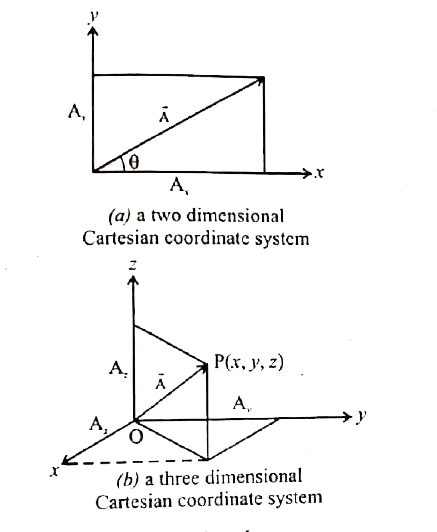
|
|
| 39785. |
If A= 3i - 4j and B= - I - 4j, calculate vec(A) + vec(B) and |vec(A) + vec(B)| |
|
Answer» `TAN^(-1) (4)` with + x- AXIS in clock WISE |
|
| 39786. |
The thickness of ice in a lake is 10 cm and its temperature is -10^(0)C. The thermal conductivity of ice = 0.004 cal cm^(-1)" sec"^(-1)""^(0)C^(-1). Density of ice = 0.92 g/cc, latent heat of ice = 80 cal/g. The time taken for thickness of ice to be doubled is |
|
Answer» `10^(6)` second |
|
| 39787. |
Velocity of water in a river is ……. |
|
Answer» same everywhere. |
|
| 39788. |
The eye of a farsighted person has a near point of 90cm. Objects nearer than 90cm cannot be seen clearly. A converging lens is used to correct the vision of a book placed 25cm from the eye. Find the focal length of this lens. |
|
Answer» `+40CM` |
|
| 39789. |
A ball strikes a horizontal floor at an angle theta= 45^(@) with the normal to floor. The coefficient of restitution between the ball and the floor is e=1/2. The fraction of its kinetic energy lost in collision is |
|
Answer» Solution :Let u be the velocity of ball before COLLISION. Speed of the ball after collision will become `v= SQRT(u^(2) sin^(2) THETA + e^(2)u^(2) cos^(2) theta)= sqrt(((u)/(sqrt2))^(2) + ((u)/(2 sqrt2))^(2))= sqrt((5)/(8))u` `therefore` Praction of KE lost in collision `=((1)/(2) m u^(2) - (1)/(2) mv^(2))/((1)/(2) m u^(2))= 1- ((v)/(u))^(2)=1- (5)/(8)= (3)/(8)` |
|
| 39790. |
A ray of light is incident normally on one of the refracting surfaces of a prism of refracting angle 60^@. The emergent ray grazes the other refracting surface. Find the refractive index of the material of the prism. |
|
Answer» 1.155 |
|
| 39791. |
For an adiabatic process ____ |
|
Answer» `DeltaS=0` |
|
| 39792. |
A body is projected with velocity .u. so that the maximum height is thrice the horizontal range. Then the maximum height is |
|
Answer» `(72 U^(2))/(145 G)` |
|
| 39793. |
The length of a rod is measured by different instruments. Of the following the accurate result is |
|
Answer» 500 mm |
|
| 39794. |
Two cars are approaching each other on a straight road and moving with a velocity of 30 kmh^(-1).if the sound produced in a car is of frequency 500 Hz, what will be the frequency of sound as heard by the person sitting in the other car ? When the two cars have crossed each other and are moving away from each other.what will be the frequency of sound as heard by the same person ? Speed of sound =330 ms^(-1). |
|
Answer» |
|
| 39795. |
A source of heat supplies heat at a constant rate to a substance. Fig. shows the variation of temperature of the substance with the heat supplied. The slope of segment DE represents: |
|
Answer» the LATENT heat of VAPORISATION |
|
| 39796. |
Ten coins each of mass 10 gm are placed one above the other. The reaction force exerted by 7^(th) coin from the bottom on the 8^(th) coin is (g=10 m//s^(2)) |
|
Answer» 0.3 N |
|
| 39797. |
Assertion :Circular motion is a motion described by a particle traversing a circular path .Reason :The whirling motion of a stone attached to a string .from the following statements select the correct statement |
|
Answer» Assertion is false and REASON is TRUE. |
|
| 39798. |
…………. Error or ……………. Error is the ratio of …………….. To …………… of the quantity measured. |
|
Answer» |
|
| 39799. |
How can a truck driver steer a truck travelling at constant speed such that (i) its acceleration is zero and (ii) magnitude of acceleration is constant ? |
|
Answer» Solution :(i)For zero acceleration, the driver should steer straight . Here constant SPEED implies that at a particular gear, the accelerator of truck is pressed such that it has ATTAINED a constant speed. Now to maintain zero acceleration after that, steering of the truck should be straight . (ii) For magnitude of acceleration to be constant , the driver should steer at angle such that the truck follows circular motion . The direction of acceleration changes continously but its magnitude REMAINS constant . |
|
| 39800. |
The scalar and vector products of two vectors are 48sqrt3 and 144 respectively. What is angle between the two vectors.? |
|
Answer» |
|