

Saved Bookmarks
This section includes InterviewSolutions, each offering curated multiple-choice questions to sharpen your knowledge and support exam preparation. Choose a topic below to get started.
| 38951. |
A disc of mass M and radius R is rolling with angular speed omega on a horizontal plane as shown in figure. The magnitude of angular momentum of the disc about the origin O is |
|
Answer» `(1/2)MR^(2)OMEGA` 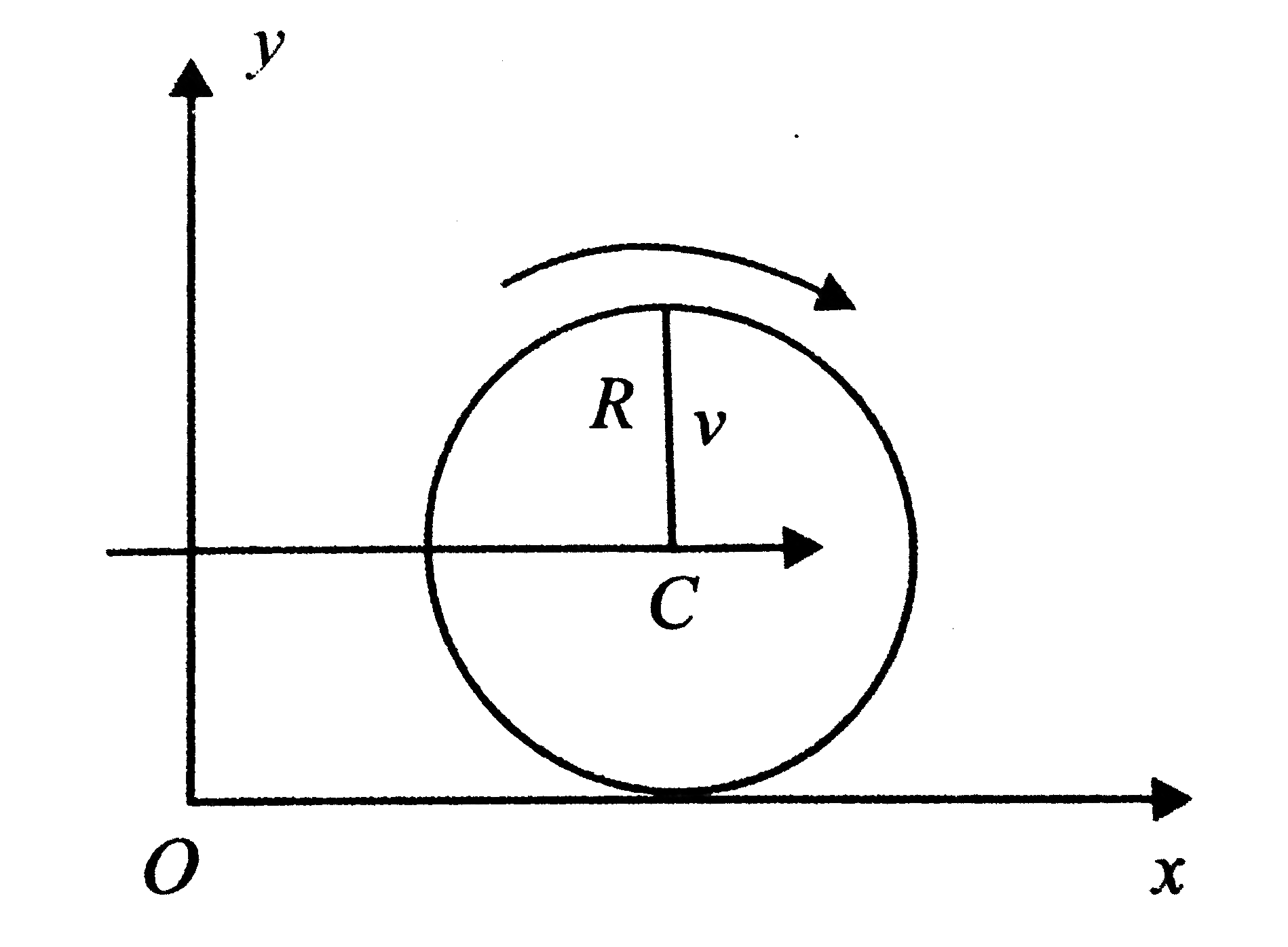 `L=L_(T)+L_(R), L_(t)=` angular momentum due to translational motion `L_(R)=` angular momentum due to rotational motion about `CM` `L=MVxxR+I_(CM)omegaI_(CM)` `=MI` about centre of mass `C` `=M(Romega)R+1/2MR^(2)omega(V=Romega` in case of ROLLING motion and SURFACE at rest) `=3/2MR^(2)omega` |
|
| 38952. |
Which out of (i) value of velocity, (ii) value of acceleration, (iii) value of force, (iv) the momentum vector of the body is not constant during uniform circular motion ? |
| Answer» SOLUTION :Themomentumvector. | |
| 38953. |
Two particles of equal mass have velocitiesvecV _(1)= 4hati ms^(-1) and vecV _(2)= 4hatj ms^(-1) First particle has an acceleration veca_(1)=(5hati+5hathatj)ms^(-1)while the acceleration of the other particle is zero. The centre of mass of the two particles moves in a path of |
|
Answer» STRAIGHT LINE |
|
| 38954. |
A capillary tube is immersed vertically into water in a vessel kept in a stationary lift, the rise of water in it is h. If the lift moves upwards with an acceleration 'a' then the rise of water in the capillary tube is |
|
Answer» `( HG)/( a-G)` |
|
| 38955. |
An astronaut orbiting in a spaceship round the earth has centripetal acceleration 4.378 m//s^(-2) . Find the height of the space ship. |
| Answer» SOLUTION :3175.7 KM | |
| 38956. |
A body of mass 1kg makes an elastic collision with another body at rest and continues to move in the original direction after collision with a velocity equal to 1/5th of its original velocity. Find the mass of second body. |
|
Answer» `(2)/(3) KG` |
|
| 38957. |
A stick has a length of 12.132cm and another stick has a length of 12.4cm.If the two sticks are placed end to end, what is their total length? If the two sticks are placed side by side , what is the difference in their lengths? |
|
Answer» Solution :Let lengths of the STICKS are named as `l_(1)=12.132cm, l_(2)=12.4cm` Here `l_(2)`has one decimal place and `l_(1)`has to be ROUNDED off t o have only TWO decimal places `l_(1)+l_(2)=12.13+12.4=24.53`. This is to be rounded off to have one decimal place only. `:.` The total length is` 24.5cm` `l_(1)=12.132, l_(2)=12.4`. ` l_(1)-l_(2)=12.4-12.132` Here `12.4`has only decimal place and hence `12.132`should have only two decimal places. `:.l_(1)-l_(2)=12.4-12.13=0.27` this should be rounded off to have only one decimal place . `:.l_(1)-l_(2)=0.3` Hence difference of their lengths is `0.3`CM |
|
| 38958. |
A 10 kg collar P slides with negligible friction on the fixed vertical shaft. When the collar is released from rest at the bottom position shown, it moves up the shaft under the action of the constant force F = 200 N applied to the cable. The position of the small pulley at B is fixed. Find the spring constant k (in k-N // m) which the spring must have if its maximum compression is to be limited to 0.4 m. |
|
Answer» |
|
| 38959. |
Passage - VII : A uniform rod of mass M and length 2a, can turn freely about end which is fixed. It is started with angular velocity omega from the position in which it hangs vertically. The least angular velocity with which it must begin to move so that it may perform complete revolution in a vertical plane is, |
|
Answer» `sqrt((3G)/(2A))` |
|
| 38960. |
Assertion: For the planets orbiting around the sun, angular speed, linear speed, K.E. changes with time , but angular momentum remains constant. Reason: No torque is acting on the rotating planet. So its angular momentum is constant. |
|
Answer» Both ASSERTION and Reason are true and Reason is the CORRECT EXPLANATION of Assertion |
|
| 38961. |
Passage - VII : A uniform rod of mass M and length 2a, can turn freely about end which is fixed. It is started with angular velocity omega from the position in which it hangs vertically. Its angular velocity at an instant when it makes an angle theta with downward vertical is |
|
Answer» `(omega^(2)-(2G)/(3a)(1-costheta))^(1/2)` |
|
| 38962. |
The coefficient of linear expansion 'alpha' of a rod of length 2 m varies with the distance 'x' from end of the rods as alpha= alpha_(0) + alpha_(1) x where alpha_(0) = 1.5 xx 10^(-5) //°C and alpha_(1) = 2.5 xx 10^(-6)//m°C. Find the increase in |
|
Answer» 12.25 mm |
|
| 38963. |
Consider the sun as a black body of radius 7 xx 10^8m and the earth receiving its surface radiations from the sun at a rate of approximately 1500 W//m^2 . If the distance of the centre of the sum from the earth's surface is 15 xx 10^10 m, then the surface temperature of the sun is |
|
Answer» 4990.5 K `E=SIGMA T^4 XX 4PI R^2` where R is the radius of the sun, then This energy spreads over a sphere of radius r, ` therefore `E = RATE of radiation incident on earth. surface ` xx 4pi r^2` `rArr sigma T^4 xx4pi R^2 = 1500 xx 4pi r^2` ` T^4 = (1500 xx r^2)/(sigma R^2)` ` = (1500 xx (15 xx 10^10)^2)/(5.67 xx 10^(-8) xx (7 xx 10^8)^2)` ` T = ( (15 xx 2.25)/(5.67 xx 49) )^(1/4) xx 10^4= 59903.7 K` |
|
| 38964. |
A good lubricant should have ………….. . |
|
Answer» HIGH viscosity |
|
| 38965. |
The Jupitar's angular diameter is 35.72'' . The distance of Earth from Jupiter is 82.27xx10^(6) km then find diameter of the jupiter. |
|
Answer» |
|
| 38966. |
When .n. number of particles of masses m, 2m, 3m,.....nm are at distances x_(1)=1, x_(2)=2, x_(3)=3,…….x_(n)=n units respectively from origin on the x-axis, then find the distance of centre of mass of the system from origin. |
|
Answer» Solution :`x_(cm) = (m(1) + 2M(2) + 3m(3)+….+(nm)n)/(m+2m+3m+…..+nm)` `x_(cm) = (m(1^(2) + 2^(2) + 3^(2) +……+n^(2))/(m(1+2+3+…..+n))), X_(cm) = ((n(n+1)(2n+1))/6)/((n(n+1))/2) =(2n+1)/3` |
|
| 38967. |
Velocity-time graph for the motion of a certain body is shown in Fig. Explain the nature of this motion. Find the initial velocity and acceleration and write the equation for the variation of displacement with time. What happens to the moving body at point B? How does the body move after this moment ? |
Answer» Solution : The VELOCITY –time graph is a STRAIGHT LINE with=ve slope. The motion is UNIFORMLY retarding up to point B and there after uniformly accelerated up to C. At point B the body stops and then its direction of velocity reversed. The initial velocity at point A is `v_0="7 ms"^1` `a=(v_f-v_0)/(triangle t)=(0-7ms^(-1))/(11s)=(-7)/(11)ms^(-2)=0.64ms^(-2)` The equation of motion for this body which gives variation of displacement with time is `S=7t-1/2 0.64t^(2)=7t-0.32t^2`. |
|
| 38968. |
According to kinetic theory of gases, molecules of a gas behave like |
|
Answer» inelastic spheres |
|
| 38969. |
A comet is revolving around the sun in a highly elliptical orbit. Which of the following will remain constant throughout its orbit ? |
|
Answer» kinetic ENERGY |
|
| 38970. |
When a system is taken from stata a to state b along the path acb as shown in figure, 60 J of heat flows into the system and 30 J of work is done by the system. Along the path adb, if the work done by the system is 10 J, heat flow into the system is |
|
Answer» 100 J For the path ACB, `Q_(acb) = Delta U_(acb) + W_(acb)` `:. Delta U_(acb) = Q_(acb) - W_(acb) = 60 J - 30 J = 30 J` For the path adb, `Q_(adb) = Delta U_(adb) + W_(adb)` As change in internal energy is path INDEPENDENT, so `Delta U_(acb) = Delta U_(adb)` `:. Q_(adb) = 30 J + 10 = 40 J` |
|
| 38971. |
Two blocks of masses M_(1) and M_(2) connected by a light spring rest on a horizontal plane . The coefficient of friction between the blocks and the surface is equal to mu . The minimum constant force that has to be applied in the horizontal direction to the block of mass M_(1) in order to shift the other block is (M_(1) + (M_(2))/(alpha)) mu g, then alphais : |
Answer»  `F = MU M_(1) G + T "" ….(i)` `T = muM_(2) g "" …..(II)` By solving , we get `alpha`. |
|
| 38972. |
One gram of saturated vapour is enclosed in a thermally insulated cylinder under a weightless piston. The outside pressure is standard m=1g of wateris introduced into the cylinder at a temperature t_(0)=22^(@)C. Neglecting the heat capacity of the cylinder and piston and friction, find the work done by the force of the atmosphere during the lowering of the piston. T= temperature of saturated vapour =373K, L sp. heat latent heat =12250//kJ//kg |
|
Answer» |
|
| 38973. |
The gravitational field in a region is given by vec(E) = (5hat(i) + 12 hat(j))N//Kg. The change in gravitational potential energy if a particle of mass 1 kg in taken from the origin to the point (12m, 5m). |
|
Answer» Solution :`Delta vec(U) = m underset((0,0))OVERSET((12,5))int vec(E).vec(d r) = underset((0,0))overset((12,5))int (E_(x) HAT(i) + E_(y) hat(J)).(dx hat(i) + d y hat(j))` `= underset(0)overset(12)int E_(x)d + underset(0)overset(5)int E_(y)dy = underset(0)overset(12)int 5dx + underset(0)overset(5)int 12 dy` `= 5x]_(0)^(12) + 12y]_(0)^(5) = 60 + 60 = 120 J` |
|
| 38974. |
Given below are observations on molar specific heats at room temperature of some common gases. The measured molar specific heats of these gases are markedly different from those for monatomic gases. Typically, molar specific heat of a monatomic gas is 2.92 cal/mol K. Explain this difference. What can you infer from the somewhat larger (than the rest) value for chlorine ? |
|
Answer» Solution :Gases given in the question are diatomic. Their specific heat is `5/2R=5/2xx1.98=4.95`. All the gases except chlorine gas have same specific heat as above. Diaformic gases atoms perform vibrational and ROTATION motion with translational motion. And nonatomic gas atoms only perform translational motion. HENCE specific heat of MONOATOMIC gas is LESS than specific heat of diatomic gas. The higher value of molar specific heat of chlorine indicats that besides rotational modes, vibrational modes are also present in chlorine at room temperature. |
|
| 38975. |
A thin circular ring of mass M and radius R is rotating in a horizontal plane about an axis vertical to its plane with a constant angular velocity omega. If two objects each mass m be attached gently to the opposite ends of a diameter of the ring, the ring will then rotate with an angular velocity ........... |
|
Answer» `(omegaM)/(M+2m)`  According to CONSERVATION of momentum, `L=L.` `therefore I_(1)omega=I.omega.` `MR^(2)omega=(MR^(2)+2mR^(2))omega.(because I.=MR^(2)+(2m)R^(2))` `therefore Momega=(M+2m)omega.` `therefore omega.=(M)/(M+2m).omega` |
|
| 38976. |
Showthat impulse is the changeof momentum |
|
Answer» Solution : According to Newton.s SECOND Law `F = (dp)/(dt)` i.e., dp = Fdt Integrate it over a TIME interval from `t_i` to `t_f` `int_(i)^(f) dp = int_(t_i)^(t_f) Fdt` `P_f - P_i = int_(t_1)^(t_2) F.dt` `P_i to` Intial momentum of the OBJECT at ` t_i` `P_f to` Final momentum of the object at `t_f ` `P_f - P_i = Delta p` = change in momentum during the time interval `Delta t. int_(t_i)^(t_f) Fdt = J` is called the impulse . If the force is constant over the time interval `Delta t` , then `int_(t_i)^(t_f) Fdt = F int_(t_i)^(t_f) dt = F (t_f - t_i)= F Delta t` `J= F Delta t = Delta p` |
|
| 38977. |
A particle moving with certain velocity collides elastically with another particle at rest. If it were head on collision, the K.E. trensferred by the colliding particle is 100% when its mass is equal to |
|
Answer» the massof the STATIONARY PARTICLE |
|
| 38978. |
If a solid sphere and solid cylinder of same mass and radius rotate about their own axis the M.I. will be greater for |
|
Answer» solid sphere `I_(S)=0.4MR^(2)` Moment of inertia of a solid cylinder `I_(C)=1/2MR^(2)` `I_(C)=0.5MR^(2)` We KNOW that `I_(C)gtI_(S)` `:.` Moment of inertia will be greater for solid cylinder. |
|
| 38979. |
The angular momentum of a body changes by 80kg m^(2)s^(-1) when its angular velocity changes from 20 rad s^(-1) to 40 rad s^(-1). Find the change in its kinetic energy of rotation. |
|
Answer» Solution :Change in angular momentum of the body `L_(2)-L_(1)=I(omega_(2)-omega_(1))` Change in KINETIC energy `=(1)/(2)L(omega_(2)^(2)-omega_(1)^(2))` `("change in K.E")/("change in angular momentum")=(omega_(2)+omega_(1))/(2)` `:.` change in K.E. `=80((20+40)/(2))=2400J` |
|
| 38980. |
A cubical ball is taken to a depth of 200m in a sea. The decrease in volume observed to be 0.1%. The bulk modulus of the ball is |
|
Answer» `19.6xx10^(8)N//m^(2)` |
|
| 38981. |
Which of the following is not a unit of time ? |
|
Answer» MEAN solar day |
|
| 38982. |
The motion of a particle executing simple harmonic motion is described by the displacement function, x(t)=Acos(omegat+phi). If the initial (t = 0) position of the particle is 1 cm and its initial velocity is omega cm/s, what are its amplitude and initial phase angle ? The angular frequency of the particle is pi s^(-1). If instead of the cosine function, we choose the sine function to describe the SHM : x = B sin (omegat + alpha), what are the amplitude and initial phase of the particle with the above initial conditions. |
| Answer» SOLUTION :`A=sqrt2cm,phi=7pi//4,B=sqrt2cm,a=pi//4` | |
| 38983. |
A liquid drop of diameter 20mm is split into 1000 small identical droplets. If surface tension of liquid is 72 xx 10^(-3) Nm^(-1) , the amount of work done in this process in muJ is nearly |
|
Answer» 815 |
|
| 38984. |
Dimensions [M L^(-1)T^(-1)] are related to ............. |
|
Answer» torque |
|
| 38985. |
A far sighted person cannot focus distinctly on objects closer than Im. What is the power of lens that will permit him to read from a distance of 40cm? |
|
Answer» Solution :As NEARPOINT is 1M and distance of OBJECT is 0.40m both in front of LENS. `P=1/f=1/v+1/u=1/-1 -1/-0.40 IMPLIES P=1.5D` |
|
| 38986. |
A set of 2 vectors is given in each option of column I. Match column I and II . |
|
Answer» |
|
| 38987. |
A block of mass m is arranged on the wedge as shown in figure . The wedge angle is theta. If the masses of pulley and thread are negligible and friction is absent , find the acceleration of the wedge . |
|
Answer» Solution :It is obvious that when block m moves downward along the incline of wedge, the wedge moves to the RIGHT . As the length of thread is constant, the distance traversed by wedge along the incline is equal to distance traversed by wedge to the right . This implies that acceleration of wedge to the right is equal to downward acceleration of wedge . Let a be the acceleration of wedge to the right . Then the force acting on the block m are (i) weight MG acting vertically downward (II) normal reaction `R_(1)` (iii)tension T (up the incline ) (IV)Fictitious force ma to the left .  The free body diagram of mass m is shoen in figure . For motion of block .m. on inclined plane `mg sin theta +ma cos theta -T = ma `....(1) As mass .m. does not breaks off the inclined plane , therefore for forces on .m. normal to inclined plane `R_(1) +ma sin theta =mg cos theta `....(2) The forces acting on the wedge are (i) weight Mg downward (ii) normal reactionof ground on wedge =`R_(2)` (iii) normal reaction of block on wedge =`R_(1)` (iv) tension (T,T) in string . The free body diagram of wedge is shown in figure . For motion of wedge in horizontal direction ` R_(1) sin theta +T-T cos theta = mg`....(4) From (1), `T=mg sin theta + ma cos theta -ma`....(5) From (2), `R_(1) =mg cos theta - ma sin theta`....(6) SUBSTITUTING these values in (3) , we get `(mg cos theta - ma sin theta ) sin theta +(mg sin theta +ma cos theta - ma ) ( 1-cos theta )=Ma` or `{M+m sin ^(2) theta +m(1-cos theta)^(2)}a` `=mg cos theta sin theta +mg sin theta (1-cos theta )` `a= (mg sin theta )/(M+m sin^(2) theta + m(1-2 cos theta+cos^(2) theta))=(mg sin theta)/ (M+m(sin^(2) theta +1 -2 cos theta+cos^(2) theta))` `:. a=(mg sin theta)/(M+2m(1-cos theta))` 
|
|
| 38988. |
Let p = pressure. 1. - latent heat of fusion, T = melting point temperature, V_2= volume of solid state and and V_1= volume of liquid state. Then, which of these are correct regarding melting point of a solid? |
|
Answer» `(dp)/(dT)=L/(T(V_2-V_1))` |
|
| 38989. |
The weight of a glass rod in air is 90g times g. Its apparent weight in a liquid at 12^(@)C is 49.6g times g, and at 97^(@)C is 51.9g times g. Determine the coefficient of real expansion of the liquid. Coefficient of volume expansion of glass =2.4 times 10^(-5@)C^(-1). |
|
Answer» |
|
| 38990. |
When the objectis at rest on the inclined rough surface |
|
Answer» staticand KINETIC frictions actingon the object is ZERO Static friction = Maximumkineticfriction =0 |
|
| 38991. |
The measured mass and volume of a body are 22.42 g and 4.7 cm ^3 the possible errors in measuements of mass and volume are respectively 0.01 g and 0.1 cm ^3 The maximum error in density is about |
|
Answer» 0.002 |
|
| 38992. |
The mean translational kinetic energy of a molecule of an ideal gas at temperature T K is |
|
Answer» `1/2KT` |
|
| 38993. |
Under what conditions is the magnitude of the aaverage velocity of a particle moving in on be dimension smaller than the average speed over same time interval ? |
| Answer» Solution :If the particle moves along a LINE with out changing the DIRECTION th emagnitude of average VELOCITY and average speed are the same . When change in the direction occures displacement would be SMALLER than the distance, hence average velocity would be smaller than the average speed . | |
| 38994. |
We use straw to suck soft drinks, why ? |
| Answer» Solution :When we suck through the straw, the pressure inside the straw become LESS than the ATMOSPHERIC pressure. DUE to the pressure difference, the soft DRINK rises in the straw and we are able to take the soft drink EASILY. | |
| 38995. |
Show that the entropy of a perfect gas can be written as S=C_(v) In p+C_(p) In V+S_(0) where S_(0) is a constant. |
|
Answer» |
|
| 38996. |
A comet orbits the sun in a highly elliptical orbit. Does the comet have a constant (a) linear speed, (b) angular speed, (c) angular momentum, (d) kinetic energy, (e) potential energy, (f) total energy throughout its orbit? Neglect any mass loss of the comet when it comes very close to the Sun. |
| Answer» Solution : All quantities vary over an ORBIT EXCEPT ANGULAR momentum and TOTAL energy. | |
| 38997. |
Consider a drop of rain water having mass 1g falling from a height of 1 km. It hits the ground with a speed of 50 m/s. Take .g. constant with a value 10 m//s^(2). The work by the (i) gravita-tional force and the (ii) resistive force of air is : |
|
Answer» (i) 10J, (II) -8.75 J |
|
| 38998. |
Give an equation for orbital velocity of a satellite. |
| Answer» SOLUTION :`v_0` = `sqrtgR` | |
| 38999. |
Statement I:Equal masses of helium and oxygen gases are given equal quantities of heat. There will be a greater rise in the temperature of helium compared to that of oxygen. Statement II: The molecular weight of oxygen is more than the molecular weight of helium. |
|
Answer» Statement I is TRUE,statement II is true,statement II is a correct explanation for statement I |
|