

Saved Bookmarks
This section includes InterviewSolutions, each offering curated multiple-choice questions to sharpen your knowledge and support exam preparation. Choose a topic below to get started.
| 38901. |
Two particles of masses m_1 and m_2in projectile motion have velocities vecv_1 and vecv_2respectively at time t = 0. They collide at time t_0 . Their velocities become vecv_1^2 and vecv_2^1at time 2t_0while still moving in air. The value of |(m_1 vecv_1^1 + m_2vec_2^1) - (m_1vecv_1 + m_2vecv_2)|is |
|
Answer» ZERO |
|
| 38902. |
There is no atmosphere on moon because |
|
Answer» It is CLOSER to earth |
|
| 38903. |
One mole of an ideal gas expands at a constanttemperature of 300 K from an initial volume of 10 litres to a final volume of 20 litres. The work done in expanding the gas is (R=8.31J/mole-K) |
|
Answer» 750 JOULES |
|
| 38904. |
To launch a satellite into its orbit, how many minimum stage of a rocket are required ? |
| Answer» Solution :Generally to LAUNCH a satellite into the ORBIT we are USING a three STAGE ROCKET. | |
| 38905. |
The difference of two unit vectors is found to have a magnitude of unity . The angle between them is |
|
Answer» |
|
| 38906. |
In a shm, what is the minimum time required for a particle to move between two points 10 cm on either side of the mean position ? The amplitude and time period of the particle are 20 cm and 2 seconds respectively. |
|
Answer» |
|
| 38907. |
Find the work done in lifting a stone of mass 10 kg and specific gravity 3 from the bed of a lake to a height of 6 m in water. |
|
Answer» Solution :MASS of STONE = 10kg, SPECIFIC gravity = `(d_(s))/(d_(W)) = 3` `"W=mgh"(1-(d_(w))/(d_(s)))=10xx9.8xx6xx(1-(1)/(3))` `W=98xx6xx(2)/(3)=392j` |
|
| 38908. |
If radius of earth is reduced to half without changing its mass, |
|
Answer» |
|
| 38909. |
An ideal gas passes along path ABCA of P to V graph as shown here. The work done in one complete cycle will be ...... |
|
Answer» 2PV `=1/2xxACxxBC` `=1/2(3V-V)XX(3P-P)` `=1/2xx2Vxx2P` =2PV |
|
| 38910. |
A particle moves in Xy plane according to the law X=a sinomegat and y=a (1-cosomegat) where a and omega are constants. The particle traces- |
|
Answer» a PARABOLA |
|
| 38911. |
The fundamental physical quantities that have same dimensions in the dimensional formulae of torque and angular momentum are |
|
Answer» MASS, time |
|
| 38912. |
If bulb of 100 W continued for 10 hour then how much electric energy will be consumed ? |
| Answer» SOLUTION :1 KWH or 1 UNIT of `3.6 xx10^(6)`J | |
| 38913. |
Certain perfect gas is found to obey PV^(3//2)= constant during adiabatic process. If such a gas at initial temperature T is adiabatically compressed to half of the initial volume, its final temperature will be |
|
Answer» `SQRT2 T` |
|
| 38914. |
When a mass of 0.5 kg is suspended from the free end of a spring, it stretches the spring by 0.2m. This mass is removed and 0.25kg mass is attached to the same free end of the spring. If the mass is pulled down and released, what is its time period?(g=10ms^(-2)) |
|
Answer» Solution :When 0.3 kg MASS is suspended, extension of the spring is 0.2m. Since in equilibrium mg = Kx (or)`0.5 XX 10= k xx 0.2 IMPLIES K= 25N//m` The time period of spring BLOCK system is `T= 2pisqrt((m)/(k))= 2pisqrt((0.25)/(25))= 0.63 s` |
|
| 38915. |
A vessel filled with water is kept on a weighing pan and the scale adjusted to zero .A block of mass M and density rho is suspended by a massless spring of spring constant k. This block is submerged inside into the water in the vessel .What is the reading of the scale ? |
Answer» Solution : Take a figure into consideration . The scale is adjusted to zero .THEREFORE , when a block suspended to a SPRING is immersed in water , then the reading of the scale will be equal to the upthrust on the block DUE to water. Upthrust experienced by the block=weight of displaced water `=(V)rho_(w)g ""("V = volume of block")` `=(m)/(rho)rho_(w)g "" (rho_(w)= " density of water")` `=((rho_(w))/(rho))mg ""(rho="density ofblock")` |
|
| 38916. |
The emissive power of a black body at T = 300 K is 100W//m^(2). Consider a body B of area A=10m^(2), coefficient of reflectivity r = 0.3, and absorptivity a = 0.2. If its temperature is 300K, then mark out the currect statement (s). |
|
Answer» The emissive power of B is `20W//m^(2)` |
|
| 38917. |
State the principle of moments for a lever. Give an example of lever. |
| Answer» SOLUTION :The ratio of effort to LOAD or effort arm to load arm is known as the mechanical ADVANTAGE `M.A.=(F_1)/(F_2)=(d_2)/(d_1)` e.g., scissors, PLIERS, crow bar, are CALLED levers. | |
| 38918. |
The angular speed of a motor wheel is increased from 1200 rpm to 3120 rpm in 16 seconds. (i) What is its angular acceleration, assuming the acceleration to be uniform? (ii) How many revolutions does the engine make during this time? |
|
Answer» Solution :(i) We shall USE `ω= ω_(0) + α t` `ω_(0)` =initial angular SPEED in rad/s =`2 π ×` angular speed in rev/s = `(2pixx" angular speed in rev/min")/(60s//min)` `=(2pixx1200)/(60)"rad/s"` `=40pi" rad/s"` Similarly `omega` = final angular speed in rad/s `=(2pixx3120)/(60)"rad/s"` `=2pixx52" rad/s"` `=104pi" rad/s"` `therefore` Angular acceleration `alpha=(omega-omega_(0))/(t)=4pi" rad/s"^(2)` The angular acceleration of the ENGINE = `4π "rad/s"^(2)` (ii) The angular displacement in TIME t is given by `theta=omega_(0)t+(1)/(2)alphat^(2)` `=(40pixx16+(1)/(2)xx4pixx16^(2))rad` `=(640pi+512pi)rad` `=1152pirad` Number of revolutions = `(1152pi)/(2pi)=576` |
|
| 38919. |
Show that the coefficient of area expansions, (DeltaA//A)//DeltaT, of a rectangular sheet of the solid is twice its linear expansively, alpha_(l).(alpha_(l)=10^(-5)K^(-1)) |
Answer» Solution :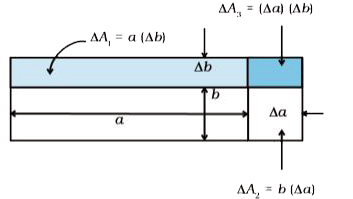 Consider a RECTANGULAR sheet of the solid material of length a and BREADTH b (Fig. 11.8). When the TEMPERATURE INCREASES by`Delta T, a `Increases by `Delta a = alpha_(1) a Delta T` andbincreases by `Delta b = alpha_(1), b Detla T`. From Fig. 11.8, the increase in area `Delta A = DeltaA_(1) + DeltaA_(2) + DeltaA_(3)` `DeltaA = a Deltab + b Delta a + (Delta a) (Deltab)` ` = a alpha_(1) b DeltaT + b alpha_(1) a DeltaT + (alpha_(1))^(2) AB (Delta T)^(2)` ` = alpha_(1) ab DeltaT (2 +alpha_(1) DeltaT) = alpha_(1) A DeltaT (2 + alpha_(1) DeltaT)` Since `alpha_(1) approx 10^(-5) K^(-1)`,from Table 11.1 , the product `alpha_(1) Delta T ` for fractional temperature is small in comparision with 2 and may be neglected. Hence, `((Delta A)/A) 1/(Delta T) approx 2alpha_(l) ` |
|
| 38920. |
Each side of a cube is measured to be 7.203m. What is (i) the total surface area and (ii) the volume of the cube to appropriate significant figures ? |
|
Answer» SOLUTION :The number of significant FIGURES in the measured length is 4. The calculated area and the volume should THEREFORE be rounded off to 4 significant figures. Surface area of the cube = `6(7.203)^(2)m^(2)` `=311.299254m^(2)` `=311.3 m^(2)` Volume of the cube = `(7.203)^(3) m^(3)` =`373.714754 m^(3)` =`373.7 m^(3)` |
|
| 38921. |
In Fery's blackbody |
|
Answer» INNER surface of inner wall is coated with lamp black and outer surface of outer wall is silver polished |
|
| 38922. |
In an experiment to determine the coefficient of viscosity of a liquid using the formual eta=(piPr^(4))/(8l Q) the radius of the capillary tube was measured to be 0.41 mm using an instrument of least count 0.001 cm, length l was measured usinga metre scale as 15 cm. The percentae error in the pressure difference is 0.4% and the percentage error in the volume of the liquid flow out per second Q is 0.3% what is the maximum percentage error in the coefficient of viscosity? |
|
Answer» |
|
| 38923. |
A simple pendulum is oscillating between extreme positions P and Q about the mean position O. Which of the following statement are true about the motion of pendulum? |
|
Answer» At point O, the acceleration of the bob is different from ZERO |
|
| 38924. |
In aboveproblem about an axis passing through any sideof framethe momentof inertia of threebodies is |
|
Answer» `ML^(2)` |
|
| 38925. |
(A) : hollow shaft is found to be stronger than a solid shaft made of same material and same quantity. (R): Rigidity modulus is the ratio of shearing stress to shearing strain. |
|
Answer» Both .A. and .R. are TRUE and .R. is the correct explanation of .A. |
|
| 38926. |
If the mnormal force is doubled then coefficient of friction is |
|
Answer» HALVED |
|
| 38927. |
A particle of mass M is placed at the centre of a uniform spherical shell of equal mass and radius a. Find the gravitational potential at a point P at a distance a/2 from the centre. |
|
Answer» SOLUTION :The gravitational potential at the point P DUE to the particle at the centre is `V_(1) = -(GM)/(a//2) = -(2GM)/(a)` The potential at P due to the SHELL is `V_(2) = -(Gm)/(a)` The net potential at P is `V_(1) = V_(2) = -(3Gm)/(a)` |
|
| 38928. |
If Sn=2+0.4n find initial velocity and acceleration |
|
Answer» SOLUTION :We have `S_(N)=u+a(n-1/2), S_(n)=(u-a/2)+an` `S_(n)=2+0.4n` COMPARING with above EQUATION U=2.2 UNITS a=0.4 units |
|
| 38929. |
What is elastic fatigue? |
| Answer» Solution :The state of temporary loss of elastic properties of a body DUE to continuous PERIODIC STREE is caleld elsatic fatiguel. When fatigue is DEVELOPED we can break the body with LITTLE stress far below the breaking stress. To remove elastic fatigue rest must be given to the body otehrwiese it will break away. | |
| 38930. |
Moment of a force of magnitude 20 N acting along positive x-direction at point (3m,0,0) about the point (0,2,0) (in N-m) is |
|
Answer» 20 `=[(0-3)hat(i)+(2-0)hat(j)+(0-0)hat(k)]XX[20 hat(i)]` `=[3 hat(i)+2hat(j)]xx[20 hat(i)]=-40 hat(k)`. |
|
| 38931. |
You hold a rubber ball in your hand. The Newton’s third law companion force to the force of gravity on the ball is the force exerted by the |
|
Answer» BALL on the earth |
|
| 38932. |
The potential energy of a harmonic oscillator of mass 2 kg in its mean position is 5 J. If its total energy is 9J and its amplitude is 0.01 m, find its time period. |
|
Answer» SOLUTION :`1/2kA^(2)+(9-5)=4J` `:.k=8/(A^(2))=8/((0.01)^(2))=8xx10^(4)N//m` `T=2pisqrt(m/k)=2pisqrt(2/(8xx10^(4)))=(PI)/100S` |
|
| 38933. |
If |vec(A)| = 4N, |vec(B)| = 3N the value of |vec(A) xx vec(B)|^(2) + |vec(A).vec(B)|^(2) = |
|
Answer» 5N |
|
| 38934. |
A particle of mass 1 kg is attached to a string of length 5 m. The string is attached to a fixed point O. It is released from theposition as shown in Fig. Calculate a. the impulse developed in the string when it becorries taut, b. the velocity of the particle just after the string becomes taut, c. the impulse developed in this string PQ at this instant. |
Answer» Solution :From `M` to `N` the ball will fall a distance o `4m`, then impulse will be developed in the string ON. 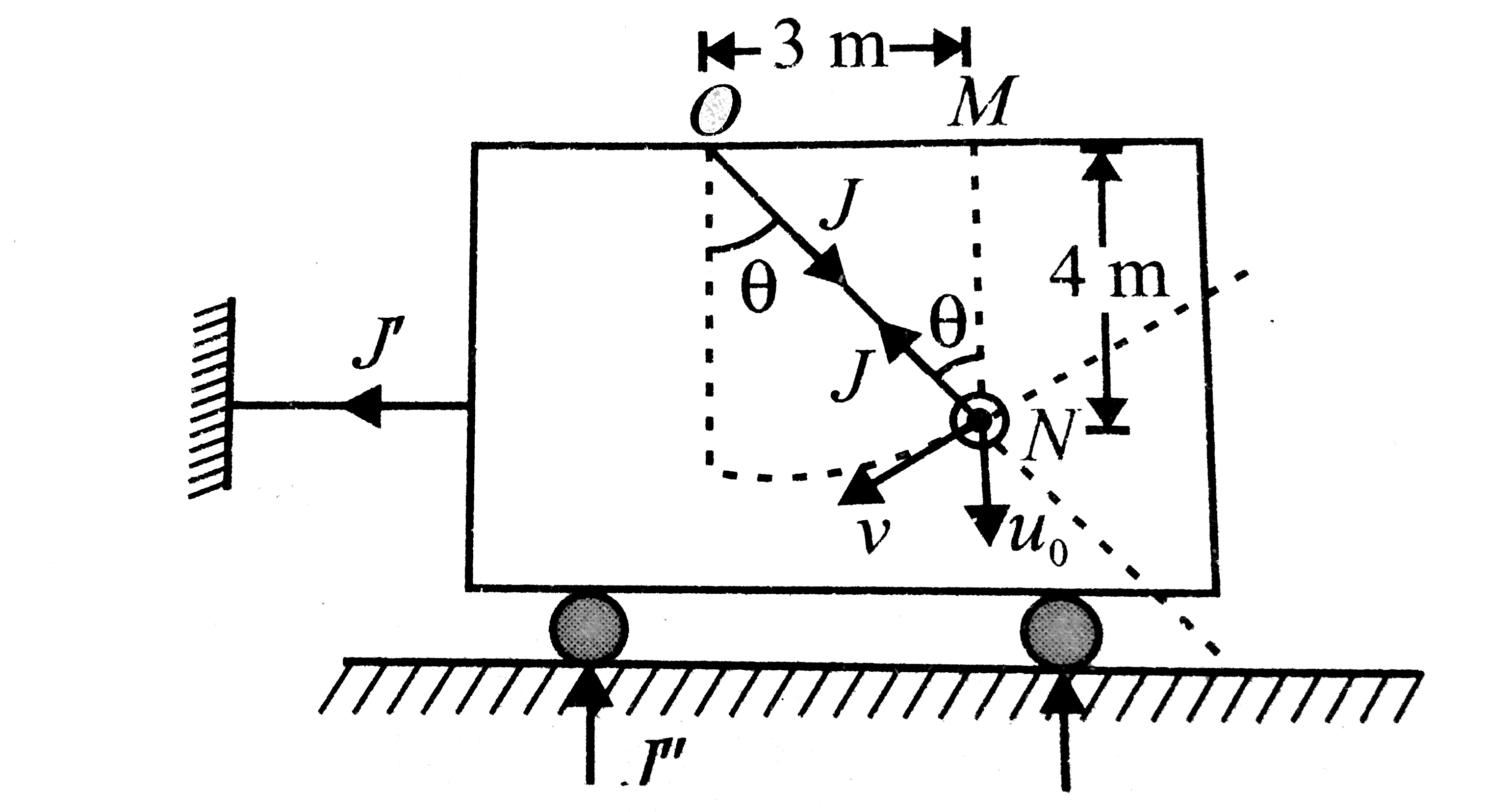 VELOCITY of the ball just before the string BECOMES tight ` u_(0)=sqrt(2xx10xx4)=sqrt(80)m//s` velocity of the ball in the DIRECTION perpendicular to the impulse will remain same (just after and just before the impulse developed.) `v=u_(0)sintheta=sqrt(80)xx3/5=15/(sqrt(5))m//s` `J=mu_0costheta=1sqrt(80)xx4/5=16/(sqrt(5)) kgm//s` `J'=Jsintheta=4/(5sqrt(5))kgm//s` and impulse given by earth `J''=Jcostheta=64/(5sqrt(5))kgm//s` |
|
| 38935. |
Three liquids A,B and C having same specific heat and mass m , 2m and 3m have temperature 20^@C, 40^@C and 60^@C respectively. Temperature of the mixture when : {:("Column -I","Column -II"),("A) A and B are mixed,is at","P)" 35^@C),("B) A and C are mixed , is at ","Q)" 52^@C),("C) B and C are mixed , is at ","Q)" 50^@C),("D) A , B and C all three are mixed , is at ","S)"45^@C),(,"T) None"):} |
|
Answer» <P> |
|
| 38936. |
If a planet of given density were made larger (keeping its density unchanged) its force of attraction for an object on its surface would increased because of increased mass of the plane but would decrease because of larger separation between the centre of the planet and its surface. Which effect would dominate? |
|
Answer» INCREASE in mass |
|
| 38937. |
Choose the false statement |
|
Answer» Scalar product and VECTOR porduct obey commutative LAW |
|
| 38938. |
An ideal gas is initially at temperature T and volume V. Its volume increases by DV due to an increase in Temperature.dT, while pressure remains constant Here gamma=1/V=(dV)/(dT) What will be the nature of the graph between gamma and l? |
|
Answer» Solution :In CASE an ideal gas `pV=RT or ,V=(RT)/p` When pressure remains CONSTANT, we have `(DV)/(dT)=R/P` `thereforegamma=1/V(dV)/(dT)=1/VR/P=R/(RT)=1/T` i.e., `gamma T=1`=constant So the graph `gamma-T` will be a rectangular HYPERBOLA [Fig.6.20] 
|
|
| 38939. |
The escape velocity on a planet is v. If the radius of the planet contracts to 1//4^("th")the present value without any change in its mass, then the escape velocity becomes |
|
Answer» v |
|
| 38940. |
A solid floats in a liquid at 20°C with 75% 0f it immersed. When the liquids is heated to 100°C, the same solid floats with 80% of it immersed in the liquid. Calculate the coefficient of expansion of the liquid. Assume the volume of the solid to be constant. |
|
Answer» |
|
| 38941. |
If the Earth's pull on the Moon suddenly disappears, what will happen to the Moon? |
| Answer» Solution : Basically, the moon would become the THIRD planet, however the orbit may change. The moon is in orbit AROUND the EARTH, and what happens will DEPEND on just when the earth disappears The moon travels around the earth at about 1 km/sec and the Earth - moon PAIR travel around the sun at about 30 km/sec. This extra 1 km/sec movement will result in an orbit change . | |
| 38942. |
A rectangular box lies on a rough inclined surface The co- efficient of friction between the surface and the box mu Let the mass of box be m (a) At what angle of inclination 0 of the plane to the horizontal will box just start to slide down the plane ? (b) What isthe force acting on box down the plane if the angle of inclination of the plane is increases toalpha gt theta? (c) What is the force needed to be applied upwards along the plane to make the box either remain stationary or just move up with unifrom speed ? (d) What is the force needed to be applied upwards along the plane to make the box move up the plane with acceleration a ? |
|
Answer» Solution :(a) As the box tends to slide down force of friction will ACT up the PLANE As is clear from box will just start slidding down , when ` mg sin theta = f = mu R = mu mg cos theta` or ` tan theta = mu or theta = tan^(-1) (mu) ` (b) When ANGLE of inclination is increased to `ALPHA gt theta` then net force acting on the box down the plane is ` F_(1) = mg sin alpha - f = mg sin alpha + f = mg (sin alpha+ mu cos alpha)` (In this case friction would act down the plane ) (d) If the box is to be moved with an upward acceleration a then upward force NEEDED ` F_(3) = mg (sin alpha+ mu cos alpha) + ma ` 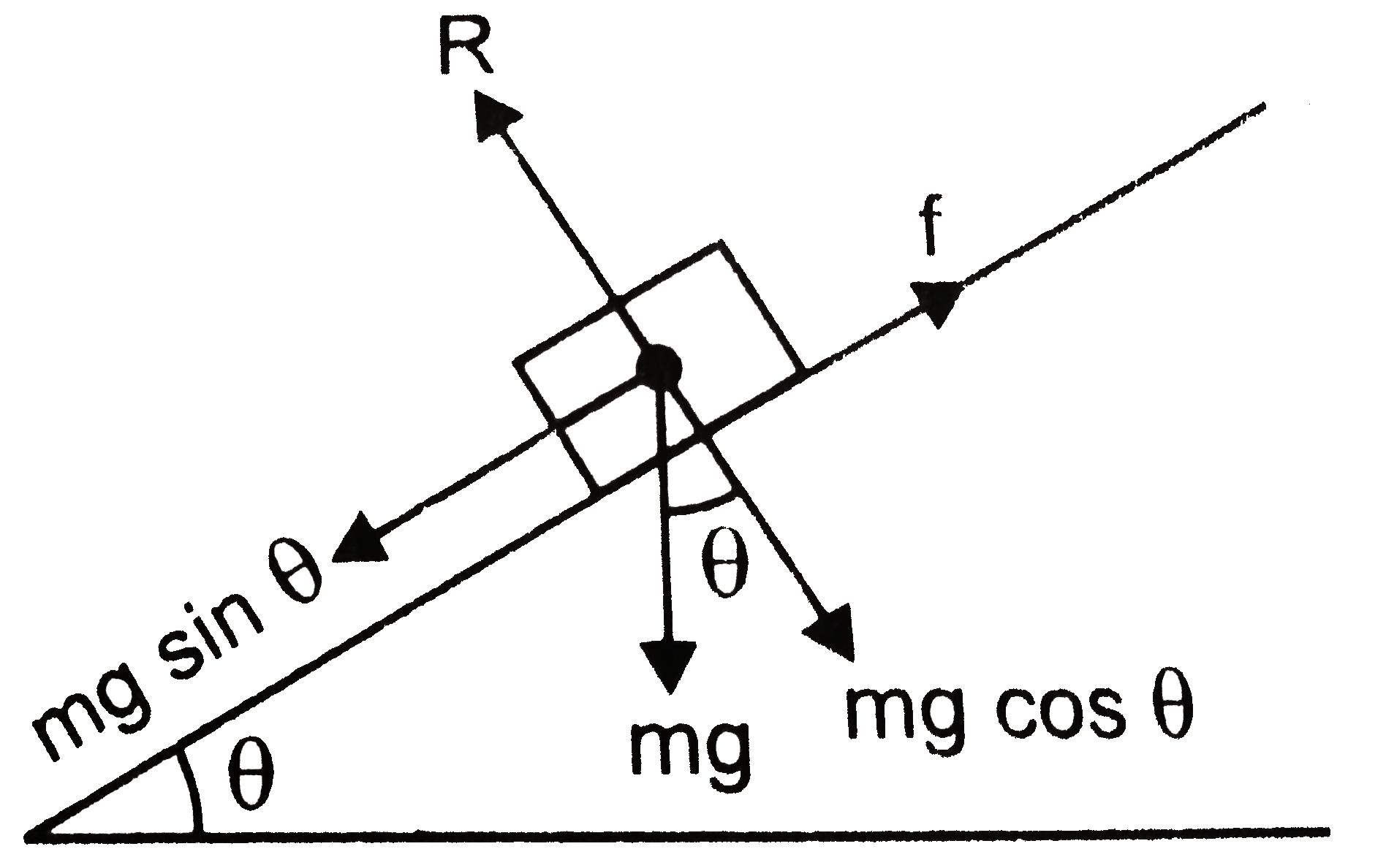 . .
|
|
| 38943. |
For a monoatomic ideal gas undergoing an adiabatic change, the relation between temperature and volume is TV^(x) = constant, where x is |
|
Answer» Solution :For an adiabatic change, `TV^(gamma - 1)` = CONSTANT …(i) `TV^(x)` = constant (Given) ….(II) COMPARING (i) and (ii), we get `x = gamma - 1` For a monatomic gas, `gamma = (5)/(3) :. x = (5)/(3) - 1 = (2)/(3)` |
|
| 38944. |
A body is projected horizontally from the top of hill with a velocity of 9.8 m/s. What time elapse before the vertical velocity is twice the horizontal velocity? |
| Answer» Answer :C | |
| 38945. |
The velocity with which a body should be projected from the surface of the earth such that it reaches a maximum height equal to n times the radius R of the earth is |
|
Answer» `sqrt((N)/(n+_1)(GM)/(R))` |
|
| 38946. |
Is it neccesary that all black coloured bodies to be regarded as perfectly black bodies ? |
| Answer» Solution :Not neccesary. For EXAMPLE a highly polished BLACK surface NEED not behave as a PERFECT black body. | |
| 38947. |
Why are shock absorbers used in cars, scooters, and motore cycles ? |
| Answer» Solution :To increse the TIME of JERK and THEREBY decrese the IMPULSIVE FORCE. | |
| 38948. |
The ends of a metal rod of length 40 cm are maintained at temperatures 100^(@)Cand20^(@)C respectively. At steady state condition, the temperature at a point at a distance 30 cm from the hot end of the rod is |
| Answer» SOLUTION :`40^(@)C` | |
| 38949. |
The initial state of a certain gas is (P_(i)V_(i) T_(i)). It undergoes expansion till its volume becomes V_(int).Consider the following two cases. a) The expansion takes place at constant temperature. b) The expansion takes place at constant pressure. Plot the P-V diagram for each case. In which of the two cases, is the work done by the gas more ? |
Answer» Solution :The P-V DIAGRAM for each case is SHOWN in the FIGURE. In case (i) `P_(i)V_(i)=P_(f)V_(f)` : therefore PROCESS is isothermal. Work done = area under the PV curve so work is more when the gas expands at constant pressure.
|
|
| 38950. |
T_(1)T_(2) and T_(3) the time periods of a given pendulum on the surface of the earth, at a depth h in a mine and at an altitude h above the earth's surface respeceively, then |
|
Answer» `T_(1)=T_(2)` |
|