

Saved Bookmarks
This section includes InterviewSolutions, each offering curated multiple-choice questions to sharpen your knowledge and support exam preparation. Choose a topic below to get started.
| 38851. |
The relation between P and T for monoatomic gas during adiabatic process is PpropT^(C). The value of C is |
|
Answer» `5//2` |
|
| 38852. |
Trajectory of two particles projected from origin with speeds v_(1) and v_(2) at angles theta_(1) and theta_(2) with positive x- axis respectively are as shown in the figure. Given that (g=-10m//s^(2)(hatj)). Choose the correct option related to diagram. |
|
Answer» `v_(1)-v_(2)=2v_(1)` |
|
| 38853. |
Estimate the fraction of molecular volume to the actual volume occupied by oxygen gas at STP. Take the diameter of an oxygen molecule to be 3Å. |
|
Answer» `3.8 XX 10^(-4)` |
|
| 38854. |
If the unit of force were 10N, that of power were 1MW and that of time were 1 millisecond then the unit of length would be |
| Answer» ANSWER :B | |
| 38855. |
A prism of mass M is placed on a horizontal surface. A block of mass m slides on the prism, which in tum slides on thehorizontal surface. Assuming all surfaces to be frictionless, find the acceleration of block with respect to prism. |
|
Answer» Solution :Let `a_0` be the acceleration of prism in the backward direction. The MASS .m. is placed on non-inertial frame, THEREFORE it is acted on by fictitious force `ma_0` in the forward direction. The forces acting on massm are i) Weight mg acting downward,  ii) Normal reaction R, iii) Fictitious force `ma_0` According free body diagram of .m. is shown in FIGURE. Suppose block m slides down the prism with acceleration a. The equation of motion of .m. PARALLEL to incline is `ma_0 cos theta + mg sin theta = ma ` `implies a = a_0 cos theta + g sin theta ` ........... (1) The block is in equilibrium perpendicular to incline, so resolving force perpendicular to incline  `R_1 + ma_0 sin theta = mg cos theta ` ........ (2) Now we consider the forces acting on the prism. As prism is on GROUND (inertial frame) no fictitious force acts on it. The forces on prism are i) Weight (Mg) downward. ii) Normal force `R_1` exerted by block iii) Normal reaction `R_1` exerted by ground For horizontal motion of prism `R _1sin theta = Ma_0 implies R_1 = (Ma_0)/(sin theta ) `......... (3) substituting this value in (2) , `(Ma_0)/(sin theta) + ma_0 sin theta = mg cos theta ` This gives ` a_0 = ( mg sin theta cos theta)/( M + m sin^(2) theta ) `............ (4) `:. ` From (1) , ` a=(mg sin theta cos^(2) theta )/( M + m sin^(2) theta ) + g sin theta ` `= ((M+m) g sin theta )/( M + m sin^2 theta )` |
|
| 38856. |
If S_(n)=2+0.4n find initial velocity and acceleration |
|
Answer» SOLUTION :We have `S_(n)=U+a(n-(1)/(2))` `S_(n)=(u-(a)/(2))+an` `S_(n)=2+0.4n` COMPARING with above EQUATION `U=2.2` units `a=0.4` units |
|
| 38857. |
Impulse of a force is a measure of total effect of the force It is given by the product of everage force and the time for which the force acts on the body . Impulse of a force is measured by the total change in linear momentum produed during impact Impulsevec(I) = vec(F)_("avg") xxt = vec (p_(2)) - vec(p_(1))A given change in linear momentum can be produced by applyinga larger force for a shorter time or by applying a smaller force for a longer time Read the above passage and answer the following questions (i) What is the function of shockers in autos (ii) What values of life do you learn from this study ? |
|
Answer» Solution :(i) When autos PLY over an uneven road , impulsive forces are exerted by the road The funcation of shockers is to increase the time of impact As `F xx t` = constant , therefore when `t` increases `F` decreases the force/jerk experiencedby the rider of the VEHICLE raduces (ii) In day life the RELATION `F xx t ` = change in linear momentum = constant implies that to achieve any goal or to affect any change the product of force and time SHALL be constant when your efforts are weak you require longer time to achieve the goal . |
|
| 38858. |
A balloon carrying a stone rises from rest on the ground with a constant acceleration 10 m//s^(2). After 5 s, the stone is released and ultimately it strikes the ground. Sketch a v-t graph for the stone and the maximum height attained by it. |
Answer» Solution :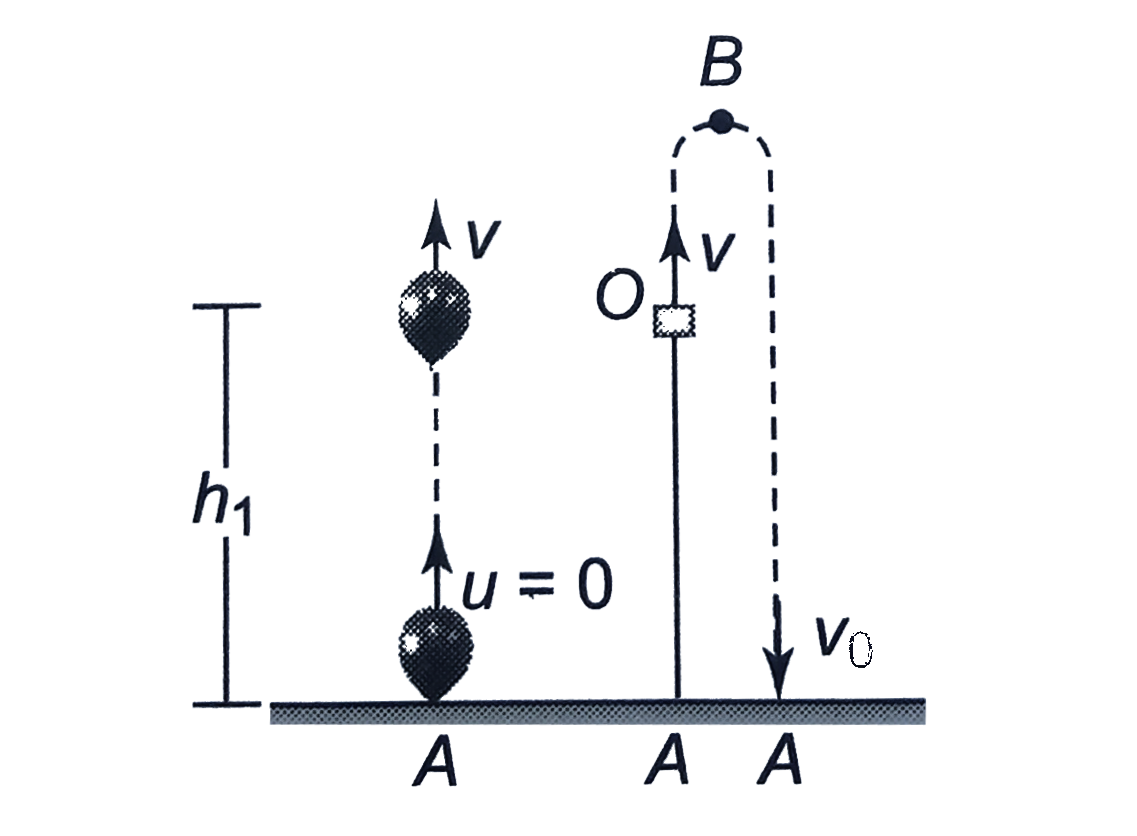 First the stone will accelerate with balloon. ACCELERATED motion: `t=0` to `t=5s` `v=u+a_(1)t=0+10t=50 m//s` `h_(1)=ut+1/2a_(1)t^(2)=0+1/2xx10xx5^(2)=125 m` After release, the stone will move under gravity. Assuming O as the origin and upward direction +ve, O to A through B: Displacement`=-h_(1)=-125 m` `-h_(1)=v t_(2)-1/2g t_(2)^(2)` `-125=50t_(2)-5 t_(2)^(2)` `t_(2)^(2)-10t-25=0` `t_(2)=(10+-sqrt(100+100))/2 =(10+-10sqrt(2))/2` `t_(2)=(10+-10xx1.4)/2 =12 s,-2s` The stone will strike the ground after 12 s (from its release). VELOCITY of the stone at t=12 s, `v_(0)=v-g t_(2)=50-10xx12=-70 m//s` v-t graph for stone A to O: `t=0, v=0` `t=5 s, v=50 m//s` `v=10t` `y=10 x` (straight line) 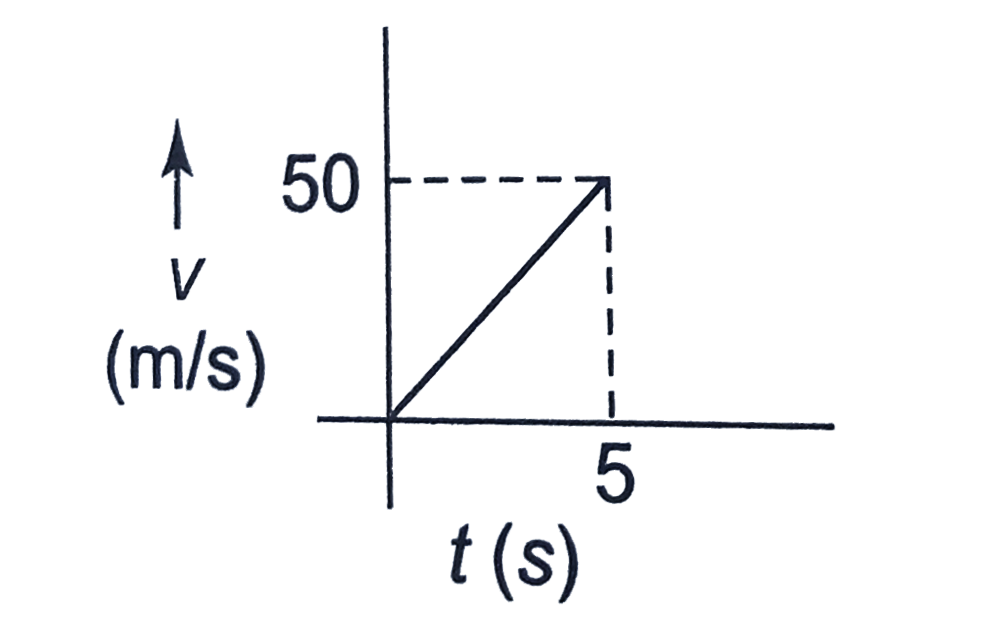 O to A through B: `v=50-10 t` `t=0, v=50 m//s` `t=12 s, v=-70 m//s` `v=0implies50-10timplies t=5 s` Shape: y=50-10x(straight line) y=c+mx c=50, +ve m=-10, -ve 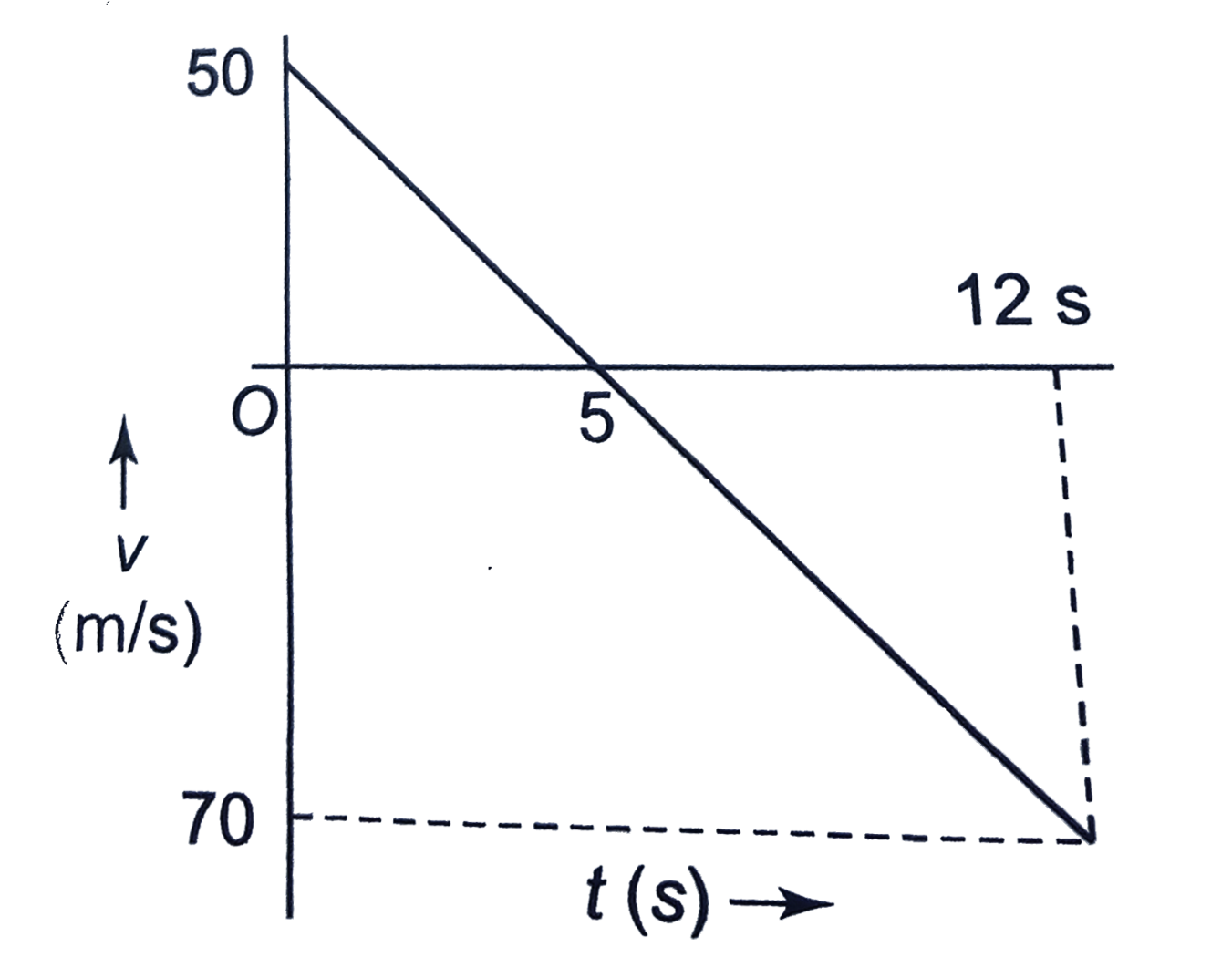 Comdining the above two graph, we get the following graph: 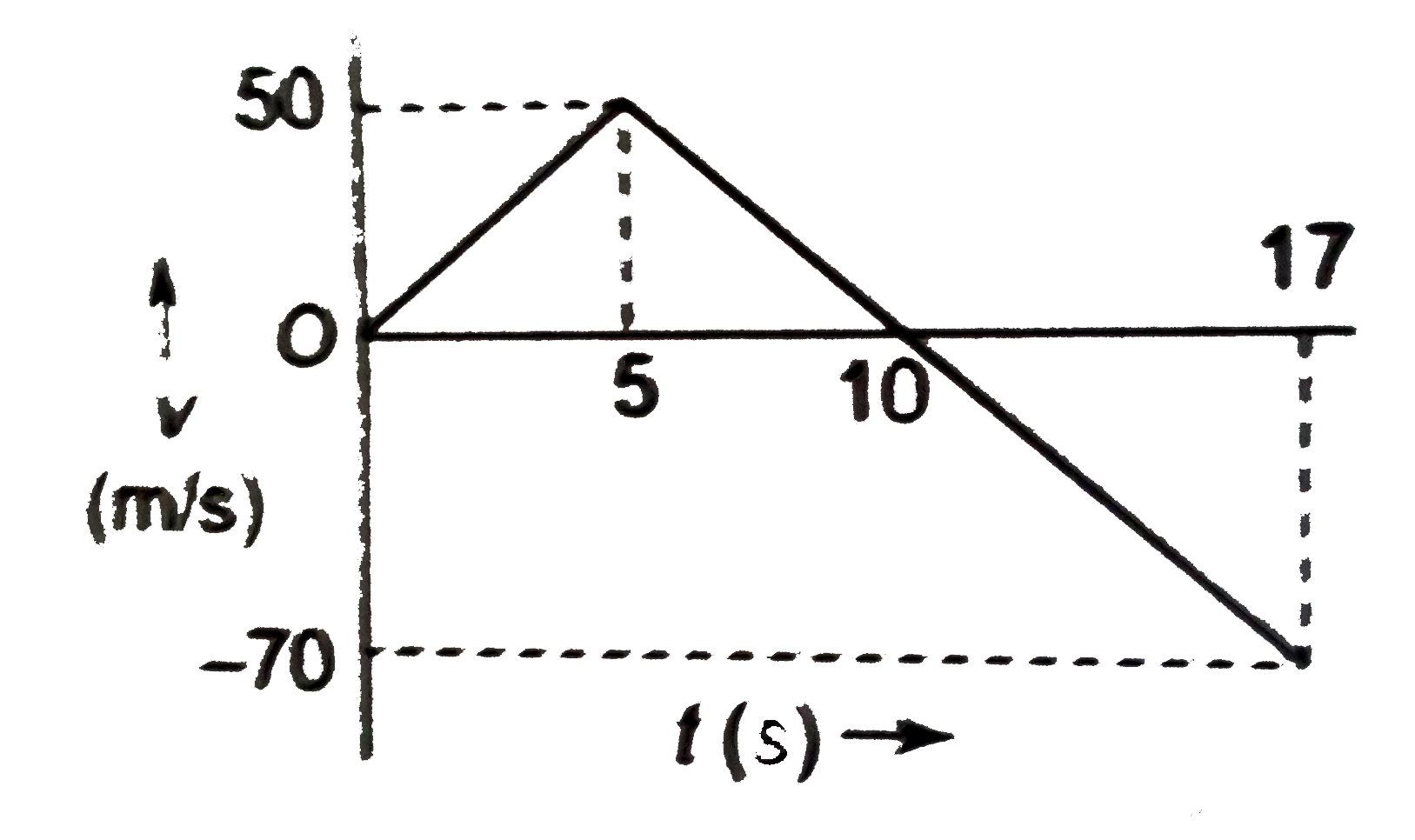 The area of the v-t graph from t=0 to t=10 s will give the maximum HEIGHT attained by the stone. Maximum height`=1/2xx50xx10=250 m` OR If we take time from the start of the balloon, the velocity of the stone in terms of time after its release will be `v=50-10(t-5)=100-10t(5 s lt = t lt = 17 s)` `t=5 s, v=50 m//s` `t=17 s, v=-70 m//s` `v=0implies100-10T=0impliest=10 s` 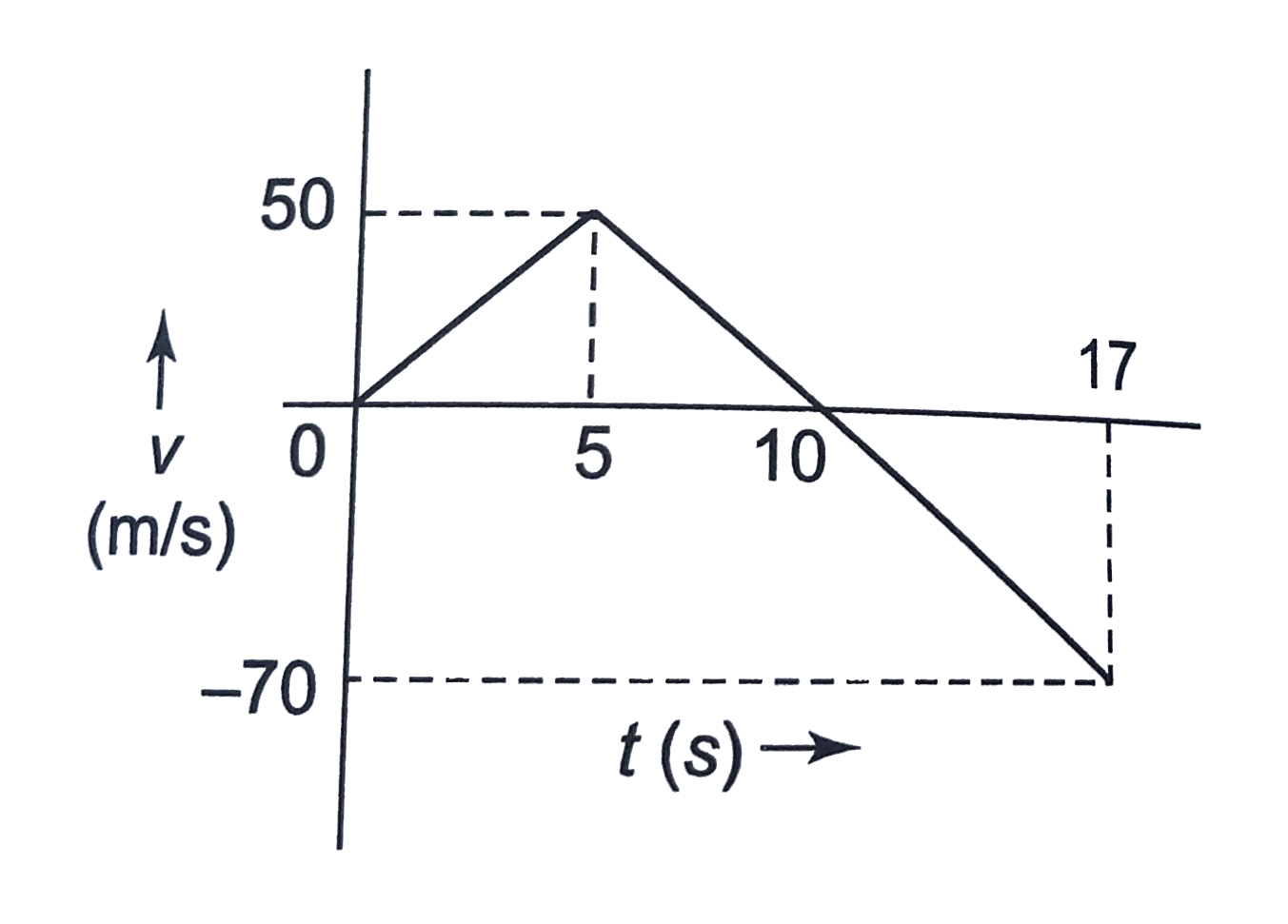
|
|
| 38859. |
Ifa person moving from pole to equator of the earth then the centrifugal forceactingon him is |
|
Answer» increases |
|
| 38860. |
Define a scalar. Give examples |
| Answer» Solution :Scalar is a property which can be DESCRIBED only by MAGNITUDE. Example MASS, distance and SPEED. | |
| 38861. |
A uniform rod of length 1 m mass 4 kg is supports on tow knife-edges placed10 cm from each end. A 60 N weight is suspended at 30 cm from one end. The reactions at the knife edges is. |
|
Answer» a. 60 N, 40 N 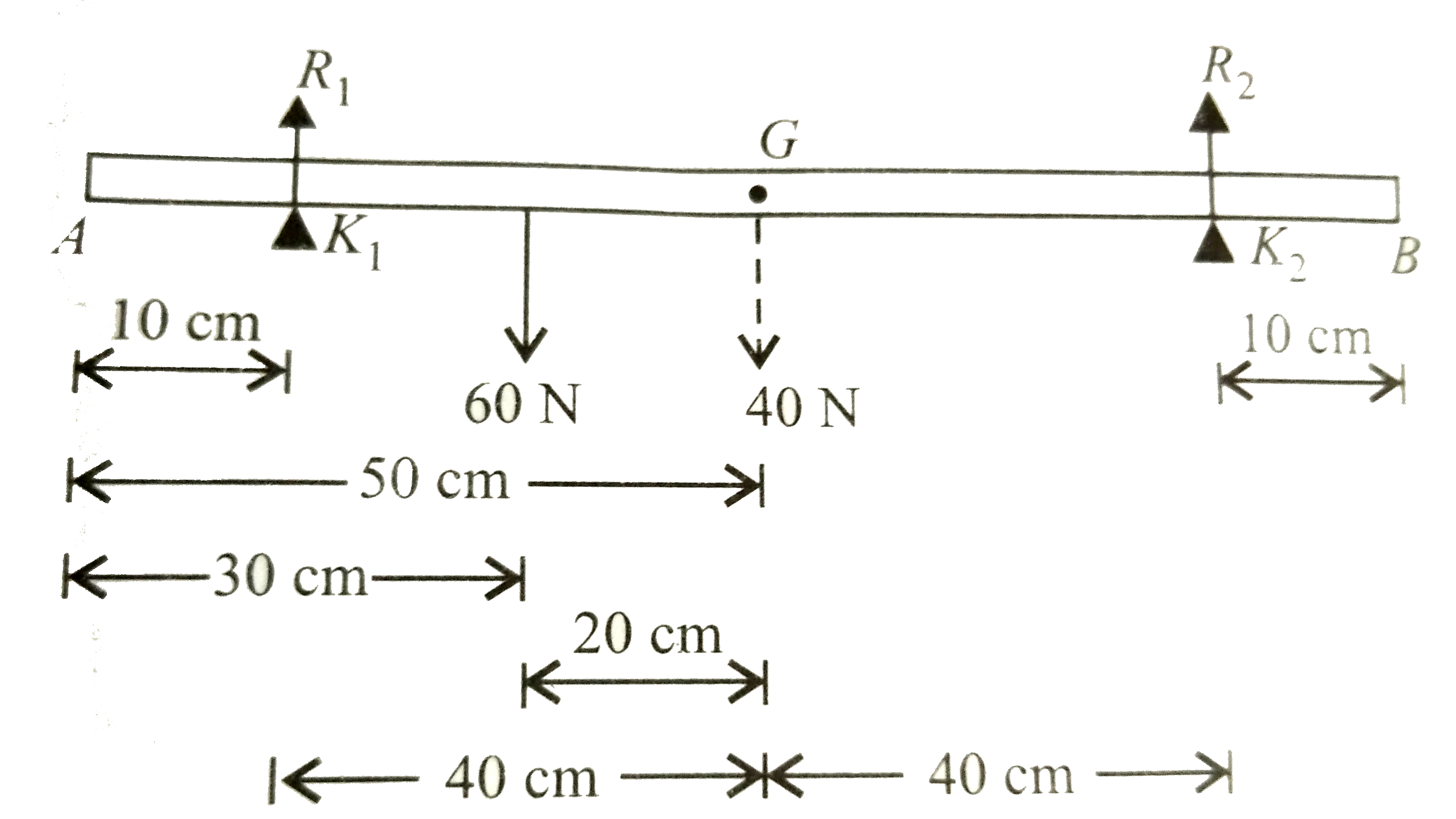 AB is the rod. `K_(1)` and `K_(2)` are the two knife EDGES. Since the rod is uniform, therefore its weight acts at its center of GRAVITY G. Let `R_(1)` and `R_(2)` be reactions at the knife edges. For the translational equilibrium of the rod, `R_(1)+R_(2)-60N-40N=0` `R_(1)+R_(2)=60N+40N=100N` For the rotational equilibrium, talking moments about G, we GET `-R_(1)(40)+60(2)+R_(2)(40)=0` `R_(1)-R_(2)=1200/40=30 N`..............(ii) Adding (i) and (ii), we get `2R_(1)=130N` or `R_(1)=65N` Substituting this VALUE in Eq. (i), we get `R_(2)=35N` |
|
| 38862. |
“When a person walk on rough surface then frictional force act in opposite direction of motion” - True or false ? |
Answer» SOLUTION :Falsewhenpersonwalkon roughsurfaceitpushessurfacein backwarddirectionfrictionalforceact in forwarddirection . 
|
|
| 38863. |
In the given arrangement, n number of equal masses are connected by strings of negligible masses. The tension in the string connected to n^("th") mass is : |
|
Answer» `(mMg)/(nm+M)` 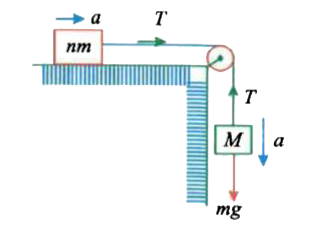 from diagram `mg-T=ma RARR (1), T=nma rarr (2)` for `n^("th")` block `T_(n)=ma` |
|
| 38864. |
what is stress ? |
|
Answer» Solution :The internal RESTORING FORCE acting PER unit area is called stress . stress = deforming force (F)/ area(A) |
|
| 38865. |
A woman pushes a trunk on a railway platform that has a rough surface, She applies a force F over a distance of 20 m as shown by the graph. Calculate the work done by the woman. |
|
Answer» Solution :`W= int FDX =` Area under the graph W = Area of RECTANGLE + Area of trapezium `= (100 N) (10 m) + 1/2 (100 N + 50 N) (10 m)` ` = 1000 J + 750 J = 1750 J. ` |
|
| 38866. |
The difference in the value of 'g' at poles and at a place latitude 45^(@) is |
|
Answer» `R omega^(2)` |
|
| 38867. |
Elastic collision is due to |
|
Answer» CONSERVATIVE FORCE |
|
| 38868. |
Which of the following conversions is correct? |
|
Answer» 1 atm `=1.01xx10^(4)PA` |
|
| 38869. |
In a temperature scale X ice point of water is assigned a value of 20^(@) X and the boiling point of water is assigned a value of 220^(@) X . In another scale Y the ice point of water is assigned a value of - 20^(@) Y and the boiling point is given a value of 380^(@) Y. At what temperature the numerical value of temperature on both the scales will be same? |
|
Answer» |
|
| 38870. |
When a stopper is pulled from a filled wash basin, the water drians out while circulating like a small whirl pool. The angular velocity of a fluid element about a vertical axis through the orifice appears to be greater near the orifice. The angular velocity of fluid element varies. |
|
Answer» inversely as the square of its DISTANCE from the AXIS through the ORIFICE. |
|
| 38871. |
Three particles each of mass m are placed at the three corners of an equilateral triangle of side a. The work done on the system to increase the sides of the triangle to 2a is: |
|
Answer» Solution :The center of mass of an equilateral triangle LIES at its geometrical center G. The positions of the mass m,, m, and m, are at positions A, B and C as shown in the Figure. From the given position of the masses, the coordinates of the masses mand m, are easily marked as (0,0) and (1,0) espectively. To find the position of m, the Pythagoras theorem is applied. A As the ADBC is a right angle triangle,  `BC^(2)=CD^(2)+DB^(2)` `CD^(2)=BC^(2)-DB^(2)` `CD^(2)=1^(2)-((1)/(2))^(2)=1-((1)/(4))=(3)/(4)` `CD=(sqrt(2))/(2)` The position of mass `m_(3)` is `((1)/(2), (sqrt(3))/(2)) or (0.5, 0.35 sqrt(3))` X coordinate of center of mass, `X_(CM)=(m_(1)x_(1)+m_(2)x_(2)+m_(3)x_(3))` `m_(1)+m_(2)m_(3))` `X_(CM)=((1xx0)+(2xx1)+(3xx0.5))/(1+2+3)=(35)/(6),X_(CM)=(7)/(12)m` x-coordinate of center of mass, `Y_(CM)=(m_(1)y_(1)+m_(2)y_(2)+m_(2)m_(3)y_(3))/(m_(1)+m_(2)+m_(3))` `Y_(CM)=((1xx0)+(2xx0)+(3xx0.5xx sqrt(3)))/(1+2+3)=(1.5 sqrt(3))/(6)` `Y_(CM)=(sqt(3))/(4)m` `:.` The coordinates of center of mass Grey) is `x_(CM),y_(CM)` is `((7)/(12), (sqrt(7))/(4))` |
|
| 38872. |
Substance which contracts on heating, among the following is lnvar Brass Silver Iodide Type metal |
| Answer» ANSWER :C | |
| 38873. |
When an ideal diatomic gas is heated at constant pressure, the fraction of heat energy supplied which is used in doing work to maintain pressure constant is |
|
Answer» `5//7` |
|
| 38874. |
(A): Two balls of different masses are thrown vertically upward with same speed, they will pass through their point of projection in the downward direction with the same speed. (neglect air resistance) (R): The maximum height and downward velocity attained at the point of projection are independent of the mass of the ball. |
|
Answer» Both (A) and (R) are true and (R) is the CORRECT EXPLANATION of (A) |
|
| 38875. |
A string of negligible mass passes over a pulley of mass m which is clamped. It supports a block of mass M at its lower free end. What is force exerted on pulley by the support ? |
|
Answer» Solution :There are TWO forces acting on SUPPORT, (i) T, the tension due to horizontal PART of STRING, where T = Mg (ii) (M + m)g, TOTAL weight of pulley and block along vertical. `F=sqrt((Mg)^(2)+[(M+m)g]^(2))` `= (sqrt((M+m)^(2)+M^(2)))g` 
|
|
| 38876. |
The K.E. of a satellite is 2MJ. Its total energy is |
|
Answer» `-0.5` MJ |
|
| 38877. |
The work done by a magnetic field on moving charge is |
|
Answer» ZERO because `VECF` ACTS parallel to `VECV.` |
|
| 38878. |
State with reasons , whether the following algebraic operations with scalar and vectorphysical quantities are meaningful : (a)adding anytwo scalars , (b) adding a scalar to a vector of the same dimesions ,(c ) multiplying any vector by any scalar , (d) multiplying any twoscalars , (e ) adding any two vectors , (f) adding a component of a vector to the same vector . |
|
Answer» |
|
| 38879. |
Two satellite A and B revolve round a planet in coplanar circular orbits in the same sense . Their period of revolving are 1h hour and 8 hours respectively . The radius of the orbit of A is 10^(4)km. Then speed of B relative to A when they are closein kmph is |
|
Answer» `10^(4)PI` |
|
| 38880. |
m grams of a gas of a molecular weight M is flowing in an isolated tube withvelocity 2V. If the gas flow is suddenly stopped the rise in its temperature is , (gamma=ratio of specific heats, R=universal gas constant, J=Mechanical equilent of heat) |
|
Answer» `(2Mv^(2)(GAMMA-1))/(RJ)` |
|
| 38881. |
Three point masses each of mass 'm' are joined together using a string to form an equilateral triangle of side 'a'. The system is placed on a smooth horizontal surface and rotated with a constant angular velocity 'w' about a vertical axis passing through the centroid. Then the tension in each string is |
|
Answer» `ma omea^2` |
|
| 38883. |
On tripling the absolute temperature of thesource, the efficiency of a Carnot.s heat engine becomes double that of the initial efficiency. Then the initial efficiency of the engine is ________ |
| Answer» ANSWER :D | |
| 38884. |
A uniform solid sphere of diameter 0.2m and mass 10kg is rotated about its diameter with an angular velocity of 2 rad s^(-1). Then its angular momentum is kg m^(2)s^(-1) is |
|
Answer» 0.01 |
|
| 38885. |
A substance of mass in kg requires it power input of P watt to remain in the molten state at its melting point. When the power is turned off, the sample completely solidifies in time t sec. The latent hent of fusion of the substance is |
|
Answer» `(PM)/t` |
|
| 38886. |
Find the natural frequency of the system shown in figure. The pulleys are smooth and massless. |
| Answer» SOLUTION :`1/pi SQRT((2K)/(M))` | |
| 38887. |
Compare the components of vector equation vecF_(1)+vecF_(2)+vecF_(3)=vecF_(4). |
|
Answer» Solution :We can resolve all the VECTORS in x, y and z components with respect to Cartesian coordinate system. Once we resolve the components we can separately equate the x components on both SIDES, y components on both sides, and z components on both the sides of the equation, we then get `F_(1X)+F_(2x)+F_(3X)=F_(4x)` `F_(1y)+F_(2y)+F_(3y)+F_(4Y)` `F_(1z)+F_(2z)+F_(3z)+F_(4z)` |
|
| 38888. |
(A): The average and instantaneous velocities have same value in a uniform motion. (R) : In uniform motion, the velocity of an object increases uniformly. |
|
Answer» Both (A) and (R) are true and (R) is the correct EXPLANATION of (A) |
|
| 38889. |
A normal pressure, the volume of a gas at 10^(@)C is 200 c.c. At the same pressure, when the gas is heated to 100^(0)C its volume becomes 250 c.c. Find the volume coefficient of the gas. |
|
Answer» Solution :Initial volume `V_(1)=200` c.c , Initial TEMPERATURE `t_(1)=10^(@)C` FINAL volume `V_(2)=250` c.c , Final temperature `t_(2)=100^(@)C` Volume coefficient of the gas `ALPHA=(V_(2)-V_(1))/(V_(1)t_(2)-V_(2)t_(1))=(250-200)/(200 TIMES 100-250 times 10)=50/17500=0.002857l^(@)C` |
|
| 38890. |
A horizontal force of 1N is needed to keep a block of mass 0.25kg sliding on a horizontal surface with a constant speed. Find the coefficient of sliding friction. (g=10ms^(-2)) |
|
Answer» |
|
| 38891. |
The adjoining diagram shows the biasing of an npn-transistor in common emitter configuration used in an amplifer. The design of the transistor is such that 98% of the charge carries passing through the emitter reach the collector. If base current changes from 50 muA to 100muA, then the corresponding change in the voltage across the load resistance R_(L) will be |
|
Answer» 0.25 V |
|
| 38892. |
For a rectangle base is (hat(i) + hat(j) + hat(k)) and adjacent side is (4 hat(j) + 3hat(k)). If the area of rectangle is 5^(n) then value of n is |
|
Answer» |
|
| 38893. |
A ray of light is incident normally on one of the refracting surfaces of a prism of refracting angle A. The emergent ray grazes the other refracting surface. Find the refractive index of the material of the prism. |
|
Answer» SOLUTION :For normal INCIDENCE on ONE of the refracting faces of the prism `i_1=0 and r_1=0` But `r_1+r_2=A` when light undergoes refraction through a PRISMS. `therefore 0+r_2=A, r_2=A` When the emergent light grazes the second surface, `r_2` becomes the critical angle ( C) i.e., `C=A and mu=1/(sin C)=1/ (sin A)` |
|
| 38894. |
The coefficient of real expansion of a liquid is 7.52 xx10^(-4)//^(@)C and the coefficient of apparent expansion of the liquid is 7.25 xx10^(-4)//^(@) C. Find the coefficient of linear expansion of the material of the vessel. |
|
Answer» Solution :Coefficient of real expansion of the liquid `(gamma _(R)) = 7.52 xx 10 ^(-4) //^(@)C` Coefficient of apparent expansion of the liquid `, (gamma _(a)) = 7.25 xx 10 ^(-4) //^(@)C` we know ` gamma _(R) = gamma _(a) + gamma + gamma _(a) + 3 alpha , 3 alpha = gamma _(R) - gamma _(s) = 7.52 xx 10 ^(-4) = 0.27 xx 10 ^(-4)` `alpha = ( 0.27 xx 10 ^(-4))/(3) = 0.09 xx 10 ^(-4)` `therefore` Coefficient of LINEAR expansion of VESSEL material `= 9 xx 10 ^(-6) //^(@)C` |
|
| 38895. |
A car is moving with a constant speed on a straight line. A bullet of mass 10 g and velocity 800 m//s is passed through a mud wall of thickness 1 m. Its velocity reduces to 100 m//s. Find the average resistance offered by the mud wall. |
|
Answer» SOLUTION :`FS = 1/2mv^2-1/2"mu"^2` `F xx1=1/2xx10xx10^-3(100^2-800^2)` F= - 3150 N Resistive force =3150 N |
|
| 38896. |
25.852g of a substance occupies 6.31 cm^(3) Express its density by keeping the significant Express its density by keeping the significant figures in view. |
|
Answer» |
|
| 38898. |
A mass of 12 Kg at rest explodes into two pieces of masses 4 Kg and 8 Kg which move in opposite directions. If the velocity of 8 Kg piece is 6 ms^(-1), then the kinetic energy of the other piece in joules is |
|
Answer» 64 |
|
| 38899. |
The displacement of a particle is given by x = (t-2)^(2)where x is in metre and t in second. The distance covered by the particle in first 4 seconds is |
|
Answer» 4m Velocity, `v = (dx)/(dt) = (d)/(dt)(t-2) ^(2) = 2 (t -2) m//s` Acceleration,` a = (dv)/(dt) = (d)/(dt) [2 (t -2)]` `=2 [1-0]=2m//s^(2)` When,` t =0 implies v=- 4m//s` `t = 2s implies v =0 m//s` `t = 4s implies v = 4 m//s` 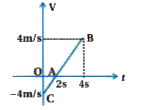 u-t graphs is shown in adjacent diagram. Distance travelled = area of the GRAPH = area OAC + area ABD `= (4XX 2)/(2) + 1/2xx 2 xx 4 =8m` |
|
| 38900. |
The temperature at which Centrigrade thermometer and Kelvin thermometer gives the same reading, is |
|
Answer» `4^(@)` |
|


