

Saved Bookmarks
This section includes 7 InterviewSolutions, each offering curated multiple-choice questions to sharpen your Current Affairs knowledge and support exam preparation. Choose a topic below to get started.
| 1. |
Moment of inertia of a ring of mass M and radius R about a tangent to the circle of the ring is |
|
Answer» `MR^(2)` |
|
| 2. |
Radiant energy from the sun strikes the earth at a rate of 1.4 xx 10^(3) "watt/m"^(2). Calculate the temperature of the surface of the sun. Average distance of earth from sun = 1.5 xx 10^(11) m, Stefan's constant = 5.7 xx 10^(-8) "Wm"^(-2) K^(-4) ( Radius of sun= 7 xx10^(8) m ) |
|
Answer» 5801K |
|
| 3. |
The displacements of a particle executing SHM at three consecutive seconds are 6 cm, 10 cm and 6 cm respectively. Find out the frequency of oscillation of the particle. |
|
Answer» SOLUTION :DISPLACEMENT, `x=Acos(omegat+THETA)` LET initially at t = 0, displacement = 6 cm. So, at t = 1 s, displacement = 10 cm and at t = 2 s, displacement is = 6 cm `therefore" "6=Acostheta""...(1)` `10=Acos(omega+theta)""...(2)` `6=Acos(2omega+theta)""...(3)` From (1) and (3) we get, `cos(2omega+theta)=costheta=cos(-theta)` or, `2omega+theta=-thetaor,omega=-theta` `therefore" "` From (2), we get `10=Acos0or,A=10cm.` From (1), we get `6=10cos(-omega)or,cosomega=3/5` or, `omega=0.927"rad"*s^(-1)` `therefore"Frequency"=omega/(2pi)=0.927/(2xx3.14)=0.148s^(-1)`. |
|
| 4. |
Which of the following statements are not correct? a) Shearing stress is possible in liquids but not in gases b) Elastomers are class of solids that donot obey Hooke.s law c) Elastic limit is the property of material of body where as elasticity is the property of a body d) Bulk modulus of most of the solid material is zero. |
|
Answer» Both a and b |
|
| 5. |
The acceleration of aparticle varie with time as shown in the figure Find the displacement of the particle in the interval from 1 = 2s to t = 4s Assume that v = 0 at t=0 |
|
Answer» 6.67 m |
|
| 6. |
A glass rod weighs 90g times g in air. It weighs 49.6g times g when immersed in a liquid at 12^(@)C, and 51.9g times g at 97^(@)C. Find the real expansion coefficient of the liquid. [Volume expansion coefficientof glass =2.4 times 10^(-5@)C^(-1)] |
|
Answer» Solution :LET the VOLUME of the glass rod be `V_(1) " at " 12 ^(@)C`, and density of the liquid be `rho_(1).` The mass of the displaced liquid at that temperature `""=90-49.6=40.4g` `THEREFORE` Volume of the glass rod at that temperature, `"" V_(1)=40.4/rho_(1) "...(1)"` Again at `97^(@)C`, mass of the displaced liquid `""=90-51.9=38.1g` Let at `97^(@)C` the volume of the glass rod be `V_(2)` and density of the liquid be `rho_(2)`. `therefore "" V_(2)=38.1/rho_(2) "...(2)"` From (1) and (2), `"" V_(2)/V_(1)=rho_(1)/rho_(2) times 38.1/40.4 "...(3)"` Now for the glass rod, `V_(2)=V_(1)[1+2.4 times 10^(-5) times 85]` `therefore"" V_(2)/V_(1)=1+2.4 times 10^(-5) times 85=1.00204` In case of liquid, `rho_(1)=rho_(2)[1+gamma times 85]` `therefore "" rho_(1)/rho_(2)=1+gamma times 85` Fromequation (3), `"" 1.00204=(1+gamma times 85) times 38.1/40.4` or, `"" 1+85gamma=(1.00204 times 40.4)/38.1` or,`""85gamma=(1.00204 times 40.4)/38.1-1=2.382/38.1` or, `"" gamma=7.35 times 10^(-4@)C^(-1).` |
|
| 7. |
Four spheres each of diameter 2a and mass mare placed with their centres on the four corners of a square of the side b. Calculate the moment of inertia of the system about any side of the square. |
|
Answer» SOLUTION :`I_(1)=(2)/(5)Ma^(2)` `I_(2)=(2)/(5)Ma^(2)+mb^(2)` `I_(3)=(2)/(5)ma^(2)++mb^(2)` `I_(4)=(2)/(5)ma^(2)` `:.` Moment of Inertia of the system I `=I_(1)+I_(2)+I_(3)+I_(4)` `=(2)/(5)ma^(2)+(2)/(5)ma^(2)+mb^(2)+(2)/(5)ma^(2)+mb^(2)+(2)/(5)ma^(2)` `I=(8)/(6)ma^(2)+2MB^(2)` 
|
|
| 8. |
A small block slides with velocity 0.5 sqrt(gr) on the horizontal frictionless surface as shown in fig. The block leaves the surface at point C. The angle theta it the fig is: |
|
Answer» `COS^(-1)(4//9)` |
|
| 9. |
A particle of mass m is placed upon the smooth face of a prism, also of mass m, which particle is placed , is inclined at an angle alpha to the horizontal . Show that when the particle has moved a distance x down the face of the prism the prism itself will have moved a distance of (1)/(2)x "cos" alpha |
|
Answer» |
|
| 10. |
A body is whirled in a horizontal circle of radius vector vec(r ). It has an angular velocity of vec(omega). The velocity at any point on circular path is |
|
Answer» `V=R OMEGA` |
|
| 11. |
A boy and a man carry a uniform pole of length 8 m and of mass 60 kg by supporting it on their shoulders. They are located at the ends of the pole. Where should a load of 90 kg be suspended from boy.s end so that boy carries only one - third of the total load ? |
Answer» Solution :The MASS of pole acts from its centre .C.. Let the load be placed at a distance x. from the boy.s end  If `N_(1),N_(2)` are the normal reactions on man and boy respectively then `N_(1)=(2)/(3)(60+90)g=100gN` `N_(2)=(1)/(3)(60+90)g=50gN` Taking turning effects about boy.s end .B., we have. `N_(1)xx8-60gxx4-90gxxx=0` or `100gxx8-60gxx4-90gxxx=0` on solving x=6.22m |
|
| 12. |
Four point masses each of value m, are placed at the corners of a square ABCD of side l, The moment of inertia of the system about an axis passing throught A and parallel to BD is |
|
Answer» `sqrt(3) ml^(2)` `AC=BD=sqrt(l^(2)+l^(2))=sqrt(2)l` Moment of inertia of four point masses about BD `I_(BD)=m((lsqrt(2))/(2))^(2)+mxx0+m((lsqrt(2))/(2))^(2)+mxx0` `I_(BD) = ml^(2)` Applying the theorem of parallel axis, `I_(xy)=I_(BD)+M(AO)^(2)=ml^(2)+4m((l)/(sqrt(2)))^(2)=3ml^(2)`. |
|
| 13. |
When mg of water at 10^@Cis mixed with mg of ice at 0^@Cwhich of the following statements are false ? |
|
Answer» The temperature of the system will be given by equation, `MXX 80+ mxx1 XX (T-0) = mxx 1XX(10-T)` |
|
| 14. |
At what temperature, hydrogen molecules will escape from the earth.s surface ? (Take mass of hydrogen molecule = 0.34 xx 10^(-6) kg, Boltzmann constant = 1.38 xx 10^(-23) KJ^(-1), Radius of earth= 6.4 xx 10^6 m and acceleration due to gravity=9.8 ms^(-2)) |
| Answer» ANSWER :D | |
| 15. |
A block slides on ice with a velocity of 5m//s comes to rest after moving through a distance of 13.5m . Find the coefficient of friction ? |
|
Answer» |
|
| 16. |
A solid aluminium sphere and a solid copper sphere of twice the radius are heated to the same temperature and are allowed to cool under identical surrounding temperature. Assume that the emissivity of both the spheres is the same. Find the ratio of (a) the rate of heat from the aluminium sphere to the rate of heat loss from the copper sphere and (b) the rate of fall of temperature of the the aluminium sphere to the rate of fall temperature of teh copper sphere. The specific heat capacity of aluminium = 900 J//kg -^(@)C and that of copper = 390 J//kg-^(@)C. The density of copper is 3.4 times the density of aluminium. |
|
Answer» Solution :(a) `(u_(1))/(u_(2)) = (e sigma A_(1) T^(4))/(e sigma A_(2) T^(4)) = (r_(1)^(2))/(r_(2)^(2)) = ((r )/(2R))^(2) = (1)/(4)` (B) Rate of fall of temperature `(dT)/(dt) = (e sigma A)/(ms) (T^(4) - T_(0)^(4))` `= (e sigma 4 pi r^(2))/(RHO (4)/(3) pi r^(3) s) (T^(4) - T_(0)^(4))` `= (3 e sigma)/(rho RS) (T^(4) - T_(0)^(4))` `((dT//dt))/((dT//dt)) = (rho_(2) r_(2) s_(2))/(rho_(1) r_(1) s_(1)) = (3.4) ((2 r)/(r )) ((390)/(900))` ` = (2.95)/(1)` 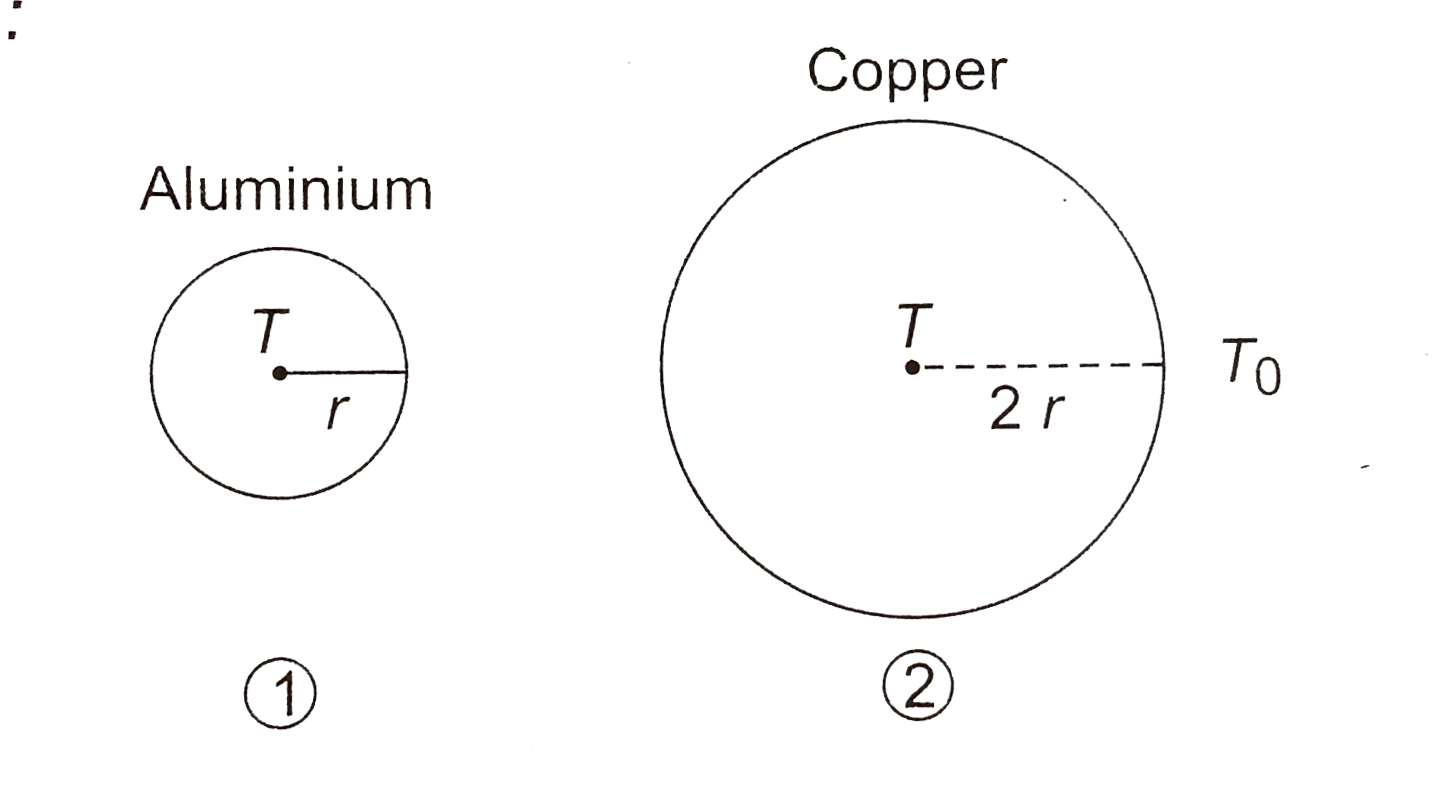 
|
|
| 17. |
(A) The sun looks reddish at the time of sunrise and sunset because of dispersion of light. ( R) The wavelength of red colour is less than the wavelength of blue colour. |
|
Answer» Both A and R are true and R is the CORRECT explanation of A |
|
| 18. |
A disc of mass 4 kg and radius 6 metre is free to rotate in horizontal plane about a vertical fixed axis passing through its centre. There is asmooth groove along the diameter of the disc and two small blocks of masses 2 kg each are placed in it on either side of the centre of the disc as shown in figure. The disc is given initial angular velocity omega_(0) =12 rad/sec and released. Find the angular speed of disc (in radian/sec) when the blocks reach the ends of the disc. |
|
Answer» |
|
| 19. |
(A): The v-t graph perpendicular to time axis is not possible in practice (R) : Infinite acceleration can be realized in practice. |
|
Answer» Both (A) and (R) are true and (R) is the CORRECT explanation of (A) |
|
| 20. |
The coefficient of friction between a car wheels and a roadway is 0.5 The least distance in which the car can accelerate from rest to a speed of 72 kmph is (g=10 ms^(-2)) |
|
Answer» 10m |
|
| 21. |
A 2kg block is connected with two springs of force constants K_(1) = 100 N/m and K_(2) = 300 N/m as show in figure. The block is released from rest with the springs unstreched. Find the acceleration of the block in its lowest position (g = 10 m//s^(2)) |
|
Answer» Solution :LET .X. be the maximum displacement of block downwards. Then from conservation of MECHANICAL enery : decrease in potential energy of 2 kg block = increase in ELASTIC potential energy of both the springs `thereforemg x =(1)/(2)(k_(1)+k_(2))x^(2)` `orx = (2mg)/(k_(1)+k_(2))=((2)(2)(10))/(100+300)=0.1m` ACCELERATION of block in this position is `a=((k_(1)+k_(2))x-mg)/(m)("upwards")` `=((400)(0.1)-(2)(10))/(2)=10m//s^(2)"upwards"` |
|
| 22. |
The strain stress curves of three wires of different material as shown in fig. A,B,C are the elastic limits of the wire. The figure show that |
|
Answer» Elasticity of wire A is maximum |
|
| 23. |
A small particle of mass m attached with a light inextensible thread of length L is moving in a vertical circle. In the given case the particle is moving in a complete vertical circle and ration of its maximum to minimum velocity is 2 : 1. Minimum velocity of the particle is |
|
Answer» `4 SQRT((gL)/(3))` |
|
| 24. |
A small particle of mass m attached with a light inextensible thread of length L is moving in a vertical circle. In the given case the particle is moving in a complete vertical circle and ration of its maximum to minimum velocity is 2 : 1. Velocity of the particle when it is moving vertically downward is |
|
Answer» `SQRT((10gL)/(3))` |
|
| 25. |
A small particle of mass m attached with a light inextensible thread of length L is moving in a vertical circle. In the given case the particle is moving in a complete vertical circle and ration of its maximum to minimum velocity is 2 : 1. The kinetic energy of the particle at the lowest position is |
|
Answer» `(4mgL)/(3)` |
|
| 26. |
Two satellite A and B are orbiting around the Earth in circular orbits of the same radius. The mass of A is 16 times that of B. What I sthe ratio of the period of revolution of B to that A ? |
|
Answer» Solution :`T = (2 PI r)/(upsilon)` and `upsilon = sqrt(Gm//r)`, where `M` is the mass of the Earth. It means `T` is independent of mass of the satellite but depends upon the RADIUS of the ORBITAL PATH. So `T_(B)//T_(A) = 1: 1` |
|
| 27. |
Calculate the kinetic energy per molecule and also rms velocity of a gas at 127^@C . Given k_B = 1.38 xx10^(-23) J "molecule"^(-1) K^(-1)and mass per molecule of the gas =6.4xx10^(-27) kg . |
|
Answer» SOLUTION :Here, T = 127 + 23 = 400 K, `m =6.4 xx10^(-27) KG` (i) Kinetic energy per molecule `=1/2mv_(rms)^2=3/2k_BT` `=3/2xx1.38xx10^(-23) xx400` `=8.28xx10^(-21)J` (ii) Now `1/2mv_(rms)^2=8.28xx10^(-21) J` `:.v_(rms)=SQRT(2xx8.28xx10^(-21))/m` `=sqrt((2xx8.28xx10^(-21))/(6.4xx10^(-27)))` `=1.608xx10^3 MS^(-1)` |
|
| 28. |
A wire increase by 10 ^(-6)times its original length when a stress of 10 ^(8) Nm ^(-2) is applied to it, calculate its Young's modulus. |
|
Answer» SOLUTION :`10^(14) NM ^(2)` `Y= ("STRESS")/((Delta l )/(l )) = (10 ^(8))/( 10 ^(-6)) = 10 ^(14) Nm ^(-2)` |
|
| 29. |
An object of mass 10 kg moving with a speed of 15 ms- hits the wall and comes to res within (a) 0.03 second (b) 10 second. Calculate the impulse and average force acting on the object in both the cases |
|
Answer» <P> Solution :Initial momentum of the OBJECT `P_i= 10 xx 15= 150 kg ms^(-1)`Final momentum of the object `P_f = 0` `Delta P = 150 - 0 = 150 kg MG^(-1)` (a) Impulse J= `DeltaP` = 150 N s and Average force `F_(avg) = (Delta P)/(Delta t) = (150)/(0.03) = 5000 N` (B) Impulse`J = Delta P = 150 N ` s and average force `F_(avg) = 150/10 = 15N` We see that, impulse is the same in both CASES, but the average force is different. |
|
| 30. |
Which of the following statements is correct for any thermodynamics system |
|
Answer» The internal energy CHANGE in all process |
|
| 31. |
A body of mass 100 gm is suspended from a massless spring of natural 1m. If the spring streaches through a vertical distance of 20 cm, the potential energy stored in the spring is (g= 10 ms^(-2)) |
|
Answer» `1.2 J` |
|
| 32. |
A uniform rope of length L, resting on a frictionless horizontal table is pulled at one end by a force F. What is the tension in the rope at a distance x from the end where the force is applied ? |
|
Answer» F (L - X) |
|
| 33. |
The range of distance can be measured by the direct method is…………. |
|
Answer» 102 to 10-5m` |
|
| 34. |
The time period of simple pendulum at the surface of earth is T. If it is taken to a height equal to the radius of earth. Find the period of new oscillations |
|
Answer» Solution :At a HEIGHT R new `G^(1)+(GM)/(r^(2))=(GM)/((2R)^(2))=g/4:.Tprop1/(SQRT(g))` `(T^(1))/(T_(0))=sqrt(g/(g_(1)))=sqrt(g/(g/4))=2` (or) `T^(1)=2T_(0)` |
|
| 35. |
The second law of thermodynamics. |
|
Answer» GIVES the definition of temperature |
|
| 36. |
A physical relation is epsilon=epsilon_(0)epsilon_(r) where epsilon= electric permittivity of a medium epsilon_(0)= electric permittivity of vacuum epsilon_(r)= relative permittivity of medium What are dimensions of relative permittivity? |
|
Answer» `[ML^(2)T^(-2)]` RELATIVE permittivity is the RATIO of `epsilon` and `epsilon_(0)` hence it is dimensionsless . i.e. `[M^(0)L^(0)T^(0)]` |
|
| 37. |
We open a file keeping one flap on a table. Each flap is square, of mass m and dimension (30 xx 30) cm^(2). Assume that the file does not slip on thetable - |
|
Answer» The maximum height attained by the centre of mass of the COMPLETE file is `7.5 cm` |
|
| 38. |
To measure the atmospheric pressure, four different tubes of length 1m, 2m , 3m and 4m are used. If the height of the mercury column in the tubes is h_(1),h_(2),h_(3),h_(4) respectively in the four cases, then h_(1):h_(2):h_(3):h_(4) |
|
Answer» 1:2:3:4 |
|
| 39. |
Use the result of the above problem to show thata light ray reflected from three mutually perpendicular plane mirrors in succession reverses its direction. |
|
Answer» |
|
| 40. |
What are the essential requirements for the choice of standerd unit ? Who decides the units ? |
| Answer» SOLUTION :1 (B) 7 | |
| 41. |
What is the difference between an echo and a reverberation? |
| Answer» SOLUTION :An ECHO is produced when SOUND reflection from a DISTANT obstacle comes back after an interval 1/10 second or more. in an echo, the origintal and reflected sounds are heard separtely | |
| 42. |
The first law of thermodynamics is a statement of |
|
Answer» CONSERVATION of HEAT |
|
| 43. |
When a bouler of mass 240kg is placed on a floating iceberg, it is found that the iceberg just sinks. What is the mass of iceberg? (Given R.D. of ice=0.90 and density of sea water=1.02). |
|
Answer» Solution :MASS of bouler =240kg Let the mass of iceberg =M `rho_("ice")=90kgm^(-3)""rhg_(w)=1020kgm^(-3)` APPLYING (240+M)g= `vrho_(p_(w))g.` we get `240+M=(M)/(rho)S_(w) 240=M((rho_(w))/(rho)-1)` hence `M=(240)/((rho_(w))/(rho)-1) =(240)/((1020)/(900)-1)=(240 xx 45)/(rho)` M=1800kg |
|
| 44. |
Two identical bodies A and B moving with velocities 13 m/s and - 15 m/s respectively collide head-on elastically. What will be their velocities after collision? |
|
Answer» SOLUTION :When masses are equal, velocities are just interchanged after an elastic head-on COLLISION. `:.` After collision, velocity of` A = - 15 m//s` velocity of `B = 13 m//s ` |
|
| 45. |
Three solid spheres each of mass 1 kg and radius 2m are arranged at the three corners of an equilateral triangle of side 10m, such that centres of the spheres coincide with the corners of the triangle. When they are release form that position, the speed of any one sphere at the time of collision would be (G is universal gravitation). |
|
Answer» `sqrt((3G)/10)` |
|
| 46. |
A satellite can be in a geostationary orbit around earth at a distance r from the centrer. If the angular velocity of earth about its axis doubles, a satellite can now be in a geostationary orbit around if its distance from the centre is |
|
Answer» `(R )/(2)` `omega^(2)=(GM)/(r^(3))` so `omega_(1)^(2)r_(1)^(3)=omega_(2)^(2)r_(2)^(3)` `r_(2)^(3)=r_(1)^(3)((omega_(1))/(omega_(2)))^(2) rArr r_(2)^(3)=(r_(1)^(3))/(4) rArr r_(2)=(r_(1))/(4^(1//3))` |
|
| 47. |
Explain the freely falling apple on Earth using the concept of gravitational potential V(r)? |
|
Answer» Solution :The gravitational POTENTIAL V (R) at a point of HEIGHT h from the SURFACE of the Earth is given by, `V(r = R + h) = (GM_E)/((R + h))` The gravitational potential V(r) on the surface of Earth is given by `V(r = R) = ( GM_E)/R` Thus we SEE that `V (r = R) < V(r = R + h)` |
|
| 48. |
Torque due to a force is the product of………….and……………..of line of action…………. . |
| Answer» Solution :FORCE , PERPENDICULAR distance , of force from the AXIS of ROTATION. | |
| 49. |
A boat going down stream crosses a float at a point A. 't_1'minutes later the boat reverses its direction and in the next 't_2'minutes it crosses the float at a distance L from the point A. The velocity of the river is |
|
Answer» `2L//t_1` |
|
| 50. |
The centre of gravity of a body on the earth coinides with its centre of mass for a 'small' object whereas for an 'extended' object it may not. What is the qualitative meaning of 'small' and 'extended' in this regard ? For which of the following the two coincide ? A building a pond, a lake, a mountain ? |
|
Answer» Solution :When VERTICAL height of an object is very small compared to the radius of EARTH, the object is said to be small. Otherwise, the object is said to be extended. A BUILDING and a pond are treated as small objects. In their cases, the centre of GRAVITY coincides with the centre of mass. A DEEP lake and a mountain are taken as extended objects. In their cases, the centre of gravity may not coinide with the centre of mass. |
|