

Saved Bookmarks
This section includes 7 InterviewSolutions, each offering curated multiple-choice questions to sharpen your Current Affairs knowledge and support exam preparation. Choose a topic below to get started.
| 1. |
If the frequency of a rotating platform is v and the distance of a boy from the centre is r, what is the area swept out per second by the line connecting the boy to the centre? |
|
Answer» `pi r upsilon` |
|
| 2. |
Two perfectly elastic spheres of masses 4kg and 6kg moving in opposite directions with velocities of 4m/s and 6m/s collide with each other. Their velocities after head on collision are |
|
Answer» `0.4 m//s and -3.6m//s` |
|
| 3. |
Use the assumptions of the previous question. An object weighed by a spring balance at the equator gives the same reading as a reading taken at a depth d below the earth.s surface at a pole (d |
|
Answer» `(omega^(2)R^(2))/g` |
|
| 4. |
The refractive index of the material of a prism is sqrt2 and the angle of the prism is 30^@. One of the two refracting surfaces of the prism is made a mirror inwards, by silver coating. A beam of monochromatic light entering the prism from the other face will retrace its path (after reflection from the silvered surface ) if its angle of incidence on the prism is |
| Answer» ANSWER :B | |
| 5. |
A particle is subjected to two S H Ms x_(1)=A_(1) sin wtand x_(2)=A_(2)sin (wt+pi//4). The resultant SHM will have an amplitude of |
|
Answer» `(A_(1)+A_(2))/2` |
|
| 6. |
Three rods of same length and area of cross-section but of thermal conductivities K, 2K and 3K are connected in series in the same order. Free end of the first rod is at 0^(@)C and free end of third rod is at 55^(@)C. In steady state, temperature difference across the middle rod is |
|
Answer» `15^(@) C` |
|
| 7. |
A cylist on a level road takes a sharp circular turn of radius 3m ( g = 10 mcdot s^(-2) ). If the coefficient of static friction between the cycle tyre and the road is 0.2, at which of the following speeds will the cyclist not skid while taking the turn? |
|
Answer» `14.4 " ""km"CDOT h^(-1)` `v_(m) = sqrt(mu r g ) = sqrt( 0.2 xx 3 xx 10) = 2.45` m/s ` = (2.45 xx 60 xx 60 )/(1000)` km/h = 8.82 km.`h^(-1)` Among the GIVEN options 7.2 km`cdot h^(-1)` is less than this. The option B is correct. |
|
| 8. |
Two particles which are initially at rest , move towards each other under the action of their internal attraction . If their speeds are v and 2v at any instant , then the speed of centre of mass of the system will be |
|
Answer» 2 V |
|
| 9. |
A massless platform is kept on a light elastic spring, as shown in the figure. When particle of mass 0.1 kg is dropped on the pan from a height of 0.24 m, the particle strikes the pan, and the spring is compressed by 0.01 m. From what height should the particle be dropped to cause a compression of 0.04 m? |
|
Answer» 0.96 m Loss in POTENTIAL energy of the particle = gain in elastic energy of the spring `:. mg (h + y) = 1/2 ky^2` Now, as the particle and spring remain same, hence, `(h_1 + y_1)/(h_2 + y_2) = ((y_1)/(y_2))^(2) implies ((0.24 + 0.01)/(h_2 + 0.04)) = ((0.01)/(0.04))^(2)` Solving we get, `h_2 = 3.96 m`. |
|
| 10. |
A body of mass 25 kg is at rest on a horizontal surface. Minimum horizontal force required to just start motion is 73.5N and a force of 49N is needed to keep the body movingwith a constant velocity. What is the coefficient of (i) static friction and (ii) kinetic friction ? |
|
Answer» Solution :`m=25kg` Coefficient of static FRICTION `=mu_(s)=("Limiting friction")/(mg)=(7.5)/(25xx9.8)=0.3` Coefficient of kinetic friction `=mu_(K)=(49)/(25xx9.8)=0.2` |
|
| 11. |
Two capillary tubes of radiir and 4r and lengths l, 3l are fitted horizontally to the bottom of the vessel with pressure head p in parallel with each other. Calculate the radius of the single tube of same length l which can replace the two capillaries such that rate of flow is not affected. |
|
Answer» SOLUTION :r = RADIUS of each capillary `V_1V_2` = rate of flow of liquids through two capillaries `l_1l_2` = lengths of capillaries Total rate of flow of liquid `V=V_1 + V_2` l= LENGTH of a single tube which can replace the two capillaries. `V=(pi pr^(4))/(8 ETAL) .........(ii)` Using (i) and (ii) `(pi pr^(4))/(8 etal)=(pi pr^(4))/(8 eta) [1/l_(1)+1/l_(2)]` `1/l=1/l_(1)+1/l_(2)` `l=(l_(1) l_(2))/(l_(1)+l_(2))` |
|
| 12. |
vA train runs along an unbanked circular track of radius 30 m at a speed of 54 km/h. The mass of the train is 10^6kg.What provides the centripetal force required for this purpose — The engine or the rails ?What is the angle of banking required to prevent wearing out of the rail ? |
|
Answer» SOLUTION :The centripetal force is provided by the lateral thrust by the rail on the FLANGES of the wheels.By the Third LAW, the train exerts an equal and opposite thrust on the rail causing its wear and tear. Angle of banking ` = tan^(-1)( (v^2)/(R g)) = tan^(-1) ( (15 XX 15)/(30 xx 10)) = 37^@` |
|
| 13. |
A projectile aimed at a mark which is in the horizontal plane through the point of projection falls a cm short of it when theh elevation is alpha and goes b cm far when the elevation is beta. Show thatif the speed of projection is same in all the cases the proper elevation is |
|
Answer» |
|
| 14. |
A ball is thrown straigt upward with a speed v from a point h meter above the ground. The time taken for the ball to strike the ground is |
|
Answer» `(v)/(G)[1+sqrt(1+(2hg)/(v^(2)))]` |
|
| 15. |
Which matters should take in mind for calculation of torque and which are not? |
|
Answer» Solution :The role of moment of INERTIA and torque in the rotational motion of rigid body is SIMILAR to the role of MASS and force in translational motion. In rotational motion of rigid body only components of torque parallel to fixed axis should be taken in mind because these components are responsible for ROTATION of the body relative to axis. Component of torque perpendicular to the axis of rotation, rotates the axis from its position. For cancelling the EFFECT of perpendicular components of torque necessary torque will be created and hence axis becomes steady. So the perpendicular components of torque should not be considered in mind. In short, for the calculation of torque following matters should not keep in mind. (1) We need to consider only those forces that lie in planes perpendicular to the axis. (2) We need to consider only those components of the position vectors which are perpendicular to the axis. |
|
| 16. |
A 16cm^(3) of water flows per second through a capillary tube of radius r cm and of length 1 cm, when connected to pressure head of h cm of water. If a tube of the same length and radius r//2 is connected to the same pressure head, find the mass of water flowing per minute through the tube. |
|
Answer» <P> SOLUTION :`V_(1)=(piP_(1)r_(1)^(4))/(8 eta l_(1))` and `V_(2)=(piP_(2)r_(2)^(4))/(8 eta l_(2))``(V_(2))/(V_(1))=(P_(2))/(P_(1))xx(r_(2)^(4))/(r_(1)^(4))xx(l_(1))/(l_(2))=((r//2)^(4))/(r^(4))=l/l=(1/2)^(4)=1/16` `V_(2)=16/16=1cm^(3)//s` VOLUME of water flow per minute `=1xx60=60cm^(3)` /min `:.` Mass of water FLOWING per minute `=60xx1=60` gram /min |
|
| 17. |
A gun fires two bullets with same velocity at 60^(@) and 30^(@) with horizontal. The bullets strike at the same horizontal distance. The ratio of maximum height for the two bullets is in the ratio of |
|
Answer» SOLUTION :Max height attained `h_(max)=(u^(2)sin^(2)theta)/(2g)` `:.h_(max)propsin^(2)theta` i.e., `h_(max)PROP(1-cos2theta)/(2)` `(h_(max1))/(h_(max2))=(3//2)/(1//2)=3` |
|
| 18. |
Assertion(A+B).(A-B) is always positve. Reasonthis is positive If |A|gt|B| |
|
Answer» If both ASSETION and Reason are correct but Reason is the correct explanation of Assertion. |
|
| 19. |
When m gm of water at 10^@Cis mixed with m gm of ice at 0^@C, which of the following statementsare false ? |
|
Answer» The tem |
|
| 20. |
The work done by Sun on Earth in one year will be: |
|
Answer» ZERO |
|
| 21. |
A needle of 12 cm length is on the surface of water. The extra force required, over its weight, to take it out form the surface of water is (surface tension = 72 dyne cm^(-1)) |
|
Answer» 72 N |
|
| 22. |
A wooden box having dimensions 80 cm x 60 cm x 30 cm and thickness 3 cm contains ice. What will be the rate of melting of ice if external temperature is 30^@Cand coefficient of thermal conductivity is 0.176 Wm^(-1) K^(-1)and latent heat of ice = 80 cal/g. |
|
Answer» Solution :`DELTA x = 3 cm = 3 xx 10^(-2) m` Area ` = 2[ (80 xx 60) + 60 xx 30) + (30 xx 80) ] cm^2` ` = 2(4800 + 1800 + 2400) cm^2 = 1.8m^2` `Delta T = 30^@C` ` K = 0.176 Wm^(-1) K^(-1)` ` = 0.04 cal m^(-1) K^(-1)` m = mass of ice MELTED `(dQ)/(dt) = mL = KA (Delta T)/(Delta x)` ` RARR m = (KA Delta T)/(Delta x L) = (0.04 xx 1.8 xx 30)/(3 xx 10^(-2) xx 80) = 0.9 g ` |
|
| 23. |
Defineone mole. |
| Answer» Solution :One mole is the amount of substance that CONTAINS as MANY ELEMENTARY ENTITIES as there are atoms in 0.012 kg of pure carbon-12. | |
| 24. |
Calculate the work done if one mole of an ideal gas is compressed isothermally at a temperature 27^(@)C from volume of 5 litres to 1 litre. Given R = 8.31 Jmole ^(-1) K^(-1). |
|
Answer» |
|
| 25. |
The set of quantities which can form a group of fundamental quantities in any system of measurement is |
|
Answer» VELOCITY, ACCELERATION and Force |
|
| 26. |
A stone is dropped from the top of a tower of height h=60m. Simultaneously another stone is projected vertically upwards from the foot of the tower. They meet at a height (2h)/(3) from the ground level. The initial velocity of the stone projected upwards is (g=10ms^(-2)) |
|
Answer» `20MS^(-1)` |
|
| 27. |
Explain angular velocity and angular acceleration about fixed axis and derive the equation of rotational motion and write the analogy between the equations of linear motion and rotational motion. |
|
Answer» Solution :As shown in the FIGURE a RIGID body rotating about fixed Z-axis in XYZ cartesion co-ordinate system. Any particle P of the body circulating in XY-plane. The angular position of this particle P at `t=0` time is `theta_(0)` and `t=t` time it is `theta_(0)+theta` `therefore` In time t its angular displacement is `theta`. Now select X. and Y. parallel to X and Y. Z-axis is already fixed. Intrateneous angular velocity `omega` = time RATE of change of angular displacement `therefore omega=(d theta)/(dt)`, is in the direction of fixed Z-axis so it can be taken as scaler. Angular acceleration `alpha` = time rate of change of angular velocity. `alpha=(domega)/(dt)`, is in the direction of fixed axis so it can be also taken as scalar. EQUATIONS of pure linear motion `v=v_(0)+at` `x=x_(0)+v_(0)t+(1)/(2)at^(2)` `v^(2)=v_(0)^(2)+2a(x-x_(0))` where `x_(0)` = initial position x = final position `v_(0)` = initial velocity v = final velocity a = acceleration, t = time Equation of pure rotational motion `omega=omega_(0)+at` `theta=theta_(0)+omega_(0)t+(1)/(2)alphat^(2)` `omega^(2)=omega_(0)^(2)+2alpha(theta-theta_(0))` where `theta_(0)` = Initial angular position `theta` = Final angular position `omega_(0)` =Initial angular velocity `omega` = Final angular velocity `alpha` = Angular acceleration t = time |
|
| 28. |
the two block shown here rest on a frictionless surface. If they are pulled apart by a small distance and released at t=0, the time when 1kg block comes to rest can be- |
|
Answer» `(2pi)/(3)sec`. |
|
| 29. |
At a depth of 1000 m in an ocean (a) What is theabsolute pressure ? (b)What is the gauge pressure ? © Find the force acting on the window of area 20cmxx20cm of a submarine at this depth the interior of which is maintained at sea level atmospheric pressure. (the density of sea water =1.03xx10^(3)xx10^(3)kgm^(-3),g=10ms^(-2)) |
|
Answer» Solution :Depth in sea water H = 1000 m Density of sea water `rho=1.03xx10^(3)xx10^(3)kgm^(-3)` Acceleration of gravity `g=10ms^(-2)` ATMOSPHERIC pressure at sea water SURFACE, `P_(a)=1.01xx10^(5)Nm^(-2)` (a) Absolute pressure at h depth, `P=P_(a)+hrhog` `=1.01xx10^(5)+1000xx1.03xx10^(3)xx10` `1.01xx10^(5)+103xx10^(5)` `=104.01xx10^(5)Pa` `=104atm[because10^(5)Pa=1atm]` (b)GAUGE pressure `P-P_(a)=hrhog=P_(g)` `therefore P-P_(a)=1000xx1.03xx10^(3)xx10` `P_(g)=103xx10^(5)Pa` where gauge pressure `P_(g)=P-P_(a)` `=103 atm` The pressure outside the submarine is `P=P_(a)+hrhog` and the pressure inside it is `P_(a)` Therefore The NET pressure acting on the window is gauge pressure `P_(g)=rhogh` The area of the windown `A=20cmxx20cm` `=400cm^(2)` `=400xx10^(-4)m^(2)` `therefore` The force acting on Windown, `F=P_(g)A` `=103xx10^(5)xx400xx10^(-4)` `=41200xx10` `thereforeF=4.12xx10^(5)N` |
|
| 30. |
A horizontal disc rotates freely with angular velocity 'omega' about a vertical axis through its centre. A ring, having the same mass and radius as the disc, is gently placed on the dics. The common angular velocity with which the two ratatewill be, |
|
Answer» `OMEGA` |
|
| 31. |
If a circular piece of tin has a measured radius of 2.6cm, then what is its circumference? |
|
Answer» Solution :r= 2.6cm Circumference of circular disc= `2pi r` `=2 xx 3.1428 xx 2.6` Here 2.6 has only 2 significant DIGITS. HENCE in the above MULTIPLICATION `pi` value should be written with `2 + 1= 3` significant figures. `pi= 3.1428= 3.14` Circumference `=2 xx 3.14 xx 2.6` = 16.328 This is to be rounded off to 2 significant digits. Circumference is 16cm. |
|
| 32. |
The gravitational field due to a mass distributionis E= (A)/(x^2) in x-direction. Here A is a constant. Taking the gravitational potential to be zero at infinity, potential at x is |
|
Answer» `(2A)/(X)` |
|
| 33. |
What is force of buoyancy? |
| Answer» SOLUTION :The normal force EXERTED due to the LIQUID DENSITY. | |
| 34. |
A monoatomic gas undergoes a process given by 2dU + 3d W = 0, then what is the process |
|
Answer» Solution :`dQ = dU + dW` `RARR dQ = dU - (2dU)/(3) =(dU)/(3) = (1)/(3) nC_(v)dT` `=(1)/(3)n.(3)/(2)RdT=(nRdT)/(2) rArr C=(1)/(n)(dQ)/(dT)=(R )/(2)` It is not ISOBARIC as C is not equal to `(5R)/(2)` It is not adiabatic as `c ne 0` It is not isothermal as `c ne oo` so itis an polytropic process. |
|
| 35. |
Explain the reason of separation of cream from milk. |
| Answer» Solution :CREAM will REMAIN near the AXIS of rotation. | |
| 36. |
Which of the following remains constant incase of vibration of the particles in a stationary wave ? |
|
Answer» velocity |
|
| 37. |
The internal energy U is a unique function ofany thermal state, because change in U |
|
Answer» Does not DEPEND upon path |
|
| 38. |
A false balance is such that the beam remains horizontal when pans are empty. An object weighs W_(1) when placed in one pan and W_(2) when placed in the other pan. The true weight of the object is |
|
Answer» `(W_(1)+W_(2))/(2)` |
|
| 39. |
The dimensional formula for latent heat is |
|
Answer» `MLT^(-2)` |
|
| 40. |
A swimmer crosses a flowing stream of width .d.to and fro in time t_(1). The time taken to cover the same distance up and down the stream is t_(2). If t_(3) is is the time the swimmer would take to swim a distance 2d in still water, then |
|
Answer» SOLUTION :Let v be the river velocity and u the velocity of SWIMMER in still water. Then `t_(1) = 2((d)/(sqrt(u^(2) - v^(2))))` …..(i) `t_(2) = (d)/(u + v) + (d)/(u-v) = (2ud)/(u^(2) - v^(2))` ….(ii) and `t_(3) = (2d)/(u)` ….(iii) from equations (i), (ii) and (iii) `t_(1)^(2) = t_(2)t_(3) rArr t_(1) = sqrt(t_(2)t_(3))` |
|
| 41. |
For a string, tied with two fixed rigid supports, scparated by 75 cm has two consecutive harmonics at 315 Hz and 420 Hz. Find its minimum frequency. |
|
Answer» Solution :Two consecutive HARMONICS, `f _(N) = n f _(1)` `f _(n +1) =(n +1) f _(1)` `therefore f_( n+1) - f _(n) = f _(1)` `therefore f _(1) = 420 - 315 = 105 Hz` `therefore f _(min) = f _(1) = 105 Hz` |
|
| 42. |
A uniform rod of weight F_(g) and length L is supported at its ends by a frictionless through as shown in figure. (a) Show that the centre of gravity of the rod must be vertically over point O when the rod is in equilibrium. (b) Determine the equilibrium value of the angle theta. |
Answer» Solution :a. Just THREE FORCES act on the rod forces perpendicular to the SIDES of the through at `A` and `B`, and its weight. The lines of action of `A` and `B` will intersect at a point above the rod. They will have no torque about this point. The rod's weight will CAUSE a torque about the point of intersection as in figure a. and the rod will not be equlibrium unles the centre of the rod lies vertically below the intersection point as is shown in figure b. 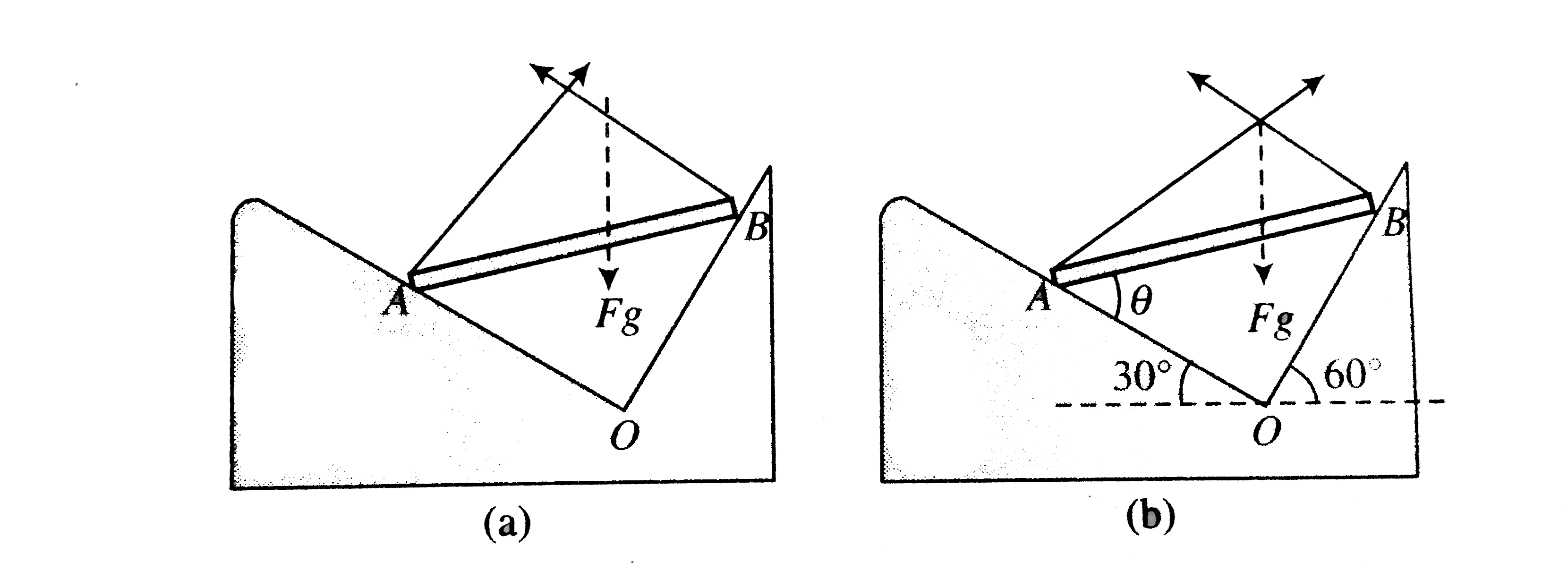 All three forces must be concurrent. Then the line of action of the weight is a diagonal of the rectangle formed by the through and the NORMAL forces, and the rod's centre of gravity is vertically above the bottom of the trough. b. In figure b, `vecAOcos30^@=vecBOcos60.0^@` `L^(2)=|vecAO|^(2)+|vecBO|^(2)+|vecAO^(2)((cos^(2)30^@)/(cos^(2)60^@))` `vecAO=L/(sqrt(1+(cos^(2)30^@)/(cos^(2)60^@)))=L/2` so `costheta=(|vecAO|)/L=1/2` and `theta=60^@` |
|
| 43. |
A person in lift which ascents up with acceleration 10ms^(-2)drops a stone from a height 10m. The time of decent is ___ [g=10 ms^(-2)] |
|
Answer» 1s |
|
| 44. |
In an elastic collision of two billiard balls,which of the the following quantities remain conserved during the short time of collision of the balls ? (i.e. when they are in contact) (a) Kinetic energy. (b) Total linear momentum. Give reason for your answer in each case. |
| Answer» Solution :There may be increase in PE while balls are in contact, this decreases KE. HENCE, KE is not conserved. Here, resultant external force is zero, hence the TOTAL linear MOMENTUM is conserved. | |
| 45. |
The water equivalent of a copper calorimeter is 4.5 g If the specific heat of copper is 0.09 "cal g"^(-1) C^(-1) ,then |
|
Answer» mass of the CALORIMETERIS 0.5 kg |
|
| 46. |
Which of the following graph represents the motion of a satellite revolving about a planet (T is period of revolution and R is radius of orbit) |
|
Answer»
|
|
| 47. |
A glass slab of thickness 8cm contains the same number of waves as 10cms long path of water when both are transversed by the same monochromatic light. IF the refractive index of water is 4//3 the refractive index of glass is |
|
Answer» `5/3` |
|
| 48. |
Of steam and boiling water whieh causes more burns"? |
|
Answer» |
|
| 49. |
If temperature rises, the coefficient of viscosity of a liquid ……….. . |
|
Answer» DECREASES |
|
| 50. |
(A): Banking of roads reduces wear and tear of the tyres. (R) : Dependence on friction to provide centripetal force increases with banking of a road. |
|
Answer» Both .A. and .R. are true and .R. is the CORRECT EXPLANATION of .A. |
|


