

Saved Bookmarks
| 1. |
A uniform rod of weight F_(g) and length L is supported at its ends by a frictionless through as shown in figure. (a) Show that the centre of gravity of the rod must be vertically over point O when the rod is in equilibrium. (b) Determine the equilibrium value of the angle theta. |
Answer» Solution :a. Just THREE FORCES act on the rod forces perpendicular to the SIDES of the through at `A` and `B`, and its weight. The lines of action of `A` and `B` will intersect at a point above the rod. They will have no torque about this point. The rod's weight will CAUSE a torque about the point of intersection as in figure a. and the rod will not be equlibrium unles the centre of the rod lies vertically below the intersection point as is shown in figure b. 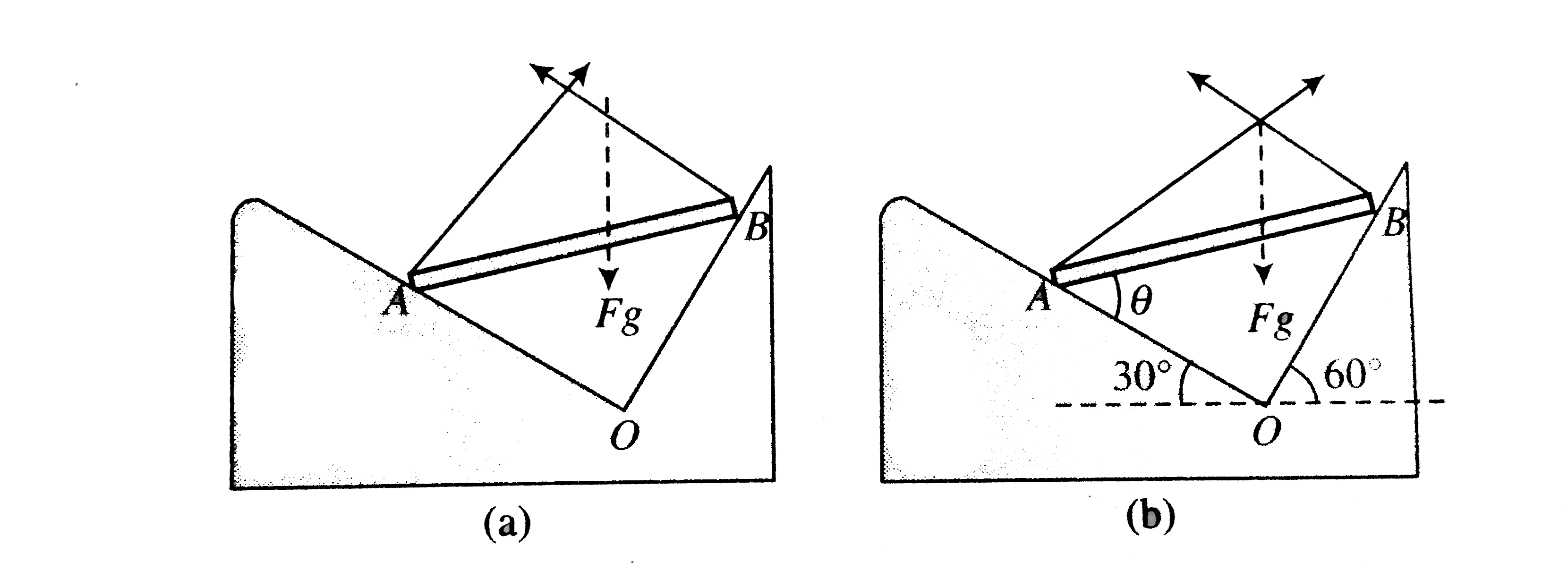 All three forces must be concurrent. Then the line of action of the weight is a diagonal of the rectangle formed by the through and the NORMAL forces, and the rod's centre of gravity is vertically above the bottom of the trough. b. In figure b, `vecAOcos30^@=vecBOcos60.0^@` `L^(2)=|vecAO|^(2)+|vecBO|^(2)+|vecAO^(2)((cos^(2)30^@)/(cos^(2)60^@))` `vecAO=L/(sqrt(1+(cos^(2)30^@)/(cos^(2)60^@)))=L/2` so `costheta=(|vecAO|)/L=1/2` and `theta=60^@` |
|