

Saved Bookmarks
This section includes 7 InterviewSolutions, each offering curated multiple-choice questions to sharpen your Current Affairs knowledge and support exam preparation. Choose a topic below to get started.
| 1. |
Three particles A,B,C of mass m each are joined to each other by massless rigid rods to form an equilateral triangle of side a. Another particle of mass m hits B with a velocity v_(0) directed along BC as shown. The colliding particle stops immediately after impact. (i) Calculate the time required by the triangle ABC to complete half-revolution in its subsequent motion. (ii) What is the net displacement of point B during this interval ? |
Answer» 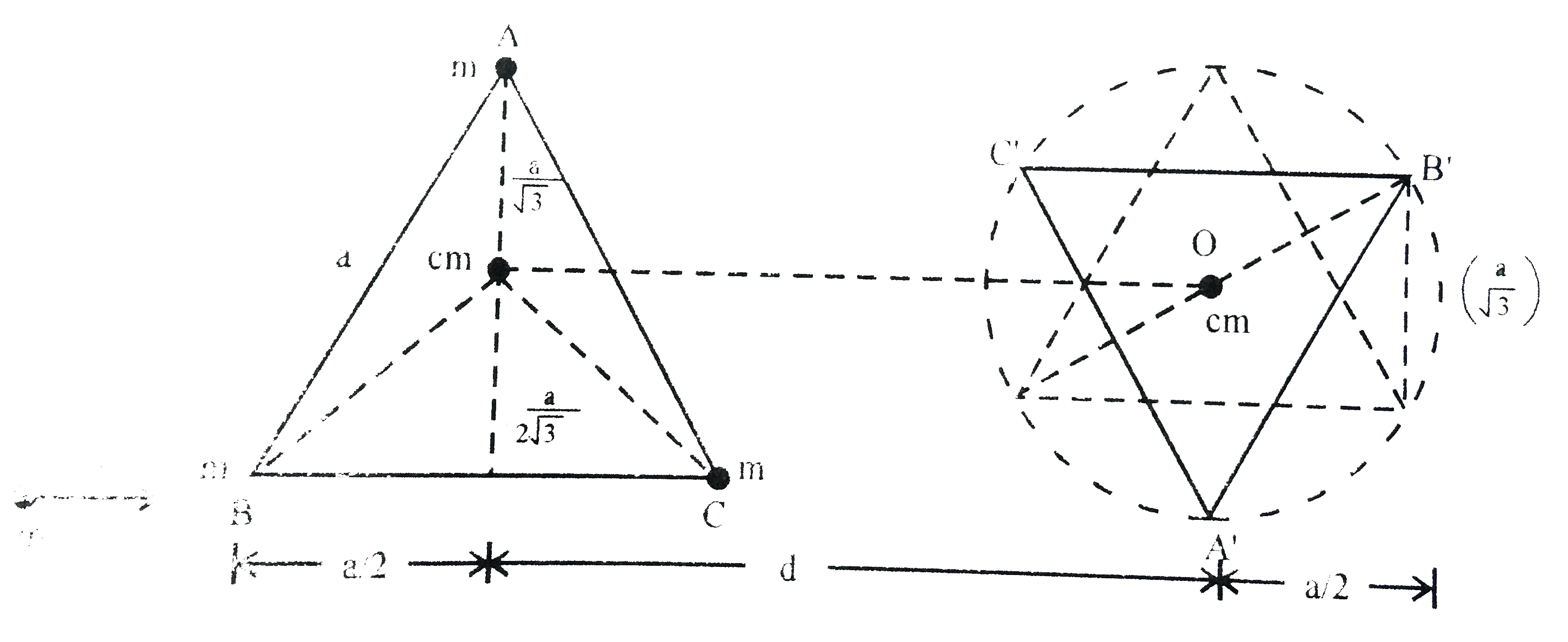 Structure will have translational motion of `C.M` and rotational motion about `C.M` From conservation of linear momentum `mv_(0) = 3 mv_(CM)` `v_(CM) = (v_(0))/(3)` Impulse received by particle is `mv_(0)`. Same and opposite impulse will be received by structure so angular impulse `= I omega` `mv_(0) xx (a)/(2 sqrt(3)) = 3m ((a)/(sqrt(3)))^(2) xx omega` `omega = (v_(0))/(2 sqrt(3) a)` (i) time taken to complete half REVOLUTION `= (PI)/(omega)` `t = (pi)/((v_(0)//2 sqrt(3a))) rArr t = (2 sqrt(3) pi a)/(v_(0)) rArr t = (6 pi a)/(sqrt(3) v_(0))` (ii) linear displacement =`sqrt((d+a)^(2) + ((a)/(sqrt(3)))^(2)) = sqrt((v_(CM) t + a)^(2) + ((a)/(sqrt(3)))^(2))` =`sqrt((v_(0)/(3) xx (6 PIA)/(sqrt(3) v_(0)) +a)^(2) + ((a)/(sqrt(3)))^(2)) =sqrt((a^(2))/(3) (2 pi + sqrt(3))^(2) + (a^(2))/(3)) = (a)/(sqrt(3)) sqrt((2 pi + sqrt(3))^(2) + 1)`. |
|
| 2. |
A woman throws an object of mass 500g with a speed of 25 ms^(-1) . (a) What is the impulse imparted to the object? (b) If the object hits a wall and rebounds with half the original speed what is the change in momentum of the object ? |
|
Answer» SOLUTION :Here, ` m = 500 g = (1)/(2) KG , u = 25 ms^(-1) ` (a) Impulse IMPARTED = change in momentum = initial momentum given ` m u = (1)/(2) xx25 = 12.5 Ns ` (b) On rebounding force the wall ` UPSILON = -(1)/(2) xx 25 = - 12.5 m//s ` Change in momentum ` = m (upsilon- u ) = (1)/(2) (-12.5- 25) = - 18.75 kg ms^(-1)` . |
|
| 3. |
Fraunhoffer lines in solar spectrum can be cited as an example of |
|
Answer» Stefan's LAW |
|
| 4. |
The escape velocity of a body depends upon its mass .m. as |
|
Answer» `m^@` |
|
| 5. |
The amplitude of a damped oscillation reduces to one third of its original value a_(0) in 20s. The amplitude of such oscillation after a period of 40s will be…………….. |
|
Answer» `a_(0)//9` |
|
| 6. |
A Carnot's cycle operating between T_(1) = 600 K and T_(2) = 300 K producing 1.5 kJ of mechanical work per cycle. The heat transferred to the engine by the reservoirs is |
|
Answer» 2.5 kJ |
|
| 7. |
The moment of inertia of an uniform circular disc about its central axis is I.. Its M.I about a tangent in its plane is equal to |
|
Answer» 2I |
|
| 8. |
A wave of frequency 100 Hz s sent along a string towards a fixed unit. When this wave travels back after reflection a node is formed at a distance of 10 cm from the fixed end of the string.The speeds of incident (or reflected) waves are : |
|
Answer» `10 m//s` `(lambda)/(2)=10 CM` `:.` WAVE length `lambda=20 cm 20xx10^(-2)m` `:.` Speed of the wave `v= v lambda` `=100xx20xx10^(-2)` `=20 m//s` |
|
| 9. |
(I) Relation between rotational kinetic energy and Angular momentum is (L^(2))/(2I) (II) Rotational work done is F theta Which one is correct ? |
|
Answer» Solution :We know that, ROTATIONAL KINETIC Energy `E_(kr)=(1)/(2) I OMEGA^(2)=(1)/(2) I omega xx omega=(1)/(2). L omega=(1)/(2) (L^(2))/(I)` `E_(kr)=(L^(2))/(2I), L^(2)=2IE_(kr)` `L=sqrt(2IE_(kr))= sqrt(21). sqrt(E_(kr))` GRAPH of `sqrt(E_(kr))` and L : The shape of the graph is a straight LINE. (1) The slope of the graph gives the value of moment of inertial (1) We know that the slope gives the value of moment of Inertia. The line A has higher slope and hence more moment of Inertia.  
|
|
| 10. |
A train moving at a constant velocity of 54 km/hr moves east wards for 30 minutes, then due north with the same speed for 40 minutes. What is the average velocity of the train during this run ? (in km/hr) |
|
Answer» 30 |
|
| 11. |
Explain with the help of Bernoulli's principle that why does a spinning ball follows a curve path during flight ? |
Answer» Solution :(i) Ball moving withou spin : Streamlines for a fluid around non - spin ball In above fihure , the streamlines around a non - spinning ball moving relative to the fluid. It is clear that the velocity of fluid (air) above and below the ball at corresponding points is the same resulting in zero pressure DIFFERENCE. Air therefore , EXERTS no UPWARD or downwardforce on the ball . Ball moving with spin : As a result there isan upward force resulting in a dynamic LIFT of the wings .  In above figure a spinning ball is shown . A spinning ball drags airalong with it. If surface is rough more air drags. The crowding of streamlines ay above the ball indicates high velocity and low pressure , while the sparse streamlines below the ball indicates low velocity and high pressure. Thus difference in velocities of air results in the pressure difference between the lower and UPPER faces and there is a net upward force on the ball . This dynamic lift due to spinning is called Magnus effect. |
|
| 12. |
Two balls are projected simultaneously with the same speed from the top of a tower -one upwards and the other downwards. If they reach the ground in 6s and 2s, the height of the tower is ("g = 10 ms"^(-2)) |
|
Answer» 120m |
|
| 13. |
A book of mass m is at rest on the table (i) What are the forces acting on the book (ii) What are forces exerted by the book (iii) draw the free body diagram for the book. |
|
Answer» SOLUTION :(1) There are two forces acting on the BOOK. (i) GRAVITATIONAL force (mg) acting downwards on the book. (ii) Normal contact force (N) exerted by the surface of the table on the book. It acts upwards. (2) According to NEWTON's third law, there are two reaction forces exerted by the book. (i) The book exerts an EQUAL and opposite force (mg) on the Earth which acts upwards. (ii) The book exerts a force which is equal and opposite to normal force on the surface of the table (N) acting downwards. (3) 
|
|
| 14. |
The ratio of energy and temperature is known as ……….. |
|
Answer» Stefan's constant |
|
| 15. |
A 10 kW drillingmachinein used for 5 minutesto bore a hole in an aluminium block of mass 10xx10^(3) kg . If 40% of the work done is utilised to raise the temperature of the block, find the rise in temperature of the aluminium block? (Specific heat of Aluminium =0.9Jkg^(-1)k^(-1)) |
|
Answer» Solution :Work done by the drilling machine in 5 minutes = W W = power `xx` time `=10xx10^(3) xx 5 xx60 = 3xx10^(6)`J The energy utilised to raise the TEMPERATURE of the block `=40% ` of `W = 3 xx 10^(6) xx (40)/(100)=12xx10^(5)J` Heat gained by ALUMINIUM block = MASS `xx` specific heat `xx` increase in temperature. `12xx10^( 5) =(10 xx 10^(3) ) xx 0.9 xx Deltat` `:.Deltat=(12xx10^(5))/(0.9xx10^(4) ) =133.3^(@)C` |
|
| 16. |
To a person going east in a car at velocityof 25 kmph, a train appears to move towards north with a velocity of 25 sqrt(3) kmph. The actual velocity of train is |
|
Answer» 25 KMPH |
|
| 17. |
A lead bullet of mass 10 g travelling at 300 m//s strikes against a block of wood and comes to rest. Assuming 50% of heat is absorbed by the bullet, the increase in its temperature is (Specific heat of lead = 150 J//kg^(@)C) |
| Answer» Answer :C | |
| 18. |
Three rods of materialX andthree rodsof materail Y are connected as shown in figure. All therodsare of idental lengthand cross- sectionareas. If theend Ais maintained at 60^(@) C and the junction E at 10^(@)C , calculate the temperature of thejunction B, C and D . The thermalconductivityof X is 9.2 xx 10^(-2)kilocal/m""^(@)C s andthat of Y is 4.6 xx 10^(-2) kilocal/m""^(@)C s. |
|
Answer» SOLUTION :Let `theta_(B), theta_(C)`and `theta_(D)`be thetemperature of junctionB,C and Drespectively at staady STATE . Let `K_(x)` and `k_(y)` be thermalconductivites of rodsof materialX and Y respectively . The concept in solving the problem is that in steady state heat enteringper SECONDAT anyjunctionmust be EQUALTO thatleaving the junction.  As `K_(x) = 9.2 xx 10^(-2)` ans `K_(y) = 4.6 xx 10^(-2) kilocal m^(-1) (""^(@)C)^(-1) (sec)^(-1)` i.e..,`(K_(x))/(K_(y)) = (9.2 xx 10^(-2))/(4.6 xx 10^(-2))2 ` Let `K_(x) = 2K, K_(y) = K` (or) `(K_(y)A(60-theta_(B)))/(l) = (K_(x)A(theta_(B) - theta_(C)))/(l) + (K_(y) A(theta_(B) - theta_(C)))/(l)` (or)`K (60 - theta_(B)) = 2K(theta_(B) - theta_(C))+ K(theta_(b) - theta_(D)) therefore (60-theta_(B)) = 2(theta_(B) - theta_(C)) + theta_(B) - theta_(D)` `therefore4 theta_(B) - 2 theta_(C) - 2 theta_(D) = 60...........(1)` Forjunction `C_(1),H_(1) = H_(3) + H_(5) therefore(K_(y)A(theta_(B) - theta_(C)))/(l) = (K_(x)A(theta_(c) - 10))/(l) + (k_(y)A(theta_(D) - 10))/(l)` Thisgives `therefore theta_(B) - 3 theta_(C)+ theta_(D) = - 10..........(2)` For junction D, `H_(2) + H_(3)= H_(5)therefore(k_(y) A(theta_(B) - theta_(D)))/(l) + (k_(y)A(theta_(C) - theta_(D)))/(l) = (k_(y) A(theta_(D) - 10))/(l)` (or) ` K(theta_(B) - theta_(D)) + 2K(theta_(C) - theta_(D)) = k(theta_(D) - 10)` Thisgives `theta_(B) +2theta_(C) - 4 theta_(D)= - 10..............(3)`from (2) and (3) `THETA _(B)-3theta_(C) - theta_(D) = theta_(B) + 2 theta_(C) - 4 theta_(D)` i.e., `5theta_(C) = 5 theta_(D) "" or "" theta_(C) = theta_(D) ............(4)`Substituting this in (1) and (2), we get . ` 4 theta_(B) - 3 theta_(C) = 60.............(5) , theta_(B) - 2theta_(C) = - 10............(6)` Solving (5) and (6), we get `theta_(B) = 30^(@)C, theta_(C) = 20^(@)C` As `theta_(c) = theta_(D)"" therefore "" theta_(C) = theta_(D) = 20^(@)C` `therefore` Thus the temperatureof junction , B, Cand D are `30^(@),20^(@)C and 20^(@)C`respectively. |
|
| 19. |
What is specific heat ? Give its unit and on which factors does specific heat depends upon ? |
|
Answer» Solution :The amount of HEAT absorbed or REJECTED to CHANGE the temperature of UNIT mass of it by one unit. This QUANTITY is referred to as the specific heat capacity of the substance. If `DeltaQ` stands for the amount of heat absorbed or rejected by a substance of mass m when it undergoes a temperature change `DeltaT`, then the specific heat capacity, of that substance is given by `s=(S)/(m)=(DeltaQ)/(mDeltaT)` `:.DeltaQ="ms"DeltaT` The specific heat capacity is the property of the substance which determines the change in the temperature of the substance (undergoing no phase change) when a given quantity of heat is absorbed (or rejected) by it. It depends on the neture of the substance and its temperature. The SI unit of specific heat capacity is `"J kg"^(-1)K^(-1)` and dimensional formula is `M^(0)L^(2)T^(-2)K^(-1)`. |
|
| 20. |
A bubble of air of diameter 0.2 cm rises up uniformly in water with a velocity of 200cm//s . If the density of water is 1gcm^(-3) , find coefficient of viscosity of water. Neglect density of air w.r.t that of water.(g=9.8m//s^(2)) |
|
Answer» Solution :`r=(d)/(2)=(0.2)/(2)=0.1cm,v_(t)=-200cm//s` Bubble MOVES upward so it is taken negative `rho_(o)=1(g)/(CM^(3))` `rho=0,eta=?` `v_(t)=(2)/(9)(r^(2)g)/(eta)(rho-rho_(o))` `thereforeeta=(2)/(9)(r^(2)g)/(v_(t))(rho-rho_(0))` `thereforeeta=(2)/(9)(r^(2)g)/(v_(t))(rho-rho_(0))` `=10.9xx10^(-3)` `=0.0109` poise |
|
| 21. |
A block is placed on a rough horizontal surface. A constant force F is acting on the block as shown in the figure. Column-1 gives the magnitude of force F and column-2 gives information about friction acting on the block. Match the entries in column-1 to all possible entries in column-2. |
|
Answer» |
|
| 22. |
A car of mass m is moving on a level circular track of radius R. If mu_s represents the static friction between the road and tyres of the car, the maximum speed of the car in circular motion is given by |
|
Answer» `sqrt(mu_s Rg)` ` f lemu_s N =(mv^2)/(R ),v^2 LE(mu_sRN )/(m )` `v^2lemu_sRg"" [ :.N= MG ]` `ORV lesqrt( mu_sRg)` ` therefore` Themaximumspeedof thecar incircular MOTIONIS `v_("max") = sqrt( mu_sRg)` |
|
| 23. |
Consider P toV diagram for an ideal gas shown in figure. Out of the following diagrams which figure, represents the T toP diagram ? |
|
Answer» (IV) 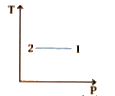 PV = constant, so PROCESS is isothermal, hence volume decreases and pressure INCREASES and when volume increases, pressure decreases and if temperature remains constant, volume increases when pressure decreases. This is CORRESPONDS to diagram (iii) option (C). |
|
| 24. |
At ...... temperature water and water vapour are equal dense. |
| Answer» SOLUTION :CRITICAL TEMPERATURE (273.16 K) | |
| 25. |
A satellite is revolving in circular orbit of radius r around the earth of mass M. Time of revolution of satellite is |
|
Answer» `Tprop(r^(5))/(GM)` `rArr T=2pisqrt((r^(3))/(GM))rArr T=prop sqrt((r^(3))/(GM))`. |
|
| 26. |
A sphere of weight W = 100 N is kept stationary on a rough inclined plane by a horizontal string AB as shown in figure. Then : |
|
Answer» tension in th STRING is 100 N |
|
| 27. |
Where will a man hear a louder sound in the case of stationary wave (node or antinode) and why? |
|
Answer» Solution :The SOUND is heard due to variation in PRESSURE `TRIANGLEP` = `-Elasticityxx Strain` At the antinodes, strain is minimum. At the nodes strain is maximum. So variation of pressure is maximum at the nodes. Hence a loud sound is heard at the NODE. |
|
| 28. |
Explain linear expansion of solid. |
|
Answer» Solution :`(i)` The INCREASE in length of a body due to the increase in its temperature is called linear expansion. `(II)` In solids, for a small change in temperature `DeltaT`, the fractional change in length is directly PROPORTIONAL to `DeltaT`.   `(DELTAL)/(L)=alpha_(L)DeltaT` `alpha_(L)=(DeltaL)/(LDeltaT)` `(iii)` Where, `alpha_(L)=` COEFFICIENT of linear expansion. `DeltaL=` Change in length `L=` Original length `DeltaL=` Change in temperature |
|
| 29. |
Two identical cylindrical containers A and B are interconnected by a tube of negligible dimensions. Container A is filled with an ice block up to height H = 1.8 m and container B is filled up to same height with water. Ice is at 0^(@)C and water is at 40^(@)C. Due to heat exchange between water and ice, the ice block begins to melt. Assume that the ice block melt in horizontal layers starting from the bottom. The thickness of ice block reduces uniformly over the entire cross section of the container. The ice block moves without friction inside the container and no water enters between the vertical wall of the container and the ice block. Heat is exchanged only between the ice block and the water and there is no heat exchange with containers or atmosphere. Calculate the height of water in container B when thermal equilibrium is attained. Relative density and specific latent heat of fusion of ice are 0.9 and 80 cal g^(-1) respectively. Specific heat capacity of water is 1 cal g^(-1) .^(@)C^(-1). |
|
Answer» |
|
| 30. |
In the figure, pulleys are smooth and strings are massless, m_(1)=1 kg and m_(2)=(1)/(3)kg. To keep m_(3) at rest, mass m_(3) should be |
|
Answer» 1 kg 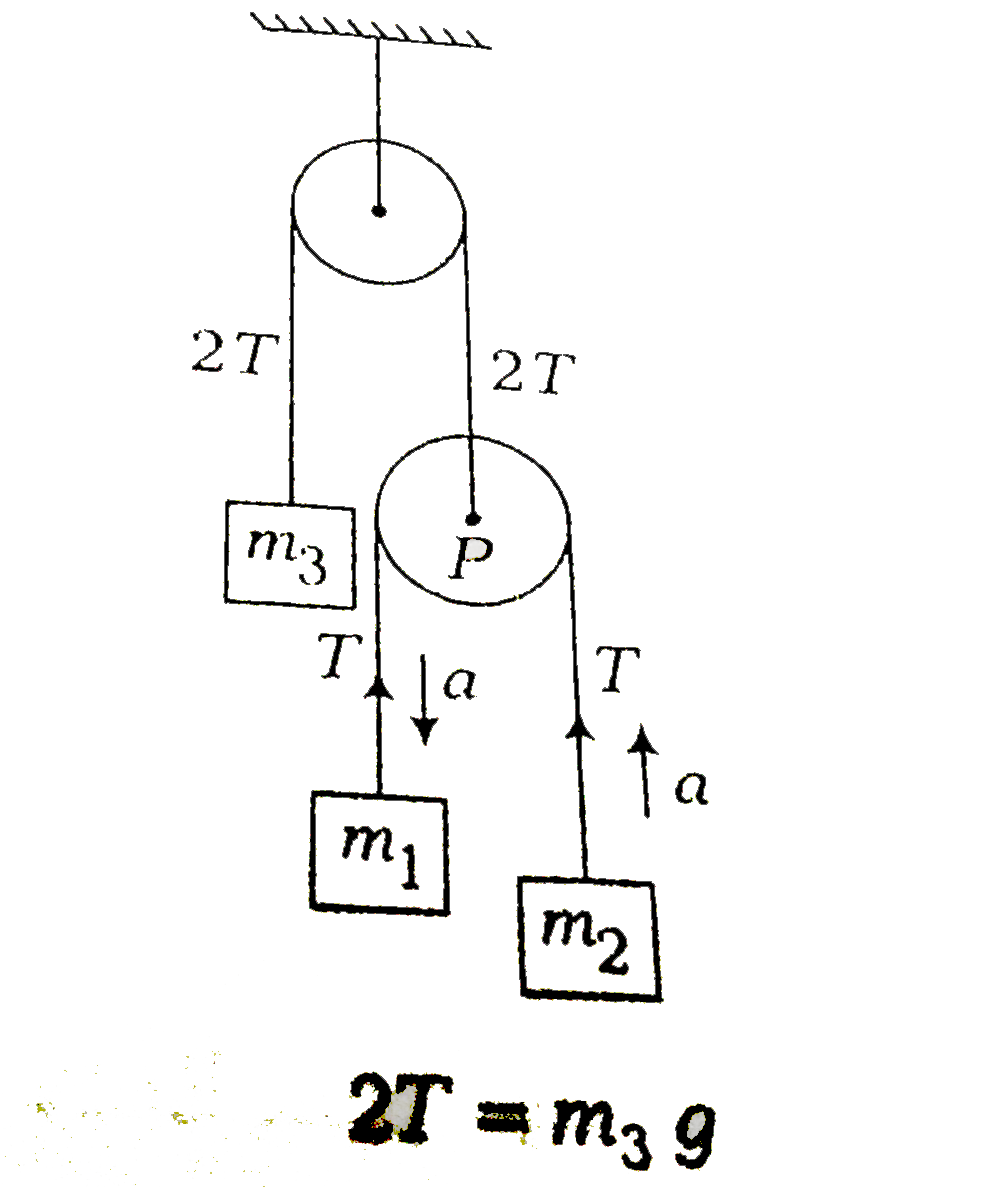 2T`=m_(3)g`….(i) Further if `m_(3)` is at rest, then pully P is also at rest. Writing equations of motion. `m_(1)g-T=m_(1)a` ….(II) `T-m_(2)g=m_(2)a` ...(iii) Solving Eq. (ii) and (iii) we GET, `m_(3)=1 kg ` |
|
| 31. |
A body falls for 5 s from rest. If the acceleration due to gravity of earth ceases to act, the distance it travels in the next 3 s is |
|
Answer» 73.5 m |
|
| 32. |
The moment of inertia of a disc is 100 g . cm^(2) . The disc rotates with an angular velocity 2 rad/s. The rotational kinetic energy of the disc is |
| Answer» Answer :B | |
| 33. |
A star can be considered as spherical ball of hot gas of radius R. Inside the star, the density of the gas is rho_(r) at radius r and mass of the gas within this region is M_(r). A star in it's prime age is said to be under quilibrium due to gravitational pull and outward radiation pressure (p). consider the shell of thikness dr as in the figure of previous question. if the pressure on this shell is dp then the correc equation is (G is universal gravitational constant) |
|
Answer» <P>`(dp)/(dr)=-(GM_(R))/(r^(2))rhor` `(P)(4pir^(2))-(p+dp)(4pir^(2))` `=(GM)/(r^(2))=sum_(1)4pi^(2)dr` `-dp=(GM_(r)rho_(r)dr)/(r^(2))` `(dp)/(dr)=-(GM_(r))/(r^(2))rho_(r)` |
|
| 34. |
Photon is quantum of radiation with energy E = hv, where v is frequency and his Planck's constant. The dimensions of h are the same as that of |
|
Answer» linear impulse `[h]=([E])/([v])=([ML^(2)T^(-2)])/([T^(-1)]=[M^(1)L^(2)T^(-1)]` For (A), DIMENSION of linear impulse = Dimension of momentum`[M^(1)L^(1)T^(-1)]` For (B) and (D), Dimensions of angular impulse = Dimension of angular momentum = `[M^(1)L^(-2)T^(-1)]` This is EQUAL to the dimension of Planck.s constant h. |
|
| 35. |
Four particles of masses m_(1) = 1 kg, m_(2) = 2 kg, m_(3) = 3 kg and m_(4) = 4 kg are located at the corners of a rectangle as shown in Fig. Locate the position of centre of mass. |
|
Answer» Solution :Here, `m_(1) = 1kg, m_(2) = 2 KG, m_(3) = 3 kg`, `m_(4) = 4kg` As is clear form Fig. `m_(1)` is taken at the origin. Therefore, `x_(1) = 0, y_(1) = 0`. For `m_(2) , x_(2) = a hati, y_(2) = 0` For `m_(3) , x_(3) = a hati , y_(3) = b HATJ` For `m_(4) , x_(4) = 0, y_(4) = b hatj` Co-ordinates of centre of mass of the SYSTEM are `X = (m_(1)x_(1) + m_(2)x_(2) + m_(3)x_(3) + m_(4)x_(4))/(m_(1) + m_(2) + m_(3) + m_(4))` `= (1 xx 0 + 2 (a hati) + 3 (a hati) + 4 xx 0)/(1 + 2+ 3+ 4) = 0.5 a hati` `y = (m_(1)y_(1) + m_(2)y_(2) + m_(3)y_(3) + m_(4)y_(4))/(m_(1) + m_(2) + m_(3) + m_(4))` `= (1 xx 0 + 2 xx 0 + 3 xx b hatj + 4 xx b hatj)/(1 + 2+ 3+ 4) = 0.7 b hatj` Position of centre of mass of the system is `[0.5 a hatj + 0.7 b hatj]` |
|
| 36. |
Assertion : Geostationary satellites appear fixed from any point on earth. Reason : The time period of geostationary satellite is |
|
Answer» If both assertion and reason are true and reason is the correct explanation of assertion |
|
| 37. |
In inelastic, which is conserved |
|
Answer» LINEAR collision |
|
| 38. |
A fully loaded Boeing aircraft has a mass of 3.3xx10^(5) kg, its total wing area is 500m^(2). It is in level flight with a speed of 960 km/h. a. Estimate the pressure difference between the lower andupper surfaces of the wings b. Estimate the fractional increases in the speed of the air upper surface of the wing relative to the lower surface. (The density of air is rho=1.2kgm^(-3)) |
|
Answer» Solution :a. The weight of the Boeing aricraft is BALANCED by the upward force DUE to the pressure difference `DeltaPxxA=3.3xx10^(5)kg xx9.8` `DeltaP=(3.3xx10^(5)kgxx9.8ms^(-2))//500m^(2)` `=6.5xx10^(3)Nm^(-2)` b. We ignore the small height difference between the TOP andbottom sides in Eq. The pressure difference between them is then `DELTA=(rho)/2(v_(2)^(2)-v_(1)^(2))` Where `v_(2)` is the speed of air over the upper surface and `v_(1)` is the speed under the bottom surface. `(v_(2)-v_(1s))=(2Deltarho)/(rho(v_(2)-v_(1))` Taking the average speed `v_(av)=(v_(2)+v_(1))//2=960km//h=267ms^(-1)`, we have `(v_(2)-v_(1s))//v_(av)=(DeltaP)/(rho v_(av)^(2))~~0.08` The speed above the wing needs to be only 8% higher than that below. |
|
| 39. |
At constant volume, temperature is increased. Then |
|
Answer» COLLISION on walls will be less |
|
| 40. |
What is unit ? Write its types. |
|
Answer» Solution :To DESCRIBE natural and MAN made events around us many concepts are required. These concepts are CALLED quantity, There are two types of unit. (1) Fundamentaluantity : Minimum number of quantities which are independent of each other and by USING these quantities any event can be described are called fundamental quantities E.g. : length, mass and time . (2) Derived quantity : Quantity which are obtained by using fundamental quantity are called derived quantity. E.g.: velocity, acceleration, force, work, power |
|
| 41. |
Change in temperature of the medium changes |
|
Answer» frequency of sound waves |
|
| 42. |
Select the correct expression from the following: Moment of inertia of a solid cylinder having radius R_(0) is: |
|
Answer» `MR_(0)^(2)` |
|
| 43. |
Two astronauts each having mass 'm' are connected by a light rope of lengt l_(0). They are orbiting around their centre of mass with angular speed 'omega_(0)'in free space. Now astronaut - 1 starts collecting rope slowly such that final length of the string between them reduces to l_(0)//2 and becaomes constant (treat astronauts as particle) |
|
Answer» FINAL angular speed of system is `2omega_(0)` |
|
| 44. |
Two bodies of masses 4 kg and 16 kg at rest to acted upon by same force. The ratio of times required to attain the same speed is, |
|
Answer» `1:1` |
|
| 45. |
A ball is projected horizontally with a velocity of 5ms^(-1) from the top of a tower of height 10m. When it reaches the ground (g = 10 ms^(-2)) |
|
Answer» Vertical COMPONENT of its velocity is `15 ms^(-1)` |
|
| 46. |
A body weighing 20kg just slides down a rough inclined plane that rises 5 in 12. What is the coefficient of friction ? |
|
Answer» |
|
| 47. |
A person does 30 kJ work on 2 kg of water by stirring using a paddle wheel. While stirring, around 5 kcal of heat is released from water through its container to the surface and surroundings by thermal conduction and radiation. What is the change in internal energy of the system? |
|
Answer» Solution :Work done on the system (by the PERSON while stirring), `W =- 30 KJ = - 30,000 J` Heat flowing out of the system, `Q = -" 5 kcal"= -5 XX 4184 J = 20920 J` Using First law of thermodynamics `Delta U=Q-W` `Delta U=-20,920J-(30,000)J` `DeltaU=-20,920J+30,000J=9080J` Here, the heat LOST is than the work done on the system, so that CHANGE in internal energy is positive. |
|
| 48. |
A standard unit should be (a) consistent (b) reproducible (c ) invariable (d) easily available for usage |
|
Answer» only a & B are true |
|
| 49. |
A vessel contains oil of density 0.8gm//cm^(3) over mercury of density 13.6gm//cm^(3) .Solid sphere floats with half of its volume immersed in mercury and the other half in the oil . The density of the sphere is ….. gm//cm^(3). |
|
Answer» `3.3`  LET density of sphere is `rho` , Density of oil is `rho_(1)` and density of mercury is `rho_(2)` Weight of sphere `W=(4)/(3)PIR^(3)rhog`….(1) Where R= RADIUS of sphere BUOYANT force on sphere in oil , `F_(1)=(2)/(3)piR^(3)rho_(1)g`....(2) Buoyant force on sphere in mercury, `F_(2)=(2)/(3)piR^(2)rho_(2)g`....(3) Weight of sphere `W=F_(1)+F_(2)` `therefore(4)/(3)piR^(3)rhog=(2)/(3)piR^(3)rho_(1)g+(2)/(3)piR^(3)rho_(2)g` `therefore2rho=rho_(1)+rho_(2)` `therefore2rho=0.8+13.6` `therefore2rho=14.4` `thereforerho=7.2gcm^(-3)` |
|