

Saved Bookmarks
| 1. |
Three particles A,B,C of mass m each are joined to each other by massless rigid rods to form an equilateral triangle of side a. Another particle of mass m hits B with a velocity v_(0) directed along BC as shown. The colliding particle stops immediately after impact. (i) Calculate the time required by the triangle ABC to complete half-revolution in its subsequent motion. (ii) What is the net displacement of point B during this interval ? |
Answer» 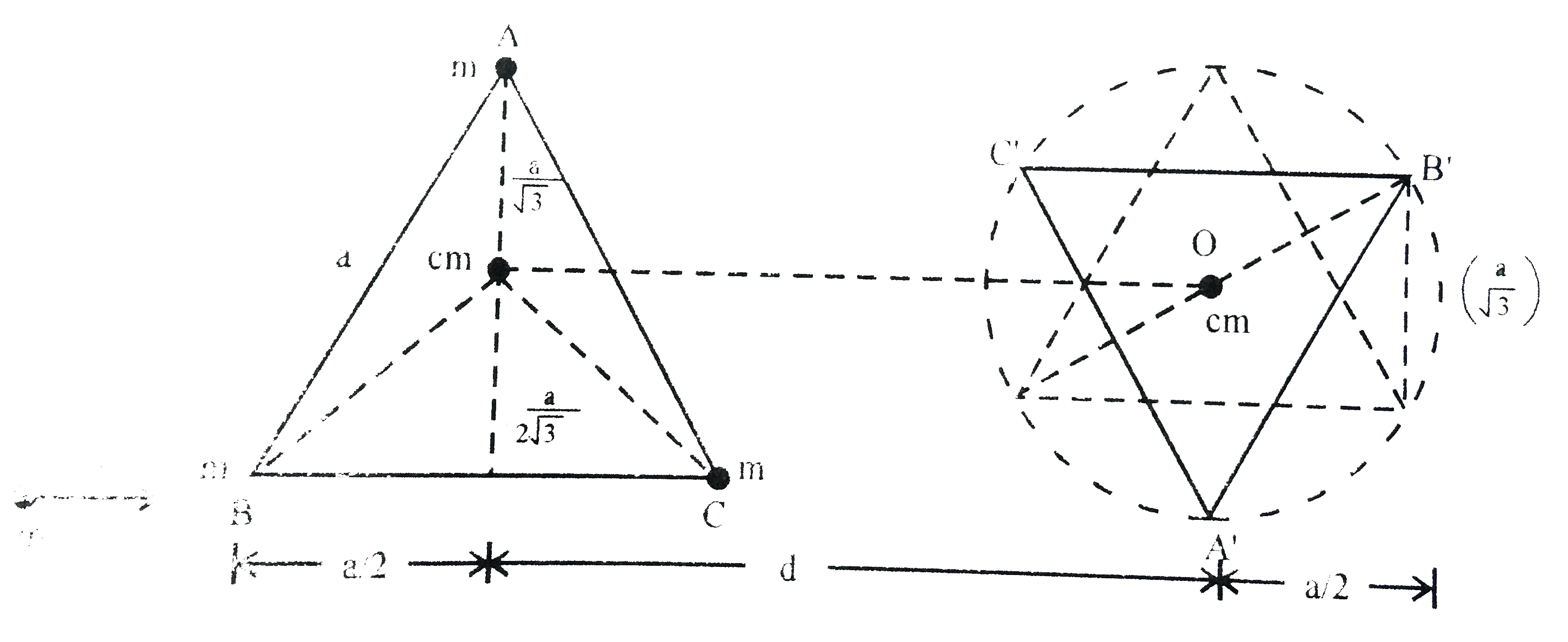 Structure will have translational motion of `C.M` and rotational motion about `C.M` From conservation of linear momentum `mv_(0) = 3 mv_(CM)` `v_(CM) = (v_(0))/(3)` Impulse received by particle is `mv_(0)`. Same and opposite impulse will be received by structure so angular impulse `= I omega` `mv_(0) xx (a)/(2 sqrt(3)) = 3m ((a)/(sqrt(3)))^(2) xx omega` `omega = (v_(0))/(2 sqrt(3) a)` (i) time taken to complete half REVOLUTION `= (PI)/(omega)` `t = (pi)/((v_(0)//2 sqrt(3a))) rArr t = (2 sqrt(3) pi a)/(v_(0)) rArr t = (6 pi a)/(sqrt(3) v_(0))` (ii) linear displacement =`sqrt((d+a)^(2) + ((a)/(sqrt(3)))^(2)) = sqrt((v_(CM) t + a)^(2) + ((a)/(sqrt(3)))^(2))` =`sqrt((v_(0)/(3) xx (6 PIA)/(sqrt(3) v_(0)) +a)^(2) + ((a)/(sqrt(3)))^(2)) =sqrt((a^(2))/(3) (2 pi + sqrt(3))^(2) + (a^(2))/(3)) = (a)/(sqrt(3)) sqrt((2 pi + sqrt(3))^(2) + 1)`. |
|