

Saved Bookmarks
This section includes 7 InterviewSolutions, each offering curated multiple-choice questions to sharpen your Current Affairs knowledge and support exam preparation. Choose a topic below to get started.
| 1. |
A ball of mass m is distributed from the top of a fixed smooth circular tube in a verticalp lane and falls impinging on a ball of mass 2 m at the bottom. The coefficient of restitution is 1/2. Find the heights to which the balls rise after a second impact. |
Answer» Solution :The situation is SHOWN in the figure. If `u` be the velocity of ball `A` just before the impact. Then 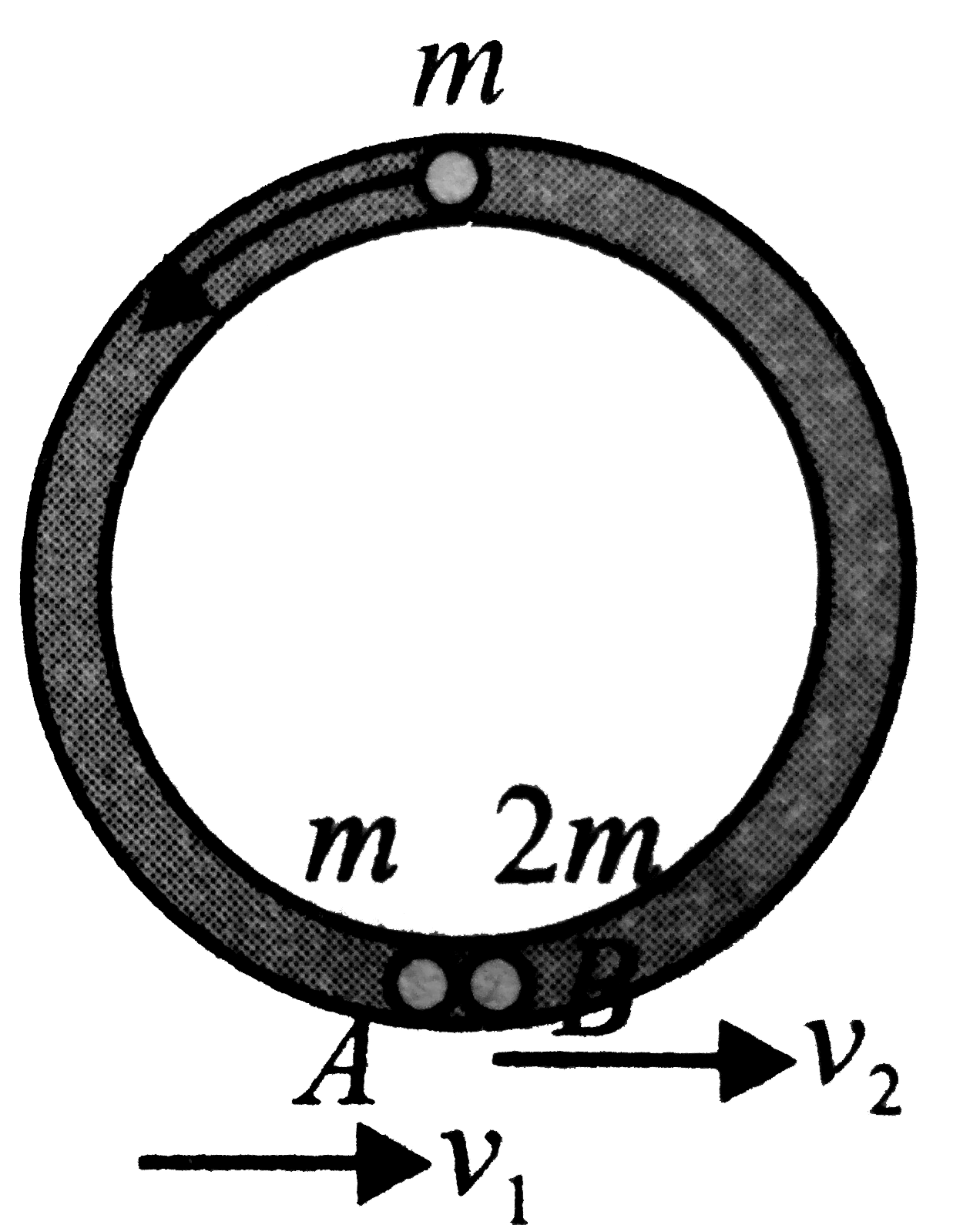 `u=sqrt(2g(2a))` consider the first impact between `A` and `B` if velocities of the balls become `v_(1)` and `v_(2)`. respectively, according to linear momentum conservation. `mu+0=mv_(1)+2mv_(2)` ..........i coefficient of restitution is given as `e=(v_(2)-v_(1))/u=1/2`........ii on solving eqn i and ii we GET `v_(1)=0` and `v_(2)=u/2` ball `A` comes to rest, second impact between `A` and `B` occurs, when ball `B` RETURNS to its initial position owht the sam SPEED `u/2`. if after the second impact the velocities ofthe two balls becomes `v_(3)` and `v_(4)` again from linear momentum conservation and coefficient of restitution. `2m(u/2)+0=mv_(3)+2mv_(4)`..........III `e=(v_(3)-v_(4))/(u/2)=1/2`.........iv on solving eqn iii and iv we get `v_(3)=u/2` and `v_(4)=u/4` both the velocities are positive, it implies that both masses will move in the same direction after the second impact. if `h_(1)` and `h_(2)` are the heights to which the masses `m` and `2m` will rise after the second impact according to energy conservation we have for ball of mass `m`, `1/2m(u/2)^(2)=mgh_(1)` or `h_(1)=u^(2)/(8g)=a/2` for ball of mass `2m` `1/2(2m)(u/4)^(2)=2mgh_(2)` or `h_(2)=u^(2)/(32g)=a/8` |
|
| 2. |
A businessman uses a faulty balance of unequal arms of lengths x and y respectively. He sells W kg of tea to each customer. While selling to the 1 st and the 2 nd customers he keeps the counterpoising weight on the left pan and on the right pan respectively. Does he gain or lose? |
|
Answer» Solution :Suppose the lengths of the LEFT and the right arms of the balance are x and y respectively. For the first customer he places the counterpoising weight in the left pan. In this case the tea is placed in the other pan. Suppose `W_(1)` kg of tea BALANCES W kgweight. HENCE `Wxxx = W_(1)XXY` or, `W_(1)= (Wx)/(y)` For the SECOND customer he places the W kg counterpoising weight in the right pan. Suppose, in this case `W_(2)` kg tea is placed in the other pan. `:. W_(2)xxx= Wxxy` or, `W_(2)= (Wy)/(x)` The customers pay for 2 W kg but get `(W_(1)+W_(2))` kg of tea. `W_(1)+W_(2)-2W = (Wx)/(y)+(Wy)/(x)-2W` `=W((x)/(y)+(y)/(x)-2)=(W)/(xy)(x-y)^(2)` which is positive quantity. `:. (W_(1)+W_(2)) gt 2W`. Hence there is a loss for the business man. |
|
| 3. |
An object, projected with a velocity greater than or equal to 11.2 kms^(-1)will not come back to the earth. Explain. |
| Answer» Solution :The escape velocity of a body on the earth is 11.2 km/s. This MEANS a body that PROJECTED with 11.2 km/sor greater than this velocity will not come BACK to the earth. | |
| 4. |
The terminal velocity of a small ball falling in a viscous liquid depends upon i) its mass m ii) its radius r iii) the coefficient of viscosity of the liquid eta and iv) acceleration due to gravity. Which of the following relations is dimensionally true for the terminal velocity. |
|
Answer» `V=(KMG)/(ETAR)` |
|
| 5. |
A block of solid insolublein water weighs 24gm in air and 21gm when completely immersed in water. Its weight when completely immersed in liquid of specific gravity 1.1 is |
|
Answer» `20.7gm` |
|
| 6. |
Two block of masses m and 2m are kept on a smooth inclined plane and the system is pushed using force 3mg as shown . Find the contact force between those two blocks |
|
Answer» |
|
| 7. |
A) Natural convection can take place in gravity free region B) Forced convection is the principle in maintaining constant temperature of our body. |
|
Answer» A is correct, B is WRONG |
|
| 8. |
Define an adiabatic process. |
|
Answer» Solution :Adiabatic process: This is a process in which no heat flows into or out of the system `(Q = 0)`. But the gas can expand by spending its internal energy or gas can be compressed through some external work. So the pressure, volume and temperature of the system may change in an adiabatic process. For an adiabatic process, the first law BECOMES `DeltaU = W`. This implies that the work is done by the gas at the expense of internal energy or work is done on the system which increases its internal energy.  The adiabatic process can be achieved by the following methods: (i) Thermally insulating the system from surroundings so that no heat flows into or out of the system, for example, when thermally insulated cylinder of gas is compressed (adiabatie compression) or expanded (adiabatic expansion) as shown in the Figure. (ii) If the process occurs so quickly that there is no time to exchange heat with surroundings even THOUGH there is no thermal insulation. A few examples are shown in Figure. The equation of STATE for an adiabatic process is given by `PV^(gamma) ="constant...(1)"` Here `gamma` is called adiabatic exponent `(gamma = C_(P)//C_(V))` which depends on the nature of the gas. The equation (1) implies that if the gas goes from an equilibrium state `(P_(i)V_(i))`to another equilibrium state `(P_(f)V_(f))` adiabatically then it satisfies the relation `P_(i)V_(i)^(gamma)=P_(f)V_(f)^(gamma)"...(2)"` The PV diagram for an adiabatic process is also called adiabat. But actually the adiabatic curve is steeper than isothemal curve. We can also rewrite the equation (1) in terms to T and V. From ideal gas equation, the pressure `P=(muRT)/(V)`. Substituting this equation (1), we have `(muRT)/(V)V^(gamma)="constant (or ) "(T)/(V)V^(gamma)=("cosntant")/(muR)` Note here that is another constant. So it can be written as `TV^(gamma-1)="constant....(3)"` The equation implies that if the gas goes from an initial equilibrium state `(T_(i), V_(i))` to final equilibrium state `(T_(i), V_(i))` to final equilibrium state `(T_(f),V_(f))` adiabatically then it satisfies the relation `T_(i)V_(i)^(gamma-1)=T_(f)V_(f)^(gamma-1)"....(4)"` The equation of state for adiabatic process can also be written in terms of T and P as `T^(gamma)P^(1-gamma)="constant....(5)"` 
|
|
| 9. |
A horizontal plane supports a plank with a bar of mass m=1kg placed on it and attached by alight elastic non deformed cord of length l_(0)=40 cm to a point O as shown in fig. The coefficient of friction between the bar and the plank equal to mu=0.2. The plank is slowly shifted to the right until thebar starts sliding over it.It occurs at the moment when the card deviates from the vertical by an angle theta=30^(@), then the work that has been performed by that moment by the friction force acting on the bar in the reference frame fixed to the plane is N/100J,then find N |
|
Answer» |
|
| 10. |
A block of mass 1kg is dropped on a spring from a height of 20cm. If the spring compresses by 5cm, the force constant of the spring is (g= 10 ms^(-2)) |
| Answer» Answer :A | |
| 11. |
A river of salty water is flowing with a velocity 2 ms^(-1)If the density of the water is 1.28 c c^(-1), then the kinetic momentum during a collision, the condition is energy of each cubic meter of water is |
|
Answer» 2.4 j |
|
| 12. |
Define weight. |
| Answer» Solution :The weight of an object W is defined as the downward force whose MAGNITUDE W is equal to that of upward force that must be applied to the object to hold it at rest or at constant velocity RELATIVE to the EARTH. | |
| 13. |
Two bulbs have filaments of lengths, Emissivity's and diameters in the ratio of 2: 1. If ratio of their powers is 1 :2 then, ratio of their temperatures is |
|
Answer» `1:1` |
|
| 14. |
The load verses elongation graph for four wires of the same material is shown in figure which of the wire is thickest |
|
Answer» A |
|
| 15. |
The amplitude of damped oscillator becomes 1//3 in 2 s. Its amplitude after 6 s is 1//n times the original. The value of n is |
|
Answer» `2^(3)` |
|
| 16. |
A body of mass 5 kg is placed on a rough horizontal surface of coefficient of static horizontal surface of coefficient of static friction (1)/(3). The least pulling force to the applied on the body atan angle 45^(@) with the horizontal to slide it, it ___________ (g=10 ms^(-2)) |
|
Answer» `25sqrt(5)N` |
|
| 17. |
A simple pendulum is made by attaching1Kg bob to 5m long copper wire of diameter0.08cm and it hasa certatinperiod of oscillationand 10kg bob is replacedby kg bb the change in time period is (Y = 12.4xx10^(10) Nm^(-2)) |
|
Answer» `0.0035 sec` |
|
| 18. |
If heat is supplied to a solid. its temperature |
|
Answer» MUST increase |
|
| 19. |
A parallel sides glass slab of thickness 4cm is made of a material of refractive index sqrt3. When light is incident on one of the parallel faces at an angle of 60^@, it emerges from the other parallel face. Find the lateral displacement of the emergent beam. |
|
Answer» Solution :By snell.s law `mu= (SIN i)/(sin r),SQRT3= (sin 60^@)/(sin r)` `sqrt3=sqrt3/(2 sin r), sin r=1/2`, Hence, `r=30^@`, Lateral shift `=t/ (COS r) sin (i-r)` `=4/(cos 30^@) sin (60^@-30^@)=4((sin 30^@)/(cos 30^@))=4 TAN 30^@=4/sqrt3` 
|
|
| 20. |
Define the SI unit of length. |
|
Answer» SOLUTION :GIVEN `v=at^(2)+(b)/(c+t)` The physical QUANTITIES which are having same dimensional formula only can be added . Dimensional formula for `v=LT^(-1)` Dimensional formula for `c=T` Dimensional formula for `at^(2)=LT^(-1)` `a=(LT^(-1))/(T^(2))=LT^(-3)` Dimensional formula for `(b)/(c+t)=LT^(-1)` `thereforeb=L[becausec+t=T]` . |
|
| 21. |
What isanequationof state? Giveanexample |
|
Answer» Solution :Equation of STATE: The equation which connects the state variables in a specific MANNER is called equation of state. An IDEAL gas obeys the equation `PV = NkT` at thermodynamic equilibrium. For example, if we push the piston of a gas CONTAINER, the volume of the gas will decrease but pressure will increase or if heat is supplied to the gas, its temperature will increase, pressure and volume of the gas may also increase. |
|
| 22. |
Anomalous expansion of water is blessing for living organisms in water''. Explain this statement. |
|
Answer» Solution :Anomalous expansion of water : Thermal expansion of water is non uniform with temperature. It contracts on heating between `0^(@)C` and `4^(@)C`. The volume of a GIVEN amount of water DECREASES as it is cooled from room temperature, until its temperature reaches `4^(@)C`. Below `4^(@)C`, the volume increases, and therefore the density decreases. This means that water has a maximum density at `4^(@)C`.  This PROPERTY has an important environmental effect : Bodies of water, such as lakes and ponds, freeze at the top first. As a LAKE cools toward `4^(@)C`, water near the surface loses energy to the ATMOSPHERE, becomes denser, and sinks, the warmer, less dense water near the bottom rises. However, once the colder water on top reaches temperature below `4^(@)C`, it becomes less dense and remains at the surface, where it freezes. If water did not have this property, lakes and ponds would freeze from the bottom up, which would destroy much of their animal and plant life. |
|
| 23. |
The displacement x of a particle at the instant when its velocity v is given by v = sqrt(3x +16). Find its acceleration and initial velocity |
|
Answer» Solution :`v=sqrt(3x+16) or v^(2)=3x+16` `or v^(2)-16=3x` COMPARING with `v^(2)-U^(2)=2AS`. we get u=4 units, 2a=3 or a=1.5 units. |
|
| 24. |
Three particles of masses 8 kg, 4 kg and 4 kg situated at (4,1), (-2,2) and (1,-3) are acted upon by external forces 6bar(j)N,-6 bar(i)N and 14 bar(i)N. The acceleration of centre of mass of the system is |
|
Answer» `0.625 MS^(-2)` |
|
| 25. |
A particle of mass m moving with velocity v is collide with a stationary particle of mass 2 m . The speed of the system , after collision will be ………. |
|
Answer» `v/2`  Here `m_(1)=m, v_(1) =v` `m_(2) =2M, v_(2) =0` Suppose after collision speed of the system = v Momentum is CONSERVED in collision of both PARTICLES . ` :. M_(1)v_(1)+m_(2)v_(2) =(m_(1)+m_(2))v` ` :. v. = (MV+2mxx0)/(m+2m)` ` :.v = (mv)/(3m)` ` :. v = v/3` |
|
| 26. |
An ice skater moving at 10m//s comes to a halt in 100m on a ice surface. Calculate the coefficient of friction between the ice and the skater ? |
|
Answer» Solution :`U=10m//s`, `v=0`, `s=100m` `a=(v^(2)-u^(2))/(2s)=(0-100)/(2xx100)=-0.5ms^(-2)` Reaction force `=R=mg=mxx9.8N` COEFFICIENT of FRICTION `=mu=(F)//(R )=(ma)/(mg)=(a)/(G)=(0.5)/(9.8)=0.05` |
|
| 27. |
A geostationary satellite is orbiting the earth at a height or 6R above the surface of the earth. The time period of another satellite at a height of 2.5R from the surface of the earth is |
| Answer» ANSWER :D | |
| 28. |
Which of the following animals possesses ink gland? |
|
Answer» `H_(2)` |
|
| 29. |
Statement-1 : The centre of mass of any uniform triangular plate is at its centroid. Statement-2 : The centre of mass of any symmetrical body lies on its axis of symmetry. |
|
Answer» Statement-1 is true, statement-2 is true and statement-2 is CORRECT explanation for statement-1. |
|
| 30. |
A block B is pushed momentarily along a horizontal surface with an initial velocity V. If mu is the coefficient of sliding friction between B and the surface, block B will come to rest after a time ? |
|
Answer» `(g mu)/(V)` Finalvelocityv= 0 Now v= `v_(0)+ at` `0 =v - at` `a= (0-v)/(t ) =- (v )/(L )` Nowfrictionforcef= `mu` R= `mu` mg`(:. , R = mg ) ` `:. ,` Retardation- ma = `mu mg` from equation (1) and (2) `(v)/( t ) = mu g `(Avoiding-sign) `t= (v ) /(mu g)` |
|
| 31. |
Vector vec(a) is increased byDelta vec(a) . If increment in magnitude of vec(a) is greater than magnitude of increment vector then angle between vec(a)andDelta vec(a) is : |
|
Answer» greater than ` PI //6` |
|
| 32. |
Heat of 30 kcal is supplied to a system and 4200 J of external work is done on the system so that its volume decreases at constant pressure. What is the change in its internal energy. (J = 4200J/kcal) |
|
Answer» `1.302 XX 10^5 J` |
|
| 33. |
When 20xx10^(-3) kg of water at 15^(@)C is placed in the tube of an ice calorimeer, it si found that the mercury thread mvoes through 29cm. If a metal of mass 12g and 100^(@)C is placed in the tube, the mercury thread contracts by 12cm. Find the specific heat capacity of metal. (Specific heat capacity of water =4200J kg^(-1)K^(-1)) |
|
Answer» |
|
| 34. |
If vec(a)=m vec(b)+vec(c ). The scalar m is |
|
Answer» `(VEC(a).vec(B)- vec(b).vec(C ))/(b^(2))` |
|
| 35. |
A body is thrown vertically up from the top fo atower with a velocity of 5 ms ^(-1) . It reaches the gorund after 5 s. find the heigth of the tower |
|
Answer» |
|
| 36. |
A flywheel is rotating at the rate of 100 rpm and slows down at a constant rate of 1 " rad"//"s"^2. Calculate the time required to stop the flywheel and the number of rotations made by the flywheel before coming to rest? |
|
Answer» |
|
| 37. |
At what position of a body executing shm its velocity (i) maximum and (ii) zero ? |
| Answer» Solution :(i) at the EQUILIBRIUM POSITION (II) at the extreme POSITIONS | |
| 38. |
A shell is projected from a level ground with a velocity u at angle theta the horizontal. When the shell is at the highest point it explodes into two equal fragments. One of the fragments retraces its path to the point of projection. At what distance from the point of projection does the other fragment fall. |
|
Answer» `(2U^(2)Sin 2THETA)/(G)` |
|
| 39. |
If C the velocity of light, h planck's onstant and G Gravitational constant are taken as fundamental quantites, then the dimensional formula of mass is |
|
Answer» `C^((1)/(2))G^((-1)/(2))H^((1)/(2))` |
|
| 40. |
Coefficient of limiting frictions between any two surfaces in contact is ….. Force of …… and ……. Between them. |
| Answer» Solution :RATIO of , limiting FRICTION , NORMAL reaction . | |
| 41. |
A force F is given by F = at +bt^2, where t' is time. What are dimensions of 'a' and 'b' ? |
|
Answer» `MLT^(-3)` and `ML^2T^4` |
|
| 42. |
Moment of inertia of a uniform solid sphere about an axis passing through the edge along its tangents is |
|
Answer» `(2)/(3)MR^(2)` |
|
| 43. |
Given a+b+c+d=0 , which of the following statements are correct(a) a,b,c and d must each be null vector , (b) The magnitude of (a+c) equals the magnitude of (b+d),(c ) The magnitude of a can never be greater than the sum of the magnitudes of b ,c and d, (d) b+c mustlie in the plane of and d if a and d are not collinear , and in the line of a and d , if they are collimear ? |
|
Answer» |
|
| 44. |
The following are the P-V diagrams for cyclic process for a gas. Then the heat is absorbed by the gas in the process |
| Answer» Answer :D | |
| 45. |
(A): If a container with a porous wall, filled with a mixture of two gases, is placed in an evacuate space, the lighter of two gases will escape out sooner (R) : The rms velocity of gas moleculer is inversly proportional to the square root of molecular weight of gas at constant temperature |
|
Answer» Both (A) and ( R) are TRUE and (R ) is the CORRECT explanation of (A) |
|
| 46. |
An object of mass m is moved up a smooth inclined plane of inclination theta through a length l of the inclined plane and height h. What is the work done ? |
| Answer» SOLUTION :MGH (or) MGL SIN `THETA` | |
| 47. |
Two satellites A&B move round the earth in the same orbit. The mass of B is twice that A,then |
|
Answer» speed of A & B are equal |
|
| 48. |
A constant torque of 3.14 N mis exerted on a pivoted wheel. If the angular acceleration of the wheel is 4 pi "rad/" s^(2) then the moment of inertia of the wheel is |
|
Answer» `0.25 KG m^(2)` As `tau = I alpha` `THEREFORE I = (tau)/(alpha) = (3.14)/(4pi) = (3.14)/(4 xx 3.14) = 0.25 kg m^(2)` |
|
| 49. |
Consider a heat engine as shown in figure. Q_1 and Q_2 are heat added both to T_1 and heat taken from T_2 in one cycle of engine. W is the mechanical work done on the engine. If W gt 0, then possibilities are : |
|
Answer» `Q_1 gt Q_2 gt 0` `Q_1=W+Q_2` `THEREFORE W=Q_1-Q_2` But W `gt` 0 `therefore Q_1-Q_2 gt 0` `therefore Q_1 gt Q_2` if `Q_1` and `Q_2` both are positive but if `Q_1` and `Q_2` both are negative then `Q_2 -Q_1 lt 0` `therefore Q_2 lt Q_1` HENCE, `Q_2 lt Q_1 lt 0` |
|
| 50. |
A uniform rod of mass m and lkength 2a lies at rest on rotating with angular speed omega_(0)=40rad//s is placed between two smooth walls on a rough ground. Distance between the walls isslightly greater than the diameter of the sphere . Cofficent of friction between the sphere and the ground is mu=0.1. Spherewill stop rotating after time t=.......s. |
|
Answer» `(4)/(13)mv^(2)` |
|