Saved Bookmarks
This section includes 7 InterviewSolutions, each offering curated multiple-choice questions to sharpen your Current Affairs knowledge and support exam preparation. Choose a topic below to get started.
| 1. |
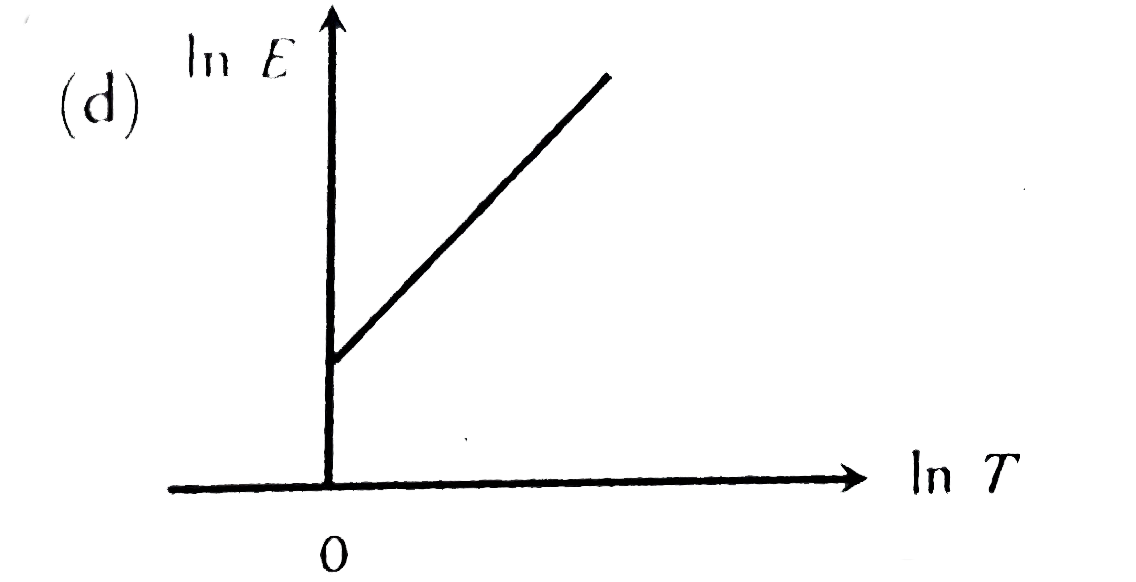
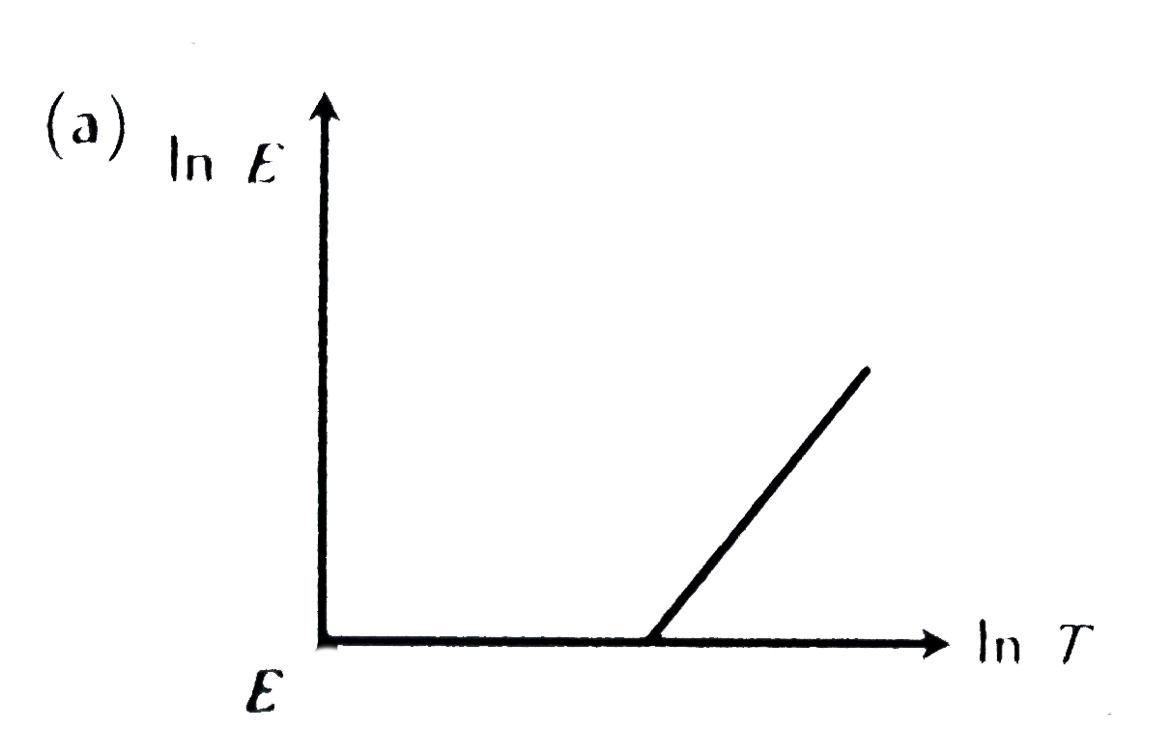
Which of the following graphs correctly represents the relation between ln E and ln T where E is the amount of radiation emitted per unit time from unit area of a body and T is the absolute temperature |
|
Answer»
|
|
| 2. |
A body of mass 40 kg stands on a weighing machine in an accelerated lift. The reading on the scaleof the weighing machine is 300 N. Find the magnitude and direction of acceleration. (g = 9.8ms^(-2)) |
|
Answer» 2.3 `m//s^2`UPWARD |
|
| 3. |
If the two frequencies are nearly equal, find the beat frequency . |
|
Answer» SOLUTION :LET ` omega_(1) = 2 PI n_(1) and omega _(2) = 2 pi n_(2) , where n_(1) and n_(2) `are two nearly equal FREQUENCLES. ` :. N_(1) = (omega_(1))/(2pi) and n_(2) = (omega_(2))/(2pi)` So, beat frequency ` = n_(1)~ n_(2) = (omega_(1))/(2pi) ~(omega_(2))/(2pi) = (1)/(2pi) (omega_(1) ~omega_(2))` |
|
| 4. |
(i) A force of 20 N acts on a body of mass 5 kg at rest. What is the acceleration of the body ? (ii) What is its velocity after 5 seconds if the same force acts ? (iii) After 5 seconds if the force ceases to act how will the body move ? |
|
Answer» (II) 20 `ms^(-1)` (iii) When the force ceases to act, the BODY continues to move with uniform velocity 20 `ms^(-1)` along a straight line by Newton.s FIRST law. (In the ABSENCE of friction) |
|
| 5. |
The basic principle of optical fibres is……………. |
|
Answer» |
|
| 6. |
If the displacement of a particle executing SHM, is given by y=0.30 sin (220t+0.64) in metre, then the frequency and the maximum velocity of the particle are (t is in seconds)……………. |
|
Answer» 35 Hz, 66 m/s Maximum particle VELOCITY `v_(max)=Aomega=0.30xx220=66m//s` |
|
| 7. |
Two blocks of masses 10kg and 4kg are connected by a spring of negligible mass and placed on a frictionless horizontal surface. An impulse gives a velocity of 14ms^(-1) to the heavier block in the direction of the lighter block. What is the velocity of the centre of mass ? |
|
Answer» |
|
| 8. |
Four objects with the same mass and radius are spinning freely about a diameter with the same angular speed. Arrange the work required to stop them in the decreasing order (a) Solid sphere (b) Hollow sphere (c ) Disc (d) Hoop |
|
Answer» d,b,C,a |
|
| 9. |
One light year is ……………. In vacuum in…………….. . |
|
Answer» |
|
| 10. |
A ball 'A' of mass 'm' moving along positive x-direction with kinetic energy 'K' and momentum P undergoes elastic head on collision with a stationary ball B of mass 'M'. After collision the ball A moves along negative X-direction with kinetic energy (K)/(9). Final momentum of B is |
| Answer» ANSWER :C | |
| 11. |
Water rises to a height h in a capillary tube of certain diametr. This capillary tube is replaced by a similar tube of half the diameter. Now the water will rise to a height of |
| Answer» Answer :C | |
| 12. |
The SI unit of coefficient of elasticity is |
|
Answer» `Nm^-2` |
|
| 13. |
See the diagrams carefully in Column-1 and match each with the obeying relation (S) in column-2. The string is massless, inextensible and pulley is frictionless in each case. a=g/3, m= mass of block T = tension in a given string, a_("pulley") = acceleration of movable pulley in each case, acceleration due to gravity is g. |
|
Answer» |
|
| 14. |
T_(1), T_(2) and T_(3) the time periods of a given pendulum on the surface of the earth, at a depth 'h' in a mine and at an altitude 'h' above the earth's surface respectively, then |
|
Answer» `T_(1)= T_(2)=T_(3)` |
|
| 15. |
A solid body is balanced on a lever by a fixed weight, about a fulcrum, with the distance be fulcrum and the weight being 50 units. When the body is completely immersed in water, the distance had to be decreased by 25 units and when immersed in alcohol, the distance had to be decreased by 20 units. What is the specific gravity of alcohol? |
|
Answer» Solution :Let/unit be the distance of the body from the fulcrum. Let m.m, and m, be the mass of the body in air, water and alcohol respectively and the fixed weight. Applying principle of moments to each of the THREE cases we have mg,=50W …….(i) `m_(1)GL`=25W .........(ii) and `m_(2)gl=30W` ..........(III) SUBTRACTING (ii) and (iii) separately from we have `(m-m_(1))gl`=25W.......(iv) and `(m-m_(2))`gl=20W .......(iv)  R.D of alcohol =`("Mass of certain volumw of alcohol")/("mass of the same volume of water")=(m-m_(2))/(m-m_(1))` DIVIDING equation (v)by equation (iv) `(m-m_(2))/(m-m_(1))=(20)/(25)=0.8` |
|
| 16. |
To definite the coefficient of gases, the initial volume or pressure is always taken at 0^@CBut for the coefficients of expansion of solids and liquids , the initial temperature need not be taken as 0^@C. Why? |
| Answer» Solution :the values of the coefficients of EXPANSION of SOLIDS are liquid are very small here, in this CASE the volume at any temperature can be taken as the initial volume. The coefficient of volume expansion ofa gas is relatively higher. SO if we consider volumes or pressures at DIFFERENT temperature as the inital volume or pressure, the coefficient of expansion differs considerably. Hence , to definite the coefficient of expansion of gases, the initial volume or pressure should always be taken at `0^@C` | |
| 17. |
The radius of atom is of the ordar of 1Å & radius of nucleus is of the order of fermi. How many magnitudes higher is the volume of the atom as compared to the volume of uncleus? |
| Answer» SOLUTION :`(V_("ATOM"))/(V_("nucleus")) = 4/3 PI ((10^(-10)m)^(3))/((10^(-15)m)^(3)) = 10^(15)` | |
| 18. |
A) When external forces are involved, momentum of the system is not conserved. B) When stationary bomb explodes, energy released is converted to K.E of fragments C) When rubber ball hits the wall, its kineticenergy is not conserved. |
|
Answer» A and C are TRUE |
|
| 19. |
The temperature of a piece of iron is 27°C and it is radiating energy at the rate of "QkWm"^(-2). If its temperature is raised to 151°C, the rate of radiation of energy will become approximately |
|
Answer» `2Qk WM^(-2)` |
|
| 20. |
If acceleration due to gravity g, the speed of light c and pressure p are taken as the fundamental quantities then find the dimensions of length. |
|
Answer» <P> `cxx(c//g)=LT^(-1)xxT=L`, Dimensions of length `=c^(2)g^(-1)p^(@)` |
|
| 21. |
If vec(F)= hat(i) + 2hat(j) + hat(k) and vec(V)= 4hat(i)- hat(j) + 7hat(k) find vec(F).vec(V) |
|
Answer» 6W |
|
| 22. |
A spring balance has a scale that reads from 0 to 50 kg. The length of the scale is 20 cm. A body suspended from this spring, when displaced and released, oscillates with period of 0.60 s. What is the weight of the body ? |
|
Answer» Solution :Here, m= 50KG, MAX extension, `y= 20-0- 20CM = 0.2 cm , T= 0.6s, `Max .Force , `F= mg= 50 xx 9.8N` `:. K= (F)/(y)= (50 xx 9.8)/(0.2)= 2450Nm^(-1)` therefore As `T= 2pisqrt((m)/(k)), m= (T^(2)k)/(4pi^(2))= ((0.6)^(2)xx 2450)/(4 xx (3.14)^(2))= 22.36 kg` `:.` weight of body = `mg = 22.36 xx 9.8 = 219 .1 N` |
|
| 23. |
A bus of mass 6 metric tons is pulled at a speed of 18 KMPH on a smooth incline of inclination 1 in 20 . Power of the engine is (g=10m^(-2)) |
|
Answer» 15 kW |
|
| 24. |
The rate of emission of heat of a substance is directly proportional to . . . . . . . . of temperature of it and surroundings. |
|
Answer» |
|
| 25. |
Show that the scalarproductof two vectors obeys the law of disrtrictive |
|
Answer» SOLUTION :According to figure, `Ovec(P)= vec(A ) , O vec (Q) = vec(B) and vec(QR) = vec(C )` Now `vec(A) . (vec(B) +vec(C )) ` = (Magnitude of `vec(A)) xx ` ( Componentof `vec(B) +vec(C )` along the DIRCTION of `vec(A)`) `= |vec(A) |` (ON) ` = |vec(A)| (OM +MN)` ` = | vec(A)| OM +|vec(A)|MN` ` :. vec(A) . (vec(B) + vec(C )) = |vec(A)|xx (" component of" vec(B)" along" vec(A)) +|vec(A)|` (component of `vec(C ) `along `vec(A)`) ` :. vec(A) . (vec(B) +vec (C )) = vec(A) . vec(B) +vec(A) .vec(C )` |
|
| 26. |
The moment of inertia of a thin uniform rod of mass M and length L about an axis passing through its midpoint and perpendicular to its length is I_(0). Its moment of inertia about an axis passing through one of its ends and perpendicular to its length is ............. |
|
Answer» `I_(0)+(ML^(2))/(2)`  The MOMENT of inertia about the MIDDLE axis is `I_(0)`, Now ACCORDING to parallel axis `I=I_(0)+Md^(2)` putting `d=(L)/(2)` `I=I_(0)+M((L)/(2))^(2)` `therefore I=I_(0)+(ML^(2))/(4)` |
|
| 27. |
A physical quantity X is related to four measurable quantities a, b, c and d as follows X=a^(2)b^(3)c^((5)/(2))d^(-2). The percentange error in the measurement of a, b, c and d are 1 %, 2%, 3% and 4% respectively. What is the percentage error in quantity X? If the value of X calculated on the basis of the above relation is 2.763. to what value should you round off the result. |
|
Answer» Solution :GIVEN physical quantity `X=a^(2)b^(2)c^((5)/(2))d^(-2)` Maximum percentage error in x s, `(DeltaX)/(X)xx100=[2((Deltaa)/(a)xx100)+3((DELTAB)/(b)xx100)+(5)/(2)((DeltaC)/(c)x100)+2((Deltad)/(d)xx100)]` `=[(2(1)+3(2)+(5)/(2)(3)+2(4)]%` `=[2+6+(15)/(2)+8]=+-23.5%` `:.` Percentage error in `X=23.5%` RELATIVE error in X = 0.235 = 0.24 (By rounding off upto two significant figures) The CALCULATED value of x should be round off upto two significant digits `:. 2.8` |
|
| 28. |
Consider a small water drop in air. If T is the surface tension, then the force due to surface tension acting on the smaller section ABC shown in the figure is 2pi RT sin^(n)theta Determine the value of n. |
|
Answer» |
|
| 29. |
What is 'axis of rotation'? |
|
Answer» Solution :Axis of rotation is an imaginary point or line about which a given BODY or SYSTEM is rotating. All the points on the axis of rotation are stationary. 1) The axis of rotation may be inside the body. Ex: Axis of rotation of a WHEEL is at itscentre. 2) The axis of rotation may be outside the body. Ex: When a stone is tied to a rope and rotated then axis ofrotation is perpendicular to the rope at its other END. |
|
| 30. |
Of two masses of 5 kg each falling from height of 10 m , by which 2 kg water is stirred. The rise in temperature of water will be |
|
Answer» `2.6^(@)C` |
|
| 31. |
A man stands on a rotating platform, with his arms stretched horizontally holding a weight of 5 kg in each hand. The angular speed of the platform is 30 revolutions per minute. The man then brings his arms close to his body such that the distance of each weight from the axis changes from 90 cm to 20 cm. The moment of inertia of the man together with the platform may be taken as constant and equal to 7.6 kg.m^(2). What is his new angular speed ? ( Neglect friction.) |
|
Answer» |
|
| 32. |
A disc rotating with an angular velocity omega_(0). A constant retarding torque is applied on it to stop the disc. The angular velocity becomes omega_(0)//2after n rotations. How many more rotations will it make before coming to rest? |
|
Answer» n |
|
| 33. |
When a satellite is going round the earth in a circular orbit of radius 'r' and with a velocity V. If it loses some of the energy then |
|
Answer» R and V both will increases |
|
| 34. |
Power applied to a particle varies with time as P=(3t^(2)-2t+1) watt, where t is in second. The change in its kinetic enery between time t = 2 sec. and t = 4 sec. is |
| Answer» Answer :B | |
| 35. |
A ball of mass 400 gm is dropped from a height of 5m. A boy on the ground hits the ball vertically upwards with a bat with an average force of 100N so that it attains a vertical height of 20m. Find the time for which the ball remains in contact with the bat. |
|
Answer» 0.12 s |
|
| 36. |
A projectile is fired at a speed of 100 m/s at an angle of 37° above the horizontal. At the highest point, the projectile breaks into two parts of mass ratio 1 :3, the smaller coming to rest. Find the distance from the launching point to the point where the heavier piece lands. |
|
Answer» Solution :At the highest POINT, the projectile has horizontal velocity. The lighter part comes to rest. Hence, the heavier part will move with increased horizontal velocity. In vertical direction, both parts have zero velocity and undergo same acceleration. Thus, both will hit the ground together. As internal forces do not affect the motion of the centre of mass, the centre of mass hits the ground at the position where the original projectile would have landed. The range of the original projectile is, `x_(CM) = (2u^(2)sin theta cos theta)/G =(2 xx 10^(4) xx 3/5 xx 4/5)/10m = 960 m` The centre of mass will hit the ground at this position. As the SMALLER block comes to rest after breaking, it falls down vertically and hits the ground at half of the range, i.e., at x = 480M. If the heavier block hits the ground at `x_2`, then `x_(CM) =(m_(1)x_(1) + m_(2)x_(2))/(m_(1) + m_(2))` (or) `960= ((m)(480) + (3m)(x_(2)))/(m+3m)` or `x_(2) = 1120` m. |
|
| 37. |
The power of awater pump is 2 kw.If g=10ms^-1 the amount of water it can raise to a height of 10 m in minute is |
|
Answer» 2000litre |
|
| 38. |
The rise of water into a capillary tube placed vertically is h. When it is tilted through an angle, the vertical height of water raised will be : |
| Answer» Answer :C | |
| 39. |
According to Newton's law of gravitation, if each body in the universe attracts every other body, why don't two bodies come towards each other? |
| Answer» Solution :`implies` Because gravitational FORCE exerted by `F PROP m_(1)m_(2)`. Two BODIES are very small and `m_(1)m_2`will be small and so F is small and HENCE they do not attract each other. | |
| 40. |
Define root mean square speed (v_(rms)). Write down its equations. |
|
Answer» SOLUTION :Root MEAN SQUARE speed is defined as the square root of the mean of the square of speeds of all molecules. It is denoted by `v_(RMS)=sqrt(barv^(2))` . Mean square speed `barv^(2)=(3kT)/(m)` `v_(rms)=sqrt((3kT)/(m))=1.73 sqrt((kT)/(m))` |
|
| 41. |
Calculate the natural angular frequency'omega' of the system as shown in figure. The mass and friction of the pulleys are negligible |
| Answer» SOLUTION :`SQRT((K)/(2M))` | |
| 42. |
A body is dropped from a height 122.5 m. If its stopped after 3 seconds and again released the the futher time of descent is |
|
Answer» 2s |
|
| 43. |
The work done by the body which is in SHM against the restoring force is stored in the form of |
|
Answer» K.E, |
|
| 44. |
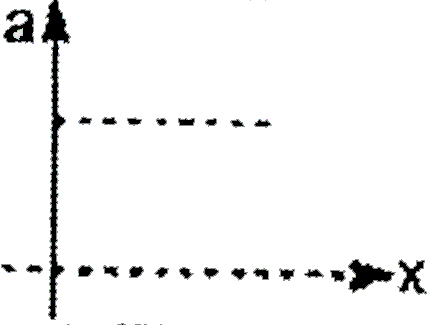
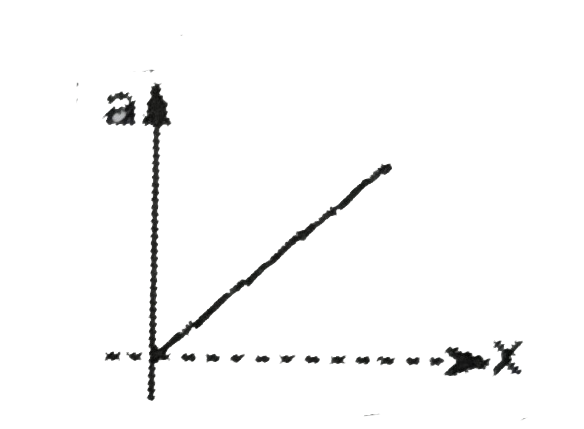
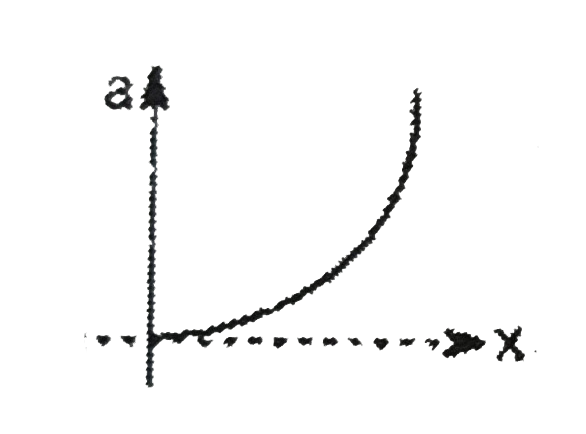
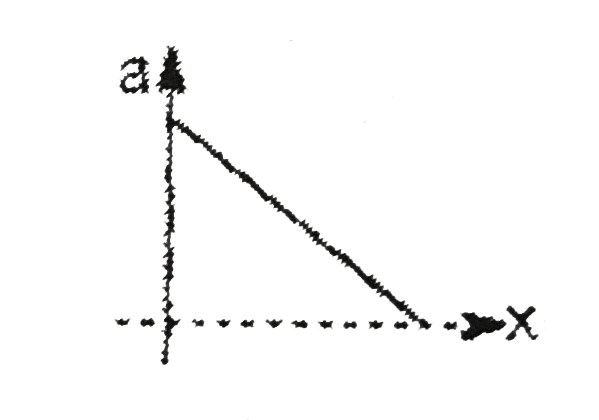
A rod of mass m and length l is hinged at one of its end A as shown in figure. A force F is applied at a distance x from A. The acceleration of centre of mass (a) variea with x as: |
|
Answer» |
|
| 45. |
A physicalquantity'Q' isgivenbyQ=(A^ 2 B^ ( 3//2 )) /( C^ 4D ^ (1//2 )). Thepercentageerrorin A, B, C, D,E are1%,2%,4% , 2 % respectively .Calculatetheminimumandmaximumpercentageerrorsin'Q' |
|
Answer» Solution : (a)Minimumerror`= [ ( 4xx 4 + 1)-( 2+ 3) ]% =12%` (B)Maximumerror=` (4xx4+1+ 2+ 3 ) % = 22 % ` |
|
| 46. |
In which of the following cases the planet will have same value of 'g' as that of the value on the earth (a) with mass double to that of earth and radius sqrt(2) times that of earth (b) with mass fourtimes that of earth and radius sqrt(2) times that of earth (c) with mass one fourth that of the earth and radius half that of earth (d) with mass twice that of earth and radius 1/3 that of earth |
| Answer» Answer :B | |
| 48. |
To remove thechromatic aberration, the combination of lenses should be such that |
|
Answer» `F_(R)+F_(v)=0` |
|
| 49. |
A pendulum of mass m hangs from a support fixed to a trolley. The direction of the string (i.e., angle theta) when the trolley rolls up a plane of inclination alpha with acceleration 'a' is |
|
Answer» Zero |
|
`<br><img src=)