

Saved Bookmarks
This section includes 7 InterviewSolutions, each offering curated multiple-choice questions to sharpen your Current Affairs knowledge and support exam preparation. Choose a topic below to get started.
| 1. |
A satellite revolves round a planet in an elliptical orbit. Its maximum and minimum distance from planet are 1.5xx10^(7) metre and 0.5xx10^(7) metre respectively. If the speed of the satellite at the farthest point is 5xx10^(3)m//s. Calculate the speed at the nearest point. |
Answer» Solution :The angular momentum of the satellite about the planet is CONSTANT. `thereforemv_(1)r_(1)=mv_(2)r_(2)` (or)`v_(1)r_(1)=v_(2)r_(2)` `therefore` Speed at nearest part `v_(1)=(v_(2)r_(2))/(r_1)=(5XX10^(3)xx1.5xx10^(7))/(0.5xx10^(7))` `therefore""v_(1)=1.5xx10^(4)m//s` |
|
| 2. |
Two wires A and B are of the same material their lengths are in the ratio 1 : 2 and the diameter are in the ratio 2 : 1. If they are pulled by the same force, their increase in length will be in the ratio ........ |
|
Answer» `2:1` `Y = (F)/(pi r ^(2)) xx (L)/(l)` Here Y and FARE CONSTANTS for both wires. `THEREFORE (1)/( r _(1) ^(2)) . (L_(1))/( l _(1)) = ( 1)/( r _(2)^(6)). (L_(2))/( l _(2))` `therefore ( l _(1))/(l_(2)) = (r _(2) ^(2) xx L _(1))/( r _(1) ^(2) xx L _(2)) = (((D _(2))/( 2 )) ^(2) xx L _(1))/(( (D _(1))/( 2 )) ^(2) xx L _(2))` `therefore ( l _(1))/( l _(2)) = ( D _(2) ^(2) xx L _(1))/( D _(1) ^(2) xx L _(2)) = ( D _(2) ^(2))/( ( 2D _(2)) ^(2)) xx (L _(2))/( 2 L _(2)) = 1/8` HENCE `l _(1) : l_(2) = 1:8` |
|
| 3. |
Two balls are projected simultaneously from the top of a tall building. The first ball is projected horizontally at speed u_(1) = 10 m//s and the other one is projected at an angle theta = tan^(-1) ((4)/(3)) to the horizontal with a velocity u_(2). [g = 10 m//s^(2)] (a) Find minimum value of u_(2) (= u_(0)) so that the velocity vector of the two balls can get perpendicular to each other at some point of time during their course of flight. ltbr? (b) Find the time after which velocities of the two balls become perpendicular if the second one was projected with speed u_(0). |
|
Answer» |
|
| 4. |
The dimensions of "resistance" xx "capacitance" are same as that of |
|
Answer» Solution :`"RESISTANCE"= ("Voltage")/("Current")` and `"Capacitance"= ("CHARGE")/("Voltage")` `:. "Resistance" xx "capacitance " =("Voltage")/("Current")xx("Charge")/("Voltage")= ("Charge")/("Current")= ("Current" xx "Time")/("Current")= "Time"` |
|
| 5. |
“ Velocity can not be added to temperature". This is in accordance with which law of Physics? |
| Answer» SOLUTION :PRINCIPLE of HOMOGENEITY of DIMENSIONS. | |
| 6. |
A bullet travels horizontally overhead a man at a height h=5 m at speed v=0.660 m s^(-1). How far is the bullet from the man when he hears its whistle? V, velocity of sound =340 m s^(-1). |
|
Answer» |
|
| 7. |
There is a hole of radius r in a cylindrical glass pot. To what depth in the sea can it be immersed so that water may not enter it ? (Surface tension of water is T) |
|
Answer» `(2T)/(r )` |
|
| 8. |
If the change in the value of g at a height h above the surface of the earth is same as at depth .x. below the surface of the earth, then (h lt lt R) |
|
Answer» x = H |
|
| 9. |
The height of the building is 50ft. The same in millimetre is |
|
Answer» `560mm` `:. n_(2)=(n_(1)u_(1))/(u_(2))implies(50 ft)/(mm) =(50xx12xx2.54cm)/(0.1cm)=15240mm` `:. 50ft=15240mm` |
|
| 10. |
A helicopter is ascending vertically with a speed of 8.0 ms^(-1) .At a height of 120 m above the earth ,a package is dropped from a window.How much time does it take for the package to reach the ground? |
|
Answer» 1.23s |
|
| 11. |
A system consists of 3 particles each of mass m located at points (1, 1), (2, 2) and (3, 3). The coordinates of the centre of mass are |
|
Answer» Solution :The coordinates of the centre of mass are `X_(CM) = (m_(1) x_(1) + m_(2) x_(2) + m_(3) x_(3))/(m_(1) + m_(2) + m_(3))= (m XX 1 + m xx 2 + m xx 3)/(m + m + m)` `Y_(CM) = (m_(1) y_(1) + m_(2) y_(2) + m_(3) y_(3))/(m_(1) + m_(2) + m_(3)) = ( m xx 1 + m xx 2 + m xx3)/(m + m + m) = 2` HENCE , the coordinates of centre of mass are (2,2) 
|
|
| 12. |
A bob of mass m suspended by a light string of length L is whirled into a vertical circle as shown in figure. What will be X the trajectory of the particle if the string is cut at (a) Point B (b) Point C (c) Point X |
|
Answer» Solution :(a) If the string is cut at PARABOLA any point, then velocity of body of mass m is along the tangent Parabola to the circle. Tangent at point B is vertically downward so the trajectory of the particle is the straight line. (b) Tangent at point C is A Straight line horizontally towards right. So the trajectory of the particle is the parabola. (c) Tangent at point X makes some ANGLE with the HORIZONTAL. Again bob will follow a parabolic PATH with vertex higher than C. 
|
|
| 13. |
Which of the following statements are true for wave motion ? |
|
Answer» Mechanical tansverse waves can PROPAGATE through all MEDIUMS. |
|
| 14. |
There is a hole in a metal disc. What happens to the size of the hole if the metal disc is heated? |
| Answer» Solution :When metal PLATE with a circular hole is HEATED, the distance between the MOLECULES on the peripheryof the hole should increases due to expansion. Hence the DIAMETER of the hole increases. | |
| 15. |
Where does a body weigh more – at the surface of the earth or in a mine? |
| Answer» Solution :When the child presses the SEAT radially outwards, by Newton.s 3RD law the seat presses the child radially INWARDS and the FORCE PROVIDES the centripetal force. | |
| 16. |
A cylinder is released from rest from the top of an incline of inclination and length r. If the cylinder roles without slippling its speed at the bottom |
|
Answer» `SQRT((4glsintheta)/(3))` |
|
| 17. |
The kinetic energy of a body is s.K.. If one - fourth of its mass is removed and velocity is doubled, its new kinetic energy is , |
| Answer» Answer :B | |
| 18. |
Read the following statements and choose the correct answer. a) For a freely falling body the average velocity is proportional to square root of height of fall. b) For a freely falling body the displacements in successive equal time intervals are in the ratio 1:4:9: c) For a vertically projected body the displacement during last second of time of flight changes with velocity of projection. d) For a body projected from the top of the tower the displacement of the body is negative when the body crosses the point of projection. |
|
Answer» a, C, d are TRUE |
|
| 19. |
A block of mass m_(2) is placed on a horizontal table and another block of mass m_(1) is placed on top of it. An increasing horizontal force F = at is exerted on the upper block but the lower block never moves as a result. If the co-efficient of friction between the blocks is mu_(1) and that between the lower block and the table is mu_(2), then what is the maximum possible value of mu_(1)//mu_(2)? |
|
Answer» `m_(2)/(m_(1))` or,`(m_(1)+m_(2))/(m_(1))GT(mu_(1))/(mu_(2))` or,`(mu_(1))/(mu_(2))LT1+(m_(2))/(m_(1))" ""or",(mu_(1)/mu^(2))_("max")=1+(m_(2))/(m_(1))` 
|
|
| 20. |
The gravitational field due to a mass distribution is E = (A)/(x^(2)) in x-direction. Here A is a constant. Taking the gravitaitonal potential to be zero at infinity , potential at x is |
|
Answer» `(2A)/(x)` |
|
| 21. |
Discuss the law of transverse vibration in stretched strings. |
|
Answer» Solution :There are THREE laws of transverse vibrations of stretched STRINGS which are given as follows: (i) The law of length: For a given wire with tension T (which is FIXED) and mass per unit length `mu` (fixed) the frequency varies inversely with the vibrating length. Therefore, `f propto 1/l (II) The law of tension: For a given vibrating length l (fixed) and mass pre unit length `mu` (fixed) the frequency varies directly with the square root of the tension T. `f propto sqrt(T)` `rArr f =A sqrt(T)`, where A is a constant. (iii) The law of mass: For a given vibrating length l (fixed) and tension T (fixed) the frequency varies inversely with the square root of the mass per unit length `mu`, `f propto 1/sqrt(mu)` `rArr f= B/sqrt(mu)`, where B is a constant. |
|
| 22. |
Match Column-I with Column-II : {:("Column-I","Column-II"),("(1) The magnitude of escape speed of surface of Earth",(a)2.38kms^-1),("(2) The magnitude of escape speed on surface of Moon",(b)7.92kms^-1),(,(c) 11.2kms^-1):} |
|
Answer» |
|
| 23. |
What is the resultant vectors , when two vectors are at right angles to each other ? |
|
Answer» `R = sqrt(P^(2) Q^(2))` ` = sqrt(P^(2) +Q^(2))` |
|
| 24. |
A uniform rope of length l and mass m hangs over a horizontal table with two third part on the table. The coefficient of friction between the table and the chain is mu. The work done by the friction during the period the chain slips completely off the table |
|
Answer» `2/9mu MGL` |
|
| 25. |
The density of the atmosphere at sea level is 1.29 kg//m^3. Assuming that it does not change with altitude, Then how high would the atmosphere extend? |
|
Answer» Solution :We use Eq.10.7 `pgh=1.29 kg m^-3 times 9.8 ms^2 times h m=1.01 times 10^5 Pa` `therefore h=7989 m=8km` In reality the DENSITY of air decreases with height. So does the value of g. The atmospheric cover extends with DECREASING pressure over 100km. we should also NOTE that the SEA level atmospheric pressure is not always 760 nm of Hg. A DROP in the Hg level by 10mm or more is a sign of an approaching storm. |
|
| 26. |
If the least count of a screw gauge is 0.001 cm and diameter of a wire measured by it is 0.236 cm, find the permissible percentage error in the measurement. |
|
Answer» |
|
| 27. |
Two particles of masses 100 gm and 300 gm have at a given time, position 2hati + 5hatj + 13hatkand -6hati + 4hatj -2hatkrespectively and velocities 10hati - 7hatj - 3hatk and -7hati - 9hatj - 6hatk m/s respectively. Deduce the instantaneous position and velocity of the Centre of mass. |
|
Answer» Solution :Let the position vector of CM. be `vecR` `m_(1) = 100 gm = 0.1 kg` `m_(2) = 300 gm = 0.3 kg` `vecr_(1) = 2hati + 5hatj + 13 hatk` `vecr_(2) = -6hati + 4hatj - 2HATK` `vecR `=? `vecR = (m_(1)vecr_(1) + m_(2)vecr_(2))/(m+m_(2))` `=(0.1(2hati + 5hatj + 13hatk) + 0.3 (-6hati + 4hatj - 2hatk))/(0.1 + 0.3)` `=(-16hati + 17hatj + 7 hatk)/5 m` `vecr_(1) = 10 hati -7hatj - 3hatk` `vecr_(2)=7hati - 9hatj - 6hatk` The VELOCITY of C.M. `vecv = (m_(1)vecv_(1) + m_(2)vecv_(2))/(m + m_(2))` `=(0.1(10 hati -7hatj - 3hatk) + 0.3(7hati - 9hatj + 6hatk))/(0.1 + 0.4)` `=(3HATI -2hatj + 9hatk)/4 = ms^(-1)` |
|
| 28. |
What is meant by maintained oscillation ? Given an example. |
|
Answer» Solution :While playing in swing, the OSCILLATIONS will stop after a few cycles, this is due to damping. To avoid source, the amplitude of the oscillation can be MADE constant. Such vibration are known as maintained vibration. Example: The vibration of a tuning fork getting energy from a BATTERY or from external power supply. |
|
| 29. |
One mole of an ideal gas at STP occupies 22.4 L. What is the ratio of molar volume to atomic volume of a mole of hydrogen? Why is the ratio so large? Take size of hydrogen molecule to be 1 Å. |
|
Answer» Solution :Å = `10^(-10)` m Atomic volume of 1 mole of hydrogen = Avogadro.s NUMBER `XX` volume of hydrogen molecule `= 6.023 xx 10^(23) xx 4/3 xx pi xx (10^(-10) m)^(3)` = 25.2 `xx 10^(-7) m^(3)` Molar volume = `22.4 L = 22.4 xx 10^(-3) m^(3)` `("Molar volume")/("Atomic volume") = 0.89 xx 10^(4) ~~ 10^(4)` This ratio is large because ACTUAL size of gas molecule is negligible in comparison to the inter molecular separation. |
|
| 30. |
A astronomical telescope has objective and eyepiece of focal lengths 40cm and 4cm respectively, To view an object 200m away from the objective, the lenses must be separated by a distance. |
|
Answer» 37.3cm |
|
| 31. |
A solid sphere rolls without slipping on a rough horizontal floor, moving with a speed v. It makes an elastic collision with a smooth vertical wall. After impact |
|
Answer» it will move with a SPEED `v` initially 
|
|
| 32. |
A simple pendulum is fixed on a trolly which is sliding down on a frictionless plane at an angle 60^(@). The ratio of time period when the trolly is on a horizontal plane to the time period when the trolly is sliding is |
|
Answer» `SQRT(3): 2` |
|
| 33. |
A rectangular metal slab of mass 33.333 g has its length 8.0 cm, breadth 5.0 cm and thickness 1mm. The mass is measured with accuracy up to 1 mg with a sensitive balance. The length and breadth are measured with vernier calipers having a least count of 0.01 cm. The thickness is measured with a screw gauge of least count 0.01 mm. The percentage accuracy in density calculated from the above measurements is |
|
Answer» 0.13 |
|
| 34. |
Match list I with list II for a projectile. |
|
Answer» a-f, B-n, c-g, d-e |
|
| 35. |
A book with many printing errors contains four different formulas for the displacement y of a particle undergoing a certain peroidic motion : (a) y = asin2pi t//T (b) y=asinvt ("c") y=(a//T) sin t//a (d) y=(a//sqrt2) (sin 2pi t//T + cos 2pit//T) (a = maximum displacement of the particle, v=speed of the particle. T=time-period of motion). Rule out the wrong formulas on dimensional grounds) |
|
Answer» Solution :(ii) `y=asinvt` Here, ANGLE = vt. Its dimensional formula should be `M^(0)L^(0)T^(0)` But `[vt]=(M^(0)L^(1)T^(-1))(T^(1))=M^(0)L^(1)T^(0)` HENCE, (ii) is dimensionally incorrect. (iii) `y=(a)/(T)"sin"(t)/(a)` Here `(a)/(T)` should have same dimensional formula as of y(Displacement). `[(a)/(t)]=(M^(0)L^(1)T^(-2))/(T^(1))=M^(0)L^(1)T^(-1)` Hence, (iii) is dimensionally incorrect. (i) and (IV) are dimensionally correct. |
|
| 36. |
An object of mass 0.2 kg executes simple harmonic oscillations along the x-axis with a frequency (25)/(pi)Hz. At position x = 0.04m, the object has kinctic cnergy 0.5J and (potential energy is zero at mean position) Find its amplitude of vibration. |
|
Answer» SOLUTION :`omega= 2pif= sqrt((k)/(m)) :. K= (2pif)^(2)m` Total energy of OSCILLATION is (0.5+0.4) = 0.9J `:. 0.9 =(1)/(2)KA^(2)` or `A- sqrt((1.8)/(k))= sqrt((1.8)/((2pif)^(2)m))= (1)/(2pif)sqrt((1.8)/(0.2))= (1)/(2PI((25)/(pi)))sqrt((1.8)/(0.2))= (3)/(50) m= 6cm ` |
|
| 37. |
A bar of cross-section A is subjected to equal and opposite tensile forces F at its ends. Consider a plane through the bar making an angletheta with a plane at right angles to the bar. |
|
Answer» SOLUTION :By definition of bulk modulus, `B_(w)=-V(Deltap)/(DeltaV)=-100xx((100xx1.013xx10^(5)))/((99.5-100))=2.026xx10^(9)N//m^(2)` Now as isothermal elasticity of a gas is equal to its pressure `B_(A)=E_(theta)=p_(0)=1.013xx10^(5)N//m^(2)` So that `(B_(W))/(B_(A))=(C_(A))/(C_(W))=(2.026xx10^(9))/(1.013xx10^(5))=2xx10` [ as C= compressibility `(1)/(B)]` i.e., bulk modulus of water is very large as COMPARED to air. This means that air is about 20,000 times more compressive than water, i.e., the average distance between air molecules is much larger than that between water molecules. |
|
| 38. |
A constant force (F) is applied on a stationary particle os mass 'm'. The velocity attained by the particle in a certain displacement will be proportional to |
| Answer» ANSWER :D | |
| 39. |
An object is in uniform motion along a straight line, what will be position time graph for the motion of object, if (i) both x_0positivev negative|vec v| is constant (ii) x_0= negative v negative is |vec v| constant (iii)x_0 = negative , v = positive |vecv| is constant (iv) both x_0 and v arepositive |v| is constant . |
Answer» SOLUTION :
|
|
| 40. |
Three measurements are made as 18.425 cm, 7.21 cm and 5.0 cm. The sum of measurements upto correct number of significant figure is |
|
Answer» 30.635 CM 18.425 + 7.21 + 5.0 = 30.635 = 30.6 cm |
|
| 41. |
(A) : Work done by friction over a closed path is not zero and no potential energy can be assocciated with friction.(R ) : Potential energy is defined only for conservative force. |
|
Answer» Both (A) and (R ) are true and (R ) is the correct EXPLANATION of (A) |
|
| 42. |
A steel wire of 2mm in diameter is stretched by applying a force of 72N. Find the stress in the wire. |
|
Answer» SOLUTION :`r = 1 xx 10^(-3)m, F= 72N` The stress `= (F)/(A)= (F)/(pi r^(2))= (72)/(pi(1 xx 10^(-3))^(2))` ` =(72)/(pi xx 10^(-6))= 2.292 xx 10^(7)Nm^(-2)`. |
|
| 43. |
Name one factor on which the coefficient of friction depends. |
| Answer» SOLUTION :Naute of SURFACES in CONTACT | |
| 44. |
An engine delivered power of 30 kW to a car of mass 1250 kg and velocity of 30 m/s . If the friction force of surface is 750N what will be the maximum acceleration of car ? |
|
Answer» <P>`1/3ms^(-2)` Resistive FORCE = 750 N Force exerted by engine , `F =P/v =(30,0000)/30 = 1000 N ` maximum acceleration produced ` = ("Force exerted by engine " - " Resistious force ")/("mass of CAR")` ` a = (1000- 750)/1250 = 250/1250 =1/5 m//s^(2)` |
|
| 45. |
Its final velocity at the burn out. Assume that acceleration due to gravity is contant at g = 9.8 m//s^(2) and there is no air resistance |
|
Answer» 2730 m/s |
|
| 46. |
By repeating the same measurement several times, the errors that can be reduced are |
|
Answer» DETERMINATE errors |
|
| 47. |
Determine the maximum horizontal force F that may be applied to the plank of mass m for which the solid sphere does not slip as it begins to roll on the plank. The sphere has a mass M and radius R. The coefficient of static and kinetic friction between the sphere and the plank are mu_(S) and mu_(k) respectively. |
Answer» Solution :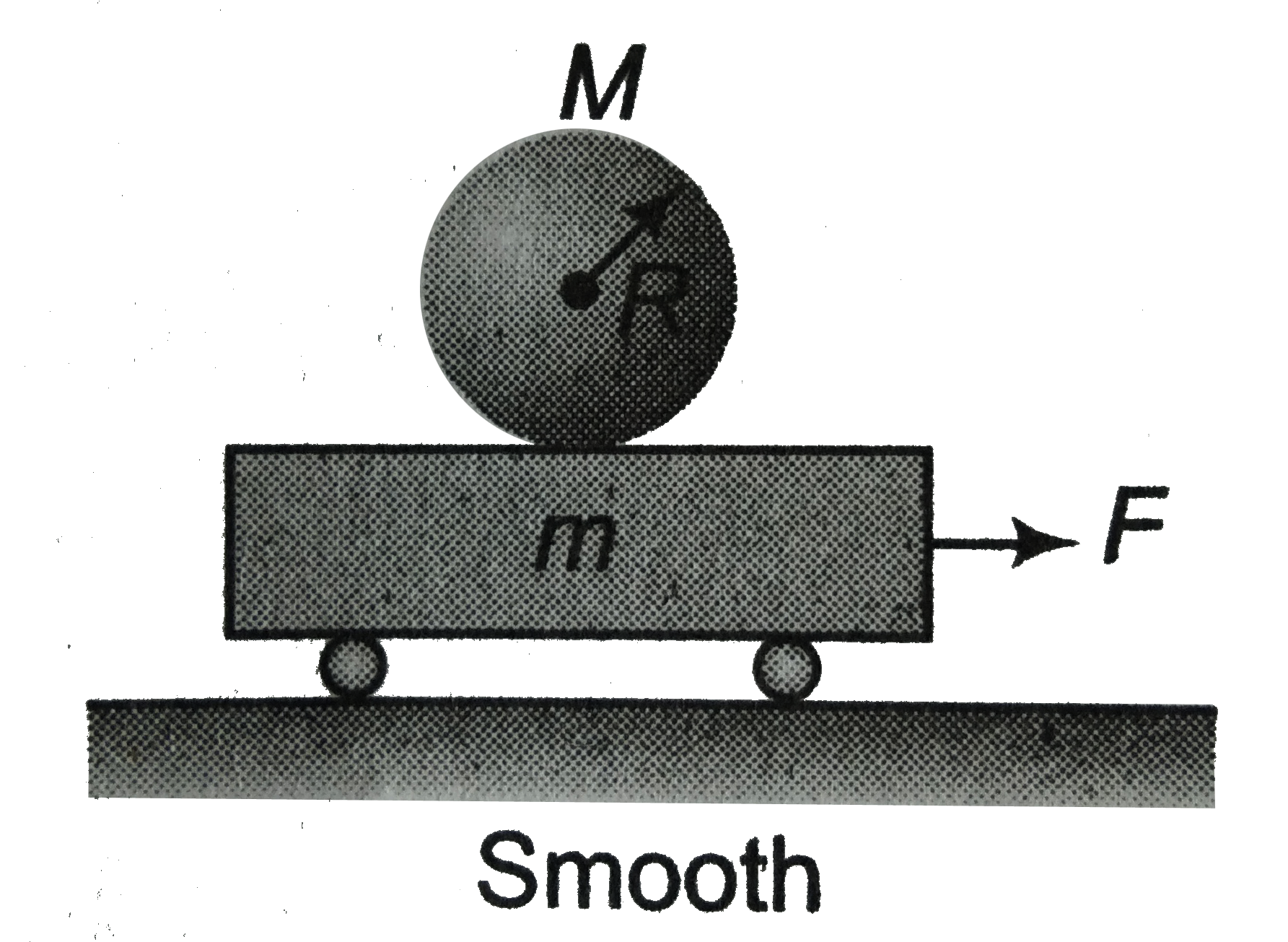 the FREE diagrams of the sphere and the plank are as shown below: Writing equation of motion For sphere EQUATIONS of motion For sphere linear acceleration `a_(1)=(mu_(s)Mg)/(M)=mu_(s)G` .. (i) Angular acceleration `alpha=((mu_(s)Mg)R)/((2)/(5)MR^(2))` `=(5)/(2)(mu_(S)g)/(R)` ...(ii) For plank linear acceleration `a_(2)=(F-mu_(S)Mg)/(m)`..(iii) For no SLIPPING `a_(2)=a_(1)+Ralpha`..(iv) Solving the above four equations we get `F=mu_(S)g(M+(7)/(2)m)` THUS, maximum value of `F` can be `mu_(S)g(M+(7)/(2)m)` |
|
| 48. |
Two men with weights in the ratio 4:3 run up a staircase in time in the ratio 12:11. The ratio of power of the first to that of second is |
|
Answer» `4/3` (W = WEIGHT = mg) `:. (P_1)/(P_2) = (W_1)/(W_2) xx (t_2)/(t_1) = 4/3 xx 11/12 = 11/9` (h is the same in both CASES) . |
|
| 49. |
In modern times which method is used to measure the distance between the earth and planet? |
| Answer» SOLUTION :RADAR - ECHO METHOD | |
| 50. |
Explain escape energy and give its definition. |
|
Answer» Solution :`implies` If we throw a stone upwards with our hand, it goes to a certain height and then falls back towards the earth `implies` If it throw with larger speed it gets greater heights. `implies`If a stone throw with such INITIAL speed, it goes to infinite distance from earth gravitational field forever. In this position there is no attraction on it by the earth. `implies` The thoughts of this situation is as below: `implies` Suppose, a body is lying in the gravitational field of earth at a distance r from the centre of earth. This body is stationary, the total energy of this body , ` E_i` = Kinetic energy + POTENTIAL energy `E=0 +(-(GM_Em)/r)` `E=-(GM_Em)/r""...(1)` `:. E = - (GM_(E)m)/(R_E+h) ""..(2)` `implies`At infinite distance the total energy of body is considered as zero. `implies` If energy `+ (GM_(E) m)/((R_(E) +h))` (or more this) is supply to body, its total energy becomes zero and the body will GO to infinite distance it does not RETURN in gravitational field of earth. This energy is known as escape energy. |
|