

Saved Bookmarks
This section includes 7 InterviewSolutions, each offering curated multiple-choice questions to sharpen your Current Affairs knowledge and support exam preparation. Choose a topic below to get started.
| 1. |
If vecA=2hati+3hatj+6hatk and vecB=3hati-6hatj+2hatk then vector perpendicular to both vecA and vecB has magnitude K tims htat of 6hati+2hatj-3hatk. Then K= |
|
Answer» 1 |
|
| 2. |
A gas bubble from an explosion under water oscillates with a period T proportional to pap "E where P is the statie pressure, p is the density of water and E is the total energy of the explosion. So, values of a, b and care ..... ... and ... respectively. |
|
Answer» <P> SOLUTION :Here `T prop p^(a) rho^(b) E^(c)` is GIVEN.`:. T=kP^(a) rho^(b)E^(c)` where k is a dimensionless constant. `[T]=T^(1),[K]=M^(0)L^(0)T^(-1)` `:.[T]=[k][P]^(a)[rho]^(b) [E]^(c)` But `[P]=M^(1)L^(-1)T^(-2)` `:.T^(1)=(M^(1)L^(-1)T^(-2))^(a)(M^(1)+L^(-3))^(b)(M^(1)L^(2)T^(-2))^(c)` `( :.[rho]=M^(1)L^(-3)T^(0)[E]=M^(1)L^(2)T^(-2))` `:. T^(1)=M^(a+b+c)L^(-a-3b+2c)T^(-2a-2c)` COMPARING powers of T, we get `-2a-2c=1:.a+c=-(1)/(2)...(i)` Comparing powers of M, we get `-a-3b+2c= :.2c=a+3b=a+(3)/(2)` [ From eq. (ii) `:.2c-a=(3)/(2)...(iii)` On addition of eq. (i) and (ii) `a+c=-(1)/(2)` `(+-a+2c=(3)/(2))/(3c=1)` `:.c=(1)/(3)...(iv)` Putting value of c in eq (i) we get `a+(1)/(3)=-(1)/(3)` `:. a=-(1)/(2)-(1)/(3)` `:.a=-(5)/(6)...(V)` From eq. (ii), (iv) and (v), `a=-(5)/(6),b=(1)/(2) and c=(1)/(3)` |
|
| 3. |
A metal ball at 30^@ C is dropped from a height of 6.2 km. The ball is heated due to the air resistance and it completely melts before reaching the ground. The molten substance falls slowly on the ground. Calculate the latent heat of fusion of metal. Specific heat of lead = 126 J kg^(-1)""^(@)C^(-1). Melting point of metal is 200^@ C ("use" g= 10 ms^(-2)) |
| Answer» SOLUTION :`40.58kJ //KG` | |
| 4. |
A body starts with a velocity (2hati+3hatj+11k) m//s and moves with an acceleration (5hati+5hatj-5k)m//s^(2).What is its velocity after 0.2 sec? |
|
Answer» |
|
| 5. |
A body of mass 5 xx 10^(-3) kg is launched upon a rough inclined plane making an angle of 30^(@) with the horizontal Obtain the coefficient of friction between the body and the plane if the time of ascent is half the time of descent . |
|
Answer» Solution :Here, ` m = 5 xx 10^(-3) kg , theta = 30^(@) , mu = ? T_(1) = (1)/(2) t 2 ` If f is the force of friction between the body and inclined plane , then ` f = mu R = mu mg cos theta` Let `a_(1)` be the acceleration while ascending the plane as SHOWN in Here friction is acting down the INCLINE . `mg sin theta + f = m a_(2)` let `a_(2)` be acceleration while descending down the plane as shown in Here , friction is up the plane `mg sin theta - f = m a_(2) ` Divide (II) by (III) `(mg sin theta + f )/(mg sin theta - f ) = a_(1)/(a_(2)) ` ` (mg sin theta + mu mg cos theta)/(mg sin theta - mu mg cos theta )= a_(1)/(a_(2)) ` ` (mg cos theta (tan theta + mu ))/(mg cos theta(tan theta - mu ) )=(a_1)/(a_(2)) ` If `t_(1)` is time of ascent and `t_(2)` is time of descent for length of plane `(l)` then `l = (1)/(2) a_(1) t_(1)^(2) = (1)/(2) a_(2) t_(2)^(2)` `a_(1)/(a_(2))= t_(2)^(2)/(t_(1)^(2)) = ((1)/(2))^(2) = (4)/(1)` From (iv) , `(tan theta + mu )/(tan theta - mu )= (4)/(1)` ` tan theta + mu = 4 tan theta - 4 mu ` ` 5 mu = 3 tan theta ` ` mu = (3)/(5) tan 30^(@) = (3)/(sqrt3) ` ` mu = (1.732)/(5) = 0.346 ` 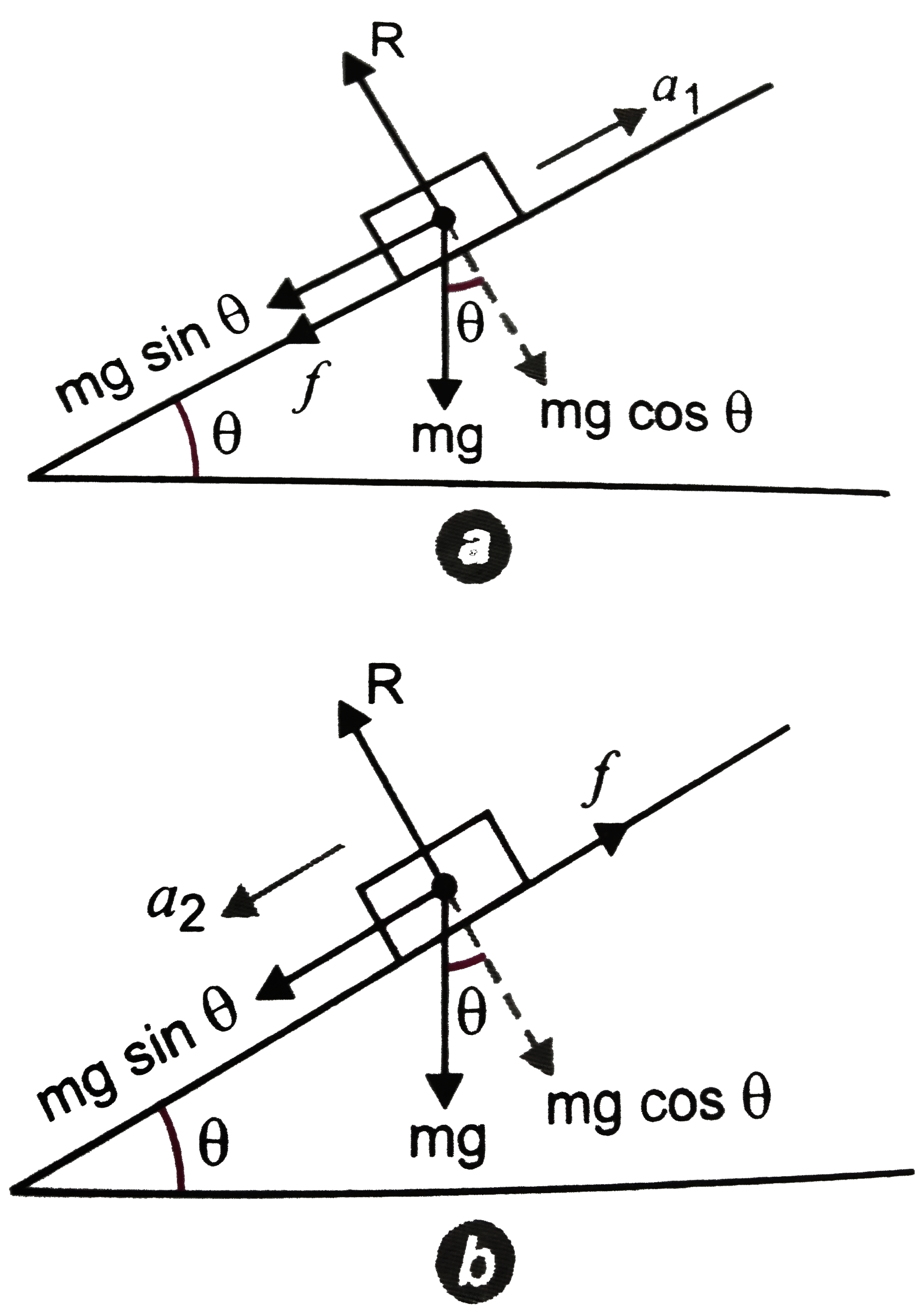 . .
|
|
| 6. |
Two bodies of equal masses moving mutually at right angles to each other, collide elastically. After the collision, the particles will move in |
|
Answer» MUTUALLY PERPENDICULAR directions |
|
| 7. |
(A) : When a person walks on a stationary boat in still water, centre of mass of person and boat system is not displaced.(R ) : Internal forces connot alter the position of c.m. |
|
Answer» Both (A) and (R ) are true and (R ) is the correct EXPLANATION of (A) |
|
| 8. |
In case of an orbiting satellite, if the radius of orbit is decreased, then (a) its KE decreases (b) its PE decreases (c) its mechanical energy decreases |
|
Answer» only a & B are TRUE |
|
| 9. |
A wedge shaped block 'A' of mass M is at rest on a smooth horizontal surface. A small block 'B' of mass 'm' placed at the top edge of inclined plane of length 'L' as shown in the figure. By the time, the block 'B' reaches the bottom end, the wedge A moves a distance of |
|
Answer» `(mL)/(M COS THETA)` |
|
| 10. |
Error in the measurenment of radius of a sphere is 1%. Find the error in the measurement of volume. |
|
Answer» Solution :`(DELTA R)/( r ) XX 100 = 1%` Volume of SPHERE V `= (4)/(3) pir^3` Error in the measurement of volume `(Delta V)/( V) = 100 = 3 (DELTAR)/(r ) xx 100 = 3 xx 1 = 3%` |
|
| 11. |
The distance between Ahmedabad and Surat is 300 km. Two trains set off simultaneously towards each other with speeds 60 km/h and 40 km/h respectively. When will they cross each other? |
|
Answer» 3 hours Initial velocity of SHATABDI Express `v _(0) = v _(12) = v _(1) -v _(2) ` `v _(0) = 30 - 20 = 10 ms ^(-1)` Now `v ^(2) =v _(0) ^(2) + 2ad` Putting `v =0, v _(0) =10 ms ^(-1), d=50 m,` `0= 100 + 2 xx a xx 50` `therefore a xx 100 =- 100` `therefore a =-1` `therefore -a =1 ms ^(-2)` `therefore` DECELERATION `=1 ms ^(-2)` |
|
| 12. |
If spheres of the same material and same radius r are touching each other, then show that the gravitational force between them is directly proportional to r^4. |
| Answer» SOLUTION :F = `(Gm_1 m_2)/(2r)^2` = `(G4/3 pir^3 rho xx 4/3 pir^3 rho)/(2r)^2` = `4/9 pi^2 rho^2 Gr^4` or `F PROP r^4` | |
| 13. |
Find the work done in blowing a soap bubble of radius R if pressure outside in p_(0)and the surface tension of the soap solution is T. |
|
Answer» |
|
| 14. |
How much energy will be emitted from a furnace at 3000K temperature active as a perfect black body per unit area in 1 hour ? (sigma=5.7xx10^(-8)" Wm"^(-2)K^(-4)) |
|
Answer» `1.1xx10^(12)J` `=(1)(1)xx5.7xx10^(-8)XX(3000)^(4)xx3600` `=16621.1xx10^(6)=1.66212xx10^(10)J` `~~1.7xx10^(10)J` |
|
| 15. |
During the oscillations of the bob of a simple pendulum. What is the quantity that remains constant ? |
| Answer» SOLUTION :TOTAL ENERGY of BOB in simple pendulum reamains constant at all instants. | |
| 16. |
The angular acceleration a of a spinning top as a function of t is : alpha = 3t^(2)+ 5t. At t = 0, the angular velocity omega_(0) = 10 rad/s and angular position theta = 8 rad. The angular position as a function of time t is given by which of the following expression? |
|
Answer» `(1)/(4) t^(4) + (5)/(6) t^(3) + 10 t + 8` `alpha = (d^(2) THETA)/(dt^(2)) = 3t^(2) + 5t "" … (i)` `alpha = (d^(2) theta)/(dt^(2)) = 3t^(2) +5t "" …. (i)` Integrate both sides w.r.t. t in equation (i) , we get `(d theta)/(dt) = t^(3) + (5)/(2) t^(2) + C_(1)` where `C_(1)` is a constant of integration . or `omega = (d theta)/(dt) = t^(3) + (5)/(2) t^(2) + C_(1)` Using initial conditions , at t = 0 , `omega_(0) = 10` RAD/s `THEREFORE C_(1) = 10` rad/s or `(d theta)/(dt) = t^(3) + (5)/(2) t^(2) + 10 "" .... (ii)` Integrate both sides w.r.t t in equation (ii) , we get `theta = (1)/(4) t^(4) + (5)/(6) t^(3) + 10 t + C_(2)` where `C_(2)` is a constant of integration . Using initial conditions , at t = 0 , `theta_(0) = 8` rad `therefore C_(2) = 8` rad or `theta = (1)/(4) t^(4) + (5)/(6) t^(3) + 10 t + 8` |
|
| 17. |
A body moves along a circle of radius (20)/(pi)m with constant tangential acceleration . If the velocity of the body is 80 m/s at the end of the second revolution after motion has begun . Then calculate the tangential acceleration . |
|
Answer» Solution :RADIUS `r = (20)/(pi) m` Velocity `v = 80 ms^(-1)` Initial angular velocity `omega(0) = 0` `omega = (r)/(omega)` `theta = 2 rev = 4 pi RAD` As `omega ^(2) + omega_(0)^(2) + 2 ALPHA theta` `((v)/(r))^(2) = 0^(2) + 2 ((a)/(r)) theta` `a = (v^(2))/(2 r theta)` `:. a = ((80)^(2))/(2 xx (20)/(pi) xx 4 pi) = 40 ms^(-2)` |
|
| 18. |
Resultant of two vectors of magnitude P and Q is of magnitude .Q.. If the magnitude of .Q. . If the magnitude of vecQ is doubled now the angle made by new resultant with vecP is |
|
Answer» `30^(0)` |
|
| 19. |
Torque of a force F = -3hati + hatj +5hatk acting at the point r =7hati+3hatj+hatkis |
|
Answer» `14hati - 38hatj +16hatk` |
|
| 20. |
Ice, water and steam co-exist at triple point temperature 273.16 K and pressure 4.6 mm Hg In a system in which the triple point conditions of temeprature and pressure exist, the pressure is increased a little while keeping the temperature constant , then the system contains. |
|
Answer» ICE only |
|
| 22. |
The resistances corresponding to the lower and the uppper fixed points, in a platinum resistance thermometer are 3.50Omegaand3.65Omega. What would be the resistance at a temperature equal to the freezing point of mercury (-37^(@)C)? |
|
Answer» Solution :Given `R_(0) =3.50 Omega , R_(100) = 3.65 Omega and t = - 37^@C , R_(t) = ? ` `:.` Using `t=[(R_t-R_0)/(R_(100)-R_0)]100^@C` We have , `-37^@C=[(R_(t)-3.50)/(3.65-3.50)]100^@CimpliesR_(t)-3.50=-0.056impliesR_(t)=3.55Omega` `:.` The REQUIRED RESISTANCE is `3.55 Omega` . |
|
| 23. |
A stone of mass 1kg is tied to one end of a string of length 0.5m. If is whirled in a vertical circle. If the maximum tension in the string is 58.8N, the velocity at the top is |
|
Answer» `1.82 MS^(-1)` |
|
| 24. |
The sap in trees , which consists mainly of water in summer , rises in a system of capillaries of radius r=2.5xx10^(-5)m .The surface tension ofsap is T=7.28xx10^(-2)Nm^(-1)and the angle of contact is 0^(@) .Does surface tension alone account for the supply of water to the top of all trees ? |
|
Answer» SOLUTION :Radius `(R )=2.5xx10^(-5)m` Surface TENSION `(S)=7.28xx10^(-2)N//m` Angle of contact `theta=0^(@)` Height h `=(2Scostheta)/(rrhog)` `=(2xx7.28xx10^(-2)xxcos0^(@))/((2.5xx10^(-5))(10^(-3))(9.8))` `=0.6`m |
|
| 25. |
A torry and a car moving with the same kinetic energy are brought to rest by the application of brakes. Which provide equal retarding forces. Which of them will come to rest in shorter time? Which will come to rest in less distance? |
|
Answer» Solution :(a) Initial kinetie energy of each vehicle is K and when they come to rest their final kinetic energy is zero. The change in kinetic energy of both the car and lorry is K. By work -energy theorem FS= Change in kinetic energy `FS= K, S = (K)/(F)` Where F is the retarding force. As K and F are same for both the vehicles, they come to rest after travelling the same distance (b) To find the time in which each vehicle comes to rest, we have to consider the momentum, `p = sqrt(2m xx K) " since " K= (p^(2))/(2m)` Th initial momentum of the car is less than that of the lorry as K is same for both but mass of the car is less than that of the lorry. Final momentum is zero for both the vehicles. So, change in momentum is less for the car. By Newton.s second LAW, `F= (Delta P)/(Delta t), Delta t= (Delta p)/(F)` Since .F. is same, `Delta t PROP Delta p` As car has smaller momentum, the car comes to rest EARLIER. |
|
| 26. |
A heavy circular disc is revolving in a horizontal plane about the centre which is fixed. An insect of mass 1/n th that of the disc walks from the centre along a radius and then flies away. Show that the final angular velocity is n/(n+2) times the original angular velocity of the disc. |
| Answer» Solution :`I_(1)omega_(2) =I_(2)omega_(2) , (1//2) MR^(2)+ (1//n) mr^(2)]omega_(2), omega_(2) = nomega_(1)//n +2` | |
| 27. |
What are the units and dimensions of specific gas constant? |
| Answer» SOLUTION :Unit of SPECIFIC gas constant r is joule per kilogram KELVIN J `kg^(-1)K^(-1)`. DIMENSIONAL formula : `L^(2)T^(-2)K^(-1)` | |
| 28. |
A small space is left between two rails on a railway track.Why? |
| Answer» Solution :If no SPACE is left,the RAILS WOULD bend DUE to the expansion in SUMMER. | |
| 29. |
A man is standing on top of a building 100 m high. He throws two balls vertically, one at t = 0 and after a time interval (less than 2 seconds). The later ball is thrown at a velocity of half the first. The vertical gap between first and second ball is + 15 m at t = 2 s. The gap is found to remain constant. Calculate the velocity with which the balls were thrown and the exact time interval between their throw. |
|
Answer» Solution :Let the speeds of the two balls `v _(1) and v _(2)` respectively. If `v _(2) = v, ` then `v _(1) = 2v` If `y _(1) and y _(2)` are the DISTANCE covered by the balls respectively before coming to rest, then `y_(1) = (v _(1) ^(2))/( 2G) = (4v ^(2))/( 2g) and y _(2) = (v _(2) ^(2))/( 2g) = (v ^(2))/( 2g)` `y _(1) - y _(2) = 15 m` `(4v ^(2))/(2g) - (v ^(2))/(2g) =15m` `(3v ^(2))/(2g) =15m` `therefore v ^(2) = sqrt (5m xx (2 xx 10 )) m//s ^(2)` `therefore v = 10 m//s` `therefore v _(2) = 10 m //s and v _(1) = 20 m //s` Now, `y _(1) = (v _(1) ^(2))/( 2g ) = ((20 m ) ^(2))/( 2 xx 10m15 ) = 20 m` `y_(2) = y _(1) - 15 m = 5m` If `t _(2)` is the time taken by the ball 2 to cover a distance of 5 m, then From `y _(2) = v _(2) t - (1)/(2) g t _(2) ^(2) ` `5 = 10 t _(2) - 5t _(2) ^(2) or t _(2) ^(2) + 1=0` `therefore t _(2) =1 s` Now, `t _(1)` (time taken by ball 1 to cover distance of 20 m) is 2s, time interval between the two throws `=t_(1) -t _(2) =2s -1S =1s` |
|
| 30. |
A horizontal turn table rotates about its axis at the uniform rate of 2revolutions persecond. Find themaximum distance from the axis at which a small body will remain stationary on the turn table if thecoefficient of static friction between the turn table and body is 0.8. Assume g=pi^(2)m//s^(2). |
|
Answer» |
|
| 31. |
When a particle is moving in vertical circle |
|
Answer» Solution :(i) A body of mass (m) attached to one end of a massless and inextensible stringexecutes circular motion in a VERTICAL plane with the other end of the string fixed. The length of the string becomes the radius `vecr` of the circular PATH. (ii) The motion of the body by taking the free body diagram (FBD) at a position where the position vector `vecr` makes an angle `theta` with the vertically downward direction and the instantaneous velocityis as shown in Figure. There are two forces acting on the mass. 1. Gravitationalforce which acts downward 2. TENSION ALONG the string.  Applying Newton's second law on the mass, In the tangential direction, `mg sin theta=ma_(t)` ` mg sin theta= -m((dv)/(dt))`. where, `a_(t)= -((dv)/(dt))` is tangential retardation In the radial direction, `T-mg cos theta=m a_(r), T-mg cos theta=(mv^(2))/(r)` where, `a_(r)=(v^(2))/(r)` is the centripetal acceleration. |
|
| 32. |
For what value of R in the circuit as shown, current passing through 4 Omega resistance will be zero |
| Answer» Answer :A | |
| 33. |
Figure shows the graph of pressure versus volume of an ideal gas, taken from state A to C via three different paths, i.e., ABC, AC and ADC. The internal energies of the gas corresponding to the states A and C are (P_0V_0) and (5P_0V_0) respectively. DetermineThe work done during the process DC and AB. |
|
Answer» Solution :WORK done during the process: DC = Area under the CURVE `CD, = P_0(2V_0 -V_0 )=P_0V_0` `AB=2P_0(2V_0-V_0 ) = 2P_0 V_0 ` |
|
| 34. |
Figure shows the graph of pressure versus volume of an ideal gas, taken from state A to C via three different paths, i.e., ABC, AC and ADC. The internal energies of the gas corresponding to the states A and C are (P_0V_0) and (5P_0V_0) respectively. DetermineThe total heat energy supplied to the system, during each Pressure of three processes ABC,AC and ADC. |
|
Answer» Solution : APPLYING, the FIRST law of thermodynamics, to the PROCESS : ABC from ` DELTA Q =Delta V + Delta W = 4P_0V_0 +2P_0 (2V_0 -V_0 ) =6P_0 V_0` For AC, from `Delta Q= Delta V +Delta W` `= 4P_0V_0+ 1/2[ 2P_0 +p_0 ] xx(2 V_0-V_0 ) = 5.5P_0V_0` ADC, we have ` Delta Q = Delta V+ Delta W = 4P_0V_0 +P_0 (2V_0– V_0 )=-5P_0 V_0 ` |
|
| 35. |
Figure shows the graph of pressure versus volume of an ideal gas, taken from state A to C via three different paths, i.e., ABC, AC and ADC. The internal energies of the gas corresponding to the states A and C are (P_0V_0) and (5P_0V_0) respectively. DetermineEquation of the straight line AC. |
|
Answer» SOLUTION :USING` (y-y_2 )/( X-x_2 ) = (y_1 -Y_2)/(x_1 -x_2 ) ` we have ` (y-P_0)/( x-2 V_0 ) = (2P_0 - P_0 )/( V_0-2 V_0) =- (P_0)/( V_0) ` `impliesY= P_0 {-(P_0)/(V_0) (x-2V_0)}=(P_0)/(V_0) ( 3 V_0 +x)` |
|
| 36. |
Figure shows the graph of pressure versus volume of an ideal gas, taken from state A to C via three different paths, i.e., ABC, AC and ADC. The internal energies of the gas corresponding to the states A and C are (P_0V_0) and (5P_0V_0) respectively. DetermineThe change in internal energy of the gas during the process AC. |
|
Answer» SOLUTION :Change in INTERNAL energy of the gas during the PROCESS `AC =DELTA U=U_C -U_A` `= 5P_0 V_0 -P_0 V_0 =4P_0 V_0` |
|
| 37. |
A thin uniform tube of length 9 m closed at one end is immersed in water to a depth of 7.5 m. Find the height h to which water rises in the tube. Ignore any temperature change and take atmosphere pressure as 10 mg water column. |
|
Answer» |
|
| 38. |
(A) : Angular momentum and Plank.s constant are dimensionally similar but they are not identical physical quantities (R) : Dimensionally similar quantities need not be identical |
|
Answer» Both (A) and (R) are TRUE and (R) is the correct EXPLANATION of (A) |
|
| 39. |
The Marina trench is located in the Pacific Ocean, and at one place it is nearly eleven km beneath the surface of water. The water pressure at the bottom of the trench is about 1.1xx10^(8) Pa. A steel trench. What is the change in the volume of the ball when it reaches to the bottom ? |
|
Answer» |
|
| 40. |
Why do two streamlines never intersect each other ? |
| Answer» Solution :If two streamlines intersect each other, then at the points of intersection, we can draw two tangents to the two streamlines, which WOULD imply two DIFFERENT directions of the velocity of the PARTICLE at that point. But in a streamline any particle can move only in ONE DIRECTION and hence two streamlines never intersect each other. | |
| 41. |
The sum of the volumes of some amount of gas at 27^@C and a piece of glass in it is 100 cm^3. IF the both the pressure and the celsius temperature are doubled, the volume becomes 60 cm^3.What is the volume of the piece of glass? |
|
Answer» |
|
| 42. |
Find the period of oscillation of a simple pendulum of length L suspended from the roof of a vehicle which moves without friction down an inclined plane of inclination alpha. |
|
Answer» SOLUTION :The EFFECTIVE value of ACCELERATION due to gravity `g' = g cos alpha` `T = 2 PI SQRT(L/(g')) = 2pi sqrt((L)/((cos alpha)g))` |
|
| 43. |
Two ice skaters A and B approach each other at right angles. A has mass 30 kg and velocity 1 m/s and B has a mass of 20 kg and velocity 2 m/s. They meet and stick together. The final velocity of couple is : |
|
Answer» SOLUTION :LET v = Composite velocity after collision, `theta = angle` with the direction of 30 kg mass Then from momentum conservation, `50v cos theta = 30xx1` `50v SIN theta = 20 xx2` From equations (1) and (2), `sqrt((50)^(2)+v^(2))=sqrt(900+1600)` `50v=50` v = 1 m/s. 
|
|
| 44. |
The first law of thermodynamics is concerned with conservation of |
|
Answer» NUMBER of molecules |
|
| 45. |
An artificial satellite is moving in a circular orbit around the earth . with a speed equal to half the magnitude of escape velocity from the earth.(a) Determine the height of the satellite above the earth.s surface . (b) If the satellite is stopped suddenly in its orbit and allowed to fall freely into the earth , find the speed with which its hits the surface of the earth. [g= 9.8 ms^(-2) and R_(E) = 6400km] |
|
Answer» Solution :(a) We know that for satellite motion `v_(0)=SQRT((GM)/r) =Rsqrt((G)/((R+h)))[ "as"g=(GM)/R^2and r = R+h]` In this problem `v_(0)=1/(2)v_(e)=1/2sqrt(2gR)["as "v_(e)=sqrt(2gR)]` So , `(R^2g)/(R+h)=1/2 gR` i.e , 2R =h + Rorh = R = 6400 km (B) By conservation of ME `0+[-(GMM)/r]=1/2mv^2+[-(GMm)/R]" or " v^2=2GM[(1)/R-(1)/(2R)]` [as r = R + h = R + R = 2R] `v =sqrt((GM)/R) = sqrt(gR) = sqrt(10 xx6.4 xx10^(6))= 8km//s ` |
|
| 46. |
A heated object (at time t = 0 and temperature T=T_(0)) is taken out of the oven to cool and placed on a table near an open window. Write an depression for its temperature as a function of time T, where T_(S) is the surrounding temperature |
|
Answer» `T=T_(S)-(T_(0)-T_(S))E^(-KT)` |
|
| 47. |
We have derived the formula E=(lambda)/(2pi in_0 r) considering only a finite length l of the wire. How are we justified in taking the equation valid for the entire wire of infinite length? |
| Answer» Solution :This is because, the TOTAL charge ENCLOSED will be `lambdaL` and total surface area will be `(2pi R)` L and L cancels out in `Eqn. E(2pi r) L=(lambdaL)/(in_0)` EVEN when l is INFINITY. | |
| 48. |
(A) The correctness of an equation is verified using the principle of homogeneity (B) All unit less quantities are dimensional less. |
|
Answer» Both A & B are true |
|
| 49. |
Express the SI unit of frequency. |
| Answer» SOLUTION :The SI unit of frequency is `s^(-1)` (per SECOND). | |
| 50. |
Draw the P-T and V-T diagrams for an isobaric process of expansion, corresponding to n moles of an ideal gas at a pressure P_(0), from V_(0) to 2V_(0). |
|
Answer» Solution :For the graph PF P versus T the variation is a straight line NORMAL to the pressure axis, the temperature varying from `T_(1) " to " T_(2)` as shown FIGURE. From the gas EQUATION `PV=nRT` we have, `V=[(nR)/P_(0)]T or V prop T` At `V=V_(0),T_(1)=(P_(0)V_(0))/(nR)` and at `V=2V_(0), T_(2)=(2P_(0)V_(0))/(nR)` From the graph of V versus T, the equation `V=[(nR)/P_(0)]T` or V=KT shows that the volume varies directly, as the temperature (Charless. law). So, the graph is a straight line inclined to the `(V-T)` axis, and passing through the origin (whenproduced) as shown in figure. 
|
|