

Saved Bookmarks
This section includes 7 InterviewSolutions, each offering curated multiple-choice questions to sharpen your Current Affairs knowledge and support exam preparation. Choose a topic below to get started.
| 1. |
Calculate the magnetic moment of Ti^(3+) and V^(4+). |
|
Answer» SOLUTION :`TI (Z = 22) Ti^(3+) 3d^(1)` `V (Z = 23) V^(4+) 3d^(1)` `THEREFORE mu= sqrt(1(1+2)) = sqrt(3) = 1.73 mu_(B)`. So they are paramagnetic. |
|
| 2. |
Calculate the magnetic moment of Fe^(2+) (At. No. 26)? |
|
Answer» Solution :`FE^(2+)- 1s^(2)2s^(2)2P^(6)3s^(2)3P^(6)3d^(6)` No. of unpaired electrons = 4 `:. "Magnetic moment" MU = sqrt(N(n+2))BM` `= sqrt(4(6))= sqrt(24)= 4.92 "BM"` |
|
| 3. |
Calculate the magnetic moment of a divalent ion in aqueous solution if its atomic number is 25 |
|
Answer» Solution :With atomic number 25, the divalent ion in aqueous solution will have `d^(5)` CONFIGURATION (FIVE unpaired electrons). The MAGNETIC moment, `mu` is `mu= sqrt(5(5+2)) = 5.92BM` |
|
| 4. |
Calculate the magnetic moment of a high-spin octahedral complex that has six electrons in 3d-orbitals |
|
Answer» |
|
| 5. |
Calculate the magnetic moment of a divalent ion in aqueous soluiotn if its atomicnumber is 25. |
|
Answer» SOLUTION :`Z=25` is for Mn . Its E.C.` = [AR]^(18) 3d^(5) 4s^(2)` . E.C. of its divalent ION `= [ Ar]^(18) 3d^(5) `. Thus , it has 5 unpaired ELECTRONS. `:. ` Magnetic moment `(mu) = sqrt(n(n+2)) ` B.M. `(or mu_(B)) = sqrt(5(5+2)) = 5.92 mu_(B)` |
|
| 6. |
Calculate the magnetic moment and the number of unpaired electrons in Cu^(2+). |
|
Answer» Solution :Cu (Z = 29) Electronic CONFIGURATION `[Ar]3d^(10) 4S^(1)` `Cu^(2+)` Electronic configuration `[Ar] 3d^(9)` The number of UNPAIRED electrons 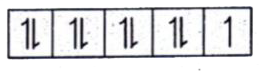 is 1. is 1.Magnetic moment `mu = sqrt(1(1+2)) = sqrt(3) = 1.732 mu_(B)` |
|
| 7. |
Calculate the longest wave length spectral line in the Paschen series of hydrogen emission spectrum |
| Answer» SOLUTION :1887.3 NM | |
| 8. |
Calculate the kinetic energy of a moving electron which has a wavelength of 4.8 pm. [mass of electron = 9.11 xx 10^(-31) kg, h = 6.626xx 10^(-34) Kg m^2s^(-1) ]. |
|
Answer» Solution :According to d-broglie equation `lamda = (h)/(mv) ` `v = (h)/(m lamda)` ` therefore v = (h)/(m lamda) = (6.626 xx 10^(-34) kg m^2 s^(-1) )/(9.11 xx 10^(-31) kg xx 4.8 xx 10^(-12) m) = 1.516 xx 10^8 ms^(-1)` KINETIC energy` =1/2 mv^2 = 1/2 xx 9.11 xx 10^(-31) kg xx (1.516 xx 10^8 ms^(-1) )^2` ` = 10.47 xx 10^(-15) kg m^2 s^(-1)= 1.047 xx 10^(-14) J` |
|
| 9. |
Calculate the K_(C) and DeltaG^(Theta) for the chemical reaction : Ni_((S))+2Ag_((aq))^(+) to Ni_((aq))^(2+)+2Ag_((S))""[E^(Theta)=1.05V] |
|
Answer» |
|
| 10. |
Calculate the K_(b) for chloroform from the following data (a) Boiling point of pure CHCl_(3)=61.3^(@)C (b) The solutionn containing 5.02g of naphthalene (C_(10)H_(8)) in 18g of CHCl_(3) boils at 69.5^(@)C |
|
Answer» |
|
| 11. |
Calculate the IP_(3) of lithium. |
| Answer» SOLUTION :`+"122.4 ev/atm"` | |
| 12. |
Calculate the ionisation energy in eV of a hydrogen atom in the ground state. |
|
Answer» SOLUTION :Since IONISATION energy is defined as the energy required to remove an ELECTRON from the outermost orbit of an atom, mathematically, we can say that since the hydrogen atom is in the ground state, ionisation energy will be the energy required to remove the electron from the first orbit to the infinite orbit (i.e., `r_(1)` to `r_(oo)` ), THUS ionisation energy `=E_(oo)-E_(1)` `=0-(-2.18 xx 10^(-11))` erg (`E_(1)= -2.18 xx 10^(-11)`erg) `therefore` ionisation energy `=2.18 xx 10^(-11)` erg `=(2.18 xx 10^(-11))/(1.602 xx 10^(-12))= 13.60eV` (1eV= `1.602 xx 10^(-12)`erg) |
|
| 13. |
Calculate the ionisation constant for the conjugate base of HF. Ionisation constant of HF at 298K is 6.8xx10^(-4). |
|
Answer» SOLUTION :The conjugate base of HF is `F^-` For `F^-. K_b=(K_w)/(K_a)=(10^(-14))/(6.8xx10^(-4))` `=1.47xx10^(-11)` |
|
| 14. |
Calculate the ionic mobility of colloidal particles in arsenic colloidal solution, if zeta potential is 0.045 V (Dielectric constant = 81, Viscosity of liquid =1.008 centipoise) |
|
Answer» |
|
| 15. |
Calculatetheinternalenergyat 298 K for theformationof onemole ofammoniaif theenthalpychangeat constantpressureis - 42.0 kJ mol^(-1) (Given: R = 8.314 JK^(-1)mol^(-1)) |
| Answer» Solution :`DELTA U = - 39. 523 KJ` | |
| 16. |
Calculate the % increase in temperature of gas when it is heated at constant pressure to occupy 20% increase in volume. |
|
Answer» SOLUTION :`V_(1)=V, T=T_(1), V_(2)=V+(20V)/(100)=(120V)/(100), T=T_(2)` `THEREFORE` From Charle.s law : `(V_(1))/(T_(1))=(V_(2))/(T_(2))` `therefore T_(2) =(120 VxxT_(1))/(100xxV) =1.2T_(1)` `therefore` INCREASE in TEMPERATURE `=1.2 T_(1) -T_(1)=0.2 T_(1)` `therefore %` increase in temperature `=(0.2T_(1))/(T_(1))xx100=20%` |
|
| 17. |
Calculate the iii) pH of 0.05 M sodium carbonate solution pK_(a) for HCO_(3)^(-) is 10.26. |
|
Answer» Solution :Sodium carbonate is a salt of weak acid, `H_2 CO_3` and a strong BASE, `NAOH`, and hence the solution is alkaline due to hydrolysis. `Na_2 CO_(3(AQ)) to 2Na_((aq))^(+)+CO_(3(aq))^(2-)` `CO_(3(aq))^(2-)+H_2O(I) hArr HCO_(3)^(-)+OH^(-)` (iii) `pH =7+(pK_a)/(2)+(logC)/(2) ` `=7+(4.74)/(2)+(log0.1)/(2)=7+2.37-0.5` `=8.87` |
|
| 18. |
Calculate the (i) hydrolysis constant, (ii) degree of hydrolysis and (iii) pH of 0.05M sodium carbonate solution pK_(a) for HCO_(3)^(-) is 10.26. |
|
Answer» Solution :(i) HYDROLYSIS constant: `h= sqrt((K_(w))/(K_(a)xx C))` Given `K_(w)=1xx10^(-14)` `c=0.05M` `pK_(a)=10.26` `pK= -log K_(a)` `K_(3)="antilog of"(-pK_(a))` `K_(a)="antilog of"(-10.26)` `K_(a)=5.49xx10^(-11)` `h= sqrt((1xx10^(-14))/(5.49xx10^(-11)xx0.05))=sqrt(3.642xx10^(-3))` `h=6.034xx10^(-2)` (II) DEGREE of hydrolysis: `K_(h)=(K_(w))/(K_(a))=(1xx10^(-14))/(5.49xx10^(-11))=1.82xx10^(-4)` (iii) `pH=7+(pK_(a))/(2)+("log"C)/(2)` `=7+(10.26)/(2)+(log(0.05))/(2)=7+5.13+((-1.30)/(2))=7+5.13-0.65` `pH=11.48` |
|
| 19. |
Calculate the ii) degree of hydrolysis and |
|
Answer» Solution :SODIUM carbonate is a salt of weak acid, `H_2 CO_3` and a strong BASE, `NaOH`, and hence the solution is alkaline due to hydrolysis. `Na_2 CO_(3(AQ)) to 2Na_((aq))^(+)+CO_(3(aq))^(2-)` `CO_(3(aq))^(2-)+H_2O(I) hArr HCO_(3)^(-)+OH^(-)` (ii) `K_(h)=(K_w)/(K_a)=(1xx10^(-14))/(1.8xx10^(-5))` `=5.56 xx 10^(-10). ` |
|
| 20. |
Calculate the i) Hydrolysis constant, |
|
Answer» Solution :Sodium carbonate is a salt of weak ACID, `H_2 CO_3` and a strong base, `NaOH`, and hence the solution is ALKALINE due to hydrolysis. `Na_2 CO_(3(aq)) to 2Na_((aq))^(+)+CO_(3(aq))^(2-)` `CO_(3(aq))^(2-)+H_2O(I) HARR HCO_(3)^(-)+OH^(-)` (i) `h=sqrt((K_w)/(K_axxC))` `=sqrt((1XX10^(-14))/(1.8xx10^(-5)xx0.1))` `h=7.5 xx10^(-5)` Given that `pK_a=4.74` `pK_a=-log K_a` i.e. , `K_a=` ANTILOG of `(-pK_a)` = antilog of `(-4.74)` = antilog of `(-5+0.26)` `=10^(-5)xx1.8` [ antilog of `0.26=1.82 cong 1.8`] |
|
| 21. |
Calculate the hydronium-ion concentration and the sulphide ion concentration of a 0.1 M H_2S solution, K_1 = 1xx10^(-7)and K_2 = 1 xx 10^(-14) |
|
Answer» Solution :` [H^+]`is mainly DUE to the first STEP of ionisation while `[S^(2-)]`is due to the second step of ionisation `1 xx 10^(-4) , 1 xx 10^(-14)` |
|
| 22. |
Na and Mg crystallize in crystals of bcc and fcc form respectively and then the amount of Na and Mg atoms present in their respective crystal unit cells is: |
|
Answer» 4 and 2 |
|
| 23. |
Calculate the hydrolysis constant of the salt containing NO_(2). Given the pK_(a) for HNO_(2) = 4.5 xx 10^(-10) |
|
Answer» `2.22 xx 10^(-5)` |
|
| 24. |
In a simple cubic, body-centred cubic and face-centred cubic structure, the ratio of the number of atoms present is respectively |
|
Answer» 8:1:6 |
|
| 25. |
Calculate the hydrolysis constant of the salt containing NO_2. Given that K_a for HNO_2=4.5 times 10^-10. |
|
Answer» `2.22 TIMES 10^-5` |
|
| 26. |
Calculate the hydrolysis constant (ii) degree of hydrolysis (iii) pH of 0.1M CH_3COONa solution (pK_a for CH_3COOH is 4.74) |
|
Answer» Solution :`CH_3COONa` is a salt of weak acid `(CH_3COOH)` and a strong base (NaOH). Hence, the solution is ALKALINE due to hydrolysis. `CH_3COO^-(aq)+H_2O (aq) leftrightarrow CH_3COOH(aq)+OH^-(aq)` Given that `pK_a=4.74` `K_a`= antilog of `(-pK_a)` =antilog of (-4.74) =antilog of (-5+0.26) `=10^-5 times 1.8` [antilog of `0.26=1.82 APPROX 1.8`] `h=sqrt((K_w)/(K_a times c))=sqrt((1times10^-14)/(1.8 times 10^-5 times0.1))=7.5 times 10^-5` (II) `K_h=K_w/K_a=(1 times 10^-14)/(1.8 times10^-5)=5.56 times 10^-10` (iii) `pH=7+(pK_a)/2+(LOG c)/2=7+4.74/2+log0.1/2=7+2.37-0.5=8.87` |
|
| 27. |
Calculate the hydrolysis constant (ii) degree of hydrolysis (iii) pH of 0.05 M sodium carbonates solution pK_a for HCO_3^- is 10.26. |
|
Answer» Solution :`h=SQRT((K_w)/(K_a timesc))` GIVEN `K_w=1 times10^-14` `c=0.05M` `pK_a=10.26` `pK_a=-logK_a` `K_a=antilog of (-pK_a)` `K_a=antilog of (-10.26)` `K_a=5.49 times10^-11` `h=sqrt((1 times10^-14)/(5.49 times10^-11 times0.05))=sqrt(3.642 times10^-3)` `h=6.034 times10^-2` (ii) Degree of HYDROLYSIS `K_h=K_w/K_a= (1 times10^-14)/(5.49 times10^-11)=1.82times10^-4` (III) `pH=7+(pK_a)/2+logC/2` `=7+10.26/2+(log(0.05))/2=7+5.13+((-1.30)/2)=7+5.13-0.65` pH=11.48 |
|
| 28. |
Calculate the heat required to make 6.4kg of CaC_2 from CaO(s) and C(s) from the reaction |
|
Answer» `5624 KCAL` |
|
| 29. |
Calculate the heat required to make 6.4 kg of CaC_(2) from CaO(s) and C(s) from the reaction : CaO(s) + 3 C(s) rarr CaCl_(2)(s) + CO(g) given that Delta_(f)H^(theta) (CaO) = - 151.6 kcal. Delta_(f)H^(theta) (CaC_(2)) = - 14.2 kcal. Delta_(f)H^(theta) (CO) = - 26.4 kcal |
|
Answer» 5624 kcal `CaO (s)+ 3C (s) rarr CaC_(2)(s)+CO (g)` `Delta H=[Delta_(f) H^(theta)(CaC_(2)) +Delta_(f) H^(theta) (CO)]- [Delta_(f)H^(theta) (Cao)+3 Delta _(f) H^(theta) (C ) ]` `= -14.2-(-26.4) -(-151.6+3 xx 0)` `=111.0` kcal HEAT required to prepare 64g of `CaC_(2)` `=111.0`kcal Heat required to prepare of 6.4 KG of `CaC_(2)` `=(111.0)/(64) xx 6400 = 1.1 xx 10^(4)` kcal |
|
| 30. |
Calculate the heat of vaporisation of water per gm at 25^(@)C and 1 atm. Given DeltaH_(f)^(@)[H_(2)O(l)]=-285.5kJ//mol DeltaH_(f)^(@)[H_(2)O(g)]=-241.6kJ//mol Comment why DeltaH_("vap")(25^(@)C)gtDeltaH_("vap")(100^(@)C) |
| Answer» SOLUTION :`DeltaH_("vap")(25^(@)C)=43.97kJ//mol=2.433kJ//gm,DeltaH_("vap")(100^(@)C)=40.62KJ//mol("given")` | |
| 31. |
Calculate the heat of the following homogeneous gaseous reaction CH_(3)COCH_(3)+2O_(2) to CH_(3)COOH+CO_(2)+H_(2)O from the following data : Bond energies (kJ): {:(C-H=414.49,,C-O=967.13),(C-C=347.92,,"Resonance energy"),(C=O=724.32,,-COOH=117.23),(O=O=494.04,,CO_(2)=138.16),(O-H=62.64,,(-554.33kJ)):} |
|
Answer» |
|
| 32. |
Calculate the heat of the reaction : CH_(2) = CH_(2)(g) + H_(2)(g) rarr CH_(3)CH_(3)(g) given that bond energy of C-C, C=C, C-H and H-H is 80, 145, 98 and 103 kcal. |
|
Answer» `-28 kcal mol^(-1)` `= 145 + 4(98) + 103 - 80 - 6 (98)` `= -28 kcal mol^(-1)` |
|
| 33. |
Calculate the heat of the following gaseous reaction : CH_(4)+4F_(2) to CF_(4)+4HF The bond energies of C-H, F-F, C-F and H-F bonds are 99.3, 38, 116 and 135 kcal/ "mole" respectively. |
|
Answer» |
|
| 34. |
Calculatethe heatof reactionof the followingreaction CH_(3)COOH_((1))+2O_(2(g)) to2CO_(2(g))+ 2H_(2) O_((1)) Giventhatheatsformationof CO_(2(g))H_(2) O_((1)) and CH_(3) COOH_((1)) are -395 kJ mol^(-1)- 285 .77kJ mol^(-1)and -490 .85 kJ mol^(-1) respectively |
| Answer» SOLUTION :`871 .69 KJ MOL^(-1)` | |
| 35. |
Calculate the heat of reaction for the following reaction SO_2+1/2O_2rarrSO_3. Given the value of heat of formation of SO_2 and SO_3 are –298.2 kJ and – 98.2 kJ . |
|
Answer» `-200 KJ` |
|
| 36. |
Calculate the heat of hydrogenation of C_(2)H_(4). If DeltaH_(f)(C_(2)H_(4))&DeltaH_(f)(C_(2)H_(6)) is x_(1) & x_(2) respectively:- |
|
Answer» `x_(1)+x_(2)` `DeltaH_(r)=sumDeltaH_(f)(P)-sumDeltaH_(f)(R)` `=x_(2)-x_(1)`. |
|
| 37. |
Calculate the heat of formation of PCl_(5)(s) from the following data 2P(s)+3Cl_(2)(g)rarr2PCl_(3)(l),DeltaH=-151.8 kcalPCl_(3)(l)+Cl_(2)(g)rarrPCl_(5)(s),DeltaH=-32.8 kcal |
|
Answer» `- 108.7` KCAL |
|
| 38. |
Calculate the heat of formation of PCl_(5)(s) from the following data : 2P(s) + 3Cl_(2)(g) rarr 2PCl_(3)(l)Delta H = -151.8 kcal PCl_(3)(l) + Cl_(2)(g) rarr PCl_(5)(s)Delta H = -32.8 kcal |
|
Answer» <P>`-108.7 kcal` (ii) `PCl_(3)(l) + Cl_(2)(g) rarr PCl_(5)(m) Delta H = - 32.8 kcal` `P(s) + (5)/(2) Cl_(2)(g) rarr PCl_(5)(s) Delta H = ?` Dividing equation (i) by 2 and add equation (ii) `P(s) + (5)/(2) Cl_(2)(g) rarr PCl_(5)(s) Delta H = -75.9 - 32.8 = -108.7 kcal` |
|
| 39. |
Calculate the heat of formation of methyl alcohol (liquid) from the following data : Heat of atomisation of C=170.9 kcal Heat of atomisation of H=52.1 kcal Heat of atomisation of O=59.6 kcal Bond energies : C-H=99 kcal C-O=84 kcal O-H=110.55 kcal Heat of liquefaction of 1 mole of CH_(3)OH=-8.4 kcal. |
|
Answer» |
|
| 40. |
Calculate the heat of formation of methane inKcal "mol"^(-1) using the following thermo chemical reactions : C(s) + O_2 (g) to Ca_2 (g) "","" DeltaH = - 94.2 "Kcal mol"^(-1) H_2 (g) + 1/2 O_2(g) to H_2 O (l) "",""DeltaH = - 68.3 "kcalmol"^(-1) CH_4 (g) + 2O_2 (g) to CO_2 (g) + 2H_2 O (l)"", ""DeltaH=-210.8 "kcal mol"^(-1) |
|
Answer» `H_2 (g)+ 1/2O_2 (g) to H_2 O (l) + 68.3 kcal ""….(2)` `CH_4 (g) + 2O_2 (g) to CO_2(g) + 2H_2 (l) + 210.8 kcal ""….(3)` The required equation is `C(g) + 2H_2 (g) to CH_4 (g)` so, `DeltaH_f= Delta H_l + (2xx DeltaH_2) - Delta H_3 =-20 "kcal MOL"^(-1)`. |
|
| 41. |
Calculate the heat of formation of KOH from the following data : K+H_(2)O+aq to KOH (aq)+(1)/(2)H_(2), DeltaH=-48.4 kcal H_(2)+(1)/(2)O_(2) to H_(2)O, DeltaH=-68.44 kcal KOH+aq to KOH (aq), DeltaH=-14.01 kcal |
|
Answer» |
|
| 42. |
Calculate the heat of formation of CH_(3)COOH (l) at 25^(@)C from the following data : CH_(3)COOH (l)+2O_(2)(g) to 2CO_(2)+2H_(2)O (l), DeltaH=-208.34 kcal C(s)+O_(2)(g) to CO_(2)(g), DeltaH=-94.05 kcal H_(2)(g)+(1)/(2)O_(2) to H_(2)O(l), DeltaH=-68.32 kcal |
|
Answer» |
|
| 43. |
Calculate the heat of formation of C_(6)H_(6), given that the heats of combustion of benzene, carbon and hydrogen are 754, 94 and 68 kcal respectively. |
|
Answer» |
|
| 44. |
Calculate the heat of formation of carbon monoxide from the following data : C(s)+O_(2)(g) to CO_(2)(g), DeltaH=-94kcal 2CO(g)+O_(2)(g) to 2CO_(2)(g), DeltaH=-136 kcal |
|
Answer» |
|
| 45. |
Calculate the heat of formation of anhydrous Al_(2)Cl_(6) from the following data : (i) 2Al(s)+6HCl(aq.) to Al_(2)Cl_(6)(aq.)+3H_(2),DeltaH=-244 kcal (ii) H_(2)(g)+Cl_(2)(g) to 2HCl (g),DeltaH=-44 kcal (iii) HCl(g)+aq. to HCl(aq),DeltaH=-17.5 kcal (iv) Al_(2)Cl_(6)(s)+aq. to Al_(2)Cl_(6)(aq.),DeltaH=-153.7 kcal |
|
Answer» Solution :we have to calculate `DeltaH` of the equation, (v) `2Al(s)+3Cl_(2)(g) to Al_(2)Cl_(6)(s),DeltaH=?` in the GIVEN equation we see that Equation (iii) does not contain any SPECIES Eqn. (v). Let us thus first consider Eqn. (i), (ii) and (iv) only and apply, `[Eqn. (i)+3xxEqn. (ii)-Eqn.(iv)]`, we get, `2Al(s)+6HCl(aq.)+3H_(2)(g)+3Cl_(2)(g)-Al_(2)Cl_(6)(s)-aq. to` `Al_(2)Cl_(6)(aq.)+3H_(2)(g)+6HCl(g)-Al_(2)Cl_(6)(aq.),` `DeltaH=-244+3xx(-44)-(-153.7)` or `2Al(s)+3Cl_(2)(g)+6HCl(aq)-aq=Al_(2)Cl_(6)(s)+6HCl(g),` `DeltaH=-222.3kcal.` Now MULTIPLYING Eqn. (iii) by `6` and ADDING it to the equation just above we get, `6HCl(g)+aq+2Al(s)+3Cl_(2)(g)+6HCl(aq)-aq to ` `6HCl(aq)+Al_(2)Cl_(6)(s)+6HCl(g),` `DeltaH=6xx(-17.5)+(-222.3)` or `2Al(s)+3Cl_(2)(g) to Al_(2)Cl_(6)(s),DeltaH=-327.3kcal.` |
|
| 46. |
Calculate the heat of formation of benzene from the following data, assuming no resonance. Bond energies : C-C=83 kcal C=C=140 kcal C-H=99 kcal Heat of atomisation of C=170.9 kcal Heat of atomisation of H=52.1 Kcal |
|
Answer» Solution :We have to calculate `DeltaH` for the reaction `6C(s)+3H_(2)(g) to C_(6)H_(6)(g)`  For REACTANTS HEAT of atomisation of 6 moles of `C=6xx170.9` KCAL Heat of atomisation of 6 moles of `H=6xx52.1` kcal For products Heat of formation of 6 moles of `C-H` bonds `=-6xx99` Heat of formation of 3 moles of C-C bonds `=-3xx83` Heat of formation of 3 moles of C=C bonds `=-3xx140` On adding, we get heat of formation of `C_(6)H_(6)`, i.e., `DeltaH=6xx170.9+6xx52.1-6xx99-3xx83-3xx140=75.0`kcal |
|
| 47. |
Calculatethe heatof combustion ofglucose thefromthe followingdata : (i)C_("graphite") + O_(2(g)) toCO_(2(g)), Delta_(C) H =- 395.00 kJmol^(-1) (ii) H_(2(g))+ .(1)/(2)O_(2(g))to H_(2) O_((1)) , Delta _(f) H =- 269.4 kJ "mol"^(-1) (iii)6C_("graphite ") + 6H _(2(g))+ 3O_(2(g)) toC_(6) H_(12) O_(6(g)) , Delta H = -1169. kJ "mol"^(-1) |
| Answer» SOLUTION :`-2816 .6 kJmol^(-1)` | |
| 48. |
Calculate the heatof combustion of methaneat roomtemperaturefromthe givenbondeneries: C-H=98.7 kcal /mol o=O = 119.1 kcal /mol C=o = 192.0 kcal /mol o-H = 110.6 kcal /mol |
|
Answer» Solution :`CH_(4)+20_(2)=CO_(2)+2H_(2)O DeltaH=? ` `Delta H=` total bond energiesreactants -Totalbond energies products `=[4xx(c-H)+2xx(o=o)]-[2xx(C=O)+4(O-H)]` `=[4xx98.7+2xx119.1-2xx192.0-4xx110.6` `=-193.4 kcal //MOL]` |
|
| 49. |
Calculate the heat of formation of acetone from the following data : (1)/(2)H_(2)(g) to H(g), DeltaH=52.1 kcal (1)/(2)O_(2)(g) to O(g),DeltaH=59.16 kcal C(s) to C(g),DeltaH=171.7kcal Bond energies: C-H=99 kcal C-C=80 kcal C=O=81 kcal |
|
Answer» |
|
| 50. |
Calculate the heat of combustion of methyl alcohol at 298 K from the following data {:("Bond" ,, C - H ,, C-O) , (O -H ,, O = O ,, C = O) , ("Energy kJ mol "^(-1) ,, 414 ,, 315.5) , (464.5 ,, 494 ,, 711):} Resonance energyof CO_(2) = -143 kJ mol^(-1) Latent heat of vaporisation of methyl alcohol = 35.5 kJ mol^(-1) Latent heat of vaporisation of water = 40.6 kJ mol^(-1) |
| Answer» SOLUTION :`-669.7` KJ MOL | |