

Saved Bookmarks
This section includes 7 InterviewSolutions, each offering curated multiple-choice questions to sharpen your Current Affairs knowledge and support exam preparation. Choose a topic below to get started.
| 1. |
Calculate equilibrium constant for Cl_(2(g))+2I_((aq))^(-) to 2Cl_((aq))^(-)+I_(2(S)) [E_((Cl_(2)|2Cl^(-)))^(Theta)=1.36V,E_((I_(2)|2I^(-)))^(Theta)=0.536V |
|
Answer» |
|
| 2. |
Calculate entropy change H_(2)O(1,1"atm",100^(@)C)toH_(2)O(g,1"atm",110^(@)C) H_(2)O(1,1"atm",100^(@)C)toH_(2)O(g,2"atm",100^(@)C) DeltaH_("vap")=40kJ//mol" "C_(p)(1)=75J//mol//K C_(p)(g)=35J//mol//K |
|
Answer» Solution :For 1 MOL (i) `underset((A))(H_(2)O(/,1"atm",100^(@)C))tounderset((B))(H_(2)O(g,1"atm",100^(@)C))tounderset((C))(H_(2)O(g,1"atm",110^(@)C))` `DeltaS_(AtoB)=(DeltaH_("vap"))/T=(40xx1000)/373` `DeltaS_(StoC)=nC_(p)(g)//nT_(2)/T_(1)=1xx35//n383/373` (II) `underset((A))(H_(2)O(/,1"atm",100^(@)C))tounderset((B))(H_(2)O(g,1"atm",100^(@)C))tounderset((C))(H_(2)O(g,2"atm",100^(@)C))` `DeltaS_(AtoB)=(DeltaH_("vap"))/T=(40.000)/373` `DeltaS_(StoC)=nR//nP_(2)/P_(1)=1xxR//n1/2` |
|
| 3. |
Calculate entropy change H_(2) O(l, 1 atm , 100 ^(@)) to H_(2)O(g, 1 atm , 110^(@)) H_(2) O(l, 1 atm , 100 ^(@)) to H_(2)O(g, 2 atm , 100^(@))DeltaH_(vap)=40kJ//"mole"""C_(p)(l)=75J//"mole"//K""C_(p)(g)=35 J//"mole"//K |
|
Answer» |
|
| 4. |
Calculate enthalpy of the reaction, F_(2)O(g)+H_(2)O(g) to O_(2)(g)+2HF(g) if the bond energies of O-F,O-H,H-F and O=O bonds are 44, 111, 135 and 119 kcal per mole respectively. |
|
Answer» SOLUTION :We have to CALCULATE `DeltaH` of the reaction `F_(2)O(g)+H_(2)O(g) to O_(2)(G)+2HF (g) ` For reactants BOND energy of 2 MOLES of O-F bonds `=2xx44` kcal Bond energy of 2 moles of O-H bonds `=2xx111` kcal For products Bond formation energy of 1 mole of O=O bonds `=-119` kcal Bond formation energy of 2 moles of H-F bonds `=-2xx135` kcal Adding, we get `DeltaH` of the required equation, `DeltaH=2xx44+2xx111-119-2xx135=-79` kcal |
|
| 5. |
Calculate enthalpy of formation of ethane at 25^(@)C if the enthalpies of combustion of carbon, hydrogen and ethane are 94.14, 68.47 and 373.3 kcal respectively. |
|
Answer» Solution :Given that, (i) `{:(C(s)+O_(2)(g) to CO_(2)(g),,DeltaH=-94.14 "kcal"):}` (ii) `{:(H_(2)(g)+(1)/(2)O_(2)(g) to H_(2)O(l),,DeltaH=-68.47"kcal"):} (III) `{:(C_(2)H_(6)(g)+3(1)/(2)O_(2)(g) to 2CO_(2)(g)+3H_(2)O(l),,DeltaH=-373.3"kcal"):}` We have to CALCULATE `DeltaH` of the equation, (iv) `{:(2C(s)+3H_(2)(g) to C_(2)H_(6)(g),,DeltaH=?):}` Carbon in Equation (i) and (iv), and hydrogen in equation (ii) and (iv) are on the same sides, but `C_(2)H_(6)` in equations (iii) and (iv) is on opposite sides. Thus following `[2xxEqn. (i) +3 xx Eqn. (ii) -Eqn. (iii)]`, we get, `2C(s)+2O_(2)(g)+3H_(2)(g)+(3)/(2)O_(2)(g)-C_(2)H_(6)(g)-3(1)/(2)O_(2)(g) to 2CO_(2)(g)+3H_(2)O(l)-2CO_(2)(g)-3H_(2)O(l)-2CO_(2)(g)-3H_(2)O(l),` `DeltaH=2xx(-94.14)+3xx(-68.47)-(-373.3)` or `{:(2C(s)+3H_(2)(g) to C_(2)H_(6)(g),,DeltaH=-20.30"kcal"):}` |
|
| 6. |
Calculate enthalpy change for the change 8S(g)toS_(8)(g), given that H_(2)S_(2)(g)to2H(g)+2S(g),DeltaH=239.0k"cal mol"^(-1) H_(2)S(g)to2H(g)+S(g),DeltaH=175.0k"cal mol"^(-1) |
|
Answer» `+512.0` k cal Hence `DeltaH_(S-S)=239-175=64kcal "MOL"^(-1)` Then `DeltaH` for `8S(G)toS_(8)` is `8xx(-64)=-512` kcal |
|
| 7. |
Calculate emf of the following cells at 25^@C in which the following reactions are taking place, use E^@ values from table Zn+Fe^(2+) (10^-3 M) leftrightarrow Zn^(2+) (10^-4 M)+Fe |
| Answer» SOLUTION :0.2595 V | |
| 8. |
Calculate emf of the following cell of 25^@C : Fe|Fe^(2+)(0.001M)||H^+(0.01M)|H_2(g)(1 bar) pt E_((Fe^(2+)//Fe)) = -0.44V E_((H^+//H_2))^@ = 0.00V |
|
Answer» SOLUTION :Cell reaction `FE + 2H^+ to Fe^(2+) + H_2` `E_("cell")^(@) = E_("CATHODE")^@- E_("anode")^@` ` = 0.00 - (0.44)` `E_("cell")^@ = 0.44 -(0.0591)/2 10 g ([10^(-3)])/([10^(-2)]^(2))` `= 0.44 - (0.0591)/2 10 g 10` `= 0.44 - (0.0591)/2` `E_("cell")^@ = 0.4105V`. |
|
| 9. |
Represent the cell in which following reaction takes place : Mg(s)+2Ag^(o+)(0.0001M)rarr Mg^(2+)(0.130M)+2Ag(s)calculate its E_(cell) if E^(c-)._(cell)=3.17V. |
|
Answer» SOLUTION :`n=2` The NERNST equation for the cell is : `E=E^(theta)-(0.059)/(2)log.([MG^(2+)])/([Ag^(+)]^(2))` `=3.17-(0.059)/(2)log.(.130)/((.0001)^(2))` `=3.17-0.21=2.96V` |
|
| 10. |
Calculate emf of the following cell at 298 K : 2Cr(s) + 2Fe^(2+)(0.1 M) to 2Cr^(3+) (0.01 M) + 3Fe(s) Given: E_(Cr^(2+)//Cr)^(@) =-0.74 V, E_(Fe^(2+)//Fe)^(@) = -0.44 V |
|
Answer» |
|
| 11. |
Calculate emf of the following cell at 25^(@)C: Fe|Fe^(2+)(0.001m)||H^(+)(0.01M)|H_(2)(g)(1" bar")|Pt(s) E^(@)(Fe^(2+)//Fe)=-0.44V,E^(@)(H^(+)//H_(2))=0.00V |
|
Answer» |
|
| 12. |
Calculate emf of the cell in which the following reaction takes place :- Ni_(s) + 2Ag^(+) (0.002M) to Ni^(+2) (0.160M) + 2Ag_((s)) Given : E_("cell")^(o) = 1.05V, (2.303RT)/(F) = 0.06, log2 = 0.3 |
|
Answer» `1.05 V` `Q = ([NI^(+2)])/([AG^(+)]^(2)) = (0.16)/((0.002)^(2)) = (0.16)/((2XX10^(-3))^(2)) = (0.16)/(4xx10^(-6))` `Q = (0.16xx10^(6))/(4) = (16xx10^4)/(4) = 4xx10^(4)` `E_("cell") = E_("cell")^(0)-(0.06)/(n) logQ` (from nernst EQUATION) `E_("cell") = 1.05 - (0.06)/(2)log(4xx10^(4))` `=1.05 - 0.03{log4+log10^(4)}` `=1.05 - 0.03{0.6+4 log 10}` `=1.05 - 0.03 {4.6} = 0.912 V`. |
|
| 13. |
Calculate EMF of following represented cell at 298 K Pb(s) |Pb^(2+)(0.04M)||Fe^(3+)(0.02M), Fe^(2+)(0.01M) |Pb(s) ("Given" :E_("cell")^(o)=0.90V) |
|
Answer» 1.0182 V `=2PI[(0.529xx25)/(5)-(0.529xx4)/(2)]` `=2pi(0.529xx3)` 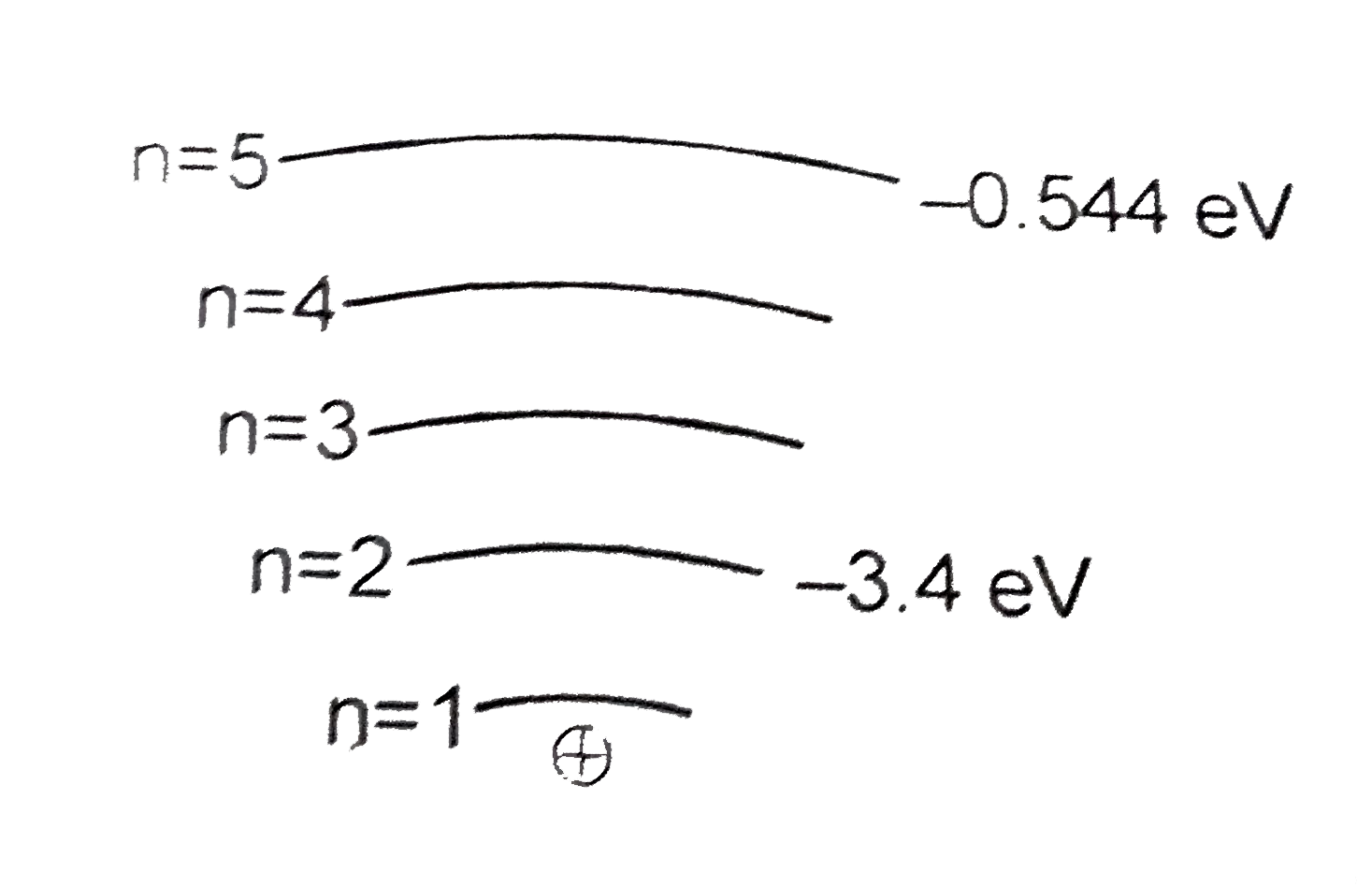
|
|
| 14. |
Calculate emf of cell for the following reaction. Ni_((S))+2Ag^(+)(0.002M) to Ni^(+2)(0.160M)+2Ag_((S)) [where, E_(cell)^(@)=1.05V]. |
|
Answer» `1.9142` |
|
| 15. |
Calculate elevation in boiling point of final solution (in kelvin) obtained after removal of of solid solvent from a solution having 1 mole of non-volatile nonelectrolyte solute in 1000g solvent and cooled to a temperature of 3^(@) C below the freezing point of solvent . Given : Cryoscopic constant of solvent =1.5 K kg mol^(-1) and ebullioscopic constant of solvent = 1 K kg mol^(-1). |
|
Answer» |
|
| 16. |
Calculate electrode potential of Zn^(2+)(0.1M)//Zn"||"Cl^(-)(0.01)//Cl_(2), Pt E^(@)Zn^(2+)//Zn = -0.762V, E^(@) 1/2 Cl_(2)//Cl^(-) = + 1.36V |
|
Answer» |
|
| 17. |
Calculate effective nuclear charge on a valence electron in a nitrogen atom N = 1s^(2) 2s^(2)2p^(3). |
|
Answer» SOLUTION :`=4xx0.35+2xx0.85` =3.1 `Z.=Z-sigma=7-3.1=3.9` |
|
| 18. |
Calculate E_("Cell")^(@)Cu//Cu^(2+)||Ag^(+)\\Ag E_(Cu)^(@)=0.34V,E_(Ag)^(@),E_(Ag)^(@)=+0.80V |
|
Answer» Solution :`E_("CELL")^(@)=E_(AG)^(@)-E_(Cu)^(@)=0.80-0.34` =0.46 V |
|
| 19. |
Calculate E_(cell) for Cr|Cr^(3+)||Cr^(3+)|Cr: |
|
Answer» `(0.028V)` `CU^(2+) (AQ) + 2E^(-) rightarrow Cu(s)` |
|
| 20. |
CalculateE_("cell")^(0),Delta G^(@) and equilibriumconstantfor thereaction2Cu^(+) to Cu^(2+)+Cu E_(Cu)^(0)| Cu = 0.52 V " and" E_(Cu) ^(0),Cu^(+) = 0.16V . |
|
Answer» `E_(Cu^(+))^(0) | Cu =0.52 V , E_(Ca^(2+)) , Cu^(+)= 0.16 V` ` 1 F =96500 C` `E_("cell")^(0)= ?Delta G^(@) = ? ` (i) Theformulationof thecell : `Pt| Cu_((aq))^(+)Cu_((aq))^(2+) "||" Cu_((aq))^(+) | Cu_((s))` `((LHE .Cu_((aq))^(+) to Cu_((aq))^(+)+ e^(-))/(RHE. Cu_((aq))^(+)toCu_((s))))/(2Cu_((aq))^(+) to Cu_((aq))^(2+) + Cu_((s)))""underset"(Overall cell reaction )"underset"(Reduction atcathode)"("(Oxidation at anode)")` `:. n=1` `E_("cell")^(0)= E_(cu^(+) |Cu)- E_(Cu^(+2))^(0).Cu^(+)` `=0.52- 0.16 =0.36 V` (ii) `Delta G^(@)=- nFE_("Cell")^(0)=- 1xx 96500 xx 0.36` `=- 34740 J` `=- 34.74 kJ` (ii)If Kis theequilibriumconstantfor theelectrochemicalredox reaction then `K= ([Cu^(2+)])/([Cu^(+)]^(2)) ` `E_("cell")^(0)= (0.0592)/(n) log_(10) k` `:. log_(10)K = (nxx E_("cell ")^(0))/(0.0592)` `=(1xx 0.36)/(0.0592)` `=6.081 ` `:. K = A16 .081 = 1x2 xx 10^(6) ("MOL" DM^(-3))^(-1)(or "mol"^(-1) dm^(3))` |
|
| 21. |
Calculate EAN of the metal in complexes (a) Fe(C_(2)O_(4))_(3)^(3-) and (b) CO(NO_(2))_(6)^(3-) |
|
Answer» SOLUTION :`Fe(C_(2)O_(4))_(3)^(3-)`the LIGAND `C_(2)O_(4)^(2-)` is a BIDENTATE ligand and oxidation no. of metalis +3 `THEREFORE` Electrons lellin`Fe^(3+) - 23` Electrons gained from 3 bidentate ligands = 12 `thereforeEAN = 23+ 12 =35` (b) For Co ATOMIC number = 27 Electrons lost =3 Electrons gained from `6 ligands = 12impliesEAN = 36` |
|
| 22. |
Calculate EAN in the following complexes : (1) [Cr(H_(2)O)_(2) (NH_(3))_(2) (en)] Cl_(3), (2) [Ni(en)_(2)]SO_(4) |
Answer» SOLUTION :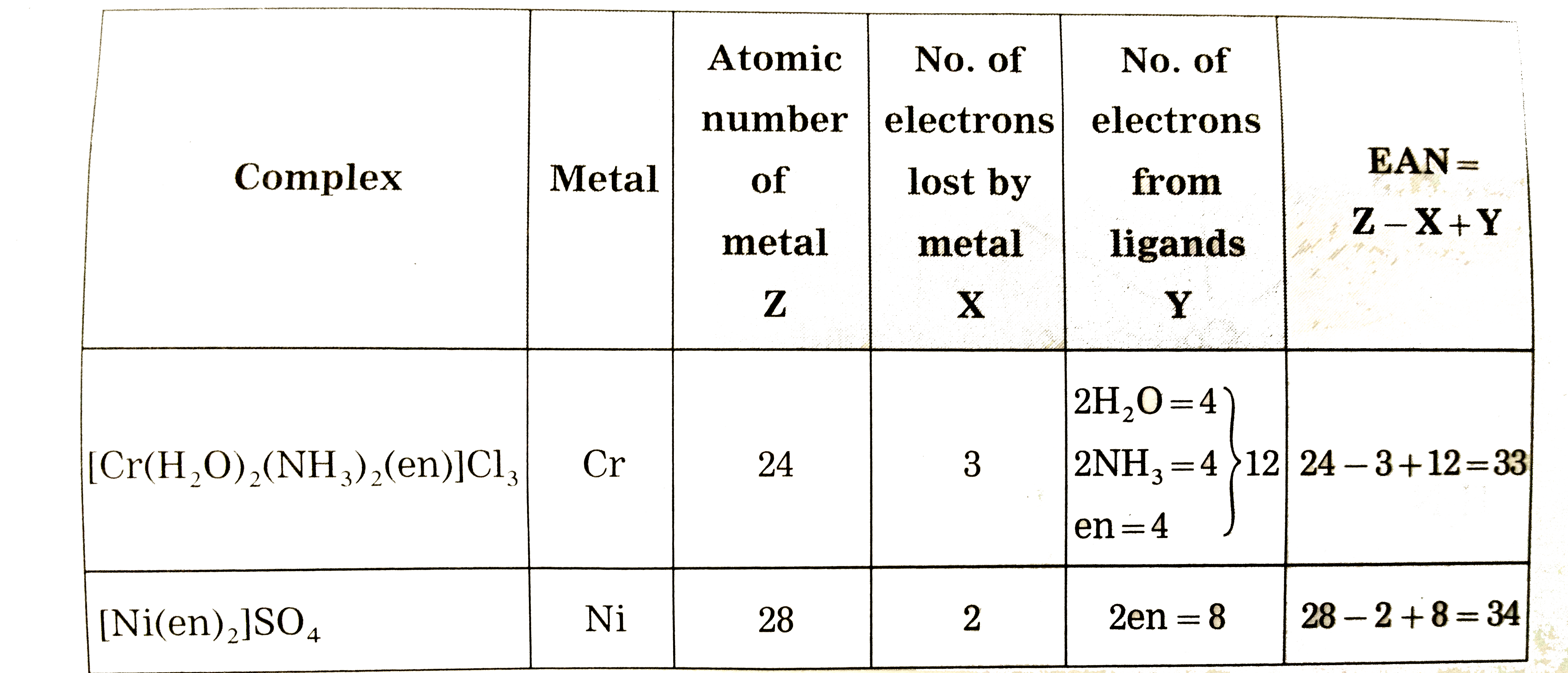
|
|
| 23. |
Calculate EAN of iron in potassium ferricyanide. |
|
Answer» SOLUTION :EAN = Z-X + Y = 26-3-12 = 35 . |
|
| 25. |
Calculate E^0 and E for the cell Sn||Sn^(@+)(1M)||Pb^(2+)(10^(-3)M)|Pb,E^0(Sn^(2+)|Sn)=-0.14V,E^0(Pb^(2+)|Pb)=-0.13V is thecell representation is correct ? |
|
Answer» |
|
| 26. |
Calculate E of the cell withCu^(2+) (0.1)//Cu electrode andCl^(-)(0.1M)// 1/2Cl_(2), Pt electrode. E^(@) Cu^(2+)//Cu= +0.33V and E^(@) 1/2 Cl_(2)//Cl^(-) = 1.36V |
|
Answer» |
|
| 27. |
Calculate E_(" cell")^(@)E_("cell") and Delta G for thefollowingreactionat 25^(@)C Mg_((s)) +Sn^(2+)(0.03 M) toMg^(2+)(0.04 M) +Sn_((s)) E_(Mg^(+2)|M) ^(@) =- 2.37 V and E_(Sn^(2+) | Sn)^(@)=- 0.14 V is thereactionspontaneous |
|
Answer» Solution :`(i) E_("cell ")^(@) =2 .23 V , (ii) E_("cell ")=2.226V DELTA G =429 .6 KJ` `(iii) ` Since `E_("cell") gt 0, Delta G lt 0` the reactionis spontaneous |
|
| 28. |
Calculate difference in work done in process -I to process -II. (Given : pi =3) |
|
Answer» `=- (2xx2 +(3xx1xx1)/(2)) + (3xx1xx1)/(2)+8xx 2+0 =-5.5 +(3)/(2)+16 =12` Process - II`W=((3XX 2xx2)/(2)+4xx2) = - (6+8)=- 14 ` Diffrence in workdone= 12 -(-14)= 26 |
|
| 29. |
Calculate DeltaS_(r)^(@) at298 K of ,(i) Na(s) +(1)/(2)CL_(2)(g) to NaCl(s), (ii) (1)/(2) N_(2)(s) + 2H _(2)(g) +(1)/(2) Cl_(2)(g) to NH_(4) Cl(s)(iii)C(graphite)to C( diamond). The values of S^(@) ofNa, Cl_(2), NaCl, NH_(4) Cl, N_(2), H_(2),"diamond& graphite are" 51, 223,72,95 ,192,131, 2.43 & 5.69 JK^(-1)mol^(-1)respectively . |
|
Answer» (i) `""DeltaS = 72 - [51+(223)/(2)]` `= - 90.5 J K^(-1) "Mole"^(-1)`(ii) `""(DeltaS^(@))_(R) = - 374.5 J//K-"Mole"` (III) `""(DeltaS^(@))_(R) = - 3.26 J//K-"Mole"` |
|
| 30. |
Calculate Delta_(r)G^(@) and log K_(c)for the following reaction at 298 K. 2Cr_((s))+Cd_((aq))^(3+)+33Cd_((s)){Given :E^(@)""_(Cell")=+0.34V,IF=96500Cmol^(-1)] |
|
Answer» Solution :`2Cr_((s))+3Cd_((aq))^(3+)+3Cd(s)` `E^(@)cell =0.34V, IF=96500C//mol.` `DELTAG^(@)=-NFE^(@)cell` For this reaction , N = 6 `[{:(2Crto2Cr^(3+)+6E^(-)),(3Cd^(3+)+6e^(-)to3Cd):}]` `DeltaG =-6 xx96500xx0.34` `DeltaG=-196860J//molk_(c)` `DeltaG=-2.303RT log k_(c)` `logk_(c)""(-DeltaG)/(2.303xx8.314xx298)` `logk_(c)=(+196860)/(2.303xx8.314xx298)` `log k_(c)=34.5014` |
|
| 31. |
Calculate Delta_rG^@ for the following reactions: Fe^(+2) (aq)+Ag^(+) (aq) to Fe^(+3) (aq)+Ag (s) |
|
Answer» Solution :`Delta_rG^@=-N FE^@` `=-1 times 96500 times 0.03` `=2895 J OR 2.895 K J` |
|
| 32. |
Calculate Delta_("neut")H of HA. If bond dissociation energy of H-A is 5KJ//"mol" |
|
Answer» |
|
| 33. |
Calculate DeltaH_f^@ for chloride ion from the following data1/2 H_2(g) + 1/2 Cl_2(g) to HCl (g) , Delta H_f^@ = -92.4kJHCl(g) + xH_2O to H^(+)(aq) + Cl^(-) (aq), Delta H_(298) = -74.8kJ Delta H_f^@ [H^(+) (aq) ] = 0.0kJ |
| Answer» SOLUTION :`-167.2 KJ` | |
| 34. |
Calculate DeltaH^(@) for the reaction,Na_(2)O(s)+SO_(3)(g)rarrNa_(2)SO_(4)(g) Given the following : (i) Na(s)+H_(2)O(l)rarrNaOH(s)+(1)/(2)H_(2)(g) DeltaH^(@) =-146 kJ(ii)Na_(2)SO_(4)(s)+H_(2)O(l)rarr2NaOH(s)+SO_(3)(g)DeltaH^(@)=+418 kJ(iii)2Na_(2)O(s)+2H_(2)(g)rarr4Na(s)+2H_(2)O(l) DeltaH^(@)=+259 kJ |
|
Answer» `+823` kJ |
|
| 35. |
Calculate DeltaH (in joules) for C (graphite) rarr C (diamond), From the following data C ("graphite")+O_(2(g))rarrCO_(2(g)),DeltaH=-393.5 kJC("diamond")+O_(2(g))rarrCO_(2(g)),DeltaH=-395.4 kJ |
|
Answer» 1900 |
|
| 36. |
Calculate DeltaH at 358 K for the reaction Fe_(2)O_(3)(s)+3H_(2)(g) to 2Fe(s)+3H_(2)O(l) Given that, DeltaH_(298)=-33.29 kJ "mole"^(-1) and C_(p) for Fe_(2)O_(3)(s),Fe(s),H_(2)O(l) and H_(2)(g) are 103.8, 25.1, 75.3 and 28.8 J/K "mole". |
|
Answer» SOLUTION :`DeltaC_(p)=2xx25.1+3xx75.3-[103.8+3xx28.8]` `=85.9 "J/K mole"` We have, `(DeltaH_(2)-DeltaH_(1))/(T_(2)-T_(1))=DeltaC_(p)` ….(EQN. 9a) `(DeltaH_(358)-(-33290))/(358-298)=85.9` `DeltaH_(358)=-28136 "J/mole"` `=-28.136 "kJ/mole"`. |
|
| 37. |
Calculate DeltaH^(@) for the reaction between ethene and water to form ethyl alcohol from the following data: Delta_(c)H^(@)C_(2)H_(5)OH_((1))=-136kJ Delta_(c)H^(@)C_(2)H_(4(g))=-1410kJ Does the calculated DeltaH^(@)represent the enthalpy of formation of liquid ethanol ? |
|
Answer» SOLUTION :`CH_(2)=CH_(2(g))+H_(2)O_((g))hArrCH_(3)CH_(2)OH_((g))` `DeltaH=sumnH^(@)f_("PRODUCTS")-sumnH^(@)f_("reactants")` `=(1xx-1368)-[(1xx(-1410)+(1xx-286))` `=-1368-[-1410-286]` `=-168-[-1696]` `DeltaH=328J//mol` No calculated value does not represent the enthalpy of formation of liquid enthanol. Standard enthalpy of formation for liquid ethanol is `-277.6kJ//mol.` |
|
| 38. |
Calculate DeltaH for the following homogeneous gaseous reaction CH_(3)COCH_(3)+2O_(2) to CH_(3)COOH+CO_(2)+H_(2)O from the following data: Bond energies : C-H=99 "kcal" C-C=83 "kcal" C=O=173 "kcal" O=O=118 "kcal" C-O=84 "kcal" O-H=110 "kcal" |
|
Answer» Solution :We have `H-overset(H)overset(|)UNDERSET(H)underset(|)(C )-overset(O)overset(||)(C )-overset(H)overset(|)underset(H)underset(|)(C )-H+2O=O to H-overset(H)overset(|)underset(H)underset(|)(C )-overset(O)overset(||)(C )-O-H+O=C=O` `+H-O-H`, `DeltaH=?` For REACTANTS Bond energy of 6 moles of C-H bonds `=6xx99` kcal Bond energy of 2 moles of C-C bonds `=2xx83` kcal Bond energy of 1 mole of `C=O` bonds `=1xx173` kcal Bond energy of 2 moles of O=O bonds `=2xx118` kcal For products Energy of formation of 3 moles of C-H bonds `=-3xx99` kcal Energy of formation of 1 mole of C-C bonds `=-83` kcal Energy of formation of 1 mole of C=O bonds `=-173` kcal Energy of formation of 1 mole of C-O bonds `=-84` kcal Energy of formation of 1 mole of O-H bonds `=-110` kcal Energy of formation of 2 moles of C=O bonds `=-2xx173` kcal Energy of formation of 2 moles of O-H bonds `=-2xx110` kcal Adding up, we get `DeltaH` of the required equation i.e., `DeltaH=-144` kcal |
|
| 39. |
Calculate DeltaG_(r)^(@) of the following reaction Ag^(+)(aq)+cI^(-)(aq)rarrAgCI(s) Given DeltaG_(r)^(@)(AgCI)rarr109 kJ Mol^(-1) DeltaG_(r)^(@)(CI^(-))rarr-129 kJ Mol^(-1) DeltaG_(r)^(@)(ag^(-))rarr77 kJ Mol^(-1) (i)Represent the above reaction in form of a cel (ii) Calcualte E^(@) of the cel (iii) Find log_(10)K_(sp) of AgCI |
|
Answer» `68 kj mol^(-)` (i) `Ag(s)|Ag^(+)||AgCI||CI^(-)|CI_(2),pt` (ii) `E_(cell)^(@)=0.59V` (iii)`log_(10)K_(sp)=-10` |
|
| 40. |
Calculate DeltaG_(r)^(@) of the following reaction: (a) Ag^(+)(aq)+Cl^(-)(aq)rarrAgCl(s) Given Represent the above reaction in form of a cell. Calculate E^(@) of the cell. Find "log"_(10) K_(sp) of AgCl. (b) 6.539xx10^(-2)g of metallic Zn(u=65.39) was added to 100mL of saturated solution of AgCl. Calculate "log"_(10)([Zn^(2+)])/([Ag^(+)]^(2)). Given that Ag^(+)+e^(-)rarrAg. E^(@)=0.80V Zn^(2+)+2e^(-)rarrZn, E^(@)=-76V Also find how many moles of Ag will be formed? |
| Answer» | |
| 41. |
Calculate DeltaG for(i) H_(2)O(l,2 atm , 300K)to H_(2)O(g, 2 atm, 300 K )(ii)H_(2)O(l,P" "atm , 300K)to H_(2)O(g, P" "atm, 300 K ) Cacluate pforwhich DeltaG = 0 Given: DeltaH_(373)= 40 kJ ""C_(P) (H_(2) O, l) = 75 J//mol //K""C_(P) (H_(2) O, g) = 35 J//mol //K |
|
Answer» |
|
| 42. |
Calculate |Delta_(f)G^(@)| for (NH_(4)Cl, s) at 350 K. Given : Delta_(f)H^(@) (NH_(4)Cl, s)=-314.5" kJ/mol" {:(S_(N_(2)(g))^(@)=192 JK^(-1) mol^(-1),,S_(H_(2)(g))^(@)=130.5 JK^(-1) mol^(-1),),(S_(Cl_(2)(g))^(@)=223 JK^(-1) mol^(-1),,S_(NH_(4)Cl(s))^(@)=94.5 JK^(-1) mol^(-1),,"All given data at 300 K".),(Delta_(r)C_(P)=-20" J/mol-K",,ln(350/300)=0.15,):} |
|
Answer» <P> Solution :`Delta_(f)S^(@)(NH_(4)Cl, s)` at `300 K=S_(NH_(4)Cl(s))^(@)-[1/2 S_(N_(2))^(@)+2S_(H_(2))+1/2 S_(Cl_(2))^(@)]``=94.5-(1/2xx192+2xx130.5+1/2xx223)` `=94.5-(96+261+111.5)` `Delta_(f)S_(300)^(@)""=-374 JK^(-1) mol^(-1)` `Delta_(f)S_(310)^(@)""=Delta_(f)S_(300)^(@)+Delta_(r)C_(p)ln (350/300)` `=-374-20xx(0.15)=-377 JK^(-1) mol^(-1)` `Delta_(f)H_(310)^(@)""=Delta_(f)H_(300)^(@)+Delta_(r)C_(p) [350-300]` `=-314.5-(20xx50)/(1000)=-315.5` `Delta_(f) G_(350)^(@)""=Delta_(f)H^(@)-T. Delta_(f) S^(@)` `=-315.5-(350xx(-377))/(1000) ""rArr-183.55" kJ/mol"` `|Delta_(f) G_(350)^(@)|""=183.55" kJ/mol"rArr""183" kJ/mol"` |
|
| 43. |
Calculate DeltaG at 298 K for the following reaction if the reaction mixture consists of 1 atm of N_(2),3 atm of H_(2) and 1 atm of NH_(3). N_(2)(g)+3H_(2)(g) hArr 2NH_(3)(g),DeltaG^(0)=-33.32 kJ What is the effect of increasing pressure on the reaction ? |
|
Answer» SOLUTION :`Q=(p_(NH_(3))^(2))/(p_(N_(2))*p_(H_(2))^(3))=(1^(2))/(1xx3^(2))=3.7xx10^(-2)` where Q is the REACTION quotient `:.DeltaG=DeltaG^(@)+2.303RTlogQ` `DeltaG=(-33.32)+2.303xx8.314xx10^(-3)xx298log(3.7xx10^(-2))` `DeltaG=-41.49kJ` Thus, increasing the pressure of `H_(2)` from 1 atm (std. condition) to 3 atm, free energy CHANGE, `DeltaG` becomes more negative that is from `-33.32kJ` to `-41.49kJ`. Hence increase in pressure favours the forward reaction. |
|
| 44. |
CalculateDeltaG for conversion of oxtgen to ozone 3//2O_(2(g))toO_(3(g))at 298K, if K_(p) for this coversion is 2.47xx10^(-29) |
|
Answer» <P>`163kJ mol^(-1)` THEREFORE, `DeltaG^(@)=-2.303xx(8.314)xx(298)(log2.47xx10^(-29))` `DeltaG^(@)=16,300J mol^(-1)=163KJmol^(-1).` |
|
| 45. |
Calculate Delta H^(theta) for the reaction : H_(2)O (l) rarr H_(2)(g) + (1)/(2) O_(2) (g) Given 2H_(2)(g) + O_(2)(g) rarr 2H_(2)O(l) Delta H = -571.6 kJ |
|
Answer» 571.6 KJ |
|
| 46. |
Calculate Delta U reaction for the hydrogenation of acetalence at constant volume and at 77^(@)C. Given that -DeltaH_(f)(H_(2)O)= -678 kcal mole , Delta H_("comb")(C_(2)H_(2))= -310.1 kcal//ms^(2) |
|
Answer» `C_(2)H_(2(G)) + H_(2(g)) rarr C_(2)H_(4(g)) ""DeltaH-DeltaU-=?` `H_(2(g))+ (1)/(2)O_(2(g)) rarr H_(2)O(l) "" DeltaH- = -67.8 """…"`(1) `C_(2)H_(2(g)) + (5)/(2)O_(2(g)) rarr 2CO_(2) + 2H_(2)O(l)"" DeltaH-=-310.1"""..."`(2) `C_(2)H_(4) + 3O_(2(g)) rarr 2CO_(2(g)) + 2H_(2)O(l)"" DeltaH-=-337.2 """..."(3)` `(1) + (2) -(3)` `implies C_(2)H_(2(g)) rarr C_(2)H_(4(g))` `DeltaH_(rxxn) = -67.8 - 310.1 + 337.2 = -40.7 KCal` `DeltaH = DeltaU + Deltan(g)RT` `-40.7= DeltaU +(-1) xx 2 10^(-3) xx 350` `DeltaU= -40.7+.7` `DeltaU=-40"KCal"//"mole"` |
|
| 47. |
Calculate Delta G^(0) for the reaction CaF_(2)(s) hArr Ca^(2+)(aq)+2F^(-)(aq) Given that, DeltaG_(f)^(0)(CaF_(2)(s))=-1162 kJ//"mole" DeltaG_(f)^(0)(Ca^(2+)(aq))=-553.0"and" DeltaG_(f)^(0)(F^(-)(aq))=-276.5kJ//"mole" Also calculate K_(sp) for this reaction at 25^(@)C. |
|
Answer» |
|
| 48. |
Calculate Delta G^@ for the following reaction.Ag^(+) (aq) + Cl^(-) (aq) to AgCl(s)Given Delta G_f^@ (AgCl) = - 109kJ //"mol"Delta G_f^@ (Cl^-) = -129 kJ/mol Delta G_f^@ (Ag^+) = 77 kJ/mol Represent the above reaction in the form of a cell. Also calculate E^@of the cell and find log K_(sp) of AgCl. |
| Answer» SOLUTION :`(AG|AgCl, CL^(-) Ag^(+) | Ag) 0.59V, -10` | |
| 49. |
Calculate crystal field stabilization energy for [Fe(CN)_(6)]^(3-). |
| Answer» SOLUTION :`2.0Delta_(0)` | |
| 50. |
Calculate conductance of 1 M AgNO_(3) solution at 298 K if the inter electrode distance is 5 cm and the area of each electrode is 2 cm^(2). The equivalent conductance of the solution L_(E)=94.3" S "cm^(2)equiv^(-1) |
|
Answer» `1"M " AgNO_(3)=1"N " AgNO_(3) , Lambda_(E)=(1000xxk)/(N)` or `(94.3" S "cm^(2)" equiv"^(-1))=((1000 cm^(3))xxk)/((1" equiv".))` `k=((94.3s cm^(2)" equiv"^(-1))xx1("equiv"))/((1000 cm^(3)))=0.09435" S cm"^(-1)` Step II. Calculation of conductance (C ) `k="Conductance"xx"CELL constant"` Conductance (C )`=(k)/("cell constant")=((0.09435" S cm"^(-1)))/((5//2 cm^(-1)))=0.03774" S "=37.74xx10^(-3)" S "`. |
|