

Saved Bookmarks
This section includes 7 InterviewSolutions, each offering curated multiple-choice questions to sharpen your Current Affairs knowledge and support exam preparation. Choose a topic below to get started.
| 1. |
Calculate change in internal energy for a gas under going from state-I (300K,2xx10^(-2)m^(3)) to state - II (400K,4xx10^(-2)m^(3)) for one mol. Of vanderwal gas. (a) If gas is ideal [C_(v)=12J//Kmol] (b) If gas is real {"Given":((delU)/(delV))_(T)=T((delP)/(delT))_(V)-P" "C_(V)=12J//k//mol" "a=2J.m.//mol^(2)} |
|
Answer» Solution :(a) `DeltaU=nC_(V)(T_(2)-T_(1))=1xx12xx100=1200J` (b) `du=((delU)/(DELT))_(v)DT+((delU)/(delV))_(T)DV` `[[(P+a/V^(2))(V-b)=RT],[P=(RT)/(V-b)-a/V^(2)],[rArr(delP)/(delT)=R/(V-b)]]` = `((delU)/(delT))_(v)dT+[T((delP)/(delT))_(V)-P]dV` = `C_(V)dT+a/V^(2)dV` `dU=C_(V)(T_(2)-T_(1))+a(1/V_(1)-1/V_(2))` = `C_(V)(100)+a(1/4)xx10^(2)` = `12xx100+2(1/4)xx100=1250` |
|
| 2. |
Calculate change in internal energyof CO_(2) for two mole, if temperatur change I s100 K invery high tempertaure range. |
|
Answer» |
|
| 3. |
Calculate [CH_3COOH]//[CH_3COO]in a buffer solution whose pH is 7.0. Explain how it is possible to have any acid in a neutral solution. |
| Answer» SOLUTION :`5.6 XX 10^(-3)` , possible when some base is PRESENT | |
| 4. |
Calculate |C.F.S.E| (mod value) is term of Dq. For complex ion [MnF_(6)]^(3-). |
Answer» 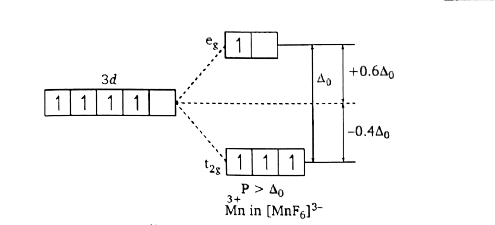 `C.F.S.E.` VALUE`=-(3xx0.4Delta_(0))+(1xx0.6Delta_(0))=-0.6Delta_(0)=-6Dq` `|CFSE|=6Dq`. |
|
| 5. |
Calculate Boyle temperature range for CO_(2) if its van der Waal's constants a and b are 3.592 atm "litre"^(2)" mole"^(2) and b =0.0427" litre mole"^(-1). |
|
Answer» Solution :`T_(B) =(a)/(RB) =(3.592)/(0.0821xx0.0427)=1024.7K =752^(@)C` THUS, `CO_(2)` BEHAVES IDEAL in nature in the temperature range `752 pm t^(@)C` |
|
| 6. |
Calculate cell potential at 298K for the following cell. Zn_((S))|Zn^(2+)(0.6M)||Cu^(2+)(0.3M)|Cu_((S))[E_(cell)^(Theta)=1.1V] |
|
Answer» SOLUTION :Reaction : `Zn_((S))|Zn^(2+)(0.6M)||CU^(2+)(0.3M)|Cu_((S))` Where, `n=2,""E_(cell)^(THETA)=1.1V` `[Zn^(2+)]=0.6,""[Cu^(2+)]=0.3M` Cell potential=`E_(cell)` `E_(cell)=E_(cell)^(Theta)-(0.059)/(n)"log"([Zn^(2+)])/([Cu^(2+)])` `=1.1-(0.059)/(2)"log"(0.6)/(0.3)` `=1.1-0.0295log2` `=1.1-(0.0295)(0.3010)` `=1.1-0.0089` `=1.0911`V |
|
| 7. |
Calculate cell potential of electrochemical cell made up of Cr and Na. E_(Cr^(+3)//Cr)^(@)=-0.74V,E_(Na^(+)//Na)^(@)=-2.71V |
|
Answer» 3.45 V `E_(cell)^(@)=E_("RED (cathode)")^(@)-E_("red (anode)")^(@)` =-0.74+2.71=1.97 V |
|
| 8. |
Calculate C - Cl bond enthalpy from following reaction : CH_(3) Cl(g) + Cl_(2) (g) to CH_(2) Cl_(2) (g) + HCl(g) Delta H^(@) = - 104 kJ. If C-H,Cl - Cl and H - Cl bond enthalpies are 414, 243 and 431 kJ "mol"^(-1) respectively. |
|
Answer» SOLUTION :`DELTA H^(@) = sum H_("reactant bond")^(@) - sum H_("product bond")^(@)` `- 104 = (3 XX H_(c - H)^(@) + H_(C - Cl)^(@) + H_(Cl - Cl)^(@))` `(2 xx H_(C - H)^(@) + H_(C - Cl)^(@) + H_(H - Cl)^(@))` `- 104 = (3 xx 414 + X + 243)` `- (2 xx 414 + 2K + 2K + 431)` `- 104 = (1242 + X + 243) - (828 + 2X + 431)` `104 = 226 - X` `:. X = 330 KJ mol^(-1)` |
|
| 9. |
Calculate boiling point of a solution pepared by dissoving 15.0 g of NaCI in 250.0 g of water (K_(b) for water = 0.512 K kg mol^(-1)), Molar mass of NaCI=58.44 g mol^(-1)). |
|
Answer» NaCI DISSOCIATES in AQUEOUS solution as : `NaCI(s)overset(("aq"))toNa^(+)("aq")+CI^(-)("aq")` `i=2, W_(B)=15.0 G, M_(B)=58.44" g mol"^(-1), W_(A)=250 g=0.25 kg` `K_(b)=0.152" K kg mol"^(-1)` `DeltaT_(b)=ixxK_(b)xxm=(ixxK_(b)xxW_(B))/(M_(B)xxW_(A))` `DeltaT_(b)=(2xx(0.512" K kg mol"^(-1))xx(15.0g))/((58.44"g mol"^(-1))xx(0.25 Kg))=1.05 K` Step II. Calculation of boilling point of solution `(T_(b))` `T_(b)=T_(b)^(@)+DeltaT_(b)=(373+1.05)K=374.05 K` |
|
| 10. |
Calculate an integer obtained by adding solution codes of all true statements and duducting solution codes of all incorrect statements. {:("Statements",,"Solution codes"),("1. " PV_(m) "for all gases whether real or ideal approach to same value as P approaches zero.",,12),("2. Vander-wall constant a for " H_(2) "is more as compared to a for " O_(2),,8),("3. Vander-wall theory assumes interparticle interactions to be either attactive or repulsive",,2),("4. At normal temperature compressibility of He gas can be less than that of ideal gas. ",,5),("5. Negative deviations in Z vs P curve is attributed to finite size of molecules.",,4),("6. Free volumes available for molecules of an ideal gas is same as volume of container.",,3),("7. Isotherms of an ideal gas and real gas will be non intersecting hyperbolas.",,2):} |
|
Answer» |
|
| 11. |
Calculate Alred Rochow electronegativity in Fusing Slater rule, r_(F)=0.7065Å. |
|
Answer» SOLUTION :`X=(0.359)/(r^2)Z.+0.744` `=0.359xx((0.35xx6+0.85xx2))/((0.7056)^(2))+0.744=4.23` |
|
| 12. |
Calculate (a) molality(b) molarity and (c ) mole fraction of KI if the density of 20 % (mass / mass) aqueous KI is 1.202 g mL^(-1). |
|
Answer» Solution :(a)Molar mass of KI `= 39+127=16 g mol^(-1)` 20% (mass/mass) aqueous solution of KI means 20 kg of KI is present in 100 g of solution. That is, 20 g of KI is present in `(100 - 20)` g of water = 80 g of water THEREFORE, molality of the solution `= ("Moles of KI")/("Mass of water in kg")=((20)/(166))/(0.08)=1.506 m` = 1.51 m (approximately). (b)It is GIVEN that the density of hte solution `= 1.202 g mL^(-1)` `therefore` Volume of 100 g solution `= ("Mass")/("Density")=(100 g)/(1.202 g mL^(-1))` = 83.19 mL `= 83.19xx10^(-3)L` Therefore, molarity of the solution `= ((20)/(160))/(83.19xx10^(-3)L)=1.45M` (c )Moles of KI `= (20)/(166)=0.12 mol` Moles of water `= (80)/(18)=4.44 mol` Mole fraction of KI `= (0.12)/(0.12+4.44)=0.0263`. |
|
| 13. |
Calculate (a) molality (b) molarity and (c) mole fraction of KI if the density of 20% (mass/mass) aqueous KI is 1.202 g mL^(-1) |
|
Answer» Solution : Let the MASS of solution in water = 100 g The mass of KI = 20 g ` therefore ` Mass of SOLVENT (water) = 100 - 20 = 80 g = 0.080 KG (a) Calculation of molality Molar mass of KI = 39 + 127 = 166 g `"MOL"^(-1)` Number of moles of KI `= 20/166 = 0.120` Molality of solution = Number of moles of KI / Mass of solvent in kg ` = (1.120)/(0.080) = 1.5 m` (b) Calculation of molarity Density of solution = 1.202 g` mL^(-1)` Volume of solution ` = (100g)/(1.202 g mL^(-1) ) = 83.2 mL = 0.0832 L`(volume = mass/density) Molarity of solution = Moles of solute / olume of solution in L ` = (0.120)/(0.0832) = 1.44 M` (c) Calculation of mole fraction of KI Number of moles of KI = 0.120 Number of moles of water = Mass of water / Molar mass of water ` = 80/18 = 4.44` Mole fraction of KI= `(0.120)/(0.120 + 4.44) = (0.120)/(4.560) = 0.0263` |
|
| 14. |
Calculate (a) molaity (b) molarity and (c) mole fraction of KI if the density of 20% (mass/mass) aqueous KI s "1.202 g mL"^(-1). |
|
Answer» Solution :`20%` (MASS/mass) aqueous KI solution means that Mass of KI = 20 g, `""` Mass of solution in water = 100 g `therefore"Mass of solvent (water) "=100-20=80g=0.080 KG` (a) Calculation of molality `"Molar mass of KI"=39+127="166 g mol"^(-1)"" therefore"Moles of KI"=("20 g")/("166 g mol"^(-1))=0.120` `"Molality of solution"=("No. of moles of KI")/("Mass of solvent in kg")=("0.120 MOLE")/("0.080 kg")="1.5 mol kg"^(-1)`. (b) Calculation of molarity `"Density of solution "="1.202 g mL"^(-1)""therefore"VOLUME of solution "=(100g)/("1.202 g mL"^(-1))="83.2 mL = 0.0832 L"` `"Molarity of solution"=("Moles of solute")/("Volume of solution in L")=("0.120 mole")/("0.0832 L")="1.44 M".` (c) Calculation of mole fraction of KI No. of moles of KI = 0.120 `"No. of moles of water"=("Mass of water")/("Molar mass of water")=("80 g")/("18 g mol"^(-1))=4.44` `"Mole fraction of KI"=("No. of moles of KI")/("Total no. of moles in solution")=(0.120)/(0.120+4.44)=(0.120)/(4.560)=0.0262`. |
|
| 15. |
Calculat the equilibrium constant for the reaction, Zn(s)+Ag_(2)O(s)+H_(2)O(l) rarr 2Ag(s)+Zn^(2+)(aq.)+2 OH^(-) (aq.) when E_(cell)^(@)=1.11 at 298 K. |
|
Answer» |
|
| 16. |
Calculalting the amount the product from the amount of charge in an electrolysis: A constant current of 0.452 A is passed through an electrolytic cell containing molten CaCl_(2) for a time of 1.50 hours. Write the electrode reactions and calculate the quantity of products (in grams) formed at the electrodes. Also find the volume (at STP) of any gaseous product formed. Strategy: to convert the current and time to grams or litres of product, carry out the sequence of conversions in Figure 3.9. |
|
Answer» Solution :Since the only ions present in molten `CaCl_(2)` are `Ca^(2+)` and `Cl^(-)`, the reactions are `{:("Anode": 2Cl^(-)(1)rarr Cl_(2)(g)+2e^(-)),("Cathode": Ca^(2+)(1)+2e^(-)rarrCa(1)),(bar("Overall": Ca^(2+)(1)+2Cl^(-)(1)rarr Ca(1)+Cl_(2)(g))):}` The quantities of `Ca` metal and `Cl_(2)` gas formed depend on the number of electrons that PASS through the electrolytic cell, which in turn depends on the current and time or CHARGE. Step 1: Because electrons can be thought of as a reactant in the electrolysis process, the first step is to calculate the charge and the number of moles of electrons PASSED throgh the cell: `Q = It` Charge `= (0.452 A)(1.50h)((3600s)/(1h))((1 C)/(1 A.s))` `(0.452(C)/(s)) (1.50h) ((60 min)/(h)) ((60 s)/(min))` `= 2440.8 C = 2.44 xx 10^(3)C` Moles of `e^(-) = 2.44 xx 10^(3)C (("1 mol" e^(-))/(96,500C))` `= 0.025 mol e^(-)` Step 2 : The cathode reaction yield `1` mol of `Ca` PER `2` mol of electrons, so `0.025//2` or `0.0125` mol of `Ca` will be obtained: `Ca^(2+) + 2e^(-) rarr Ca` Moles of `Ca = (0.025 mol e^(-)) ((1 mol Ca)/(2 mol e^(-)))` `= 0.0125 mol Ca` Step 3: Converting the number ofmoles of `Ca` to grams of `Ca` gives Grams of `Ca = (0.0125 mol Ca) ((40g Ca)/(mol Ca))` `= 0.5 g Ca` As a shortcut, the entire porcess of conversion of coulombs to grams can be carried out in one step: `? g Ca = (2.44 xx 10^(3)C)(1 "mole"^(-))/(96,500 C)(1 mol Ca)/(2 "mole"^(-))((40 g Ca)/(1 mol Ca))` `= 0.5 g Ca` Step 4: The anode reaction gives `1 mol` of `Cl_(2)` per 2 mol of electrons, so `0.0125 mol` of `Cl_(2)` will be obtained: `2Ci^(-)(l) rarr Cl_(2)(g) + 2e^(-)` Moles of `Cl_(2) = (0.025 "mole"^(-)) ((1 mol Cl_(2))/(2 mol E^(-)))` `= 0.0125 mol Cl_(2)` Step 5: Converting the number of moles of `Cl_(2)` to grams of `Cl_(2)` gives Grams of `Cl_(2) = (0.125 mol Cl_(2)) ((71 g Cl_(2))/(1 mol Cl_(2)))` `= 8.88 g Cl_(2)` Step 6: Since `1` mole of an ideal gas OCCUPIES `22.4 L` at STP, the volume of `Cl_(2)` obtained is Litres of `Cl_(2) = (0.125 mol Cl_(2))((22.4 L Cl_(2))/(1 mol Cl_(2)))` `= 0.28 L` As a shortcut, the entire sequence of conversions can be carried out in just one step. For example the volume of `Cl_(2)` produced at the anode is `(0.452(C)/(s))(1.50 h)((3600s)/(h))((1mol e^(-))/(96,500C))((1molCl_(2))/(2 "mole"^(-)))` `((22.4LCl_(2))/(1molCl_(2)) = 0.28 L` |
|
| 17. |
Calculate (5.7xx10^(6))div(4.2xx10^(3))""(ii)(5.7xx10^(6))div(4.2xx10^(-3))""(iii)(5.7xx10^(-6))div(4.2xx10^(-3)) |
|
Answer» SOLUTION :`(5.7xx10^(6))DIV(4.2xx10^(3))=(5.7xx10^(6))/(4.2xx10^(3))=(5.7)/(4.2)xx10^(6-3)=1.357xx10^(3)` `(ii) (5.7xx10^(6))div(4.2xx10^(-3))=(5.7xx10^(6))/(4.2xx10^(-3))=(5.2xx10^(6))/(4.2xx10^(-3))=(5.7)/(4.2)xx10^(6-(-3))=1.357xx10^(9)` `(iii)(5.7xx10^(-6))div(4.2xx10^(-3))=(5.7xx10^(-6))/(4.2xx10^(-3))=5.7xx10^(-6(-3))=1.357xx10^(-3)` |
|
| 18. |
Calcuim phosphide (Ca_3P_2) formed by reacting calcuim orthophosphate (Ca_3(PO_4)_2) with magnesium was hydrolsed by water. The evolved phosphine (PH_3) was burnt in air to yield phosphorus pentoxide (P_2O_5).reducingcalcuim phosphide. (At. Wt. Mg=24, P=31) Ca_3(PO_4)_2+Mg toCa_3P_2+MgO Ca_3P_2+H_2OtoCa(OH)_2+PH_3 PH_3+O_2toP_2O_5+H_2O MgO+P_2O_5tounderset("magnesium metaphosphate")(Mg(PO_3)_2) |
|
Answer» `Ca_3(PO_4)_2+8Mgt OCa_3P_2+8MgO` `Ca_3P_2+6H_2Oto3Ca(OH)_2+2PH_2` `2PH_3+4O_2toP_2O_5+3H_2O` `MgO+P_2O_5toMg(PO_3)_2` moles of magnesium USED =0.8 moles moles of MgO formed =0.8 moles moles of `Ca_3P_2` formed 0.1 moles moles of `PH_3` formed=0.2 moles moles of `P_2O_5` formed =0.1 moles (LIMITING REAGENT) moles of `Mg(PO_3)_2=0.1` moles mass of `Mg(PO_3)_2=18.2` gram |
|
| 19. |
Calcuate the molality of a sulphuric acid solution in which the mole fraction of water is 0.85. |
|
Answer» Solution :Mole fraction of water = 0.85 Mole fraction of `H_(2)SO_(4)` in the solution `=1-0.85=0.15,"i.e., "(n_(2))/(n_(1)+n_(2))=0.15` where `n_(2)` is the number of mole of `H_(2)SO_(4)` and `n_(1)` is the number of moles of `H_(2)O` in the solution. Molality of `H_(2)SO_(4)` solution means the number of moles of `H_(2)SO_(4)` present in 1000 g of `H_(2)O`. Thus, we have to FIND `n_(2)` when `w_(1)=1000`, i.e., `n_(1)=(1000)/(18)=55.55" moles."` Substituting the value of `n_(1)` in equation (i), we GET `(n_(2))/(55.55+n_(2))=0.15"or"n_(2)=0.15n_(2)+8.3325 or 0.85n_(2)=8.3325` `n_(2)=(8.3325)/(0.85)="9.8 moles, i.e, Molality"= 9.8m.` Alternatively, `(n_(1))/(n_(1)+n_(2))=0.85"...(i)"THEREFORE""(n_(2))/(n_(1)+n_(2))=1-0.85=0.15"...(II)"` Dividing (ii) by (i), we get `(n_(2))/(n_(1))=(0.15)/(0.85)or(n_(2))/(1000//18)=(0.15)/(0.85)orn_(2)=(0.15)/(0.85)XX(1000)/(18)=9.8" moles"` `"Hence,molality= 9.8 m"` |
|
| 20. |
Calcuim and magnesium ion form a 10^5 litre of sample of hard water was quantitatively precipitated as carbonates and weight of ppt obtained was found to be 568 g. Precipitate lost 264 g of weight on strong heating. |
|
Answer» Degree of HARDNESS of water is 4 ppm `44/100xxa+44/84xx(568-a)=264` or a=400 g |
|
| 21. |
Calcualte the potential of an indicator electrode versus the standard hydrogen electode, which originally contained 0.1 M MnO_(4)^(-) and 0.8 M H^(+) andwhich was treated with Fe^(2+) necessary to reduce 90% of MnO_(4)^(-) to Mn^(2+). (E_(MnO_(4)^(-)//Mn^(2+))^(@) = 1.51 V) |
|
Answer» |
|
| 22. |
Calcualte the percentage of cation in ammonium dichromate. |
|
Answer» SOLUTION :MOLECULAR FORMULA of ammonium DICHROMATE is `(NH_(4))_(2)Cr_(2)O_(7)` Mol. Mass of `(NH_(4))_(2)Cr_(2)O_(7)=2xx(14+4)+2xx52+7xx16=252` No. of parts by mass of CATION viz `NH_(4)^(+)=2xx(14+4)=36 therefore %" of "NH_(4)^(+)=(36)/(252)xx100(100)/(7)=14.29%.` |
|
| 23. |
Calcualte the numberof unpaired electrons in the following gaseous ions : Mn^(3+) , Cr^(3+), V^(3+) and Ti^(3+) Which one of these is most stable in aqueous solution ? |
| Answer» Solution :`Mn^(3+) = 3d^(4) = 4` UNPAIRED ELECTRON, `Cr^(3+) = 3 d^(3) = 3`unpaired electrons, `V^(3+) = 3d^(2) = 2` unpaired electrons, `Ti^(3+) = 3d^(1) = 1` unpaired electron. `Cr^(3+) ` is most stable out OFTHESE sin aqueoussolution because it has half- FILLED `t_(2g)` level `(i.e., t_(2g)^(3))` discussed in unit . | |
| 24. |
Calculate the percentage composition of the various elements in MgSO_(4). |
|
Answer» Solution :`"MOL. Mass of "MgSO_(4)=24+32+4xx16=120` `%" of Mg"=("No. of parts by mass of Mg")/("Mol. mass of "MgSO_(4))xx100=(24)/(120)xx100=20%` `%" of S"=("No. of parts by mass of S")/("Mol. mass of "MgSO_(4))xx100=(32)/(120)xx100=26.67%` `%" of O"=("No. of parts by mass of O")/("Mol. mass of "MgSO_(4))xx100=(64)/(120)xx100=53.33%` |
|
| 25. |
Calcualte the number of oxygen atoms in 88g CO_(2). What would be the mass of CO having the same number of oxygen atoms? |
|
Answer» Solution :88g `CO_(2)=2` moles of `CO_(2)`One molecule CONSISTS of 2 OXYGEN atoms. No. of oxygen atoms `=2xx2xx6.02xx10^(23)=24.08xx10^(23)` CO molecuel has one oxygen atom. Mass of CO containing 24.08`XX 10^(23)` oxygen atoms `=(28)/(6.02xx10^(23))xx24.08xx10^(23)=112g` |
|
| 26. |
Calcualte the molarity of a solution containing 14 g of KOH in 750 mL of solution. |
|
Answer» `"Mass of KOH =14g Molar mass of KOH"=56" G mol"^(-1)` `"Voluem of solution"=56" g mol"^(-1)` `"Volume of solution"=750mL=750/1000=0.75 L` `"Molarity (M)"=((14g)//(56" g mol"^(-1)))/((0.75 g L))molL^(-1)=0.33 M` |
|
| 27. |
Calcualte the mass of sodium acetate (CH_(3)COONa) required to make 500 mL of 0.375 molar aqueous solution. Molar mass of sodium acetate is 82.0245 g mol^(-1). |
|
Answer» Solution :0.375 M aqueous solution means that 1000 ML of the solution contain SODIUM ACETATE = 0.375 MOLE `THEREFORE"500 mL of the solution should contain sodium acetate"=(0.375)/(2)"mole"` Molar mass of sodium acetate = `82.0245gmol^(-1)` `therefore"Mass of sodium acetate acquired "=(0.375)/(2)" mole"xx"82.0245 g mol"^(-1)=15.380g.` |
|
| 29. |
Calcualte the emf of the following cell at 298 K: 2Cr(s) + 3Fe^(2+) (0.1 M ) to 2Cr^(3+) (0.01 M) + 3Fe(s) Given: E_("Cr^(3+)//Cr)^(@) = -0.74 V, E_(Fe^(2+)//Fe)^(@) = -0.44 V. |
|
Answer» Solution :Standard emf of the CR - Fe cell is calculated as under: `E_("cell")^(@) = E_("cathode")^(@) - E_("ANODE")^(@)` `=-0.44 - (-0.74) = 0.30 V` `E_("cell") = E_("cell")^(@) - 0.059/n log ([Cr^(3+)]^(2))/([Fe^(2+)]^(3))` Substituting the values, we have, `E_("cell") = 0.30 - 0.059/6 log ([0.01]^(2))/([0.1]^(3)) = 0.30 -(-0.059//6) = 0.3098 V` |
|
| 30. |
Calcualte the EMF of the following cell Zn|Zn^(2+)(0.01M)||Zn^(2+)(0.1M)|Zn at 298K |
|
Answer» |
|
| 31. |
Calcualte the emf of the following cell at 25^(@) C Ag(s) | Ag^(+) (10^(-3) M) || Cu^(2+) (10^(-1) M) | Cu(s) Given: E_("cell")^(@) = +0.46 V and log 10^(n) =n. |
|
Answer» Solution :The cell reaction is : `Cu + 2Ag^(+) to Cu^(2+) + 2Ag` EMF of the cell can be obtained by using the NERNST EQUATION: `E_("cell") = E_("cell")^(@) -0.059/2 LOG ([Cu^(2+)])/([Ag^(+)]^(2))` Substituting the values, we get `E_("cell") = 0.46 V - 0.059/2 log ([10^(-1)])/([10^(-3)])^(2)` `=0.46 - 0.0295 log 10^(5)` `=0.46 - 0.1475` or `E_("cell") = 0.3125` V |
|
| 32. |
Calcualte the EMF of the cellj Zn-Hg(c_1M)|Zn^(2+)(aq)|Hg-Zn(c_2M) at 25^(@)C, if the concentrations of the zinc amalgam are, c_1=10g per 100g of mercury and c_2=1g per 100g of mercury. |
|
Answer» |
|
| 33. |
Calcualte [OH^(-)] & [H_(2)C_(2)O_(4)] in a 0.005M Na_(2)C_(2)O_(4) solution.Given :K_(a_(1))&K_(a_(2)) for oxalic acid are 5.6xx10^(-2)& 5.4xx10^(-5)Take sqrt((1)/(108))=0.096 |
|
Answer» `[OH^(-)]=9.6xx10^(-7)M` `((0.005h)(0.005h))/((0.005))=(10^(-9))/(5.4):.h=1.92xx10^(-4)` `[OH^(-)]=0.005h=9.6xx10^(-7)M.` `{:(,HC_(2)O_(4)^(-)+H_(2)OhArr, H_(2)C_(2)O_(4),+,OH^(-),,K_(h_(2))=(K_(w))/(K_(a_(1)))=(10^(-12))/(5.6)),(t=eq,~~9.6xx10^(-7),,,~~9.6xx10^(-7),):}` `[H_(2)C_(2)O_(4)]=K_(h_(2))=(5)/(28)xx10^(-12)M` |
|
| 34. |
Calcualte the concentration of nitric acid in moles per litre in a sample which has a density, 1.41 g mL^(-1) and mass per cent of nitric in it being 69%. |
|
Answer» Solution :Mass PERCENT of `69%` means that 100 G of nitric acid solution contain 69 g of nitric acid by mass. Molar mass of nitric acid `(HNO_(3))=1+14+48=63gmol^(-1)` `therefore"Moles in 69 g "HNO_(3)=(69g)/(63gmol^(-1))=1.095" mole"` `"Volume of 100 g nitirc acid solution"=(100G)/(1.41g mL^(-1))=70.92mL=0.07092L` `therefore"CONC. of "HNO_(3)" in moles per litre"=("1.095 mole")/("0.07092 L")=15.44M` |
|
| 35. |
Calcualte the emf of the cell in mV (at least first two digits must match with correct answer) Ag(s), AgIO_(3) | Ag^(+) (xM), HIO_(3) (1M) || Zn^(2+)(1M) | Zn(s) If K_(sp) = 3 xx 10^(-8) for AgIO_(3) and K_(a) = 1/6 for HIO_(3) and E_(cell)^(@) for 2Ag + Zn^(2+) rightarrow 2Ag^(+) + Zn is -1.56V (log 3 = 0.48) (Take (RT)/(F) = 0.059) (Give your answer in magnitude only) |
|
Answer» |
|
| 36. |
Calcualte relative rate of effusion of SO_(2) to CH_(4) under given condition (i) Under similar condition of pressure & temperature. (ii) Through a container containing SO_(2) and CH_(4) in 3:2 mass ratio (iii) If the mixture obtained by effusing out a mixture ( n_(SO_(2))//n_(CH_(4)) = 8 //1) for three effusing steps. |
|
Answer» |
|
| 37. |
Calcualte [H^(+)] in a solution containing 0.1M HCOOH and 0.1M HCON.K_(a) for HCOOH and HOCN are 1.8xx10^(-4) and 3.3xx10^(-4).Take sqrt(50)=7.14 |
|
Answer» SOLUTION :Given is the case of a mixture of two WEAK monoprotic acids So applying direct RELATION: `[H^(+)]=sqrt(C_(1)k_(a_(1))+C_(2)K_(a_(2)))` `=sqrt(0.1xx1.8xx10^(-4)+0.1xx3.3xx10^(-4))` `=7.14xx10^(-3)M` |
|
| 38. |
Calcualte emf of the following at 25^(@) C Fe | Fe^(2+) (0.001) || H^(+) (0.01 M) | H_(2) (g) (1 bar) | Pt(s) E^(@) (Fe^(2+)[Fe])^(@) = -0.44 V, E(H^(+)|H_(2))^(@) = 0.00 V |
|
Answer» Solution :The CELL reaction is Fe (s) `+2H^(+)(AQ) to Fe^(2+)(aq) + H_(2)` `E_("cell")^(@) = 0.00 -(0.44) = 0.44` volt `E_("cell") = E_("cell")^(@) - 0.059/2 LOG ([Fe^(2+)])/([H^(+)]^(2)` `E_("cell") = 0.44 - 0.059/2 log ([0.001])/([0.01])^(2)` `=0.44 - 0.0295 XX 1 = 0.44 - 0.0295 = 0.4105` volt |
|
| 39. |
Calclate the DeltaH for two propagation steps in thereaction of methane with chorine, the bond eneriesforCH_(3) -H,CH_(3)-Cl,andCl -Clare respectivley105,85,103 and58 kcal / mol |
|
Answer» Solution :(Breaking of `CH_(3)-H bond )+`(formating of H-cl bond ) `=105+)-103)=+2` KCAL / mol STEP 2.(breaking of Cl-ClBond )+(formating of `CH_(3)-Cl `bond) `85+(-85)=- 27`kcal /mol ] |
|
| 40. |
calcualate the amount of heat evolved when 500 cm^(3) of 0.1M HCl is mixed with 200 cm^(3) of 0.2 M NaOH. |
|
Answer» 57.3kJ at t=0, number of moles = `(500xx0.1)/1000 = (200xx0.2)/1000 ` =0.05 =0.04 during neutralisation of 1 MOLE of NaOH by 1 mole of HCl, heat ecolved = 57. 3 kJ to neutralised 0.04 moles of NaOH by 0.04 molw of NaOH, heat evolved `57.3 XX 0.04` = 2.292 kJ |
|
| 41. |
Calculate the equilibrium constant for the reaction Cu(s)+2Ag+(aq)rarrCu^(+2)(aq)+2Ag(s),E_("cell")^(@)=0.46V. |
| Answer» SOLUTION :`1.314 X 10^(107)` | |
| 42. |
Calcium super phosphate is prepared from phosphate using the acid |
| Answer» Answer :A | |
| 43. |
Calcium sulphate is found in nature in two forms, anhydrous calcium sulphate and hydrated calcium sulphate. When anhydrous calcium sulphate is heated with coke, sulphur dioxide gas is obtained. When hydrated calcium suphate is heated to 200^(@)C, it forms anhydrous salt. Q.The anhydrous calcium sulphate is called : |
|
Answer» gypsum |
|
| 44. |
How alkali earth metal dissolve in liquid ammonia ? |
| Answer» | |
| 45. |
Calcium superphosphate is: |
|
Answer» `CA(H_2PO_4)_2` |
|
| 46. |
Calcium salt of acid 'X' on dry distillation gives cyclophentanone. What is 'X'? |
| Answer» SOLUTION :ADIPIC ACID | |
| 47. |
Calcium pyrophosphate is represented by the formula Ca_(2)P_(2)O_(7). The molecular formula of ferric pyrophosphate is: |
|
Answer» `Fe_(2)P_(2)O_(7)` |
|
| 49. |
Calcium propionate on refluxing yields: |
|
Answer» Propanol-2 |
|