Saved Bookmarks
This section includes InterviewSolutions, each offering curated multiple-choice questions to sharpen your knowledge and support exam preparation. Choose a topic below to get started.
| 44051. |
Which of the following is not a primary quantity? |
|
Answer» Mass |
|
| 44052. |
At which place earth's magnetism becomes horizontal ? |
|
Answer» Magnetic pole |
|
| 44053. |
A small pin fixed on the table and top of it is viewed from above from a distance of 50 cm. By what distance would the pin appear to be raised if it is viewed from the same point through a 15 cm thick glass slab held parallel to the table? Refractive index of glass = 1.5. Does the answer depend upon the location of the slab? |
|
Answer» Solution :The apparent displacement of the pin, `X = d (1 - (1)/(mu))` [d = apparent depth and `mu` = REFRACTIVE index] `= 15 (1 - (1)/(1.5)) = 5 cm` For SMALL angles of INCIDENCE the answer will not depend on the position of the glass. |
|
| 44054. |
""_(92)U^(238) rarr ""_(90)Th^(234) + ""_(2)X^(4), what is X ? |
|
Answer» THORIUM |
|
| 44055. |
A soap bubble is being blown on a tube of radius 1cm. The surface tension of the soap solution ils 0.05N//m and the bubble makes an angle of 60^(@) with the tube in equilibrium state as shown. If the excess of pressure over the atmospheric pressure in the tube in Pascal (Pa) is x, find x |
|
Answer» `4piTcostheta =PIR^(2)DeltaP` |
|
| 44056. |
When an object is placed at a distance of 25 cm from a concave mirror, the magnification is m_(1). The object is moved 15 cm farther away with respect to the earlier position, and the magnification becomes m_(2). If m_(1)//m_(2)=4 the focal length of the mirror is (Assume that image is real and m_(1), m_(2) are numerical value) |
|
Answer» 10 cm |
|
| 44057. |
The velocity vecv of a particle of mass 'm' acted upon by a constant force is given by vecv (t) = A[cos (kt) bari - sin (kt) barj] . Then the angle between the force and the velocity of the particle is (Here A and k are constants) |
|
Answer» `90^(@)` |
|
| 44058. |
A charge is distributed with a linear density lamda over a rod of the length L placed along radius vector drawn from the point where a point charge q is located. The distance between q and the nearest point on linear charge is R. The electrical force experienced by the linear charge due to q is |
|
Answer» `(qlamdaL)/(4piepsilon_(0)R^(2))` Considered a small element on LINE charge as shown, then force experienced by q due to this element is, `DF(qlamdadr)/(4piepsi_(0)r^(2))` `F=intdF=overset(R+L)underset(R)int(qlamdadr)/(4piepsi_(0)r^(2))=(qlamdaL)/(4piepsi_(0)R(R+L))` 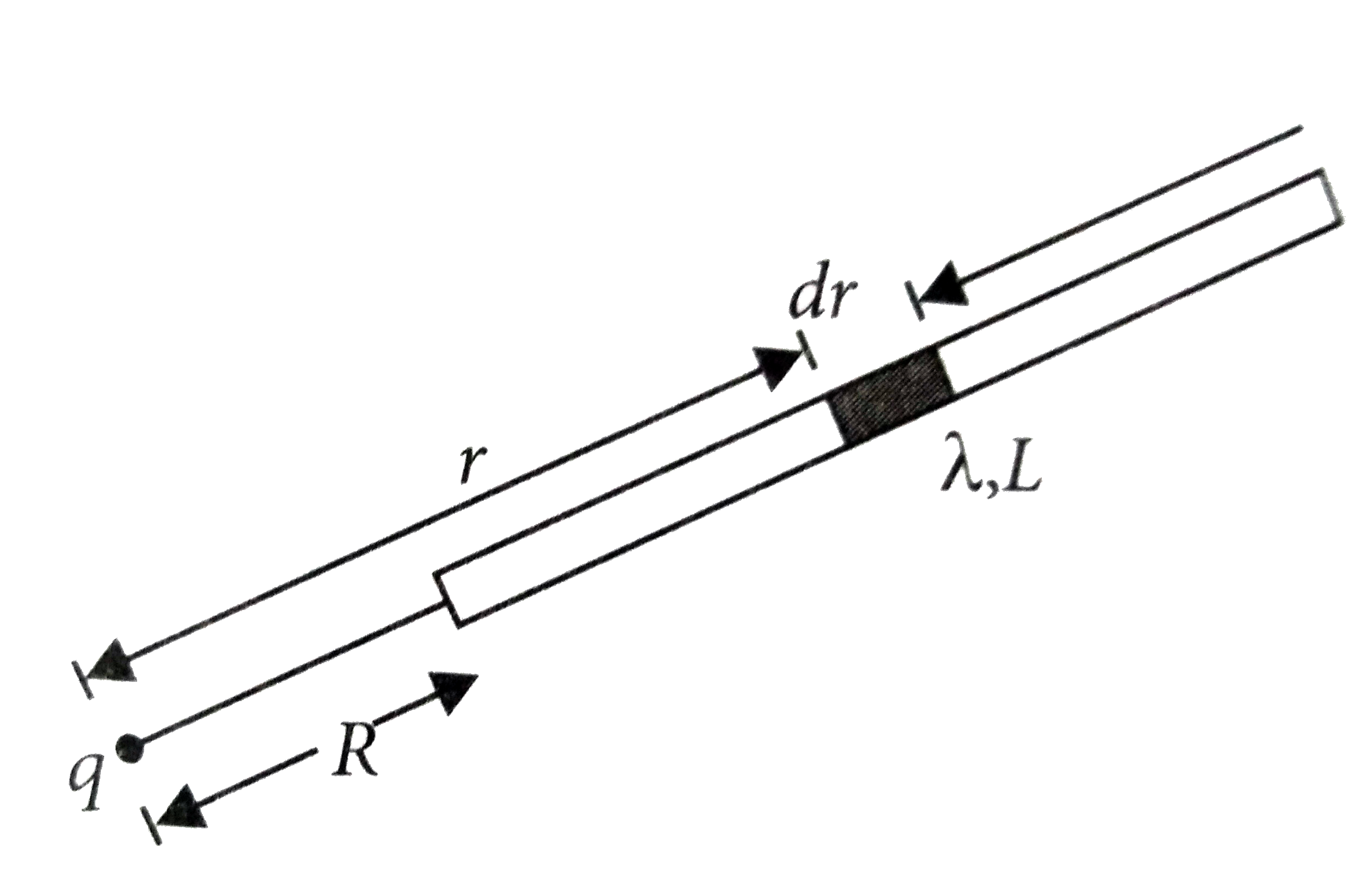
|
|
| 44059. |
The image of a small electric bulb fixed on the wall of a room is to be obtained on the opposite wall 3 m away by means of a large convex lens. What is the maximum possible focal length of the lens required for the purpose ? |
|
Answer» SOLUTION :For fixed DISTANCE ‘s’ between object and screen, for the LENS equation to give real solution for u = v = 2f, ‘f’ should not be GREATER than4f = s. `THEREFORE f=s//4` |
|
| 44060. |
In Bohr model of hydrogen atom, the force on the electron depends on the principal quantum number (n) as |
|
Answer» INDEPENDENT of n Also, `vprop(1)/(n)an DR propn^(2)rArrFprop(1)/(n^(4))` |
|
| 44061. |
Allow two lights rays to incident on a screen after passing through two slits. What happens to the pattern on the screen when the whole apparatus is dipped in water. |
| Answer» Solution :Because light has WAVE nature.Two SLITS GIVES effect of COHERENT sources. | |
| 44062. |
In an intrinsic semiconductor the energy gap Egis 1.2eV. Its hole mobility is much smaller than electron mobility and independent of temperature. What is the ratio between conductivity at 600K and that at 300K? Assume that the temperature dependence of intrinsic carrier concentration n_(i)is given by: n_(i) = n_(o) "exp" (-E_(g)/(2k_(B)T)) Where n_(0) is a constant. |
| Answer» SOLUTION :About `1 XX 10^(5)` | |
| 44063. |
A stone is dropped from the window of a train running at 50 (km)/(hr). If the window is 1.5m above the ground, find the distance along the track which the stone moves before it strikes the ground. Acceleration towards the earth= 9.8 m /s^2. |
|
Answer» 8.64 |
|
| 44064. |
Light of intensity I is incident perpendicularly on a perfectly reflecting plate of area A kept in a gravity free space. If the photons strike the plate symmetrically and initially the spring was at its natural length, find the maximum compression in the springs. |
|
Answer» IA/Kc `Delta X = (2F)/(3K) = (4IA)/(3Kc) ` |
|
| 44065. |
The maximum tension in the string of a pendulum is three times the minimum tension: |
|
Answer» MAXIMUM tension in STRING is `(4mg)/(5)` |
|
| 44066. |
A vessel of volume 5000 cm^3 contains (1/20) moles of molecular nitrogen at 1800K. If 30% of the molecules are now dissociated the pressure inside the vessel (in Pa) will be |
|
Answer» `1.49 XX 10^(5)` |
|
| 44067. |
The relation between principle quantum number (n) and orbital radius (r) in Bohr atomic model is ..... |
|
Answer» `R prop N^(2)` |
|
| 44068. |
A circular coil has 275 turns and a radius of 0.045 m. The coil is used as an ac generator by rotating it in a 0.500 T magnetic field, as shown in the figure. At what angular speed should the coil be rotated so that the maximum emf is 175 V? |
|
Answer» 28 rad/s |
|
| 44069. |
A stone is projected from the top of a tower with velocity 20ms^(-1) making an angle 30^(@) with the horizontal. If the total time of flight is 5s and g=10ms^(-2) |
|
Answer» the height of the TOWER is 75m |
|
| 44070. |
An ideal gas A and a real gas B have their volumes increased from V to 2V under isothermal conditions. What is the increase in their internal energies? |
|
Answer» of B will be more than that of A |
|
| 44071. |
A glass slab (mu = 1.5) of thickness 6 cm is placed over a paper. What is the shift in the letters? |
| Answer» Solution :Normal shift, `X = 1 (1 - (1)/(mu)) = 6 (1-(1)/(1.5)) cm = 2cm` | |
| 44072. |
Figure shows sqare current caarrying coil of edge lengthL. The magnetic field on the coil is given by vec(B)=(B_(0)y)/L hat(i)+(B_(0)x)/L hat(j) where B_(0) is a positive constant. |
|
Answer» If coil is free to rotate about x axis torque on the coil is given by `1/2iAB_(0)hat(i)` 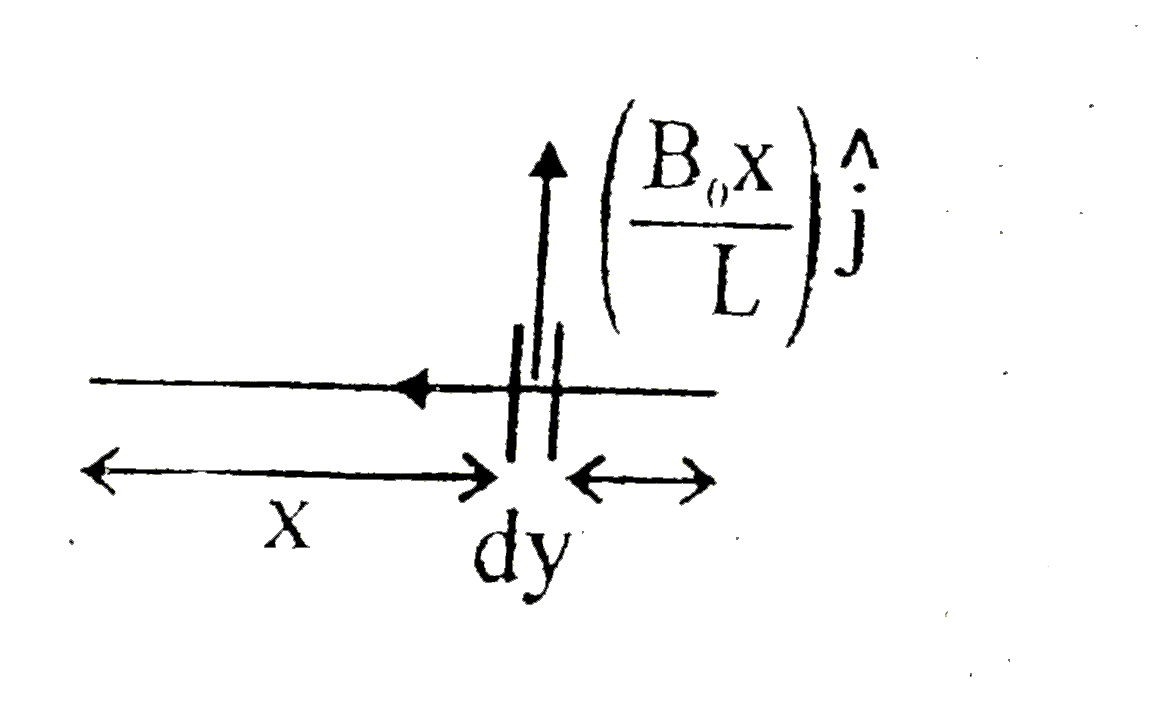 `(dvec(F))=underset0oversetLinti dx((B_(0)x)/2)=(iB_(0)L)/2` `dvec(f)=(-B_(0)L)/2hat(k)` Similary for `vec(f)_(2)=-(-iB_(0)L)/2hat(k)` `vec(f)_(3)=(iB_(0)L)/2hat(k)` `vec(f)_(4)=(iB_(0)L)/2 hat(k)` `vec(f)_(n)=0` If coil is constrained to rotate about `y-ax is |vec(tau)|=1((B_(0)L)/2)L` `=(iAB_(0))/2` Rightarrow Similarly for torque about torque has same magnitude 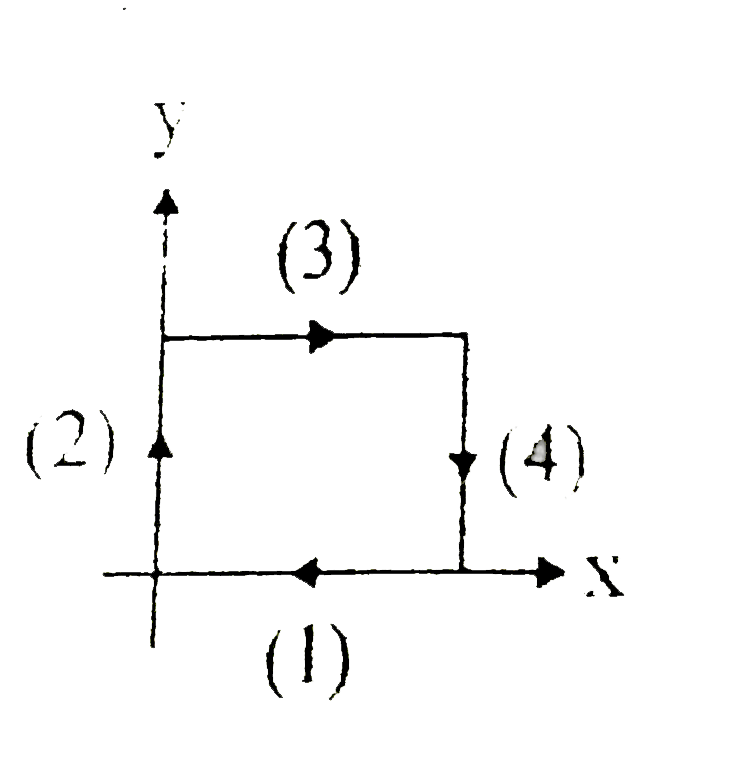
|
|
| 44073. |
A bucket of total height is half filled with a liquid of index and half with another liquid of index. The apparent depth of the bucket for an observer directly above the bucket |
|
Answer» 45cm |
|
| 44074. |
The linear speed of the tip of the minute hand of a clock when its length is 20 cm long |
|
Answer» `2.49 XX 10 ^(-3) m/sec` |
|
| 44075. |
Three point masses m, 2m and m, connected with ideal spring (of spring constant k) and ideal string as shown in the figure, are placed on a smooth horizontal surface At t=0, three constant forces F, 2F and 3F start acting on the point masses m, 2m and m respectively, as shown in figure. Find the maximum extension in the spring |
|
Answer» `(2F)/(m)` 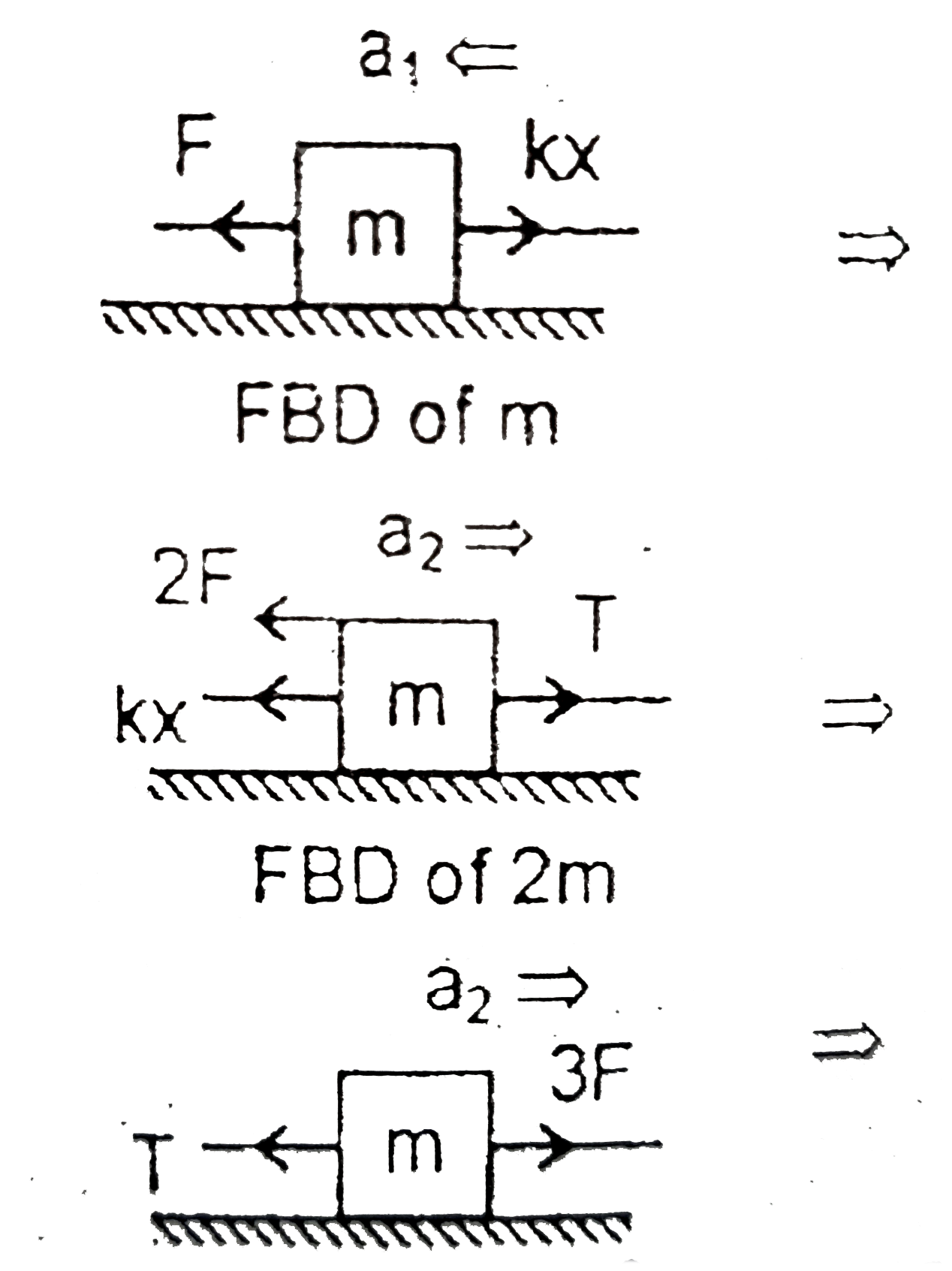 `rArr F-kx=ma_(1)rArr a_(1)=(F-kx)/(m)`….(`1`) `rArr F-kx=ma_(1)rArr a_(1)=(F-kx)/(m)`….(`1`) 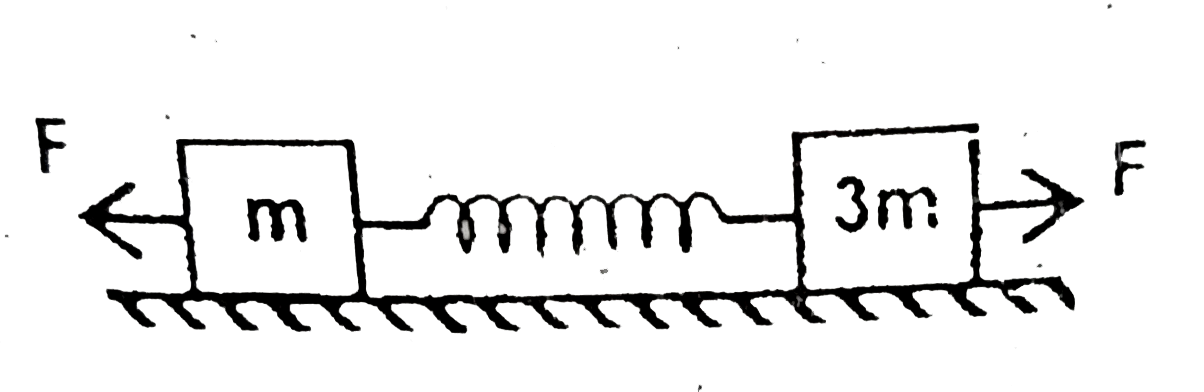 `rArr T-kx-2F=2ma_(2)`……(`2`) `rArr T-kx-2F=2ma_(2)`……(`2`) 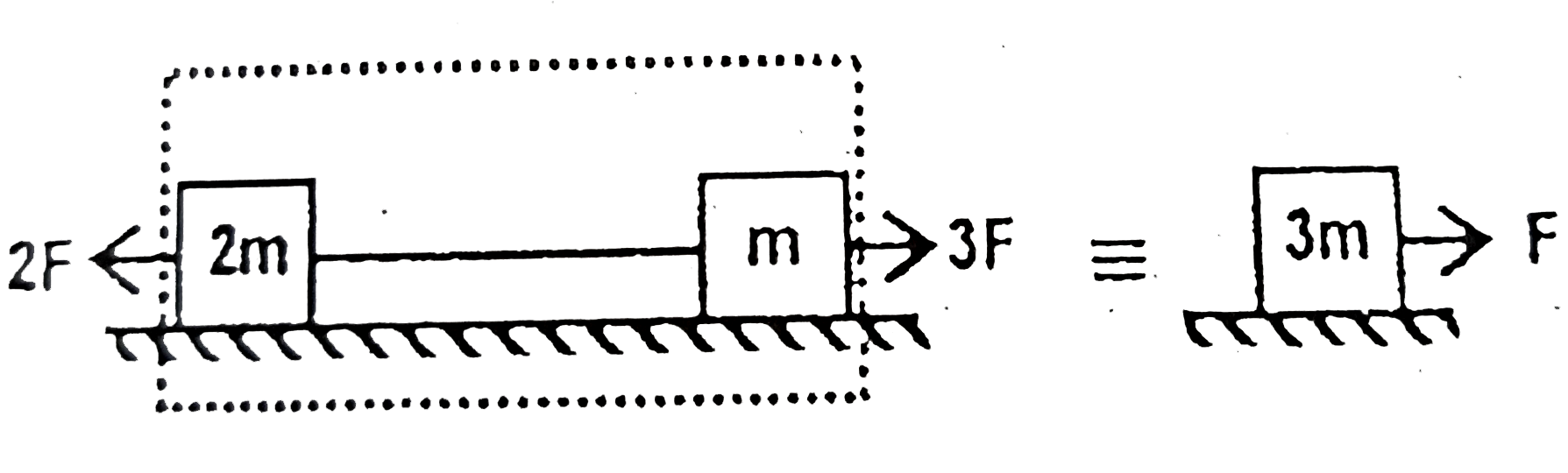 `rArr3F-T=ma_(2)`.....(`3`) `rArr3F-T=ma_(2)`.....(`3`) With the help of EQUATIONS (`2`) and (`3`), we have `F=kx=3ma_(2)rArr(F-kx)/(3m)=a_(2)`.......(`4`) With the help of equations (`1`) and (`4`), we have `veca_(12)=veca_(1)-veca_(2)=a_(1)(-HATI)-a_(2)(hati)=(a_(1)+a_(2))(hati)` `V_(12)(dV_(12))/(dx)=a_(12)=(4(F-kx))/(3m)rArrint_(0)^(0)V_(12)dV_(12)=(4)/(3m)int_(0)^(x)(F-kx)dx` `rArr0=(4)/(3m)[Fx-(kx^(2))/(2)]rArrX_(max)=(2F)/(k)` Second method : System is EQUIVALENT to Because Above system behaves as single unit ` |
|
| 44076. |
A bulb and a capacitor are connected in series to an a.c. source of variable frequency. How will the brightness of the bulb change on increasing the frequency of the a.c. source. Give reason. |
| Answer» SOLUTION : Brightness of the BULB INCREASES on increasing the FREQUENCY of a.c. source because with increase in frequency capacitive reactance Xc and consequently the impedance decreases. | |
| 44077. |
State and prove De Morgan's Frist and second theorems. |
|
Answer» Solution :The first theorem STATES that the complement of the sum of two logical inputs is equal to the product of its complements. Proof : The Boolean equation for NOR gate is `Y = bar(A+B)` . The Boolean equation for a BUBBLED AND gate is `Y=barA.barB` . Both cases generate same outputs for same inputs. It can be verified using the following truth table. 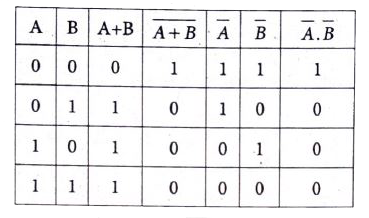 From the above truth table, we can conclude`bar(A+B) = bar(A).bar(B)` . THUS De Morgan’s First Theorem is proved. It also says that a NOR gate is equal to a bubbled AND gate. The CORRESPONDING logic circuit diagram is shown in figure. 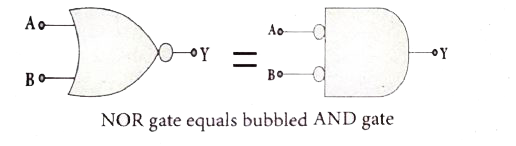 De Morgan.s Second Theorem: The second theorem states that the complement of che product of two inputs is equal to the sum of its complements. Proof: The Boolean equation for NAND gate is `Y = bar(AB)`. The Boolean equation for bubbled OR gate is `Y = bar(A+B)` . A and B are the inputs and Y is the output. The above two equations produces the same output for the same inputs. It can be verified by using the truth table. 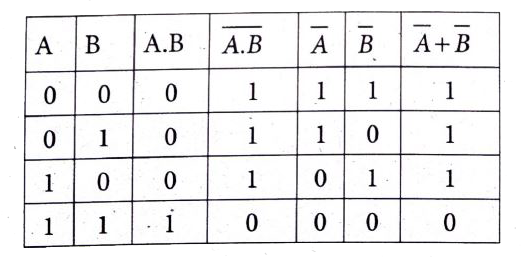 from the above truth table we can conclude `bar(A.B) = barA + barB`.Thus De Morgan’s Second Theorem is proved. It also says, a NAND gate is equal to a bubbled OR gate. The logic circuit diagram is shown in figure. 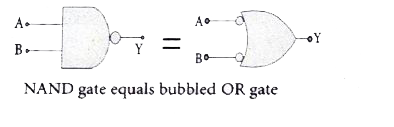
|
|
| 44078. |
The resistance of a conductor is5 Omega at 50°C and 6 Omega at 100°C. What is its temperature at 0°C? |
| Answer» Answer :D | |
| 44080. |
..... has same dimensions as of sqrt((I)/(mB)) each sign has its fixed significance. |
|
Answer» distance |
|
| 44081. |
(a) When monochromatic light is incident on a surface separating two media, the reflected and refracted light both have the same frequency as the incident frequency. Explain why? (b) When light travels from a rarer to a denser medium, the speed decreases. Does the reduction in speed imply a reduction in the energy carried by the light wave? (c) In the wave picture of light, intensity of light is determined by the square of the amplitude of the wave. What determines the intensity of light in the photon picture of light |
|
Answer» Solution :(a) Reflection and refraction arise through interaction of incident light with the ATOMIC constituents of matter. Atoms may be viewed asoscillators, which take up the frequency of the external agency (light) CAUSING forced oscillations. The frequency of light emitted by a charged oscillator equals its frequency of OSCILLATION. Thus, the frequency of scattered light equals the frequency of incident light. (b) No. Energy carried by a wave depends on the amplitude of the wave, not on the speed of wave propagation. (c) For a given frequency, intensity of light in the photon picture is determined by the NUMBER of photons crossing an unit area per unit time. |
|
| 44082. |
In the above question, the electric force acting on a point charge of 2 C placed at the origin will be : |
| Answer» Answer :D | |
| 44083. |
A student has 10 resistors, each of resistance r. The minimum resistance that can be obtained by him using these resistors is |
|
Answer» 10r |
|
| 44084. |
Two blocks A and B each of massm are connected by a massless spring of natural length L and spring constant K. The blocks are initially resting on a smooth horizontal floor with the spring at its natural length, as shown in figure below. A third identical bloack C, also of mass m, moves on the floor with a speed v along the line joining A and B, and collides with A. Then : |
|
Answer» the KINETIC energy of the A-B SYSTEM, at maximum compression of the spring, is ZERO |
|
| 44085. |
The two forces 2sqrt(2)N and xN are acting at a point their resultant is perpendicular to hat(x)N and having magnitude of vec(6) N. The angle between the two forces and magnitude of x are |
|
Answer» `theta = 1210^@ , x = SQRT(2)N` |
|
| 44086. |
A gun fires 50 g bullets with velocity 1000 ms^(-1) each. The soldier holding the gun can exert an average force of 180 N against the gun. The maximum number of bullets, he can fire per minute is |
|
Answer» 216 `F = 180 N, m = 50 g, V = 1000 ms^(-1)`(Given) `180= (n XX 50 xx 10^(-3) x 1000)/1` `THEREFORE n=180/50=3.6` Number of bullets fired per min = 3.6 x 60 = 216 |
|
| 44087. |
The current gain of a transistor is 100. If the base current changes by 200 muA, what is the change in collected current ? |
|
Answer» 200 mA |
|
| 44088. |
An ideal gas expands from state (P_(1), V_(1)) to state (P_(2), V_(2)), where P_(2) = 2P_(1) and V_(2) = 2V_(1). The path of the gas is expressed by the following relation, P = P_(1) [1 + ((V - V_(1))/(V_(1)))^(2)] |
|
Answer» <P>`P_(1) V_(1)` |
|
| 44089. |
A charged particle is free to move in an electric field. Will it always move along electric lines of force? |
| Answer» Solution :If the charged particle is INITIALLY at rest in an electric field, it will move ALONG the tangent to the electric line of force. HOWEVER, if the charged particle has INITIAL velocity and makes some angle with the line of force, then the resultant path will not be along the line of force. | |
| 44090. |
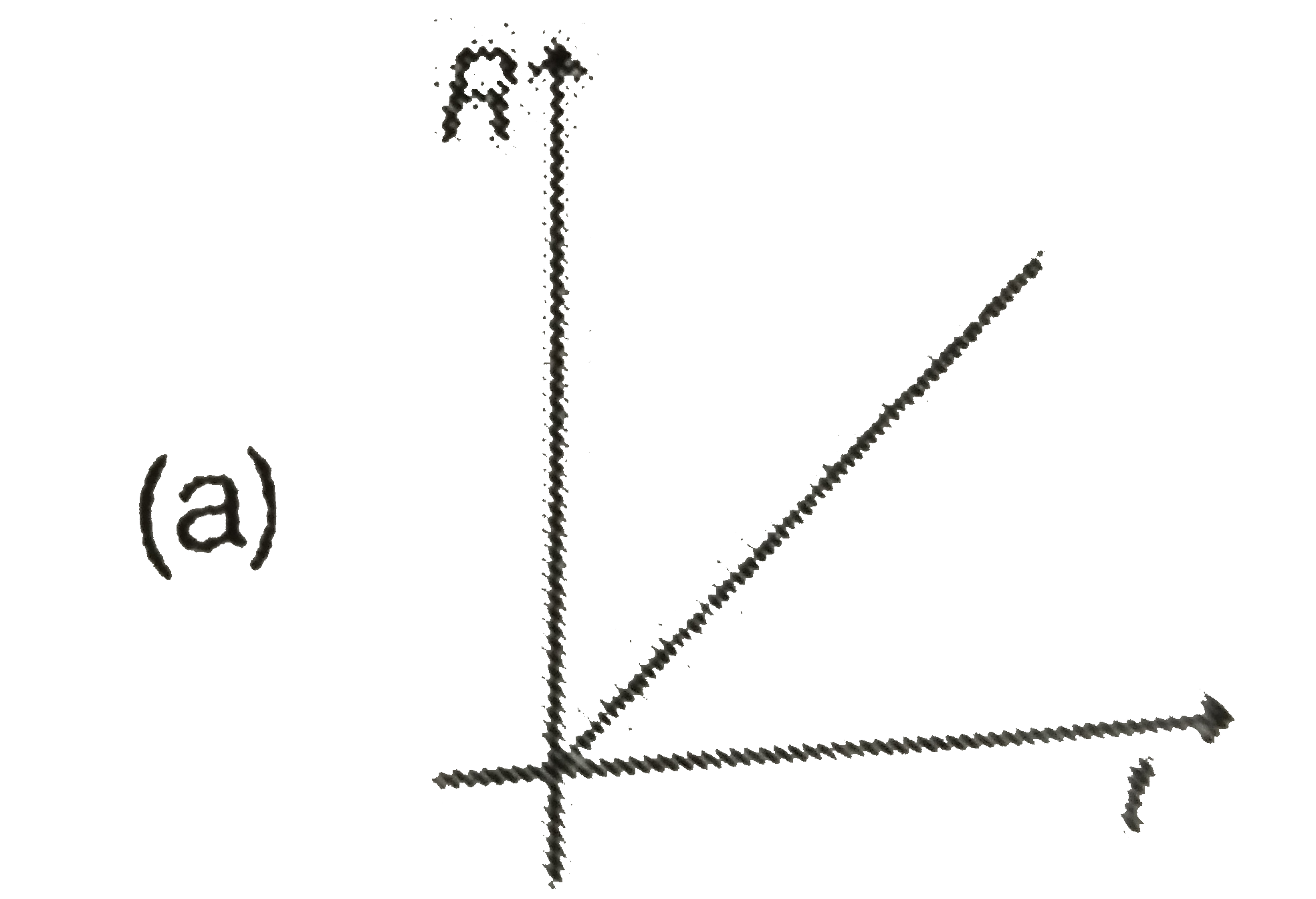
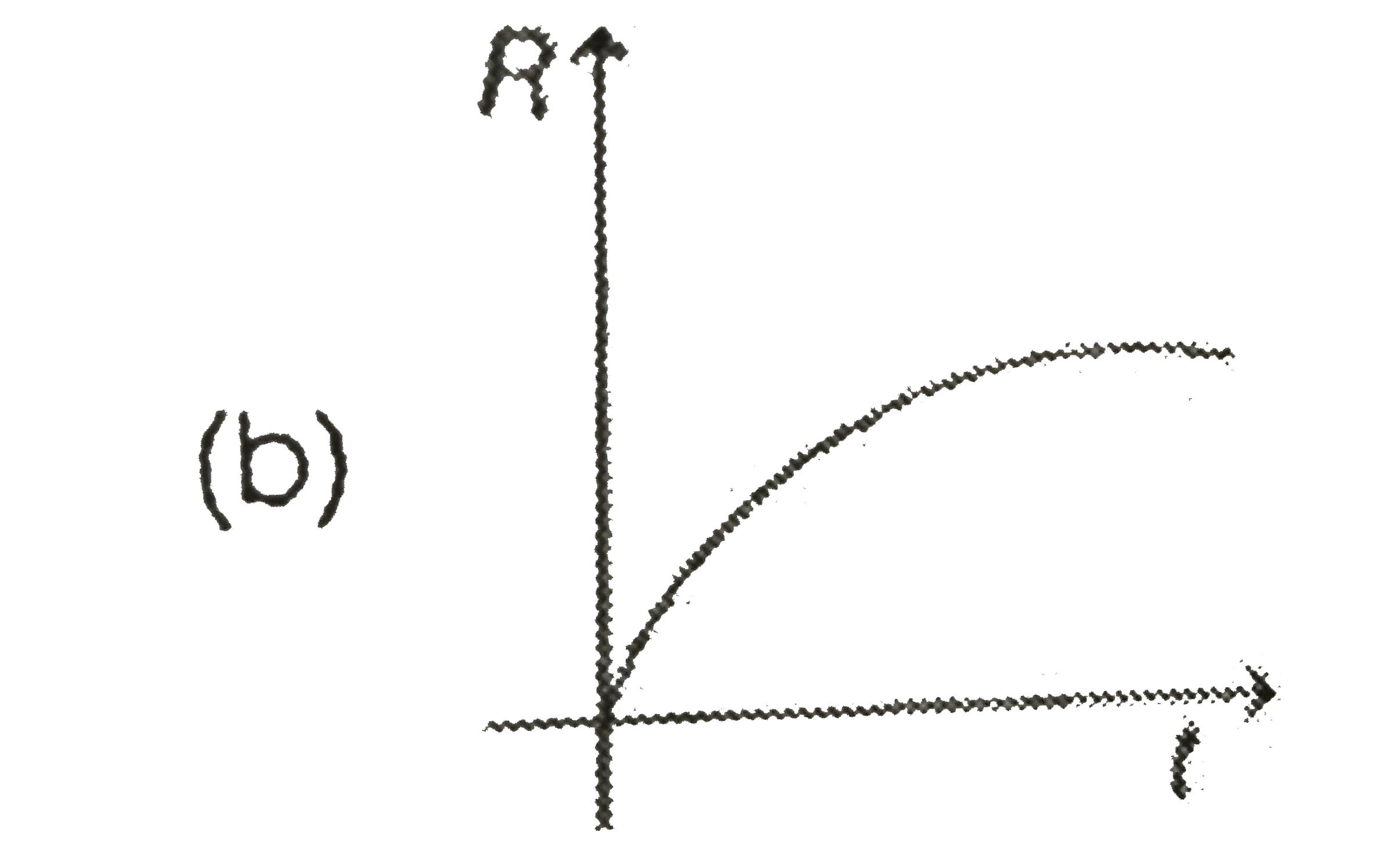
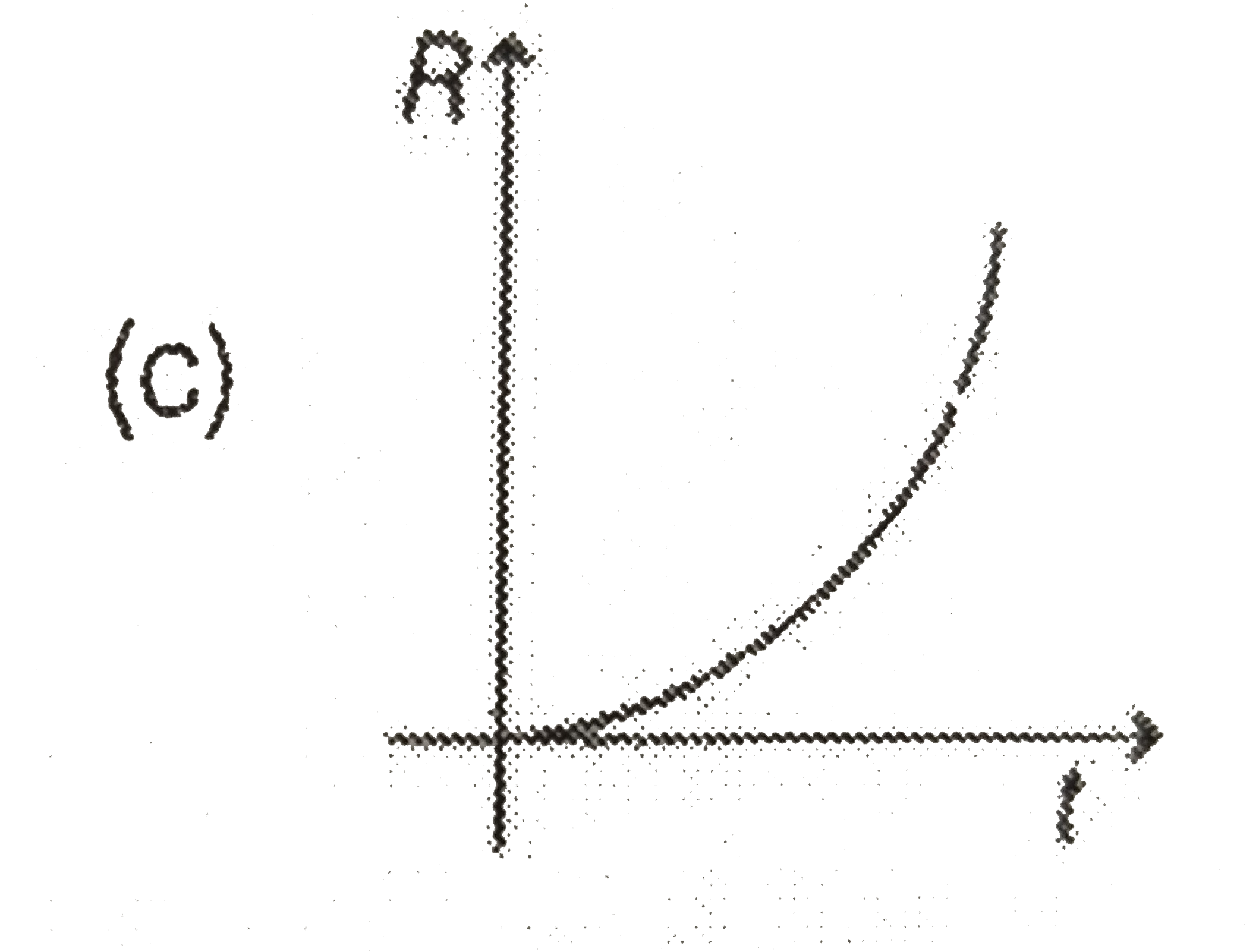
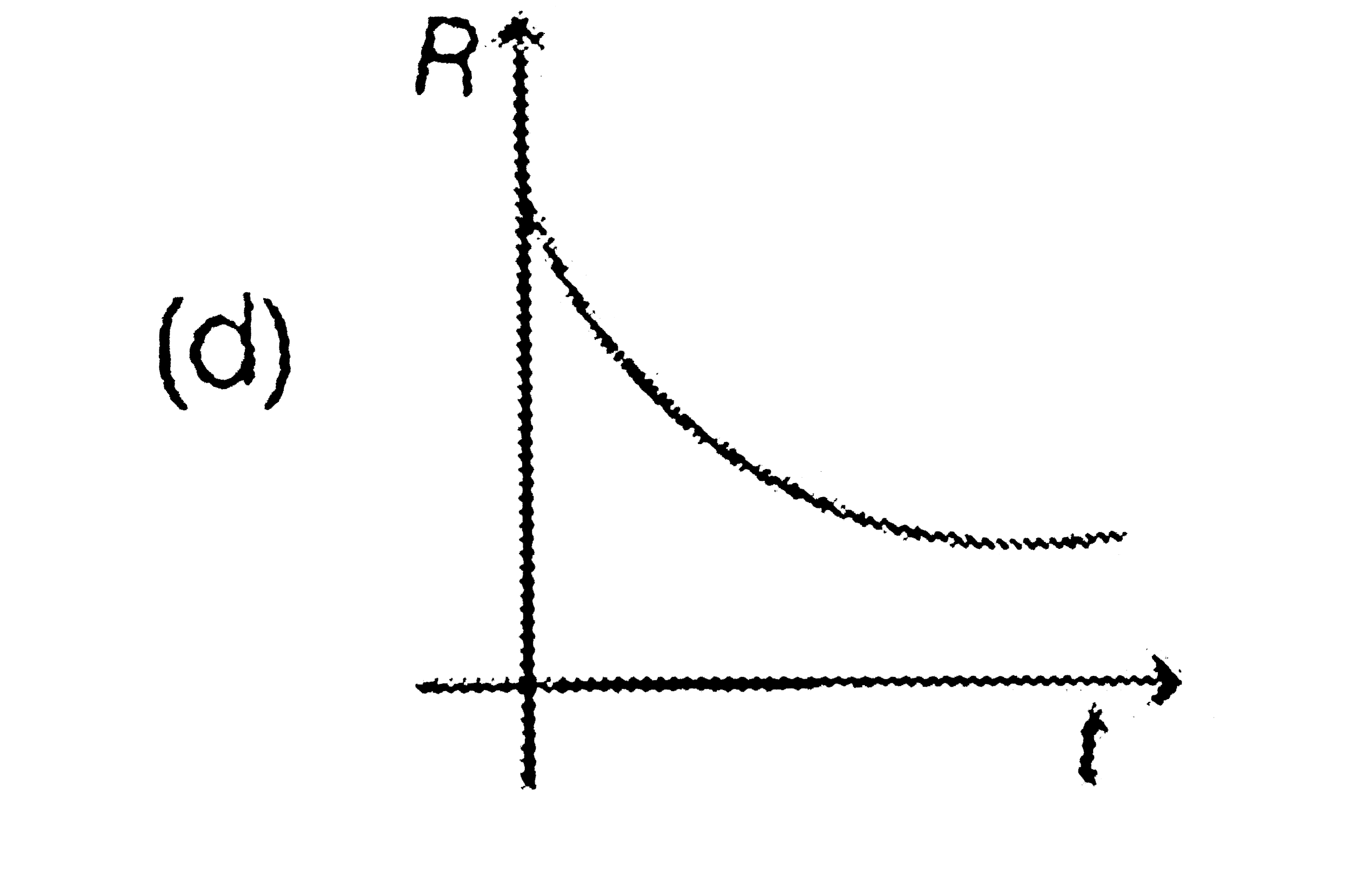
Consider the YDSE (Young's double slit experiment ) arrangement shown in figure . The screen in the arrangement starts accelerating from rest in positive x-direction, with acceleration a=kt, (here k is a constant ), then rate of change of fringe width ( R) varies with time t as |
|
Answer»
|
|
| 44091. |
Derivelensmaker'sformulafora convexlens. |
Answer» Solution :Lensmaker.sformula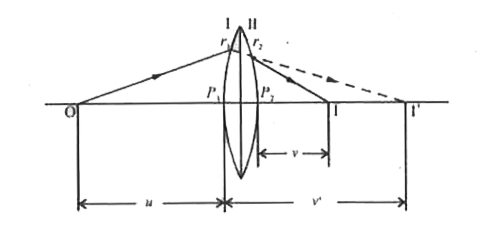 LET`r_(1) and r_(2)`be theradiiof curvatureof thethinlens . LET`r_(1) and r_(2)`be theradiiof curvatureof thethinlens . Let Obe thepointat adistanceu fromthepoleof thefirstcurvedsurfaceof thelens. Realimageis FORMEDAT I.at a distancev.fromthepole`P_(1)`thisimageis formedin thedensermedium. Weknowthat FROMTHE refractionformula , `(n_1)/(-u )+(N_2)/(v)=(n_2-n_1)/(r )i.e.,(n_1)/(-u)+(n_2)/(v.)=(n_2-N_(1))/(r_1)` Where`n_1`is therefractiveindexofrarermediumand ` n_(2)`thatof thedensermedium`(n_(2)gt n_(1))`, FOrthe secondsurface, realimageat I.willserveas - ve. Theobjectspaceis thelensme - diumfor refractivethroughthe secondcurvedsurface. finalimageis formedin AIRAT Iandat adistanceof .v.from ` P_(2)` ` (n_1)/(-u)+(n_2)/(v)=(n_2-n_1)/(r )` ` i.e.,(n_2)/(-v)+(n_1)/(v)=(n_(2)-n_(1))/(-r_2)` Adding (1)and (2)we get ` (n_1)/(-u ) +(n_1)/(v)=(n_2-n_1)((1)/(r_(1))-(1)/(r_(2)))` ` or(1)/(-u )+(1)/(v)=(n_(2)-n_(1))/(n_(1))((1)/(r_(1))-(1)/(r_(2)))` when`u= oo , v= f` when `u=f , v=oo` ` therefore` Thetermon the L.H.Scan bereplacedby ` (1)/(f)`wheref is thefocallengthof lens . `i.e.,(1)/(f)=((n_2-n_1)/(n_1))((1)/(r_1)-(1)/(r_(2)))` Theequation(4)is calledthe lensmaker.sformula Note:(1)usingtheequation(4) ,it canbe shownthat `""_(1) N_(2)= 1-[(r_1r_2)/(f(r_1-r_(2)))]` where ` ""_(1)N_(2)=(n_(2))/(n_(1))` (2)forradiusof curvaturethe letter.R.may beused . |
|
| 44092. |
The mean free path of a molecule of He gas is alpha. Its mean free path along any arbitrary coordinates axis will be |
|
Answer» `ALPHA` |
|
| 44093. |
A Carnot's engine is working between 7^(@)C and 287^(@)C. It is desired to increase its efficiency to 70%. By how much should the temperature of source be increase ? |
|
Answer» `273^(@)C` `ETA =(70)/(100) cdot" then "(7)/(10)=(T_(1)-280)/(T_(1))" or "T_(1)=933.3 K.` INCREASE in temperature `=933.3-560=373.3^(@)C`. `therefore` Correct choice is (c ). |
|
| 44094. |
A parallel plate capacitor is charged by connecting it to a battery. The battery is disconnected and the plates of the capacitor are pulled apart to make the separation between the plates twice. Again the capacitor is connected to the battery (with same polarity) then |
|
Answer» Charge from the battery FLOWS into the capacitor after reconnection |
|
| 44095. |
Which range of frequencies can be transmitted suitable by sky wave propagation? |
| Answer» Answer :C | |
| 44096. |
In a half wave rectifier, a p-n junction diode with internal resistance 2 Omegais used. If the load resistance of 2Omega is used in the circuit, then find the efficiency of this half wave rectifier. |
| Answer» ANSWER :C | |
| 44097. |
Temperature coefficient of resistance for________ Is positive but for ____ and ____ is negative. |
| Answer» SOLUTION :METALS (or CONDUCTORS), INSULATORS, SEMI conductors | |
| 44098. |
A stationary upright cone has a taper angle theta=45^@, and the area of the lateral surface S_0=4.0m^2. Find: (a) its taper angle, (b) its lateral surface area, in the reference frame moving with a velocity v=(4//5)c along the axis of the cone. |
|
Answer» Solution :In the frame K in which the CONE is at rest the coordinates of A are `(0,0,0)` and of B are `(h, h tan theta, 0)`. In the frame `K^'`, which is moving with velocity v along the axis of the cone, the coordinates of A and B at time `t^'` are `A:(-VT^',0,0), B: (hsqrt(1-beta^2)-vt^', h tan theta, 0)` Thus the TAPER angle in the frame `K'` is `tan theta'=(tan theta)/(sqrt(1-beta^2))(=(y_B'-y_A')/(x_B'-x_A'))` and the lateral surface area is, `S=pih'^(2) SEC theta' tan theta'` `=pih^2(1-beta^2)(tantheta)/(sqrt(1-beta^2))sqrt(1+(tan^2theta)/(1-beta^2))=S_0sqrt(1-beta^2cos^2theta)` Here `S_0=pih^2sectheta tan theta` is the lateral surface area in the rest frame and `h'=hsqrt(1-beta^2)`, `beta=v//c`. |
|
| 44099. |
Magnetic north pole of Earth is nearer to geographic ...... pole. |
|
Answer» East |
|
| 44100. |
In maxwell's speed distribution curve, for N_(2 ) gas, the average of |relative velocity| between two molecules at 300 k will be : - |
|
Answer» 300 m/sec 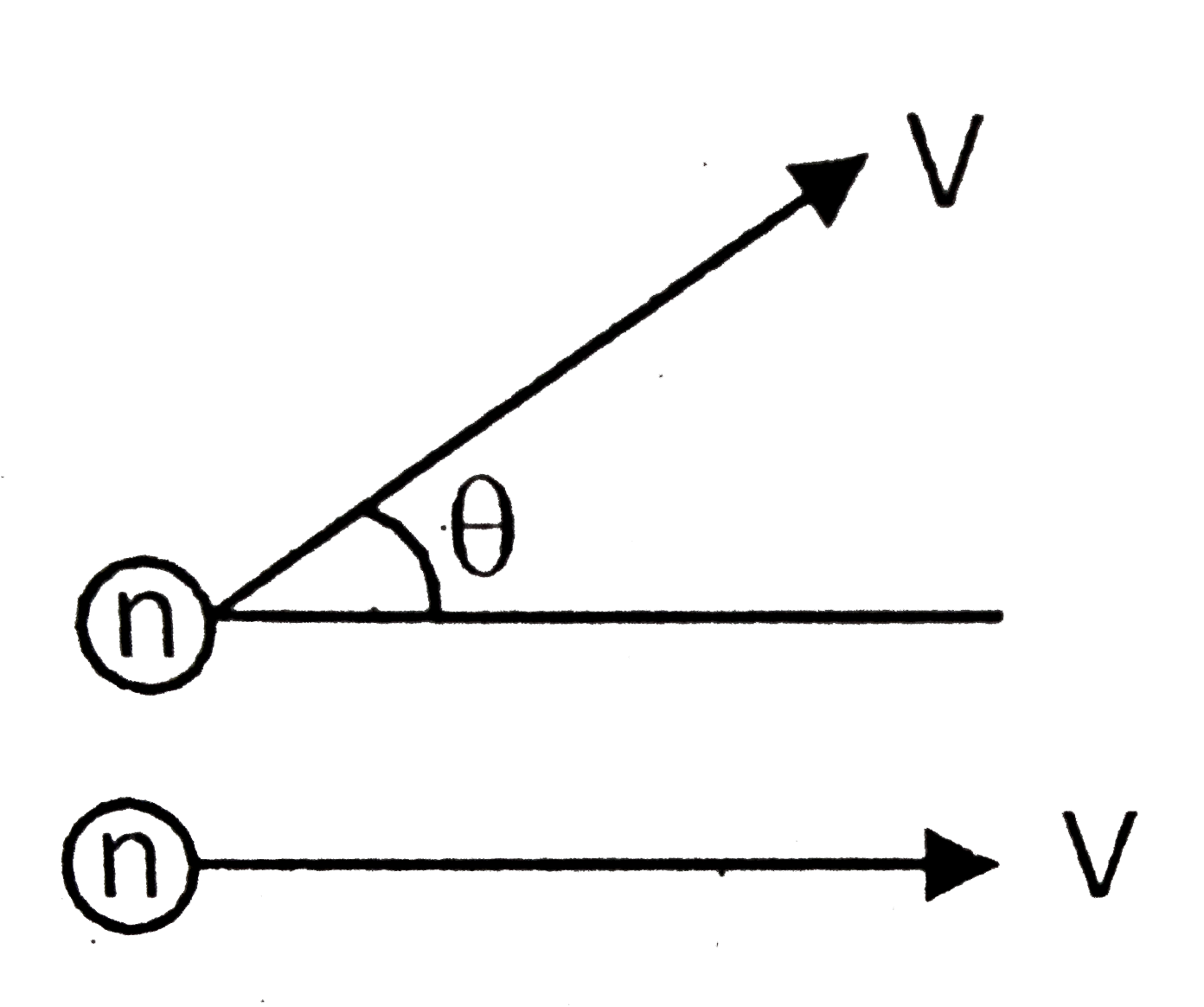 `|V_("rel")|=sqrt(V^(2)+V^(2)-2(V)(V) cos theta)=2 V|"sin" (theta)/(2)|` `langle V_("rel") RANGLE=(overset(pi)underset(0)INT 2V1|"sin"(theta)/(2)|d theta)/(overset(pi)underset(0)int d theta)=(4V)/(pi)` `langle V_("rel") rangle =(4)/(pi) V_("AVERAGE")=(4)/(pi) sqrt((8RT)/(pi m_(0))) =(4)/(pi) sqrt((8xx8.3 xx 300)/(3.14 xx 28 xx 10^(-3))) =606` m/sec |
|