Saved Bookmarks
This section includes InterviewSolutions, each offering curated multiple-choice questions to sharpen your knowledge and support exam preparation. Choose a topic below to get started.
| 44001. |
Find the position of the image formed by the lens combination given in the Fig. |
|
Answer» Solution :Image formed by the first LENS `(1)/(v_(1))-(1)/(u_(1))=(1)/(f_(1))` `(1)/(v_(1))-(1)/(-30)=(1)/(10)` The image formed by the first lens serves as the object for the second. This is at a distance of `(15 - 5) cm = 10 cm` to the right of the second lens. Though the image is real, it serves as a VIRTUAL object for the second lens, which means that the rays appear to come from it for the second lens. `(1)/(v_(2))-(1)/(10)=(1)/(-10)` `or v_(2)=oo` The virtual image is formed at an infinite distance to the left of the second lens. This acts as an object for the third lens. `(1)/(v_(3))-(1)/(u_(3))=(1)/(f_(3))` `or (1)/(v_(3))=(1)/(oo)+(1)/(30)` `or v_(3)=30cm` The FINAL image is formed 30 cm to the right of the third lens. |
|
| 44002. |
When a ray of light travel from one medium to other then the physical quantity which does not change is |
|
Answer» VELOCITY |
|
| 44003. |
A rectangular coil 6 cm long and 2 cm wide is placed in a magnetic field of 0.02 T. If the loop contains 200 turns and carries a current of 50 mA, the torque on the coil (with loop face parallel to the field) is |
|
Answer» `2.4xx10^(-4)NM` |
|
| 44004. |
A cubical block of wood, of length 10 cm, floats at the interface between oil of density 800 kg//m^3and water. The lower surface of the block is 1.5 cm below the interface. If the depth of water is 10 cm below the interface and oil is upto 10 cm above the interface then the difference in pressure at the lower and the upper face of the wooden block is (Assume density of waterrho = 1000 kg //m^3) and acceleration of gravity , g = 10 m//s^2) |
|
Answer» 850 Pa 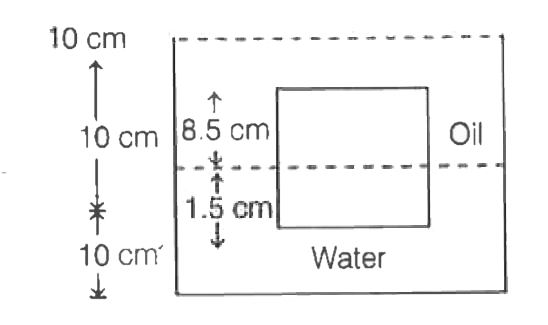 density of oil `rho_0 = 800 kg//m^3 ` density of oil `rho_0 = 800 kg//m^3 ` and density of WATER, `rho_w = 10^3 kg//m^3` If ` V_1` and `V_2`be the volume of wooden block in water and oil respectively, then `V_1 : V_2 = 1.5 : 8.5` ` V_1/V_2 = (1.5)/(8.5) = 3.17` ` therefore V_1 = 3/17 V_2 "" ...(i)` ` therefore V_1 + V_2= V`where is the volume of the block From EQ. (1), we get ` 3/17 V_2 + V_2 = V rArr V_2 = 17/20 V` ` therefore V_1 = 3/20 V` If ` rho ` be the density of the block weight of block ` therefore ` weight of oil displaced+weight of water displaced ` V rho G = V_1 rho_(omega) g + V_2 rho_(oil) g` ` V rho g = 3/20 V rho_w g + 17/20 V rho_(oil) g` ` rho = 3/20 rho_w + 17/20 rho_(oil) = 3/20 xx 10000 + 17/20 xx 800 ` ` = 830 kg//m^3` ` therefore ` PRESSURE difference ` p = rho g h = 830 xx 10 xx 0.1 = 830 Pa` |
|
| 44005. |
The magnetic field energy in an inductor changes from maximum value to minimum value in 5.0 ms when connected to an AC source. The frequency of the source is |
| Answer» Answer :B | |
| 44006. |
(a) Define the term ‘activity’ of a given sample of radio nuclide. Write the expression for the law of radioactive decay in terms of the activity of a given sample. (b) A radioactive isotope has a half-life of T years. How long will it take the activity to reduce to 3.125% of its original value ? (c) When a nucleus (X) undergoes beta-decay, it transforms to the nucleus (Y). Does the pair (X, Y) form isotopes, isobars or isotones ? Justify your answer. |
|
Answer» Solution :(a) Activity of a radio nuclide is defined as the rate of disintegration of the given sample of radio nuclide. Thus, activity `R=-(dN)/(dt)`. As per LAW of radioactive decay, activity of a radio nuclide is directly proportional to the QUANTITY (number of nuclei present) of given radio nuclide. Mathematically, `RpropN or R=lambdaN`,where `lambda` is a constant known as the disintegration constant and its value depends on the nature of radionuclide. As per above relation, the activity goes on DECREASING with time as per relation: `R_(t)=R_(0)e^(-lambdat)`, where `R_(0)`=activity at time t=0 and `R_(t)`=activity at time t. (b) Here `R_(t)=3.125% "of"R_(0)=3.125/100R_(0)=R_(0)/32=R_(0)(1/2)^(5)` As activity FALLS to one-half of its original value in one half-life. Hence, it will fall to `(1/2)^(5)R_(0)` in 5 half-lives. `therefore` Time `t=5T_(1/2)=5Tyears` (c) The `beta`-decay process can be expressed as: `" "_(Z)^(A)Xoverset(-beta^(-))(to)" "_(Z+1)^(A)Y+" "_(-1)^(0)e+bar(nu)` As X and Y both have same MASS numbers but different atomic numbers, they represent an isobar pair. |
|
| 44007. |
A solenoid has 10^(3) turns per unit length. On passing a current of 2A, magnetic induction is measured to be 4piWb//m^(2) . Calculate magnetic susceptibility of core |
|
Answer» 49999 |
|
| 44008. |
The electrical conductivity of an intrinsic semiconductor at 0 K is |
|
Answer» LESS than that of an insulator |
|
| 44009. |
Let p(r ) = (Q)/(pi R^(4))r be the charge density distributionfor a solid sphere of radius R and total charge Q For a point .p. inside the sphere at distance r_(1) from the centre of the spere, the magnitude of electric field is |
|
Answer» `(Q)/(4piin_(0)r_(1)^(2))` |
|
| 44010. |
A body is released from the top of a smooth inclined plane of inclination theta. It reaches the bottom with velocity v. If the angle of inclination is doubled for the same length of the plane, what will be the velocity of the body on reaching the ground: |
| Answer» Answer :C | |
| 44011. |
What do you mean by ferromagnetic material? |
| Answer» Solution :FERROMAGNETIC substances are those which GETS strongly MAGNETIZED in an ecternal magnetic field. | |
| 44012. |
On interchanging the resistance thebalance point of a meter bridge shifts to the left by 10 cm. The resistance of their seris combination is 1 k Omega. How much was the resistance on the left slot before the interchange ? |
|
Answer» 990 `Omega` In first situation `(R_(1))/(R_(2))= (l)/(100 - l) "" `... (1) `l_(2) = 100- l` By moving the place `(R_(2))/(R_(1)) = (l - 10)/(110 - l) "" `.... (2) `l_(2) = 100 - (l - 10)` `= 100 - l+ 10` `= 110 - l ` Now ` (R_(1))/(R_(2)) xx (R_(2))/(R_(1)) = 1 ` `(l)/(100 - l) xx (l - 10)/(110 - l) =1 ` `therefore l^(2) - 10 l = 11000 - 100 l - 110 l + l^(2)` `therefore= 200 l = 11000` `therefore l = 55 ` cm Now from EQ. (1) `(R_(1))/(100 - R_(1))= (55)/(100 - 55)` `[ because R_(1) + R_(2) = 1000 , therefore R_(2) = 1000 - R_(2) ] ` `therefore (R_(1))/(1000 - R_(1))= (55)/(45)` = `(11)/(9)` , ` therefore9 R_(1) = 11000 - 11 R_(1)` `therefore 20 R_(1) = 11000` `therefore R_(1) = 550 Omega` |
|
| 44013. |
Use Kirchhoff s rules to obtain conditions for the balance condition in a Wheatstone bridge. |
|
Answer» <P> SOLUTION :Condition of balance of a Wheatstone BRIDGE: The CIRCUIT diagram of Wheatstone bridge is shown in fig. P, Q, R and 5 are four resistance forming a closed bridge, called Wheatstone bridge. A battery is connected across A and C, while a galvanometer is connected between B and D. At balance, there is no current in galvanometer.Derivation of Formula: Lei the current given by battery in the balanced position be I. This current on reaching point A is divided into two parts `I_(1)` and `I_(2)`. As there is no current in galvanometer in balanced state, current in resistances P and Q is `I_(2)` and in resistances R and S it is `I_(1)`. Applying Kirchhoff s I law at point A `I-I_(1)-I_(2)=0`or`I=I_(1)+I_(2) ""`...(i) Applying Kirchhoff’s II law to closed mesh ABDA `-I_(2)P+I_(2)R=0`or`I_(1)P=I_(2)R ""`....(ii) Applying Kirchhoff’s II law to mesh BCDB `-I_(1)P+I_(2)R=0`or`I_(1)Q=I_(2)S ""`...(iii) Dividing equation (ii) by (iii), we get `(I_(1)P)/(I_(1)Q)=(I_(2)R)/(I_(2)S)`or`(P)/(Q)=(R )/(S) ""` ...(iv) This is tne condition of balance of Wheatstone bridge. 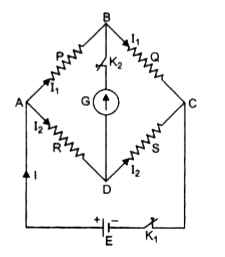
|
|
| 44014. |
Consider thecircular loop having current I nad with central point O. the magnetic field at the central point O is |
|
Answer» `(2mu_(0)i)/(3pi R)` acting DOWNWARD |
|
| 44015. |
In Young's double-slit experiment , the slits are 0.5 mm apart and interference is observed on a screen placed at 1.0 m from the slits. It is found that the 9th bright fringe is at 8.835 mm from the 2nd dark fringe on the same side of the interference pattern. Find the wavelength of light used. |
|
Answer» Solution :Data: `d=0.5mm= 5 xx 10^(-4)m, D=1.0m`, `x_(9)-x_(2)= 8.835 MM = 8.835 xx 10^(-3)`m (on the same side of the CENTER of the interference pattern) `x_(n) = (nlambdaD)/(d)`…………….(bright FRINGE) `x_(m)^(') = ((2m-1)lambdaD)/(2d)`………………..(dark fringe) `therefore x_(9) - x_(2)^(') = (9lambdaD)/d - ((2 xx 2-1)lambdaD)/(2d)` `=(9lambdaD)/d - (3lambdad)/(2d) = ((18-3)lambdaD)/(2d) = (15lambdaD)/(2d)` `therefore` The wavelength of light used, `lambda= (2d(x_(9)-x_(2)^(')))/(15D)` `=(2 xx 5 xx 10^(-4) xx 8.835 xx 10^(-3))/(15 xx 1.0)` `= 5.89 xx 10^(-7)m = 5890 Å` |
|
| 44016. |
Resistivity of alloys is, in general, less than that of pure metals. |
| Answer» SOLUTION :FALSE - In GENERAL, resistivity of alloys is greater than that of pure metals. | |
| 44017. |
A ball of mass 0.5 kg, initially at rest, acquires a speed of 4 m/s immediately after being kicked by a force of strength 20 N. for how long did this force act on the ball? |
|
Answer» 0.01s `Fdeltat=mvimpliesDeltat=(mv)/(F)=((0.5kg)(4m//s))/(20N)=0.1s`. |
|
| 44018. |
The colour coded carbon resistance has three bands. the bands from left are blue, yellow and red the resistance is |
|
Answer» `6400 OMEGA+- 20 % ` |
|
| 44019. |
One of the of Young's double slits is covered with a glass plate as shown in figure. The positionof centralmaximum will, |
|
Answer» GET SHIFTED downwards |
|
| 44020. |
Two sound waves of frequencies 100Hz and 102Hz and having same amplitude ‘A’ are interferingA stationary detector which can detect waves of amplitude greater than or equal to A. In a time interval of 12 seconds, find the total duration (in sec.) which detector is active |
|
Answer» |
|
| 44021. |
For thin convex lens if magnification is one then object distance and image distances are ..... |
|
Answer» F,f `thereforev=u` `therefore1/f=1/v-1/u`[TAKING v=u and u negative] `therefore1/f=1/v+1/u` `therefore1/f=2/v` `therefore v=2f thereforeu=2f` |
|
| 44022. |
The number of turns in the coil of an ac generator is 5000 and the area of the coil is 0.25 m^2 . The coil is rotated at the rate of 100 cycles/sec in a magnetic field of 0.2 T. The peak value of the emf generated is nearly |
| Answer» ANSWER :D | |
| 44023. |
A straight conductor 2m long ,carrying a current of 5 A is placed at placed at right angle to uniform magnetic field of 0.5T.The force on it is : |
|
Answer» ZERO |
|
| 44024. |
The source which emit light of same wavelength , same frequency and equal intensity or amplitude in the same direction is called ? |
| Answer» SOLUTION :COHERENT SOURCE | |
| 44025. |
An equilateral prism of unknown refractive index has a prism angle A. A light ray incident at an angle 0.8 A suffers minimum deviation. What will be the speed of light inside the prism ? |
| Answer» SOLUTION :`2.01xx10^(8)MS^(-1)` | |
| 44026. |
A beam of monochrometic radiation is incident on a photosensitive surface. Answer the following with reasons. Do the photoelectrons have same kinetic energy? |
| Answer» Solution :No, the DIFFERENT ELECTRONS BELONG to different energy LEVELS in the following conduction band. | |
| 44027. |
Monochromatic light of yellow colour is incident on a face of a prism. Refractive index of prism for yellow colour is a//2 . It is observed that for two different values of angle of incidence, 60^(@) and 32.3^(@), deviation suffered by the ray while passing through the prism has the same value of 8=32.3^(@). Consider now that white light is incident on a face of the % given prism at an angle of incidence (i). Obviously it will undergo dispersion. Match Column-I w.ith Column-ll with regard to dispersion of white light as it passes through the prism. [sin20^(@) = 0.34, sin 14^(@) = 0.24] |
|
Answer» |
|
| 44028. |
a. How many excess electrons must be added to one plate and removed from the other to give a 5.000 nF parallel plate capacitor 25.0 J of stored energy ? b. How could you modify the geometry of this capacitor so that can store 50.0 J of energy without changing the charge on its plates? |
| Answer» Solution :WITHOUT changing charge on the PLATES, we can make C half. `C=(epsi_(0)A)/(d)`, i.e. double the PLATE separation or inserting dielectric of dielectric of a VALUE such that C becomes. | |
| 44029. |
A pure resistance and a pure inductance are connected in series across a 100 volt A.C line. A voltmeter gives same reading whether connected across resistance or inductance. It does read ........ V. |
|
Answer» 50 V  If both the component connected in parallel to the voltmeter, both shows same voltage. `V_"rms"`=100 V `therefore V_m =sqrt2xxV_"rms"` =1.414 X 100 =141.4 Applying Kirchoff.s SECOND LAW to the circuit `V_m=V_1+V_2` `therefore V_m=2V_1` or `2V_2 "" [because V_1=V_2]` `therefore 141.4 =2V_1` `therefore V_1=70.7 V` or `V_2`=70.7 V Second Method : Here `V_(rms(R))=V_(rms(L))` `therefore V_(rms)^2=V_R^2+V_L^2` `therefore V_(rms)^2 =V_R^2+V_R^2 "" [because V_R=V_L]` `therefore (100)^2 =2V_R^2` `therefore V_4=100/sqrt2 =70.7 V = V_L` |
|
| 44030. |
At what frequency 1 henry inductance offers the same impedance as 1muF capacitator ? |
|
Answer» `(500)/(2piHz)` |
|
| 44031. |
A progressive sound wave of frequency 500 Hz is travelling through air with speed 350 m/s. A compression maxima appears at a place at a given instant. The minimum time interval after which the rerefaction maxima occurs at the same point is : |
|
Answer» 250 s T = `(1)/(v) = (1)/(500) ` T = SEC. TIME interval between compression and rare faction is t = `(T)/(2)`. `therefore t = (1)/(2 XX 500) = (1)/(1000)` sec. Hence the correct choice is (d). |
|
| 44032. |
A spring block system is placed on a horizontal rough surface as shown in the figure. The block is given velocity when the spring is in natural length. The total distance travelled by the block before if finally comes to rest is 2/k meters. Find the value of k |
|
Answer» `(-3)/5(50)x-(1/2xx50x^(2))=0-1/2xx5(4/5sqrt(10))^(2)` `25x^(2)+30x-16=0impliesx=2/5` METERS So at maximum COMPRESSION spring FORCE `=50(2/5)=20N` and friction force `=3/5(50)=30N` Hence the block will not move so distance `=2/5m` |
|
| 44033. |
The dielectric constant of air is 1.006. The speed of electromagnetic wave travelling in air is a xx 10^(8) ms^(-1), where a is about |
|
Answer» 3 velocity `c=(1)/(SQRT(mu_(0) epsilon_(0)))=3 xx 10^(8) ms^(-1)` Air acts almost as vaccum. `:.` a = 3 approximately |
|
| 44034. |
Cross-sectional area of silicon slab at 300 K temperature having length 10 cm is 1 xx 10^(-4) m^(2) Find the current passing through slab if 2 V battery is joined paraUcl to its lengch mobility of electron = 0.14 m^(2) V^(-1) S^(-1) and electron density= 1.5 xx 10^(16) m^(-3) . |
|
Answer» `6.72 xx 10^(-4)` A l = 10 cm = `10^(-1)` m , A = 1 `xx 10^(-4) m^(2)` V = 2 V , I = (?) `mu = 0.14 m^(2) V^(-1) s^(-1)` n = 1.5 ` xx 10^(16) m(-3)` Current passing through slab = I = `"nev"_(d)`Abut , `mu = (v_(d))/(E)rArr v_(d)= E mu ` `therefore I = " NE E "mu A ` Here V = El `rArr E = (V)/(l) ` `therefore I= ("neV"mu A)/(l) ` ` = (1.5 xx 10^(16) xx 1.6 xx 10^(-19) xx 0.14xx 2 xx 10^(-4))/(10^(-1))` `thereforeI = 6.72 xx 10^(-7)` A |
|
| 44035. |
In Young's double - slit experiment if yellow light is replaced by blue light, the interference fringes become |
|
Answer» wider We know that, FRING width `(BETA)=(D lambda)/(d)` `beta alpha lambda` Here, `lambda` is decreases. Hence, the interference fringes become narrower. |
|
| 44036. |
One coulomb charge is initially at rest and is acceler ated through a potential difference of 1 volt. During this process the kinetic energy acquired by the charge is |
| Answer» Answer :A | |
| 44037. |
Carbon, silicon and germanium have four valence electrons each . These are characterised by valence and conduction bands separated by energy band gap respectively equal to (E_(g))_(C) , (E_(g))_(Si) and (E_(g))_(Ge) . Which of the following statements is true ? |
|
Answer» `(E_(G))_(SI) lt (E_(g))_(GE) lt (E_(g))_(C)` |
|
| 44038. |
A straight wire of length (pi^2) meter is carrying a current of 2A and the magnetic field due to it is measured at a point distance lcm from it. If the wire is to be bent into a circle and is to carry the same current as before, the ratio of the magnetic field as its centre to that obtained in the first case would be |
| Answer» ANSWER :B | |
| 44039. |
Derive expression for the capacitance of the parallel plate capacitor, |
Answer» Solution :Arrangement of two large plane parallel conducting plates separated by a small distance is known as parallel plate capacitor. Non-conducting MEDIUM is kept between two planes of such capacitor. Free SPACE will be taken as non-conducting medium. According to figure, the charge on plate I and plate 2 Q and - Q respectively and d is the separation between them A is the area of each plate. d is much smaller than the linear dimension of the plates `[ d ltltA]` so we can use the result on electric field ` E= (sigma)/(2 in_(0))` by an infinite plane sheet of uniform surface charge DENSITY where, `sigma=` surface charge density & `pm sigma= (Q)/(A)` `in_(0)` = permittivity of free space A = area of plate Q= Charge on plate Region below the plate 1, `E= (sigma)/(2 in_(0))-(sigma)/(2 in_(0))` `:. E =0` Region above the plate `E= (sigma)/(2in_(0))- (sigma)/(2 in_(0))` `:. E=0` The electric field between plate 1 and 2 ` E= (sigma)/(2 in_(0))+(sigma)/(2in_(0))` `= (sigma)/(in_(0))` `:. E = (Q)/(in_(0)A)` The direction of electric field is from the positive to the negative plate. The electric field is localised between the two plates but the field lines bend outward at the edges an effect called .fringing of the field.. Hence `E= (Q)/(in_(0)A)` will not be uniform on the entire plate. However for `d^(2) lt lt A` these EFFECTS can be ignored in the region far from the edges. For uniform electric field, `V= Ed ` `:. V = (Qd)/(in_(0)A)` Capacitance of parallel plate capacitor `C= (Q)/(V)= (Q)/(Qd//in_(0)A)` `:. (in_(0)A)/(d)` is the capacitance of capacitor . Capacitance of parallel plate capacitor depend on the foil owing factors : (1) Area of plate `[C prop A]` (2) Separation between twoplates `[C prop (1)/(d)]` (3) Permittivity of medium between two plates `C prop epsilon` |
|
| 44040. |
A closely wound solenoid of 2000 turns and are of cross - section 1.6xx10^(-4)m^2 carrying a current of 4.0 A , is suspended through its centre allowing it to turn in a horizontal plane. a. What is the magnetic moment associated with the solenoid ? b. What is the force and torque on the solenoid if a uniform horizontal magnetic field of 7.5xx10^(-2)T is set up at an angle of 30^@ with the axis of the solenoid ? |
|
Answer» SOLUTION :N = 200 , A`1.6xx10^(-4)m^2,I=4.0A` a. `m=ANI = 1.6 xx10^(-4) xx2000xx4.0=1.28Am^2` , along the axis b. `B = 7.5 xx10^(-2)T, theta = 30^@` NET force = 0 `tau=mBsintheta=1.28xx7.5xx10^(-2)xxsin30=0.64xx7.5xx10^(-2)=4.800xx10^(-2)Nm` By the ACTION of this, the solenoid can come to the direction of external FIELD. |
|
| 44041. |
The greatest height h of the sand pile that can be erected without spilling the sand onto the surrounding circular area of radius R (If mu is the coefficient of friction between sand particles) is |
|
Answer» R `THEREFORE ""12S =VT =SQRT(2dS)t` `144S^(2)=2dS t^(2)` `S=(1)/(72)dt^(2)` 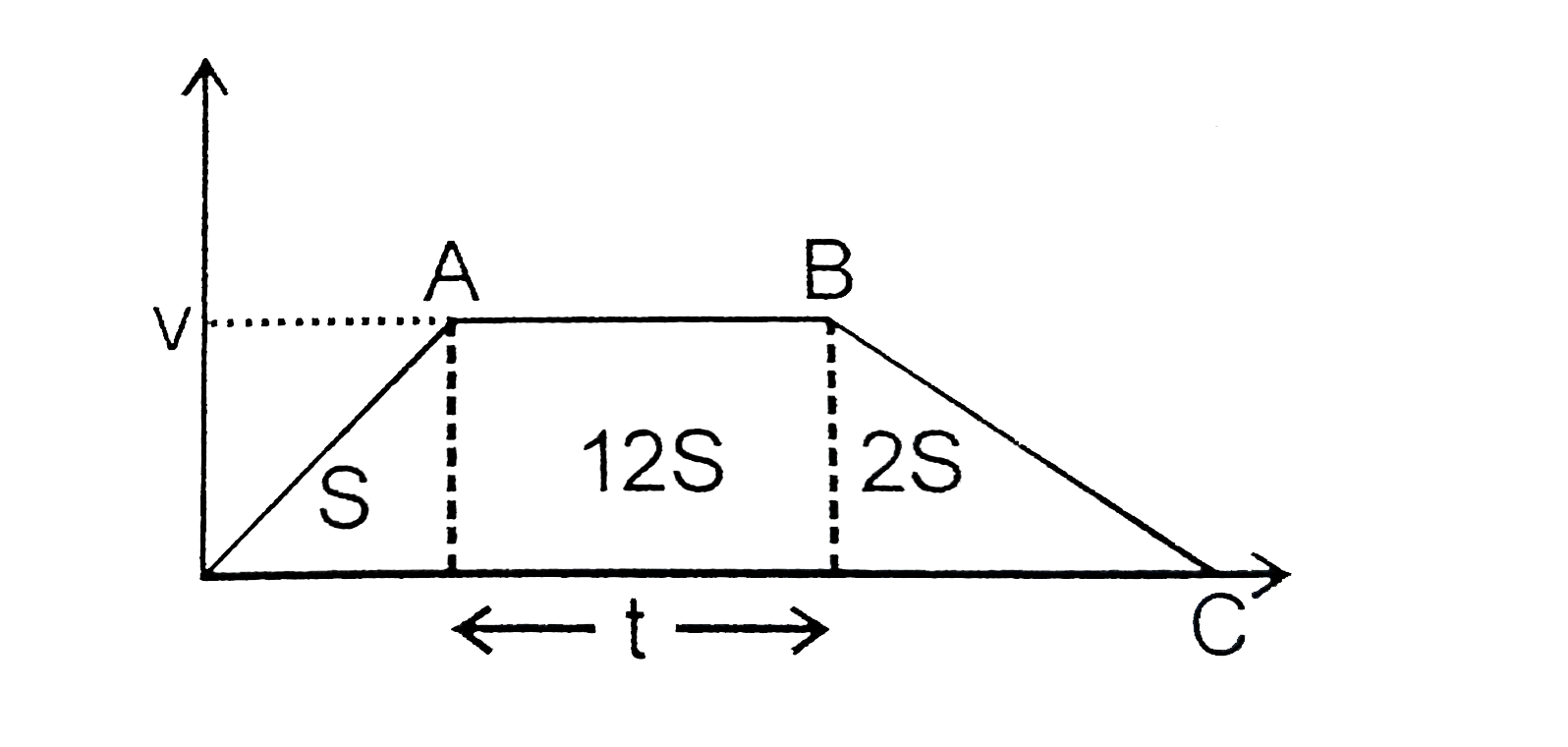
|
|
| 44042. |
Statement-1 : in case of beats, intensity of sound at some position in space remains maximum and , at others ,it remains minimum. because Statement -2 : Beats are formed due to superposition of sound waves of unequal frequencies. |
|
Answer» STATEMENT -1 is TRUE, statement -2 is True, Statement -2 is a correct explanation for Statement -1. |
|
| 44043. |
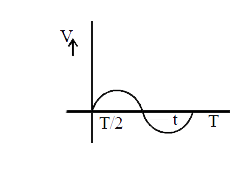
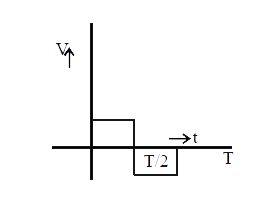
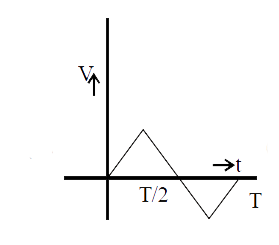
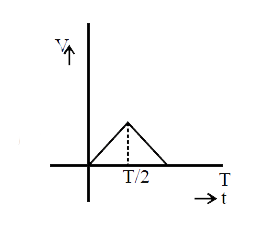
The current (I) in the inductance is varying with time acroding to the plot shown in figure. Which one of thhe following is the correct variation of voltage with time in the coil ? |
|
Answer»
|
|
| 44044. |
The shortest wavelength for Lyman series is 912 Å. What will be the longest wavelength in Paschen series? |
|
Answer» 1216 Å `:. 1/lambda =R[1/p^(2) -1/n^(2)]` `1/lambda =R[1/9-1/16]` `lambda=144/(7R)=144/(7xx1.093xx10^(7))=18751 Å` |
|
| 44045. |
Nucleus A decays to B with decay constant lamda_(1) and B decuys to C with decay constants lamda_(2). Initially at t=0, number of nuclei of A and B are 2N_(0) and N_(0) respectively. At some instant t=t_(0), number of nuclei of B stop changing. Find t_(0) if at this intant number of nucleiof B is (3N_(0))/(2) |
|
Answer» `t_(0)=(1)/(lamda_(1))ln""(4lamda_(1))/(3lamda_(2))` |
|
| 44046. |
A conducting wire frame is placed in a magnetic field which is directed into the paper. The magnetic field is increasing at a constant rate. The directions of induced currents in wires AB and CD are |
|
Answer» B to A and D to C |
|
| 44047. |
(A) : Electromagnetic waves are tranverse in nature. (R) : The Poynting,s vector which gives the power density is given by vecP=vecExxvecB |
|
Answer» Both 'A' and 'R' are TRUE and 'R' is the CORRECT EXPLANATION of 'A'. |
|
| 44048. |
The CGS unit of magnetising intensity is 1 oersted, where 1 oersted = |
|
Answer» `80Am` |
|
| 44049. |
h d G has the dimensions of (h = height, d = density, G = "gravitational constant") |
|
Answer» PRESSURE |
|
| 44050. |
A conducting wire frame is placed in a magnetic field which is directed into the paper. The magnetic field is increasing at a constant rate. The directions of induced currents in wires AB and CD are |
|
Answer» B to A and D to C |
|