

Saved Bookmarks
This section includes InterviewSolutions, each offering curated multiple-choice questions to sharpen your knowledge and support exam preparation. Choose a topic below to get started.
| 43051. |
C, Si and Ge have same lattice structure. Why is C insulator while Si and Ge intrinsic semiconductors? |
|
Answer» Solution :Atoms require less energy to release electron from the orbit away from nucleus. There are four electrons in the second orbit in `""_(6)C`, four electrons in third orbit of `""_(14)Si` and four electrons in the fourth orbit of `""_(32)GE`. Hence, energy REQUIRED to take out an electron from these atom (ionisation energy) will be least for Ge, more than that for Si and HIGHEST for C or the resistivity of MATERIAL depends on the energy difference between their CONDUCTION and valence band and for Cthis energy difference is 5.4 eV, for Si it is 1.1 eV and for Ge it is 0.7 eV. Hence, number of free electrons for conduction in Ge and Si are significant but neligibly small for C so Ge and Si are semiconductor and C is insulator. |
|
| 43052. |
Two point monochromatic and coherent sources of light of wavelengthIare placed on the dotted line in front of an large screen.The souces emti waves in phase with each other.the distance betweenS_(1)&S_(2)is 'd'while theiri distance from the screen is much larger ,then, "rarrif d=7lambda//2,O will be a minima "rarrif d=4.3lambda,O there will be a total of 8minima on y axis "rarrif d=7lambda,O will be a minima "rarrif d=lambdathere will be only maxima on the screen. |
|
Answer» `1,2&3` (3) Since path DIFFERNCE at `O` is `nlambda`,So`O` is maxima As we move up or down on the screen PHASE different of point alwasys remain less than`lambda1` so there is only central maxima. |
|
| 43053. |
The number of beta particles emitter by radioactive sustance is twice the number of alpha particles emitter by it. The resulting daughter is an |
|
Answer» isomer of PARENT The resultant DAUGHTER is an isotope of the original parent nucleus . |
|
| 43054. |
Four monochromatic and coherent sources of light, emitting waves in phase of wavelength lambda, are placed at the points x = 0, d = 2d and 3d on the x-axis. Then |
|
Answer» point having `|X| gt gt d` appear DARK if `d = lambda//4` |
|
| 43055. |
20 ampere current is flowing in a long straight wire. The intensity of magnetic field at a distance 10 cm from the wire will be |
|
Answer» `4XX10^(-5)Wb//m` |
|
| 43056. |
In Fresnel.s diffraction wavefront must be |
| Answer» Answer :D | |
| 43057. |
Assertion(A): Electric and gravitation fields are acting along same line. When proton and alpha- particle are projected Reason (R ) : |
|
Answer» Both `(A)` and `(R )` are TRUE and `'R'` is the CORRECT EXPLANATION of `A`. |
|
| 43058. |
Derive an expressionfor capacitance of a paralle plate capacitor |
Answer» Solution :  Consider two parallel plates P and Qeach of area a and separated by a DISTANCE d in air. Let plate P has surface desity `+sigma` and plate Q has surface CHARGE density`-sigma` and plate Q has surface charge density `-sigma` The electric field between the plates` E = (sigma)/(epsilon_(o)) = (q//A)/(epsilon_(o)` `E= (q)/(Aepsilon_(o)0`, But potentail difference plates , V = ED now capacitanece,`C= (q)/(V)= (q)/(Ed)= (q)/((q)/(Aepsilon_(0))xxd)` `C - (epsilon_(0)A)/(d)` |
|
| 43059. |
A transverse wve given by Y = 0.021 sin (x + 30t) is propagating in a string of linear density 1.3 x, 10^(-4) kg/m. If x and y are in metres and time in seconds , the tension in string is : |
|
Answer» 2.4 N here w = 30 rad /sec . And k = 1 `therefore V = (w)/(k) = (30)/(1) = 30 ms^(-1)` Now in strings v = `sqrt((T)/(m))` `therefore T = v^(2) .m = 900 xx 1.3 xx 10^(4) = 117 xx 10^(3) = 0.12 N ` hence the correct choice is (C). |
|
| 43060. |
The activity of a sample of radioactive material is A_1at time t_1 and A_2 at time t_(2)(t_2 gt t_1) . Obtain an expression for its mean life. |
|
Answer» SOLUTION :`A_1=A_o E^(-lambdat_1)` and `A_2=A_o e^(-lambdat_2) A_1/A_2=e^(LAMBDA(t_2-t_1))` `lambda(t_2-t_1)=ln|A_1/A_2|` `tau-1/lambda -(t_2-t_1)/(ln|A_1/A_2|)` |
|
| 43061. |
Why do we slip on a muddy road ? |
| Answer» Solution :The water on a MUDDY ROAD PROVIDES a thin layer in between our feet and road. This layer breaks interlocking and decreases the FRICTION. | |
| 43062. |
The breaking strength of a cable of diameter 2 cm is 2 xx 10^(5) N. What will be the breaking strength of a wire of the same material but having diameter 1 cm ? |
|
Answer» `2 xx 10^(5)` N Correct choice is (C). |
|
| 43063. |
For the wave y = 5 sin 30 pi [t -(x//240)], where x and y are in cm and t is in seconds, find the Velocity of the wave. |
| Answer» SOLUTION :240 cm/s | |
| 43064. |
The velocity v of a particle is given in terms of time t by the equation v=at+(b)/(t+c) The dimensions of a,b and c are : |
|
Answer» `L^(2),T,LT^(2)` By PRINCIPLE of homogeneity, dim `(at)`=dim`(v)`implies`a=(LT^(-1))/(T)=[LT^(-2)]` Also dim `(c )`=dim`(t)`=`[T]` Now `(b)/("time")=Velocity:.b=velocityxxtime` ` =LT^(-1)xxT=[L]` So correct choice is `(c ).` |
|
| 43065. |
When alpha, beta and gamma radiation pass through a gas, their ionizing powers, in decreasing order, are |
|
Answer» `GAMMA,ALPHA,BETA` |
|
| 43066. |
Ship A is moving Westwards with a speed of 20kmh^(-1)and another ship B which is at 200 km South of A is moving Northwards with a speed of 10km h^(-1). The time after which the distance between them is shortest and the shortest distance between them respectively, |
|
Answer» `4 h, 80 SQRT(5) km` Let ship A travel `x_(A)`DISTANCE and ship B travel `x_(B)`distance, in TIME t . So, `u_(A) = (x_(A))/(t)rArrt = (x_(A))/(20)` and`u_(B) = (x_(B))/(t) rArr t = (x_(B))/(10) rArr (x_(A))/(20) = (x_(B))/(0) rArr x_(A) = 2x_(B)` So, `AB = sqrt(x_(4)^(2)+(200-x_(B))^(2))` `= sqrt(4x_(B)^(2)+ 40000+x_(B)^(2) - 400x_(B))` `= sqrt(5x_(B)^(2)-400x_(B) +40000)` Differentiate distance AB w.r.t. `x_(B) ` forfinding valueof `x_(B)` `(d(AB))/(dx_(B)) =(1)/(2sqrt(5x_(B)^(2)-400x_(B)+40000))(10x_(B) - 400)=0` or`x_(B) = 40 m ` Again differentiating, SO, `((d^(2)(AB))/(dx_(B)^(2)))_(x_(B)= 40 m)gt 0""[:. "Distance always greater than zero"]` Hence `x_(B) `at point, `x_(B) =40 `m distance, AB will be shortest. So, `AB = sqrt(5XX 40^(2) - 400 xx40 +4000)` `AB = sqrt(32000)` or `AB = 80sqrt(5) km` The time after which the distance AB is shortest `t = (x_(A))/(20) = (x_(B))/(10)=(40)/(10)= 4 hr` . 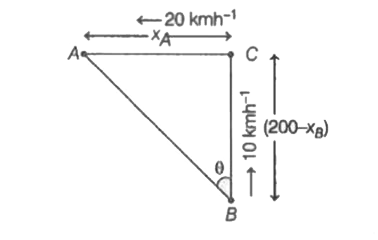
|
|
| 43067. |
The P.d between the terminals A&B is |
|
Answer» 2 V |
|
| 43068. |
Where did Lencho expect the downpour to come from? |
|
Answer» North |
|
| 43069. |
Two large conducting spheres carrying charges Q_1, and Q_2, are brought close to each other. Is the magnitude of electrostatic force between theme exactly given by (Q_1Q_2)/(4pi epsi_(0) r^(2)), where r is the distance between their centres? b. If Coulomb's law involved 1/r^(3) dependence ("instead of "1/r^2), would Gauss law be still true? c. A small test charge is released at rest at a point in an electrostatic field configuration. Will it travel along the field line passing through that point? d. What is the work done by the field of a nucleus in a complete circular orbit of the electron? What if the orbit is elliptical? e. We know that electric field is discontinuous across the surface of a charged conductor. Is electric potential also discontinuous there? f. What meaning would you give to the capacitance of a single conductor? g. Guess a possible reason why water has a much greater dielectric constant (=80) than say, mica (= 6). |
|
Answer» Solution :a. No, The given relation is Coulomb.s law which is true for point charges. In the present case, as the spheres are brought closer, the distribution of charge on them BECOMES non uniform. b. No. The surface area in space varies as `1/r^2`. Hence `1/r^(2)` dependence is essential. c. Not necessarily. The motion of charged particle need not be along the line of the field. It does so in the uniform field. The field GIVES the direction of acceleration and not that of velocity in GENERAL. d. Zero. For any complete path in electrostatic field (the shape does not matter), it is zero. e. No. POTENTIAL is continuous there f. The single CONDUCTOR can form condenser with the other conductor at infinity. Hence the meaning of storage of charge retains. g. Water molecules are polar molecules. |
|
| 43070. |
List some advantages of reflecting telescope. |
|
Answer» Solution :(i) The IMAGE formed is free from chromatic aberration. (ii) The spherical aberration can also be minimised by using a parabolic mirror as objective. (III) The image formed is very BRIGHT due to its LARGE light gathering power. As such it, ENABLES us to see even very faint stars |
|
| 43071. |
A coin kept on a horizontal rotating disc has its centre at a distance of0.25 cm from the axis of rotation of the disc. If mu is 0.2. What is the angular velocity of the disc at which the coin is about to slip off ? |
|
Answer» 28 rad/sec |
|
| 43072. |
Calculate the radius of curvature of an equi-concave lens of refractive index 1.5, when it is kept in a medium of refractive index 1.4, to have a power of - 5 D ? |
|
Answer» Solution :Here, `R_(1) =R_(2) = R` (say), `n_(L) = 1.5,n_(m) = 1.4` and POWER of lens P = `-5 D` `therefore P =1/f =(n_(L)/n_(m)-1)(1/R_(1) + 1/R_(2)) = (n_(L)/n_(m)-1).2/R` `RARR R = (n_(L)/n_(m)-1).2/P = (1.5/1.4 -1) xx 2/(-5) = 0.029m = 2.9 cm` |
|
| 43073. |
A radiation of energy 'E' falls normally on a perfectly reflecting surface. The momentum transferred to the surface (C =velocity of light) is: |
|
Answer» `(2E)/C` |
|
| 43074. |
The equation of a travelling sound wave is y = 6.0 sin (600 t - 1.8 x) where is measured in 10^(-5) m, t in second and x in metre. Find the ratio of the velocity amplitude of the particles to the wave speed. |
| Answer» SOLUTION :`1.1 XX 10^(-4)` | |
| 43075. |
AssertionIf a loop is placed in a non-uniform (with respect to position) magnetic field, then induced emf is produced in the loop. Reason In a non-uniform magnetic field, magnetic flux passing through the loop will change. Therefore, induced emf is produced. |
|
Answer» If both Assertion and REASON are CORRENT and Reason is the corrent EXPLANATION of Assertion. |
|
| 43076. |
The equation of a travelling sound wave is y = 6.0 sin (600 t - 1.8 x) where is measured in 10^(-5) m, t in second and x in metre. Find the ratio of the displacement amplitude of the particles to the wavelength of the wave. |
| Answer» SOLUTION :`1.7 XX 10^(-5)` | |
| 43077. |
The massof anoxgyenmolecule differsfromthat ofa nitrogenmolecule. Dothe oxygenmoleculesand thenitrogenmoleculesin airhavethe samermsspeedv_(rms) ? |
|
Answer» SOLUTION :weknow that ` V_(rms)`isrelated toKavgbyequation. ` K_(AVG)= 1/2mv_(rms )^(2)` Although thetwotypesof moleculeshavethe same`K_(Avg) `they havedifferentmassesm andthustheirrmsspeedsmustdiffer. the findtheir rmsspeeds , wesolveEq. 20-15for ` v_(rms ) `andthensubstitutefor molecularmassm withequation`M = m N_A`becausemolarmassesM canbefoundinappendixF.weobtain ` V_(rms) = sqrt((2K _(avg) N_A)/(M ))` Calculations:INTHE airthatwebreatheoxygenandnitrogenare diatomicmolecules`(O_2and N_2)`-eachmolecule consistsof twoatoms. themolarmass`M_(O_2)` ofdiatomicoxygenis 1( 15.9994g / mol ) `~~= 0.0320` Kg/ moland themolarmass`M_(N_2)`of diatomicnitrogenis `2 ( 14.0067g // mol ) ~~ 0.0280kg // mol ` NowwecansubstituteknowndataintoEq 20-27foroxygenwefind ` V_(rms ) =sqrt((2 ( 6.21 xx 10^(-21)J)(6.02 xx 10^(23) mol ^(-1)))/( 0.0320kg // mol ))` `=483m//s ` Similarly,fornitrogenwefind ` V_(rms )= 517m//s ` the nitrogenwe find ` V_(rms )= 517m//s` Thenitrogenmolecules, withtheirsmaller MASS( ANDTHE sameaveragekineticenergy) , havethegreaterrmsspeed . |
|
| 43078. |
An angular ring with inner and outer radii R_(1) and R_(2) is rolling without slipping with a uniform angular speed. The ratio of the forces experienced by the two particles situated on the inner and outer parts of the ring (F_(1))/(F_(2)) is : |
|
Answer» `(R_(2))/(R_(1))` `therefore (F_(1))/(F_(2))=(R_(1))/(R_(2))` |
|
| 43079. |
Frequency of radiation incident on metal surface is called threshold frequency. |
|
Answer» Any |
|
| 43080. |
A light bulb is at 100 W for a 220 V supply . Find (a) the resistance of the bulb , (b) the peak voltage of the source , and (c ) the rms current through the bulb. |
|
Answer» <P> Solution :a. We are GIVEN P = 100 W and V = 220V. The resistance of the bulb is`R = (V^2)/(P) = ((220)^2)/(100) = 484 Omega` B. The peak voltage of the source is `v_m =sqrt2 V = 311 V` C . Since P = IV `I = P/V= 100/220 = 0.450 A` |
|
| 43081. |
two point charges + 1n C and -4 nc are 1m apart in air . Find the positions along the line joining the two charges at which resultant potential is zero. |
Answer» SOLUTION :  `V= (1)/(4piepsilon_(n) ) (q)/(r )` Position between the CHANGES `V_(1) + V_(2)= 0` `(1)/(4piepsilon_(0)) (1xx10^(-9))/(X) +(-(1)/(4piepsilon_(0))(4XX10^(-9))/(1-x))=0` `(1)/(4piepsilon_(0))(1xx10^(-9))/(x) = (1)/(4piepsilon_(0)) (4xx10^(-9))/(1-x)` `4X=1-x` `4x = x=1` `5x=1` `x= 0.2m` position beyond the charges  `(1)/(4piepsilon_(0)) (1xx10^(-9))/(x) = (1)/(4piepsi_(0)) ( 4xx10^(-9))/( 1+ x)` `4x=1+X` `3X=1` `X= 0.333 m` |
|
| 43082. |
A solenoid, of length 1.0 m, has a radius of 1 cm and has a total of 1000 turns wound on it. It carries a current of 5 A. Calculate the magnitude of the axial magnetic field inside the solenoid. If an electron were to move with a speed of 10^(4) m s^(-1) along the axis of this current carrying solenoid, what would be the force experienced by electron ? |
|
Answer» Solution :Here length of solenoid l = 1.0m, total no. of turns `N = 1000` and current flowing l = 5 A `:.` Magnetic field INSIDE the solenoid along its axial line `B = mu_0 N/l cdot I = 4 pi xx 10^(-7) xx 1000/1.0 xx 5 = 6.28 xx 10^(-3)T`. As ELECTRON is to move with a speed a `10^(4) m s^(-1)` along the axis of solenoid , hence `vecv` and `vecB` are along the same line. Hence, FORCE experienced with this eletron will be zero. |
|
| 43083. |
A body of mass m kg collides elastically with another body at rest and then continues to move in the original direction with one half of its original speed. What is the mass of the target body ? |
|
Answer» m KG |
|
| 43085. |
A system has two charges q_(A)=2.5 xx10^(-7) c and Q_(B)=-2.5 xx10^(-7) c locatedat points a (0,0,-15 cm) and B:(0,0+15cm) respectively what are the total charge and electric dipole moment of the system |
| Answer» Solution :Total charge is ZERO DIPOLE moment `=7.5 xx10^(-8)` C m along z AXIS | |
| 43086. |
A rifle (1)/(16) bullet loses th of its velocity while passing through one plank of wood. The smallest number of similar plancks required to stop the bullet completely is : |
|
Answer» 6 |
|
| 43087. |
A body having a temperature of 27^@C is kept in a room having a temperature of 27^@C . Does the body emit any radiation in this case when the room temperature is the same as body temperature ? |
|
Answer» Yes |
|
| 43088. |
In a cylinder whose diameter is exactly 1.0 cm at 30^@C is to be slid into a hole of diameter 0.9997cm in a steel plate at the same temperature. The minimum required rise in temperature of the plate is(The coefficient of linear expansion of steel = 12xx10^(-6)//^@C ) : |
|
Answer» |
|
| 43089. |
What did the author eat for breakfast? |
|
Answer» THICK and stale chapatis with a LITTLE BUTTER and sugar SPREAD in it |
|
| 43090. |
Even Carnot engine cannot give 100% efficiency because we cannot : |
|
Answer» PREVENT radiation `therefore` Correct choice is (c ). |
|
| 43091. |
If each resistance in the given circuit has value, the reading of the ammeter is (in A): |
|
Answer» (E-V)R `V=IR`………(II) `EV=(R+r)/R=1+r/R implies r=((E-V)/V)R` |
|
| 43092. |
The Process of superimposing message signal on high frequency wave is called |
|
Answer» AMPLIFICATION |
|
| 43093. |
What will be the formula of mass of the earth in terms of g, R and G ? |
|
Answer» `"G"(R )/(g)` Equating both the values of gravitational force, `(GMm)/(R^(2))=mg" or "M="g"(R^(2))/(G)` where M is the mass of the EARTH. |
|
| 43094. |
Two billiard balls each of mass 0.05 kg moving in opposite directions with speed 6ms^(-1) collide and rebound with the same speed . What is the impulse imparted to each ball due to the other ? |
|
Answer» `0.5 KG m//s ` |
|
| 43095. |
Whichof the followingis /are correct? |
|
Answer» A uniform capillaryis heldverticallywith its lowerend dipped in water . The waterrise to 10 cm . If thecapillaryis nowbroken at a level of 6 cmabove waterlevelin the vessel , a FOUNTAIN will be observed . |
|
| 43096. |
The forces that keep the nucleus bound in the nucleus what we call ? |
| Answer» SOLUTION :NUCLEAR FORCES | |
| 43097. |
Theminimum energyrequired to excite a hydrogenatom from its ground state is . |
|
Answer» 13.6 eV |
|
| 43098. |
In a L-C oscillator circuit at any instant of time current is I and charge on capacitor is Q then the total energy of the system will be ……… |
|
Answer» `Q^2/(2C)` `=(Q_0^2cos^2omega_0t)/(2C)+1/2LQ_0^2omega_0^2 sin^2 omega_0t` `=1/2Q_0^2[(cos^2 omega_0t)/C+Lomega_0^2 sin^2 omega_0t]` `=Q_0^2/2[(cos^2omega_0t)/C+1/C sin^2omega_0t] [because omega_0^2 =1/(LC)]` `=Q^2/2[cos^2 omega_0^t +sin^2omega_0t]` `=Q^2/(2C)` |
|
| 43099. |
The angular momentum of an electron in a hydrogen atom is proportion to |
|
Answer» `1sqrt( R )` |
|
| 43100. |
A single circular loop of wire with radius 0.02 cm carries a current of 8.0A.It is placed at the centre of a solenoid that has length 0.65 m,radius 0.080 mand 1300 turns. |
|
Answer» The value of the current in the solenoid so that the magnetic field at the centre of the loop becomes zero,is EQUAL to `4.4 A`. Magnitude of `B_(solienoid)`=Magnitude of `B_("loop")` `mu_(0)NI=(mu_(0)I)/(2R)` here`n="Total no. of turn"/"Total length"=1300/0.65` `i=1/(2R)xx1/n=(8xx0.65)/(2xx0.02xx1300xx10^(-2))=10 A` For given condition: Total magnetic field at the centre of loop `=|B_("loop")|+|B_("solenoid")| :' |B_("loop")|=|B_("solenoid")|` `=2|B_("loop") =2xx(mu_(o)I)/(2R)` `=(2xx4pixx10^(-7)xx8)/(2xx0.02xx10^(-2))=16pixx10^(-3) T`. |
|