

Saved Bookmarks
This section includes 7 InterviewSolutions, each offering curated multiple-choice questions to sharpen your Current Affairs knowledge and support exam preparation. Choose a topic below to get started.
| 1. |
Five moles of hydrogen initially at STP is compressed adiabatically so that its temperature becomes 673 K. The increase in internal energy of the gas , in kilo joule is (R= 8.3 J// mol-K, gamma= 1.4 for diatomic gas) |
|
Answer» 80.5 |
|
| 2. |
The specific heat of a substance varies as (3t^(2) + t) xx 10^(-3) cal/g^(0)C. What is the amount of heat required to raise the temperature of 1 kg of substance from 10^(0)C " to " 20^(0)C ? |
|
Answer» 2.15 |
|
| 3. |
A small body is placed at the top of a smooth sphereof radius r. what should be the horizontal velocity given to the body so that it loses contact with the sphere when its height from the centre of the sphere is (4r)/(5)? |
|
Answer» |
|
| 4. |
Find moment of inertia of a ring of mass 4kg and radius 20cm about its tangent. |
| Answer» SOLUTION :`I_("TANGENT")=0.24kgm^(2)` | |
| 5. |
The ratio of displacement at any position and………….remains constant for a particle executed SHM. |
| Answer» SOLUTION :ACCELERATION. | |
| 6. |
The equation of motion of a particle is given by x=5+3 sin(pit), where x is in cm and t in seconds. Find the amplitude of motion at one fourth of the time period of motion (in cm): |
| Answer» ANSWER :B | |
| 7. |
The mass of a body is 20.0 g and its volume is 10.0 cm^(3). If possible maximum errors in the measurement of mass of body and volume of body are 0.001 g and 0.01 cm^(3) respectively, then the maximum error in the value of density is |
|
Answer» ` 0.001 g cm^( -3)` As density `RHO= (M)/(V)` `:. (Deltarho)/(rho)= (DeltaM)/(M)+ (DeltaV)/(V)= (0.001)/(20.0)+ (0.01)/(10.0)= (5 XX 10^(-5))+ (1 xx 10^(-3))= 1.05 xx 10^(-3)` or `Deltarho = (1.05 xx 10^(-3))xxrho= 1.05 xx 10^(-3) xx 10^(-3) xx (20.0)/(10.0)= 0.002gcm^(-3)` |
|
| 8. |
A thin circular metal disc of radius 500mm is set rotating about a central axis normal to its plane upon raising its temperature gradually, the radius increases to 507.5 mm, the percentage change in the rotational KE will be ----- |
|
Answer» `1.5%` |
|
| 9. |
A uniform metre scale of mass 2kg is suspended from one end. If it is displaced through an angle 60^(@) from the vertical, the increase in its potential energy is, |
|
Answer» 4.9J |
|
| 10. |
A satellite is launched into a circular orbit of radius R around the earth. A second satellite is launched into an orbit of radius 4R. The ratio of their respective periods is |
|
Answer» `4:1` `T_2 = K(8) R^(3/2)` `(T_1)/(T_2) = (KR^(3/2))/(8KR^(3/2)) = 1/8 impliesT_1 : T_2 = 1:8` |
|
| 11. |
From a disc of radius R and mass M , a circular hole of diameter R , whose rim passes through the centre is cut . What is the moment of inertia of the remaining part of the disc about a perpendicular axis , passing through the centre ? |
|
Answer» 11 `MR^(2) //32` Mass of removal portion of disc , `M. = (M)/(pi R^(2)) xx pi ((R)/(2))^(2) = (M)/(4)`  MOMENT of interia of removed portion about an AXIS passing through centre of disc O and perpendicular to the plane of disc , `I._(O) = I_(O.) + M.d^(2) = (1)/(2) xx (M)/(4) xx ((R)/(2))^(2) + (M)/(4) xx ((R)/(2))^(2)` `= (MR^(2))/(32) + (MR^(2))/(16) = (3 MR^(2))/(32)` The moment of inertia of complete disc about centre O is `I_(O) = (1)/(2) MR^(2)` So, moment of inertia of the disc with removed portion is `I = I_(O) - I._(O) = (1)/(2) MR^(2) - (3MR^(2))/(32) = (13 MR^(2))/(32)` |
|
| 12. |
For frequency of spring oscillator make doubly……… |
|
Answer» MASS has to made one forth `therefore 2= sqrt((m_1)/(m_2))` `f alpha (1)/(sqrt(m))` `therefore (m_2)/(m_1)= 4`. mass has to made four times. |
|
| 13. |
A flim of water if found between two straight parallel wires of length 0.10m each separated by 5 xx 10^(-3)m. If their separation is increased by 1 xx 10^(-3)m, while maintaining their parallelism, how much work will have to be done? (S.T. of water is 7.2 xx 10^(-2) Nm^(-2)). |
|
Answer» Solution :GIVEN `d=5 xx 10^(-3) m, l=0.10m` `d=6 xx 10^(-3)m, l=0.10m` `A=ld =0.10 xx 5 xx 10^(-3) =5 xx 10^(-4)m^(2)` `A.=ld. =0.1 xx 6 xx 10^(-3) =6 xx 10^(-4) m^(2)` `DeltaA=1 xx 10^(-4) m^(2)`. Net AREA `=2DeltaA=2 xx 10^(-4)m^(2)` Work done `=(T)(2DeltaA)=0.072 xx 2 xx 1 xx 10^(-4)=0.144 xx 10^(-4) =1.44 xx 10^(-5)J` |
|
| 14. |
An iron rod of length 50cm is joined end to end to an aluminium rod of length 100cm. All measurements refer to 20^(@)C. The coefficients of linear expansion of iron and aluminium are 12xx10^(-6)//""^(@)Cand24xx10^(-6)//""^(@)C respectively. The average coefficient of composite rod is |
|
Answer» `20 xx 10^(-6)//""^(@) C` |
|
| 15. |
(A): For a real gas internal energy depends on its temperature as well as volume also.(R): For a real gas interatomic potential energy depends on volume and kinetic energy depends on temperature. |
|
Answer» Both (A) and ( R) are TRUE and (R ) is the CORRECT EXPLANATION of (A) |
|
| 16. |
A particle of mass 10gm is describing an SHM along a straight line with a time period of 2sec and amplitude 10cm. Then its KE at 2 cm from the equilibrium position is |
|
Answer» `4.8 xx 10^(-4)J` |
|
| 17. |
Law of conservation of eneryg is a universal law for all states of matter. Which theorem gives the law of conservation of energy for a flowing liquid? |
| Answer» SOLUTION :Bernoulli.s THEOREM. | |
| 18. |
Length breadth, thickness of a cuboid is 5.412 m 0.021mand 1.23mrespectively. Find total surface area and volume of cuboid in view of significant digit. |
| Answer» SOLUTION :`A=63.89 m^(2)V=25.43 m^(3)` | |
| 19. |
Give example of situation in which an applied force does not result in a change in kinetic energy . |
|
Answer» SOLUTION :When a charged particle moves in a CIRCULAR path under uniform normal magnetic field , the force is CENTRAL and movement is tangential , work done by the force is zero . As speed is also constant we can SAY that = `DELTAK = 0 ` ` (##KPK_AIO_PHY_XI_P1_C06_E04_031_S01.png" width="80%"> |
|
| 20. |
Order of magnitude of a quantity si the ……….., which gives us a value…………. . |
|
Answer» |
|
| 21. |
If a planet of given density were made larger keeping its density unchaed) its force of attraction for an object on its surface would increased because of increased mass of the plane but would decreases because of largerseparation between the centre of the planet and its surface. Which effect would dominate ? |
|
Answer» INCREASE in mass |
|
| 22. |
A particle of mass m is dropped in a tunnel dug along the diameter of the earth, from the surface find. (1) Its energy of oscillation (2) Time taken to move from surface to a depth Re/2 (3) Velocities at a depth Re/2 and centre (4) graph between a Vs v (5) If it is released from a height h above the surface, will the motion be SHM ? |
|
Answer» Solution :(1) ENERGY of oscillation `E = (1)/(2) mw^(2)A^(2) = (1)/(2)m((g)/(Re)) Re^(2) = (1)/(2) mg Re` (2) TIME taken to Re/2 x = A cos wt `(Re)/(2) = Re cos wt` 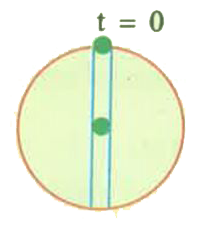 `wt = (pi)/(3), (2pi)/(T)t = (pi)/(3)` `t = (T)/(6) = (2pi)/(6) sqrt((Re)/(g)) = (pi)/(3) sqrt((Re)/(g))` (3) `v = w sqrt(A^(2) x^(2))` `v = sqrt((g)/(Re)) sqrt(Re^(2) - (Re^(2))/(4)) = sqrt((g)/(RE)) xx Re (sqrt(3))/(2) = (sqrt(3g Re))/(2)` (4) `because "" v = w sqrt(A^(2) - x^(2))` `therefore""(v^(2))/(w^(2)A^(2)) + (x^(2))/(A^(2)) = 1` (5) Out side the earth.s SURFACE the FORCE is gravitational which is not proportional to .x.. Therefore the motion will not S.H.M. but oscillatory. |
|
| 23. |
A particle will leave a vertical circle of radius r when its velocity at the lowest point of the circle (upsilon L) is . |
| Answer» Answer :c | |
| 24. |
Calculate the time taken for particele energy to drop to half its initial value in the case of a damped oscillator. |
|
Answer» SOLUTION :We know that `E(t)=E(0)e^(-BT//m)` where`""E(0)=(1)/(2)KA^(2)` `"Given,"E(t)=(1)/(2)(E(0)),""therefore ""(1)/(2)=e^(-bt//m)=e^((1)/(bt//m))` `"i.e."e^(bt//m)=2""(bt)/(m)=2.303log 2=0.693` `t=(0.693m)/(B)` |
|
| 25. |
Acceleration -displacemnet graph of a particle executing SHM is as shown in given figure. The time period of its oscillations is (in s) |
|
Answer» `pi/2` |
|
| 26. |
A child is standing at one end of a long trolley moving with a speed v on a smooth horizontal floor. If the child starts running towards the other end of the trolley with a speed u, the centre of mass of the system (trolley + child) will move with a speed |
| Answer» Solution :The force exerted by the cliild is an internal force acting on the system of CHILD and TROLLEY. SINCE there is no EXTERNAL force the speed of centre of mass remains the same as v. | |
| 27. |
The earth has a radius of 6400 km. The inner core of 1000 km radius is solid. Outside it, there is a region from 1000 km to a radius of 3500 km which is in molten state. Then again from 3500 km to 6400 km the earth is solid. Only longitudinal (P) waves can travel inside a liquid. Assume that the P wave has a speed of 8 kms^(-1) in solid parts and of 5 kms^(-1) in liquid parts of the earth. An earthquake occurs at some place close to the surface of the earth. Calculate the time after which it will be recorded in a seismometer at a diametrically opposite point on the earth if wave travels along diameter ? |
Answer» Solution : Here required time is `t =t _(1) + t _(2) +t _(3)` `= (d _(1))/( v _(1)) + (d_(2))/( v _(2)) + (d_(3))/( v _(3))` `= (2 ( 1000 -0))/( 8) + (2 (3500 -1000))/(5) + (2 ( 6400 - 3500))/(8)` `= 2 [125 +500 +362.5]` `=2 xx 987.5` `therefore t = 1975 s` |
|
| 28. |
Suppose if humans had evolved in a planet near the star Sirius, then they would have had the ability to see the _______ rays. |
|
Answer» ultra VIOLET ray |
|
| 29. |
If the percentage error in the measurement of mass and momentum of a body are 3% and 2% respectively, then maximum possible error in kinetic energy is ………..... |
| Answer» SOLUTION :`7%` | |
| 30. |
A steel wire, 2mm in diameter, is just stretched between two fixed points at a temperature of 30^@C . Determine its tension when the temperature falls to 20^@C . (Coefficient of linear expansion of steel = 0.000011//""^@C, Young's modulus for steel = 2.0xx10^11Nm^(-2)) |
|
Answer» Solution :THERMAL stress `= F/A = Y alpha Delta t ` Tension in the WIRE ` = Y alpha A (t_2 - t_1)` Here `Y = 2.0 xx 10^11 NM^(-2), alpha = 11 xx 10^(-6) //""^@C, t_2 = 30^@C, t_1 = 20^@C, ` radius = 1mm ` = 1 xx 10^(-3) m, ` `A = pi r^2 = pi (1 xx 10^(-3))^2= pi xx 10^(-6) m^2` The tension in the wire ` = 2.0 xx 10^11 xx 11 xx 10^(-6) xx pi xx 10^(-6) xx (30 - 20)= 69.14N` |
|
| 31. |
Two blocks M_(1) and M_(2) having equal mass are free to move on a horizontal frictionless surface . M_(2) is attached to a massless spring as shown in figure .Intially M_(2)is at rest and M_(1) is moving toward M_(2) with speed v and collides head- on with M_(2) . |
|
Answer» Whilespring is fully compressed all the KE of `M_(1)` is stored as PE of spring . (A) The spring will continue to compress until the two blocks acquire will be conserved . (C ) Is spring is MASSLESS wholeenergy of `M_(1)` will be impared to `M_(2) and M_(1)` will be at rest , then (D) Collision is INELASTIC ,even if friction is not involved . |
|
| 32. |
To maintain a rotor at a uniform angular speed of 200 rad.s^(-1), an engine needs to transmit a torque of 180 N. m . What is the power required by the engine? ( Note: uniform angular velocity in the absence of friction implies zero torque. In practice, applied torque is needed to counter frictional torque ) Assume that the engine is 100% efficient. |
|
Answer» |
|
| 33. |
One mole of an ideal diatomic gas undergoes a transition from A to B along a path AB as shown in the figure, The change in internal energy of the gas during the transition is: |
|
Answer» 20 KJ  `DeltaW=nC_V DeltaT` ….(1) but `DeltaT=T_2-T_1` `=(P_2V_2)/(NR)-(P_1V_1)/(nR) [ because T=(PV)/(nR)]` `=(P_2V_2-P_1V_1)/(nR)` Putting this VALUE in equation (1), `DeltaU=(nR)/(gamma-1) ((P_2V_2-P_1V_1)/(nR)) "" (because C_V=R/(gamma-1))` `=(P_2V_2 -P_1V_1)/(gamma-1)` `=((5xx4-2xx6)xx10^3)/(3/5-1) "" (because gamma=3/5)` `=((20-12)xx10^3)/(-2/5)` `=-(8xx10^3)/(2)xx5` =-20 kJ |
|
| 34. |
The acceleration due to gravity near the surface of a planet of radius R and density d is proportional to: |
|
Answer» `d/(R^(2))` |
|
| 35. |
A metallic solid sphere is rotating about its diameter as axis of rotation. If the temperature is increased by 200^(@)C. The percentage increase in its moment of inertia is : (coefficient of linear) expansion of the metal =10^(-5)//^(@)C) |
|
Answer» 0.1 `(DeltaI)/(I)=2(DeltaR)/(R )=(2R alphat)/(R )=2alpha Deltat` `(DeltaI)/(I)=2xx10^(-5)xx200=4xx10^(-3)` `"Percentage INCREASE "=4xx10^(-3)xx100=0.4` |
|
| 36. |
Water and mercury are filled in two cylindrical vessels up to same height. Both vessels have a hole in the wall near the bottom. The velocity of water and mercury coming out of the holes are v_(1) and v_(2) respectively. |
|
Answer» `v_(1)=v_(2)` |
|
| 37. |
Error in the measurement of radius of a sphere is 2%. Then error in the measurement of surface area is .............. |
| Answer» SOLUTION :`4%` | |
| 38. |
A body is thrown with velocity (4i + 3j) metre per second. Its maximum height is (g = 10 ms^(-2)) |
|
Answer» 2.5 m |
|
| 39. |
The period of oscillation of a simple pendulum is T in a stationary lift. If the lift moves upwards with an acceleration of 8g, the period will…………. |
|
Answer» remain the same THUS, the NEW TIME period is `T//3`. |
|
| 40. |
Two moles of an ideal monatomic gas are confined within a cylinder by a massless and frictionless spring loaded piston of cross-sectional area 4 xx 10^(-3)m^2. The spring is, initially, in its relaxed state. Now the gas is heated by an electric heater, placed inside the cylinder, for some time. During this time, the gas expands and does 50 J of work in moving the piston through a distance 0.10 m. The temperature of the gas increases by 50 K. Calculate the spring constant and the heat supplied by the heater. |
|
Answer» Solution :`W = intPdV= int(P_0+(kx)/( A )) Adx, i.e.,W= [p_0 Ax +1/2kx^2]` ` i.e.,50 =10 ^5 xx 4 xx 10^(-5)xx 0.1xx ( 0.1 )^2 ` then ` K= 2000( N//m)` `(b )dU = nC_vd T = 2 xx 3/2R xx 50= 150xx 8.3= 1245J` Butfrom1stof thermodynamics: dQ`=dU+dW= 1245+50= 1295J.` |
|
| 41. |
A circular loop of string rotates about its axis on a frictionless horizontal plane at a uniform rate so that the tangential speed of any particle of the string is v. if a small transvers disturbance is produced at a point of the loop,with what speed (relative to the string) will this disturbance travel on the string? |
|
Answer» Solution :Suppose F is the TENSION in the string due to its ROTATION. CHOOSE a small element of the string of length l. if `mu` is the mass per unit length of the string, then mass of the element, using newton's second law for the element, we have `2F sin theta//2=mv^(2)//R` For small `theta, sin theta//2=theta//2` 2F(theta/2)=(mv^(2))/(R)` `Ftheta=(muRtheta)V^(2)/R` `F=MUV^(2)` The speed of the disturbance `=sqrt(F)/(mu)=sqrt(muv^(2))/(mu)=v` 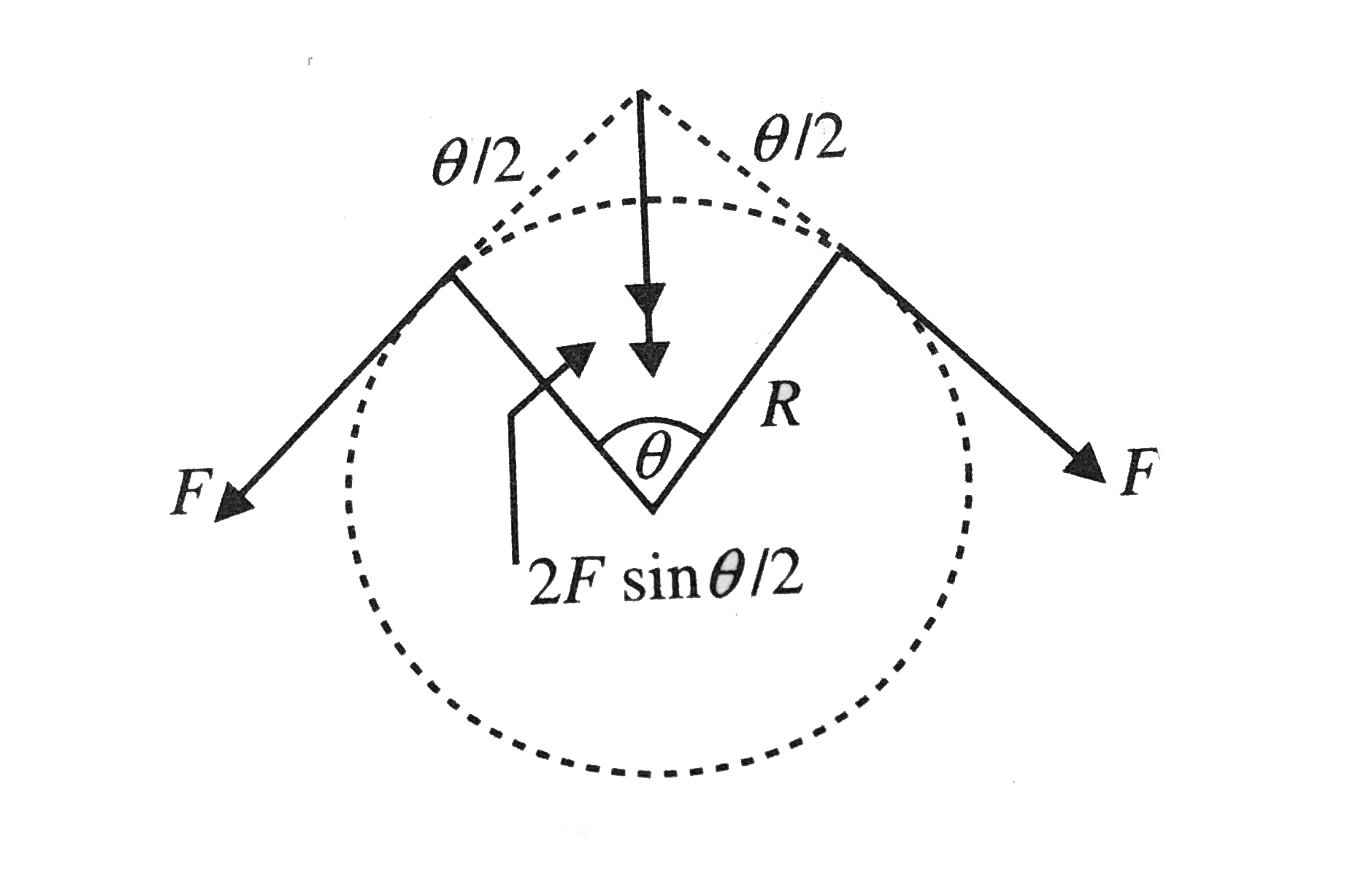
|
|
| 42. |
A force F is required to break a wire of length Land radius r. What is the force required to break a wire of the same material, twice the length and 4 times the radius? |
|
Answer» Solution :BREAKING stress is independent of LENGTH. It is EQUAL to breaking force per unit area. So breaking stress `=(F)/(pir^(2))` , So `(F)/(pir^(2))` in first case is equal to `(F^(1))/(PI(4pi)^(2))` `:.F.=16F` , So the force required is 16 F in the second case. |
|
| 43. |
Water rises to a height of 6cm in a capillary tube. If T = 7.2 xx 10^(-2) Nm^(-1)and g = 10ms^(-2)the radius of the tube is |
|
Answer» 0.24 MM |
|
| 44. |
A pendulum clock performs 86405 half-oscillations per day. At the beginning of a day the clock goes fast, but at the end of the day it goes slow by 15 s. What is the difference in maximum and minimum temperatures on that day? alpha for the material of the pendulum = 16xx10^(-6@)C^(-1) |
|
Answer» |
|
| 45. |
A steel wire of length 1 m and cross sectional area 1.5 mm^(2) is hung from a rigid support, with a stone of volume 2000 cm^3 hanging from the other end. Find the decrease in the length of the wire, when the stone is completely immersed in water. ( Y = 2 xx 10^(11) "Nm"^(-2) rho_("water") = 10 kgm^(-3) ) |
|
Answer» 0.06533 mm |
|
| 46. |
In new temperature scale W, freezing point of water is 39^(@)W and boiling point is 239^(@)W. What would be the temperature on new temperature scale for 39^(@)C temperature ? |
|
Answer» `200^(@)W` `(39)/(100)=(W-39)/(200)` `2xx39+39=W` `:.W=39xx(200)/(100)+39` `=39xx2+39` `=78+39` `=117^(@)W` |
|
| 47. |
Water is flowing through a horizontal pipe of irregular cross section . If the pressure at a point where the velocity is 0.2ms^(-1) is 30 mm Hg , what will be the pressure at a point where the velocity is 1.2ms^(-1) ? (Density of mercury =13.6gcm^(-3),g=1000cms^(-2) , Density of water =1gcm^(-3)) |
|
Answer» SOLUTION :`v_(1)=0.2m//s=20cm//s` `v_(2)=1.2m//s=120cm//s` `h_(1)=30mmHg=3cmHg` `rho.=13.6gcm^(-3)` `rho=1gcm^(-3)` `g=1000cm//s^(2)` `h_(2)=?` For horizontal pipe `y_(1)=y_(2)`,using Bernoulli.s equation, `P_(1)+(1)/(2)rhov_(1)^(2)=P_(2)+(1)/(2)rhov_(2)^(2)` `P_(2)=P_(1)+(1)/(2)rho(v_(1)^(2)-v_(2)^(2))` `=h_(1)rho.g+(1)/(2)rho(v_(1)^(2)-v_(2)^(2))` `=30xx10^(-1)xx13.6xx10^(3)+(1)/(2)XX1(20^(2)-120^(2))` `=40.8xx10^(3)-140xx50` `40.8xx10^(3)-7XX10^(3)` `P_(2)=33.8xx10^(3)dyn//cm^(2)` `h_(2)=(P_(2))/(rhog)=(33.8xx10^(3))/(13.6xx10^(3))` `thereforeh_(2)=2.485cm-Hg` |
|
| 48. |
A 1.0HP motor pumps out water from a well of depth 20m and fills a water tank of volume 2238 litres at a height of 10m from the ground. The running time of the motor to fill the empty tank is (g= 10 ms^(-2)) |
|
Answer» 5 min |
|
| 49. |
Give the magnitude and direction of the net force acting on a high - speed electron in space far from all material objects, and free of electric and magnetic field . |
| Answer» SOLUTION : As no field (gravitaional /ELECTRIC /magentuc ) is actingon the electroon ,NET FORCE on it is Zero . | |
| 50. |
A roller of mass 500kg is attached by a light horizontal chain to a tractor of mass 500kg. Assume the force offriction exerted by the ground to be 1000N. If the system has a forward acceleration of 2ms^(-2), calculate (i) the total force required for the motion and (ii) the tension in the chain. |
|
Answer» (ii) Tension= Mass of ROLLER `xx` acceleration `+` frictional force `=1100N` |
|