

Saved Bookmarks
This section includes 7 InterviewSolutions, each offering curated multiple-choice questions to sharpen your Current Affairs knowledge and support exam preparation. Choose a topic below to get started.
| 1. |
A wire that obeys Hooke.s law is of length L_(1) when it is in equilibrium under a tension F_(1)It.s length becomes L_(2) when the tension is increased to F_(2).Calculate the energy stored in the wire during this process. |
|
Answer» Solution :ENERGY stored = Area of SHADED region `=(1)/(2)(F_(1)+F_(2))[(L_(1)-l)-(L_(1)-l)]=(1)/(2)(F_(1)+F_(2))(L_(2)-L_(1))` |
|
| 2. |
An aluminimum wire of cross - sectional area1 xx 10^(-6) m^(2) is joined to a steel wire of the same cross - sectional area . This compound wire is stretched on a sonometer , pulled by a weight of 10 kg. The total length of the compound wire between the bridges is 1.5 m of which the aluminium wire is 0.6 m and the rest is steel wire . Transverse vibrations are set up in the wire by using an external source of variable frequency . Find the lowest frequency of excitation for which standing waves are formed , such that the joint in the wire is a node . What is the total number of nodes observed at this frequency , excluding the two at the ends of the wire ? The density of aluminium is 2.6 xx 10^(3) kg//m^(3)and that of steel is 1.04 xx 10^(4) kg//m^(3) |
|
Answer» Solution :Let `l_(1) and l_(2)` be the lengths of aluminum and steel wires , respectively . Given` l _(1) = 0.6 m , l_(1) + l_(2) = 1.5 m` `:. L_(2) = 1.5 - 0.6 = 0.9 m` If aluminium wire vibrates in `p_(1)` loops and steel wire in `p_(2)` loops , then frequency `n` is given by `n = n_(1) = (P_(1))/( 2l_(1)) SQRT (((T)/( m_(1)))) = (P_(1))/( 2l_(1)) sqrt (((T)/(A rho_(1))))` Also , `n = n_(2) = (P_(2))/( 2l_(2)) sqrt (((T)/( m_(2)))) = (P_(2))/( 2l_(2)) sqrt (((T)/(A rho_(2))))` `:. (P_(1))/(P_(2)) = (l_(1))/( l_(2))sqrt(((rho_(1))/( rho_(2)))) = ( 0.6)/(0.9) sqrt(((2.6 xx 10^(3))/(1.04 xx 10^(4))))` `:. P_(1) : P_(2) = 1 : 3` The MINIMUM number of loops in aluminimum wire ` = 1` and minimum number of loops in steel wire `= 3`. The stationary vibratuions in composite wire as shown in Fig. 7.69. Obviously TOTAL number of nodes `= 5`. The number of nodes excluding the two at the ends ` = 5 - 2 = 3` . Thus , the LOWEST frequency ` n = (1)/( 2 l_(1)) sqrt(((T)/( m_(1)))) = (1)/( 2 xx 0.6) sqrt (((10 xx 9.8)/( 1 xx 10^(-6) xx 2.6 xx 10^(3)))) = 162 HZ` 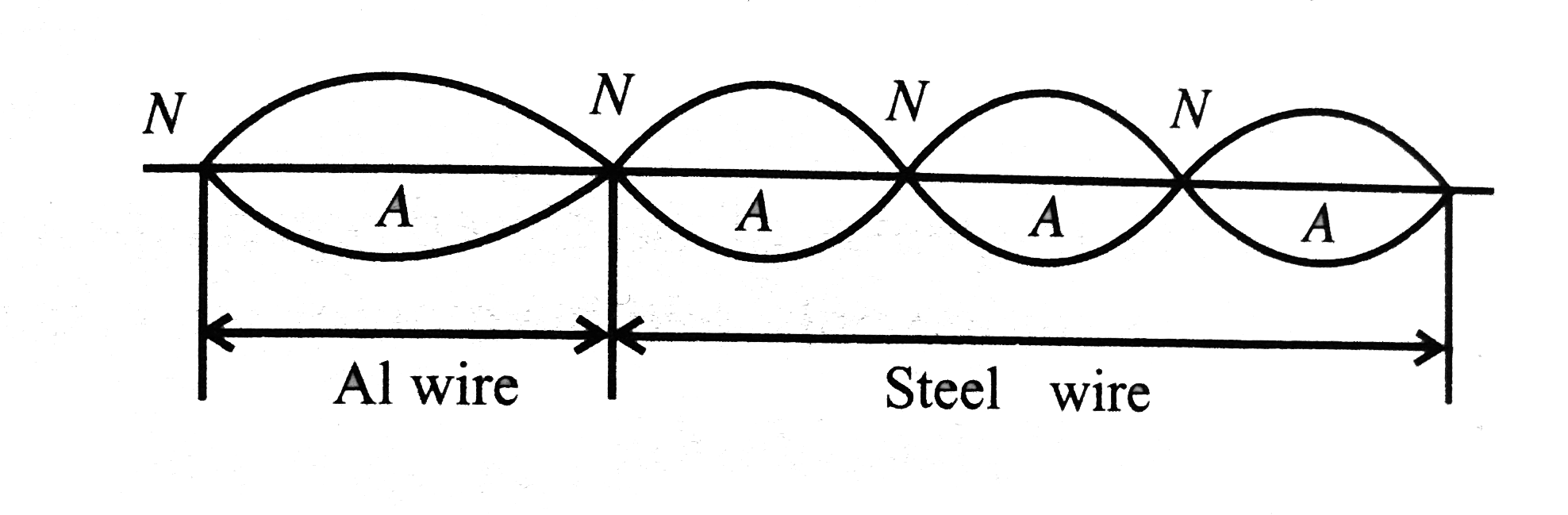
|
|
| 3. |
The resultant of three vectors 1,2 and 3 units whose directions are those of the sides of an equilateral triangle is at an angle of |
|
Answer» `30^@`with the first vector |
|
| 4. |
An object of specfic gravity Pis hung from a massless string. The tension in the string is T. The object is immersed ir water so that one half of its volume is submerged, the new tension in the string is |
| Answer» SOLUTION :`((2RHO-1)/(2rho))T` | |
| 5. |
kwh is the parctical unit of |
|
Answer» ENERGY |
|
| 6. |
(A) : Mass, Volume and time may be taken as fundamental quantities in a system. (R) : Quantities which are independent of one another are called fundamental quantities. |
|
Answer» Both (A) and (R) are TRUE and (R) is the correct EXPLANATION of (A) |
|
| 7. |
A sonometer wire is stretched by hanging a 10 cm high brass cylinder vertically from one of its ends. The wire resonates with a tuning fork of frequency256 Hz . Now the cylinder is partially immersed in water. If the wire and the tuningfork are vibrated simultaneously, 4 beats are heard per second. Calculate the length of the portion of the cylinder that was immersed in water.Given , density of brass= 8 . 5 g * cm^(-3) . |
|
Answer» Solution :The apparent loss of weight of the partially immersed cylinder reduces the tension in the wire. So , the frequency of the vibrating wire decreases. When the cylinder is partially immersed I water, the FUNDAMENTAL frequency of thewire is ` n_(2) = n_(1) - 4 = 256 - 4 = 252 ` HZ Now ,` (n_(1))/(n_(2))= sqrt((T_(1))/(T_(2)))`or ,`(256)/(252) = sqrt((T_(1))/(T_(2)))` Here, `T_(1)` = weight of the cylinder = ` 10 alpha rho g =10 alpha XX 8 . 5 xx g ` ` T_(2)`= weight of the partially immersedcylinder = weight of the cylinder in air - weight of the water displaced ` = 1= alpha xx 8 . 5 xx g - lalpha xx 1 xx g ` where `alpha = `area of cross section of the cylinder l = height of the cylinder immersed in water `:. (256)/(252) = sqrt((10 alpha xx 8 . 5 xx g )/(10 alpha xx 8.5 xx g - l alpha xx 1 xx g )) = sqrt((85)/(85 - l ))` or ,`(85)/(85 - l) = ((256)/(252))^(2) or, 85 - l = 85 xx ((252)/(256))^(2)` or,`l = 85 xx [ 1 - ((252)/(256))^(2)] = 2 . 64 ` cm . |
|
| 8. |
If a stream of air is blown under one of the pans of a physical balance in equilibrium, then the pan will ……………. . |
|
Answer» GO up |
|
| 9. |
The coefficient of performance of a refrigerator if it is to maintain eatables kept inside at 7^(@)C and the room temperature is 38^(@)C is |
|
Answer» 15.5 |
|
| 10. |
An ideal spring supports a disc of mass M. A body of mass m is released from a certain height from where it falls to hit M. The two masses stick together at the moment they touch and move together from then on. The oscillations reach to a height a above the original level of the disc and depth b below it. The constant of the force of the spring is |
|
Answer» `(2MG)/(b-a)` |
|
| 11. |
An elevator accelerates upwards at a constant rate. A uniform string of length L and mass m supports a small block of mass M that hangs from the ceiling of the elevator. The tension at distance at distance l from the ceiling is T. The acceleration of the elevator is |
|
Answer» `T/(M+m-(ML)/L)-G` |
|
| 12. |
A locomotive of mass 'm' starts moving so that its velocity varies as V = Ksqrt(S) , where 'K' is a constant and 'S', is the distance traversed. The total work done by all the forces acting on the locomotive during the first 't' seconds after the start of motion is, |
|
Answer» `(1)/(2)mK^(4)t^(2)` |
|
| 13. |
The windshield of a truck is inclined at 37^(@) to the horizontal. The truck is moving horizontally with a constant acceleration of a = 5 m//s^(2). At the instant the velocity of the truck is v_(0) = 0.77 m//s, an insect jumps from point A on the windshield, with a velocity u = 2.64 m//s (relative to ground) in vertically upward direction. It falls back at point B on the windshield. Calculate distance AB. Assume that the insect moves freely under gravity and g = 10 m//s^(2). |
|
Answer» |
|
| 14. |
A simple pendulum of length 0.2 m has bob of mass 5gm, it is pulled asided through an angle 60^(@) from the vertical. A spherical body of mass 2.5 gm is placed at the lowest position of the bob. When the bob is released it strikes the spherical body and comes to rest. What is the velocity of the spherical body ? (g=9.8 ms^(-2)) (in m/s). |
|
Answer» `1.4` |
|
| 15. |
If m_(1) = 3kg and m_2 = 1 kg what is the angular momentum of the system about center of pulley ? The radius of the pulley is 0.3 m and its moment of inertia about its axle is 0.14 kg m^2. The system moves with a linear velocity of 2 m/s on a frictionless horizontal surface ? |
| Answer» SOLUTION :`L = m_(1)VR + m_(2)vr+ lv//r = (3+1) xx 2XX 0.3 + 0.14 xx (2//0.3) = 3.33 Js`, (r-radius of PULLEY) | |
| 16. |
The set containing only vector quantitiesis |
|
Answer» THERMAL capapcity, Magnitude susceptibility and Electric CHARGE |
|
| 17. |
A fly wheel is attached to an engine on order to |
|
Answer» INCREASE its speed |
|
| 18. |
An astronomical telescope consisting of an objective of focal length 60cm and eyepiece of focal length 3cm is focused on the moon so that the final image is formed at least distance of distinct vision, i.e., 25cm from the eye- piece. Assuming the angular diameter of moon (1//2)^@ as the objective, calculate (a) angular size and (b) linear size of image seen through the telescope. |
|
Answer» SOLUTION :As final image is at LEAST distance of distinct VISION `|M|=f_0/f_e[1+f_e/D]=60/3[1+3/25]=22.4` Now as by definition `M=(theta/theta_0)` so the angular SIZE of image `theta= M times theta_c= 22.4 times [1/2]^@=11.2^@=pi/180^@ times 11.2 =0.2 rad` And if I is the size of final image which is at least distance of distinct vision, `theta=(I/25)i.e., I=25 times theta= 25 times 0.2=5cm` |
|
| 19. |
An aluminium wire and a steel wire of the same length and cross-section are joined end to end. The composite wire is hund from a rigid support and a load is suspended from the free end. If the increase in the length of the composite wire is 2.7mm, find the increase in the length of each wire. (Y_(Al)=0.7xx10^(11)Nm^(-2), Y_("steel")=2xx10^(11)Nm^(-2)) |
|
Answer» Solution :Total increase in LENGTH, `e=e_(1)+e_(2)`. `e_(1)+e_(2)=2.7"mmwe know e"=(FL)/(AY)` As F, A, L are same for both the wires. So, `e PROP (1)/(Y)` `(e_(1))/(e_(2))=(Y_(2))/(Y_(1))=(2xx10^(11))/(7xx10^(11))=(20)/(7), e_(1)=(20)/(7)e_(2)` substituting in `e_(1)+e_(2)=2.7`mm `(20)/(7)e_(2)+e_(2)=2.7mm, (27e_(2))/(7)=2.7`mm `e_(2)=0.7mm, e_(1)=(20)/(7)e_(2)=(20)/(7)xx0.7=2.0`mm |
|
| 20. |
A longitudinal force F produces an extension in a wire of length L.The force necessary to produce the same extension in a wire of length 4L of the same material and radius as the first wire is. |
|
Answer» F |
|
| 21. |
A body is kept on the floor of a train. When the train accelerates forward, the body gains a backward acceleration. Which force is responsible for the backward acceleration? |
| Answer» Solution :A TRAIN moving with an ACCELERATION forms a noninertial frame of REFERENCE. A pseudo force develops in such a frame. The pseudo force in this instance acts opposite to the direction of acceleration, and it CAUSES a backward acceleration of the BODY kept on the floor. | |
| 22. |
In a measurement both positive and negative errors are found to occur with equal probability. The type of errors responsible for this is |
|
Answer» PROPORTIONAL errors |
|
| 23. |
If the acceleration of a particle remains constant in magnitude but not in direction, is its path necessarily a straight line or a circle ? |
| Answer» Solution :When the magnitude REMAINS constant and the direction CHANGES, the PARTICLE moves in a CIRCULAR PATH. | |
| 24. |
Passage - I: A rod of metal X of length 50.0 cm elongates by 0. 10 cm when it is heated from 0°C to 100°C. Another rod of metal Y of length 80.0 cm elongates by 0.08cm for the same rise in temperature. A third rod of length 50 cm, made by welding pieces of rods X and Y placed end to end, elongates by 0.03 cm when its temperature is raised from 0°C to 50°C. The length of the rod of metal Y in the composite piece is |
|
Answer» 10 cm |
|
| 25. |
Passage - I: A rod of metal X of length 50.0 cm elongates by 0. 10 cm when it is heated from 0°C to 100°C. Another rod of metal Y of length 80.0 cm elongates by 0.08cm for the same rise in temperature. A third rod of length 50 cm, made by welding pieces of rods X and Y placed end to end, elongates by 0.03 cm when its temperature is raised from 0°C to 50°C. The length of the rod of metal X in the composite piece is |
|
Answer» 10 cm |
|
| 26. |
Passage - I: A rod of metal X of length 50.0 cm elongates by 0. 10 cm when it is heated from 0°C to 100°C. Another rod of metal Y of length 80.0 cm elongates by 0.08cm for the same rise in temperature. A third rod of length 50 cm, made by welding pieces of rods X and Y placed end to end, elongates by 0.03 cm when its temperature is raised from 0°C to 50°C. The coefficients of linear expansion of metal X and of metal Y are in the ratio of |
|
Answer» `2:1` |
|
| 27. |
A body falling from rest was obsconds. How long (in seconds ) had it been falling befor it was boserved. |
|
Answer» Solution :Let the body be FALLING for (t) second and DISTANCE TRAVELLED by (S) metres before the observations arte taken. Distance travelled in (t+2)seconds ` = (S + 78.4) m . Then ` S = 1/2 xx 9. 8 xx t^2` …(i)` ltvrgt and ` (S+ 7.8 ) = 1/2 xx (9.8) ( t+2)^2` ...(II) Solivng (i) and (ii) , we get ` t= 3 s`. |
|
| 28. |
PQR is a right angled triangle made of brass rod bent as shown. If it is heated to a high temperature the angle PQR. |
|
Answer» increases |
|
| 29. |
A mass of 15 kg is tied at the end of a steel wire of the length lm. It is whirled in a vertical plane with angular velocity 1 rad/s. Cross sectional area of the wire is 0.06 cm^(2). Calculate the elongation of the wire when the mass is at its lowest position. Y_("steel”) = 2 xx 10 ^(11) Nm ^(-2) |
|
Answer» Solution :Here `l = 1m ` `m = 15 kg ` `omega = 1 rad s ^(-1)` `A = 0.06 CM ^(2)` `= 6 xx 10 ^(-6) m ^(2)` `Y_("steel") = 2 xx 10 ^(11) Nm ^(-2)` `g =9.8 ms ^(-2)` centrifugal force in circular motion F = centrepetal force `=(mv ^(2))/(l) = m l omega ^(2) [ because V = r omega ]` Atthe lowest position total force acting on the body is the sum of gravitational force and centrifugal force `((mv ^(2))/(r ))` `= mg + m l omega ^(2)` `= m ( g + l omega ^(2))` `= 15 (9.8 + 1 xx (1) ^(2))=15 xx 10 .8 = 162 N` Now stress`sigma = (F)/(A) = (162)/( 6 xx 10 ^(-6)) = 27 xx 10 ^(6) Nm ^(-2)` Now Young.s MODULUS `Y = (sigma )/( epsi _(l)) = (sigma _(l))/( (Delta l )/( l )) = (sigma _(1) l )/(Delta l ) ` `therefore Delta l = (sigma _(1) l)/( Y) = ( 27 xx 10 ^(6) xx 1 )/(2 xx 10 ^(11))=13.5 xx 10 %(-5) m` `therefore Delta l =0.135 mm` |
|
| 30. |
Mention any two sources of systematic errors . |
| Answer» Solution :The TWO SOURCES of systematic ERRORS are (i) INSTRUMENTAL error (ii) personal error . | |
| 31. |
A particle is moving east wards with a velocity of 5ms^(-1), In 10 S, the velocity changes to 5ms^(-1) north wards. The average acceleration in this time is |
|
Answer» `1//sqrt(2) MS^(-2)` towards NORTH EAST |
|
| 32. |
A man inside an artificial satellite feels weightlessness, because the force of attraction due to earth is |
|
Answer» ZERO at that place |
|
| 33. |
(A) : Bulk modulus of elasticity (B) represents incompressibility of the material.(R) : Bulk modulus of elasticity is proportional to change in pressure. |
|
Answer» Both (A) and (R) are TRUE and (R) is the correct EXPLANATION of (A) |
|
| 34. |
A rod of length l and negligible mass is suspended at its two ends by two wires of steel (wire A) and aliminium (wire B) of equal length (Fig. 7(EP).4). The cross-sectional areas of wires A and B are 1.0 mm^(2) and 2.0 mm^(2), respectively . (Y_(Al)=70xx10^(9) Nm^(-2) and Y_(steel)=200xx10^(9) Nm^(-2)) |
|
Answer» Mass m should be suspended close to wire A to have equal stresses in both the wires. let the mass m be suspended at DISTANCE x from left end of the rod for equal STRESS in the wires. Let `F_(1)` and `F_(2)` be the tension in the wires. Then `F_(1)x= F_(2)(l-x)`or`(F_(1))/(F_(2))=(l-x)/(x)`…(i) `s_(1) =(F_(1))/(A_(1))= (F_(1))/(10^(-6))` and`S_(2)=(F_(2))/(A_(2))=(F_(2))/(2xx10^(-6))` For equal stress, `S_(1)=S_(2)`or`(F_(1))/(10^(-4))=(F_(2))/(2xx10^(6))`or`(F_(1))/(F_(2))=(1)/(2)`....(II) From (i) and (ii), we get `(l-x)/(x)=(1)/(2)` On solving, `x=2 l//3` It means mass m is suspended close to wire B. As,strain `=(strees)/(Y)`. For equal strain, `(F_(1)//10^(-6))/(Y_(s))=(F_(2)//(2xx10^(-6)))/(Y_(AL))` `(F_(1))/(F_(2))=(Y_(s))/(2Y_(Al))=((200xx10^(9)))/(2xx70xx10^(9))=(10)/(7)` From (i) and (iii),`(l-x)/(x)=(10)/(7)` On solving, `x=(7)/(17)l` It means m is suspended close to wire A. 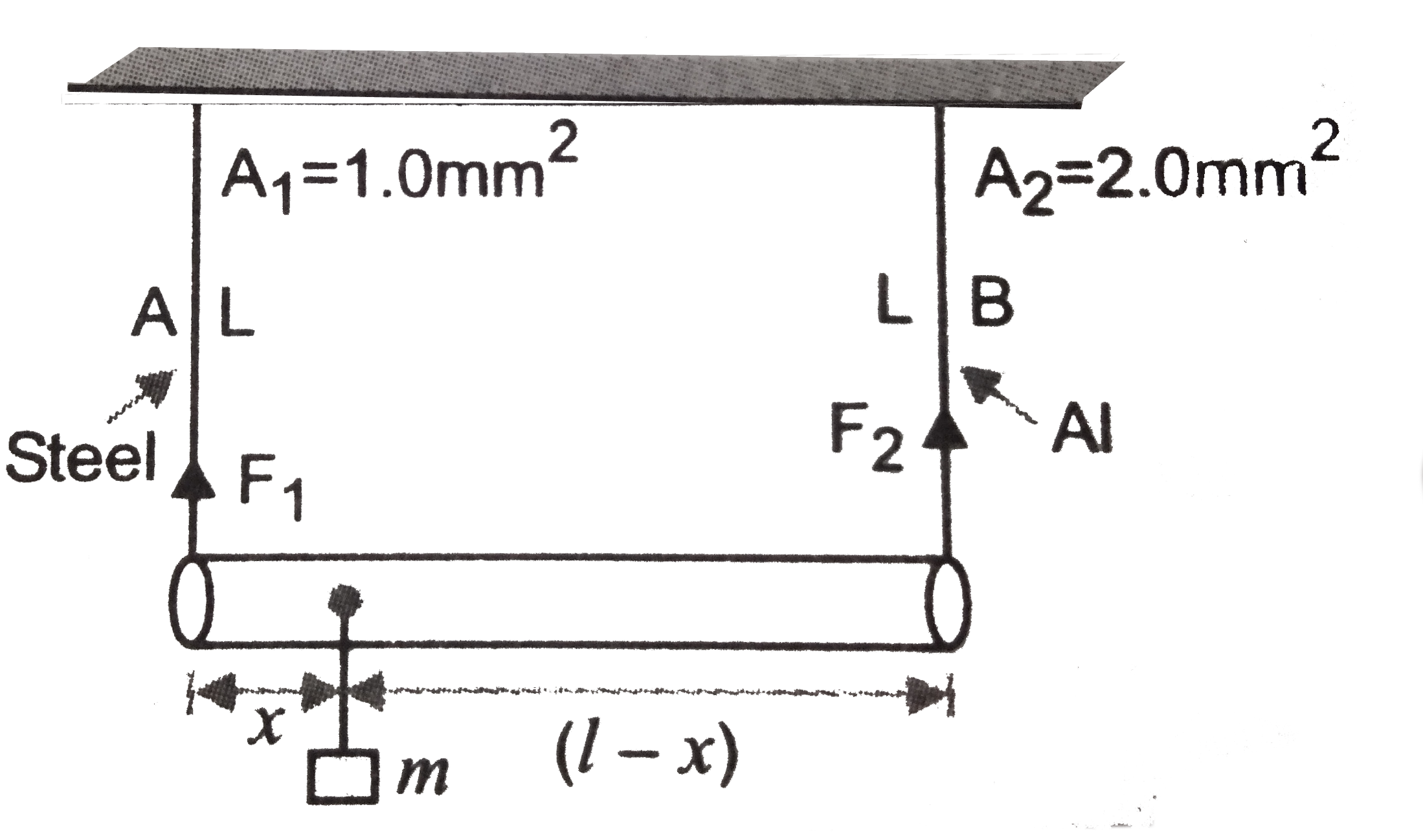
|
|
| 35. |
When 15.753 is round off to 3 significant digit …... Is obtained. |
|
Answer» |
|
| 36. |
A force of (10hati-3hatj+6hatk)N acts on a body of 5 kg and displaces it from (6hati+5hatj-3hatk)m"to" (10hati-2hatj+7hatk)m. The work done is |
|
Answer» 100J `"DISPLACEMENT vector"=vecx=(x_(2)-x_(1))HATI+(y_(2)-y_(1))hatj+(z_(2)-z_(1))hatk` `vecx=(10-6)hati+(-2-5)hatj+(7+3)hatk=4hati-7hatj+10hatk` `"We know that WORK done" =w=vecF.vecs=(10hati-3hatj+6hatk)(4hati-7hatj+10k)` `=40+21+60=121J` |
|
| 37. |
Three particles describes circular path of radii r_(1), r_(2)and r_(3) with constant speed such that all the particles take same time to complete the revolution. If omega_(1), omega_(2), omega_(3) be the angular velocity v_(1), v_(2), v_(3) be linear velocities and a_(1), a_(2), a_(3), be linear acceleration then which of the follwing is not correct? |
|
Answer» `omega_(1): omega_(2): omega_(3)= 1:1:1` |
|
| 38. |
If the velocity of sound in air is 340 ms^(-1) , a person singing a note of frequency 250 cps is producing sound waves with a wavelength of ………. . |
| Answer» Solution :`F. = (340)/(250) = 1.36` m | |
| 39. |
The shape of the curve representing the relation between the speed and kinetic energy of a moving object is |
|
Answer» PARABOLA Where m is the MASS of the object and V is the speed of the object. `:. K prop v^2` THEREFORE, the curve between speed and kinetic energy is parabola. |
|
| 40. |
A structural steel rod has a radius 10 mm and a larngth of 2.0 m.A force of 10 KN stretches it along its length. Calculate (a) Stress (b) Elongation and (c ) Strain on the rod. Young's modulus of structural steel is 2.0 xx 10 ^(11) Nm ^(-2) . |
|
Answer» Solution :Stress`=3.18 xx 10 ^(7) NM ^(-2),` Elongation `Delta L = 1.59 xx 10 ^(-4) M,` Strain `= 0.016 %` |
|
| 41. |
A rocket is fired upwards vertically with a net acceleration of 4m//s^(2) and initial velocity zero. After 5 seconds its fuel is finished and it decelerates with g. At the highest point its velocity becomes zero. There after it accelerates downwards with acceleration g and return back to ground. i) Plot velocity - time graph for complete journey ii) Displacement-time graph for the complete journey. (Take g=10m//s^(2)) |
|
Answer» Solution :Stage I : To find velocity of rocket after 5 seconds `V_(A)=0+at_(OA)=(4)(5)=20ms^(-1)` Stage II : To find further time of ascent after 5 seconds. `0=20-g t_(AB)` `therefore t_(AB)=(20)/(10)=2`seconds Here, the TOTAL vertical displacement of stage (i) and stage (ii) is = AREA of `OAB=(1)/(2)(7)(20)=70m`.  Stage-iii : If `t_(BC)` is time of descent then `70=(1)/(2)(10)t_(BC)^(2)` `therefore t_(BC)=sqrt(14)=3.7s` |
|
| 42. |
What is thermal expansion? |
|
Answer» Solution :Thermal expansion is the tendency of matter to change in shape, area, and volume due to a change in temperature. All three states of matter (solid, liquid and gas) expand when heated. When a solid is heated, its atoms vibrate with higher amplitude about their fixed points. The relative change in the size of solids is small. Railway tracks are given small gaps so that in the SUMMER, the tracks expand and do not buckle. Railroad tracks and bridges have expansion joints to allow them to expand and contract freely with temperature changes.  Liquids, have LESS intermolecular forces than solids and hence they expand more than solids. This is the principle behind the mercury thermometers. In the case of gas molecules, the intermolecular forces are almost negligible and hence they expand much more than solids. For example in hot air balloons when gas particles get heated, they expand and TAKE up more space. The increase in dimension of a body due to the increase in its temperature is called thermal expansion. The expansion in length is called linear expansion. Similarly the expansion in area is termed as area expansion and the expansion in volume is termed as volume expansion.  Linear Expansion : In solids, for a small change in temperature `DeltaT`, the fractional change in length `((DeltaL)/(L_(0)))` is directly proportional to `DeltaT`. `(DeltaL)/(L_(0))=alpha_(L)DeltaT` `"THEREFORE,"alpha_(L)=(DeltaL)/(L_(0)DeltaT)` Where, `alpha_(L)=` coefficient of linear expansion, `DeltaL=` Change in length, L = Original length, `DeltaT=` Change in temperature. Area Expansion : For a small change in temperature `DeltaT` the fractional change in area `((DELTAA)/(A_(0)))` of a substance is directly proportional to `DeltaT` and it can be written as `(DeltaA)/(A_(0))=alpha_(A)DeltaT` `"Therefore,"alpha_(L)=(DeltaA)/(A_(0)DeltaT)` Where, `alpha_(L)=` coefficient of area expansion. `DeltaA=` Change in area, A = Original area, `DeltaT=`Change in temperature. Volume Expansion : For a small change in temperature `DeltaT` the fractional change in volume `((DeltaV)/(V))` of a substance is directly propportional to `DeltaT`. `((DeltaV)/(V_(0)))alpha_(L)DeltaT` `"Therefore,"alpha_(V)=(DeltaV)/(V_(0)DeltaT)` Where, `alpha_(V)=` coefficient of volume expansion, `DeltaV=` Change in volume, V = Original volume, `DeltaT=` Change in temperature, Unit of coefficient of linear, area and volumetric expansion of solids is `""^(@)C^(-1) or K^(-1)` |
|
| 44. |
Select the incorrect pair from the following given pairs : For aparticle executing SHM |
|
Answer» Time period `T=(2PI)/(omega)`, acceleration `a=- omega^(2)X` |
|
| 45. |
All the surfaces shown in figure are frictionless. The mass of the car is M, that of the block is mk and the spring has spring constant. Initialy the car and the block are at rest and the spring is stretched through a length x_0 when the system is released. a. Find the amplitude of the simple harmonic motion of the blocks and of the car as seen from the road. b. Find the time periods of the two simple harmonic motions. |
|
Answer» a. From LAW of conservation of momentum `mx_1=Mx_2` ………1 [Block and mass oscillates in opposite direction bt `xprarr` stretched part]. From equation 1 and equation 2` `:. x_0=x_1+m/Mx_1` `=((M+m)/M)x` `so, x_2=x_0-x_1` `x_0[1-M/(M+m)]` `=(mx_0)/(M+m)` respectively b. At any position, let the velocity be `v_1 and v_2` respectively. Here `v_1 velocity of m'` with RESPECT to M. By energy method, Total Energy=Constant `1/2mv_2^2+1/2m(v_1-v_2)^2+1/2k(x_1+x_2)^2` ltbr.gt =constant.......3 `[v_1-v-2=` absolute velocity of mass m as seen from the road] `Mx_2=mx_1` `rarr x_1=(M/m)x_2`.........4 `Mv_2=m(v_1-v_2)` `rarr (v_1-v_2)=(M/m)v_2`..........5 Putting the above values in equation 3 we GET `1/2Mv_2^I2+1/2m M/m^2 v_2^2+1/2kx_2^2(1+M/m)` `:.M(1+M/m)v_2^2+k(1+M/m)x_2^2=constant` `rarr Mv_2^2+k(1+M/m)x_2^2=constant` Taking derivative of both sides, `M_2v_2(dv_2)/(DT)=k((M+m)/m)2x_2(dx_2)/(dt)=0` `rarr ma_2+k((M+m)/m)x_2=0` `[because v_2=(dx_2)/(dt)]` `a_2/x_2=(-kM+m)/(Mm)omega^2` `:. omega=(-k(M+m))/(Mm)` So time period `T=2pi sqrt((Mm)/(M+m))` |
|
| 46. |
The sum of magnitudes of two forces acting at a point is 16N. If their resultant is normal to the smaller force and has a magnitude of 8N. Then the forces are |
|
Answer» Solution :Let `vecF` be the resultant of TWO forces `vecF_(1) and vecF_(2)` as SHOWN in figure with `F_(2)>F_(1)`. `F_(2)SINTHETA = F_(1)""……..(i)` `F_(2)costheta= F = 8 ""…………(ii)` Squarting and adding Eqs (i) and (ii), we get `F_(2)^(2) = F_(1)^(2) + 64"".........(iii)` Given `F_(1)+F_(2) = 16""............(iv)` Solving Eqs. (iii) and (iv), we get `F_(1) = 6N and F_(2) = 10N` |
|
| 47. |
One litre of helium under a pressure of 2 atm and at a temperature of 27^(@)C is heated until its pressure and volume are doubled. What is the final temperature of the gas ? |
|
Answer» |
|
| 48. |
Two simple harmonic motions act on a particle. These harmonic motions are x=Acos(omegat+delta),y=Acos(omegat+alpha) When delta=alpha+(pi)/(2), the resulting motion is………….. |
|
Answer» A circle and the actual motion is clockwise `y=Acos(omegat+alpha)` Squaring and ADDING the two equations, We get `x^(2)+y^(2)=A^(2)`. This is an equation of a circle Hence the resultant motion is circular. The motion is counter clockwise. |
|
| 49. |
What are beats? Give the theory of beats. |
|
Answer» Solution :The phenomenon of waxing and waning of SOUND as a result of superposition of two progressive waves differing in their frequencies SLIGHTLY `( le 10 Hz)` is known as beats (AUDIBLE). Let `y_1=A SIN omega_1 t and y_2 sin omega_2 t` represent two progressive waves travelling in the same. DIRECTION and superpose with each other. `y=y_1+y_2=A(sin omega_1 t+sin omega_2 t)` i.e., `y=2A sin.((omega_1+omega_2))/(2) t cos.((omega_1+omega_2))/(2) t` i.e., `omega=(omega_1+omega_2)/(2)` and `omega_b=omega_2 or f_b=f_1-f_2` where `'f_b'` is known as the beat frequency and `t_b=(1)/(f_b)=(1)/(f_1-f_2)` as the beat period. 
|
|
| 50. |
Givem below in column I are the relations between vectorsvec a, vec b and vec c and in column II are that orientations of vec a, vec b and vec C in the (XY) plane . Match therelation in column I to correct orientatlons in column II. Column I , Column II (a)vec a+vec b=vec c , (i) . (b)vec a- vec c =vec b , (ii) . (c ) vec b - vec a =vec c , (iii) . (d)vec a+ vec b+ vec c =0 (iv) . |
|
Answer» Solution :(a) ` VECA + vec b= vec c`, it matches with potion (iv). ` (b) vec a -vec c= vec b`, it matches with option (III). (c ) ` veca + vec b= vec c`, it matches with potion (i). ` (d) vec A -vec B= vec C =0`, it matches with option (ii). |
|