

Saved Bookmarks
| 1. |
A rod of length l and negligible mass is suspended at its two ends by two wires of steel (wire A) and aliminium (wire B) of equal length (Fig. 7(EP).4). The cross-sectional areas of wires A and B are 1.0 mm^(2) and 2.0 mm^(2), respectively . (Y_(Al)=70xx10^(9) Nm^(-2) and Y_(steel)=200xx10^(9) Nm^(-2)) |
|
Answer» Mass m should be suspended close to wire A to have equal stresses in both the wires. let the mass m be suspended at DISTANCE x from left end of the rod for equal STRESS in the wires. Let `F_(1)` and `F_(2)` be the tension in the wires. Then `F_(1)x= F_(2)(l-x)`or`(F_(1))/(F_(2))=(l-x)/(x)`…(i) `s_(1) =(F_(1))/(A_(1))= (F_(1))/(10^(-6))` and`S_(2)=(F_(2))/(A_(2))=(F_(2))/(2xx10^(-6))` For equal stress, `S_(1)=S_(2)`or`(F_(1))/(10^(-4))=(F_(2))/(2xx10^(6))`or`(F_(1))/(F_(2))=(1)/(2)`....(II) From (i) and (ii), we get `(l-x)/(x)=(1)/(2)` On solving, `x=2 l//3` It means mass m is suspended close to wire B. As,strain `=(strees)/(Y)`. For equal strain, `(F_(1)//10^(-6))/(Y_(s))=(F_(2)//(2xx10^(-6)))/(Y_(AL))` `(F_(1))/(F_(2))=(Y_(s))/(2Y_(Al))=((200xx10^(9)))/(2xx70xx10^(9))=(10)/(7)` From (i) and (iii),`(l-x)/(x)=(10)/(7)` On solving, `x=(7)/(17)l` It means m is suspended close to wire A. 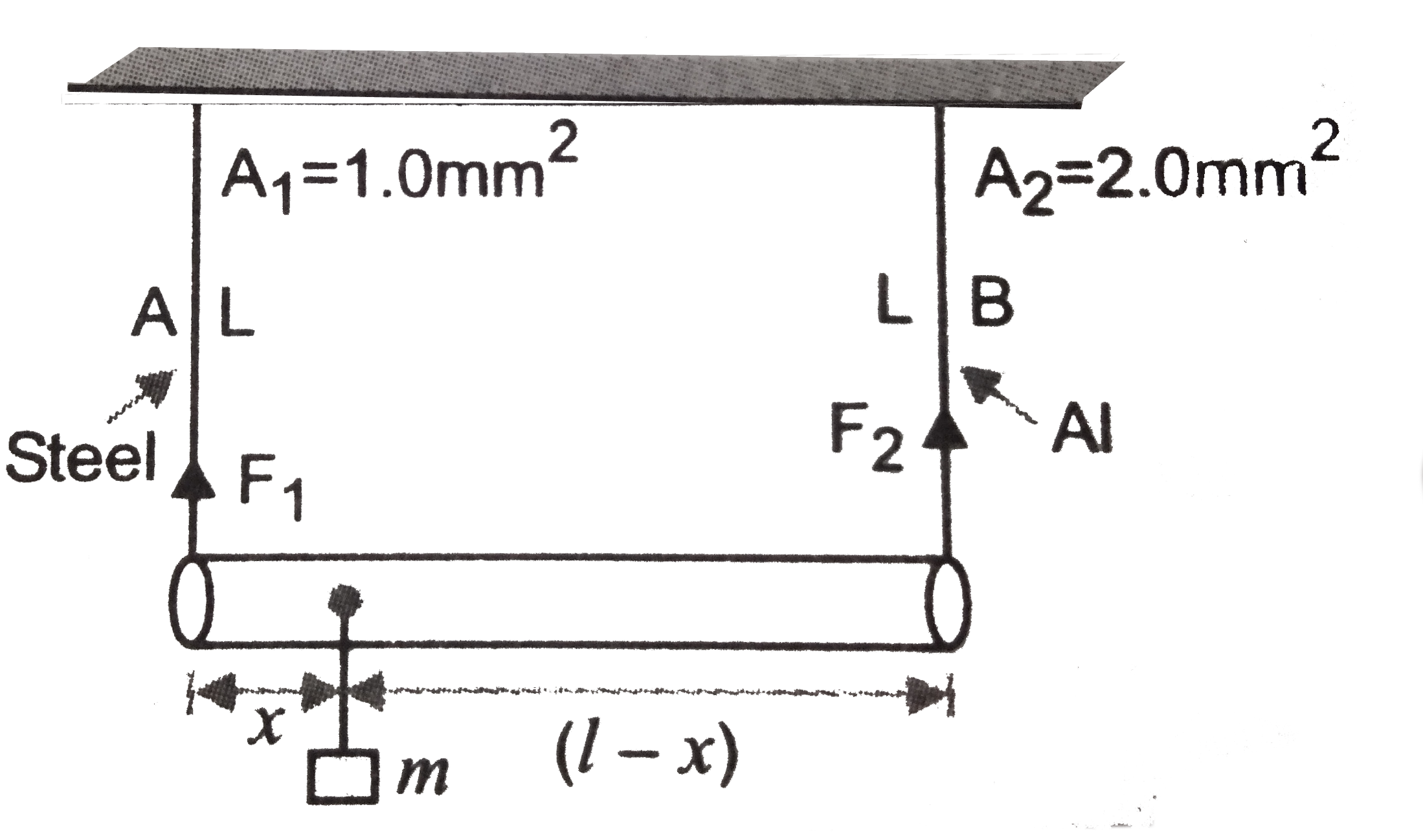
|
|