Saved Bookmarks
This section includes 7 InterviewSolutions, each offering curated multiple-choice questions to sharpen your Current Affairs knowledge and support exam preparation. Choose a topic below to get started.
| 1. |
In a double star system, two stars of masses m_(1)and m_2 seperated by a distance d rotate about their centre of mass. Then their common angular velocity would be: |
|
Answer» `sqrt((Gm_(1))/d^(3))` |
|
| 2. |
A triangular, square and circular plate of same thickness and made up of different materials are arranged as shown in figure. Where does the centre of mass of the arrangement lie? (the ratio of their respective densities are 3(8 + pi) : 6 :1 |
|
Answer» |
|
| 3. |
Rain drops come down with |
|
Answer» zero ACCELERATION and non-zero VELOCITY |
|
| 4. |
A vector makes angles alpha,beta "and" gamma with the X,Y and Z axes respectively . Find the value of the expression (sin^(2)alpha+sin^(2)beta+sin^(2)gamma)/(cos^(2)alpha+cos^(2)beta+cos^(2)gamma) |
|
Answer» |
|
| 5. |
A bullet is fired from a gun. The force on the bullet is given by F=600-2xx 10^5t , where F is in newton and t' is in second. The force on the bullet becomes zero as soon as it leaves the barrel. The average impulse imparted to the bullet is |
|
Answer» 9Ns |
|
| 6. |
N/(kg) is also an unit of gravitational acceleration. |
|
Answer» `N/(kg)=(kgxxmxxs^-2)/(kg)=ms^-2` which is UNIT of G. |
|
| 7. |
A point sized sphere of mass .m. is suspended from a point using a string of length .l.. It is then pulled to a side till the string is horizontal and released. As the mass passes through the portion where the string is vertical, magnitude of its angular momentum is |
|
Answer» `mlsqrt(GL)` |
|
| 8. |
At the same instant, ball A is ball B is projected vertically building of height h and ball B is projected vertically upward from the ground with velocity u. The ration of velocty of A to the velocity of B at the point of cllistion is same asthe ratio of height of this point from top of the building to the height from the ground, find the height of the point of collision above theground. |
|
Answer» form figure `(v_(A))/(v_(B))=((1-x)h)/(xh)/(x) =k` Hence, `v_(A)=k v_(B)` `rArr sqrt (2g(1-x)h)=k sqrt((u^(2)-2gxh)` Hence, `2g(1-x)h=k^(2)(u^(2)-2gxh)` `2g ((1+x))/(x)g =k^(2) ((u^(2))/(x)-2 gh)` `2gkh =k^(2)(u^(2)/(x-2gh)` `k=(2ghx)/((u^(2)-2hgx))` `((1-x))/(x) =(A)/((u^(2)-A)) (let `2ghx=A) rArr z=(u^(2)-2A)/(u^(2))`. `rArr x (1+(2gh)/(u^(2)))=1` or `x=u^(2)/((u^(2)+2gh)` Hence , `xh =(u^(2)h)/(u^(2)+2gh)` 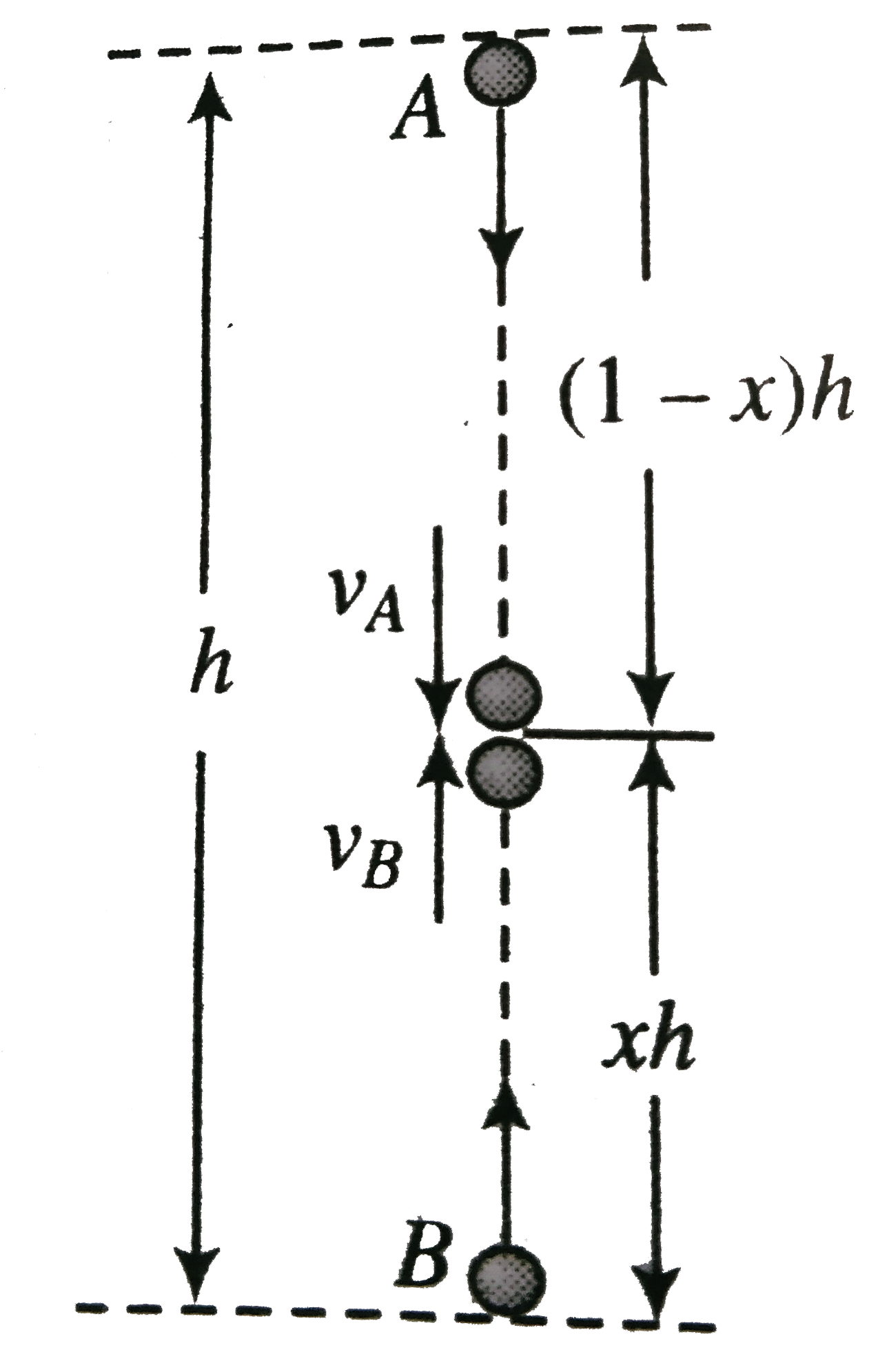 . .
|
|
| 9. |
A car is moving in a circular path with a uniform speed y. Find the magnitude of change in its velocity when the car rotates through an angle theta. |
|
Answer» Solution :Change in VELOCITY `vec(Deltav)=vecv-vecu` The MAGNITUDE of change in velocity `Deltav=sqrt(v^(2)+u^(2)-2uvcostheta)` As the SPEED is UNIFORM `=|vecv|=|vecu|=v` `:.Deltav=2vsin((theta)/(2))`. |
|
| 10. |
The acceleration due to gravityat a depth of 1600 km inside the earth. |
|
Answer» 0 |
|
| 11. |
Two satellite revolving around a planet in the same orbit have the ratio of their masses m_1/m_2 =1/4The ratio of their orbital velocities v_1/v_2= .... |
|
Answer» 1 `v_0 =SQRT((GM_e)/R)` HENCE orbital velocity does not depend on mass |
|
| 12. |
A scalar quantity is one that |
|
Answer» is conserved in a process |
|
| 13. |
Estimate the volume of a water molecule using the data in Example 13.1. |
|
Answer» Solution :In the LIQUID (or solid) phase, the molecules of water are quite closely packed. The density of water molecule may therefore, be regarded as roughly equal to the density of bulk `"water" = 1000 kgm^(-3)`. To estimate the volume of a water molecule, we need to know the MASS of a single water molecule. We know that 1 mole of water has a mass approximately equal to (2 + 16)g = 18 g = 0.018 kg. Since 1 mole contains about `6 xx 10^(23)` molecules (Avogadro.s number), the mass of a molecule of water is `(0.018)//(6 xx 10^(23)) "kg" = 3 xx 10^(-26)` kg. Therefore, a rough estimate of the volume of a water molecule is as follows: `"Volume of a water molecule" = (3 xx 10^(-26) "kg")// (1000 "kg" m^(-3) )` `= 3 xx 10^(-29) m^(3)` ` = (4//3) pi (RADIUS)^(3)` Hence, `"Radius" ~~ 2 xx 10^(-10) m = 2 Å` |
|
| 14. |
A pump motor is used to deliver water at a certain rate from a given pipe. To obtain, twice as much water from the same pipe, in the same time, the power of motor has to be increased to n times. Find n. |
|
Answer» |
|
| 15. |
A railway engine pulls a bogie of mass 10 tonne (metric ton). Average resistance against motion due to friction etc. is 39.2 N per tonne. What will be the tension on the chain when (i) the train is moving with a uniform velocity (ii) the train is moving with an acceleration of 1 mcdot s^(-2) ? ( 1 tonne = 10^(3) kg ) |
|
Answer» |
|
| 16. |
The rear side of truck is open and a box of mass 50kg is placed at 3.2m away from the open end. The co-efficient of friction between the box and the surface is 0.2. If the truck starts from rest and moves on a straight road with acceleration 2.1ms^(-2) the box falls off the truck after a time (g=10ms^(-2)) |
| Answer» ANSWER :C | |
| 17. |
A tank filled water is connected to another empty tank lying to the right side of the first tank. Until the level of water in the tanks become same (a) Centre of mass of water shifts down at constant rate (b) centre of mass of water shifts down and rate of change of shift in centre of mass decreases gradually and becomes zero (c ) centre of mass shifts towards right as well |
|
Answer» only a and C are correct |
|
| 18. |
The altitude at which the weight of a body is only 64% of its weight on the surface of the earth is (Radius of the earth is 6400 km) |
|
Answer» 1600m |
|
| 19. |
A drop of water of volume 0.05 cm^(3) is pressed between two glass plates, as a consequence of which it spreads and occupies an area of 40 cm^(2). If the surface tension of water is 70 dyne/cm, then the normal force required to separate out the two glass plates will be in Newton |
|
Answer» 90 |
|
| 20. |
A body P is connected to a large body Q through a conducting rod of length L, cross-sectional area A and thermal conductivity K. This assembly is placed in an atmosphere of temperature T_(A)and body Q is also maintained at temperature T_(A). Let heat capacity of body P is C and it is initially at temperature T_(1). If in time t second temperatur4e of body P falls to T_(2). Then, choose the correct option. |
|
Answer» `log((T_(2)-T_(A))/(T_(1)-T_(A)))=-(K_(1)(KA)/(LC))t` |
|
| 21. |
One mole of a monoatomic gas is mixed with one mole of a diatomic gas. What will be the gamma for the mixture? |
|
Answer» 1.5 |
|
| 22. |
What is the average value of acceleration vector in uniform circular motion over one cycle? |
| Answer» SOLUTION :NULL VECTOR. | |
| 23. |
Figure shows two processes A and B on asystem. Let AQ_(1) and AQ_(2)be the heat given to the system in processes A and B respectively. Then |
|
Answer» `DeltaQ_(1) GT DeltaQ_(2)` |
|
| 24. |
A rigid body rotates about a fixed axis with variable angular velocity equal to alpha-beta, at the time t, where alpha,beta are constant. The angle through which it rotates before its stops |
|
Answer» `(alpha^(2))/(2beta)` INITIAL ANGULAR velocity `= alpha` Angular retardation `= beta` `:.` Angular rotated before it STOPS `alpha^(2)` `0=alpha^(2)-2 beta thetarArr theta =(alpha^(2))/(2beta)`. |
|
| 25. |
An engineer is designing a conveyor system for loading lay bales into a wagon. Each bale is 0.25 m high, and 0.80 m long (the dimension perpendicular to the plane of the figure), with mass 30.0 kg. The centre of gravity of each bale is at its geometrical centre. The coefficient of static friction between a bal and the conveyor belt is 0.60, and the belt moves with constant speed. The angle beta of the conveyoris slowly increased. At some critical angle a bale will tip (if it doesn't slip first), and at some different critical it will slip (if it doesn't tip first). Which statement is correct ? |
|
Answer» It will TIP FIRST if `mu_(s)=0.6` |
|
| 26. |
An engineer is designing a conveyor system for loading lay bales into a wagon. Each bale is 0.25 m high, and 0.80 m long (the dimension perpendicular to the plane of the figure), with mass 30.0 kg. The centre of gravity of each bale is at its geometrical centre. The coefficient of static friction between a bal and the conveyor belt is 0.60, and the belt moves with constant speed. The angle beta of the conveyoris slowly increased. At some critical angle a bale will tip (if it doesn't slip first), and at some different critical it will slip (if it doesn't tip first). Find the second critical angle (in the same conditions ) at which it slips. |
|
Answer» `BETA="TAN"^(-1)(0.50)` |
|
| 27. |
The densities of wood and benzene at 0^C are 880 kg m^3 and 900 kg m^(-3) respectively. The coefficients of volume expansion are 1.2 xx10^(-3) 0^C(-1) for wood and 1.5 xx 10^(-3) 0^C(-1) for benzene. At temperature will a piece of wood just sink in benzene? |
|
Answer» Solution :Given `f_w = 880 kg/m^3,` ` f_b= 900kg/m^3` `T_1=0^@C,` `gamma_w = 1.2 xx 10^-3/^@C,` ` gamma_b = (1.5 xx 10^-3/^@C)` The sphere begins to sink when ` rArr (mg)_sphere = displaced water ` ` (Vf'_w)G = (Vf'_b)g` ` rArrf_w /(1+(gamma_w) Delta THETA)= f_b/(1+(gamma_b) Delta theta)` ` rArr (880/(1+1.2 xx (10^-3) Delta theta))= (900/ ( 1+1.5 xx (10^-3) Delta theta))` ` rArr (880+880 xx 1.5 xx (10^-3) Delta theta )` ` (900+900 xx 1.2 xx (10^-3) Delta theta)` `rArr (880 xx 1.5 xx (10^-3)- 900 xx 1.2 xx (10^-3))Delta theta` ` =20` ` rArr (1320-1080) xx (10^-3)Delta theta = 20` ` rArrDelta theta = 83.3^@C` ` T_2- T_1 = 83rArrT_2- 0^@C= 83` ` rArr T_2 = 83^@C` |
|
| 28. |
An engineer is designing a conveyor system for loading lay bales into a wagon. Each bale is 0.25 m high, and 0.80 m long (the dimension perpendicular to the plane of the figure), with mass 30.0 kg. The centre of gravity of each bale is at its geometrical centre. The coefficient of static friction between a bal and the conveyor belt is 0.60, and the belt moves with constant speed. The angle beta of the conveyoris slowly increased. At some critical angle a bale will tip (if it doesn't slip first), and at some different critical it will slip (if it doesn't tip first). Find the first critical angle (In the same conditions ) at which it tips. |
|
Answer» `BETA="TAN"^(-1)(0.50)` |
|
| 29. |
Dimension of [mu_(0)epsi_(0)]^(-(1)/(2)).... |
|
Answer» `L^((1)/(2))T^(-(1)/(2))` `:. [mu_(0)epsi_(0)]^(-(1)/(2))=[V]` `=M^(0)L^(1)T^(-1)` `=LT^(-1)` |
|
| 30. |
Under a constant pressure, the rate of flow of liquid through capillary is V. if the length of capillary is doubled and the diameter of the bore is halved, the rate of flow would be …… |
|
Answer» `(V)/(4)` RATE of FLOW `V=(piPr^(4))/(8etal)` DIAMETER `d.=(d)/(2)thereforer.=(R)/(2)` and `l=2l` `V.=(pip(r.)^(4))/(8etal)` `thereforeV.=(pip((r)/(2))^(4))/(8eta(2l))` `thereforeV.(pip((r^(4))/(16)))/(2(8etal))` `thereforeV.=(pipr^(4))/(32(8etal))` `thereforeV.=(V)/(32)` |
|
| 31. |
The volume of a solid rubber ball, when it is carried from the surface to the bottom of a 200 m deep lake decreases by 1%. Find the bulk modulus of rubber ball . |
|
Answer» |
|
| 32. |
Arrange the fundamental forces in the order of decreasing strength. |
| Answer» Solution :STRONG NUCLEAR FORCE`gt`ELECTROMAGNETIC forces `gt` Weak nuclear force `gt` Gravitational force. | |
| 33. |
What is heat transfer ? Give its types. |
|
Answer» Solution :Heat is a type of energy. Heat is energy transfer from one system to another or from one part of a system to another part, arising DUE to temperature difference. THUS, motion of heat in substance is called heat transfer. There are 3 distinet modes of heat transfer : conduction, convection and radiation. (1) Conduction : Heat transfer in solids. Convection : Heat transfer in FLUIDS. Rasiation : No MEDIUM is required for heat transfer. 
|
|
| 34. |
If the angular momentum of a rotating body about a fixed axis is increased by 10%. Its kinetic energy will be increased by |
|
Answer» 0.1 For a given I (MOMENT of inertia of a body) , `K_(R) prop L^(2)` When the angular momentum of a body is increased by 10% i.e., `(L)/(10)` , its angular momentum will BECOME `L. = L + (L)/(10)= (11L)/(10)` `therefore (K._(R))/(K_(R)) = (L.^(2))/(L^(2)) = (((11L)/(10))^(2))/(L^(2)) = (121)/(100) , or K._(R) = (121)/(100) K_(R)` Percentage increase in the kinetic energy `(K._(R) - K_(R))/(K_(R)) xx 100 % = ((121)/(100) K_(R) - K_(R))/(K_(R)) xx 100 % = 21 %` |
|
| 35. |
A particle having SHM is located at different positions as shown below. The phase difference between the position marked by A and |
|
Answer» B is `(PI)/(2)` radian |
|
| 36. |
If A and B are invertible matrices, then which of the following is not correct |
|
Answer»
|
|
| 37. |
(A): To unscrew a rusted nut, we need a wrench with longer arm. (R): Wrench with longer arm reduces the torque of the arm. |
|
Answer» Both .A. and .R. are TRUE and .R. is the correct explanation of .A. |
|
| 38. |
Consider a planet moving in an elliptical orbit round the sun. The work done on the planet by the gravitational force of the sun (a) is zero in any small part of the orbit (b)is zero is some parts of the orbit (c) is zero in one complete revolution (d) is zero in no part of the motion |
|
Answer» only a and C are TRUE |
|
| 39. |
Radius of gyration of object is constant. |
|
Answer» |
|
| 40. |
{:("List -I","List -II"),((a)"Zeroth law of thermodynamics",(e)"Direction of flow of heat energy"),((b)"First law of thermodynamics",(f) "Zero work done"),((c)"Free expansion of gas ",(g)"Temperature"),((d)"Second law of thermodynamics",(h)"Law of conservation of energy"):} |
|
Answer» a-f, B-h, c-g, d-e |
|
| 41. |
Water in a river 20 m deep is flowing at a speed of 10ms^(-1). The shearing stress between the horizontal layers of water in the river in Nm^(-2) is (Coefficient of viscosity of water =10^(-3) SI units) |
|
Answer» `1XX10^(-2)` |
|
| 42. |
If we study the vibration of a pipe open at both ends, then which of the following statement isnot true? |
|
Answer» OPEN end will be antinode |
|
| 43. |
What are concurrent forces. |
|
Answer» SOLUTION :Concurrentforces are ACOLLECTION offorcesis SAIDTO beconcurrentas WELLAS coplanarforces. ACCORDINGTO Lami'stheoremthe magnitudeof eachforceof thesystemis proportionalto sineof the anglebetweenthe othertwoforces. Theconstantof proportionalityissamefor allthreeforces. |
|
| 44. |
The radius of a wheel is R and its radius of gyration about its axis passing through its center and perpendicular to its plane is K. If the wheel is rolling without slipping the ratio of its rotational kinetic energy to its translational kinetic energy is- |
|
Answer» `(K^(2))/(R^(2))` |
|
| 45. |
A solid body is floating in water with 5/6th of its volume inside the water. What fraction of its volume will be outside if it ftoats in a liquid of specific gravity 1.6? |
|
Answer» SOLUTION :If V m`""^(3)` is the volume of the BODY, then Volume of body inside water =`5/6V m^(3)` Weight of body = Weight of water displaced `=5/6 V xx 10^(3) xx G .......(i)` When the body floats in a liquid of specific GRAVITY 1.6, let V. be its volume outside the liquid. Then, volume of liquid displaced =V-V. Weight of body = weight of liquid displaced `=(V-V.) xx 1.6 xx 10^(3) x g ........(ii)` Comparing (i) and (ii), we get `5/6 V xx 10^(3) xx g=(V-V.) xx 1.6 xx 10^(3) xx g` `(V-V.) xx 1.6 xx 10^(3) xx g=5/6 V xx 10^(3) xx g` `rArr (V-V.)/V=5/6 xx 10/16=(25)/(48)` `rArr 1-(V.)/V=(25)/(48)` `rArr (V.)/(V)=1-(25)/(48)=(23)/(48)` |
|
| 46. |
When a load of 3 kg is hung from one end of a copper wire of length 2 m and diameter 0.5 mm, it increases in length by 2.38 mm, Find the young's modulus for the material of the wire. |
|
Answer» |
|
| 47. |
If motion is not linear then path length = magnitude of displacement. |
|
Answer» |
|
| 48. |
If unit of mass is 1 kg, unit of time is 1 minute and unit of acceleration is 10 m s^(-2), then unit of energy is |
|
Answer» `36 XX 10^(6)J` |
|
| 49. |
State examples for linear simple harmonic oscillator. |
| Answer» Solution :The block-SPRING SYSTEM is a linear simple harmoinci oscillator. All oscillating SYSTEMS like DIVING board, violin string have some element of springiness, K( spring constant and mass m). | |
| 50. |
According to a stationary observer on the earth, which of the following are inertial frames of reference ?(i) Merry go round, (ii) giant wheel (iii) A vehicle moving with uniform velocity and (iv) your class room. |
| Answer» Solution : For a stationary observer on EARTH 1) A vehicle moving with UNIFORM VELOCITY and 2) class room are inertial FRAMES of reference.The non inertial frames of reference are (1) Merry go ROUND and (2) gaint wheel. | |