

Saved Bookmarks
This section includes 7 InterviewSolutions, each offering curated multiple-choice questions to sharpen your Current Affairs knowledge and support exam preparation. Choose a topic below to get started.
| 1. |
Calculate the number of unpaired electrons in the following gaseous ions : Mn^(3+),Cr^(3+),V^(3+) and Ti^(3+) Which one of these is the most stable in aqueous solution ? |
| Answer» Solution :`Mn^(3+):3D^(4)` has 4 UNPAIRED electrons, `Cr^(3+):3d^(3)` has 3 unpaired electrons, `V^(3+):3d^(2)` has 2 unpaired electrons, `Ti^(3+):3d^(1)` has 1 unpaired electron. `Cr^(3+)` is most stable out of these in aqueous solution because it has half-filled `t_(2g)` LEVEL (i.e., `t_(2g)^(3)`). | |
| 2. |
Calculate the number of unit cells in 8.1g of aluminium if it crystallizes in a f.c.c., structure. (Atomic mass of AI = 27 g mol^(-1)) (b) Given reasons: (i) In stoichiometric defects, NaCl exhibits Schottky defect and not Frenkel defect. (ii) Silicon on droping with Phosphorus forms n-type semiconductor. (iii) Ferrimagnetic substances show better magnetism than antiferromagnetic substances. |
|
Answer» SOLUTION :(a) 27g of aluminium have `6.02 xx 10^(23)` atoms of Al 8.1 G of aluminium have `(6.02 xx 10^(23))/(27) xx 8.1` `= 12.06 xx 10^(22)` atoms of aluminium Now in FCC structure : 1 unit cell has 4 aluminium atoms i.e., `12.06 xx 10^(23)` atoms have `(1)/(4) xx 12.06 xx 10^(22)` unit cells `= 3.05 xx 10^(22)` unit cells (b) (i) NaCl exhibits schottky defect because of the small difference in the size of cations and anions as i FRENKEL defect, large difference in the size of cations and anions. (ii) Phosphorus have `5e^(-)s` in the valence shell, hence, it forms four covalent bonds with silicon atoms, the fifth extra `e^(-)` is free and gets delocalized and increase the conductivity of silicon. Hence, because of the presence of free `e^(-)`, it forms n-types semiconductor (iii) Ferrimagnetic substances possess small net magnetic moment but antiferromagnetic substances posses zero net magnetic moment because it contains equal no. of `e^(-)s` with opposite SPIN but ferrimagnetic have UNEQUAL no. of `e^(-)s` with opposite spin 
|
|
| 4. |
Calculate the number of particles (atoms) per unit cell in a FCC crystal lattice. |
|
Answer» SOLUTION :Step-1: Number of corners = 8 Step-2: The contribution of corner =`1/8` Step-3: Number of faces = 6 Step-4: Contribution at the FACE =`1/2` Step-5: Number of particle in FCC `8" corners "xx 1/8 `size of atom per corner = `8 xx 1/8 = 1` 6 `faces xx 1/2` size of atom per face = `6 xx 1/2 = 3` atoms No. of particles in the unit CELL of FCC = `(8 xx 1/8)+(6 xx 1/2) = 1+3 = 4` atoms. 
|
|
| 5. |
Calculate the number of neutrons in the remaining atom after emission of an alpha particle from 92^(X^(238)) atom. also report the mass number and atomic number of the product atom. |
|
Answer» Solution :`92^(X^(238)) rarrA^(X^(m))+2^(He^(4))` comparing mass NUMBER of both sides 238 =m+4 m=238-4 =234 comparingatomicnumberon both sides 92=A+2 A=92-2 =90 X hasatomic number=90 and mass number =234 number of neutrons =234-90 =144 |
|
| 6. |
Calculate the number of neutrons in the remaining atom after emission of an α particle from 92^(X^(238)) atom. also report the mass number and atomic number of the product atom. |
|
Answer» Solution :`92^(X^(238)) rarrA^(X^(m))+2^(He^(4))` comparing mass number of both sides 238 =m+4 m=238-4 =234 comparingatomicnumberon both sides 92=A+2 A=92-2 =90 X hasatomic number=90 and mass number =234 number of NEUTRONS =234-90 =144 |
|
| 7. |
Calculate the number of neutrons emitted when ""_92^235Uundergoes controlled nuclear fission to ""_54^142Xe and "_38^90Sr. |
| Answer» SOLUTION :`""_92^235U to ""_54^142Xe + ""_38^90Sr +3 ""_0^1 N` | |
| 8. |
Calculate the number of moles of nitrogen is required to produce 15.6 moles of ammonia by reaction with hydrogen ? |
|
Answer» |
|
| 9. |
Calculate the number of moles of NaOH required to remove the SO_2from 10 metric tons of atmosphere if the SO_2is 0.1% by mass. 1 metric ton = 1.0 xx 10^6 g .2NaOH + SO_2toNa_2SO_3 + H_2O |
| Answer» SOLUTION :312 MOLE | |
| 10. |
Calculate the number of moles of methanol in 5 litres of its 2 m solution, if the density of the solution is "0.981 kg L"^(-1) (Molar mass of methanol = "32.0 g mol"^(-1)) |
|
Answer» 2 moles of `CH_(3)OH=2xx32 g=64g` `THEREFORE"Mass of solution "=1000+64 = 1064 g = 1.064 g""therefore"Volume of solution "=(1.064)/(0.981)=1.085L` Thus, 1.085 L of the solution contain `CH_(3)OH ` = 2 moles `therefore " 5 L of the solution will contain " CH_(3)OH=(2)/(1.085)XX5="9.22 moles"` |
|
| 11. |
Calculate the number of moles of KMnO_(4) neededto react completelywith one mole of ferrous oxalate in acidic medium. |
|
Answer» Solution :`2KMnO_(4)+ 3H_(2)SO_(4) rarr K_(2)SO_(4)+ 2MnSO_(4) +3H_(2)O+ 5(O)] xx3` `FeC_(2)O_(4)+ H_(2)SO_(4) rarr FeSO_(4)+ H_(2)C_(2)O_(4)] xx 10` ` 2FeSO_(4)+ H_(2)SO_(4) + (O) rarr Fe_(2)(SO_(4))_(3)+ H_(2)O] xx 5` `H_(2)C_(2)O_(4) + (O) rarr 2CO_(2)+ H_(2)O] xx 10` `bar (6 KMnO_(4) + 24 H_(2)SO_(4) + 10 FeC_(2)O_(4) rarr 3K_(2)SO_(4) + 6 MnSO_(4) + 5Fe_(2)(SO_(4))_(3)+ 20 CO_(2)+ 24 H_(2)O)` Thus, 10 MOLES of ferrous oxalate reacts with 6 moles of `KMnO_(4)` `:. ` 1 mole of ferrous oxalate will react with `KMnO_(4)= ( 6)/(10) ` mole `= (3)/( 5) ` mole |
|
| 12. |
Calculate the number of moles of iron can be obtained from Fe_2O_3 by the use of 28 mol of carbon monoxide. |
|
Answer» |
|
| 13. |
Calculate the number of moles of gas present in the container of volume 10L at 300K. If the manometer containing glyceric shown 3.8m difference in level as shown diagram. [volume of gas in limb is negligible] [Take R=0.08 atm-lit K^(-1)"mol"^(-1), Density of glyceric=2.72 gm//ml, d_("mercury")=13.6gm//ml] |
|
Answer» <P>0.81 mole `=76+76cm=152 cm "of" Hg "or" 2` atm `n=(PV)/(RT)=(2xx10)/(0.08xx300)=(20)/(24)=0.81` MOL |
|
| 14. |
Calculate the number of moles in : (i) 392 grams of sulphuric acid (ii) 44.8 litres of carbon dioxide at STP (iii) 6.022xx10^(23) molecules of oxygen (iv) 9.0 grams of aluminium (v) 1 metric ton of iron (1 metric ton =10^(3)kg) (vi) 7.9 mg of Ca (vii) 65 mu of carbon. |
|
Answer» Solution :(i) `"1 MOLE of "H_(2)SO_(4)=98g.""(because" Molecular mass of "H_(2)SO_(4)=2xx1+32+4xx16=98u)` Thus, 98 g of `H_(2)SO_(4)`=1 mole of `H_(2)SO_(4)""therefore"392 g of "H_(2)SO_(4)=(1)/(98)xx392="4 moles of "H_(2)SO_(4)`. (ii) 1 mole of `CO_(2)=22.4` litres at STP, i.e., 22.4 litres of `CO_(2)` at STP = 1 mole `therefore 44.8 ` litres of `CO_(2)` at STP = `(1)/(22.4)xx44.8="2 moles "CO_(2)` (iii) 1 mole of `O_(2)` molecules =`6.022xx10^(22)" molecules"` `6.022xx10^(23) " molecules"=" 1 mole of OXYGEN molecules."` (iv) 1 mole of Al = 27 g of Al `""(because"Atomic mass of aluminimum"=27u)` `" i.e. 27 g of aluminium = 1 mole of Al"therefore"9 g of aluminium "=(1)/(27)xx9=0.33" mole of Al"` (v) `"1 metric ton of Fe"=10^(3)kg=10^(6)g` `"1 mole of Fe = 56 g of Fe"therefore""10^(6)g" of "Fe=(10^(6))/(56)" moles"=1.786xx10^(4)"moles".` (vi) 7.9 mg of Ca `=7.9xx10^(-3)" g of Ca"=(7.9xx10^(-3))/(40)"mol"=1.975xx10^(-4)"mol(At. mass of Ca = 40 U)"` (VII) `65.5mu " g of C"=65.5xx10^(-6)g" g of C"=(65.5xx10^(-6))/(12)"mol"=5.458xx10^(-6)"mol"` |
|
| 16. |
Calculate the number of molecules present in 350 cm^(3) of NH_(3) gas at 273 K ans 2 atmosphere pressure. |
|
Answer» Solution :First of all, we have to determine the volume of THEGAS at STP. `{:("Given conditions","At STP"),(V_(1)=350cm^(3),V_(2)=?),(T_(1)=273K,T_(2)=273K),(P_(1)="2 atmospheres",P_(2)="1 atm"):}` `"Applying gas equation :"=(P_(1)V_(1))/(T_(1))=(P_(2)V_(2))/(T_(2)), " we get"(350xx2)/(273)=(1xxV_(2))/(272) or V_(2)=(350xx2)/(273)xx(273)/(1)=700CM^(3)` By mole concept, 1 mole of `NH_(3)=6.022xx10^(23)" molecules"=22400 cm^(3)" at STP"` Thus, 22400 `cm^(3)` of `NH_(3)` at STP contain `=(6.022xx10^(23))/(22400)xx700=1.882xx10^(22)" molecules"` `"Alternatively, applying gas equation,PV=nRT"` `n=(PV)/(RT)=("2 atm"xx0.350L)/("0.0821 L atm K"^(-1)"MOL"^(-1)xx273K)=0.0312" mole"` `therefore"No. of molecules"=0.0312 xx6.022xx10^(23)=1.88xx10^(22)`. |
|
| 17. |
Calculate the number of molecules present in 22 g of CO_(2)? |
| Answer» SOLUTION :`3.011xx10^(23)` MOLECULES | |
| 18. |
Calculate the number of molecules present (i) in 34.20 grams of cane sugar (C_(12)H_(22)O_(11)) (ii) in one litre of water assuming that the density of water is 1g//cm^(3). (iii) in one drop of water having mass 0.05 g. |
|
Answer» Solution :1 mole of `C_(12H_(22)O_(11)=342g` `[because" Molecular mass of CANE sugar "(C_(12)H_(22)O_(11))=12xx12+22xx1+11xx16=342" amu"]` `=6.022xx10^(23)" MOLECULES"` Now, 342 g of cane sugar contain `6.022xx10^(23)" molecules"` `therefore"34.2g of cane sugar will contain"=(6.022xx10^(22))/(342)xx34.2=6.022xx10^(23)" molecules"` (ii) 1 mole of water = 18 g = `6.022xx10^(23)" molecules"` Mass of 1 litre of water = `"Volume"XX"density"=100mLxx1"g mL"^(-1)=1000g` `"Now,18 g of water contain"=6.022xx10^(23)" molecules"` `therefore"1000 g of water will contain"=(6.022xx10^(23)xx1000)/(18)` `=3.346xx10^(25)" molecules"` (iii) 1 mole of `H_(2)O` = 18 g = `6.022xx10^(23)" molecules"` Mass of 1 drop of water = 0.05 g Now, 18 g of `H_(2)` contain = `6.022xx10^(23)" molecules"` `therefore 0.05g" of "H_(2)O" will contain"=(6.022xx10^(23))/(18)xx0.05=1.673xx10^(21)" molecules"` |
|
| 19. |
Calculate the number of molecules of exalic acid (C_(2)H_(2)O_(2).2H_(2)O) in 100 mL of 0.2 N oxalic acid |
|
Answer» `"Normality"=("Mass of oxalic acid Equivalent mass")/("Volume of solution in litres")` `"Equivalent mass of oxalic acid "=("Molecular mass")/2 ` =`126//2=63 " g equiv"^(-1)`. `(0.2"equic L"^(-1))=("Mass os oxalic acid")/(("63.0" g equiv"^(-1))xx(0.1L))` `"Mass os exalic acid "=(0.2" equiv"^(-1))xx(63.0"g equiv"^(-1))xx(0.1 L)` =0.126 g. Step II. Calculation of no. of molecules molecules of exalic acid `"Molecular mass of oxalix acid" (C_(2)H_(2)O_(4).2H_(2)O)=126 g` `"126 g of oxalic acid contain molecules"=N_(0)=6/022xx10^(23)` 0.126 g of oxalic acid contain molecules `= (6.022xx10^(23)xx(0.126 g))/((126g))` `=6.022xx10^(21)`. |
|
| 20. |
Calculate the number of millilitres at STP of H_(2)S gas needed to precipitate cupric sulphide completely from 100mL of a solution containing 0.75 g of CuCl_(2) in 1L. |
|
Answer» 21.4 NUMBER of MOLES of `H_(2)S`=Number of moles of `CuCl_(2)` `=(0.75)/(134.5)=0.00557` Volume of `H_(2)S=0.00557xx22400=124.8mL`. |
|
| 21. |
Calculate the number of milliequivalents, gram eq., weight in grams and number of moles contained in 10 litres of 0.5 M Na(OH)_(2) solution. (Ba=137) . |
|
Answer» Solution :Normality of `Ba(OH)_(2)` solution = MOLARITY `xx`acidity …(Eqn.6) `=0.5 xx2` 1 N m.e of the solution = normality `xx` vol.in mL ` = 1 xx 10000` `=10000` Equivalent of the solution = `(m.e)/(1000)""…(Eqn.3)` `=(1000)/1000` =10 Weight of `Ba(OH)_(2)` in solution = equivalent `xx` eq.wt ....(Eqn.4) `= 10 xx85.5` = 855 G `{"equivalent wt. of "Ba(OH)_(2)=("mol.wt")/("acidity")xx171/2 = 85.5}` Moles of `NA(OH)_(2)` solution = `("wt. in grams")/("mol .wt")` `= (855)/171 = 5.00 ` moles . |
|
| 22. |
Calculate the number of mole of Na_(2)S_(2)O_(3) that will react with I_(2) obtained when 1 mole of K_(2)Cr_(2)O_(7) reacts with excess of Kl in acidic medium. |
|
Answer» SOLUTION :`Cr_(2)O_(7)^(2-)+14H^(+)+6Ito2Cr^(3+)+7H_(2)O+3I_(2)` `3I_(2)+6Na_(2)S_(2)O_(3)to3Na_(2)S_(4)O_(6)+6NaI` |
|
| 23. |
Calculate the number of m.eof H_(2)SO_(4) present in 10 mL of N/2 H_(2)SO_(4) solution. |
|
Answer» SOLUTION :NUMBER of m.e = normaliity `XX` VOLUME in ML …(Eqn.1) `1/2 xx10=5` |
|
| 24. |
Calculatethe number of m.e and equivalent of NaOH present in 1 litre of N/10 NaOH solution . |
|
Answer» Solution :Number of m.e = normaliity `xx` VOLUME in ML …(Eqn.1) `1/10 xx1000 = 100` Number of EQUIVALENTS = `("no of m.e")/(1000) ` `=100/1000 = 0.10 ` |
|
| 25. |
Calculate the number of lone pairs on central atom in the following molecule and predict the geometry XeF_(4) |
Answer» Solution : XE has the electronic configuration in the outmost ORBIT as 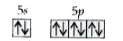 In the excited state , the configuration becomes 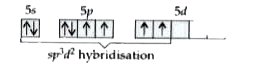 No. of LONE pairs :2 Geometry: Octahedral |
|
| 26. |
Calculate the number of kWhof electricity is necessary to produce 1 metric ton (1000 kg) of aluminium by Hall process in a cell operating at 15 V. |
|
Answer» |
|
| 27. |
Calculate the number of geometrical isomers in the following polyenes. (i) H_(3)C-CH=CH-CH=CH-CH=CH-CH=CH-Br (ii) H_(3)C-CH=CH-CH=CH-CH=CH-CH=CH-CH_(3) (iii) C_(6)H_(5)-CH=CH-CH=CH-CH=CH-C_(6)H_(5) (iv) C_(6)H_(5)-CH=CH-CH=CH-Cl |
|
Answer» Solution :(i) The MOLECULE has FOUR double bonds and cannot be divided into two EQUAL HALVES unsymmetrical the number of GEOMETRICAL isomers `=2^((n-1))+2^((n//2)-1)` `=2^(3)+2^(1)=8+2=10` (iii) The molecule has three double bonds (odd number). The number of geometrical isomers `=2^((n-1))+2^((n+1)/(2)-1)` `=2^(2)+2^(2-1)=4+2=6` (iv) The molecule has two double bonds and is unsymeetrical The number of geometrical isomers `=2^(n)=2^(3)=4` |
|
| 28. |
Calculate the number of g -moles of CaO that could be obtained from 42.54g of CaCO_(3) and convert the number of g-moles to grams. |
|
Answer» SOLUTION :No. of g-moles `=(42.54)/(100)=0.4254`. MASS of `CaO=0.4254xx56=23.8gl` |
|
| 29. |
Calculate the number of g-molecules (mole of molecules) in the following : (i) 3.2 gm CH_(4) (ii) 70 gm nitrogen (iii) 4.5xx10^(24) molecules of ozone (iv) 2.4xx10^(21) atoms of hydrogen (v) 11.2 L ideal gas at 0^(@) C and 1 atm (vi) 4.54 ml SO_(3) gas at STP (vii) 8.21 L C_(2)H_(6) gas at 400 K and 2 atm (viii) 164.2 ml He gas at 27^(@)C and 570 torr [N_(A)=6xx10^(23)] |
|
Answer» Solution :(i) 3.2 gram `CH_(4)` number of moles `(CH_(4))=(w)/(M)=(3.2)/(16)=0.2` moles (ii) 70 gram `N_(2)` Number of moles `=(w)/(M)=(70)/(28)=2.5` (iii) `4.5xx10^(24)` molecules of `O_(3)` Number of moles `=("no. of molecules ")/(N_(A))=(4.5xx10^(24))/(6xx10^(23))=7.5` (iv) `2.4xx10^(21)` atoms of hydrogen Number of gram molecules of `H_(2)=("no. of molecules")/(N_(A))=(2.4xx10^(21))/(2xx6xx10^(23))=0.002` (v) 11.2 litre ideal gas at `0^(@)` C and 1 atm Number of moles `=("Volume at " 0^(@) C & 1 atm)/(22.4 "LITRES")=(11.2)/(22.4)=0.5` (VI) 4.54 mol `SO_(3)` gas at STP Number of moles `=(V_("STP")(ml))/(22700ml)=(4.52)/(22700)=2xx10^(-4)` (vii) 8.21 litre `C_(2)H_(6)` at 400 K and 2 litre `=n(PV)/(R.T)=(2xx8.21)/(0.0821xx400)=0.5` (viii) `164.2xx` ml He gas at `27^(@)C and 570` torr `n=(PV)/(RT)=((570)/(760)atm)xx(164.2xx10^(-3) "litre")/(0.0821xx300)=0.005` |
|
| 30. |
Calculate the number of disintegrations which 1g of ""^(226)Ra (t_((1)/(2))=1600yr) would undergo per second. What quantity of Na^(24) (t_((1)/(2))=15 hours) would undergo the same no. of disintegrations per second |
| Answer» Solution :`3.658 xx 10^(10) dps, 1.37 xx 10^(-7)G` | |
| 31. |
Calculate the number of coulombs delivered by a Daniel cell, initially containing 1 litre each of 1M Cu^(2+) and 1M Zn^(2+) ion which is operated until its potential drops to 1V. E_(Cu^(2+),Cu)^@=0.34V, E_(Zn^(2+),Zn)^@=-0.76V |
|
Answer» Solution :For the DANIEL cell : `ZN, Zn^(2+)||Cu^(2+),Cu` `E_(cell)=E_(RHS) (RED.)- E_(L.H.S) (red.)` |
|
| 32. |
Calculatethe numberof coulombsrequiredto deposit2.7 xx 10^(-2)kg ofaluminiumwhen theelectrodereactionis A1^(3+ ) + 3e^(-)"to" A1(Given: Atomicweight of A1= 27 g "mol"^(-1) |
| Answer» SOLUTION :Quantityof ELECTRICITY= Q=289500 C` | |
| 33. |
Calculate the number of carbon, hydrogen and oxygen atoms in 18g of glucose. |
|
Answer» `3.61xx10^(23)` oxygen atoms |
|
| 34. |
Calculate the number of atoms present in the unit cell of a monoatomic element of (i) simple cubic (ii) body-centered cubic and (iii) face-centered cubic lattices. |
| Answer» SOLUTION :(i) 1 (i) 2 (III) 4 | |
| 35. |
Calculate the number of atoms per unit cell of FCC. |
|
Answer» SOLUTION :There are 8 lattice points at the corners of the cube and 6 lattice points at the face centres of the cube. Therefore, number of particles per UNIT cell `=(8xx(1)/(8))+(6xx(1)/(2))=4` |
|
| 36. |
Calculatethe numberof atomspresentin 2 gramsof crystalwhichhas face- centredcubic(FCC)crystallattice havingedgelengthof 100 pmand density10 g cm^(-3) |
| Answer» SOLUTION :Numberof atoms `= 8 xx 10^(23)` | |
| 37. |
Calculate the number of atoms per unit cell of bcc type. |
|
Answer» SOLUTION :(i) In a body centered CUBIC unit cell, each corner is occupied by an identical particle and in addition to that one atom occupied the body centre. (ii) Those atoms which OCCUPY the corners do nottouch each other, however they all touch the one that occupies the body centre. (iii) Hence each atom is surrounded by eight NEAREST neighbours and COORDINATION number is 8. An atom present at the body centre centre belongs to only a particular unit cell. i.e., unshared by other unit cell. 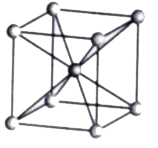 `therefore` number of atoms in a bcc unit cell `=(N_(c))/(8)+(N_(b))/(1)=(8)/(8)=(1)/(1)` `=1+1=2` |
|
| 38. |
Calculate the number of atoms per unit cell of bee type. |
|
Answer» Solution :(i) In a body centered cubic UNIT cell, each corner is occupied by an identical particle and in addition to that one atom occupied the body CENTRE. (ii) Those atoms which occupy the corners do not touch each other, however they all touch the one that occupies the body centre. (III) Hence each atom is surrounded by EIGHT nearest neighbours and coordination number is 8. An atom present at the body centre belongs to only a PARTICULAR unit cell. i.e., unshared by other unit cell. `:.` number of atoms in a bcc unit cell `=(N_(c))/(8)+(N_(c))/(1)=(8)/(8)=(1)/(1)=1+1+2` 
|
|
| 39. |
Calculate the number of atoms of the constituent elements in 53 g of Na_(2)CO_(3). |
|
Answer» SOLUTION :By mole concept, 1 mole of `Na_(2)CO_(3)=" Gram FORMULA mass of "Na_(2)CO_(3)=2xx23+12+16xx3=106g` Now, 106 g of `Na_(2)CO_(3)=" 1 mole"therefore"53 g of "Na_(2)CO_(3)=(1xx53)/(106)=0.5"mole of "Na_(2)CO_(3)` BUT1 mole of `Na_(2)CO_(3)` contains 2 moles of `Na^(+)` ion or `2xx6.022xx10^(23)Na^(+)` ions. `therefore 0.5` mole of `Na_(2)CO_(3)` will CONTAIN `2xx6.022xx10^(23)xx0.5Na^(+)" ions"=6.022xx10^(23)Na^(+)ions` Again, 1 mole of `Na_(2)CO_(3)` contains 1 mole of carbon atoms `=6.022xx10^(23)Na^(+)` ions `therefore 0.5`, mole of `Na_(2)CO_(3)` will contain `=6.022xx10^(23)xx0.5` carbon atoms `=3.011xx10^(23)" carbon atoms"` Further, 1 mole of `Na_(2)CO_(3)` contains 3 moles of oxygen atoms of `3xx6.022xx10^(23)` oxygen atoms `therefore 0.5` mole of `Na_(2)CO_(3)` will contain `=3xx6.022xx10^(23)xx0.5` oxygen atoms `=9.033xx10^(23)` oxygen atoms |
|
| 40. |
Calculate the number of atoms per unit cell in primitive, body centred and face centred cubi unit cells. |
Answer» Solution : Primitive UNIT cell : In primitive unit cell, th atoms are located only at a corners  Since each cubic unit cell has atoms on it corners, the TOTAL number of atoms per unit ce 1 is `(8 xx 1/8) = 1` atom. Body-centred unit cell : A body-centred cubi unit cell has eight atoms located at corners a cube and ONE atom at the body centred. Hence the number of atoms per unit cell is : `underset("Corner atoms)")underset(darr)(8 xx 1/8) + underset("(Body-centred atom)")underset(darr)(1) + 2`  Face-centred unit cell : A face-centred cubi unit cell has eight atoms located at the corner of a cube and SIX atoms located at the centre o each face. Hence, the number of atoms per uni cell is : `underset("(Corner atoms)")underset(darr)(8 xx 1/8) + underset("(Face atoms)")underset(darr)(6xx 1/2) = 4` 
|
|
| 41. |
Calculate the number of atoms of each elementpresent in 122.5g of KCIO_(3). |
|
Answer» Solution :NUMBER of ATOM of 'K'=`1xx6.023xx10^(23)` Number of ATOMS of 'Cl'`=1xx6.023xx10^(23)` Number of atoms of 'O'`=3xx6.023xx10^(23)` |
|
| 42. |
Calculate the number of atoms in each of the following : (i) 52 moles of He (ii) 52 u of He (iii) 52 g of He |
|
Answer» Solution :(i) `"1 mole of He"=6.022xx10^(23)" atoms"` `therefore"52 mol of He"=52xx6.022xx10^(23)" atoms"=3.131xx10^(25)" atoms"` (ii) `"1 atoms of He = 4 U of He"` `" 4 u of He = 1 atom of He"` `therefore"52 u of He"=(1)/(4)XX" 52 atoms = 13 atoms"` (III) `"1 mole of He = 4 g "=6.022xx10^(23)" atoms"` `therefore"52 g of He "=(6.022xx10^(23))/(4)xx" 52 atoms"=7.8286xx10^(24)" atoms"` |
|
| 43. |
Calculate the number of atoms in a fee unit cell. |
|
Answer» Solution :Number of ATOMS in a FCC unit cell. `=(N_(C))/(8)+(N_(f))/(2)` `=(8)/(8)+(6)/(2)=1+3=4` 
|
|
| 44. |
Calculate the number of atoms in a cubic based unit cell having one atom at each corner and two atoms on each diagonal. |
|
Answer» |
|
| 45. |
Calculate the number of atoms in a cube based unit cell having one atom on each corner and two atoms on each body diagonal. |
|
Answer» Solution :There are FOUR body diagonals passing through the centre and connecting opposite corners. Since the atoms present on the body diagonals are not shared by the surrounding unit cells, the contribution MADE by the atoms present on four body diagonals = `2 XX 4` = 8. Contribution made by the atoms present on eight corners = `1/8 xx 8` = 1 `:.` Total NUMBER of atoms present per unit cell = 8+1=9 |
|
| 46. |
Calculate the number of atoms in a cube based unit cell haying one atom on each corner and two atoms on each body diagonal. |
|
Answer» Solution :There are four body diagonals passing through the centre and CONNECTING opposite corners. Since the atoms present on the body diagonals are not shared by the SURROUNDING unit cells, the contribution MADE by the atoms present on four body diagonals = `2 xx 4` = 8. Contribution made by the atoms present on eight corners = `1/8 xx 8` = 1 `:.` Total number of atoms present per unit cell = 8+1=9 |
|
| 47. |
Calculate the number of atoms disintegrating per minute in a mass of 0.001 g of radium which is an alpha-emitter with a half-life period of 1620 years. |
| Answer» SOLUTION :`2.16 XX 10^(9)` | |
| 48. |
Calculate the number of atoms contained within face-centred cubic cm. |
| Answer» SOLUTION :The TOTAL number of atoms per unit CELL in a f.c.c`=(1/8xx8)+(1/2xx6)=1+3+4` | |
| 49. |
The total number of atoms per unit cell of a face centred cubic crystal is |
| Answer» Solution :The TOTAL NUMBER of atoms PER unit cell in a f.c.c`=(1/8xx8)+(1/2xx6)=1+3+4` | |
| 50. |
Calculate the number of atoms belong to one unit cell of simple cubic unit cell(sc) |
|
Answer» Solution :(i) In the simple cubic unit CELL, each comer is occupied by an identical atoms (or) IONS (or) molecules and they touch along the edges of CUBE, do not touch diagonally. The coordination number of cach atom is 6. (ii) Each atom in the corner of the cubic unit cell is shared by 8 neighbouring unit cells and THEREFORE atoms per unit cell is equal to `(N_(c))/(8)`. where Nc is the number of atoms at the CORNERS. (iii) `:.` no of atoms in a SC unit cell `=((N_(c))/(8))=((8)/(8))=1` 
|
|