

Saved Bookmarks
This section includes InterviewSolutions, each offering curated multiple-choice questions to sharpen your knowledge and support exam preparation. Choose a topic below to get started.
| 43351. |
A coil of a tangent galvanometer of diametre 0.24 m has 100 turns. If the horizontal component of Earth's magnetic field is 25 xx 10^(-6) T then, calculate the current which gives a deflection of 60^(@) . |
|
Answer» Solution :The DIAMETER of the COIL is 0.24 m. therefore, radius of the coil is 0.12m. Number of turns is 100 turns. Earth.s magnetic field is 25 `xx 10^(-6)` T DEFLECTION is `THETA = 60^(@) rArr tan 60^(@) = sqrt(3) = 1.732` I = `(2 R B_(H))/(mu_(0)N) tan theta = (2 xx 0.12 xx 25 xx 10^(-16))/(4 xx 10^(-7) xx 3.14 xx 100) xx 1.732 = 0.82 xx 10^(-1) `A I = 0.082 A |
|
| 43352. |
Briefly discuss the observations of Hertz, Hallwachs and Lenard. |
|
Answer» Solution :Hertz observation : In 1887, Heinrich Hertz first became successful in generating and detecting electromagnetic wave with his high voltage induction coil to cause a spark discharge between two metallic spheres. When a spark is formed, the charges will oscillate back and forth rapidly and the electromagnetic WAVES are produced. The electromagnetic waves thus produced were detected by a detector that has a copper wire bent in the shape of a circle. ALTHOUGH the detection of waves is successful, there is a problem in observing the tiny spark produced in the detector. In order to improve the visibility of the spark, Hertz made many attempts and finally noticed an important thing that small detector spark became more vigorous when it was exposed to ultraviolet light. The reason for this behaviour of the spark was not known at that time. Later it was found that it is due to the photoelectric emission. WHENEVER ultraviolet light is incident on the metallic sphere, the electrons on the outer surface are emitted which caused the spark to be more vigorous. Hallwachs. observation :  In 1888, Wilhelm Hallwachs, a German physicist, confirmed that the STRANGE behaviour of the spark is due to the action of ultraviolet light with his simple experiment. A clean circular plate of zinc is mounted on an insulating stand and is attached to a gold leaf electroscope by a wire. When the uncharged zinc plate is irradiated by ultraviolet light from an arc lamp, it becomes positively charged and the leaves will open. Further, if the negatively charged zinc plate is exposed to ultraviolet light, the leaves will close as the charges leaked away quickly. If the plate is positively charged, it becomes more positive upon UV rays irradiation and the leaves will open further. From these observations, it was concluded that negatively charged electrons were emitted from the zinc plate under the action of ultraviolet light. Lenard.s observation : In 1902, Lenard studied this electron emission phenomenon in detail. The apparatus consists of two metallic plates A and C placed in an evacuated quartz bulb. The galvanometer G and battery B are connected in the circuit. When ultraviolet light is incident on the negative plate C, an electric CURRENT flows in the circuit that is indicated by the deflection in the galvanometer. On other hand, if the positive plate is irradiated by the ultraviolet light, no current is observed in the circuit. From these observations, it is concluded that when ultraviolet light falls on the negative plate, electrons are ejected from it which are attracted by the positive plate A. On reaching the positive plate through the evacuated bulb, the circuit is completed and the current flows in it. Thus, the ultraviolet light falling on the negative plate causes the electron emission from the surface of the plate. |
|
| 43353. |
of the following transitions in the hydrogen atom, the one which gives an emission line of the highest frequency? |
|
Answer» n = 3 to n = 10 |
|
| 43354. |
An electron, an alpha-particle, and a proton have the same kinetic energy. Which of these particles has the shortest de Broglie wavelength? |
|
Answer» Solution :For a particle, DE Broglie wavelength, `lambda=h//p` Kinetic energy, `K=p^(2)//2m` Then, `lambda=h//sqrt(2mk)` For the same kinetic energy K, the de Broglie wavelength ASSOCIATED with the particle is inversely proportional to the square ROOT of their masses. A proton `(""_(1)^(1)H)` is 1836 times massive than an electron and an `ALPHA`-particle `(""_(2)^(4)He)` four times that of a proton. Hence, `alpha-` particle has the shortest de Broglie wavelength |
|
| 43355. |
Dot product of two vectors overset(rarr)A and overset(rarr)Bis defined as overset(rarr)A.overset(rarr)B=aB cos phi, where phiis angle between them when they are drawn with tails coinciding. For any two vectors. This means ovsert(rarr)A . overset(rarr)B=overset(rarr)B. overset(rarr)Athat. The scalar product obeys the commutative law of multiplication, the order of the two vectors does not matter. The vector product of two vectors overset(rarr)A and overset(rarr)Balso called the cross product, is denoted byoverset(rarr)A xx overset(rarr)B . As the name suggests, the vector product is itself a vector. overset(rarr)C=overset(rarr)A xx overset(rarr)Bthen C=AB sin theta, For non zerovectors overset(rarr)A, overset(rarr)B, overset(rarr)C,|(overset(rarr)Axxoverset(rarr)B).overset(rarr)C|=|overset(rarr)A||overset(rarr)B||overset(rarr)C| holds if and only if |
|
Answer» `overset(rarr)A.overset(rarr)B=0,overset(rarr)B.overset(rarr)C=0` i.e `barA ,BARB` and `barc` are mutually perpendicular `barA.barB=barB .barC.barA=0` |
|
| 43356. |
"I do not know what I may appear in the. world, I seem to have been only like a boy playing on the sea-shore and diverting myself every now and then finding a smoother pebble or a prettier shell than ordinary, while the great ocean of truth lay undiscovered before me." Who said this? |
|
Answer» Newton |
|
| 43357. |
State the working principle of a potentiometer. With the help of the circuit diagram explain how apotentiometer is used to compare the emfs of two primary cells. Obtain the required expression used for comparing the emfs. |
Answer» Solution : COMPARISON of emfs of two cells: A labelled circuit diagram arrangement to compare the emfs of two primary cells using a potentiometer is shown in Fig. 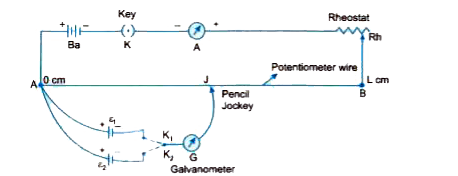 Plug is applied in KEY K and by adjusting the rheostat Rh a constant CURRENT I is allowed to flow through potentiometer wire due to the driver cell Ba. Put the plug in key `K_1` so as to connect cell &z and SLIDE the pencil jockey J till a balance (null) point is OBTAINED. Let the length of potentiometer wire AJ in this position be `l_1` , then `epsi_1 = kl_1` , where k is the potential gradient along the wire. Now plug is removed from key `K_1` and, in turn, plug is inserted in key `K_2` so as to bring `epsi_2`in the electric circuit. Again slide the pencil jockey and obtain the position of jockey for null deflection in galvanometer. Let the length now be `l_2` , then `epsi_2 = kl_2` ` therefore epsi_1/epsi_2 = l_1/l_2` |
|
| 43358. |
Dot product of two vectors overset(rarr)A and overset(rarr)Bis defined as overset(rarr)A.overset(rarr)B=aB cos phi, where phiis angle between them when they are drawn with tails coinciding. For any two vectors. This means overset(rarr)A . overset(rarr)B=overset(rarr)B. overset(rarr)Athat. The scalar product obeys the commutative law of multiplication, the order of the two vectors does not matter. The vector product of two vectors overset(rarr)A and overset(rarr)Balso called the cross product, is denoted byoverset(rarr)A xx overset(rarr)B . As the name suggests, the vector product is itself a vector. overset(rarr)C=overset(rarr)A xx overset(rarr)Bthen C=AB sin theta, overset(rarr)A=hat i+ hat j-hatk and overset(rarr)B=2 hat i +3 hat j +5 hat k angle between overset(rarr)A and overset(rarr)Bis |
|
Answer» `120^(@)` |
|
| 43359. |
A circular race track of radius 120 m is banked at an angle of 53^o . The optimum speed of car to avoid wear and tear of its tyres is (g = 10 ms^-2) |
|
Answer» 40 m/s |
|
| 43360. |
The earth is assumed to be a sphere of radius R. A platform is arranged at a height R from the surface of earth. The escape velocity of a body from this platform is fv, where v is its escape velocityfrom surfaceof the earth. The value of f is : |
|
Answer» `(1)/(2)` `v=sqrt((2GM)/(R ))` If v. is escape velocity from the platform then Kinetic energy + Gravitational POTENTIAL energy = 0. `(1)/(2)mv.^(2)+(-(GMm)/(2R))=0 rArr v.= sqrt((GM)/(R ))=FV` `THEREFORE f=(v.)/(v)=(1)/(sqrt(2))`. Thus correct choice is (c ). |
|
| 43361. |
Dot product of two vectors overset(rarr)A and overset(rarr)Bis defined as overset(rarr)A.overset(rarr)B=aB cos phi, where phiis angle between them when they are drawn with tails coinciding. For any two vectors. This means overset(rarr)A . overset(rarr)B=overset(rarr)B. overset(rarr)Athat. The scalar product obeys the commutative law of multiplication, the order of the two vectors does not matter. The vector product of two vectors overset(rarr)A and overset(rarr)Balso called the cross product, is denoted byoverset(rarr)A xx overset(rarr)B . As the name suggests, the vector product is itself a vector. overset(rarr)C=overset(rarr)A xx overset(rarr)Bthen C=AB sin theta, A force overset(rarr)F=3hat i +c hat j + 2 hatkacting on a particle causes a displacementd=4hat i+ 2 hat i + 3 hat k . If the work done (dot product of force and displacement) is 6J then the value of c is : |
|
Answer» 12 |
|
| 43362. |
When a battery is connected across a parallel combination of two unequal resistances. |
|
Answer» current PASSING through both the resistances would be equal.  Applying KVL in the closed loop containing `R_(1)` and `R_(2)` , we get - `I_(1) R_(1) + I_(2) R_(2)= 0 ` `therefore I_(1) R_(1) = I_(1) R_(2) ` `therefore V_(1) = V_(2) ` `rArr`p.d across `R_(1) and R_(2)` are equal. |
|
| 43363. |
At alternating voltage is applied across the R-L combination V =220 sin 120t V and the current I = 4sin (120t - 60^@)A developes. The power consumption is …… |
|
Answer» Solution :`V_m=220V, I_m=4A, delta=60^@` `P=(V_mI_m)/2 COS delta` `=(220xx4)/2 cos 60^@ =(220xx4)/2 XX 1/2` = 220 W |
|
| 43364. |
What is a transformer ? Mention two sources of energy loss in a transformer |
|
Answer» Solution :It is a device used to increase or decrease the AC voltages. SOURCES of Energy LOSS : (i) Magnetic flux leakage loss. (ii) Ohmic loss/loss due to theresistance of the windings (TURNINGS)/Joule.s HEAT loss. (iii) Eddy current loss. (iv) Hysteresis loss. |
|
| 43365. |
The number of photons emitted per second by a Medium wave transmitter of 10 kW power, emitting radio waves of wavelength 500m |
|
Answer» `2.51xx10^(31)` |
|
| 43366. |
In mecasuring g using a simple pendulum a student makes a positive error of 1% in_Jength of pendulum and a negative error of 3o in the value of time period. Percentage error in measurement of value of g is |
|
Answer» 0.02 |
|
| 43367. |
The resultatof two rectangular simple harmonic motions of the same frequency and unequal amplitudes butdiffering in phase by (pi)/(2) is : |
|
Answer» SIMPLE harmonic |
|
| 43368. |
The speed of electron in the first Bohr orbit is C/(137), where C is speed of light in free space. The speed of electron in the 2nd Bohr orbit will be: |
|
Answer» `1/2 ((C)/(137))` Put `r_(n) alpha n^(2)` `v alpha 1/n` `v_(2)=v_(1)/2=1/2 ((c)/(137))` |
|
| 43369. |
Calculate the specific binding energy of the nucleus of ._(7)^(14)N. Given the rest mass of nucleus of ._(7)^(14)N=14.00307u, the rest mass of proton =1.00783 u and the rest mass of neutron=1.00867 u. |
| Answer» SOLUTION :104.7 MEV | |
| 43370. |
Draw a labelled diagram showing the formation of image of a distant object using an astronomical telescope in the normal adjustment. |
|
Answer» Solution :In an astronomical TELESCOPE, the objective is a convex lens of LARGE focal length. The eye lens is also a convex lens of small focal length. The position of the eye piece is ADJUSTED so that final image is seen at infinity. Then distance between two lenses `d = f_(0)+f_(e)` 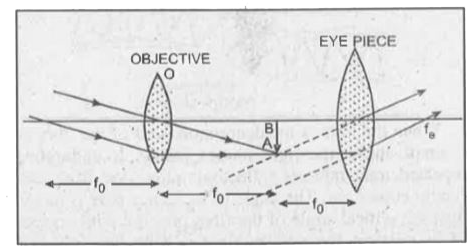
|
|
| 43371. |
The Debye temperature for silver is 213 K, the lattice constant is 2Å. Find the velocity of sound. |
|
Answer» |
|
| 43372. |
A small mirror of mass m is suspended by a light thread of length l. A short polse of laser falls on the mirror with energy E. Then, whoch of the following statement is correct? |
|
Answer» If the pulse FALLS normally on the mirror, it deflects by `theta=(2E)/((mcsqrt(2gl)))` |
|
| 43373. |
Define the term 'potential energy' of charge 'q' at a distance 'y in an external electric field. |
| Answer» Solution :Potential ENERGY of a charge .q. at a distance .r. in an external electric field is defined as the WORK done in BRINGING the given charge from infinityto the given POINT in the externalelectric field. | |
| 43374. |
जीवों का वर्गीकरण करते समय सबसे पहलेजाननी होती है |
|
Answer» समानताएँ |
|
| 43375. |
When an electron jumps from the initial orbit n_1 to the final orbit n_f the energy radiated is given by: |
|
Answer» `hv=E_i/E_f` |
|
| 43376. |
Write the relation between the path difference and wavelength of light wave used for constructive and destructive interference of light |
|
Answer» Solution :`delta=nlambda` Where `n=0,1,2,3`………constructive interference. `delta=(2n+1)(LAMBDA)/(2)`, where , `n=0,1,2,3,`…… `delta=(2n-1)(lambda)/(2)`, where , `n=1,2,3,`………..DESTRUCTIVE interference where `lambda` is WAVELENGTH of light. |
|
| 43377. |
The refractive index of glass is 1.520 for red light and 1.525 for blue light. Let D_(1) and D_(2) be minimum angles of deviation for red and blue light in a prism of this glass then : |
|
Answer» `D_(1) gt D_(2)` or `mu PROP delta_(m)`, LARGER, greater then `delta_(m)`. |
|
| 43378. |
What is meant by Sinusoidal alternating voltage? |
|
Answer» Solution :If the waveform of ALTERNATING voltage is a SINE wave, then it is known as sinusoidal alternating voltage which is give by the realtion. `v=V_(m)sinomega` where `I_(m)` is the maximumj value (amplitude)of the alternating CURRENT. The direction of sinusoidal voltage or current is reversed after every half-cycle and its magnitude is also changing CONTINUOUSLY. |
|
| 43379. |
State Joule's law of heating. |
|
Answer» SOLUTION :It states that the heat developed in an electrical circuit due to the FLOW of CURRENT varies DIRECTLY as: (i) the square of the current(ii) the resistance of the circuit and (iii) the time of flow. `H=I^(2)Rt` |
|
| 43380. |
On introducing a thin film in the path of one of the two interfering beam, the central fringe will shift by one fringe width. If mu=1.5, the thickness of the film is (wavelength of monochromatic light is lambda) |
|
Answer» `4LAMBDA` |
|
| 43381. |
Interference was observed in interference chamber where air was present, now the chamber is evacuated and if the same light is used, a careful observer will see ...... |
|
Answer» no interference |
|
| 43383. |
A uniform monochromatic beam of light of wavelength 365xx10^-9m and intensity 10^-8 W m^-2 falls on a surface having absorption coefficient 0.8 and work function 1.6 eV. Determine the number of electrons emitted per square metre per second, power absorbed per m^2, and the maximum kinetic energy of emitted photo electrons. |
|
Answer» Solution :Let N be the number of PHOTOELECTRON per second. `"Intensity"=Nxx"energy of one photon"` `I=N(hc)/(lamda)` Number of incident photons, `N_i="insident i ntensity"XX(lamda)/(hc)` `=(10^(-8)xx365xx10^(-9))/(6.62xx10^(-34)xx3xx10^(8))=18.35xx10^(8)` Number of photon `N_(ab)` absorbed by the surface per unit area per unit time (i.e., absorbed FLUX), `N_(ab)=0.8xx18.35xx10^(9)` `=1.47xx10^(10)m^(-2)s^(-1)` Emitted flux `=` No. of electrons emitted `m^(-2)s^(-1)` `=1.47xx10^(10)m^(-2)s^(-1)` Power absorbed per `m^(2)=0.8xx` Incident intensity `=0.8xx10^(-8)=8xx10^(-9)Wm^(-2)` From Einstein's PHOTOELECTRIC equation, `(KE)_(max)=hv-W_(0)=(hc)/(lamda)-W_(0)` `(6.62xx10^(-34)xx3xx10^(8))/(365xx10^(-9))-1.6xx1.6xx10^(-19)` `=2.89xx10^(-19)J=1.80eV` |
|
| 43384. |
Amplitude modulation is used for broad casting because |
|
Answer» it is more noise immune |
|
| 43385. |
A choke coil in series with a lamp is connected to a dc line. The lamp is seen to shine brightly. Insertion of an iron core in the choke causes no change in the lamp’s brightness. Predict the corresponding observations if the connection is to an ac line. |
|
Answer» Solution :In case of dc source, `F = 0 rArr X_(L)= 2pi fL = 0 rArr` Increase in the VALUE of Lwill not make any DIFFERENCE in the glow of lamp because `X_(L)` remains zero. In case of ac source, `I_("rms") = ( V_(rms))/( sqrt( R^(2) + 4pi ^(2) f^(2) L^(2)))` Here by inserting iron rod, L is increased and `I_(rms)` will decreaseand hence BRIGHTNESS of lamp will decrease further. |
|
| 43386. |
Davison and Germer.s and G.P. Thomson.s experiments gives |
|
Answer» Evidence of de Broglie.s WAVES ASSOCIATED with ELECTRONS |
|
| 43387. |
A light of intensity I_(0) passes through a material of thickness d. The resultant intensity is |
|
Answer» `I=I_(0)E^(-dt)` |
|
| 43388. |
An ohm meter measures the resistance placed between its leads. This resistance reading is indicated by a galvanometer that operates on current. The ohm meter has an internal source of voltage to create the necessary current to operate the galvanometer and also has approproate resistor to allow just right amount of current through galvanometer. A simple ohm meter is shown here. When there is an infinite resistance, there is zero current through galvanometer and it points in middle. If the test leads of this meter are directly shorted, (zero resistance) galvanometer will give fulldeflection. Galvanometer specification Resistance of galvanometer = 100 Omega Fullscale current = 0.5 mA Total number of division =40 . |
|
Answer» `20 k Omega` READING at that time the galvanometer will show full scale deflection. Full scale CURRENT `i_g = 0.5 xx 10^(-5) A` `i_g = 10/(G+R) or 0.5 xx 10^(-3) = 10/(100+R)` ,brgt or `(100+R) = (10/(0.5 xx 10^(-3))) = 20000` ,brgt or `R = 20000 - 100 = 1990 Omega = 19.9 kOmega` If needle deflect to MIDDLE of scale the current through the galvanometer will be `(1//2) xx 0.5 mAi.e., 0.25 mA. ` Hence `0.25 xx 10^(-3) = 10/(100+19900+R')` `20000 +R' = 10/(0.25 xx 10^(-3)) = 40000` or `R' = 20000 = 20kOmega` If `5Omega` is measured with this ohm meter, the needle will be near `0 Omega` MARK, hence the needle will be between C and zero. |
|
| 43389. |
Find the position of the final image formed by the lens combination given in the figure |
| Answer» Solution :30 CM to the RIGHT of the third LENS | |
| 43390. |
An ohm meter measures the resistance placed between its leads. This resistance reading is indicated by a galvanometer that operates on current. The ohm meter has an internal source of voltage to create the necessary current to operate the galvanometer and also has approproate resistor to allow just right amount of current through galvanometer. A simple ohm meter is shown here. When there is an infinite resistance, there is zero current through galvanometer and it points in middle. If the test leads of this meter are directly shorted, (zero resistance) galvanometer will give fulldeflection. Galvanometer specification Resistance of galvanometer = 100 Omega Fullscale current = 0.5 mA Total number of division =40 . |
|
Answer» `20 k Omega` reading at that time the galvanometer will show full scale deflection. Full scale current `i_g = 0.5 xx 10^(-5) A` `i_g = 10/(G+R) or 0.5 xx 10^(-3) = 10/(100+R)` ,brgt or `(100+R) = (10/(0.5 xx 10^(-3))) = 20000` ,brgt or `R = 20000 - 100 = 1990 Omega = 19.9 kOmega` If needle deflect to middle of scale the current through the galvanometer will be `(1//2) xx 0.5 mAi.e., 0.25 mA. ` Hence `0.25 xx 10^(-3) = 10/(100+19900+R')` `20000 +R' = 10/(0.25 xx 10^(-3)) = 40000` or `R' = 20000 = 20kOmega` If `5Omega` is measured with this ohm meter, the needle will be near `0 Omega` mark, hence the needle will be between C and zero. |
|
| 43391. |
A double slit apparatus is immersed in a liquid of refractive index 1.33. It has slit separation of 1 mm and distance between the plane of slits and screen 1.33 m. The slits are illuminated by a parallel beam of light whose wavelength in air is 6300 overset(*)A. What is the fringe width? |
|
Answer» `(1.33 XX 0.63)` MM |
|
| 43392. |
A binary star system is revolving in a circular path with angular speed 'omega' and mass of the stars are 'm' and '4m' respectively. Both stars stop suddenly, then the speed of havirerstar when the separation between the stars when the seperation between the stars becomes half of initial value is : |
|
Answer» `SQRT(2[((Gmomega)^(2))/(2)]^(1//3))` |
|
| 43393. |
The electric field of a plane electromagnetic wavetravelling in the +ve Z-direction is described by |
|
Answer» `Ex=E_0 SIN (KZ+omega t)` |
|
| 43394. |
On reflection from a plane mirror, how the ray is deviated ? |
| Answer» SOLUTION :`delta=180-i` | |
| 43395. |
A horizontal force of 150N produces an acceleration of 2m/s2 in a body placed on a 6 horizontal surface. A horizontal force of 200N produces an acceleration of 3m//s^2. The mass of the body and coefficient of kinetic friction are (g = 10 ms^(-2)) |
| Answer» Answer :A | |
| 43396. |
Statement(A): In intrinsic semi conductor,conductivity is mainly due to the breakage of covalent bonds. Statement(B) : In extrinsic semi conductor, the conductivity is mainly due to the addition of impurities |
|
Answer» A is true, B is FALSE |
|
| 43397. |
A thin uniform rod is rotating at an angular velocity of 7.0 "rad"//s about an axis that is perpendicular to the rod at its center. As the drawing indicates, the rod is hinged at two places, one-quarter of the length from each end. Without the aid of external torques, the rod suddenly assumes a u shape, with the arms of the u parallel to the rotation axis. What is the angular velocity of the rotating u? |
|
Answer» `3.5 "RAD"//s` |
|
| 43398. |
An inductor of 200 mH, capacitor of 400 uF and a resistor of 10 Omegaare connected in series of a.c. source of 50 V of variable frequency. Calculate the (a) angular frequency at which maximum power dissipation occurs in the circuit and the corresponding value of the effective current. (b) value of Q-factor of the circuit. |
|
Answer» Solution :Here, L = 200 mH = 0.2 H, C = 400 `muH = 400xx 10^(-6) F = 4 XX 10^(-4) F, R = 10 Omega` and `V_(rms) = 50 V` (a) For maximum power DISSIPATION, the circuit MUST be a resonant circuit having an angular frequency `omega_(0) = 1/sqrt(LC) = 1/sqrt(0.2 xx 4 xx 10^(-4)) = 50sqrt(5) s^(-1)` or `111.8 s^(-1)` `therefore` Corresponding value of effective current `I_(ETA) = V_(rms)/r = 50/10 = 5 A` (b) Q-factor `X_(L)/R = (L omega)/R = (0.2 xx 111.8)/10 = 2.24` |
|
| 43399. |
A runner weighing 60 kg raises the CG of his body by 0.25 m during each step of 1 min length. If he runs for 6 km and there is loss of 10% of the energy due to friction of air etc. What is the total energy required by him from his intake of food ? |
|
Answer» `9XX10^(5)` J For each STEP he raise the C.G. by 0.25 m `:.` P.E. required by the runner `E_P=60xx10xx0.25xx6000` =`9xx10^5J` Total energy required =`(9xx10^5xx110)/(100)=9.9xx10^5 J` |
|
| 43400. |
A magnet of magnetic dipole moment 5.0 Am^(2)is lying in a uniform magnetic field of 7 xx 10^(-4) T such that its dipole moment vector makes an angle of 30° with the field. The work done in increasing this angle from 30° to 45° ls about ......... J. |
|
Answer» `5.56 xx 10^(-4)` `= - MB cos theta _(2) - (- m B cos theta )` `= - mB ( cos theta_(2) -cos theta_(1) )` `=-5 xx 7 xx 10^(-4) ( cos 45^(@) - cos 30^(@) )` `= - 35 xx 10(-4) ((1)/(sqrt(2)) -(sqrt(3) ) /( 2)) ` `= - 35 xx 10^(-4) (-0.1588) = 5.558 xx 10^(-4)` `therefore W ~~ 5.56 xx 10^(-4)` J |
|