

Saved Bookmarks
This section includes InterviewSolutions, each offering curated multiple-choice questions to sharpen your knowledge and support exam preparation. Choose a topic below to get started.
| 39401. |
A tyre pumped to a pressure of 6 atmosphere suddenly bursts. Room temperature is 25^(@)C. Calculate the temperature of escaping air. (gamma=1.4) |
|
Answer» SOLUTION :From `P_(1)^(1-gamma) T_(1)^(gamma)=P_(2)^(1-gamma) T_(2)^(gamma)` Here, `P_(1)=6atm P_(2) =1 ATM` `T_(1)=273+25=298K, gamma=1.4` `(6)^(1-1.4) (298)^(1.4)=(1)^(1-1.4)T_(2)^(1.4)` `T_(2)^(1.4) =(298)^(1.4)6^(-0.4)=((298)^((1.4)/(1.4)))/((6)^((0.4)/(1.4)))=(298)/((6)^((2)/(7)))` using logarithms `log T_(2)=2.4742-(2)/(7) (0.7782)` `=2.4742 -0.2209=2.2533`. Anti log of `2.2533=178.7` `:.T_(2)=178.7K rArr t_(2)=178.7-273 = -94.3^(@)C` . |
|
| 39402. |
A carnot engine having an efficiency of eta=1/10 as heat engine is used as a refrigerator. If the work done on the system is 10 J, the amount of energy absorbed from the reservoir at lower temperature is _____ |
|
Answer» 100 J `alpha Q_2/W=Q_2/(Q_1-Q_2)` `therefore Q_2/W=(Q_2/Q_1)/(1-Q_2/Q_1)` `therefore Q_2/W=(1-eta)/eta[eta=1-Q_2/Q_1 RARR Q_2/Q_1=1=eta]` `therefore Q_2=Wxx(1-eta)/eta` `therefore Q_2=10xx(1-1/10)/(1/10)` `therefore Q_2`=90 J |
|
| 39403. |
As shown in figure, a stick half of which is made of wood and other half or iron is pivoted as shown in fig.(a) It is pivoted at wooden end force is applied to the other end of it at right angles to its length (b) It is pivoted at iron end and the same force is applied to the other end at right angles to its length. Then angular acceleration produced is |
|
Answer» More in CASE (B) than in (a) |
|
| 39404. |
A block slides down from top of a smooth inclined plane of elevation theta fixed in an elevator going up with an acceleration a_(0). The base of incline has length L. Find the time taken by the block to reach the bottom. |
Answer» SOLUTION :Let us solve the problem in the elevator frame. The free BODY force diagram is SHOWN. The forces are (i) N normal reaction to the plane, (ii) MG acting vertically down, (iii) `ma_(0)` (pseudo force). acting vertically down If a is the acceleration of the body with respect to incline, taking components of forces parallel to the incline. `mg sin theta + ma_(0)sin theta = ma "" therefore "" a = (g+a_(0))sin theta` This is the acceleration with respect to the elevator The distance travelled is `(L)/(cos theta)`. If t is the time for reaching the BOTTOM of icline. `(L)/(cos theta)=0+(1)/(2)(g+a_(0))sin theta.t^(2)` `t=[(2L)/((g+a_(0))sin theta cos theta)]^((1)/(2))=[(4L)/((g+a_(0))sin 2 theta)]^((1)/(2))` |
|
| 39405. |
A body weighs 200 gm in air 180 gm in a liquid and 175 gm in water. The density of the material of the body is |
|
Answer» `800kg//m^(3)` |
|
| 39406. |
How will you explain the recoil of gun using the centre of mass concept ? |
| Answer» SOLUTION :The bullet moves forward. To KEEP the CENTRE of MASS before and after FIRING the same, the rifle must move backward. | |
| 39407. |
A mass of 2.9 kg is suspended from a string of length 50 cm and is at rest. Another body of mass 100 g, which is moving horizontally with a velocity of 150 m//s strikes and sticks to it. Subsequently when the string makes an angle of 60^@ with the vertical, the tension in the string is (g = 10 m//s^(2)) |
| Answer» ANSWER :B | |
| 39408. |
The velocity of a particle, undergoing SHM is v at the position. If its amplitude is doubled, the velocity at the mean position will be……………. |
| Answer» Solution :`v=Aomega,v.=(2A)omega=2v` | |
| 39409. |
The thermo emfs of a thermocouple at the triple point and stam point are 4mV and 5.4mV, respectively. Calculate the temperature on the thermo-electric scale. What are the corresponding temperatures on the thermodynamic and Celsius scales if the variation of thermo emfs is governed by e=0.014t+4 when the emfs are in mollivolts? |
|
Answer» |
|
| 39410. |
What islatentheat ?Give is unitswith the helpof asuitablegraph , explainthetermslatentheatof fusion latentheat ofvaporisation. |
|
Answer» ` Solution :latent heat:The amountof heattransferredper unitmas duringthechangeof phaseof asubstancewithoutany changein itstemperatureis calledlatentheat of thesubstanceforparticularchange  Latentheatis denotedby Land havingSI, (i)LATENTHEAT offusion : It islatentheat forsolid -liquidstatechangeit isdenotedby Lfand is givenby latentheatof fusionLf `= (Q)/(m)` ItSI unitis `jK^(-1)` (ii) latentheat ofvaporisation : It islatentheat for liquid- gaschangeIt isdenotedby L v andoftenreferredto asheatof fusionand heatofvaporisation. Itis givenby Latentheat ofvaporisatin `L_(v)= (Q)/(m)`and its SIunitis`J KG^(-1)` startingapointA thesubstanceis initssolidphasaeheatingitbringsthe temperatureup toitsmeltingpointbut thematerialis stilla solidatpoint B. As it is heatedfurtherthe energyfrom theheatsourcegoesintobreaking thebondsholdingthe atomsisplace. Thistakesplace from Bto C.AtpointCallof the solidphasebeentransformedintothe liquidphase. Onceagainasenergyis added theenergygoes intothe KINETICENERGYOF theparticlesraisingthetemperature(C to D). AtpointD thetemperaturehasreached itsboilingpointbutit isstillintheliquidphase. frompointsD TOE thermalenergyis overcomingthe bondsand theparticleshaveenoughkineticenergyto escape FROMTHE liquidthe substanceis enteringthe gasphase. BeyondE, Furtherheatingunderpressurecan raisethe temperaturestillfurtheris howa pressurecookerworks . |
|
| 39411. |
Find the constraint relation between a_1, a_2 and a_3. |
|
Answer» SOLUTION : Points 1,2,3 and 4 are movable. Let their dis-placements from a FIXED line be ` x_1 , x_2 , x_3 and x_4` We have ` x_1 + x_4 = l_1` ( length of first string ) ..... (i) and `(x_2 - x_4)+ (x_3 - x_4) = l_2` (length of SECOND string ) or ` x_2 + x_3 - 2x_4 = l_2`............ (ii) On double ,DIFFERENTIATING with respect to time , we get ` a_1 + a_4 =0` ............ (iii) and ` a_2 + a_3 - 2a_4 = 0` ......... (IV) But since ` a_4 = -a_1 a_4 = - a_1 ` [From equation (iii) ] we have ,` a_2 + a_3 + 2a_1 =0` This is the requiredconstraint relation between ` a_1 , a_2 and a_3` 
|
|
| 39412. |
A cube a=3.0cm on each side radiates energy at the rate of P=20J//s when its temperature is 727^(@)C and surrounding temperature 27^(@)C. Determine its emissivity. |
|
Answer» |
|
| 39413. |
On an average a human heart is found to beat 300 times in a minute. Calculate its frequency and period. |
| Answer» SOLUTION :`F= 1.67 HZ, T= 0.6s`. | |
| 39414. |
A 2 kg sphere moving horizontally to the right with an initial velocity of 5 m/s strikes the lower end of an 8 kg rigid rod AB. The rod is suspended from a hinge at A and is initially at rest. Knowing that the coefficient o restitution between the rod sphere is 0.80. The velocity of the sphere immediately after the impact is V_(s)=(1)/(x)"ms"^(-1) (lft) where 'x' is |
|
Answer» |
|
| 39415. |
Calculate the percentage error in the volume of a cylinder of diameter 2.4 cm and height 10.5 cm, both measured using a metre scale of least count 0.1 cm. What will be the percentage error if dimensions are measured using a vernier calipers of least count 0.01 cm? |
|
Answer» |
|
| 39416. |
In the figure shown a smooth ring is connected to rod AB, while rod CD passes through ring. At the given instant angular velocity of rod AB about hinge A is 1 rod//sand AC=CB. Instantaneous angular velocity of rod CD about hinge C is |
|
Answer» `1rad//s` |
|
| 39417. |
A pulley of radius b=20 cm is fixed with a shaft of radus a=10 cm. Moment of inertia of shaft puley system is I=(33-800)kgm^(2) and the system is free to rotate about axis O of the shaft without friction. A block B of mass m_(2)=8 kg is resting over ann ideal spring of force costant. K=2048Nm^(-1) Lower end of the spring is fixed to the floor and the spring is vertical. Thread connected betwen shaft and block B is just taut. Another thead is connected between pulley and block A of mass m_(1)=4 kg. Initially this thread is loose. When block A is released first it falls freely through a height h=405/1024m then the thread becomes taut and block B is jerked into motion. calculate: a. Initial compressiion of the spring b. Velocity of block B when it is jerked into motion, c. Loss of energy during that jerk (g=10 ms^(-2)) |
|
Answer» Solution :Since initially thread connected with block `A` is loose, therefoe weight block `B` is balanced by compressive force in the spring. `ky_(0)=mgimpliesy_(0)=(mg)/K80/2048m` `=y_(0)=1.25/32m` or `125/32cm` Since block `A` first fall freely through HEIGHT `h`, THEREFORE, it acquires a velocity `v_(0)=sqrt(2gh)` just before the thread becomes taut. Now the thread becomes taut and a impulse is developed in it. Due to htis impulse pulley is jerked into rotational MOTION and block `B` vertically upwards. Therfore wil not be impulse in spring as spring force is not an impulsive force. let impulses developed in threads connected with blocks `A` and `B` be `J` and `J'` respectively and let the pulley start to rotate clockwise with angular velocity `omega_(0)` then velocities of blocks `A` and `B` will be `bomega_(0)` (downwards) and a `omega_(0)` (upwards) respectively. Cosidering impulses and moment a as shown in the figure. 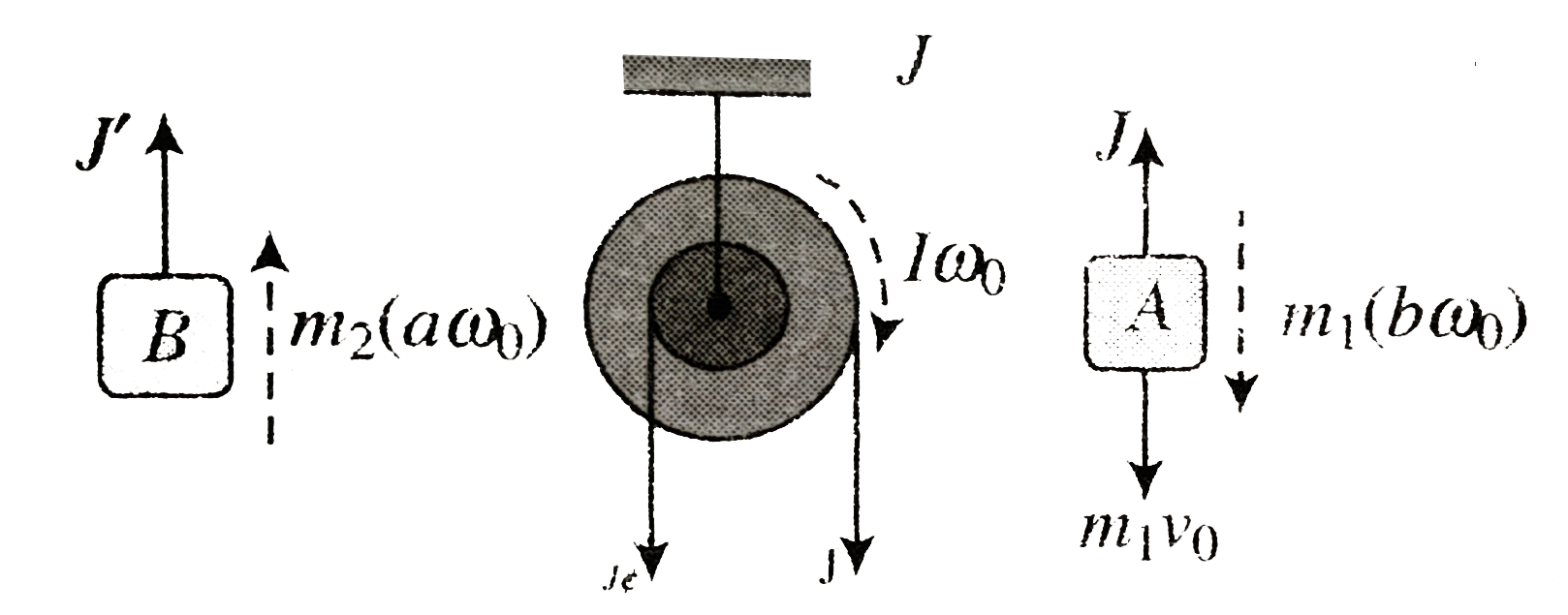 For block `B, J'=m_(2)aomega_(0)` `m_(1)v_(0)-J=m_(1)bomega_(0)` For block `A, J.b-J'.a=Iomega_(0)` From i, ii and iii `J'=6.4Ns, J=4.8Ns` `omega_(0)=8rads^(-1)` Kinetic ennergy of the system. just after the thread becomes taut, `E=1/2m_(1)(bomega_(0))^(2)+1/2m_(2)(aomega_(0))^(2)=+1/2omega_(0)^(2)=9J` Loss of energy during the jerk `E_(0)-E=873/128J` |
|
| 39418. |
A bomb of 1 kg is thrown vertically up with speed 100 m/s. After 5 seconds, it explodes into two parts. One of mass 400 gm goes down with speed 25 m/s. What will happen to the other part just afterexplosion. |
|
Answer» Solution :After 5 sec, velocity of bomb V = u - gt `= 100-10xx5=50 m//s` `therefore` initial momentum before explosion `= 1xx50 KG ms^(-1)` From momentum conservation, `1xx50=-0.4xx25+0.6 v.` `therefore v.=100 m//s`, upwards. |
|
| 39419. |
Consider a collection of a large number of particles each with speed v. The direction of velocity is randomly distributed in the collection. What is the magnitude of the relative velocity between pairs in the collection |
| Answer» ANSWER :D | |
| 39420. |
A point object is placed at a distance of 12cm on the axis of a convex lens of focal length 10cm . On the other side of the lens, a convex mirror is placed at a distance of 10cm from the lens such that the image formed by the combination coincides with the object itself. What is the focal length of convex mirror? |
|
Answer» Solution :For convex lens `1/v-1/(-12)=1/10` i.e., v=60 cm i.e., in the absence of convex mirror. Convex lens will FORM the image `I_1` at a DISTANCE of 60cm behind the lens. Since the mirror is at a distance of 10cm from the lens `I_1` will be at a distance of 60-10=50 cm from the mirror, i.e., `MI_1=50 cm`  Now as the FINAL image `I_2` s formed at the object O itself, the rays after reflection from the mirror retraces its PATH i.e., rays on the mirror are INCIDENT normallly i.e., `I_1` is the centre of the mirror , so that `R=MI_1=50 cm and ` hence `F=(R//2)=(50//2)=25 cm` |
|
| 39421. |
Choose the wrong option |
|
Answer» Inertial mass is a measure of difficulty of ACCELERATING a body by an external force whereas the gravitational force on it by an external mass |
|
| 39422. |
Half the length of a 80cm long open glass tube of narrow bore is immersed in mercury vertically. The open end of the tube is then closed and it is raised upwards so that a column of mercury of length 23 cm remains inside the tube.What is the atmospheric pressure? |
|
Answer» |
|
| 39423. |
An open knife edge of mass M is dropped from a height h on wooden floor. If the blade penetrates a distance s into the wood, the average resistance offered by the wood to the blade is |
|
Answer» MG |
|
| 39424. |
A particle whose initial mass is m_(0) is projected vertically at time t= 0 with speed gT, where T is a constant. At time t the mass of the particle has increased to m_(0)e^(t//T). If the added mass is at rest relative to particle when it is acquired The mass of the particle at its highest point is |
|
Answer» `4m_(0)` |
|
| 39425. |
A particle whose initial mass is m_(0) is projected vertically at time t= 0 with speed gT, where T is a constant. At time t the mass of the particle has increased to m_(0)e^(t//T). If the added mass is at rest relative to particle when it is acquired Find the instant 't' at which the particleis highest point |
|
Answer» 2T LN(2) |
|
| 39426. |
Four identical hollow cylindrical columns of mild steel support a big structure of mass 50,000 kg. The inner and outer radii of each column are 30 and 60 cm respectively. Assuming the load distribution to be uniform, calculate the compressional strain of each column. |
|
Answer» Solution :Here, `Y=2.0xx10^(11)PA`, Mass (M) = 51,000 kg. inner radius, `r_(1)=30CM= 0.3 m` Outer radius, `r_(2)=60cm = 0.6m` Force acting on each columns, `F=(Mg)/(4)=(50,000 xx 9.8)/(4)=122500N` Area of corss-section of each column, i.e., `A=pi r_(2)^(2)-pi r_(1)^(2)` `=pi (r_(2)^(2)-r_(1)^(2))=3.14(0.36-0.09)=0.85m^(2)` COMPRESSIONAL stress on each column, `(F)/(A)=(122500)/(0.85)=1.44xx10^(5)Pa "As Y"=("stress")/("strain")`, strain (compressional) `=("stress(compressional)")/(Y)(or) (1.44xx10^(5))/(2.0xx10^(11))=7.2xx10^(-7)` |
|
| 39427. |
Two identical rods each of moment of inertia T about a normal axis through centre are arranged in the from of a cross. The M.I. of the system about an axis through centre and perpendicular to the plane of system is: |
|
Answer» 2I |
|
| 39428. |
Assertion: In forced oscillations, th steady state motion of the particle is simpl harmonic. Reason: The frequency of particle after the free oscillations die out, is the natural frequency of the particle. |
|
Answer» If both ASSERTION and reson are TRUE and reason is the correct explanation of assertion |
|
| 39429. |
Consider a planet moving in an elliptical orbit round the sun. The work done on the planet by the gravitational force of the sun (a) is zero in any small part of the orbit (b) is zero in some parts of the orbit (c) is zero in one complete revolution (d) is zero in no part of the motion |
|
Answer» only a & C are TRUE |
|
| 39430. |
A gun of mass 20 kg has bullet of mass 0.1 kg in it. The gun is free to recoil and 804 J of recoil energy is released on firing the gun. The speed of bullet (in m s^(-1)) is |
|
Answer» `SQRT(804 xx 2010)` |
|
| 39431. |
An ideal gas of adiabatic exponent gammais expanded so that the amount of heat transferred to the gas is equal to the decrease of its internal energy. Then the equation of the process in terms of the variable T and V is |
|
Answer» `TV^((gamma -1)/(2)) = C ` |
|
| 39432. |
A force of 5 xx 10^(3) N is applied tangentially to the upper face of a cubical block of steel of side 30 cm. Find the displacement of the upper face relative to the lower one, and the angle of shear. The shear modulus of steel is 8.3 xx 10^(10) pa. |
|
Answer» SOLUTION :Area A of the upper face = `(0.30)^(2) m^(2)` The displacement `Deltax` of the upper face relative to the lower one is given by `Deltax=(YF)/(etaA), :.eta=(F/A)/(Deltax//y)` `(0.30xx5xx10^(3))/(8.3xx10^(10)xx(0.30)^(2))=2xx10^(-7)` m  `:.` ANGLE of shear `alpha ` is given by TAN`alpha= (Deltax)/(y)` `alpha=tan^(-1)((Deltax)/(y))` = `tan^(-1)((2xx10^(-7))/(0.30))=tan^(-1)(0.67xx10^(-6))` |
|
| 39433. |
A side view of a simplified form of vertical latch B is as shown . The lower member A can be pushed forward in its horizontal channel . The sides of the channels are smooth , butat the interfaces of A and B , which are at 45^(@) with the horizontal , there exists a static coefficientof friction mu = 0.4 . what is the minimum force F ( in N) that must be applied horizontally to A to start motion of the latch B upwards if it has a mass m =0.6 kg ? |
| Answer» ANSWER :C | |
| 39434. |
At which point (place) particle executes SHM have maximum kinetic energy and maximum potential energy? |
| Answer» Solution :At the equilibrium point (mean POSITION) the have MAXIMUM KINETIC energy and maximum POTENTIAL energy? | |
| 39435. |
Water venturimeter works on the principle of ………… . |
|
Answer» Newton's third LAW of motion |
|
| 39436. |
State Hooke's law of elasticity. |
|
Answer» Solution :Hooke.s low is for a small deformation, when the stress and strain are proportional to each other. it can be verified in a simple way by stretching a thin straight wire (stretches like spring) of LENGTH L and UNIFORM cross sectional area A suspended from a fixed point O. A pan and a pointer are attached at the free and of the wire. The extension produced on the wire is measured using a vernier scale arrangement. the experiment shows that for a given load, the corresponding stretching force is F and the elongation produced on the the wire is`DeltaL`. It is directly proportional to the original length L and inversely proportional to the area of cross section A. A graph is plotted using F on the x-axis and `DeltaL`on the y-axis. Therefore, `DeltaL = ("slope")F` Multiplying and dividing by volume, `V = AL` `F("slope") = (AL)/(AL)` Rearranging, we get `F/A = (L/(A("slope")))(DeltaL)/(L)` Therefore, `F/A prop ((Delta L)/(L))` Comparing with stress and strain equations, `sigma prop epsilon`. I.e., the stress is proportional to hte strain in the elastic limit.  Stress- strain profile curve : The stress versus strain profile is a plot in which stress and strain are noted for each load and a graph is drawn taking strain along the X- axis and stress along the Y- axis. The elastic characteristics of the materials can be analysed from the stress -strain profile. (a) Portion OA: in this reason, stress is very small such that stress is proportional to strain, which means Hook.s law is valid. The point A is called limit of proportionality because above this point Hook.s law is not valid. The slope of the line OA gives the Young.s modulus of the wire. (b) Portion AB: the reason is reached if the stress is increased by a very small amount. In this reason, stress is not proportional to the strain. But once the stretching force is hence, the point B is known as yield point (elastic limit). The elastic hebaviour of the material (here wire) in stress-strain curve is OAB. (c ) Portion BC: if the wire is stretched beyond the point B (elastic limit), stress increases and the wire will not regain its original length after the REMOVAL of of stretching force. (d) portion CD: with further increase in stress (beyond the point C), the stress increases rapidly and reaches the point D. Beyond D, the strain increases even when the load is REMOVED and brakes (raptures) at the point E. Therefore the maximum stress (here D) beyond which the wire breaks is called breaking stress tensile strength. The corresponding point D is known as the fracture point. The reason BCDE represent the plastic . 
|
|
| 39437. |
If the unit of length is 4m and that of velocity is 6ms^(-1), the unit of time is (in second) |
|
Answer» `2//3` |
|
| 39438. |
Which of the following examples represent (nearly) simple harmonic motion and which represent periodic but not simple harmonic motion ? (a) The rotation of earth about its axis. (b) Motion of an oscillating mercury column in a U tube, (c) Motion of a ball bearing inside a smooth curved bowl, when released from a point slightly above the lower most position.(d) General vibrations of a polyatomic molecule about its equilibrium position. |
|
Answer» Solution :(a) It is PERIODIC but not S.H.M. because it is not to and fro motion about a fixed POINT. (b) It is S.H.M., (c) It is S.H.M. (d) It is a periodic but not S.H.M. A POLYATOMIC gas molecule has a number of NATURAL frequencies and its GENERAL motion is the resultant of S.H.Ms. of a number of different frequencies. The resultant motion is periodic but not S.H.M. |
|
| 39439. |
In the given figure graph B shows the variation of potential energy versus atomic separation (r) in a material. Argue qualitatively to show that if the potential energy graph was a symmetrical one as depicted in graph A, there would have been no thermal expansion on heatin |
| Answer» | |
| 39440. |
Imagine a light planet revolving around a very massive star in a circular orbit of radius .r. with a period of revolution T On what power of .r. will the square of time period depend on the gravitational force of attraction between the planet and the star is proportional to r^(-5//2) |
|
Answer» Solution :The RESULTANT gravitational force PROVIDES NECESSARY centripetal force `(mV^2)/R=(K)/(r^(5//2))impliesV^(2)=K/(mr^(3//2))` So that `T = (2pir)/V=2pirsqrt(("mr"^(3//2))/K)` So `T^(2) prop r^(7//2)` |
|
| 39441. |
Let V and E be the gravitational potential and gravitational field strength. Then, select the correct option (s). (r is distance from the centre ) |
|
Answer» The plot of V versus R is continous for a spherical shell |
|
| 39442. |
Pressure exerted by a perfect gas is equal to …………….. . |
|
Answer» MEAN K.E . PER UNIT volume. |
|
| 39443. |
When a body is moving vertically up with constant velocity under the action of a lifting force an air resistance is absent. |
|
Answer» |
|
| 39444. |
In the case of uniform circular motion, the velocity and the acceleration are perpendicular to each other. |
|
Answer» |
|
| 39445. |
Define Root mean square speed . |
| Answer» SOLUTION :Root MEAN SQUARE speed is defined as the square root of the mean of the square of speeds of all MOLECULES. | |
| 39446. |
Two particles of masses Ikg and 3kg have position vectors 2hati+ 3hatj +4hatK and -2hati +3hatj - 4hatk respectively. The centre of mass has a position vector |
|
Answer» `hati+3hatj-2hatk` |
|
| 39447. |
Frictional force between two bodies |
|
Answer» ADDS the motion between the bodies |
|
| 39448. |
Keeping the volume constant, the pressure of the gas is increased by 10% of its original value by increasing the temperature from 27^(0) C. Find the final temperature. |
|
Answer» Solution :Initial PRESSURE of the gas `(P_(1)) = P ` Final pressure of the gas `(P_(2)) = (110)/(100)` P Initial temperature `t_(1)^(0) C = 27^(0)` C `T_(1) = 27 + 273 = 300` K Final temperature `t_(2)^(0) C `= ? At constant volume, according to Charles law `(P_(1))/(T_(1)) = (P_(2))/(T_(2))` `T_(2) = (P_(2))/(P_(1)) T_(1) = (110P//100)/(P) XX 300 = 330` `t_(2) = 330 - 273 = 57^(0)` C |
|
| 39449. |
A particle of mass 2 kg executing SHM has amplitude 10 cmand time period is 1 s.Find (i) the angular frequency (ii) the maximum speed (ii) the maximum acceleration (iv) the maximum restoring force (v) the speed when the displacement from the mean position is 8 cm (vi) the speed after (1)/(12) s the particle was at the extreme position (vii) the time taken by the particle to go directly from its mean position to half the amplitude (viii) the time taken by the particle to go directly from its exterme position to half the amplitude. |
|
Answer» Solution :Given, `m=2KG` , amplitude A=10cm , T=1 s `(i) omega=(2pi)/(T)=2pis^(-1)=6.28 s^(-1)` (ii) `v_("max")=Aomega=(10 cm)(2pis^(-1))=0.628 MS^(-1)` `(iii)a_("max")=Aomega^(2)=(10 cm)(2 pis^(-1))^(2)=4 ms^(-2)""("take" , pi^(2)=10)` (vi) `F_("max")=ma_("max")=mAomega^(2)=(2kg)(4 ms^(-2))=8N` (v) `v=omegasqrt(A^(2)-x^(2))=(6.28 s^(-1))sqrt((10 cm)^(2)-(8 cm)^(2))` `=(6.28 s^(-1))(6 cm)` =37.68 cm/s (vi) Suppose `x=A"cos"omegat`, then the particle will be at the extreme position at TIME t=0, `v=-Aomega"sin"omegat` `therefore " At "t=(1)/(12) s, v=-(10 cm)(6.28 s^(-1))"sin"(2pis^(-1).(1)/(12)s)` `=(6.28 cms^(-1))"sin"(pi)/(6)=-31.4 cms^(-1)` Negative sign INDICATES that velocity is directed towards the mean position if the particle startsto the move from the extreme right. (vii) When time is taken from the mean position, we take `x=A"sin"omegat` Suppose, the particle REACHES `x=+(A)/(2)` , at time t, then `(A)/(2)=A"sin"omegatimplies"sin"omegat=(1)/(2)implies omegat=(pi)/(6) s` or , `t=(pi)/(6 omega)=(pi)/(6xx2pi//T)=(T)/(12)=(1 s)/(12)` (viii) When time is taken from the extreme position , we take `x=A"cos"omegat` At t=0, x=A, i.e., the particle is at the extreme right Suppose at time t, the particle reaches `x=(A)/(2)`, then `(A)/(2)=A"cos"omegat` `implies"cos"omegat=(1)/(2)impliesomegat=(pi)/(3)` or `t=(pi)/(3omega)=(pi)/(3((2pi)/(T)))=(T)/(6)=(1)/(6)s` |
|
| 39450. |
State conservation of angular momentum. |
| Answer» Solution :The law of CONSERVATION of angular MOMENTUM states when no external torque acts on the BODY, the net angular momentum of a rotating rigid body REMAINS constant. | |