

Saved Bookmarks
| 1. |
A pulley of radius b=20 cm is fixed with a shaft of radus a=10 cm. Moment of inertia of shaft puley system is I=(33-800)kgm^(2) and the system is free to rotate about axis O of the shaft without friction. A block B of mass m_(2)=8 kg is resting over ann ideal spring of force costant. K=2048Nm^(-1) Lower end of the spring is fixed to the floor and the spring is vertical. Thread connected betwen shaft and block B is just taut. Another thead is connected between pulley and block A of mass m_(1)=4 kg. Initially this thread is loose. When block A is released first it falls freely through a height h=405/1024m then the thread becomes taut and block B is jerked into motion. calculate: a. Initial compressiion of the spring b. Velocity of block B when it is jerked into motion, c. Loss of energy during that jerk (g=10 ms^(-2)) |
|
Answer» Solution :Since initially thread connected with block `A` is loose, therefoe weight block `B` is balanced by compressive force in the spring. `ky_(0)=mgimpliesy_(0)=(mg)/K80/2048m` `=y_(0)=1.25/32m` or `125/32cm` Since block `A` first fall freely through HEIGHT `h`, THEREFORE, it acquires a velocity `v_(0)=sqrt(2gh)` just before the thread becomes taut. Now the thread becomes taut and a impulse is developed in it. Due to htis impulse pulley is jerked into rotational MOTION and block `B` vertically upwards. Therfore wil not be impulse in spring as spring force is not an impulsive force. let impulses developed in threads connected with blocks `A` and `B` be `J` and `J'` respectively and let the pulley start to rotate clockwise with angular velocity `omega_(0)` then velocities of blocks `A` and `B` will be `bomega_(0)` (downwards) and a `omega_(0)` (upwards) respectively. Cosidering impulses and moment a as shown in the figure. 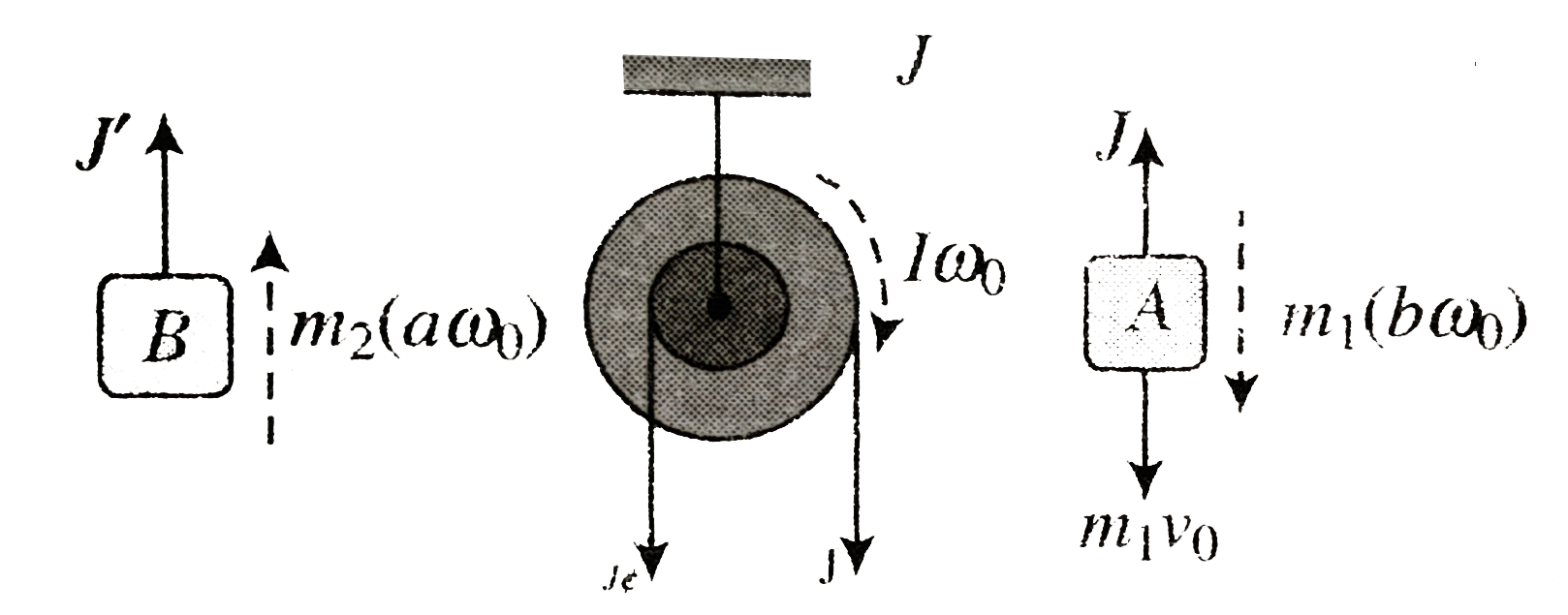 For block `B, J'=m_(2)aomega_(0)` `m_(1)v_(0)-J=m_(1)bomega_(0)` For block `A, J.b-J'.a=Iomega_(0)` From i, ii and iii `J'=6.4Ns, J=4.8Ns` `omega_(0)=8rads^(-1)` Kinetic ennergy of the system. just after the thread becomes taut, `E=1/2m_(1)(bomega_(0))^(2)+1/2m_(2)(aomega_(0))^(2)=+1/2omega_(0)^(2)=9J` Loss of energy during the jerk `E_(0)-E=873/128J` |
|