

Saved Bookmarks
This section includes InterviewSolutions, each offering curated multiple-choice questions to sharpen your knowledge and support exam preparation. Choose a topic below to get started.
| 39501. |
The diameters of open and narrow ends of a pipe connected to a venturi-meter is 20 cm and 15 cm, respectively. If the difference of pressure at the ends is 25 cm of Hg, then calculate the volume of water flowing through the pipe per second. |
|
Answer» |
|
| 39502. |
Answer the following question : Time period of a particle in SHM depends on the force constant k and mass m of the particle: T=2pisqrt(m/k). A simple pendulum executes SHM approximately. Why then is the time period of a pendulum independent of the mass of the pendulum? |
| Answer» SOLUTION :For a simple pendulum, K itself is proportional to m, so m CANCELS out | |
| 39503. |
Some of the most profound statements on the nature of science have come from Albert Einstein, one of the greatest scientists of all time. What do What do you think did Einstein mean when he said : ''The most incomprehensible thing about the world is that it is comprehensible ''? |
|
Answer» Solution :The physcial world, when SEEN by a layman, presents us with such a wide diversity of things. It seems incomprehensible, i.e., as if it cannot be understood. On study and analysis, the scinetists FIND that the PHYSICAL phenomene from atomic to astronomical RANGES can be usderstood in terms of only a few basic CONCEPTS, i.e., the physcial world becomes comperhensible. This is what is meant by Einstein's statement made above. |
|
| 39504. |
When a satellite is lifted from a lower orbit to a higher orbit a) Gravitational potential energy increases b) KE decreses c) Gravitational PE decreases d) KE increases |
|
Answer» a is only CORRECT |
|
| 39505. |
In gravity-free space, a particle is in contact with the inner surface of a hollow vertical cylinder and moves in horizontal circular path along the surface. There is some friction between the particle and the surface. The retardation of the particle is |
|
Answer» zero |
|
| 39506. |
The force Which acts in order to oppose the relative motion of the layer is known as _______ force. |
|
Answer» STATIC FRICTION |
|
| 39507. |
For example, if you, by habit, always hold your head a bit too far to the right while reading the position of a needle on the scale, you will introduce an error called as |
|
Answer» RANDOM errors |
|
| 39509. |
There is a small air bubble inside a glass sphere of radius 10cm. The bubble is 4cm below the surface and is viewed normally from the outside. The apparent depth of the bubble is |
|
Answer» 3CM below the SURFACE |
|
| 39510. |
If a force F is applied on a body and the body moves with velocity V the power will be |
| Answer» ANSWER :A | |
| 39511. |
If the mass of the electron (9xx10^(-31)kg) is taken as unit of mass, the radius of the first Bohr orbit (0.5xx10^(-10)m) as unit of length and 500 newton as the unit of force, then the unit of time in the new system would be |
|
Answer» `3 xx 10^(-22) s ` |
|
| 39512. |
An ideal gas (C_p//C_V =gamma) is taken through a process in which the pressure and the volume vary as P=aV^b.Find the value of b for which the specific heat capacity in the process is zero. |
| Answer» SOLUTION :`- GAMMA` | |
| 39513. |
A vessel of volume 'V' is half filled with a liquid of density '2d' and coefficient of apparent expansion 'x' and the other half is filled with another liquid of density 'd' but coefficient of apparent expansion '2x'. The temperature is raised through 2^(@) C, the mass of the liquid expelled out |
|
Answer» `9V XX d` |
|
| 39514. |
Which of the following units could be associated with a scalar quantity ? |
| Answer» Answer :C | |
| 39515. |
The Young's modulus of the material of a wire is Y.If the radius of the wire is doubledthe Young's modulus of the new wire will be. |
|
Answer» Y |
|
| 39516. |
A block of mass m is lowered with the help of a rope of negligible mass through a distance d with an acceleration of g/3.Work done by the rope on the block is |
|
Answer» `(2Mgd)/(3)` |
|
| 39517. |
A simple pendulum of length L_(1) has a time period T_(2) then the time period of pendulum of length (L_(1)+L_(2)) is |
|
Answer» `T1+T2` |
|
| 39518. |
One car moving on a straight road covers one third of the distance with 20 km/hr and the rest with 60 km/hr. The average speed is |
| Answer» Answer :D | |
| 39519. |
The position ofa particle is given byr=3.0hati-2.0t^(2)hatj+4.0hatkmwhere t is in seconds and the coefficients have proper units for r to be inmetres . (a)Find the v and a of the particle ? (b)What is the magnitude and direction of velocity of the particle at t=2.0s ? |
|
Answer» (b) `8.54 " ms "^(-1),70^(@)` with X - AXIS. |
|
| 39520. |
Two wires of same material and same length but diameters in the ratio 2:3 are stretched by the same length. The ratio of the forces applied on two wires is ---- |
|
Answer» `4:3` |
|
| 39521. |
Keeping the number of the moles,volume and tempreture the same,which of the following are the same for all ideal geases? |
|
Answer» RMS SPEED of a MOLE |
|
| 39522. |
In the previous question, if dv//dt = 0, then the angular acceleration of the ladder when alpha= 45^@ is. |
|
Answer» `2 V^(2) L^(2)` 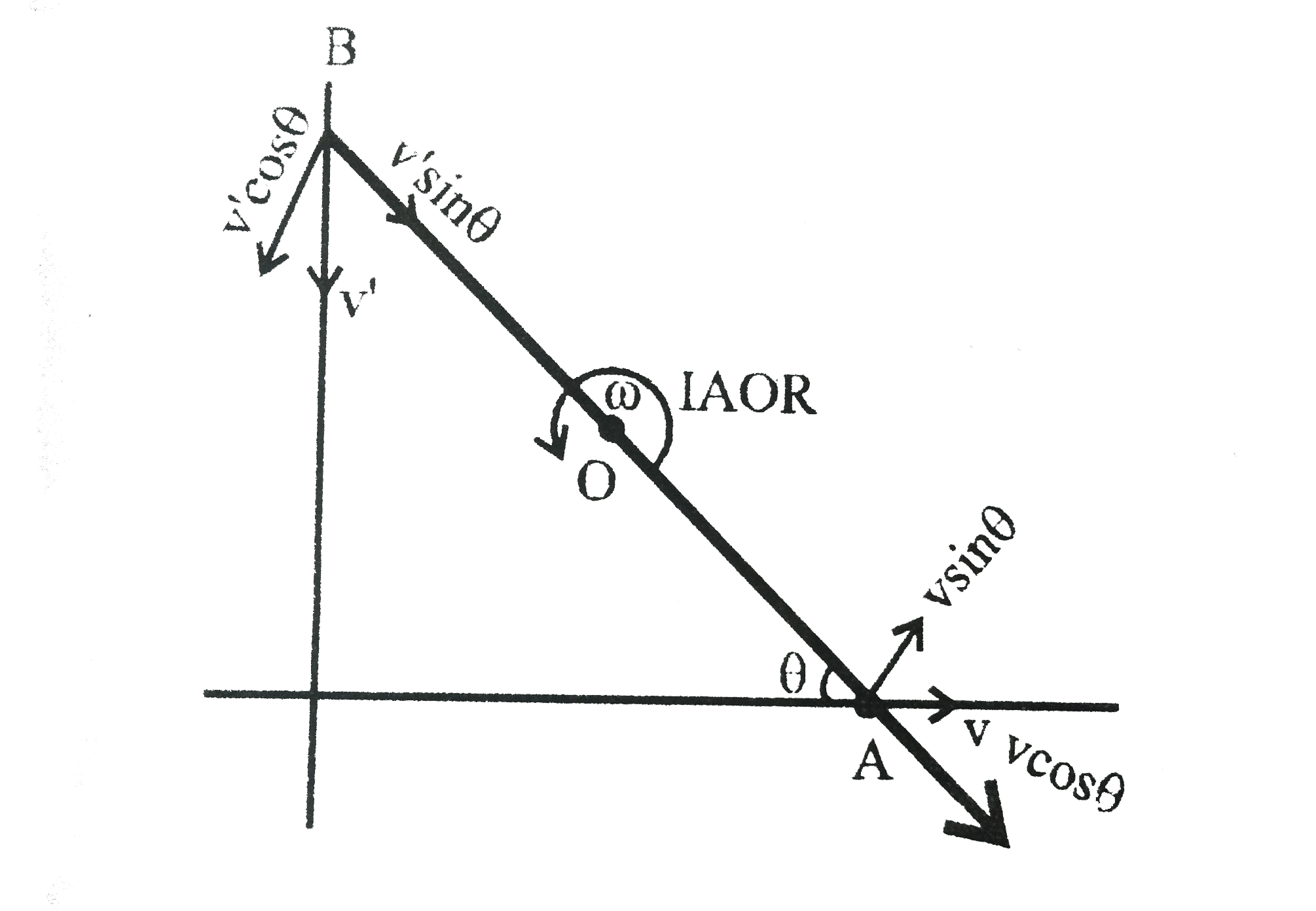 `v' sin theta = v cos theta`….(1) let INSTANTANEOUS axis of rotation is at distance `l` from END `A`. `omega = (v sin theta)/(l) = (v' cos theta)/((L-l))` ....(2) from (1) & (2) `omega = (v sin theta)/(l) = (v cos^(2) theta)/(sin theta (L - l))` `l = L sin^(2) theta`... (3) from (2) & (3) `omega = (v cosec theta)/(L)` `(d omega)/(DT) = (v)/(L) (-cos ec theta. cot theta) xx (d theta)/(dt)` `(d omega)/(dt) = (v)/(L) (-cos ec theta. cot theta) xx (v)/(L) cos ec theta` `ALPHA = - (v^(2))/(L^(2))cos ec^(2) theta. cot theta` `alpha = - (v^(2))/(L^(2)) cos ec^(2) 45^@. cot 45^@ rArr alpha = -(2v^(2))/(L^(2))`. |
|
| 39523. |
You are riding in an automobile of mass 3000 kg. Assuming that you are examining the oscillation characteristics of its suspension system. The suspension sags 15cm when the entire automobile is placed on it. Also, the amplitude of oscillation decreases by 50% during one complete oscillation. Estimate the values of (a) the spring constant k and (b) the damping constant b for the spring and shock absorber system of one wheel, assuming that each wheel supports 750 kg. |
|
Answer» SOLUTION :`F= mg = 3000 xx 10 = 3 xx 10^(4) N. X =-15 x× 10^(-2) m` 4 springs in parallel K=4K, F=-(4K) x. `K= -(F)/(4x)= (-3 xx 10^(4))/(4(-15xx 10^(2)))= 5 xx 10^(4) N//m` b) mass supported by each spring`m = (3000)/(4)= 750 Kg` damped oscillations amplitude `A_(t)= Ae^(-bt//2m)` time period `T= 2pisqrt((m)/(K))= 2 xx 3.14 sqrt((750)/( 5XX 10^(4)))= 77xx 10^(-2) "seconds"` Amplitude decreases by 50% then `At =A//2` and t = T `:. (A)/(2)= Ae^(-bt//2m)` or `b= (0.693 xx 2m)/(T)` `b= 1350 kg//s` |
|
| 39524. |
For the damped oscillator shown in Fig. 14.19, the mass m of the block is 200 g, k = 90 N m^(-1) and the damping constant b is 40 g s^(-1). Calculate (a) the period of oscillation, (b) time taken for its amplitude of vibrations to drop to half of its initial value, and (c) the time taken for its mechanical energy to drop to half its initial value. |
|
Answer» Solution :(a) We see that KM = `90x×0.2 = 18 kg Nm^(-1)=kg^(2)s^(-2),` therefore `sqrt(km)=4.243kgs^(-1)`, and `b = 0.04 kg s^(-1)`. Therefore, b is much less than `sqrt(km)` . Hence, the TIME period T from Eq. (14.34) is given by `T=2pisqrt(m/k)` `=2pisqrt((0.2kg)/(90Nm^(-1)))` = 0.3 s (b) Now, from Eq. (14.33), the time, `T_(1//2)`, for the AMPLITUDE to drop to half of its initial value is given by `T_(1//2)=("ln"(1//2))/(b//2m)` `=(0.693)/(40)xx2xx200s` `=6.93s` (c) For calculating the time, `t_(1//2)`, for its mechanical energy to drop to half its initial value we make use of Eq. (14.35). From this equation we have, `E(t_(1//2)//E(0)=exp(-bt_(1//2)//m)` Or `1//2=exp(-bt_(1//2)//m)` `"ln"(1//2)=-(bt_(1//2)//m)` Or `t_(1//2)=(0.693)/(40gs^(-1))xx200g` =3.46 s This is just half of the DECAY period for amplitude. This is not surprising, because, according to Eqs. (14.33) and (14.35), energy depends on the square of the amplitude. NOTICE that there is a factor of 2 in the exponents of the two exponentials. |
|
| 39525. |
The mass and diameter of a planet are two times those of earth. If a seconds pendulum is taken to it, the time period of the pendulum is seconds is |
|
Answer» `(1)/(SQRT(2))` |
|
| 39526. |
Force (5, 6, 7) N acts on a particle with position vector (2, 2, 1) m. The magnitude of phi torque on the particle will be ………. Nm. |
|
Answer» `sqrt(13)` `=|(2,2,1)xx(5,6,7)|` `=|(2,2,1)xx(5,6,7)|` `=|hati(14-6)-HATJ(14-5)+hatk(12-10)|` `=|8hati-9hatj+2hatk|` `=sqrt((8)^(2)+(-9)^(2)+(2)^(2))` `=sqrt(64+81+4)` `=sqrt(149)` |
|
| 39527. |
A small mass is suspended by a string from the ceiling of a car. As the car accelerates at a rate 'a' the string makes an angle theta with the vertical. Then the tension in the string |
|
Answer» mg COS `theta` |
|
| 39528. |
The density of ice is x gm/cc and that of water is y gm/cc. what is the change in volume in ce, when m gm of ice melts ? |
|
Answer» M(y-x) |
|
| 39529. |
A closed container of volume 0.02 m^(3) contains a mixture of neon and argon gases at 27^(@)C temperature and 1.0 times 10^(5)N/m^(2) pressure. If the gram-molecular weight of neon and argon are 20 and 40 respectively, find the masses of the individual gases in the container. Assuming them to be ideal (R = 8.314 J/mol-K). Total mass of the mixture is 28 g. |
|
Answer» SOLUTION :Let m be the mass of the neon gas, then mass of argon will be 28 - m. NUMBER of moles of neon, `n_(1)=m/20` Number of moles of argon, `n_(2)=(28-m)/40` Now by IDEAL gas equation, we have PV = nRT Here `n=n_(1)+n_(2)=m/20+(28-m)/40, P=1.0 times 10^(5)N//m^(2)` `T=273+27=300K, V=0.02 m^(3)` `therefore (1.0 times 10^(5)) times 0.02=[m/20+((28-m))/40] times 8.314 times 300` After solving , we get m = 4.07 g , `""` Mass of neon gas = 4.07 g Mass of argon gas = 28 - m = 28 - 4.07 = 23.93 g |
|
| 39530. |
In a P-V diagram for an ideal gas (where P is along the y-axis and V is along the x-axis), the valueof the ratio, slope of the adiabatic curve/slope of the isothermal curve at any point will be: (where symbols have their usual meanings) |
| Answer» ANSWER :B | |
| 39531. |
Answer the following question : A man with a wristwatch on his hand falls from the top of a tower. Does the watch give correct time during the free fall ? |
| Answer» Solution :YES, the MOTION in the WRISTWATCH depends on spring action and has NOTHING to do with ACCELERATION due to gravity. | |
| 39532. |
When a spring is compresssed by 3 cm the potential energy stored in it is U. When it is compressed further by 3cm, the increase in potential energy is |
|
Answer» 4 U |
|
| 39533. |
Equal masof three liquid are keptin three identical cylindrical vessels A,B and C. The densities are rho_(A),rho_(B),rho_(C) will rho_(A)ltrho_(B)ltrho_(C). The force on the base will be |
|
Answer» MAXIMUM in VESSEL A |
|
| 39534. |
Show that veca.(vecbxxvec c) is equal in magnitude to the volume of the parallelopiped formed on the three vectors, veca,vecb and vec c |
|
Answer» Solution :Suppose `VEC(OA)=vecb,vec(OC)=vecc and vec(OE)=VECA` `vecb and vec c` are adjacent sides of parallelogram OABC Area of `squareOABC,vecS=vecbxxvecc` `:.Shatn=vecbxxvecc` where `HATN` unit vector perpendicular to plane form by `vecb and vecc and theta` is angle between `veca and vecS`. `:.veca.(vecbxxvecc)=veca.vecS [because vecbxxvecc=vecS]` `=aScostheta` `=(acostheta)S` `=hS""......(1)` where in `DeltaEOE., EE.=h=acostheta` Suppose VOLUME of parallelepiped OABCDEF is V. `:.V` = Area of `squareOABCxx` perpendicular (h) of parallelogram OABC from E `:. V=sh"".....(2)` From result (1) and (2) `veca.(vecbxxvecc)=V` |
|
| 39535. |
Calculate the ratio of electric and gravitational force between two protons. Charge of each proton is 1.6 xx 10^(-19)C, mass is 1.672 xx 10^(-27)kg and G= 6.67 xx 10^(-11) Nm^(2) kg^(-2). |
|
Answer» Solution :The electric force FE `(e^2)/(4piepsilon_(0)r^2)` The GRAVITATIONAL force `Fg = (Gm^2)/r^2` `:. (Fe)/(Fg)=1/(4piepsilon_(0))xxe^2/(m^2G) = 9XX10^(9)xx` `((1.6xx10^(-19))^2)/((9.1xx10^(-31))xx^(2) xx 6.67xx 10^(-11)) = 4.17 xx10^(42)` |
|
| 39536. |
For a simple pendulum, a graph is plotted between its kinetic energy (KE) and potential energy (PE) against its displacement d. Which one of the following represents these correctly? (Graphs are schematic and not frawn to scale) |
|
Answer»
|
|
| 39537. |
It is easier to stand on two legs than to stand on a single leg. Why? |
| Answer» Solution :A body REMAINS in stable equilibrium when the vertical line through its CENTRE of gravity remains well within its base. Equilibrium is disturbed when this vertical line falls outside the base. It is difficult to maintain the vertical line passing through ONE foot only. This reduces the stability while standing on one leg. Standing on two legs increases THEBASE area through which the vertical line is more likely to PASS and hence a higher stability of equilibrium is achieved. | |
| 39538. |
Define the term wave motion? |
| Answer» Solution :Wave motion is a kind of disturbances which travels through a MEDIUM due to REPEATED VIBRATIONS of the particles of the medium about their mean positions, the disturbance being handed over from one PARTICLE to the next. | |
| 39539. |
A particle is moving in a circle of radius R=1 m with constant speed v=4m//s. The ratio of the displacement to acceleration of the foot of the perpendicular drawn from the particle onto the diameter of the circle is |
| Answer» Answer :A | |
| 39540. |
A passing aeroplane sonetimes causes the rattling of the windows of a house.Why? |
| Answer» Solution :When the FREQUENCY of sound WAVES from the engine of an matches with the natural frequency of a window,resonance TAKES place which CAUSES the rattling of window. | |
| 39541. |
The angular frequency of a fan of moment of inertia 0.1kg m^(2) is increased from 30 rpm to 60 rpm when a torque of 0.03 Nm acts on it. Find the number revolutions made by the fan while the angular frequency is increased from 30 rpm to 60 rpm. |
|
Answer» SOLUTION :Work done `=(1)/(2)I(omega_(F)^(2)-omega_(i)^(2))` `tau theta=(1)/(2)I(omega_(f)^(2)-omega_(i)^(2))` `theta=(1)/(2)((I)/(tau))(omega_(f)^(2)-omega_(i)^(2))=(0.1)/(2xx0.03)((2pi)^(2)-pi^(2))=5pi^(2)` The number of revolutions, `(theta)/(2pi)=(5pi^(2))/(2pi)=(5pi)/(2)=7.855`REV |
|
| 39542. |
A hollow cylindrical shell of radius R has mass M. It is completely filled with ice having mass m. It is placed on a horizontal floor connected to a spring (force constant k) as shown. When it is disturbed it performs oscillations without slipping on the floor. (a) Find time period of oscillation assuming that the ice is tightly pressed against the inner surface of the cylinder. (b) If the ice melts into non viscous water, find the time period of oscillations. (Neglect any volume change due to melting of ice) |
|
Answer» (B) ` 2pi sqrt((2M +m)/(K))` |
|
| 39543. |
The acceleration of a particle is increasing linearly with time t as bt. The particle starts from the origin with an initial velocity v_0 . The distance travelled by the particle in time t will be |
|
Answer» `v_0t + 1/3 bt^2` |
|
| 39544. |
If the temperature of the Sun were to increase from T to 2T and its radius from R to 2R. The ratio of radiant energy received on earth to what it was previously will be. . . .. . . |
|
Answer» 4 `W=e SIGMA(4piR^(2))T^(4)(becauseA=4piR^(2))` `WpropR^(2)T^(4)` `:.(W_(2))/(W_(1))=((R_(2))/(R_(1)))^(2)((T_(2))/(T_(1)))^(4)` `=((2R)/(R))^(2)((2T)/(T))^(4)` `=4xx16=64` |
|
| 39545. |
A particle moves along a horizontal circle witrr constant speed. If 'a' is its acceleration and 'E' is its kinetic energy A) a is constant B) E is constant C) a is variable D) E is variable |
|
Answer» A & B are correct |
|
| 39546. |
Why are bridges declared unsafe after long use? |
| Answer» SOLUTION :Due to repeated stress and strain, the elastic strength of the bridge gets reduced. After a LONG time, thebridge DEVELOPS elastic fatigue and ULTIMATELY may collapse. | |
| 39547. |
The energy required to shift a satellite from oribital radius 'r' to radius 2r is E. What energy will be required to shift the satellite from orbital radius 2r to 3r? |
| Answer» Answer :D | |
| 39548. |
A balloon from rest accelerates uniformly upward with .a. ms^2, for it seconds of time. A stone is released from the balloon. Now read the following statements to pick the right ones. (a) The stones initial velocity is zero, relative to to ballon (b) The stone.s initial velocity is nonzero, relative to earth (c) The time taken to reach the ground from the balloon.s frame of reference is inversely proportional to sqrt(a+g) (d) The time take to reach the ground from earth.s frame of reference is directly proportional to sqrt(a+g). |
| Answer» Answer :A | |
| 39549. |
The heart of a man pumps 5 litre of blood through the arteries per minute at a pressure of 150 mm of mercury.If the density of mercury be 13.6 xx10^(3) kg//m^(3)and g = 10 m//s^(2) then the power of heart in watt is : |
|
Answer» <P>`1.50` Pressure P = 150 mm of Hg `RARR H = 150 xx10^(-3) m ` Power of heart ` = P (dv)/(dt)` ` = rho gh (dv)/(dt)` ` = 13.6 xx10^(3) xx10 xx150 xx10^(-3) xx (5xx10^(-3))/60` Power of heart` = 1700 xx 10^(-3) = 1.70 `WATT = 1.70 W |
|
| 39550. |
A vertically thrown up body reaches 20m at a place on the earth. The height to which it goes on the moon if projected with same velocity is [g_("moon")=(g_("earth"))/(6)] |
|
Answer» 40 m |
|


