

Saved Bookmarks
This section includes 7 InterviewSolutions, each offering curated multiple-choice questions to sharpen your Current Affairs knowledge and support exam preparation. Choose a topic below to get started.
| 1. |
A railway truck has its centre of gravity at a height of 1.2 m above the ground and the rails are 1.5 m apart. Calculate the maximum safe speed with which it could travels round an unbanked curve of radius 32 m. |
|
Answer» `v = sqrt(gr xx AD//CD) = sqrt(9.8 xx 32 xx 0.75//1.2) = 14 m//s` |
|
| 2. |
Which of the following graphs be. I represent the qualitative variation of the linear expansivity of a typical metal (say copper) with absolute temperature? |
| Answer» ANSWER :B | |
| 3. |
The internal volume of a glass flask is V cm^(3). What volume of mercury should be kept in the flask so that the volume of the empty space over mercury in the flask remains constant at all temperatures? Coefficient of volume expansion of mercury =1.8 times 10^(-4@)C^(-1) and coefficient of linear expansion of glass =9 times 10^(-6@)C^(-1). |
|
Answer» Solution :Let the required volume of mercury be x `cm^(3)`. To keep the volume of empty SPACE CONSTANT at all temperatures, the expansion of mercury should be equal to that of glass for the same rise in temperature. If the temperature rise is `t^(@)C,` `"" x times 1.8 times 10^(-4) times t=V times 3 times 9 times 10^(-6) times t` or, `""x=(V times 27 times 10^(-6))/(1.8 times 10^(-4))=27/180V=3/20V` `therefore 3/20th` part of the flask should be filled up with mercury. |
|
| 4. |
An inifinitely long wire bent at 90^(@) at point O shown in figure. Match the following. |
|
Answer» <P> |
|
| 5. |
Derive an expression for center of mass for distributed point masses. |
|
Answer» Solution :(i) Consider the point masses `m_(1), m_(2), m_(3), ... m_(n)` whose position COORDINATES from orgin O along X-direction are `x_(1), x_(2), x_(3),...x_(n)` as shown in FIGURE. (ii) The equation for the X COORDINATE of the center of MASS is, `x_(CM)=(sum m_(i)x_(i))/(sum_(m_(i))` where `sum m_(i)=M`, is the total mass of all the particles. (iii) Hence `x_(CM)= (sum m_(i)x_(i))/(M)` (iv) Similarly, the Y and Z coordinates of center of mass can be written as,. `y_(CM)=(sum m_(i)y_(i))/(M), z_(CM)=(sum m_(i)z_(i))/(M)` (v) The position of the center of mass of these masses is `(X_(CM), Y_(CM), Z_(CM))`. In general, the position of center of mass in vector form can be expressedas, `vecr_(CM)=(sum m_(i)vecr_(i))/(M)` where `vecr_(CM)=x_(CM)hati_y_(CM)hatj+z_(CM)hatk` is the position vector of the center of mass and `vecr_(i)=x_(i)hati+y_(i)hatj+z_(i)hatk` is the position vector of the distributed point mass. |
|
| 6. |
Which among the following possesses the highest specific heat capacity? |
|
Answer» Metals |
|
| 7. |
The ratio of radii of two soap bubbles is 4 : 9. Find the ratio of (i) excess pressure inside these bubbles (ii) work done to blow these bubbles. |
|
Answer» Solution :`R_(1)/R_(2)=4/9` T=Surface tension of solution Excess pressure inside bubble of radius `R_(1)` `P_(1)=(4T)/(R_(1))` Similarly, `P_(2)=(4T)/(R_(2))` `P_(1)/P_(2)=(4T)/(R_(1)) R_(2)/(4T)=R_(2)/R_(1)=9/4` Work done in blowing up soap bubble of radius R, `=W_(1)=2 XX 4 pi R_(1)^(2)T` Similarly, `W_(2)=2 xx 4PI R_(2)^(2) T` `W_(1)/W_(2)=R_(1)^(2)/R_(2)^(2)=(4/9)^(2)=(16)/(81)` |
|
| 8. |
A train of mas 6xx10^(2) metric tons is pulled by a loco-motive of mass 150 metric ton. The speed of the train is 54 kmph. The locomotive pulls the train on the level track. The force of friction on the locomotive and the train is 10 N per metric ton. Calculate the power of the locomotive. |
|
Answer» Solution :GIVEN, mass of TRAIN, `m_(1)=6xx10^(2)" METRIC tons"=6xx10^(2)xx10^(3) kg` Mass of locomotive, `m_(2)=150" metric tons"=150xx10^(3) kg` Force of friction= 10 N/metric ton. Speed of the train=54 kmph `=54xx5/18ms^(-1)=15ms^(-1)` TOTAL mass moving`=m_(1)+m_(2)=600+150=750" metric tons"=750xx10^(3)kg` Total frictional force, `f=(10N//"metric ton") 750" metric ton"=10xx750N=7500N` Power of engine = `fv=7500xx15W=1125xx100W=112.5 kW` |
|
| 9. |
A boat containing some pieces of material is floating in a pond. What will happen on the level of waer in the pond, if out unloading the pieces in the pond, the pieces (a) float (b) sink? |
|
Answer» Solution :If M is the mas of boat and m is the mass of pieces in it, then initially as the system in floating, `m+m=v_(D)rho_(w)` i.e. the system displaces water `V_(D)=M/(rho_(w))+m/(rho_(w))` ….1 When the pieces are dropped in the POND, the boat will still float, so it displaces water `M=V_(1)rho_(w)` i.e. `V_(1)=(M//rho_(w))` a. Now if the uploaded pieces floats in the pond, the water displaced by them `m=V_(2)rhio_(w)` i.e. `V_(2)=(m//rho_(w))` So the total water displaced by the boat and the floating pieces `V_(1)+V_(2)=M/(rho_(w))+m/(rho_(w))` .......2 which is same as the water displaced by the floating system initially (EQN, 1) so the LEVEL of waterin the pond will remain unchanged. b. NOw if the unloaded pieces sik the water displaced by them will be equal to their own volume, i.e. `V_(2)^(1)=m/(rho)""|"as" rho=m/V|` and so in this situation the total volume of water diaplced by boat and siking pieces will be `V_(1)+V_(2)^(1)=(M/(rho_(w))+m/(rho))` ........3 Now as the pieces are sinking `4hogtrho_(w)` so this volume will belesser than initial water displaced by the floating system (Eqn 1) so the level of water in the pond will GO down (or fall). |
|
| 10. |
A transparent cube of 15cm edge contains a small air bubble. Its apparent depth when viewed through one face is 6cm and when viewed through the opposite face is 4cm. Then the refractive index of the material of the cube is |
|
Answer» 2 |
|
| 11. |
Different pounts in the earth are at slightly different distances from the sun and hence experience different forces due to gravitation. For a rigid body, we know that if various forces act at various points in it, the resulant motion is as if net force acts on the CM (centre of mass) causing translation and a net torque at the CM causing rotation around an axis through the CM. For the earth-sun system (approximating the earth as a uniform density sphere) |
|
Answer» the torque is zero So, torque `|tau|=|r xx F|=rF sin 0^(@)=0` |
|
| 12. |
(A): If an ideal gas expands in vacuum in an insulated chamber, DeltaQ,DeltaU,DeltaW all are zero (R ): Temperature of gas remains constant |
|
Answer» Both (A) and(R ) are TRUE and (R ) is the correct EXPLANATION of (A) |
|
| 13. |
Choose the correct statement/statements related to uniform circular motion. The acceleration.in uniform circular motion is tangential to the circle. |
| Answer» SOLUTION :STATEMENTS | |
| 14. |
In equation (P+(a)/(V^(2)))=b (thetaA)/(V) pressure, V = volume, Q = absolute temp. a, b are constant. Find dimension of a |
|
Answer» `M^(1)L^(5)T^(-2)` `[(a)/(V^(2))]=[P]` `:.[a]=[P][V]^(2)` `=(M^(1)L^(-1)T^(-2)(L^(3))^(2)` `=M^(1)L^(-1)T^(-2)xxL^(6)=M^(1)L^(5)T^(-2)` |
|
| 15. |
A boy of mass 30kg is running with a velocity of "3 ms"^(-1) on ground just tangentially to a merry - go round which is at rest. It has radius R = 2m, a massess of 120 kg radius of gyration is 1m. If the boy suddenly jumpes on to the merry -go - round, the angular velocity acquired by the system is |
|
Answer» `1" RAD s"^(-1)` |
|
| 16. |
The viscosity of falling rain drops attains limited value, because of |
|
Answer» UPTHRUST of air |
|
| 17. |
For a vehicle moving on a banked curved road, using free body diagram (FBD), obtain the formula for the maximum safe speed v_(max). |
| Answer» SOLUTION :Bankedcurvedroadprovidemoremaximumsafespeed | |
| 18. |
What should be the velocity of a listener so that the apparent frequency of the sound coming from a stationary source to him will be twice the actual frequency ? Velocity of sound in air = v . |
|
Answer» Solution :APPARENT frequency, n. = (V = u_(o))/( v - u_(s)) xx n ` In this case apparent frequency higher , the LISTENER is approaching the source, i.e., velocity of the listener ` u_(o)` is positive . Again, ` n. = 2n ` . ` therefore 2n = (v+ u_(o))/(v) xx n " or " , 2V+ v + u_(o) " or " , u_(o) = v ` i.e., the listener is approaching the stationary source with the velocity of sound . |
|
| 19. |
A ball of massm and density rho is immersed in a liquid of density 3rho at a depth h and released. To what height will the ball jump up above the surface of liquid? (neglect the resistance of water and air). |
|
Answer» Solution :Volume of ball `V=(m)/(RHO)`, Acceleration of ball INSIDE the liquid `a=(F_("net"))/(m)=("upthrust - weight")/(m)=(((m)/(rho))(3rho)(G)-mg)/(m)` = 2g (upwards) `therefore` velocity of ball while reaching at surface `V=sqrt(2ah)=sqrt(4gh)` `therefore` The ball will jump to a HEIGHT `H=(v^(2))/(2g)=(4gh)/(2g)=2h` |
|
| 20. |
(A) Just before Sunset, the sun may appear to be elliptical ( R) Refraction of light rays through the atmosphere may cause different magnification in mutually perpendicular directions. |
|
Answer» Both A and R are true and R is the CORRECT explanation of A |
|
| 21. |
In pure rolling motion of a ring (a) it rotates about instantaneous point of contact of ring and ground (b) its centre of mass moves in translatory motion only (c ) its centre of mass will have translatory as well as rotatory motion |
|
Answer» only a is correct |
|
| 22. |
A man can swim with a certain spee, in still water to cross a river to a point directly opposite to the starting point in timet_(0). When the river flows. He crosses the river directly along the same path in a time t_(1).If 'd' be the river width, then the velocity of water current is |
|
Answer» `(d SQRT(t_(1)^(2)-t_(0)^(2)))/(t_(1)t_(0))` |
|
| 23. |
A ball is projected from the ground with velocity v such that its ranege is maximum. |
|
Answer» `therefore theta=45^(@)` and `H=(v^(2)sin^(2)45^(@))/(2g)=(v^(2))/(4g)` (a) Using, `v_(y)^(2)-u_(y)^(2)=2a_(y)Y` `v_(y)^(2)-(v^(2))/(2)=2(-g)(H)/(2)` `=-g((v^(2))/(4g))=-(v^(2))/(4)` `therefore v_(y)^(2)=(v^(2))/(4) rArr v_(y)=(v)/(2)` `therefore (a)rarr(p)` (b) At the maximum height, the ball has only horizontal velocity. `therefore v_(x)=(v)/sqrt(2)` `therefore (b)rarr(q)` (c) Horizontal velocity remains the same but the vertical velocity GETS reversed. `therefore Deltav_(y)=(v)/sqrt(2)-(-(v)/sqrt(2))=(2v)/sqrt(2)=vsqrt(2)` `therefore (c)rarr(r)` (d) `vecv_(AV)=(1)/(2)(vecv_(1)+vec_(f))` `=(1)/(2)[(v)/sqrt(2)(HATI+hatj)+(v)/sqrt(2)hati]` `=(1)/(2)[(2v)/sqrt(2)hati+(v)/sqrt(2)hatj]` `therefore |vecv_(av)|=(1)/(2)sqrt(((4v^(2))/(2)+(v^(2))/(2)))=(v)/(2)sqrt((5)/(2))` `therefore (d) rarr(s)` |
|
| 24. |
A satellite appears to be at rest when seen from the equator of the earth. The height of the satellite from the surface of the earth is |
|
Answer» 36000 km |
|
| 25. |
The temperature of 10 g nitrogen gas is increased from 20^(@)C to 120^(@)C (ii) at constant pressure. Find out the amount of heat supplied, increase in internalenergy and external work done in the case. For nitrogen c_(v) = 0.177 cal cdot g^(-1) cdot^(@)C^(-1) and c_(p) = 0.248 cal cdot g^(-1) cdot^(@)C^(-1). |
|
Answer» |
|
| 26. |
You can not get something for nothing. Do you think this statement is equivalent to any law of thermodynamics? |
| Answer» SOLUTION :YES, 1ST LAW of THERMODYNAMICS. | |
| 27. |
A ball is dropped on to a fixed horizontal surface from a height .h.. The coefficient of restitution is .e.. What is the average velocity of the ball from the instant it is dropped till it goes to maximum height after first impact with ground? |
|
Answer» |
|
| 28. |
The accelerating of particle varies with time as shown (a)Find an expression for velocity in terms of t.(b)Calculate the displacement of the particle in the interval from t=2s "to" t4s.Assume that v=0 at t=0 |
|
Answer» |
|
| 29. |
A string of length l hangs freely from a rigid support. The time required by a transverse pulse to travel from bottom to half length of the string is |
|
Answer» `SQRT(lg)` |
|
| 30. |
A ball of mass 400 gm is dropped from a height of 5m . A boy on the ground hits the ball vertically upwards with a bat with an average force of 100N so that it attains a vertical height of 20m . Find the time for which the ball remains in contact with the bat |
|
Answer» |
|
| 31. |
If a measured quantity has 'n' significasnt figures, the reliable digits in it are |
|
Answer» n |
|
| 32. |
A large horizontal surface moves up and down in SHM with an amplitude of 1 cm. If a mass of 10 kg (which is placed on this surface) is to remain constinuously in contact with it. The frequency of S.H.M should not exceed |
|
Answer» `0.5 HZ` |
|
| 33. |
The ring which can slide along the rod are kept at mid point of a smooth rod of length L. The rod is rotated with constant angular velocity omega about vertical axis passing through its one end. The ring is released from mid point. The velocity of the ring, when it just leaves the rod is = (sqrt(x))/(2)omegaL. Then x is equal to |
|
Answer» |
|
| 34. |
An empty luggage carrier A of mass M=40 kg slide without friction on horizontal floor hits with a velocity v_(0)=5ms^(-1) an identical carrier B containing m=15 mg suitacase. The impact causes the suitcase to slide on the floor of carrier B and collide with the left wall of carrier B. knowing that the coefficient of restitution between the two carriers is 0.80 and that the coefficient of restitution between the suitcase and the wall of carriere B is 2//9. Assume no friction any where. Find a. the velocities of carrier A and carrier B just after collision. b. the velocity of carrier B after the suitcase its the wall for the first time is |
|
Answer» Solution :Collision of carrier `A` with carriere `B`. Let velocities of carrier `A` and `B` just after collision be `v_(A) and v_(B)` respectively. `40xx5=40=40v_(A)+40v_(B)` `v_(A)+v_(B)=5`……….i Using Newton's RESTITUTION equation `v_(B)-v_(A) 0.8(5-0)`………ii `v_(B)-v_(A)=5` Solving eqn i and ii we get `v_(A)=1/2ms^(-1), v_(B)=9/2ms^(-1)` As there is no FRICTION the suitcase will no slide with RESPECT to carrier, hence velocity of suitcase with respect to the ground will be zero. Now collision of suitcase with carrier using C.O.L.M. 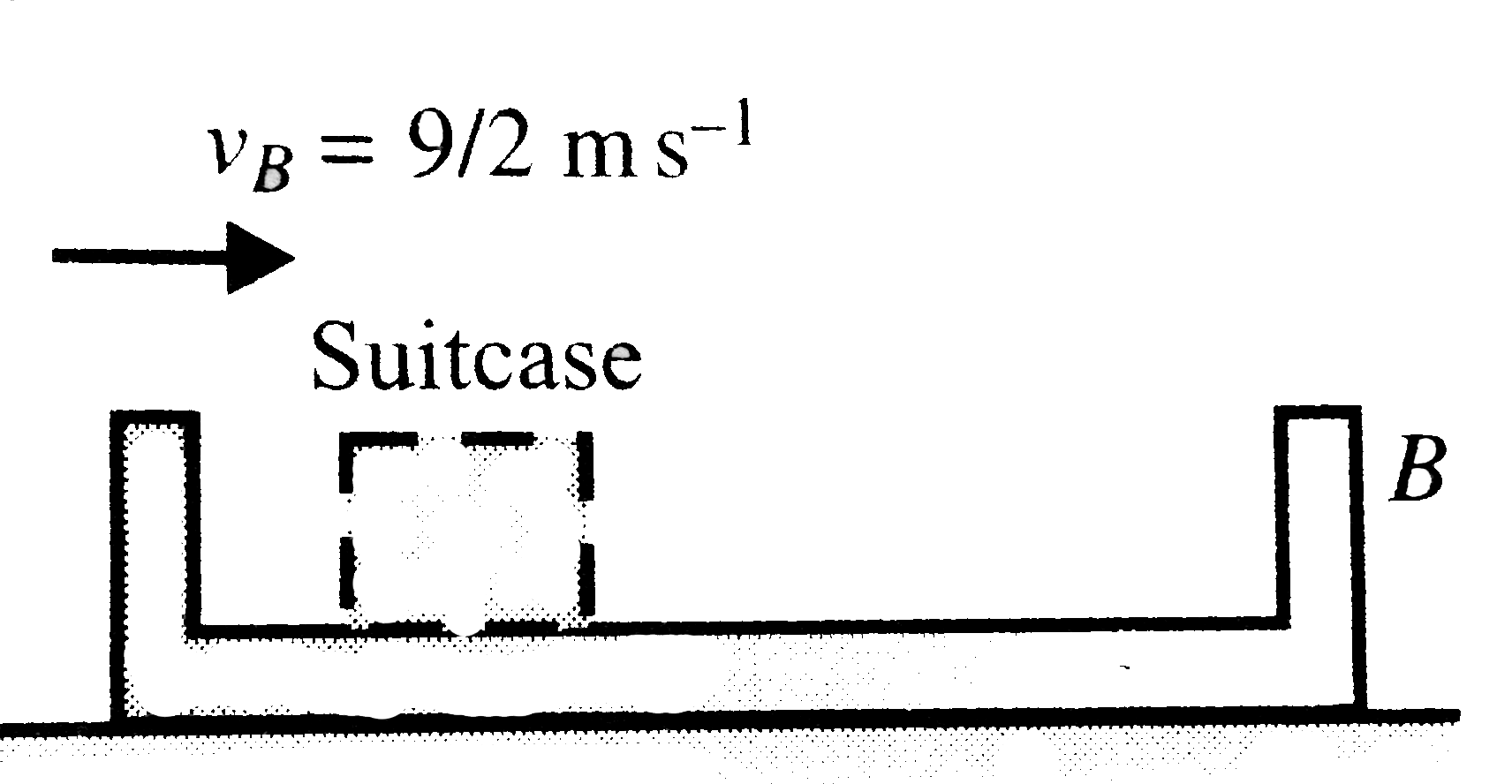 `40xx9/2+0=40v_(B)^(')+15v_(s)` Here `v_B^(')` and `v_(s)` are the velocities of carrier `B` and suitcase just after collision `180=40v_(B)^(')+15v_(s)` `36=8v_B^(')+3V_(s)` .............iii Using Newton's restitution equation ` V_(B)-V_(B)^(')=2/9(v_(B)-0)impliesv_(s)-v_(B)^(')=2/9(9/2-0)` `v_(s)-v_(B)^(')=1` After solving `v_(B)^(')=3MS^(-1)` and `v_(s)=4ms^(-1)` |
|
| 35. |
A stationary wheel starts rotating about its own axis at uniform angular acceleration 8 rad//s^(2). The time taken by it complete 77 rotation is |
| Answer» Answer :C | |
| 36. |
The X and Y - component ofvec (p)are 7hat(i) and 6hat(j). Also , the X and Y-components of vec(p)+vec(Q) are 11 hat(i) and 9 hat (j) respectively. Then magnitude of vec(Q) is : |
|
Answer» 7 |
|
| 37. |
Neglecting the density of air, the terminal velocity obtained by a raindrop of radius 0.3mm falling through air of viscosity 1.8xx10^(-5)Nsm^(-2) will be |
|
Answer» `10.9ms^(-1)` |
|
| 38. |
A rod of length l slided down along the inclined wall as shown in figure. At the instant shown in figure, the speed of end A is v, then the speed of B will be |
|
Answer» `(vsinbeta)/(SINALPHA)` |
|
| 39. |
The mass of oxygen gas occupying a volume of 11.2 litres at a temperature 27°C and a pressure of 760mm of mercury in kilograms is (Molecular weight of oxygen=32) |
|
Answer» `0.001456` |
|
| 40. |
How many significant digits are in 71450000? |
| Answer» SOLUTION :There are FOUR SIGNIFICANT DIGITS only. | |
| 41. |
Same force acts on two bodies of masses m_(1) and m_(2) (m_(2) gt m_(1)). After travelling the same distance |
|
Answer» Kinetic energy of `m_(2)` is greater than kinetic energy of `m_(1)` |
|
| 42. |
Two waves of the same frequency and intensity superimpose with each other in opposite phases . Then after superposition the ………….. . |
|
Answer» INTENSITY increases to four times |
|
| 43. |
A force vec(F)= 3 hat(j) acts on the rod at a point P(1,0,0). Here centre of rod is taken as origin. Then the torque about .O. is |
|
Answer» `3 HAT(K)` |
|
| 44. |
Four cars are moving along a straight road in the same direction. Velocity of car 1 is 10 m//s. It was found that distance between car 1 and 2 is decreasing at a rate of 2 m//s, whereas driver in car 4 observed that he was nearing car 2 at a speed of 8 m//s. The gap between car 2 and 3 is decreasing at a rate of3 m//s. (a)t = 0, after how much time t0 will the driver of car 2 see for the first time, that another car overtakes him? (b) Which car will be first to overtake car 1? |
|
Answer» (b) CAR 4 |
|
| 45. |
Starting with the same initial conditions, an ideal gas expands from volume V_(1) to V_(2) in three different ways. The work done by the gas is W_(1) if the process is purely isothermal, W_(2) if purely isobaric and W_(3) is purely adiabatic. Then |
|
Answer» `W_(2) GT W_(1) gt W_(3)` As work done by the gas = area under the P-V graph `because ("Area")_(2) gt ("Area")_(1) gt ("Area")_(3)` `:. W_(2) gt W_(1) gt W_(3)` 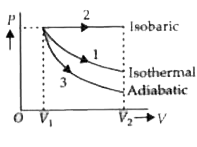
|
|
| 46. |
A car is driven round curved path of radius 18 m without the danger of skidding. The co-efficient of friction between the tyres of the car and the surface of the curved path is 0.5. What is the maximum speed in kmph of the car for safe driving nearly ? (g=10 ms^(-2)) |
|
Answer» `9.3` |
|
| 47. |
The function x=Asin^(2)omegat+Bcos^(2)omegat+Csinomegat cosomegat ore presents simple harmonic motion for which of the option ? |
|
Answer» for all VALUES of A , B & C `(Cne0)` |
|
| 48. |
Trajectory of particle in a projectile motion is given as y=x-(x^(2)//80). Here x and y are in meters. For this projectile motion match the following (g=10ms^(-2)) {:(" Column-I","Column-II"),("A) Angle of projection","P) "20 m),("B) Angle of velocity with horizontal after 4s","Q) 80 m"),("C) Maximum height","R) " 45^(@)),("D) Horizontal range","S) "tan^(-1)(1//2)),(,"T) "30^(@)):} |
|
Answer» |
|
| 49. |
A person is standing stationary at middle of a frozen lake on ice. By using Newton's first law of motion he can reach to bank of lake. |
|
Answer» |
|
| 50. |
A spherical planet (density = rho) of radius R has a spherical cavity of radius R/3, as shown (a) A small body is released at point P. How much time would it take to reach the lower surface of the cavity ? (b) A small body of mass m is placed at a distance 2R above point P, on the dotted line extended upwards. What force does the planet exert on the body ? |
Answer» 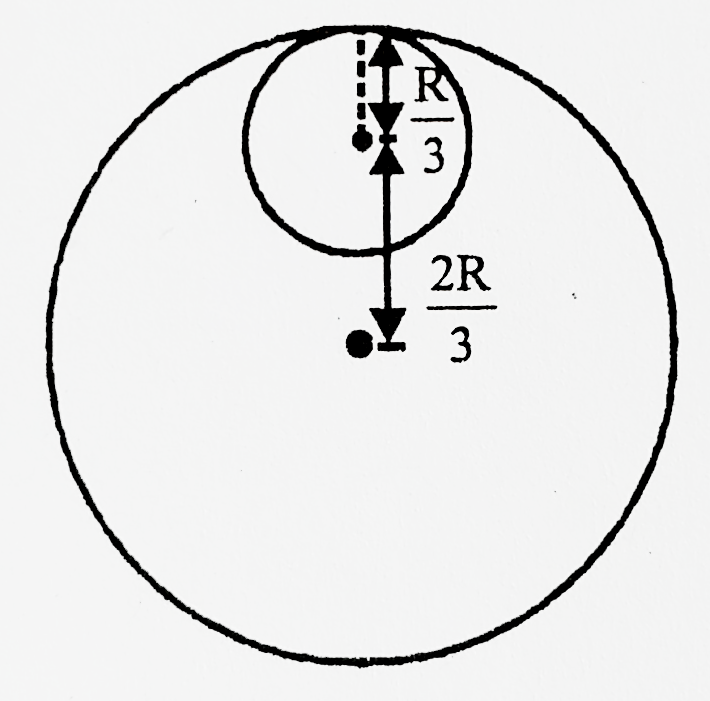 (a) Net E constant inside covity `E=(8)/(9)pi rho GR` So `(2R)/(3)=(1)/(2)at^(2)` `T = sqrt((2xx2xxR//3)/((4)/(3)piGP(2R)/(3)))=sqrt((3)/(2pi rho G))` (B) `m[(G.(4)/(3)piR^(3)P)/((3R)^(2))-(G.(4)/(3)pi((R )/(3))^(3)P)/(((7R)/(3))^(2))]=(184)/(1323)MGP pi R` |
|