

Saved Bookmarks
| 1. |
An empty luggage carrier A of mass M=40 kg slide without friction on horizontal floor hits with a velocity v_(0)=5ms^(-1) an identical carrier B containing m=15 mg suitacase. The impact causes the suitcase to slide on the floor of carrier B and collide with the left wall of carrier B. knowing that the coefficient of restitution between the two carriers is 0.80 and that the coefficient of restitution between the suitcase and the wall of carriere B is 2//9. Assume no friction any where. Find a. the velocities of carrier A and carrier B just after collision. b. the velocity of carrier B after the suitcase its the wall for the first time is |
|
Answer» Solution :Collision of carrier `A` with carriere `B`. Let velocities of carrier `A` and `B` just after collision be `v_(A) and v_(B)` respectively. `40xx5=40=40v_(A)+40v_(B)` `v_(A)+v_(B)=5`……….i Using Newton's RESTITUTION equation `v_(B)-v_(A) 0.8(5-0)`………ii `v_(B)-v_(A)=5` Solving eqn i and ii we get `v_(A)=1/2ms^(-1), v_(B)=9/2ms^(-1)` As there is no FRICTION the suitcase will no slide with RESPECT to carrier, hence velocity of suitcase with respect to the ground will be zero. Now collision of suitcase with carrier using C.O.L.M. 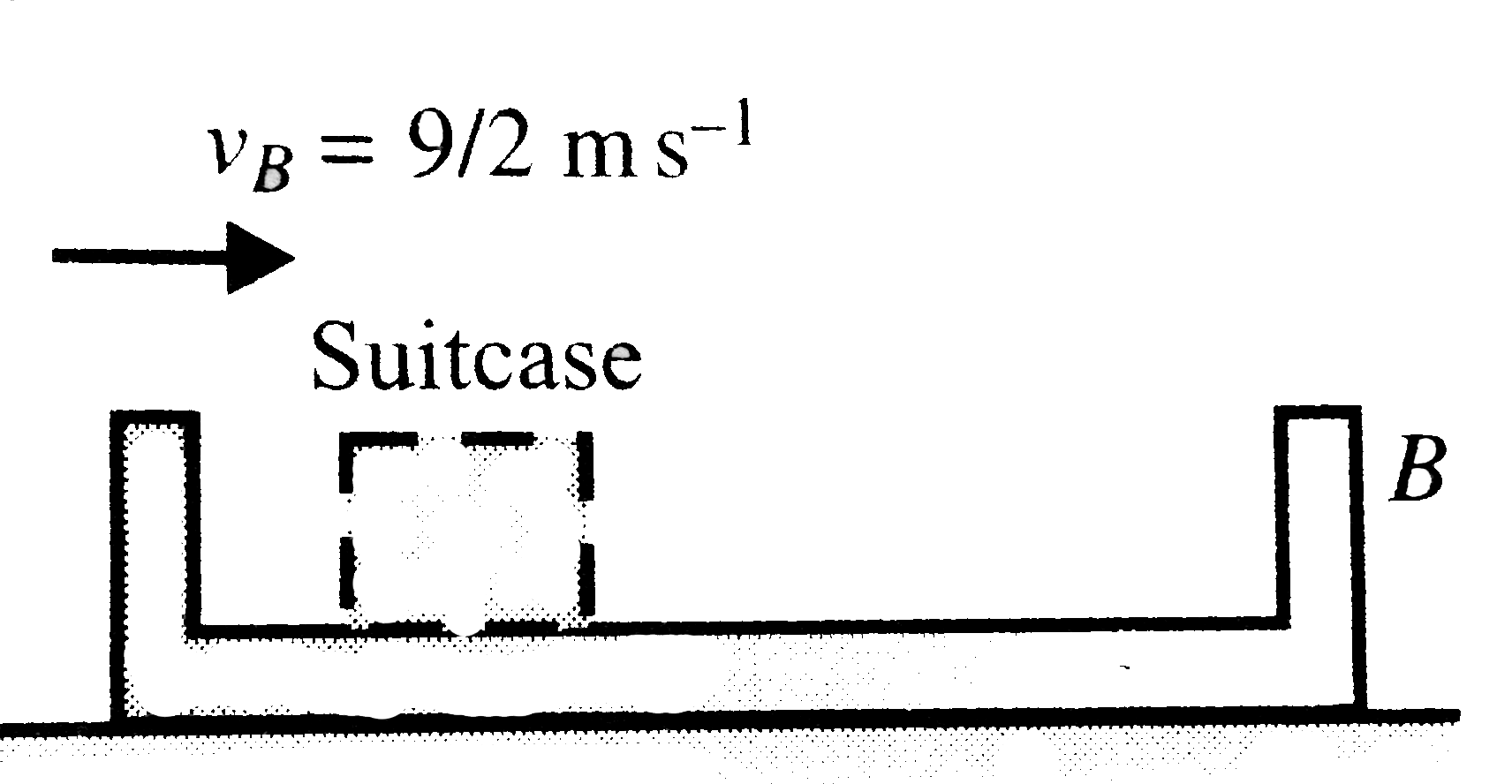 `40xx9/2+0=40v_(B)^(')+15v_(s)` Here `v_B^(')` and `v_(s)` are the velocities of carrier `B` and suitcase just after collision `180=40v_(B)^(')+15v_(s)` `36=8v_B^(')+3V_(s)` .............iii Using Newton's restitution equation ` V_(B)-V_(B)^(')=2/9(v_(B)-0)impliesv_(s)-v_(B)^(')=2/9(9/2-0)` `v_(s)-v_(B)^(')=1` After solving `v_(B)^(')=3MS^(-1)` and `v_(s)=4ms^(-1)` |
|