Saved Bookmarks
This section includes 7 InterviewSolutions, each offering curated multiple-choice questions to sharpen your Current Affairs knowledge and support exam preparation. Choose a topic below to get started.
| 1. |
(A) The mirrors used in search light are parabolic and not concave spherical. ( R) In a concave spherical mirror the image formed is always virtual. |
|
Answer» Both A and R are true and R is the correct EXPLANATION of A |
|
| 2. |
Asteel ball is allowed to fall freely from a height of36 cm onto a smooth floor. Find the height to which it rises after rebounding from the floor. Coefficient of restitution between the stee ball and the floow = 0.60. |
|
Answer» Solution :Here e = 0.60, h = 36 cm `= 36 xx 10^(-2) m` The HEIGHT attained by the body after .n. number of rebounds `= e^(2n)h`. Here n = 1 `therefore` The height attained by the body after `1^(st)` rebound `=e^(2(1))h=(0.60)^(2)(36xx10^(-2))=0.36xx0.36 = 0.13m` |
|
| 3. |
At absolute zero temperature ,the K.E. of the molecules becomes .............. . |
|
Answer» zero |
|
| 4. |
Define density .Write its unit and dimensional formula. |
|
Answer» Solution :MASS per unit volume of body is called DENSITY. If mass of body is M and volume V then density `rho=("Mass M")/("Volume V")` Density is a scalar quantity. Density is always POSITIVE. Si unit of density is : `kg//m^(3)` CGS unit of density : `g//cm^(3)` Dimensional formula of density : `M^(1)L^(-3)T^(0)`. (Primarily liquids are incompressible and at any pressure its density does not change . It remains constant . GASES are compressible and density LARGELY varies with pressure.) |
|
| 5. |
A 5.0 cm cubeof substancehas itsupper facedisplaced by 0.65 cm, bya tangentialforce of 0.25 N. Calculatethe modulusof rigidity of rigidityof thesubstance. |
|
Answer» SOLUTION :`G=(FL)/(AL), A=L^(2) , G=(FL)/(L^(2)l)=(F)/(Ll)` Here, `L=5.0xx10^(-2)m` `l=0.65xx10^(-2)m, F=0.25N`. `G=(0.25)/(5.0xx10^(-2) xx 0.65xx10^(-2)) =(0.25 xx 10^(4))/(3.25)` `=769.2Nm^(-2)` |
|
| 6. |
1 CSL is the largest practical unit of : |
|
Answer» TIME and length |
|
| 7. |
What will be the diameter of an oil molecule if twenty drops of olive oil of radius 0.12mm are spread on the surface of water, so that they form a circular film of radius 25 cm. |
| Answer» SOLUTION :`=73.7xx10^(-9)m` | |
| 8. |
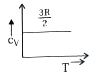
Graph of specific heat at constant volume for a monoatomic gas is ____ |
|
Answer»
`DELTAQ=DeltaU+PDeltaV` If `DeltaQ` is absorbed heat at constant volume `DeltaV=0` `THEREFORE C_V=((DeltaQ)/(DeltaT))V=((DeltaU)/(DeltaT))V=(DeltaU)/(DeltaT)` For an ideal monoatomic gas, `(DeltaU)/(DeltaT)=3/2 R, C_V=3/2R` |
|
| 9. |
A person can jump safely from a height of 2m on the earth. On a planet where acceleration due to gravity is 2.45 sm^(-2), the maximum height from which he can jump safely |
| Answer» ANSWER :A | |
| 10. |
The equation of SHM of a particle is (d^(2)y)/(dt^(2))+ky=0, where k is a positive constant. The time period of motion is given by…………….. |
|
Answer» `(2PI)/(sqrt(K))` |
|
| 11. |
(A) : Steel is preferred than aluminium in heavy-duty machines(R) : Steel is more elastic than aluminium. |
|
Answer» Both (A) and (R) are TRUE and (R) is the CORRECT EXPLANATION of (A) |
|
| 12. |
Due to thermal expansion, with rise in temperature |
|
Answer» metallic scale reading becomes less than the TRUE value |
|
| 13. |
A dart gun is fired towards a Squirrel hanging from a tree. Dart gun was initially directed towards Squirrel. P is maximum height attained by dart in its flight. Three different events can occur. (Assume Squirrel to be a particle and there is no air resistance) . |
|
Answer» |
|
| 14. |
In previous question, the amplitude of vibration is |
|
Answer» 4 UNITS |
|
| 15. |
A hoop of mass M and radius R is hung from a support fixed in a wall . Its moment of inertia about the support is |
|
Answer» `2MR^2` By theorem of PARALLEL axes , `I = I_(0) + MR^(2) = MR^(2) + MR^(2) = 2 MR^(2)` |
|
| 16. |
For a system to be in equlibrium, the torques acting on it must balance. This is true only if the torques are taken about |
|
Answer» the CENTRE of the SYSTEM |
|
| 17. |
A body cools from 60^(@) C to 50^(@) C in 6 minutes, the temperature of the surroundings being 25^(@) C. What will be its temperature after another 6 minutes ? |
|
Answer» |
|
| 18. |
The handle of a door is at a distance 40 cm from axis of rotation. If a force 5Nisapplied on the handle in a direction 30^(0) with plane of door, then the torque is |
| Answer» Answer :B | |
| 19. |
A Cylinder of radius R is spinned and then placed on an incline having coefficient mu=tan theta(theta" is the angle of incline"). The cylinder continues to spin without falling for time (Romega_(0))/("xg sin" theta). Where 'x' is |
|
Answer» |
|
| 20. |
A ball at rest is dropped from height of12m. It looses 25% of its kinetic energy on striking the ground and bounces back to a height h the value of h is |
|
Answer» `3m` |
|
| 21. |
The largest and the shortest distance of the earth from the sun are r_1 and r_2. Its distance from the sun when it is at perpendicular to the major-axis of the orbit drawn from the sun is: |
|
Answer» `(r_(1) + r_(2))/4` |
|
| 22. |
Statement I: Kepler's laws for planetary motion are consequence of Newton's laws. Statement II: Kepler's laws can be derived by using Newton's laws. |
|
Answer» STATEMENT I is true, statement II is true, statement II is a correctexplanation for statement I. |
|
| 23. |
Which of the following functions represent SHM : sin omega t+ cos 2 omega t |
|
Answer» Solution :A motion will be SHM if acceleration is directely PROPORTIONAL to its DISPLACEMENT `a=- omega^(2)y` `y= sin omegat+cos 2 omegat` `(dy)/(dt)=omega cos omegat-2 omega sin 2 omegat` `(d^(2)y)/(dt^(2))=- omega^(2)sin omegat-4omega^(2)cos omegat` `=- omega^(2)(sin omegat+4 cos omegat)` `(d^(2)y)/(dt^(2))` not proportional to -y Hence, Oscillatory but not SHM. |
|
| 24. |
Two bodies A and B have thermal emissivities of 0.01 and 0.081 respectively. The outer surface areas of the two bodies are same. The two bodies emit total radiant power at the same rate. The wavelength lambda_(B) corresponding to maximum spectral radiancy in the radiation from B is shifted radiancy in the radiation from Aby 1.00 mu m. If the temperature of A is 5802 K, calculate (a) the temperature of B and (b) wavelength lambda_(B) |
|
Answer» Solution :`e_(A) = 0.01, e_(B) = 0.81, T_(A) = 5802 K` `|lambda_(B) - lambda_(A)| = 10^(6) m` (a) Total radiant POWER is same `rho = e_(A) sigma A T_(A)^(4) = e_(B) sigma A T_(B)^(4)` `e_(A) T_(A)^(4) = e_(B) T_(B)^(4)` `T_(B) = ((e_(A))/(e_(B)))^((1)/(4)) T_(A) = ((0.01)/(0.81))^((1)/(4)) (5802)` ` = (1)/(3) xx 5802` `= 1934 K` (b) According to Wien's LAW `lambda_(A) T_(A) = lambda_(B) T_(B)` `lambda_(A) xx 1934 = lambda_(B) xx 5802` `lambda_(A) = 3 lambda_(B)` `lambda_(A) - lambda_(B) = 10^(-6)` `3lambda_(B) - lambda_(B) = 10^(-6)` `lambda_(B) = 0.5 xx 10^(-6) m = 0.5 mu m` `lambda_(A) = 3 lambda_(A) = 1.5 mu m` |
|
| 25. |
If the resultant of vecP and vecQisvecR and if R^2=P^2+Q^2 then find the anglebetweenvecP and vecQ . |
|
Answer» |
|
| 26. |
A flat car of mass m_(0) starts moving to the right due to a constant horizontal force. Sand spills on the flat car from a stationary hopper . The velocity of loading is constant and equal to mu kg//s . Find the time dependance of the velocity and the acceleration of the flat car in the process of loading . The friciton is negligible small . |
|
Answer» Solution :`m(dv)/(dt)+V(dm)/(dt)=F` Mass of the car at any instant `=m_(0)+mu t` `:. (m_(0)+MUT)(dv)/(dt)+vmu=F` `:. (dv)/(F-muv)=(dt)/(m_(0)+mut)` Integrating , we have log`(F-muv)=-log(m_(0)+mut)+C` when`t=0,v=0` `:.Log (F-muv)=-log(m_(0)+mut)+logF+log m_(0)` `:. (F-muv)/F=m_(0)/(m_(0)+mut)` `(muv)/F=(mut)/(m_(0)+mut)["SINCE" if a/B=C/d,(b-a)/b=(d-C)/d] "or" v=(FT)/(m_(0)+mut)` `:.` Acceleration `=(dv)/(dt)=d/(dt)((Ft)/(m_(0)+mut))=((m_(0)+mut)F-Ftmu)/((m_(0)+mut))^(2)` `=(Fm_(0)+muFt-muFt)/((m_(0)+mut))^(2)=(Fm_(0))/(m_(0)^(2)(1-:(mut)/m_(0))^(2))=F/(m_(0)(1-:(mut)/m_(0)))` |
|
| 27. |
A platform P is moving with a velocity v_(P) over hemispherical shell. A vertical rod AB passing trhough a hole in the platform is moving on the shell and remains vertical. There is sufficient friction between rod and shell to stop the slip. C is the crown of the shell and O is its cenre angle BOC=theta at any instant. find the velocity of point B in downward motion at that instnat: |
|
Answer» <P>`u_(p) SIN theta` `x=y tan theta` 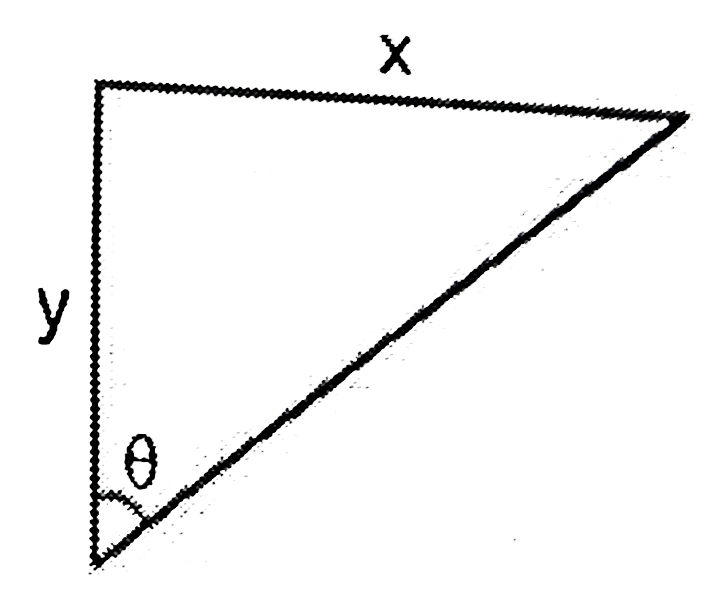
|
|
| 28. |
The resultant of vecA+vecB acts along x-axis. If A=2hati-3hatj+2hatk then B is |
|
Answer» `-2hati+hatj+hatk` |
|
| 29. |
One circular ring and one circular disc both have the same mass and radius. The ratio of their moments of inertia about their axis passing through their centres and perpendicular to their planes will be |
|
Answer» 0.042361111111111 |
|
| 30. |
The displacement y of a particle executing pariodic motion is given byy = 4 cos^(2) ((1)/(2)t)sin (1000 t)This expression may be considered as a result of the superposition of how many simple harmonic motions ? |
|
Answer» |
|
| 31. |
When a drop of liquid splits up into numebr of drops (under isothermal conditions) a.Volume increases b. Total area increases c.Energy is absorbeed d. Energy is liberated |
|
Answer» a,b are correct |
|
| 32. |
(a) Consider a stream of liquid of density rho with speed v_(1) passing abruptly from cylindrical pipe of cross-sectional area a_(1) into a wider cylindrical pipe of cross-sectional area a_(2) (see figure). The jet will mx the surrounding fluid and, after the mixing, will flow on almost uniformly with an average speed v_(2). Without referring to the details of the mixing use momentum ideas to show that the increase in pressure due to the mixing is approximately P_(2) - P_(1) = rho v_(2)(v_(1)-v_(2)) (b) Show from Bernoulli's principle h that in a gradually widening pipe we would get P_(2) - P_(1) = (1)/(2)rho (v^(1)^(2)-v_(2)^(2)) and explain the loss of pressure [the difference is (1)/(2) rho(v_(1)-v_(2))^(2)] due to the abrupt enlargement of the pipe. can you draw an analogy with elastic and inelastic collisions in particle mechanics ? |
| Answer» | |
| 33. |
Two particles are executing SHM in a straight line with same amplitude A and time period T. At time t = 0, one particle is at displacement x_1 = +A and the other at x_2 = -A//2 and they are approaching. towards each other. After what time they cross each other. |
| Answer» ANSWER :D | |
| 34. |
Two billiard balls A and B, each of mass 50g and moving in opposite directions with speed of 5 ms^(1) each, collide and rebound with the same speed. If the collision lasts for 10^(-3) s, which of the following statements are true ? |
|
Answer» The impulse imparted to each ball is 0.25 kg - `m s^(-1)` and the FORCE on each ball is 250 N Finalvelocity(u ) = `u_(1)= u_(2) = (5 m)/( s )` Timedurationof collision`=10^(3)` Changein LINEARMOMENTUM= m(v -u) `=(1)/(20)[-5 -5]=-0.5 Ns` force `= (" mpulse ")/("TIME ")= ("Change ")/( 10^(-3)` N `=(0.5)/( 10^(-3)) = 500N` Impulseand forceare oppositein direction |
|
| 35. |
Two blocks A and B of mass 2 kg and 4 kg are placed one over the other as shown in Fig. (a) . A time varying horizontal force F = 2t is applied on the upper block . Here t is in second and F is in newton . A graph drawn between accelerations of A and B on y-axis and time on x-axis is shown in Fig. (b) . Then tan theta = (1)/(K) ,K = ..... |
Answer»  Acceleration of block A and B `a_(C) = (2t)/((m_(A) + m_(B)) = ((2t)/(6))` TAN `theta = (a)/(t) = (1)/(3) = (1)/(K)` `therefore"" K = 3 ` |
|
| 36. |
For a satellite to be geostationary, which of the following are essential conditions ? a) It must always be stationed above the equator b) It must rotate from west to east c) It must be about 36,000 km above the earth d) Its orbit must be circular, and not elliptical |
| Answer» ANSWER :D | |
| 37. |
While walking the vertical component of reactive force balances our |
|
Answer» force |
|
| 38. |
A rectangular glass slab ABCD of refractive index n_1 is immersed in water of refractive index n_2(n_1 gt n_2) A ray of light is incident at the surface AB of the slab as shown. The maximum value of the angle of incidence a_(max) such that the ray comes out only from the other surface CD, is given by |
|
Answer» Solution :`r_1+r_2=90^@, therefore r_1=90^@-r_2` `(r_1) _(MAX)=90^@-(r_2)_min` `and (r_2)_min= theta_c` (for total internal reflection at AD) where `sin theta_c= n_2/n_1 or theta_c= sin^-1(n_2/n_1)` `therefore (r_1)_(max)=90^@- theta_c` Now applying Snell.s LAW at FACE AB, `n_1/n_2= (sin a_max)/(sin (r_1)_max)=(sin a_(max))/(sin (90^@- theta_c))= (sin a_max)/(COS theta_c)` or `sina_max=n_1/n_2 cos theta_c` `therefore a_max= sin^-1|n_1/n_2 cos theta_c|= sin^-1 [n_1/n_2 cos { sin^-1 (n_2/n_1)}]` 
|
|
| 39. |
If the dimension of a physical quantity are given by M^(a) L^(b) T^(e)then physical qantity will be |
|
Answer» Force If `a= 0, B=-1, c=-2` |
|
| 40. |
Explain - “Static friction force opposes impending motion” |
|
Answer» Solution :Considermotionof anacceleration Leta BOXIS lyingat BOTTOMOF compartmentoftrain. if therewas nofrictionbottomof trainwouldhavemovedfurtherboxwill try toretain itspositiondue toinertia andwouldcollidewithrear PART of compartmentbutthisdo nothappenin dayhto daylife. Thusif can be saidthat staticfrictionforceopposesimpendingmotion. thisimpendingmotionis opposedby staticfrictionforce`(f_(G))`Thisfrictionforce provideequalaccelerationin oppositedirectionofaccelerationof trainkeepboxstationary |
|
| 41. |
A particle oscillates between the points x=40mm "and"x=160mmwith an aceleration a=k(100-x), where k is a constant . The velocity of the particle is 18 m m//s when x=100 mm and is zero at both x=40 mm and x=160mm. Determine (a) the value of k (b) the velocity when x=120mm. |
|
Answer» |
|
| 42. |
Acceleration of a particle at any time t is (2thati+3t^(2)hatj)m//s^(2). If initially particle is at rest, find the velocity of the particle at time t=2s |
|
Answer» Solution :Here ACCELERATION is a function of time, i.e, acceleration is not constant . So , we can not apply `VECV=vecu+vecat` We will have to go for INTEGRATION for dinding velocity at any time t . This `dvecv=vecadt`or `int_(0)^(vecv)dvecv=int_(0)^(2)vecadt"or" vecv=int_(0)^(2)(2thati+3t^(2)HATJ)DT=[t^(2)hati+t^(3)hatj]_(0)^(2)=(4hati+8hatj)m//s` Therefore , velocity of particle at time `=2s is (4hati+8hatj)m//s` |
|
| 43. |
Guess some properties of thermalradiation . |
| Answer» Solution :(i) Radiationtravels in straight LINES . (ii) can propagatethrough vaccum with speed of LIGTH `c = 3 xx 10^(8) ms^(-1)` .(iii) Follows law ofreflection , refractionand total internalreflection andexhibitsinterface ,diffractions and polarisation. (iv)Follow INVERSE squarelaw of intesity(intensity varies as theinverse squareof the distance).(V) Risethe temperature of BODYON whichit falls. | |
| 44. |
Why are shockers used in automobiles like car? |
| Answer» SOLUTION :In the event of jump or JERK, the TIME of action of force increases. SINCE the product of force and time is constant in a given situation, therefore the force decreases. | |
| 45. |
Find the volume of the following addition with due consideration of significant figures 0.75+2.128+15.6. |
|
Answer» Solution :as this is SUM, we have to CONSIDER decimal places. Here `15.6`has ONE decimal PLACE. Here `2.128` is to be rounded off to `1+1=2`decimal places and `0.75 `should be left as it is `:.2.128=2.13` `0.75+2.13+15.6=18.48`. this is to rounded off to one decimal place. The result is `18.5`. |
|
| 46. |
When an automobile travels for a long distance , the air pressure in the tyres increases slightly . Why ? |
| Answer» Solution :Due to the FRICTION between the TYRES and the road, the tyres get HEATED . The temperature of air inside the tyres INCREASES. Consequently, the air pressure in the tyres increases slightly. | |
| 47. |
A disk and a sphere of same radius but different masses roll on two inclined planes of the same altitude and length. Which one of the two objects gets to the bottom of th plane first ? |
|
Answer» SPHERE |
|
| 49. |
Two sound waves with wavelengths 5.0 cm and 5.5 cm, respectively each propagate in a gas with velocity 330 m/s. The number of beats per second will be ………… |
| Answer» Solution :NUMBER of beats/s is= `330 [(1)/(5) - (1)/(5.5)] = 6` | |
| 50. |
A beaker contains a liquid of volume V_0. A solid block of volume V floats in the liquid with 90% of its volume submerged in the liquid. The whole system is heated to raise its temperature by Delta theta. It is observed that the height of liquid in the beaker does not change and the solid in now floating with its entire volume submerged. Calculate Delta theta. It is given that coefficient of volume expansion of the solid and the glass (beaker) are gamma_(s) and gamma_(g) respectively. |
|
Answer» |
|