

Saved Bookmarks
This section includes 7 InterviewSolutions, each offering curated multiple-choice questions to sharpen your Current Affairs knowledge and support exam preparation. Choose a topic below to get started.
| 1. |
A ground to ground projective projected at 1 = 0 is at points A at t=T//3, is at point B at t = 5T//6and reaches the ground at t = T. The difference in heights between points A and B is gT^(2)//8K.The value of 'k' is ________ |
|
Answer» |
|
| 2. |
Define a compounded physical quantity . |
| Answer» SOLUTION :A PHYSICAL QUANTITY made by combining two or more elementary quantites, is CALLED a compounded quantity (it is also called a DERIVED quantity). | |
| 3. |
A block of mass m is sliding down a stationary inclined plane. The base of the inclined plane has a length l, and the coefficient of kinetic friction between the block and inclined surface is 0.14. What should be the inclination of the plane so that the block can slide down to the ground in minimum time? |
|
Answer» Solution :Acceleration of the block ALONG the plane , a = g (sin `theta -mu. "cos" theta` ) Let the time required to slide down from A to B be t Fig. `:.AB = (1)/(2)at^(2)= (l)/("cos"theta)` or, `(1)/(2)t^(2)g (sintheta -mu."cos"theta) = (l)/("cos"theta)` or, `t^(2) = (2L)/(g) (1)/("sin"theta "cos"theta-mu."cos"^(2)theta)` `=(4l)/(g)[(1)/(sin 2thetacostheta-mu.(1+cos^(2)theta))]` When t is MINIMUM `t^(2)`is also minimum. `:. sin 2thetai-mu (1+cos2 theta)` = x (say)is maximum. `:. (dx)/(d theta)= 0 " ""or", 2 cos2 theta -mu. (0-2 SIN2 theta)` =0 or, cos 2 `theta +mu sin2 theta` =0 or , `tan2theta = -(1)/(mu.)=-(1)/(0.14) = -tan 82^(@)` or, `tan 2 theta = tan(180^(@) -82^(@)) = tan 98^(@)` `:. 2theta= 98^(@) "and"theta = 49^(@)`. 
|
|
| 4. |
Ifomega_(0), omegaare initial and final angular velocitiesthetaisthe angular displacement and alphais the angular acceleration then, choose the correct statement . |
|
Answer» `omrga^(2) = omega_(0)^(2) - 2 alpha theta` |
|
| 5. |
A curved surface is shown figure . The portion BCD is free of friction .There are three spherical balls of identical radii and masses . Balls are released from at rest one by one from A which is at a slighly greater height than C . with the surface Ab , ball 1 has large eneough friction to cause rolling down without slipping , ball 2 has a small friction and ball 3 has a negligible friction . (a) For which balls is total mechanical energy conserved ? (b) Which ball (s) can reach D ? (c ) For ball which do not reach D, which of the balls can reach back A ? |
|
Answer» Solution :(a) As ball 1 is rolling down withut slipping no disipation of ENERGY is there , total mechanical energy REMAINS UNCHANGED. Hence , it is conserved . (b) Ball 1 GAINS rtational energy , ball 2 loses energy due to friction . They cannot CROSS at C . Ball |
|
| 6. |
A vessel is half filled with a liquid at 0^(@) C. When the vessel is heated to 100^(@) C, the liqui occupies 3/4 volume of the vessel. Coefficient of apparent expansion of the liquid is |
|
Answer» `0.5 //^(@)C ` |
|
| 7. |
Matching block typeLIST - I(a) Two rotating disc are brought in contact coaxially(b) Contact force on a body placed in on rough surface(c ) To continue a motion is easier than to initiate the motion(d) For a Static friction less than limiting friction LIST - II(e ) Generated friction is equal to appliedexternal force in magnitude(f) Loss of Rotational KE is transformed partly to heat(g) The resultant of normal reaction and friction(h) Kinetic friction is less than static friction |
|
Answer» a-f, b-g, c-h, d-e |
|
| 8. |
Water rises to a height of 10cm in a capillary tube and mercury falls to a depth of 3.42 cm in the same capillary tube. If the density of mercury is 13.6gm/cc and the angle of contact is 135^@. Find ratio of surface tensions of water and mercury |
|
Answer» `13:2` |
|
| 9. |
Out of the following pairs which one does not have identical dimensions ? |
|
Answer» MOMENT of inertia and moment of a force Moment of force `(bartau)= BARR XX bar F` `:. [tau]= [r][F]= [L][MLT^(-2)]` or `[tau]= [ML^(2)T^(-2)]` Moment of inertia and moment of a force do not have identical dimensions |
|
| 10. |
Does a wave transfer momentum? |
| Answer» SOLUTION :A WAVE can transfer LINEAR as WELL as angular momentum. | |
| 11. |
A helicopter of mass 1000 kg rises with a vertical acceleration of 15 ms^(-2) The crew and the passengers weight 300 kg Give the magnitude and direction of (a) force on the floor by the the crew and passengers (b) action of the rotor of the helicopter on surrounding air (c) force on the helicopter due to surrounding air . |
|
Answer» Solution :Here , mass of helicopter , ` m_(1) = 1000 kg ` Mass of the CREW & passengers , ` m_(2) = 300 kg ` upward acceleration , ` a = 15 ms^(-2) and g = 10^(-2) ` (a) Force on the floor of helicopter by the crew and passengers = apparent weight of crew and passengers` = m_(2) (g+ a ) = 300 (10 + 15 ) = 750 N ` (b) Action of ROTOR of helicopter on surrounding air is obviously vertically downwards , because helicopter rises on account of reaction to this force of action ` F = (m_(1) + m_(2))(g + a ) = (1000 + 300) (10 + 15 ) = 1300 xx 25 = 32500 N ` (c) Force on the helicopter due to surrounding air is the reaction As action and reaction are equal and opposite THEREFORE , Force of reaction , F = 32500 N , verically upwards. |
|
| 12. |
10 grams of ice at - 20°C is added to 10 grams of water at 50°C. The amount of ice and water that are present at equilibrium respectively |
|
Answer» 0,20g |
|
| 13. |
An atomic clock is based upon the periodic vibrations produced is |
|
Answer» SODIUM ATOMS |
|
| 14. |
The angular momentum of a particle is the rotational analogue of its linear momentum.The equation connecting angular momentum and inear momentum is.. |
|
Answer» `((VECL)=(VECP)X (vecr))` |
|
| 15. |
Calculate the amount of work done by the force on a body from the following graph |
Answer» SOLUTION :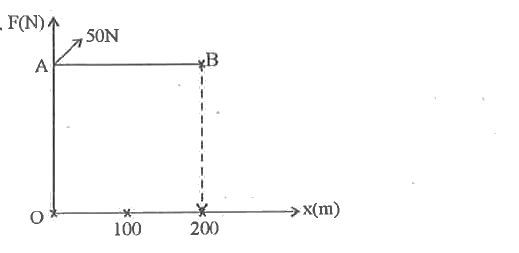 WORK DONE = `Fs=50xx200=10^(4)J=1.0xx10^(4)J` |
|
| 16. |
Let a planet revolving close to the earth, Obtain relation between escape speed and orbital speed. |
|
Answer» SOLUTION : `IMPLIES v_0 = SQRT((GM_e)/R_e)` and ESCAPE SPEED `ve= sqrt((24M_e)/R_e)` `:. v_0/v_e=sqrt((GM_e)/R_exxR_e/(24M_e))` `:. v_0/v_e=1/sqrt2 " or " v_e=sqrt2v_0` |
|
| 17. |
Two rain drops reach the earth with their terminal velocities in theratio 4:9. The ratio of their radii is |
|
Answer» `4:9` |
|
| 18. |
In case of force oscillations of a body |
|
Answer» DRIVING force is constant throughout. |
|
| 19. |
Can the direction of velocity of an object change, when acceleration is constant ? |
| Answer» Solution :YES, for an object thrown vertically UPWARDS, the direction of velocity changesduring its rise and fall. But ACCELERATION act ALWAYS downwards and remains CONSTANT. | |
| 20. |
The equation of a certain gas can be written as (T^(7//5) )/( P^(2//5))= const. Its specific heat at constant volume will be |
|
Answer» `( 3)/( 2 ) R` |
|
| 21. |
A body released from the top of a tower of height h takes T seconds to reach the ground. The position of the body at T/4 seconds is |
|
Answer» at `h/(16)` from the ground |
|
| 22. |
Explain heat capacity of substance and write its equation and unit. |
|
Answer» Solution :In the first step, heat a given quantity of water to raise its temperature by, say `20^(@)C` and note the time taken. Again take the same amount of water and raise its temperature by `40^(@)C` using the same source of heat. Note the time taken by using a stopwatch. You will find it taken about twice the time and therefore, double the quantity of heat required raising twice the temperature of same amount of water. In the SECOND step, now suppose you take double the amount of water and heat it, using the same heating arrangement, to raise the temperature by `20^(@)C`, you will find the time taken is again twice that required in the first step. In the third step, in place of water, now heat the same quantity of some oil, say mustard oil, and raise the temperature again by `20^(@)C`. Now note the time by the same stopwatch. You will find the time taken will be shorter. Therefore, the quantity of heat required for oil would be less than that required by the same amount of water for the same rise in temperature. The above observation show that the quantity of heat required to warm a given substance depends on its MASS, m, the change in temperature, `DELTAT` and the nature of substance. The change in temperature of a substance, when a given quantity of heat is absorbed or rejected by it, is CHARACTERISED by a quantity called the heat capacity of that substance. Heat capacity S : Heat capacity is the ratio of heat given to substance `DeltaQ` and corresponding change in temperature `DeltaT`. `:.S=(DeltaQ)/(DeltaT)` Where `DeltaQ` is the amount of heat SUPPLIED to the substance to change its temperature from T to `T+DeltaT`. Value of heat capacity depends on type of material and its mass. Heat capacity of substance of same material but different mass can be different. Unit of heat capacity is `"J K"^(-1)` or `"Cal K"^(-1)`. |
|
| 23. |
Two bodies of equal masses moving mutually at right angles to each other, collide elastically. After the colision, the particles will move in |
|
Answer» mutually PERPENDICULAR DIRECTIONS |
|
| 24. |
A tank is filled with two immescible liquids of densities 2rho and rho each of height h. Two holes are made to the side wall at h/2 and (3h)/2 from upper surface of the liquid, then find the ratio of velocity of efflux of the liquids through the holes. |
Answer» SOLUTION :According to Bernoullis theroem, to FIND `v_(1)`  `P+rho g(h/2)=P+1/2(rho)(v_(1)^(2))impliesv_(1)=sqrt(gh))` to find `v_(2)-P+(rhogh)+(2RHO)g(h/2)=1/2(2rho )v_(2)^(2)+P` `impliesv_(2)=sqrt(2gh):. (v_(1))/(v_(2))=1/(sqrt(2))` |
|
| 25. |
A longitudinal progressive wave is given by the equation y=5x10^(-2)sinpi(400t+x). The amplitude and wave length of the wave are (y,x are in m) |
|
Answer» `A=5x10^(-2)m`, `lambda=2m` `A=5xx10^(-2)m`, `K=pim^(-1)implieslambda=(2pi)/(K)` |
|
| 26. |
The bob of a pendulum is released from a horizontal position. If the length of the pendulum is 1.5 m, what is the speed with which the bob arrives at the lowermost point, given that it dissipated 5% of its initial energy against air resistance ? |
| Answer» Answer :A | |
| 27. |
Which of the following functions represent SHM? I. y=sinomegat-cosomegat II. y=sin^(3)t III. Y=5cos((3pi)/(4)-3omegat) |
|
Answer» I and III |
|
| 28. |
Water flows through a hose (pipe) whose internal diameter is 2 cm at a speed of 1 m/s. What should be the diameter of the nozzle if the water is to emerge at a speed of 4 m/s |
|
Answer» |
|
| 29. |
A particle executes SHM represented by the equation , y= 0.02sin(3.14t+ (pi)/(2)) meter. Find maximum acceleration |
|
Answer» SOLUTION :COMPARING equation `y= 0.02sin(3.14t+ (pi)/(2))`with the GENERAL from of the equation , `y= A sin(omegat+phi_(0))` Maximum ACCELERATION `a_("max")= -Aomega^(2)= -0.02 xx (3.14)^(2)= 0.1972 ms^(-2)` |
|
| 30. |
A car of mass 2000 kg is lifted up a distance of 30 m by a crane in 1 min. A second crane does the same job in 2 min Do the crunes consume the same or diferent amounts of fuel What is the power supplied by cacheranu? Negleat Power dissipation against friction. |
|
Answer» SOLUTION :`t-(1)=1min=60s, t_(2)=2min=120s` `W=Fs=mgs=5.88xx105J` As both CRANES do same amount of WORK so both consume same amount of fuel. `p_(1)=W/t_(1)andp_(2)=W/t_(2)` `p_(1)=9800W and p_(2)=4900W` |
|
| 31. |
A particle is confined to rotate in a circular path with decreasing linear speed. Then which of the following is correct? |
|
Answer» `vecL` (ANGULAR MOMENTUM) is conserved about the centre |
|
| 32. |
The external and internal diameters of a hollow cylinder are determined with vernier callipers and the results are recorded as 4.23 pm0.01 cm and 3.89pm0.01 cm. The thickness of the cylinder wall within the limits of error is |
|
Answer» `0.34 PM 0.01cm` |
|
| 33. |
What sortof energy is associated with a flying bird in air? |
| Answer» SOLUTION :A flying bird POSSESSES both potential and KINETIC energies because it is at a CERTAIN HEIGHT above the ground and moving with certain velocity. | |
| 34. |
Which of the following is correct statement ragarding projectile motion ? |
|
Answer» HORIZONTAL VELOCITY of PROJECTILE is constant |
|
| 35. |
Match the column I with column II ltBrgt |
|
Answer» A-s,B-r,C-q,D-p Average HUMAN life-span `:10^(9)s` AGE of Egyptian pyramids `:10^(11)s` Age of the UNIVERSE `:10^(17)s` |
|
| 36. |
The kinetic energy K of a particle moving in a straight line depends on the distances as K =as^2. The force acting on the particle is (where a is a constant) |
|
Answer» Solution :Here kinetic energy `K = 1/2 mv^2 = as^2` `:. mv^2 = 2as^2` Differentating EQN .(i) w.r.t TIME t, we get `2 mv (dv)/(dt) = 4as (DS)/(dt) = 4 asv" or " m (dv)/(dt) = 2as` . |
|
| 37. |
A satellite is revolving round the earth in a circular orbit with a velocity of 8k/s. at a height where acceleration due to gravity is 8 m//s^2 . How many high is e satellite from the earth ( Take R = 6000km) |
|
Answer» Solution :As centripetal acceleration equals to acceleration DUE to GRAVITY at that height , then `:.a=V^2/r=g_(h)impliesV^2/r=8=(64xx10^(6))/(R+h)=8` `implies R + h = 8 xx10^(6)` `h = 8 xx10^(6) - 6 xx10^(6)= 2 xx10^(6) m = 2000 KM ` |
|
| 38. |
A satellite takes 1/8 years to move round the earth in its permissible orbit of radius R. The period when it revolves round the earth in an orbit of radius '2R' is |
|
Answer» `(1)/(2sqrt(2))` YEARS |
|
| 39. |
The efficiency of a carnot engine working between temperature T_(1) and T_(2) is eta. It will be also eta if it works between temperatures |
|
Answer» `T_(1) + 10` and `T_(2) + 10` If `T_(1). = 2T_(1)` and `T._(2) = 2T_(2)`, then `eta. = 1-(T._(2))/(T._(1)) = 1 - (2T_(2))/(2T_(1)) = eta` In other cases, it is not so. |
|
| 40. |
What is the excess of pressure inside the spherical drop of water of radius 1 mm. Surface tension of water is 70xx10^(-3)N//m. |
|
Answer» Solution :Radius of water drops `r=1mm=1xx10^(-3)m` Surface tension of water `S=70xx10^(-3)Nm^(-1)` Excess PRESSURE INSIDE the DROP `P=(2S)/r=(2xx70xx10^(-3))/(1xx10^(-3))=140Nm^(-2)` |
|
| 41. |
A mass of 0.1 kg is rotated in a vertical circle using a string of length 20 cm. When the string makes an angle 30^(@) with the vertical, the speed of the mass is 1.5 ms^(-1). The tangential acceleration of the mass at that instant is |
|
Answer» `4.9 MS^(-2)` |
|
| 42. |
Derive the equations of motion for a particle (a) falling vertically (b) projected vertically. |
|
Answer» Solution :Equations of motion for a particle falling vertically downward from certain height. Consider an object of mass m falling from a height h. Assume there is no air resistance For convenience, let us CHOOSE the downward direction as positive v-axis as shown in the figure. The object experiences acceleration .g. due to gravity which is constant near the SURFACE of the Earth. We can use kinematic equations to explain its motion. We have The acceleration `veca=ghatj` By comparing the components, we get Equations of motion for a particle thrown vertically upwards `a_(x)=0,a_(2)=0,a_(y)=g` Let us take for simplicity, `a_(y)=a=g` If the particle is thrown with initial velocity .u. downward which is in negative y-axis, then velocity and position at of the particle any time t is GIVEN by `v=u+gt""......(1)` `y=ut+(1)/(2)"gt"^(2)""......(2)` The square of the speed of the particle when it is at a distance y from the hill-top, is `v^(2)=u^(2)+2gy""......(3)` Suppose the particle starts from rest. Then u=0 Then the velocity v, the position of the particle and v2 at any time I are given by (for a point y from the hill-top) `v=gt"".....(4)` `y=(1)/(2)"gt"^(2)""......(5)` `v^(2)=2gy""......(6)` The time (t = T) taken by the particle to reach the ground (for which y = h), is given by using equation (5), `h=(1)/(2)gT^(2)""......(7)` `T=sqrt((2h)/(g))"".......(8)` The equation (7) implies that greater the height (h), particle takes more time (T) to reach the ground. For lesser height (h), it takes lesser time to reach the ground, The speed of the particle when it reaches the ground (y= h) can be found using equation (6).we get `v_("ground")=sqrt2gh"".......(9)` The above equation implies that the body falling from greater height (h) will have higher velocity when it reaches the ground. The motion of a body falling towards the Earth from a small altitude `(hltltR)`, purely under the force of gravity is called free fall. (Here R is RADIUS of the Earth). A body thrown vertically upwards: Consider an object of mass m thrown vertically upwards with an initial velocity u. Let us neglect the air friction. In this case we choose the vertical direction as positive y axis as shown in the figure, then the acceleration a=-g (neglect air friction) and g points towards the negative y axis. The kinematic equations for this motion are, The velocity and position of the object at any time t are, `v=u-gt""........(10)` `s=ut-(1)/(2)"gt"^(2)""......(11)` The velocity of the object at any position y (from the point where the object is thrown) is `v^(2)=u^(2)-2gy""......(12)`  
|
|
| 43. |
The equation of trajectory ofa projectile is y = 10x-5/9x^2 If we assume g = 10 ms^(-2), the range of projectile (in metre) is |
|
Answer» 36 |
|
| 44. |
A gas deviates maximum from the ideal gas laws at |
|
Answer» HIGH TEMPERATURE and high PRESSURE |
|
| 45. |
Heat is flowing through two cylindrical rods of the same material. The diamters of the rods are in the ratio 1: 2 and the length in the ratio 2 : 1. If the temperature difference between the ends is same then ratio of the rate of flow of heat through them will be |
|
Answer» |
|
| 46. |
Give the physical states of matter. |
| Answer» SOLUTION :SOLID, liquid, gas , plasm, Bose-Einstein condensates, quark-gluon PLASMAS and hot PLASMA these are the physical states of matter. | |
| 47. |
Vertices of a triangle are given by hat(i)+3hat(j)+2hat(k), 2hat(i)-hat(j)+hat(k) and -hat(i)+2hat(j)+3hat(k), then area of triangle is (in units) |
|
Answer» `(SQRT(107))/(2)` |
|
| 48. |
Two rods OA and OB of equal length and mass are lying on xy plane as shown in figure. Let I_(x),I_(y) and I_(z) be the moment of inertia of both the rods bout x,y and z axis respectively. Then, |
|
Answer» `l_(X)=l_(y)gtl_(z)` |
|
| 49. |
The momentum of the body is doubled, what % does its K.E. change ? |
|
Answer» <P> Solution :`K.E.=p^(2)/(2m)"when p is doubled K.E.as K.E.becomes 4 TIMES"``THEREFORE%"INCREASE in K.E."=(triangleK.E.)/(K.E)xx100(4K.E-K.E.)/(K.E)XX100=3XX100=300%` |
|
| 50. |
Figure shows two identical particles 1 and 2, each of mass m, moving in opposite directions with same speed vec V along parallel lines. At a particular instant, vec r_1 and vec r_2 are their respective position vectors drawn from point A which is in the plane of the parallel lines. Which of the following is the correct statement ? . |
|
Answer» <P>Agularmomentum `I_(1)` of particlea aboutA is `I = mv (d_(1))o.` Forparticle1. `I_(1) =r_(1)xxmv`is notof plane of thepaperandperpendicularto `r_(1)` andp(mv) Similarly`I_(2)=r_(2)xxm(-v)` is intotheplaneof thepaper andperpendicular to `r_(2) and -p` Hence, totalangular momentum `l=l_(1)+l_(2)=r_(1)xxmv+(-r_(2)xxmv)` `|l|=mvd_(1)- mvd_(2)as d_(2)gt d_(1)` totalangular momentumwillbeinward Hence `I=mv(d_(2)-d_(1))ox` note: in theexpressionof angularmomentum `I=rxxp`thedirection ofl is takenby righthand rule . |
|