

Saved Bookmarks
This section includes 7 InterviewSolutions, each offering curated multiple-choice questions to sharpen your Current Affairs knowledge and support exam preparation. Choose a topic below to get started.
| 1. |
Under moves with constant velocity v in a straight line parallel to X - axis . The angular momentum with respect to the origin is |
|
Answer» 3/4 A |
|
| 2. |
An observer moves towards a stationary source of sound with a velocity one-fifth of the velocity of sound. Calculate the percentage increase in the apparent frequency? |
|
Answer» Solution :Here observer moves towards the stationary source. `:.v_(0)=-(v)/(5),v_(s)=0` Apparent frequency, `v'=(v-v_(0))/(v-v_(s))xxv=(v+(v)/(5))/(v-0)xxv=(6)/(5)v=1.2v`. The PERCENTAGE INCREASE in apparent frequency, `(v'-v)/(v)XX100=(1.2v-v)/(v)xx100` `=(0.2v)/(v)xx100=20%`. |
|
| 3. |
One mole of an ideal gas undergoes a cyclic change ABCD where the (P-V) co-ordinates are A(5, 1), B(5, 3), C(2, 3) and D(2, 1). P is in atmosphere and V is in litre. Calculate work done along AB , BC, CD and DA and also net work done in the process. Given 1 atmosphere = 1.01 xx 10^(5) Nm^(-2). |
|
Answer» |
|
| 4. |
A rod of metal - 1 of length 50.0 cm elongates by 0.10 cm when it is heated from 0^(@)C to 100^(@)C. Another rod of metal - 2 of length 80.0. cm elongates by 0.08 cm for the same rise in temperature. A third rod of length 50.0 cm, made by welding pieces of rod 1 rad and 2 rad placed end to end, elongates by 0.03 cm when it is heated from 0^(@)C to 50^(@)C. Then what is the length of metal - 1 in the third rod at 0^(@)C? |
|
Answer» SOLUTION :`"For META - 1,For metal - 2,"` `alpha_(1)=(Deltal)/(L Deltat)=(0.10)/(50.0xx100)""alpha_(2)=(Deltal)/(lDeltat)=(0.08)/(80.0xx100)` `alpha_(1)=2.0xx10^(-5)//^(@)C""alpha_(2)=1.0xx10^(-5)//^(@)C` LET the lengths of metal - 1 and metal - 2 in the third rod at `0^(@)C` be `l_(1) and l_(2)`, respectively. Then `""l_(1)+l_(2)=50.0` When this rod is heated to `50^(@)C`, then `(l._(1)=l_(1)(l+alpha_(1)50), l._(2)=l_(2)(l+alpha_(2)50)` `and""l._(1)+l._(2)=l_(1)+l_(2)+(l_(1)alpha_(1)+l_(2)alpha_(2))50` `50.03=50.0+(2l_(1)+l_(2))xx50xx10^(-5)` `2l_(1)+l_(2)=60"...(2)"` `"SOLVING (1) and (2),"l_(1)=10.0cm, l_(2)=40.0cm` |
|
| 5. |
A man can reach thepoint directly opposite on the other bank of a river by swimming across the river in time t_1 and crosses the same distance in time t_2while swimming along the current. If the velocity of the man in still water is v and velocity of the watercurrent is u, find the ratio between t_1 and t_2. |
|
Answer» Solution :Let the resultant velocity with which the man swims ACROSS the river ve w . Hence, `w=sqrt(v^2-u^2)` [Fig.2.51] and therefore , TIME REQUIRED to cross the river, `t_1=l/(sqrt(v^2-u^2)), ……(1)` where l is the width of the river. When the man swims in the direction of the CURRENT, the resultant velocity , w.=v+u and time required to cross the same distance, `t_2=l/(v+u) .....(2)` From(1) and (2) , `(t_1)/(t_2)=(v+u)/(sqrt(v^2-u^2))=(v+u)/(sqrt(v-u)*sqrt(v+u))=sqrt(v+u)/(v-u).` |
|
| 6. |
Which of the following examples represent periodic motion? A freely suspended bar magnet displaced from its N-S direction and released. |
| Answer» Solution :It is a PERIODIC motion because a freely suspended magnet if once DISPLACED from N-S direction and released, it OSCILLATES about its position. Hence, (b) will be the SHM. | |
| 7. |
A rod of length l is given two velocities v_(1) & v_(2) in opposite directions at its two ends at rigt angles to the length. The distance of the instantaneous axis of rotation from v_(1) is: |
|
Answer» ZERO |
|
| 8. |
The period of a particle executing shm is 2pi. The total energy of the particle is 0.0786 J. After a time pi//4sthe displacement is 0.2m. Calculate the amplitude and mass of the particle. |
|
Answer» Solution :Total energy = E = 0.0786 J Period `=T = 2pi` `OMEGA = (2pi)/T = (2pi)/(2pi) =1 rad//s` Displacement after a time t `= PI/4 s` is y = 0.2 m `0.2 = a sin 1 XX (pi)/4` `a= (0.2)/(sin ""pi/4)=0.2 xxsqrt2 = 0.283m` Total energy `E=1/2 momega^2a^2=1/2xxmxx1^2xx0.283^2=0.04m` `m = E/(0.04)=(0.0786)/(0.04)=1.96kg` |
|
| 9. |
Distance of geostationary satellite from the surface of earth radius (R_(e)=6400 km) in terms of R_(e) is |
|
Answer» `13.76 R_(E)` |
|
| 10. |
In a plano-convex lens radius of curvature of the lens is 10 cm. if the plane side polished, then the magnitude of the focal length of the mirror so formed will be (refractive index =1.5) (2x) cm . Find value of x. |
|
Answer» |
|
| 11. |
Name the principle which is effective in a hydraulic press. |
| Answer» SOLUTION :MULTIPLICATION of THRUST | |
| 12. |
In dimension of critical velocity v_(c) of liquid following through a tube are expressed as [eta^(x)rho^(y)r^(z)] where eta, rho and r are the coefficient of viscosity of liquid, density of liquid and radius of the tube respectively, then the values of x,y and z are given by |
|
Answer» 1,1,1 `:.v_(c)=k eta^(x) rho^(y) r^(z)` Where k is DIMENSIONLESS Writtingh dimension formula on both the side, `M^(0)L^(1)T^(-1)=(M^(1)L^(-1)T^(-1))^(x) XX (M^(1)L^(-3)T^(0))xx (M^(0)L^(1)T^(0))^(z)` `:. M^(0)L^(1)T^(-1)=M^(x)L^(-x)xx M^(y)L^(-3)T^(0)xx L^(z)` `=M^(x+y)L^(-x-3y+z)T^(-x)` COMPARING powerof M,L,T `0=x+y "" 1=-x-3y+z "" -1=-x` `:.1=-1-3(-1)+z :. x=1` `:. 0=1+y "" :.1=-1+3+z` `:.y=-1"" :. -1=z` `:.x=1, y=-1 , z=-1` |
|
| 13. |
Along a streamline, |
|
Answer» the VELOCITY of a FLUID particle remains constant |
|
| 14. |
Suggest a suitable physical situation for each of the following graphs (Fig.) |
| Answer» SOLUTION :A ball THROWN up with some INITIAL velocity rebounding from the floor with REDUCED speed after each hit. | |
| 15. |
A smooth sphere is moving on horizontal surface with a velocity vector (2vec(i) + 2vec(j))m//s immediately before it hit a vertical wall. The wall is parallel to vector vec(j) and coefficient of restitution between the sphere and the wall is e = 1/2. The velocity of the sphere after it hits the wall is |
|
Answer» `VEC(i) - vec(J)` |
|
| 16. |
A sphere of mass 0.3 kg moving with a velocity of 4 m/s collides with another sphere of mass 0.5 kg which is at rest. Assuming the collision to be elastic, their velocities after the impact are |
|
Answer» 4 m/s and `0 ms^(-1)` |
|
| 17. |
The mass of the earth is 6.0xx10^(24) kg. Calculate (i) the potential energy of a body of mass 33.5 kg and (ii) the gravitational potential, at a distance of 3.35xx10^(10) m from the centre of the earth. Take G=6.67xx10^(-1) Nm^(2) kg ^(-2) |
|
Answer» |
|
| 18. |
Assume that the acceleration due to gravity on the surface of the moon is 0.2 times the acceleration due to gravity on the surface of the earth. If R_(e ) is the maximum range of a projectlie on the earth's surface then what is the maximum range on the surface or the moon for the same velocity of projection |
|
Answer» `0.2 R_(E )` |
|
| 19. |
A ring of mass m connected through a string of length L with a block of mass M. If the ring is moving up with acceleration a_(m) and a_(M) is the acceleration of block. The relation between a_(m) and a_(M) is. |
|
Answer» Solution :As the length of the srting is constant, `L = SQRT(d^(2)+y^(2))+x`  Since, L is constant, differentiating with respect to time t, we get `(DL)/(dt)=(1)/(2)(2y)/((d^(2)+y^(2))^((1)/(2)))((DY)/(dt))+(DX)/(dt)=0` Since `(dy)/(dx)=v_(m)` and `(dx)/(dt)=v_(M)` and `cos theta = (y)/(sqrt(d^(2)+y^(2)))` so `v_(M)=-v_(m)cos theta` By differentiating, relation between `a_(m)` and `a_(M)` can be obtained, however, while doing so remember that `cos theta` is not constant, but it is variable. `a_(M)=-a_(m)cos theta`. |
|
| 20. |
Atomic clock generally used in the national standards, is based on the periodic vibrations produced in a |
|
Answer» CESIUM atom |
|
| 21. |
A cyclic process is shown in the p-T diagram. Which of the curves show the same process on a V-T diagram? |
|
Answer»
|
|
| 22. |
If a planet of radius R and density D is revolving around the sun in a circular orbit of radius r with time period T, then the mass of the sun is |
|
Answer» `(4PI^(2)r^3)/(GT)` |
|
| 23. |
Two bodies of masses 2 kg and 8 kg are at rest. If same force acts on them, the ratio of distance travelled by them before they attain same kinetic energy is |
| Answer» ANSWER :A | |
| 24. |
Let the speed of the planet at the perihelion P be V_P and the sun-planet distance SP be r_p .Relates (r_p,V_P) to the corresponding quantities at aphelion (r_A,V_A) . Will the planet take equal times to tranverse BAC and CPB ? |
Answer» Solution : According to law of conservation of angular momentum. Angular momentum of the PLANET at P = Angular momentum of the planet at A `rArr mV_P r_P=mV_A r_A` (or) `V_P/V_A=r_A/r_P` Since `r_A gt r_P` or `V_P gt V_A` Here AREA SBAC is greater than the area SCPB. According to Kepler.s SECOND law, as the areal velocity of the planet is constant around the sun, i.e equal areas are swept on equal TIMES, HENCE the planet will take longer time to traverse BAC than CPB. |
|
| 25. |
A body is projected with a velocity u at an angletheta with the horizontal . At t= 2s ,the body makes an angle 30^@ with the horizontal . 1 s later, it attainsits maximum height . Then |
|
Answer» `u=20 SQRT(3) m//s` |
|
| 26. |
A body of mass 25g is under water at a depth of 50 cm. If the specific gravity of the material of the body is 5 and g = 980cm*s^(-2), find the amount of work required to lift it very slowly to the surface. |
|
Answer» SOLUTION :Volume of water displaced by the BODY = volume of the body = `25/5=5cm^(3)` `therefore` Weight of displaced water = `5gxxg` `therefore` Downward resultant FORCE = `(25xx980-5xx980)=20xx980=19600`DYN `therefore" "` Required WORK done = `19600xx50=9.8xx10^(5)`erg. |
|
| 27. |
If a satellite is revolving around a planet of mass M in an elliptic orbit of semi-major axis a, show that the orbital speed of the satellite when it is at a distance r from the focus will be given by v^2 = GM (2/r - 1/a) |
|
Answer» Solution : Total mechanical energy of the system is ` E = - (GMm)/(2a) `which remains conserved. `KE + PE = - (GMm)/(2a)` At a position Y ORBITAL speed of the SATELLITE is v. Then KE ` = 1/2 mv^2 , PE = - (GMm)/(r ) so,1/2 mv^2 - (GMm)/(r ) = - (GMm)/(2a) " or " v^2 = GM (2/r - 1/a)` |
|
| 28. |
The distances of two planets from the sunare 10^12 m and 10^10 m respectively.The ratio of the time periods of these planets is |
|
Answer» `1000:1` |
|
| 29. |
A block of mass 5kg is placed on a rough horizontal plane whose coefficient of friction is 0.3. Find the least horizontal force needed to move the block along the plane and the resultant of normal reaction and the force applied. |
|
Answer» |
|
| 31. |
Which of the following examples represents (nearby) shm and which represents periodic but not shm. (i) The rotation of earth about its axis. (ii) Motion of an oscillating mercury column in a U-tube. (iii) Motion of a ball bearing inside a smooth curved bowl when released from a point slightly above the lowermost position. (iv) General vibration of a polyatomic molecules about its equilibrium configuration. |
|
Answer» SOLUTION :(i) and (iv) are not shm. In the case of earth its rotation is PERIODIC, but .to and fro. is not there. So it is not shm. A polyatomic molecule has a number of natural frequencies. Its vibration is a SUPERPOSITION of a number of DIFFERENT frequencies. The superposition is not shm eventhough periodic. Examples (ii) and (ill) are shm. |
|
| 32. |
Statethesecond lawof thermodynamicsin thermsofentropy. |
| Answer» Solution :"For all the processes that OCCUR in nature (IRREVERSIBLE PROCESS), the ENTROPY always INCREASES. For reversible process entropy will not change". Entropy determines the direction in which natural process should occur. | |
| 33. |
A monatomic ideal gas is following the cyclic proces ABCA. Then choose the incorrect option. |
|
Answer» molar heat capacity for the process AB is `R/2` TV = constant `RARR PV^(2)`=constant For polytropic process `PV^(m)`=constant On comparing eqn (i) and (ii) m=2 The molar heat capacity is GEVEN as `C=(R )/(GAMMA-1)-(R )/(m-1)`, for monatiomic `gamma=(5)/(3)` `C=(3R)/(2)-R=(R)/(2)` `C=((R/5)/(3)-1)-(R )/(2-1)=(3)/(2)R-R=(R )/(2)` so option (a) is correct . For BC it is an isochoric process and temperature is decreaseing so option (b) is correct. `C=C_(V)=(3)/(2)R`, so option (c )is wrong. For process CA (isothermal) `W=nRTln(V_(A)/(V_(C )))` `W=(2)/(3)/(2)nRT)ln(4)` `=(2)/(3)U_(0)ln(4)` So, option (d) is correct. |
|
| 34. |
A body is projected with an initial velocity 20 m/s at 60^(@) to the horizontal. The displacement after 2s is |
|
Answer» `20[I + (sqrt(3)-1)J]` |
|
| 35. |
What is the condition for pure rolling ? |
|
Answer» Solution :(i) In pure rolling, the point of the rolling object which comes in contact with the surface is at momentary rest. (ii) This is the case with every point that is on the edge of the rolling object. As the rolling proceeds, all the points on the edge, one by one come in contact with the surface, remain at momentary rest at the time of contact and then take the path of the cycloid. Consider the pure rolling in two different ways. (a) The combination of translational motion and rotational motion about the center of mass. (or) (b) The momentary rotational motion about the point of contact. (iii) As the point of contact is at momentary rst in pure rolling, its resultant velocity v is zero (v = 0). For example, at the point of contact, `v_("TRANS")` is forward (to right) and `v_("ROT")` is backwards (to the left).  (iv) That IMPLIES that, `v_("TRANS") and v_("ROT")` are equal in magnitude and opposite in DIRECTON `(v = v_("TRANS")-v_("ROT") = 0)`. Hence, we conclude that in pure rolling, for all the points on the edge, the magnitudes of `v_("TRANS") and v_("ROT")` are equal `(v_("TRANS")=v_("ROT"))`. As `v_("TRANS") = v_(CM) and v_("ROT") = R omega`, in pure rolling we have, `v_(CM) = R omega` (v) For the topmost point, the two velocities `v_("TRANS") and v_("ROT")` are equal in magnitude and in the same direction (to the right). Thus, the resultant velocity v is the sum of these two velocities, `v = v_("TRANS") + v_("ROT")` In other form, `v = 2 v_(CM)` Sliding (i) Sliding is the case when `v_(CM) gt R omega (or v_("TRANS") gt v_("ROT))`. The translation is more than the rotation. This kind of motion happens when sudden break is applied in a moving vehicles, or when the VEHICLE enters into a slippery road. In this case, the point of contact has more of `v_("TRANS")` than `v_("ROT")` (ii) Hence, it has a resultant velocity v in the forward direction. The kinetic frictional force `(f_(k))` OPPOSES the relative motion. Hence, it acts in the opposite direction of the relative velocity. (iii) This frictional force reduces the translational velocity and increases the rotational velocity till they become equal and the object sets on pure rolling. Sliding is also referred as forward slipping. Slipping (i) Slipping is the case when `v_(CM) lt R omega (or v_("TRANS") lt v_("ROT"))`. The rotation is more than the translation. This kind of motion happens when we suddenly start the vehicle from rest or the vehicle is STUCK in mud. (ii) In this case, the point of contact has more of `v_("ROT") "then" v_("TRANS")`. It has a resultant velocity v in the backward direction. (iii) The kinetic frictional force `(f_(k))` opposes the relative motion. Hence it acts in the opposite direction of the relative velocity. (iv) This frictional force reduces the rotational velocity and increases the translational velocity till they become equal and the object sets pure rolling. Slipping is sometimes empahasised as backward slipping. |
|
| 36. |
What is meant by simple harmonic oscillation ? Give example |
|
Answer» Solution :SIMPLE harmonic MOTION is a special type of oscillatory motio in which the ACCELERATION or force on the PARTICLE is directly proportional to its displacemen from a fixed point and is always directed towards that fixed point. Eg : Oscillation of a pendulum. SHM is a special type of PERIODIC motion, where restoring force is proporitonal to displacement and acts in the direction opposite to displacement. |
|
| 37. |
Column I gives a list of possible set of parameters measured in some expreriments. The variations of the parameers in the form of graphs are shown in Column II. Match the set of parameters given in Column I with the graphs given inColumn II. |
|
Answer» |
|
| 38. |
A ballet dancer spins about a vertical axis at 60 rpm with his arms closed. Now he stretches his arms such that M.I increases by 50%. The new speed of revolution is |
| Answer» ANSWER :B | |
| 39. |
A body of mass 10kg moves according to the relation x= t^(2) + 2t^(3). The work done by the force in the fist 2s is |
|
Answer» 7840J |
|
| 40. |
If at point of projection, the velocity of a particle is u and is directed at an angle alpha to the horizontal, then show thatit will be moving at right angles to its initial direction after a time ((u cosec alpha))/g |
|
Answer» Solution :Let t be the time after which velocity becomes perpendicular to its initial direction. As u and v are perpendicular the angle between v and vertical will be `alpha` Intitial velocity `u=(u cos alpha hati+u sin alpha hatj)` After t SEC velocity `v={u cos alpha hati +(usin alpha-"gt")hatj}` `:.` These are perpendicular their dot PRODUCT is ZERO `:.(ucos alpha i+usin j).{ucos alphai+(usin alpha-"gt")j}=0` and `t=(u cosec alpha)/G` 
|
|
| 41. |
A set of 56 tuning forks is arranged in a sequence of increasing frequencies . If each fork gives 4 beats//s with the preceding one and the last fork is found to be an octave higher of the first , find the frequency of the first fork. |
|
Answer» `:.n + (56 - 1)4 = 2n` `:. n + 220 = 2 n` `n = 220 HZ` |
|
| 42. |
What are called waves ? Mention their importance. |
|
Answer» Solution :When a pebble (small SPHERE of marble) is dropped in a POND of still water, disturbance is produced in the water SURFACE at that position. Now this disturbance does not remain confined at that position, but moves radially outward on the surface of water forming concentric circles. This gives us a feeling as if water is moving away from origin of disturbance. This is an illusion because in reality water particles on any circle, simply oscillate about their respective equilibrium positions. Here disturbance moves ahead on the surface of water because of elasticity property of a medium. Please note that there is no shifting of medium. Definition of wave : "The patterns which move without the actual physical transfer or flow of matter as a whole, are called waves." In general motion of disturbance either in medium or in vacuum is called wave (or sometimes wavebeat.) When we speak, sound moves away from us without any flow of air, from one part to another part of air medium. During the propagation of a wave, particles of medium receive energy turn by turn, causing displacements in them about their respective equilibrium positions, depending upon type of disturbance. Thus along with the energy, information in the input signal can also be transferred by the waves from one point to another. During ROUTINE talk, our vocal cord becomes transmitter of .sound and our ears become detector (or receiver) of sound. Our long distance communications depend on the transmission, propagation and reception of signals in the form of waves. During a telephone call, our voice (sound wave) is first CONVERTED into such an electrical signal which can be transmitted by the transmitter. These transmitted signals propagate through transmission channel or line (which may be copper wire, optical fibre, atmosphere or vacuum in the outer space). If the distance is very large then electrical signal is converted into light signal or electromagnetic wave. Long distance communication also involves use of artificial satellites. At the receiving end, detection of original signal is made by following above steps in reverse order, to obtain information in required form and strength. (Detailed explanation about this communication process will be given in std. 12) Importance of waves in daily life : (1) All humans can see the world all around with the help of visible light which propagates in the form of waves. (2) All humans can hear with the help of sound which also propagates in the form of waves. (3) All humans feel the warmth with the help of sun light which also propagates in the form of waves. Modern communication is based upon production, transmission and reception of radio waves which propagate in the form of electricmagnetic waves. Effects shown by streams of fast moving fundamental particles are very much like waves of certain wavelength. (depending upon their mass and speed.) Such waves are called "Matter Waves." |
|
| 43. |
A solid sphere, a hollow sphere and a disc, all having same mass and radius, are placed at the top of a smooth incline and released. Least time will be taken in reaching the bottom by |
|
Answer» the SOLID sphere |
|
| 44. |
A wheel is a rest. Its angular velocity increases uniformly and becomes 80 rad s^(-1) after 5 s. The total angular displacement is |
|
Answer» Solution :`omega=alphat` `:. alpha=(omega)/(t)=(80)/(5)=16 "rad s"^(-2)` `THETA=(1)/(2)alphat^(2)=(1)/(2)(16)(5)^(2)=200` rad |
|
| 45. |
A solid sphere, a hollow sphere and a disc, all having same mass and radius, are placed at the top of an incline and released. The friction coefficients between the objects and the incline are same and not sufficient to allow pure rolling. Least time will be taken in reaching the bottom by |
|
Answer» the SOLID sphere |
|
| 46. |
If a particle has negative velocity and negative acceleration, its speed |
|
Answer» increases |
|
| 47. |
The edge of an aluminium cube is 10 cm long. One face of the cube is firmly fixed to a vertical wall. A mass of 100 kg is then attached to the opposite face of the cube. The shear modulus of aluminium is 25 Gpa. What is the vertical deflection of this face ? |
|
Answer» |
|
| 48. |
At a certain two cars area each 10km from the intersection of roads that are perpendiuclar. Cat A is moving east at 30 km/hr while car B moves north at 50km/hr both toward the intersection. (a) Fnd their closest distance of approach . (B) Where are A and B when they are closest? |
Answer» 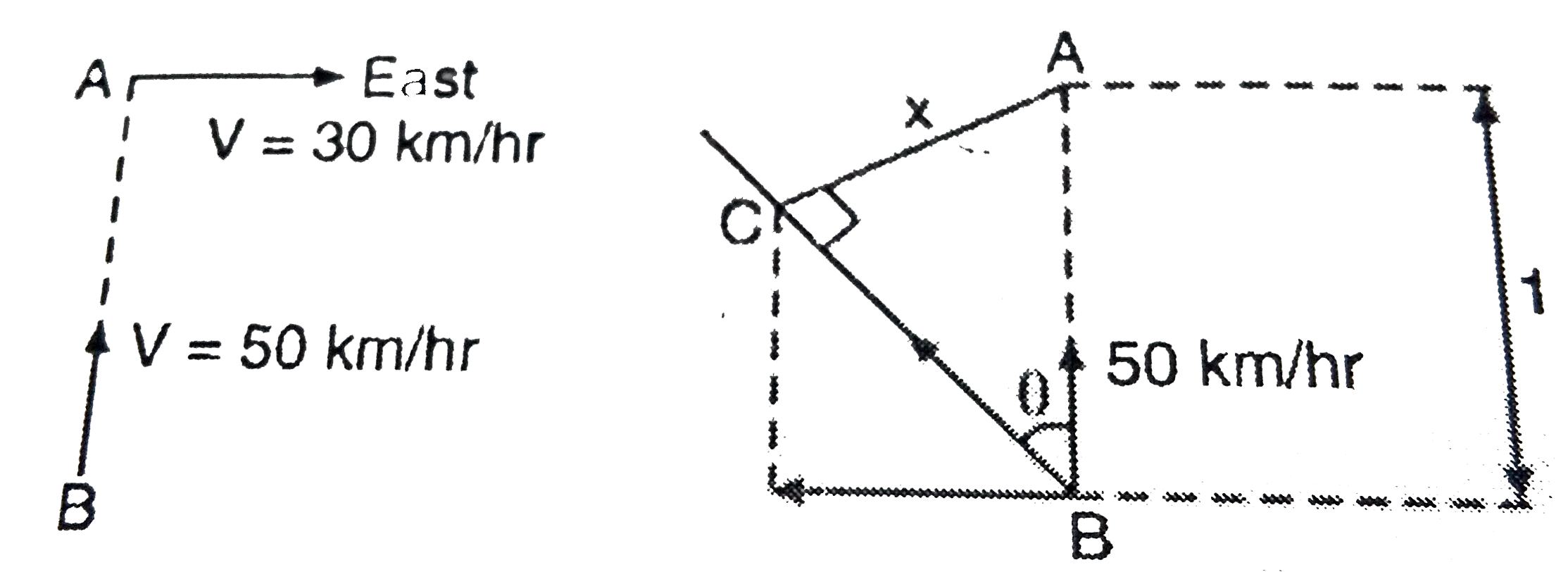 `x=10sin theta` closest approach `t=(BC)/(sqrt((30)^(2)+(50)^(2))` |
|
| 49. |
The diameter of the moon is 3.5 times 10^3 km and its distance from the earth is 3.8 times 10^5 km. IT is seen through a telescope having focal lengths of objective and eye piece as 4m and 10cm respectively. Calculate (a) magnifying power of telescope, (b) length of telescope tube and ( c) angular size of image of moon. |
|
Answer» SOLUTION :For normal adjustment (a) `|M|=f_0/f_e= ( 4 times 100)/10=40` B) `L=f_0+f_e=400+10=410 cm=4.10 m` As the angle subtended by moon on the objective of telescope `theta_0= (3.5 times 10^3)/(3.8 times 10^5)= 3.5/3.8 times 10^-2 rad` and as `|M|=|theta/theta_0|` the angular size of final image `|theta|=|M| times theta_0= 40 times 3.5/3.8 times 10^-2=0.3684 rad` i.e., `|theta|=0.368 times 180^@/PI =21^@` |
|
| 50. |
A particle moves according to the law x=a "cos"(pit)/2. The distance covered by it in the time interval between t=0 to t=3 sec is |
|
Answer» 2a |
|


