

Saved Bookmarks
This section includes 7 InterviewSolutions, each offering curated multiple-choice questions to sharpen your Current Affairs knowledge and support exam preparation. Choose a topic below to get started.
| 1. |
The process which take place under perfect thermal isolation is |
|
Answer» ISOTHERMAL |
|
| 2. |
A box of 1.00 m^(3) is filled with nitrogen at 1.50 atm at 300 K. the box has a hole of an area 0.010 mm^(2) How much time is required for the pressure to reduce by 0.10 atm, if the pressure outside is 1 atm ? |
|
Answer» Solution :Here ` V = 1.00 m^(3) , P_(i) = 1.50 -0.10 = 1.40 atm, P_(0)= 1atm` let `n_(i)` = number of molecules//volume inside the BOX, INITIALLY `n'_(i)` = number of molecules//volume inside the box, finally `n_(0)` = number of molecules//volume outside the box. If `upsilon_(1x)` is speed of a gas molecules along x DIRECTION, then as wall of box is very large compared to the hole in it. `:. upsilon_(1x)^(2)+upsilon_(1y)^(2) + upsilon_(1z) = upsilon_(rms)^(2)`, which implies `upsilon_(1x)^(2) = (upsilon_(rms)^(2))/(3)` As, `1/2 m upsilon_(rms)^(2) = 3/2 k_(B)T :. upsilon_(1x) = sqrt((k_(B)T)/(m))` Now, number of inside molecules per unit volume colliding with the wall in time `TAU` =collision frequency `xx tau` `=1/2 An_(i) upsilon_(1x)*tau = 1/2 An_(i) sqrt((k_(B)T)/(m)) xx tau` ...(i) The molecules colliding along the hole in the box move out. similarly, outside molecules colliding along the hole move in. As temperature inside and outside the box is the same, therefore, net flow of molecules out of the hole in time `tau` `1/2 A(n_(i)-n_(0)) sqrt((k_(B)T)/(m)) xx tau` After this time, number of molecules//volume inside the box change from `n_(i) to n'_(i)` and pressure inside change from `P_(i) to P'_(i)` `:. ` Number of molecules escaping out of the hole in time `tau = (n_(i)-n_(i)^('))V` ...(ii) From (i) and (ii) , `(n_(i)n_(i)) V = 1/2 A (n_(i)-n_(0))sqrt(k_BT)/(m) xx tau` ..(iii) from `P= n k_(B)T, n = (P)/(k_(B)T)` , Putting in (iii), we get `:. ((P_i)/(k_(B)T) - (P_(i)^('))/(k_(B)T)) V = 1/2 A [(P_i)/(k_(B)T) - (P_(0))/(k_(B)T)] sqrt((k_(B)T)/(m)) xx tau or tau = (2(P_(i)-P_(i)^(')))/((P_(i)-P_(0))) (V/A) sqrt((m)/(k_(B)T))` Putting the given value, we get `tau = 2 [(1.50 atm - 1.40 atm)/(1.50 atm - 1 atm)] ((1.00m^(3))/(0.01 xx 10^(-6)m^2)) ((28 xx 1.67 xx 10^(-27) kg)/(1.38 xx 10^(-23) JK xx 300 K))^(1//2)` `tau = 1.34 xx 10^(5)s`. |
|
| 3. |
Assertion : The instantaneous velocity is given by the limiting value of the average velocity as the time interval approaches zero. Reason : The direction of the average velocity is same as that of displacement. |
|
Answer» If both assertion and reason are true and reason is the correct explanation of assertion `vecv = (trianglevecr)/(trianglet) = (trianglex hati+triangleyhatj)/(trianglet) = hati(trianglex)/(trianglet) +HATJ(triangley)/(trianglet)` or` vecv = vecv_(x) hati + vecv_(y) hatj` Since `vecv = (Deltavecr)/(deltat)`, the direction of the average velocity is the same as that of `Deltavecr` . The INSTANTANEOUS velocity is the limiting value of the average velocity as the time interval approaches zero. `therefore vecv = lim_(Deltat to0) (Deltavecr)/(Deltat) = (dvecr)/(dt)`. 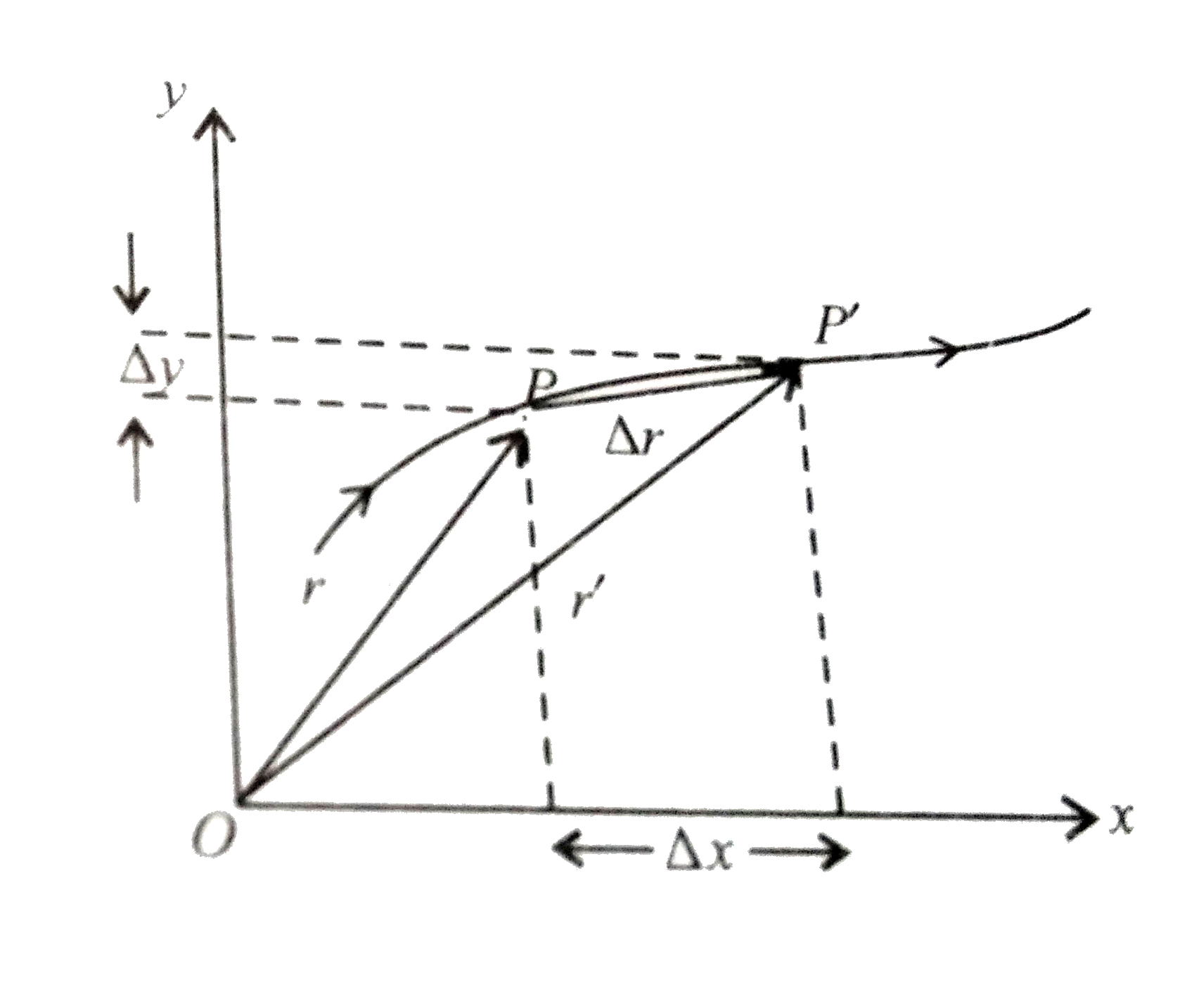
|
|
| 4. |
A lead piece of mass 25gm gives out 1200 calories of heat when it is cooled from 90^(@)C to 10^(@)C What is its (i) Specific heat (ii) thermal capacity and (iii) Water equivalent. |
|
Answer» Solution :Mass of lead piece (m) = 25gm = 0.025Kg , Amount of heat given out = 1200 calories Amount of heat energy given out (DQ) `= 1200 XX 4.2J [therefore W = JH]` The fall in temperature `(dT) = (90 - 10)^(0)C =80^(0)C = 80K` (i) Specific heat `S = 1/m (dQ)/(dT)=1/(0.025)xx(1200xx4.2)/(80)=(5040)/2 = 2520 J Kg^(-1)K^(-1)` (II) Thermal capacity `= ms = 0.025 xx 2520 = 633 K^(-1)` (iii) WATER equivalent `=ms= 63"Kg"^2`. |
|
| 5. |
There is small hole near the bottom of an open tank filled with a liquid. The speed of the water ejected does not depend on a. area of the hole b. densilty of the liquid c. height of the liquid form the hole d. acceleration due to gravity |
|
Answer» a and B are correct |
|
| 6. |
A river is of width 120m which flows at a speed of 8ms^(-1).If a man swims with a speed of 5ms^(-1)at an angle of 127^@with the stream, his drift on reaching other bank is |
|
Answer» 50m |
|
| 7. |
The position of a particle moving along the x-axis depends on the time according to the equation x=ct^(2)-bt^(3), where x is in meters and t in seconds . (a) What units must c and b have ? Let their numerical value be3.0"and"2.0, respectively. (b) What distance does the particle move, (c) What is its displacement ? At t=1.0,2.0,3.0"and"4.0s, what are (d) its velocities and (e) its acceleration? |
|
Answer» |
|
| 8. |
A wire of length L_(0) is supplied heat to raise its temperature by T. If gamma is the coefficient of volume expansion of the wire and Y is Young's modulus of the wire then the energy density stored in the wire is |
|
Answer» `(1)/(2) GAMMA^(2) T^(2) Y` |
|
| 9. |
If a nut becomes loose and gets detached from a satellite revolving around the earth, will it fall down to the earth or will it revolve in the same orbit as the satellite ? Give reason for your answer. |
| Answer» Solution : If a nut is detached from a satellite revolving in the orbit, then its VELOCITY remains equal to orbital velocity. So it CONTINUES to revolve in the same orbit. It does not fall to earth. | |
| 10. |
When a current of (5 +- 0.5)A flows through a wire, it develops a potential difference of (40 +- 1)V. The resistance of the wire is ...... |
|
Answer» `(8+-1.5) Omega` `:.(DeltaR)/(R)=(DeltaV)/(V)+(DeltaI)/(I)` `:. (DeltaR)/(8)=(1)/(40)+(0.5)/(5)=(1+4)/(40)=(5)/(40)` `:. DeltaR=(5)/(40)xx8=1Omega` `:.` Resistance of WIRE `=R+-DeltaR` `=(8+-1)Omega` |
|
| 11. |
Dimension of (1)/(2)epsi_(0)E^(2) is...... epsi_(0) permittive of vaccum E= electric field |
|
Answer» `ML^(1)T^(-2)` `:. [(1)/(2)epsi_(0)E^(2)]=(["Energy"])/(["VOLUME"])` `=(ML^(2)T^(-2))/(L^(3))` `=ML^(-1)T^(-2)` |
|
| 12. |
(A) : The angular velocity of a plantets orbiting around the sun increases when they are nearest to the sun.(R ) : The angular momentum of body is a proportional to angular velocity. |
|
Answer» Both 'A' and 'R' and TRUE and 'R' is the correct explantation of 'A' |
|
| 13. |
A circular disc is rotating about its natural axis with angular velocity of 10 rads-l. A second disc of same mass is joined to it coaxially. If the radius of disc is half of the radius of the first, then they together rotate with an angular velocity of |
|
Answer» `2.5 rads^(-1)` |
|
| 14. |
A piece of chalk when immersed in water emits bubbles. Why? |
| Answer» Solution :A chalk piece CONSISTS of PORES forming capillarities. When it is IMMERSED in water, the water begins to RISE in the capillarities and air present is EXPELLED which goes out in the form of bubbles. | |
| 15. |
Two bodies A and B of equal masses are suspended from two separate massless springs of force constants K_(1) and K_(2). If they oscillate vertically so that their maximum velocities are equal the ratio of their amplitudes is |
|
Answer» `(k_(1))/(k_(2))` |
|
| 16. |
Three bodies, a ring, a solid cylinder and a solid sphere roll down the same inclined plane without slipping.They start from rest.The radii of the bodies are identical.Which of the bodies reaches the ground with maximum velocity? |
Answer» Solution :We ASSUME conservation of energy of the rolling body, i.e. there is no loss of energy due to friction etc. The potential energy lost by the body in rolling down the inclined plane (= mgh) must, therefore, be equal to kinetic energy gained.(See Fig.7.38) Since the bodies start from rest the kinetic energy gained is equal to the final kinetic energy of the bodies.From `K=(1)/(2)mv^(2)(1+(k^(2))/(R^(2)))`, where v is the final velocity of (the centre of mass of) the body. Equating K and mgh,  `mgh=(1)/(2)mv^(2)(1+(k^(2))/(R^(2)))` `or v^(2)=((2gh)/(1+k^(2)//R^(2)))` Noteis independent of the mass of the rolling body, For a ring, `k^(2) = R^(2)` `v_("ring")=sqrt((2gh)/(1+1))` `=sqrt(gh)` For a solid cylinder `k^(2) = R^(2)//2` `v_("disc")=sqrt((2gh)/(1+1//2))` `=sqrt((4gh)/(3))` For a solid sphere `k^(2) = 2R^(2)//5` `v_("sphere")=sqrt((2gh)/(1+2//5))` `=sqrt((10gh)/(7))` From the results obtained it is clear that among the three bodies the sphere has the greatest and the ring has the least velocity of the centre of mass at the bottom of the inclined plane. Suppose the bodies have the same mass.Which body has the greatest rotational kinetic energy while REACHING the bottom of the inclined plane? |
|
| 17. |
A two particles P and Q are separated by distance d apart. P and Q move with velocity v and u making an angle 60^(@) and theta with line PQ the graph between their relative separation (s) when time t is shown in figure (2). The velocity v in terms of u |
|
Answer» `sqrt(3) u` |
|
| 18. |
A liquid flows through a horizontal tube. The velocities of the liquid in the two sections, which have areas of cross - section A_(1) and A_(2) are upsilon_(1)andupsilon_(2) respectively. The difference in the levels of the liquid in the two vertical tubes is h. a) The volume of the liquid flowing through the tube in unit time is A_(1)upsilon_(1). b) upsilon_(2)-upsilon_(1)=sqrt(2gh) c) upsilon_(2)^(2)-upsilon_(1)^(2)=2gh d) The energy per unit mass of the liquid is the same in both sections of the tube. |
|
Answer» a, C and d are correct |
|
| 19. |
What provides the restoring force for simple harmonic oscillations in the following cases? (i)simple pendulum (ii) spring (iii) column of mercury in U tube. |
| Answer» SOLUTION :WEIGHT of DIFFERENCE COLUMN | |
| 20. |
A block of mass 'm' is attached to one end of a light inextensible string passing over a smooth light Pulley B and under another smooth light Pulley A as shown is figure. The other end of a string is fixed to a ceilling . A and B are held by springs of spring constant K_1 and K_2 . Find the angular frequency of small oscillation of the system |
|
Answer» Assume that BLOCK is PULLED down by a SMALL displacement and released Let T be the extra tension which provides the restoring force. T= ma If x is the small displacement of the block , `x_1 and x_2` are extension of the springs. Here `x = 2x_1 + 2x_2` `K_1 x_1 = 2T` `K_2 x_2 = 2T` `x = ((4T)/(K_1) + (4T)/(K_2))` from T = ma `4m (1/(K_1) + 1/(K_2)) = x `(or) `a=-{(1)/(4m((1)/(K_1) + 1/(K_2)))}x , omega = SQRT(a/x) = sqrt((K_1 K_2)/(4m(K_1 + k_2)))` |
|
| 21. |
Three vectors vec(A), vec(B), vec(C) are shown in the figure. Find angle between (i) vec(A) and vec(B) (ii) vec(B) and vec(C) (iii) vec(A) and vec(C). |
Answer» SOLUTION :To find the angle between two vectors we connect the tails of the two vectors. We can SHIFT the vectors parallel to themselves such that tails of `vec(A), vec(B)` and `vec(C)` are connected as shown in FIGURE.  Now we observe that angle between `vec(A)` and `vec(B)` is `60^(@)`, `vec(B)` and `vec(C)` is `15^(@)` nad between `vec(A)` and `vec(C)` is `75^(@)`. |
|
| 22. |
A roller of mass 300kg rests against a step of height 20cm. If the radius of the roller is 50cm find the minimum horizontal force to be applied passing through its centre of mass to take the roller on the step. |
|
Answer» Solution :Taking the moments of forces about .O. h=0.2m, R=0.5m , `X^(2)=R^(2)-(R-h)^(2)` `x=sqrt(R^(2)-(R-h)^(2))=0.4m` To climb up the step, MOMENT due to HORIZONTAL force `ge` moment due to weight. `FXX(R-h) ge MGX` `F ge (mgx)/(R-h)` `F ge (300xx9.8xx0.4)/(0.3)=3920N` 
|
|
| 23. |
A stone tied to a string of length L is whirled in a vertical circle, with the other end of the string at the centre. At a certain instant of time, the stone is at its lowest position, and has a speed u. The magnitude of change in its velocity as it reaches a position, where the string is horizontal is |
|
Answer» `SQRT( u^2-2 GL)` |
|
| 24. |
The amplitude and time period of a particle of mass 0.1 kg executing simple harmonic motioni are 1 m and 6.28 s, respectively. Find its (i) angular frequency (ii) acceleration and (iii) velocity at a displacement of 0.5 m |
|
Answer» 1 rad/sec,`-1MS^(-2),sqrt(3)ms^(-1)` |
|
| 25. |
At what distance from a convex mirror of focal length 2.5m should a boy stand so that his image has a height equal to half the original height? |
|
Answer» 2.5M from the MIRROR |
|
| 26. |
In a cyclic process, which of the following statements is not correct ? |
|
Answer» Change in internal energy is zero. |
|
| 27. |
A rocket of total mass 6000 kg (mass of fuel is 5000 kg) is to be launched vertically upwards. If the rate of consumption of the fuel is 60 kgcdot s^(-1), find the minimum veloctiy of ejection of gas so that the rocket can start its upward motion as soon as the gas is ejected.What will be the impulse at that time? (g = 9.8 mcdot s^(-2) ) |
|
Answer» |
|
| 28. |
Two waves of the same frequency and amplitude super impose to produce a resultant disturbance of the same amplitude. The phase difference between the waves is. |
|
Answer» zero |
|
| 29. |
Find the scalar and vector products of two vectors. a = (3hati – 4hatj + 5hatk) and b = (– 2hati + hatj – 3hatk ) |
|
Answer» Solution :`a.b=(3hati-4hatj+5hatk).(-2hati+hatj-3hatk)` `=-6-4-15` `=-25` `axxb=|(HATI,hatj,hatk),(3,-4,5),(-2,1,-3)|=7hati-hatj-5hatk` NOTE `bxxa=-7hati+hatj+5hatk` |
|
| 30. |
Where will be the centre of mass on combining two masses m and M (M gt m) ? |
| Answer» Solution :towards .M. | |
| 31. |
P is a point at a distance r from the centre of aspherical shell of mass M and radius a, where rlt a. The gravitational potential at P is |
|
Answer» `-(GM)/R` |
|
| 32. |
Aunifrom pole of mass 20kg and length 6m is supported horizontally at its ends by two knife edges A and B. A mass of 120kg is now suspended at a distance 2m from A. Calculate reaction forces at the knife edges. |
Answer» Solution : GIVEN W=20 kg wt, P=120 kgwt, AC=BC=3m, AD=2m For STATIC equilibrium sum of UPWARD forces = sum of downward forces `R_1+R_2=120+20=140kg wt` TAKING moments about B, we write `20bar(BC)+120bar(BD)=R_1bar(BA)`, Moment of `R_2` about `B=O` `20xx3+120(4)=R_1(6)` `R_1=(540)/6=90kg wt` and `R_2=140-90=50kg wt` |
|
| 33. |
Find the ratio of escape velocities from the earth and the moon. (Mass of the earth = 6.0 xx 10^24 kg, Radius of the earth = 6400km, Mass of the moon = 7.4 xx 10^22 kg Radius of the moon 1740 km.) |
|
Answer» SOLUTION :`V_e prop sqrt(M/R)` `V_(E1)/V_(E2)=sqrt(((6.0xx10^24)/(7.4xx10^22))(1740/6400))=4.695/1` |
|
| 34. |
The end of two rods of different material with their thermal conductivities, area of cross-section and lengths all in the ratio 1 : 2 are maintained at the same temperature difference. If the rate of flow of heat in the first rod is 4 cal/s. Then in the second rod rate of heat flow in cal/s is 8xxp. Then p is equal to |
|
Answer» |
|
| 35. |
The expression for horizontal range when a body is projected at an angle with the horizontal is R = |
|
Answer» `(u SIN THETA)/(g)` |
|
| 36. |
In case of stationary wave, amplitude of particle decreases from node to antinode. |
| Answer» SOLUTION :FALSE. (ACTUALLY it INCREASES). | |
| 37. |
A body is projected horizontall from a height of 78.4 m with a velocity 10 ms^(-1). Its velocity after 3 seconds is - [g = 10 ms^(-2)] (Take direction of projection on vec(i) and vertically upward direction on vec(j)). |
|
Answer» `10 HAT(i) - 30 hat(J)` |
|
| 38. |
A cylindrical rod with one end in steam and other end in ice results in melting of 0.1 g of ice per second If the rod is replaced by another with half the length, double the radius of first and if the conductivity of material of secondis 1/4 of first, the rate at which ice melts is (in g/s) |
|
Answer» 0.4 |
|
| 39. |
A bar of cross-section A is subjected to equal and opposite tensile forces F at its ends. Consider a plane through the bar making an angle theta with a plane at right angles to the bar. (a) What is the tensile stress at this plane in terms of F, A and @ ? (b) What is the shearing stress at the plane, in terms of F, A and theta (c) For what value of thetais the tensile stress a maximum? (d) For what value of theta is the shearing stress a maximum? |
|
Answer» |
|
| 40. |
If vec(a)andvec(b) are two unit vectors such that vec(a) + 2vec(b) and 5vec(a) - 4vec(b) are perpendicupar to each other, then the angle between vec(a) and vec(b) is |
|
Answer» SOLUTION :`(vec(a)+2vec(b)).(5vec(a)-4vec(b))=0` `5a^(2)4abcostheta+10abcostheta-8b^(2)=0` `=5-4 cos THETA+10costheta-8=0[a=b=1]` `= - 3 + 6 cos theta = 0` `cos theta = 1//2, theta = 60^(@)` |
|
| 41. |
In each situation of Column-I two elelctric dipoles having moments vec(p)_(1) and vec(p)_(1) of same magnitude ("that is ", p_(1)=p_(2)) are placed on x-axis symmetrically about origin in different orientations as shown. In column-II certain inferences are drawn for these two dipoles. Then match the different orientations of dipole in column-I with the corresponding result in column-II. |
|
Answer» `:.` TORQUE on dipole `vec(tau)=vec(P)xxvec(E)` becomes zero `( :' theta=0 or theta=180^(@))` HENCE in column II. [P] option is suit for every QUERIES for column I. Electrostalic potential energy `(U)=-PE cos theta` `theta=` Angle between moment & electric field. [A] Here `theta=180^(@) :. U=-PE cos 180^(@)=PE`(+ve) [B] Here `theta=0^(@) :. U=-PE cos theta=-PE` (-ve) `[C] & [D] : theta lt 90^(@) :. U=` -V |
|
| 42. |
The system shown in figure is released from rest. String is massless, and pulley is smooth. Find work done by gravity on 4kg block and workdone by the string on 1 kg block in 2 seconds? |
|
Answer» 240J, -192 J |
|
| 43. |
A horizontal uniform glass tube of 100cm length sealed at both ends contains 10cm mercury column in the middle. The temperature and pressure of air on either side of mercury column are respectively 0^(@)C and 80cm of mercury. If the air column at one end is kept at 0^(@)C and the other end at 273^(@)C, the pressure of air which is 0^(@)C is (in cm of Hg) |
|
Answer» 76 |
|
| 44. |
On a long horizontally moving belt (Fig.), a child runs to and fro with a speed 9 km h^(-1) (with respect to the belt) between his father and mother located 50 m apart on the moving belt. The belt moves with a speed of 4 km h^(-1). For an observer on a stationary platform outside, what is the (a) speed of the child running in the direction of motion of the belt ?. (b) speed of the child running opposite to the direction of motion of the belt ? (c ) time taken by the child in (a) and (b) ? Which of the answers alter if motion is viewed by one of the parents ? |
| Answer» Solution :(a)`13 km h^(-1)`,(b)`5 km h^(-1)`,(c ) 20 s in either DIRECTION, viewed by any one of the parents, the speed of the CHILD is 9 km h–1 in either direction, answer to (c) is unaltered. | |
| 45. |
A bar of mass M and length L is in pure translatory motion with its centre of mass velocity V. It collides with and sticks to asecond identical bar which is intially at rest. (Assume that it becomes one composition bar of length 2 L). The angular velocity of the composite bar will be 3V/xL counter clockwise where 'x' is |
|
Answer» |
|
| 46. |
From a disc of mass 'm' and radius 'r'. A circular portion of radius (r )/(3) is removed from the edges. Find the M.I of the remaining system about a normal through centre of original disc |
|
Answer» Solution :Let `I_(2)` be the M.I of REMAINING poriton. M.I. of the removed PARITON about a normal axis through center of the ORIGINAL disc is `I_(1)=((m)/(9)((R)/(3))^(2))/(2)+(m)/(9)((2r)/(3))^(2)` or `I_(1)=(mr^(2))/(18)` Hence , M.I. of the remaining portion is `I_(2)=I-I_(1)=(mr^(2))/(2)-(mr^(2))/(18)` or `I_(2)=(4mr^(2))/(9)` |
|
| 47. |
The p-V diagrams of same mass of a gas are drawn at two different temperatues T_(1) and T_(2) Explain whether T_(1)gtT_(2)gt or T_(2)gtT_(1). |
|
Answer» Solution :The ideal gas equation is, `"" pV=nRTorT=(pV)/(NR) T prop pV,` if number of moles of the gas are kept constant. Here mass of the gas is constant, which implies that number of moles are constant, I,e., T `prop` pV. In the GIVEN diagram produco of p and V for `t_(2)` is more than `T_(1)` al all points (keeping EITHER p or V same for both graphs). Hence, `T_(2)GT T_(1)` |
|
| 48. |
A gun moves backward when a short is fired from it.A shell of mass 0.020 kg is fired by a gun of mass 100 kg. if the muzzle speed of the shell is 80 m/s, what is the recoil speed of the gun? |
|
Answer» Solution :m = 0.020 KG, M = 100 kg, `V = 80 MS^(-1), V- `? `V= mv/M = 0.02xx80/100 = 0.016 ms^(-1)` |
|
| 49. |
A given amount of a gas is heated till the volume and pressure both increase by 2% each. The percentage change in temperature of the gas is nearly |
|
Answer» 0.02 |
|
| 50. |
A constant force F = m_(2)g//2 is applied on the block of mass m_(1) as shown. The string and the pulley are light and the surface of the table is smooth. Find the acceleration of m_(1). |
|
Answer» `(m_(2)G)/(2m_(1))` |
|