

Saved Bookmarks
This section includes 7 InterviewSolutions, each offering curated multiple-choice questions to sharpen your Current Affairs knowledge and support exam preparation. Choose a topic below to get started.
| 1. |
Waber is derived unit of |
|
Answer» magnetic MOMENT |
|
| 2. |
By what acceleration the boy must go up so that 100 kg block remains stationary on the wedge. The wedge is fixed and is smooth.(g=10m//s^(2)) |
|
Answer» SOLUTION :For the BLOCK to remain STATIONARY, `T=Mg SIN theta=100xx10xxsin 53` `=100xx10xx(4)/(5)=800N` For man, `T-mg=ma` `T=m(g+a)rArr 800=50(10+a)a=6m//s^(2)` |
|
| 3. |
|barAxxbarB| is equal to |
|
Answer» (a) `-|BARAXXBARB|` |
|
| 4. |
Let V & E be gravitational potential & gravitational field at a distance r from the centre of a uniform solid sphere, consider the 2 statements (A) the plot of V against r is discontinuous (B) the plot of E against r is discontinuous |
|
Answer» both A & B CORRECT |
|
| 5. |
Two waves given by y_(1)=asinomegat and y_(2)=a sin (omegat+pi//2) reaching at a point superimpose. The resultant amplitude is |
| Answer» Solution :`A_(RES)=sqrt(A_(1)^(2)+A_(2)^(2))` | |
| 6. |
Three particle each of 1 kg mass are placed at corners of a right angled triangle AOB, 'O' being the origin of coordinate system (OA and OB along the x-direction and +ve y-direction). If OA = OB = 1m, the position vector of centre of mass (in metres) is |
|
Answer» `(HAT(i)+hat(J))/(3)` |
|
| 7. |
A man walks up a stationary escalator in 90sec. When this man stands on a moving escalator he goes up in 60 sec. The time taken by the man to walk up the moving escalator is |
|
Answer» 30s |
|
| 8. |
{:(,"SECTION-A",,"SECTION-B"),("a)","Surface tension decreases","e)","Minimum potential energy"),("b)","Capillary rise","f)","Domination of adhesive force"),("c)","Spherical shape of rain drops","g)","Increase in temperature"),("d)","Tiny droplets of water act as ball bearings","h)","Excess of pressure"):} |
|
Answer» a-e, b-f, c-g, d-h |
|
| 9. |
An empty plastic box of mass m is found to accelerate up at the rate of g/6 when place deep inside water. How much sand should be put inside the box so that it may accelerate down at the rate of g/6? |
|
Answer» m/5 |
|
| 10. |
Statement I : The driver of a moving car sees a wall in front of him. To avoid collision he should apply brakes rather than take a turn away from the wall. Statement II : Force of friction is needed to stop the car or take a turn on a horizontal road. |
|
Answer» STATEMENT I is TRUE, statement II is true, statement II is a CORRECT explanation for statement I. |
|
| 11. |
1 calorie=4.2 J where IJ= 1 kg m^2s^-2. Suppose we employ a system of units in which the unit of mass is alpha kg, the unit of length is beta m and the unit of time gamma s, show that a calorie has a magnitude 4.2alpha^-1beta^-2gamma^-2 in the new system. |
|
Answer» `4.2 alpha BETA^(2)GAMMA^(-2)` NEW UNITS |
|
| 12. |
During transfer of heat, if path of heat transfer is straight line, the mode of transmission of heat is……… |
| Answer» SOLUTION :RADIATION | |
| 13. |
A wire is found to have a length L when it is loaded with a block of mass M and relative density n. When the block is immersed in water, the length of the wire reduces by x, then |
|
Answer» weight of water DISPLACED when the block is immersed in water is `(Mg)/N` |
|
| 14. |
In Newton's law of cooling, if the rates of emission of radiation by a calorimeter from 75^(@)C" to "70^(@)C,70^(@)C" to "65^(@)C and from 65^(@)C to 60^(@)C are E_(1),E_(2)andE_(3) respectively then |
|
Answer» `E_(1)=E_(2)=E_(3)` |
|
| 15. |
From figure whether more work is done in the isothermal process or adiabatic process ? |
| Answer» SOLUTION :ISOTHERMAL PROCESS. | |
| 16. |
A mass of 1 kg attached to one end of a string is first lifted up with acceleration 4.9 m//s^(2) and then lowered with same acceleration. What is the ratio of tension in string in two cases. |
|
Answer» Solution :When mass is LIFTED up with acceleration `4.9 m//s^(2), T_(1)=m (9.8+4.9)` When mass is LOWERED with same acceleration, `T_(2)=m(9.8-4.9)` `THEREFORE (T_(1))/(T_(2))=(14.7)/(4.9)=3:1` |
|
| 17. |
Zeroth law of thermodynamics define………. and first law of thermodynamics define……….. |
| Answer» SOLUTION :TEMPERATURE, INTERNAL ENERGY | |
| 18. |
A) A hot hollow sphere in vacuum cools by convection B) A hot solid sphere in vacuum cools by radiation |
|
Answer» A is FALSE, B is TRUE |
|
| 19. |
A body of mass 1.0 kg is rotaing on a circular path of diameter 2.0 m at the rate of 10 rotations in 31.4 s. calculate (i) angular momentum of the body and (ii) rotational kinetic energy. |
|
Answer» |
|
| 20. |
One of the most efficient engines ever developed operated between 2100 K and 700 K. Its actualefficiency is 40%. If its efficiency is N/5 fraction of maximum possible efficiency, then N is equal to |
|
Answer» |
|
| 21. |
The action and reaction forces acting on |
|
Answer» same BODY |
|
| 22. |
Calculate the ratio of displacement to amplitude when kinetic energy of a body is thrice its potential energy. |
|
Answer» |
|
| 23. |
The work done by the conservative force for a closed path is |
|
Answer» ALWAYS negative |
|
| 24. |
The angle between vec(A) = hat(i) = 2hat(j) - hat(k) and vec(B) = - hat(i) + hat(j) - 2hat(k) is |
|
Answer» `30^(@)` |
|
| 25. |
The approximate depth of an ocean is 2700 m. The comparessibility of water is 45.4 xx 10^(-11) Pa^(-1) and density of water is 10kg/m2. What fractional compression of water will be obtained at the bottom of the ocean? |
|
Answer» `1.2 XX 10^(-2)` |
|
| 26. |
Particles of masses 1 g, 2 g, 3 g, ... 100g, are kept at the marks 1 cm, 2 cm, 3 cm, ..... 100 cm respectively on a meter scale. Find the moment of inertia of the system of particles about a perpendicular bisector of the meter scale. |
|
Answer» SOLUTION :`[1xx49^(2)+2xx48^(2)+3xx47^(2)+.........49xx1^(2)+52xx2^(2)+......98xx48^(2)+99xx49^(2)+100xx50^(2)]10^(-7)` `=100p[50^(2)+49^(2)+48^(2)+.......+1^(2)]xx10^(-7)` `=10^(-5)xx(1)/(6)xx50xx51xx101=0.431kgm^(2)` |
|
| 27. |
Figure shows three vectors vec(a), vec(b) and vec(c), where R is the midpoint of PQ. Then which of the following relations is correct ? |
|
Answer» `VEC(a) + vec(B) = 2vec(C)` |
|
| 28. |
An ideal diatomic gas undergoes a process in which its internal energy relates to the volumes as U = alpha sqrt( V ), where a is a constant. (a) Find the work performed by the gas and the amount of heat to be transferred to this gas to increase its internal energy by 100 J (b) Find the molar specific heat of the gas |
|
Answer» SOLUTION :`80J` `(9R)/(2)` |
|
| 29. |
If an ivory ball of mass 2m moving with a velocity .v. strikes head on to a close row of three identical ivory balls each of mass m as shown in the figure. Then after the colisions which may be assumed as elastic, which of the following would occur? |
|
Answer» The BALLS numbered 2 and 3 will move with VELOCITY v, the OTHERS staying at rest. |
|
| 30. |
If the mass of earth and radius suddenly become 2 times and 1//^("th") of the present value, the length of the day becomes |
|
Answer» 24th |
|
| 31. |
Bernoulli's equation for steady, non-viscous, imcompressible flow expresses the |
|
Answer» CONSERVATION of LINEAR momentum |
|
| 32. |
An iron plate 10^(-5) m^(2) area, 4 xx 10^(-3) m thick has its opposite faces maintained at 373 K and 223 K respectively. How much heat flows through the plate per second ? Thermal conductivity of iron = 80 "Wm"^(-1) "K"^(-1). |
|
Answer» |
|
| 33. |
Two cars A and B are moving west to east and south to north, respectively, along crossroads. A moves with a speed of 20 m s^-1 and is 500 m away from the point of intersection of cross roads and B moves with a speed of 15 ms^-1 and is 400 m away from the point of intersection of cross roads. Find the shortest distance between them. |
|
Answer» Solution :Method I (USING the concept of relative velocity) Let us assume the velocity of `A w.r.t. B`. To do this, we PLOT the resultant, `vec V_( A B)`. `vec V_(A B) = vec V_A - vec v_B = vec V_A + (- vec V_B)` As the accelerations of both the cars is zero, so the relative acceleration between them is also zero. Hence, the relative velocity will remain constant. So the path of `A` with respect to `B` will be straight line and ALONG the direction of relative velocity of `A` with respect to `B`. The shortest DISTANCE between `A and B` is a perpendicular from `B` on the line of motion of `A` with respect to `B`. (Fig. 5.128). `tan theta = (V_B)/(V_A) = (15)/(20) = (3)/(4)` ....(i) This `theta` is the angle made by the resultant velocity vector `|vec V_(A B)|` with the x - axis. Also we know that from (Fig. 5.128), `O C = (x)/(500) = (3)/(4)` ...(ii) From equation (i) and (ii), we get `x = 375 m`. `:. AB = OB - OC = 400 - 375 = 25 m` But the shortest distance is `BP`. From diagram, it is clear that `BP = BC cos theta = 25 xx (4)/(5)` `:. BP = 20 m` Method II (Using the concept of relative velocity of approach) At any time `t`, us plot the components of velocity of `A and B` in the direction along `AB`. From these components, we can find the velocity of approach between them at any time which is the relative velocity between them along line joining between instantaneous positions. When the distance between the two is minimum, the relative velocity of approach is zero. `:. V_A cos phi_t + V_B sin phi_t = 0` (where `prop_f` is the angle made by the line `A'B'` with the x - axis) `20 cos phi_t = -15 sin phi_t` `:. tan phi_t = - (20)/(15) = -(4)/(3)` Here we should not confuse this angle `(phi)` with the angle `theta` in method (I) because that `theta` is the angle made by the net relative velocity with x - axis, bit `phi` is the angle made by the line joining the two cars with x - axis when the velocity of apprroach is zero. `(400 - 15 t)/(500 - 20 t) = -(4)/(3)` `t = (128)/(5)s` So, `OB' = 16 m and OA' = -12 m` `A' B' = sqrt(16^2 + (-12)^2) = 20 m`. 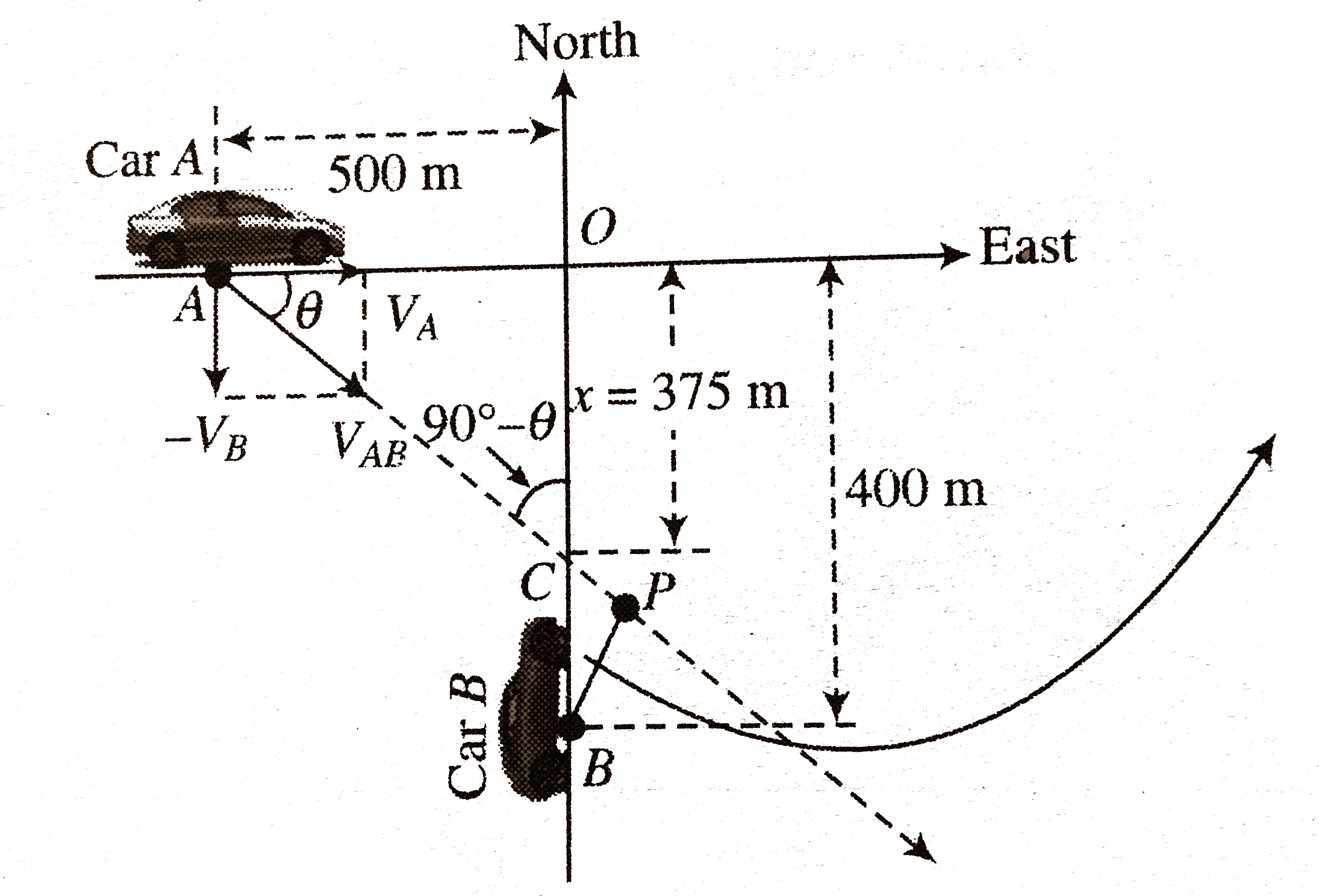 , ,  . .
|
|
| 34. |
A square plate of edge a/2 is cut out from a uniform square plate of edge 'a' as shown in figure. The mass of the remaining portion is M. The moment of inertia of the shaded portion about an axis passing through 'O' (centre of the square of side a) and perpendicular to plane of the plate is : |
|
Answer» `(9)/(64)"Ma"^(2)` |
|
| 36. |
In the following figure (not to scale), AD bisects angleBAC. If angleBAD=45^(@) is inscribed in a circle, then which of the following is the longest? |
|
Answer» `VEC(A) +vec(B) = vec(C)` |
|
| 37. |
A student measured the diameter of a wire using a screw gauge with the least count 0.001 cm and listed the measurements. Tge measures value should be recorded as: |
|
Answer» 5.320 CM |
|
| 38. |
Two identical bodies of emissivities 0.01 and 0.16 and at different temperature emit the same rate of radiation but with a difference of wavelength of maximum emission of 1 micron. The wavelengths of maximum emission of the two bodies are (in microns) |
|
Answer» 1, 2 |
|
| 39. |
A stone tiedto the end of astring 80 cm long is whirled in a horizontal circle with a constant speed . Ifthe stone makes 14 revolutions in 25 s , what is the magnitude and direction of acceleration of the stone? |
|
Answer» |
|
| 40. |
A metal bar 70 cm long and 4.00 kg in mass supported on two knife-edges placed 10 cm from each end. A 6.00 kg load is suspended at 30 cm from one end. Find the reactions at the knife- edges. (Assume the bar to be of uniform cross section and homogeneous.) |
Answer» Solution : Figure 7.26 shows the rod AB, the POSITIONS of the knife edges `K_(1) and K_(2)` , the centre of gravity of the rod at G and the suspended load at P. Note the weight of the rod W ACTS at its centre of gravity G. The rod is UNIFORM in cross section and homogeneous, hence G is at the centre of the rod, `AB = 70 cm. AG = 35 cm, AP = 30 cm, PG = 5 cm, AK_(1)= BK_(2) = 10 cm and K_(1)G = K_(2)G = 25 cm`. Also, W= weight of the rod = `4.00 kg and W_(1)`= suspended load = `6.00 kg, R_(1) and R_(2)` are the normal reactions of the support at the knife edges. For translational equilibrium of the rod, `R_(1)+R_(2)-W_(1)-W=0` (i) Note `W_(1) and W` act vertically down and `R_(1) and R_(2)` act vertically up. For considering rotational equilibrium, we take moments of the forces. A convenient point to take moments about is G. The moments of `R_(2) and W_(1)` are anticlockwise (+ve), whereas the MOMENT of `R_(1)` is clockwise (-ve). For rotational equilibrium. `-R_(1)(K_(1)G)+W_(1)(PG)+R_(2)(K_(2)G)=0` (ii) It is given that `W = 4.00g N and W_(1) = 6.00g N`, where g = acceleration due to gravity. We take `g = 9.8 m//s^(2)`. With numerical values inserted, from (i) `R_(1)+R_(2)-4.00g-6.00g=0` or `R_(1)+R_(2)=10.00gN` (iii) `=98.00N` From (ii),`– 0.25 R_(1) + 0.05 W_(1) + 0.25 R_(2) = 0` or `R_(1) – R_(2) = 1.2gN = 11.76 N` (iv) From (iii) and (iv), `R_(1) = 54.88 N`, `R_(2) = 43.12 N` Thus the reactions of the support are about 55 N at `K_(1) and 43 N` at `K_(2)`. |
|
| 41. |
What is the work done on the body moving in uniform circular motion ? |
| Answer» Solution :`W = 0:. " In" W = FD cos theta, VEC(F ) BOT vec (d) :. theta = 90^(@) cos 90^(@)=0` | |
| 42. |
If the angular momentum of the body is increased by 50%, its rotational kinetic energy is increased by ………… |
|
Answer» `125%` `therefore KalphaL^(2)` `therefore (K_(2))/(K_(1))=((L_(2))/(L_(1)))^(2)` but 50% of `L_(2)+L_(1)` `=L_(1)+0.5L_(1)` `therefore (K_(2))/(K_(1))=((3)/(2))^(2)=(3)/(2)L_(1)` `therefore (K_(2))/(K_(1))=(9)/(4)` `therefore (K_(2)-K_(1))/(K_(1))XX100=(9-4)/(4)xx100%` `therefore (K_(2)-K_(1))/(K_(1))xx100=(5)/(4)xx100=125%` |
|
| 43. |
The resultant of two parallel forces P and Q is R. If the force P shifts by a distance x, parallel to itself, prove that R will shift by (Px)/(P+Q). |
|
Answer» Solution :Suppose the parallel forces P and Q act at the points A and B the resultant R acts at C Fig. `:. PxxAC =QxxBC` or, `" " (P)/(Q)=(BC)/(AC) or, (P+Q)/(Q) =(BC+AC)/(AC) =(AB)/(AC)` `:. AC = AB xx(Q)/(P+Q)` Now if the force P acts at point D such that AD =x, then the resultant also SHIFTS and acts at E instead of C . Hence, `PxxDE =QxxBE` or, `(P)/(Q)=(BE)/(DE) or, (P+Q)/(Q)=(BE+DE)/(DE) =(BD)/(DE)=(AB-x)/(AE-x)` `:. (AE-x) (P+Q) = (AB-x) Q` `:. AE = (Q.AB+P.x)/(P+Q)` `:.` Displacement of the line of action of the resultant, `CE = AE -AC= (Q.AB+P.x)/(P+Q)-(Q.AB)/(P+Q) =(Px)/(P+Q)` 
|
|
| 44. |
An ideal gas having initial pressure P, volume Vand temperature T is allowed to expand adiabatically until its volume becomes 5.66 V while the temperature falls to T/2. How many degrees of freedom do the gas molecule have ? |
| Answer» Solution :`(T_(2) //T_(1)) = (V _(1) //V _(2)) ^( gamma -1) , (1//2) = (1//5 . 66) ^( gamma -1) , gamma =1 .4,` Number of degrees of FREEDOM `= f = 2 //(gamma -1)= 2//(1.4 - 1) = 5` | |
| 45. |
A valley has two walls inclined at 37° and 53° to the horizontal. A particle is projected from point P with a velocity of u = 20 m//s along a direction perpendicular to the incline wall OA. The Particle hits the incline surface RB perpendicularly at Q. Take g = 10 m//s^(2) and find: (a) The time of flight of the particle. (b) Vertical height h of the point P from horizontal surface OR. [tan 37^(@) = (3)/(4)] |
|
Answer» |
|
| 46. |
Define Poise. |
| Answer» Solution :If a tangential force of I dyne is REQUIRED to maintain unit velocity gradient between TWO adjascent layers of a liquid each of AREA `1 cm^2`, then the COEFFICIENT of viscosity of that liquid is one poise. | |
| 47. |
On colliding with the walls in a closed container , the ideal gas molecules. |
|
Answer» TRANSFER MOMENTUM to the WALLS |
|
| 48. |
1.50 gram of ice is mixed in 300 gram of water at 50^(@)C. Determine the resulting temperature. Given heat of fusion of ice = 336 Jg^(-1). |
|
Answer» |
|
| 49. |
A stone falls freely under gravity. It covers distances h_1, h_2, and h_2, in the first 5 seconds, the next 5 seconds and the next 5 seconds respectively. The relation between h_1, h_2 and h_2 is |
|
Answer» `h_2=3h_(1) and h_3=3h_2` |
|


